Silas spent twenty years in the service before a corrupt command stripped him of everything. Now, he’s just a man in an orange vest, waving a plastic wand under the lonely floodlights of Mile 42.
He didn’t want trouble. He just wanted to finish his shift and get home to his daughter. But when a black Lamborghini tore through the barricades at ninety miles an hour, Silas did his job.
Colton Sterling didn’t like being told to wait. He didn’t like the smell of diesel or the sight of a man like Silas standing in his way. He came out of that car smelling like expensive gin and pure entitlement.
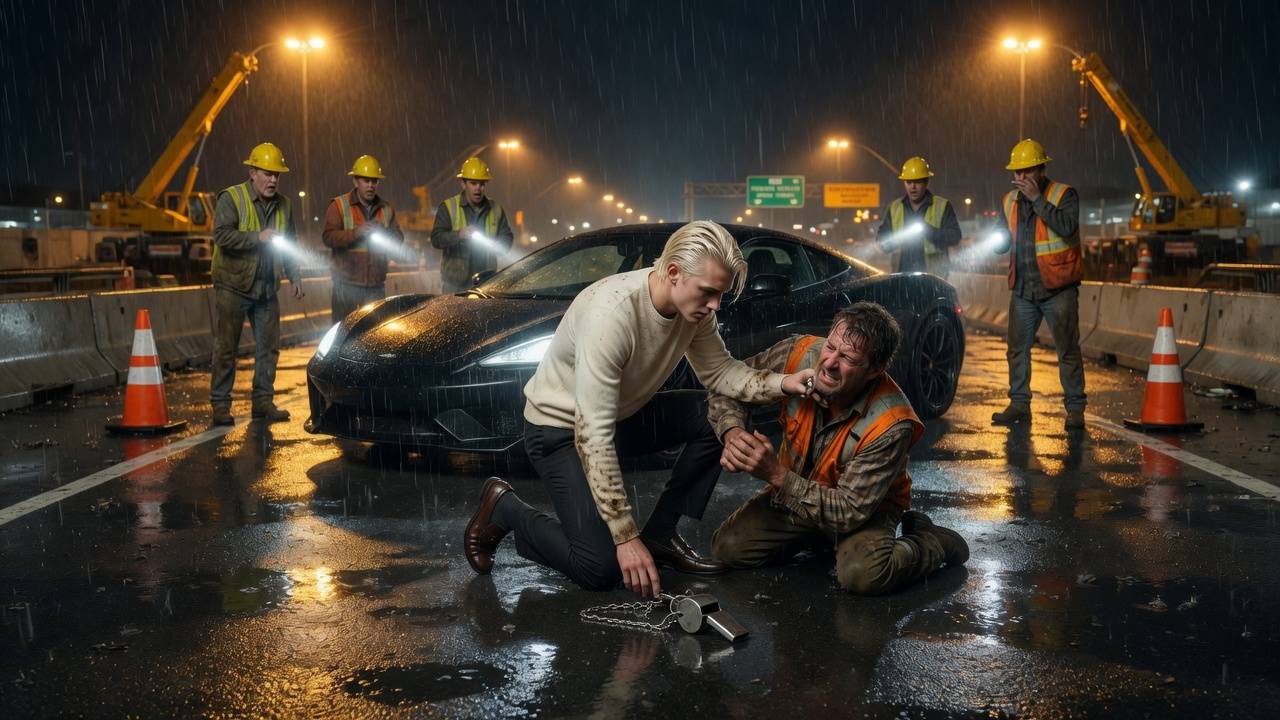
In front of the whole night crew, Colton threw a stack of hundreds into the mud. Then he found the one thing Silas still carried—the silver whistle from a life Colton could never understand.
Colton ground it into the asphalt. He grabbed Silas by the throat and told him to get on his knees and beg for his job. He thought the silence of the crew was fear.
He didn’t realize the crew wasn’t afraid for Silas. They were afraid for him. Because Silas wasn’t just a flagger—he was a ghost with a very specific set of skills.
When Colton ignored the final warning, the world at Mile 42 changed in exactly three seconds. The “peasant” didn’t just fight back; he dismantled the Senator’s son in front of every camera phone on the ridge.
Now the video is viral, the police are circling, and Silas has to decide how far he’ll go to protect the secret hidden in the back of that sports car.
The full story is in the comments.
Chapter 1
The rain in North Dakota doesn’t just fall; it attacks. It comes sideways, smelling of wet slate and old exhaust, turning the dust of the I-29 expansion project into a thick, clinging slurry that worked its way into the seams of Silas’s boots. At 11:42 PM, the world at Mile 42 was a study in jaundiced yellow and deep, oily black. The portable diesel generators hummed with a bone-deep vibration that Silas felt in his teeth, their floodlights casting long, distorted shadows across the fresh-cut asphalt.
Silas adjusted the brim of his hard hat, wiping a mix of sweat and rainwater from his eyes. His orange safety vest was frayed at the edges, the reflective tape peeling, a far cry from the crisp, decorated wool of the dress blues he’d worn five years ago. He was forty-five, but in this light, under the weight of a twelve-hour shift, he looked sixty. His hands, calloused and scarred from two decades of military service and five years of manual labor, gripped the plastic handle of his “Stop/Slow” paddle with a steady, practiced stillness.
“Hey, Sarge,” a voice crackled through the cheap radio clipped to his shoulder.
Silas thumbed the button. “It’s just Silas, Miller. And keep the channel clear. We’ve got the asphalt trucks backing in at the north transition.”
“Copy that. Just… you see that storm? Looks like the sky is bruised. My wife says there’s a cell coming out of Bismarck that’ll wash us out by midnight.”
“Focus on the trucks, Miller. We’ve got four hours of pouring left.”
Silas clipped the radio back. He didn’t mind the rain. Rain was honest. It didn’t care about your rank or your bank account. It just fell. He reached into the small pocket of his vest and felt the cool, familiar shape of the silver whistle. It was a tarnished thing, engraved with his old unit insignia and his former rank: Master Sergeant S. Vance. It was the only piece of his former life he hadn’t sold or thrown away after the court-martial. It was a phantom limb, a reminder of the man who had once commanded an MP brigade before he’d refused an order that would have burned a village to save a politician’s optics.
He hadn’t been a hero. He’d just been a man who reached his limit. And that limit had cost him his pension, his reputation, and nearly his sanity.
A low rumble started in the distance, different from the rhythmic throb of the generators. It was high-pitched, predatory—the scream of a high-performance engine being pushed to its breaking point. Silas shifted his weight, his boots crunching on the loose gravel of the shoulder. He raised his LED baton, the red light cutting a sharp, bloody line through the gloom.
“Miller, we’ve got a fast mover heading north,” Silas said, his voice dropping into the flat, tactical calm that used to settle over him during perimeter checks in Kandahar. “Warn the crew at the bridge abutment. This guy isn’t slowing down.”
The car appeared over the crest of the hill like a low-flying jet. The headlights were blinding, two spears of white light that turned the rain into a curtain of diamonds. It hit the first row of reflective cones at eighty miles an hour. They didn’t just move; they exploded, orange plastic shards flying into the darkness like shrapnel.
Silas stepped into the center of the lane. He didn’t move fast, and he didn’t hesitate. He held the paddle high, the “STOP” sign facing the oncoming beast. He was a lone, orange-clad figure against a wall of darkness.
The car—a black Lamborghini Urus—shrieked to a halt, the ceramic brakes glowing a dull, angry red. It stopped barely six inches from Silas’s knees, the heat from the engine bay rolling off the hood in shimmering waves. The smell of burnt rubber and expensive leather filled the air, thick and suffocating.
The driver’s side window slid down with a smooth, mechanical hiss. A young man, probably no older than twenty-five, looked out. He had a face that suggested he had never been told “no” in his entire life—symmetrical, arrogant, and flushed with the heat of something chemical. His blonde hair was slicked back, and he wore a cream-colored designer sweater that probably cost more than Silas’s truck.
“The hell is this?” the kid shouted, the bass from the car’s stereo thumping a hole in the night. “I’m in a hurry. Move the sign.”
“Construction zone, sir,” Silas said. He kept his voice level, his eyes tracking the driver’s hands. “Lane is closed for barrier movement. You’ll have to wait five minutes while the crane clears the transition.”
“Do you have any idea who I am?” the kid asked. He leaned out of the window, a sneer twisting his features. In the passenger seat, a girl in a silk dress was giggling, her phone held up to record the encounter. “I don’t wait for ‘cranes,’ and I definitely don’t wait for guys who get paid by the hour to stand in the mud.”
“I know you’re doing eighty in a forty-five, Mr. Sterling,” Silas said. He’d recognized the face from the local news. Colton Sterling, the son of Senator Sterling. The boy was a local legend for all the wrong reasons—DUI dismissals, assault charges that vanished in the night, and a trail of broken things behind him.
Silas looked past Colton. In the narrow gap behind the front seats, a man was huddled. He was wrapped in a blood-stained windbreaker, his face pale and drawn. The man caught Silas’s eye for a fraction of a second—a look of pure, paralyzing terror—before ducking his head.
Silas felt the old itch at the base of his skull. The feeling of a situation going south. This wasn’t just a rich kid with a heavy foot. There was a secret in the back of that car, and it was bleeding.
“Five minutes, Mr. Sterling,” Silas repeated, his grip tightening on the paddle. “And I’d keep your hands on the wheel. You’re weaving.”
Colton’s eyes narrowed into slits. “My father signs the bills that pay for this shitty road. He could have you replaced with a plastic cone by morning. Now move, or I’ll move you.”
“Five minutes,” Silas said. He didn’t move an inch.
Colton slammed the car into gear, the engine roaring like a wounded animal, but Silas stood his ground. He was thinking of his daughter, Maya, waiting at home with a plate of lukewarm spaghetti. He was thinking of the witness in the back of the car. And he was thinking of the silver whistle in his pocket, a silent reminder that some orders are worth refusing, and some lines are worth holding.
The rain turned into a deluge, and the storm at Mile 42 began in earnest.
Chapter 2
The tension at the roadblock was a physical thing, thick and suffocating. Silas could hear the night crew behind him. They had stopped working. The pavers were idling, their rhythmic thumping sounding like a nervous heartbeat. Miller, Sanchez, and Old Man Henderson stood in the shadows of the machinery, their flashlights flickering like fireflies in the rain.
“Silas, just let him go,” Miller’s voice crackled over the radio, high and thin with panic. “That’s Sterling’s kid. You know how this ends. He’ll call his old man, and we’ll all be looking for work by sunrise. Just open the lane, man.”
Silas didn’t reach for the radio. He didn’t take his eyes off Colton Sterling. The boy was vibrating, his fingers drumming a frantic rhythm on the steering wheel. He kept glancing at the rearview mirror, his eyes darting toward the darkness of the highway behind him. He wasn’t just angry; he was fleeing.
“I’m going to count to three,” Colton said, his voice rising to a shrill, jagged pitch. “If you don’t move that paddle, I’m going to drive right through you. My insurance is worth more than your life, you pathetic peasant.”
“I can’t let you through, Colton,” Silas said. His voice was flat, the sound of iron on stone. “The road is physically gone three hundred yards ahead. They’re setting the bridge deck. You’ll drop twenty feet into the Red River. I’m not protecting my job; I’m protecting your life. Sit tight.”
Colton laughed, a harsh, ugly sound that cut through the roar of the rain. He turned to the girl in the passenger seat. “Check this out, Tiff. Watch the hero do his thing.”
He reached into the center console and pulled out a thick, rubber-banded stack of hundred-dollar bills. Without looking, he hurled it through the window. The money hit Silas’s chest and exploded, the bills fluttering into the mud like wet, green leaves.
“There,” Colton sneered, his face glowing in the light of the dashboard. “That’s ten grand. That’s probably two years of waving that stick for you. Take it and go find a bar. Tell them the road is closed for everyone else.”
Silas didn’t even look at the ground. He didn’t look at the money that could have paid for Maya’s dental work, her new bike, and six months of the rent he was struggling to meet. “Pick it up. It’s littering.”
The crew behind Silas sucked in a collective breath. They knew Silas was different—he didn’t gossip, he didn’t complain about the cold, and he seemed to have a core of something harder than the asphalt they laid. But this was suicide. In this county, the Sterlings didn’t just have money; they had gravity. Everything moved toward them.
Colton’s door swung open. He stepped out into the rain, his white designer sneakers sinking into the mud. He was taller than Silas, fueled by the arrogance of a man who had never faced a consequence he couldn’t buy his way out of. He walked right up to Silas, the smell of gin and expensive cologne cutting through the diesel fumes.
“You think you’re special?” Colton poked a finger into Silas’s chest, right over the heart. “You’re a speed bump. You’re a nobody in a neon vest. My dad could have you erased, and the sheriff would help him dig the hole.”
Silas looked down at the finger, then back up at Colton. His eyes were cold, distant, seeing through the boy as if he were a window. “You’re blocking the lane, son. Get back in the car before you get hurt.”
Colton reached out and snatched the LED baton from Silas’s hand. He looked at it with pure, unadulterated disgust, then snapped it over his knee. The plastic cracked, the red light flickering once like a dying star before going dark. He dropped the pieces into the muck.
“There,” Colton whispered, leaning in so close Silas could see the dilated pupils. “Now you don’t have a job. See how that works? No baton, no authority. Just a man in the rain.”
He stepped closer, his chest pressing against Silas’s. He was looking for a flinch, a sign of the fear he was used to seeing in people’s eyes. But Silas remained a statue. He was thinking of the man in the backseat—Elias Thorne. Thorne was the lead witness in the racketeering case against Senator Sterling. He’d gone missing two days ago. And here he was, bleeding in the back of a black Lamborghini.
Colton reached out again, but this time he didn’t poke Silas. He reached into the small vest pocket and felt the cold, heavy shape of the silver whistle.
“What’s this?” Colton pulled it out, the silver chain snapping. He held it up, the tarnished metal catching the amber light of the floodlights. “A whistle? What, are you a real cop? Or are you just some pathetic old vet playing dress-up?”
“Give that back,” Silas said. The calm was still there, but it was thinner now, a sheet of ice over a dark, deep lake.
“Oh, did I touch a nerve?” Colton’s eyes lit up with predatory glee. He read the inscription on the side. “Master Sergeant Vance. Disgraced, right? I heard about the losers they hire for these crews. Failed soldiers. Men who couldn’t cut it.”
Colton dropped the whistle into the mud. He took a slow, deliberate step and ground his heel into it, twisting his foot until the silver was buried deep in the sludge.
“Oops,” Colton whispered. “Looks like your service didn’t mean shit.”
He grabbed Silas by the collar of his safety vest, his knuckles white as he yanked Silas forward, forcing him to stumble. He shoved Silas toward the front of the car, his voice rising to a roar that the girl with the phone was capturing perfectly.
“Get on your knees,” Colton commanded. “Kiss the hood of my car and apologize for wasting my time, or I swear to God, you won’t live to see the sun.”
Silas looked at the mud where his whistle was buried. He looked at the man in the back of the car, who was pressing a shaking hand against the glass. The iron band in Silas’s chest snapped.
Chapter 3
The silence that followed Colton’s command was heavier than the rain. It was the kind of silence that precedes a landslide—the moment when the earth is still holding on, but the foundation has already failed. Silas felt the hot trickle of blood from where the baton’s edge had caught his forehead, a stinging reminder of the reality he was in.
“I said get down!” Colton roared again, his face a mask of purple rage. He shoved Silas’s shoulder, trying to force him toward the hood of the Lamborghini. “Are you deaf? Kneel!”
Silas took a half-step back to find his balance. He didn’t look at the gun Colton was reaching for in his waistband. He looked at the men behind him. Sanchez was holding his phone up, but his hands were shaking so hard the image must have been a blur. Miller had backed away, his face pale as a ghost under the floodlights. They were good men, hard-working men, but they were civilians. They saw a monster with a Senator’s name. Silas saw a scared kid with a chemical edge.
“Colton,” Silas said, his voice low and vibrating with a frequency that made the nearby worker flinch. “I am going to tell you this once. You have a man in your backseat who is bleeding. You have a car that has front-end damage consistent with a hit-and-run at Mile 42—the same mile where a state witness went missing. You are in a lot of trouble, and you are making it worse.”
Colton froze for a second. The girl in the car, Tiffany, stopped laughing. She looked at the front of the car, then back at Colton. “Colt? What is he talking about? You said we just hit a deer.”
“Shut up, Tiff!” Colton screamed, his voice cracking. He turned back to Silas, his eyes wide and wild. “You don’t know anything. You’re a flagger! You’re a nobody!”
“I know what a 9mm looks like, Colton,” Silas said, nodding toward the boy’s waistband. “And I know that if you pull that out, this stops being a conversation about traffic. Take your hand away.”
“I’ll kill you!” Colton’s hand gripped the handle of the Glock 43. “I’ll say you attacked me! I have witnesses! Tiff will say you tried to rob us!”
“Look at them, Colton,” Silas said, gesturing toward the construction crew. “They aren’t your friends. They aren’t on your payroll. They’re watching you humiliate a man for doing his job. You think your dad can buy all of them?”
The social pressure hit Colton like a physical blow. He looked around at the circle of workers, their flashlights trained on him. He saw the cold, silent judgment in their eyes. For a boy who lived for applause and feared nothing but anonymity, the silence was unbearable. He needed to re-establish dominance. He needed Silas to break.
Colton lunged forward. He didn’t pull the gun, but he used his left hand to grab Silas’s safety vest again, twisting the fabric until it choked Silas’s throat. He yanked Silas’s head down toward the mud.
“I don’t care about them!” Colton hissed into Silas’s ear. “I’m a Sterling. We own this dirt. You’re just part of the fill.”
He kicked the spot where the whistle was buried, a petty, final act of desecration. Then he raised his right hand—not with the gun, but with the heavy, chrome-plated flashlight he’d snatched from Silas’s belt earlier. He brought it down with a sickening thud against the side of Silas’s head.
The world went white for a second. Silas felt his knees buckle. He tasted copper and grit. The crew let out a collective cry, but nobody stepped forward. Colton was the sun, and the gravity of his name kept them all in orbit.
“Look at him!” Colton shouted, preening for the camera phone. “The big soldier! The master sergeant! He’s leaking! He’s just a dog in the rain!”
Colton grabbed Silas by the hair, forcing his face toward the wet, black hood of the car. “Kiss it. Apologize to the car. Say you’re sorry for being born.”
Silas looked at the reflection in the paint. He saw a man he hadn’t seen in five years. Not the flagger. Not the broken vet. He saw the man who had stood his ground in a dusty village square while three hundred armed men waited for him to blink. He saw the man who had survived the court-martial because he knew that even if they took his rank, they couldn’t take his soul.
“Last warning, Colton,” Silas whispered. “Take your foot off the whistle.”
Colton laughed, a high, hysterical sound. “Or what? You’re going to flag me to death?” He ground his heel down one last time, a crunch of silver against asphalt that echoed in the quiet between thunderclaps. He reached for the gun again, his fingers closing around the grip.
The iron band in Silas’s chest didn’t just snap. It vanished.
Chapter 4
The rain was a roar now, a rhythmic drumming against the metal skin of the pavers and the idling Lamborghini. Colton’s hand was frozen at his waist, his fingers twitching near the grip of the Glock. He was terrified, but his terror had nowhere to go but forward. He had committed to the humiliation, and he didn’t know how to retreat without losing the only thing he valued: his sense of untouchable power.
“I’ll do it!” Colton screamed, his voice cracking. “I’ll blow your head off! Get back! All of you, get back!”
The crew scrambled, ducking behind the heavy machinery. Miller tripped over a lead cord, his face hitting the mud. Tiffany, the girl in the car, had finally stopped filming. She sat frozen, her mouth a small ‘O’ of dawning horror as she realized this wasn’t going to be a viral prank. It was becoming a crime scene.
“Take your hand off the gun, Colton,” Silas said. He stayed perfectly still, his hands open and at his sides. He wasn’t in a fighting stance, but his weight was centered, his feet slightly wider than his shoulders, his boots buried two inches in the North Dakota muck. “You’ve already killed one person tonight at Mile 42. Don’t make it two. It’s over.”
“It’s not over until I say!” Colton lunged forward, not pulling the gun yet, but using his left hand to grab Silas’s safety vest again. He yanked Silas toward him, trying to use his superior height to bully him into the ground. “You think you’re better than me? You’re a ghost! You don’t even exist!”
Colton shoved Silas hard, his palm hitting Silas’s chest, trying to force him back into the car’s grill.
“Take your foot off the whistle, Colton,” Silas said, his voice dropping an octave. “Last warning.”
Colton laughed, a spray of spit and gin hitting Silas’s face. “Screw your whistle!” He ground his heel down one last time, a sickening crunch of silver against stone. He raised his right hand, the gun clearing his waistband.
The world slowed to a crawl. Silas didn’t think; he simply was.
MOVE 1: THE SNAP
As Colton’s hand rose with the weapon, Silas stepped in. He didn’t retreat; he occupied the space Colton thought he owned. Silas’s left hand shot up, his palm striking the inside of Colton’s wrist with the force of a hammer. Crack. The gun was knocked off-line, pointing harmlessly into the dark fields. Simultaneously, Silas’s right hand gripped Colton’s elbow, twisting it inward. Colton’s shoulder snapped forward, his balance disintegrating. His chest was wide open, his designer sweater a bright target in the dark.
MOVE 2: THE STRIKE
Silas didn’t give him a second to breathe. He planted his lead foot and drove his right palm-heel straight into the center of Colton’s sternum. It wasn’t a punch; it was a transfer of mass. Silas’s hip rotated, his shoulder followed, and all the quiet rage of the last five years flowed through his arm. The impact made a sound like a wet rug being hit with a bat. Colton’s breath left him in a single, ragged gasp. His ribs jolted, his feet left the mud for a fraction of a second, and his head snapped back.
MOVE 3: THE FALL
Before Colton could even begin to stumble, Silas’s right foot was back on the ground. He lifted his left knee, drove his hip forward, and slammed the sole of his heavy work boot into Colton’s chest. It was a textbook front push kick, delivered with the mechanical precision of a man who had trained five hundred recruits to do the same.
Colton flew backward. He hit the front of his own Lamborghini with a metallic thud, his body rolling over the hood and sliding off the side into the deep, oily puddle at the edge of the construction zone. The gun clattered away into the darkness, lost under a pile of gravel.
Silence fell over Mile 42, broken only by the hiss of the rain and Colton’s agonizing attempts to draw air into his lungs.
Colton rolled onto his side, coughing up a mixture of rainwater and bile. He looked up at Silas, his slicked-back hair now a tangled mess of mud and straw, his expensive sweater ruined. The arrogance was gone, replaced by the raw, shivering panic of a child who had realized the world didn’t belong to him.
“Wait—stop!” Colton wheezed, raising a shaking hand as Silas stepped toward him. “I’m sorry! Please! My dad… my dad will kill me if I get arrested! I’ll give you more money! Just let me go!”
He was sobbing now, a pathetic, high-pitched sound that made the crew look away in embarrassment. He scrambled backward on his elbows, trying to get away from the man in the orange vest.
Silas stopped three feet away. He didn’t look angry. He looked tired. He reached down into the mud, fingers searching until they found the silver whistle. It was flattened, the pea inside crushed, the chain snapped. He wiped the muck off it with his thumb and tucked it into his pocket.
“Your dad isn’t here to save you from Mile 42, Colton,” Silas said softly. He looked toward the south, where a single set of blue and red lights was finally cresting the hill. “And he isn’t going to save you from what’s in the trunk of that car.”
Silas turned to Miller, who was still staring, his mouth hanging open. “Miller, call the Highway Patrol. Tell them we have a 10-50 with a suspected hit and run. And tell them to bring a medic for the man in the backseat.”
Silas looked back down at Colton, who was curled into a ball in the mud, weeping into his designer sleeves.
“The road is closed, Colton,” Silas said. “It’s been closed for a long time.”