Chapter 5
The adrenaline didn’t leave Hayes all at once; it curdled. It turned from a sharp, electric hum in his marrow to a dull, throbbing ache in his lead hand. By the time he reached the galley of The Mercy, his knuckles were the color of a bruised plum and twice their normal size. He sat at the small, laminate table, the boat swaying rhythmically as the storm’s outer bands began to shove the hull against the pilings.
Toby sat across from him. The boy hadn’t said a word since they’d left the pier. He was staring at his father’s hand, his eyes wide and unreadable. The silence between them wasn’t peaceful; it was heavy with the questions Hayes had spent a decade dodging.
“Get the ice from the bait locker,” Hayes said, his voice sounding like it had been dragged over gravel.
Toby nodded and stood up. He moved with a strange, hesitant stiffness, as if he were afraid that a sudden movement might trigger another explosion. When he returned with a plastic bag of half-melted cubes, he set it on the table but didn’t sit back down.
“You really hit him,” Toby whispered. It wasn’t a question. It was an observation of a world that had just shifted on its axis.
“He touched the helmet, Toby. He shouldn’t have done that.” Hayes pressed the ice to his knuckles. The cold was a shock, but the throb underneath didn’t stop. It felt like the heartbeat of a ghost. “Violence isn’t the answer to most things. You remember that. I’m not proud of losing my temper.”
“But he was hurting you,” Toby said, his voice rising with a sudden, sharp defensive energy. “He was stepping on Grandpa’s stuff. He was being a jerk in front of everyone. You warned him. I heard you.”
“Warnings don’t make it right,” Hayes grunted. He looked out the porthole. The sky was a bruised purple now, the kind of color that meant the Gulf was about to vomit onto the coast. “They just make it inevitable. There’s a difference.”
“Is that why the Navy let you go?” Toby asked.
The question hit Hayes harder than any punch Belmont could have thrown. He froze, the ice bag dripping cold water onto the table. He hadn’t told Toby the truth—not the whole truth. Toby knew his dad had been a diver. He knew his dad had saved a girl from a sinking charter boat. He didn’t know that Hayes had abandoned his post on a nuclear-powered submarine tender during a high-stakes NATO exercise to do it. He didn’t know that while Hayes was pulling a terrified eight-year-old out of a dark cabin, his commanding officer was screaming into a dead radio, and the subsequent court-martial had stripped Hayes of his rank, his pension, and his pride.
“The Navy has rules,” Hayes said, choosing his words like he was walking through a minefield. “Sometimes, the rules don’t care about the person in the water. I chose the person. The Navy chose the rules. That’s all you need to know.”
“Benny said you were a hero,” Toby persisted. “He said you were the best they had. If you were the best, why did they treat you like… like you were a criminal?”
“Because in the military, sometimes doing the right thing is the same as doing the wrong thing. It’s about who you belong to, Toby. And I stopped belonging to them the second I went overboard without authorization.”
The heavy clomp-clomp of boots on the deck interrupted them. Hayes stood up, his hand dropping to his side, hiding the injury. He expected the police. He expected Belmont to be standing there with a sergeant and a pair of handcuffs. Instead, the hatch slid open to reveal Sarah Vance. She was drenched, her Coast Guard windbreaker plastered to her frame, her face set in a grim line that told Hayes the night was about to get much longer.
“Toby, go to the forward cabin and check the radio,” Sarah said, not looking at the boy. “The weather service is updating the surge projections.”
Toby looked at his father, saw the silent command to obey, and disappeared into the shadows of the bow.
Sarah stepped into the galley and slid the hatch shut. She didn’t sit down. She stood there, dripping on the floorboards, looking at Hayes with a mixture of pity and frustration.
“The video has six thousand views on the local Facebook group, Elias,” she said. “Belmont’s lawyer has already called the precinct. They’re classifying it as aggravated assault because of the push kick. They’re saying you used ‘specialized combat training’ on a civilian.”
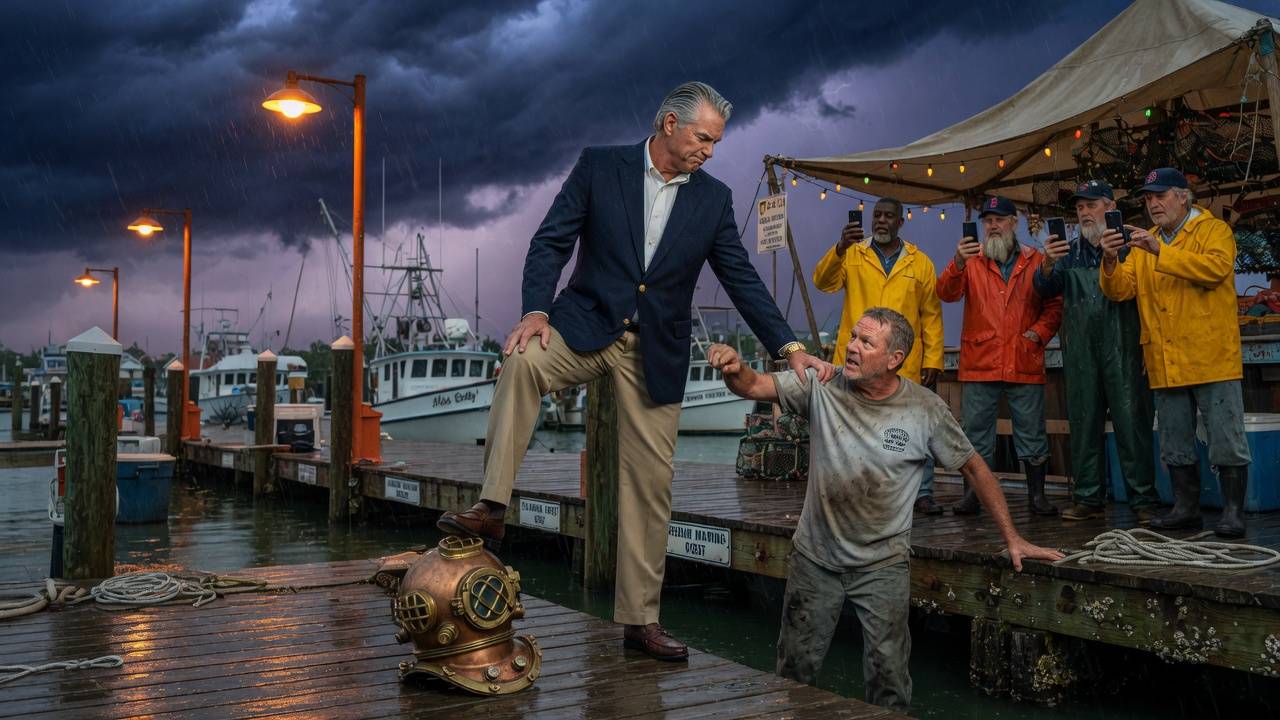
“He grabbed me first,” Hayes said. “I have twenty witnesses who saw him step on the helmet and pull me by the throat.”
“Witnesses who are mostly drunk fishermen or people who owe you money,” Sarah countered. “Belmont has a medical report. He’s claiming a cracked sternum and internal bruising. He’s in a private clinic in Naples right now, leaning on every political connection he has to make sure you never see the outside of a cell.”
“Let him try. I’m not running.”
“You don’t have to run. You just have to be smart.” Sarah stepped closer, her voice dropping. “He’s not just after your pride, Elias. He’s desperate. I did some digging. The Sovereign wasn’t just a yacht. It was a shell company asset. If that boat stays at the bottom, Belmont gets a twelve-million-dollar payout. If it’s recovered and the hull shows signs of a pre-existing mechanical failure—or if the cargo isn’t what he claimed—he goes to federal prison for insurance fraud.”
Hayes let out a long, slow breath. “He wants the coordinates so he can send his own team down to blow the hull. Erase the evidence before the surveyors get there.”
“Exactly. And he knows the storm is going to shift the debris. If he doesn’t get to it tonight, the currents in the trench will bury it under ten feet of silt. He’s losing his window.”
A sudden, violent gust of wind rocked The Mercy, sending a stack of charts sliding off the navigation desk. The boat groaned, the sound of wood and steel protesting the rising tide.
“Benny’s gone,” Hayes said, realizing the deckhand’s absence for the first time. “He wasn’t here when I came back.”
“Benny’s at the north pier,” Sarah said. “I saw him talking to one of Belmont’s guys. The one with the tactical gear. I think they’re prepping a salvage tug, Elias. They don’t have the coordinates, but they have the general area. They’re going to try to sweep the floor with side-scan sonar before the eye of the storm passes over.”
Hayes felt a cold spike of dread. “They’ll kill themselves. Nobody goes out in this. The surge is going to be eight feet in the channel.”
“Belmont doesn’t care about the crew. He cares about the payout. And if he finds that wreck, he’ll destroy it, and then he’ll come back here and finish you off legally.”
Hayes looked at his father’s helmet, sitting on the counter. The scuff mark from Belmont’s boot seemed to glow in the dim light of the cabin. He thought about the “Dishonorable” stamp on his papers. He thought about Toby’s face when he asked if they were losers.
He had spent twenty years trying to stay out of the current. He had spent twenty years being the “bottom-feeder” Belmont called him, living on the scraps of a life he’d lost. But the water was rising, and the old Navy Diver—the one who couldn’t stand to hear a Mayday without answering—was finally waking up.
“I’m not letting him have it,” Hayes said.
“Elias, you can’t go out there,” Sarah warned, her hand going to his arm. “The Coast Guard is under a ‘no-launch’ order. If you get into trouble, I can’t come for you. You’ll be on your own.”
“I’ve been on my own since the day I saved that girl, Sarah. That hasn’t changed.”
He walked to the forward cabin. Toby was sitting by the radio, his headphones on, his back to the door. Hayes stood there for a long moment, watching the small, fragile frame of his son. He realized then that he couldn’t protect Toby by hiding the truth. He could only protect him by showing him what it looked like when a man finally stopped being afraid of his own shadow.
“Toby,” Hayes said.
The boy turned, pulling the headphones down.
“I need you to go with Lieutenant Vance. You’re going to stay at the station tonight. It’s higher ground, and they have a generator.”
“What about you?” Toby asked, his voice trembling. “What about The Mercy?”
“The boat and I have an appointment,” Hayes said. He walked over and knelt in front of his son, ignoring the scream of pain from his swollen hand. He reached out and gripped Toby’s shoulder. “I told you that doing the right thing is sometimes the same as doing the wrong thing. Well, tonight, I’m going to do the ‘wrong’ thing one last time. And I need you to trust that I’m doing it for the right reasons.”
“Are you coming back?”
Hayes looked at the boy, seeing his own eyes reflected in that young face. “I’m a diver, Toby. We always come back up. We just have to watch the pressure.”
He stood up and looked at Sarah. She didn’t try to stop him again. She knew him well enough to know that the anchor had already been hauled. She nodded once, grabbed Toby’s hand, and led him out into the screaming wind.
Hayes watched them go, their figures swallowed by the horizontal rain. Then, he turned to the engine room. He had a boat to start, a wreck to protect, and a debt to settle that had nothing to do with money.
Chapter 6
The Gulf of Mexico wasn’t water anymore; it was an engine of chaos. The Mercy crested a fifteen-foot wave, her bow slamming into the trough with a bone-jarring impact that sent a spray of salt and foam over the bridge. The windshield wipers were useless, struggling against the deluge that turned the world into a flickering, grey-black nightmare.
Hayes stood at the wheel, his legs braced, his injured hand duct-taped to the spoke for stability. The engine was screaming, a high-pitched whine of overtaxed pistons and screaming belts. Every time the prop left the water, the RPMs spiked into the red, threatening to shatter the drive shaft.
“Come on, girl,” Hayes hissed through gritted teeth. “Hold together for one more mile.”
He was navigating by instinct and a handheld GPS that was losing signal every thirty seconds. He knew the shelf was close. He knew where the Sovereign lay, tucked into a limestone crevice that should have protected her from the initial gale. But the storm was shifting everything. The ocean floor was being rearranged by the weight of the surge.
A light flickered to his starboard. A high-intensity strobe, cutting through the rain.
Hayes squinted. It was the salvage tug. A beast of a boat, steel-hulled and powerful, but being handled with the grace of a drunken bull. He could see them through the binoculars—Belmont’s “muscle” guys were on the deck, struggling with a winch cable. They were trying to drop a heavy ROV (Remotely Operated Vehicle) into the water, but they were doing it in the middle of a sea state that would crush a submarine.
“Idiots,” Hayes muttered.
They were right over the wreck. He could tell by the way the waves were breaking—there was a submerged obstruction forcing the water to churn in a specific, violent pattern.
He throttled back, bringing The Mercy into the lee of the larger tug, using the steel hull as a temporary windbreak. He stepped out onto the deck, the wind nearly tearing the breath from his lungs. He saw Benny. The kid was standing near the winch, looking terrified, his hands shaking as he tried to secure a guide rope.
“Benny!” Hayes roared.
The kid looked over, his eyes widening as he saw the battered silhouette of The Mercy. He started to wave, but a massive wave hit the tug, sending it rolling forty degrees to the port. The ROV, a thousand pounds of expensive electronics and steel, broke its tether.
It swung like a wrecking ball across the deck.
One of Belmont’s guys, the one called Vance, tried to dodge, but the wet deck betrayed him. He slipped, his leg catching in a coil of loose cable. The ROV slammed into the railing, shattering the metal, and then plummeted into the dark water. The cable, still attached to the winch and Vance’s leg, whipped tight.
Vance was dragged across the deck, screaming as the weight of the sinking ROV pulled him toward the jagged opening in the rail.
“Cut the cable!” Benny yelled, reaching for a knife.
But the other guard, panicked and blinded by the rain, grabbed Benny and shoved him back, thinking the kid was trying to sabotage the mission.
Hayes didn’t think. He didn’t weigh the legal costs or the “Dishonorable” stain on his record. He saw a man in the water, and the Mayday in his head went off like a bomb.
He ducked back into the wheelhouse, grabbed his father’s Mark V helmet from the seat, and hauled it onto the deck. He didn’t have time for a full suit. He didn’t have time for a surface-supply line. He grabbed a pony bottle—a small, emergency air tank—and rigged it to the helmet’s intake. He lashed a heavy dive weight to his belt and stepped onto the gunwale.
He looked at the tug. Vance was gone. The cable had snapped, and the man had been pulled under, trapped in the entanglement of the ROV’s harness.
“Cap, no!” Benny screamed from the tug’s rail.
Hayes didn’t listen. He pulled the helmet over his head, the familiar, heavy darkness of the brass dome swallowing the world. He bit down on the regulator and stepped into the abyss.
The water was a chaotic washing machine for the first ten feet, but as he sank, the roar of the storm faded into a dull, rhythmic thrum. He hit the bottom hard, the silt billowing up around him like a shroud. He used his dive light to cut through the murk.
There it was. The Sovereign. The yacht was cracked open like an egg, its white hull gleaming like a bone in the dark. And there, tangled in a web of cables and fiberglass, was Vance. The man was still alive, his eyes wide behind his mask, his hands feebly clawing at the ROV that was pinning him against the wreck.
Hayes moved with the slow, deliberate strength of a man who had spent his life in the pressure. He reached Vance, using a heavy dive knife to saw through the thick, nylon cables. The man was running out of air; Hayes could see the panicked, shallow bubbles escaping his regulator.
He freed Vance’s leg, but the man was too weak to swim. The surge was pulling at them even at eighty feet, the current trying to drag them into the deep trench.
Hayes grabbed Vance by the collar of his tactical vest. He looked up. He could see the shadowy hull of The Mercy hovering above, a ghost ship in the storm. He inflated Vance’s BCD (Buoyancy Control Device) and started the long, agonizing ascent.
Every foot was a battle. The pressure in Hayes’s ears was a screaming needle, and the air in his small tank was whistling thin. He could feel the nitrogen bubbling in his blood, the “bends” waiting to claim him for his arrogance. But he didn’t let go.
They breached the surface twenty yards from The Mercy. The waves were even worse now, mountain ranges of black water. Hayes felt a hand grab his collar.
It was Benny. The kid had jumped from the tug and swam to The Mercy, taking the wheel when Hayes went over. He was leaning over the dive platform, his face streaked with tears and salt.
“I got you, Cap! I got you!”
They hauled Vance onto the deck. The man was unconscious but breathing. Hayes collapsed next to him, tearing the Mark V helmet off his head. He gasped in the cold, wet air, his lungs burning, his heart hammering against his ribs like a trapped bird.
The salvage tug was gone, its lights disappearing as it fled the eye of the storm. Belmont had abandoned his men. He had abandoned his ship. He had chosen the money, and in the end, the sea had chosen to keep the truth.
The morning after the storm was unnervingly quiet. The Florida sun came out, pale and apologetic, illuminating the wreckage that littered the St. Jude’s Marina. Boats were piled on top of each other like discarded toys. The bait shop was a skeleton of wood and wet sand.
Hayes sat on the edge of the pier, his hand in a fresh cast, watching the Coast Guard recovery team haul the last of the Sovereign’s debris onto a barge. Sarah Vance stood next to him, a cup of coffee in her hand.
“Vance is going to testify,” she said. “He told the deputies everything. The ROV had a demolition charge on it. Belmont wanted to blow the hull to hide the fact that the engines had been stripped before the yacht even left the dock. It’s a slam-dunk for federal fraud.”
“And the assault charges?” Hayes asked.
Sarah smiled, a small, tired thing. “The witnesses all had a sudden change of heart. They remembered that Belmont attacked you first. And after the video of you diving into a Category 2 storm to save his bodyguard went viral? No DA in the state is going to touch you. You’re a hero again, Elias. Whether you like it or not.”
Hayes looked at The Mercy. She was battered. Her railing was gone, and her hull was scraped to the primer. But she was afloat. She had ridden out the storm.
He felt a presence behind him. Toby. The boy was holding the Mark V helmet. He had spent the morning polishing the brass, removing the scuff mark from Belmont’s boot.
“Dad?” Toby said.
Hayes turned.
“I looked it up,” Toby said, holding the helmet out. “The NATO exercise. The submarine tender. I found the girl you saved. Her name is Clara. She’s a doctor in Seattle now. She wrote a blog post about the ‘Ghost Diver’ who saved her when the Navy wouldn’t.”
Hayes felt a lump in his throat that no amount of seawater could wash away.
“They gave you a dishonorable discharge because you wouldn’t let a little girl drown,” Toby said, his voice firm. “That’s not a loser, Dad. That’s a Captain.”
Hayes took the helmet. It felt lighter than it ever had. He looked at his son, seeing the pride he’d spent twenty years trying to earn, only to realize he’d had it all along.
“Come on,” Hayes said, standing up. “We have a boat to fix. The engine is seasoned, but she needs a little love.”
They walked down the pier together, two men shaped by the water, leaving the ghosts of the past at the bottom of the bay. The storm had taken a lot, but it had left the only thing that mattered: a father who could finally look his son in the eye, and a Captain who was no longer afraid of the deep.