Chapter 5
The silence that followed the heavy thud of Brock’s body hitting the marble was unlike any silence Elias had heard in the jungle. In the jungle, silence was a held breath, a predator waiting. Here, it was the sound of a thousand social gears grinding to a halt. The air in the terminal felt thick, smelling of expensive scotch and the copper tang of adrenaline.
Elias stood with his feet planted, his breathing heavy but rhythmic. He didn’t look at the crowd. He didn’t look at the phones. He looked only at Brock, who was currently curled into a ball on the floor, clutching his chest and wheezing. The boy’s face was no longer that of a venture capitalist; it was the face of a child who had realized for the first time that the world didn’t have a safety rail.
“You… you broke my ribs,” Brock managed to gasp, his voice high and thin.
“You’re breathing,” Elias said, his voice raspy but steady. “If I’d broken them the way I was taught, you wouldn’t be talking. You’d be drowning.”
Sarah stepped out from behind the bistro counter, her face pale, her phone still gripped in her hand. She looked at Brock, then at Elias, her eyes wide with a mixture of terror and fierce pride. “Elias, we have to go. Now. Before the police get here.”
“I’m not running, Sarah,” Elias said. He reached down and picked up his guitar case, clicking the latches shut. The tattered flag was safely in his pocket, a warm weight against his chest. “I have a permit. I was standing in my space. He came into it.”
“Elias, look around,” Sarah whispered, stepping closer. She nodded toward the grand staircase.
Coming down the stairs was a man who looked like an older, more polished version of Brock. Thomas Harrison moved with the practiced gait of a man who had spent thirty years commanding boardrooms and country clubs. Behind him was the HR manager for the station, a woman named Linda who looked like she was already calculating the cost of a lawsuit.
Thomas stopped ten feet away, his eyes moving from his son on the floor to the old man in the olive jacket. For a split second, his gaze locked with Elias’s. There was a flicker of something there—a spark of recognition that traveled across fifty years of silence. Thomas knew those eyes. He knew that stance.
“Dad,” Brock wheezed, reaching out a hand. “He attacked me. The old man… he’s crazy. He just… he hit me.”
Thomas didn’t move to help his son up immediately. He stayed perfectly still, his eyes never leaving Elias. “Brock, shut up,” he said, his voice a low, dangerous rumble.
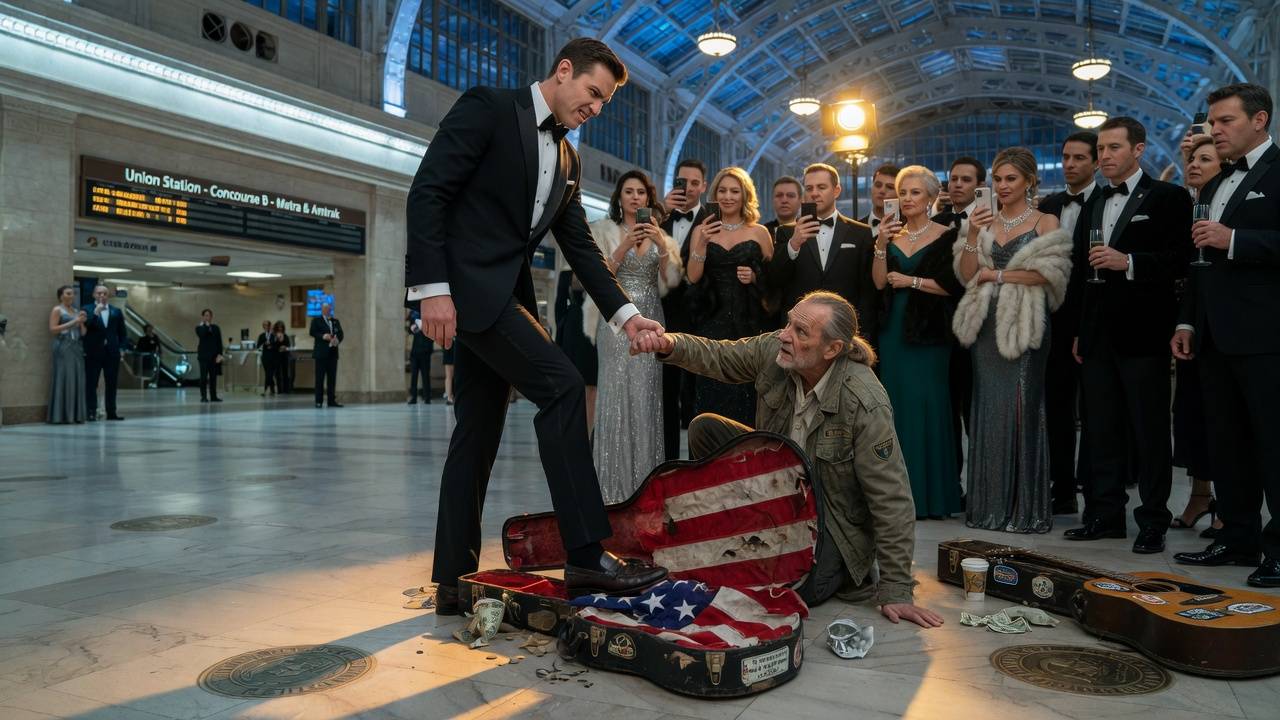
“He poured scotch on me, Thomas,” Elias said. He didn’t use a title. He didn’t use “sir.” He used the name he’d shouted over the roar of mortar fire in 1969. “He stepped on the flag. My flag. The one from the A Shau.”
The color drained from Thomas’s face. The socialites in the background were still filming, their phones captureing every second of the confrontation. The HR manager, Linda, stepped forward, her voice sharp and corporate.
“Officer Marcus,” she snapped, looking at the young guard who was still standing paralyzed by the trash can. “Detain this man. Now. He has assaulted a guest of the terminal. We’ll be pressing full charges.”
Marcus didn’t move. He looked at Elias—the man who had taught him how to tune a guitar, the man who told him stories about what it meant to actually serve something bigger than yourself. Then he looked at Thomas Harrison, the man whose foundation paid his meager salary.
“I saw the whole thing, Linda,” Marcus said, his voice surprisingly firm. “Mr. Harrison’s son initiated physical contact. He grabbed Elias by the throat. Elias defended himself.”
“I don’t care what you saw,” Linda hissed. “Look at the cameras. Look at the guests. Do you want to keep your job, Marcus?”
“I’ve got it all right here,” Sarah said, stepping forward and holding up her phone. “From the first penny he threw to the moment he stepped on the flag. It’s already uploading to a private cloud. You touch Elias, and this goes to every news outlet in Chicago before the sun comes up.”
The standoff was absolute. Thomas Harrison finally moved, stepping toward his son and hauling him to his feet with a rough, unsympathetic yank. Brock groaned, leaning heavily on his father.
“We’re leaving,” Thomas said, his voice tight.
“Dad?” Brock looked confused, his arrogance replaced by a wavering, pathetic need for validation. “He hit me! We have to call the police!”
“I said we’re leaving, Brock,” Thomas repeated, leaning in close to his son’s ear, but loud enough for Elias to hear. “Because if we don’t, I’m going to have to explain to the board why my son was filmed assaulting a Congressional Medal of Honor recipient over a bottle of scotch.”
Elias felt a sharp pang in his chest at the mention of the medal. He didn’t wear it. He kept it in a velvet box under his bed, next to the letters from David. He didn’t want to be a hero; he just wanted to be left alone.
Thomas looked at Elias one last time. There was no apology in his eyes, only a weary, bitter kind of respect. He knew Elias wouldn’t talk—not because of loyalty to Thomas, but because Elias had too much dignity to use the past as a weapon.
“Goodnight, Elias,” Thomas said.
“Goodnight, Thomas,” Elias replied.
The crowd parted like a dark sea as the Harrisons walked away. The socialites began to disperse, their whispers filling the terminal like the buzzing of flies. The show was over, but the residue was everywhere.
Elias felt his knees start to tremble. The adrenaline was fading, leaving behind the cold, hollow ache of his heart condition. He sat back down on his milk crate, his hands shaking so hard he couldn’t even reach for his pills.
“Elias!” Sarah was beside him in an instant, her hand on his shoulder. “Take a breath. Just breathe.”
“I’m fine,” he lied, though the world was starting to gray at the edges. “Just… I need to go home.”
“You’re not going home alone,” Marcus said, walking over. He took off his uniform cap, looking down at it. “I’m walking you to the train. And then I’m quitting this job.”
“Don’t be a fool, Marcus,” Elias wheezed. “You need the work.”
“I need to be able to look in the mirror more,” Marcus said.
As they helped him stand, Elias’s phone buzzed in his pocket. It was an old flip phone, the battery held together with a piece of tape. He pulled it out with trembling fingers. There was one new text message from a number he hadn’t seen in four years.
I saw the video, Pop. Are you okay? I’m at the bus station. I’m coming home.
Elias stared at the screen, a single tear cutting through the dried scotch on his cheek. The fight was over, but the real work was just beginning.
Chapter 6
The apartment on 63rd Street felt smaller than usual, the shadows in the corners deeper. Elias sat in his recliner, his guitar case leaning against the wall, unopened. He hadn’t turned on the lights. The only illumination came from the streetlamps outside, casting orange, slatted bars across the linoleum floor.
He had spent the last three hours in a state of suspended animation. The physical pain was manageable—a dull throb in his shoulder where he’d hit the pillar—but the emotional exhaustion was a lead weight. Every time he closed his eyes, he saw Brock’s face, then his father’s, then the wet, dark jungle of 1969. It was all a circle. Nothing ever truly stayed buried.
A knock sounded at the door. It was soft, hesitant.
Elias didn’t move for a long moment. He was afraid that if he stood up, the vision would vanish. He’d had this dream a hundred times—the knock, the door opening, the reconciliation. But this time, the air in the room felt different. It felt real.
He pushed himself out of the chair, his joints popping like small-caliber fire. He walked to the door and turned the deadbolt.
David stood in the hallway. He looked older, his face lined with the kind of weariness that comes from trying to outrun yourself. He was carrying a single duffel bag, his hair cut short, a faint scar running through his eyebrow. He looked so much like the man in the photo Elias carried that it made his throat ache.
“Pop,” David said.
“David.”
They stood there for a long beat, the four years of silence a canyon between them. David looked past his father into the dim apartment, his eyes landing on the guitar case.
“I saw the video on the news,” David said, his voice thick. “Some girl posted it. It went viral. People are calling you the ‘Subway Samurai.’ They’re saying you’re a hero.”
“I’m not a hero, David,” Elias said, stepping back to let his son in. “I’m just an old man who got tired of being stepped on.”
David walked into the room, setting his bag down by the door. He looked around the small kitchen, at the stack of mail on the counter, at the single plate in the sink. The guilt on his face was a physical thing, a shadow he couldn’t shake.
“I should have called,” David whispered. “After the discharge… I was ashamed. I thought you’d look at me and see a failure. I thought you’d compare me to the men you served with and see that I didn’t measure up.”
Elias walked over to the kitchen table and sat down, gesturing for David to do the same. “You think I stayed in that station every Friday night to judge you? I stayed there because I was afraid you’d come through and I wouldn’t be there to catch you.”
David sat, his head bowed. “I saw what you did to that guy, Pop. You still got the hands.”
“I wish I didn’t,” Elias said. “I spent fifty years trying to forget how to hurt people. That boy… Brock… he’s a fool. But he’s a fool because no one ever told him ‘no.’ I didn’t want to be the one to tell him, but he left me no choice.”
“The news says the Harrison family is ‘reviewing’ the incident,” David said. “But the internet is eating them alive. They can’t hide from this one. That waitress, Sarah? She’s doing interviews. She’s telling everyone who you really are.”
“I don’t want the attention, David. I just want to sit in my chair and listen to the quiet.”
“You won’t have to listen to it alone anymore,” David said. He reached across the table, his hand hesitant before covering his father’s. Elias’s hand was cold, the skin like parchment, but it was steady now. “I’m staying. I got a job lead at the rail yards. I’m going to get my life back, Pop. I want to be the kind of man you saved in that video.”
Elias looked at his son, and for the first time in a decade, the tightness in his chest eased without the help of a pill. The world was still cold, and the Harrisons of the world would always be waiting in the shadows, but he wasn’t a ghost anymore. He was a father.
They spent the rest of the night talking—not about the war, not about the terminal, but about the small things. About the way the city had changed, about the guitar strings Elias needed to buy, about the mother David still missed every single day.
As the sun began to peek over the Chicago skyline, casting a gray, hopeful light through the window, Elias stood up and walked over to his guitar case. He opened it, looking down at the worn wood of the Melody Maker.
“You going to play?” David asked.
“Not today,” Elias said. He reached into his pocket and pulled out the folded flag. It was still stained with the shadow of a shoe print, a permanent reminder of the night the world tried to break him. He laid it carefully over the top of the guitar, smoothing out the wrinkles. “I think I’ve played my last set in that station.”
“What are you going to do now?”
Elias looked at his son, then out at the waking city. “I’m going to take a walk. And then I’m going to make some breakfast. I think we have some eggs in the fridge.”
The terminal would still be there. The trains would still run. The elite would still scurry to their galas, draped in silk and indifference. But in a small apartment on 63rd Street, the silence had finally been broken. Elias closed the guitar case, the click of the latches sounding like a period at the end of a very long, very painful sentence.
He walked to the window and pulled back the curtain. The street was empty, the puddles reflecting the morning sky. It wasn’t a perfect ending—his heart was still weak, his son was still healing, and the Harrisons would likely find a way to spin the truth. But as Elias watched the first bus of the morning roll past, he felt a strange, quiet dignity.
He had seen better men die for less. But today, he was going to live for more.