Chapter 5
The administrative wing of Harrison Military Academy didn’t smell like the rain-soaked parade grounds. It smelled like floor wax, expensive mahogany, and the sterile chill of an air-conditioning system that never slept. Sam Vance sat in a hard-backed wooden chair in the “White Box,” the nickname cadets gave to the windowless holding room adjacent to the Provost’s office. His knuckles were raw, and his tan uniform was a disaster of mud and grass stains, but he didn’t feel like a cadet anymore. He felt like a witness.
He had been sitting there for three hours. The silence was its own kind of interrogation, a tactic designed to make a teenager start rehearsing apologies. But Sam didn’t have any apologies left. Every time he closed his eyes, he saw the look on General Harrison’s face as his fingers touched the mud-caked letter. It hadn’t been anger. It had been the sudden, skeletal realization that the ghost he’d buried three years ago had just walked back into the room.
The door creaked open. It wasn’t the Provost. It was Major Vance—the man whose name Sam shared but whose soul was entirely owned by the Academy’s branding. The Major didn’t sit down. He paced the small room, his heels clicking on the linoleum with a rhythm that felt like a countdown.
“Do you have any idea what you’ve done, Sam?” the Major asked. His voice wasn’t booming like it was on the field. It was thin, tight with a panic he was trying to dress up as disappointment.
“I retrieved my brother’s medal, Sir,” Sam said. His voice was steady, despite the way his ribs ached where he’d taken the brunt of the impact during the structure break.
“You assaulted the son of a General,” the Major snapped, stopping his pacing to lean over the table. “In front of the entire battalion. On a day when the Board of Trustees was present. You didn’t just break regulations; you detonated them. And that… that piece of paper you gave the General. Do you realize the legal ramifications of making accusations like that? It’s slander. It’s a criminal offense against the uniform.”
Sam looked at the Major. He saw a man who had spent twenty years polishing his career, only to see it threatened by a seventeen-year-old with a blood-stained piece of history.
“It’s not slander if it’s true, Sir,” Sam said. “The letter was written by Leo Vance. Not a cadet, but a Sergeant who died following orders that never should have been given. If the General wants to talk about criminal offenses, maybe we should start with the extraction mission in the Khunjerab Pass.”
The Major went pale. He stood up straight, adjusting his belt as if he could pull his authority back into place. “You’re a child. You don’t understand the complexities of command. Mistakes are made in the field. But you? You made a mistake here, in a controlled environment. The General is currently with his son at the infirmary. Brooks has a suspected fractured sternum and a concussion. They’re talking about filing police reports, Sam. Criminal assault charges.”
Sam felt the first ripple of real fear, but it was cold, not hot. He thought of his mother. He thought of the house. “And the letter?”
“The General destroyed it,” the Major said, his voice dropping to a whisper. “He said it was a forgery. A desperate attempt by a failing cadet to distract from his own violence. It’s gone, Sam. Your leverage, your proof—it’s in a shredder in the main office. All that’s left is a video of you beating a defenseless cadet in the mud.”
Sam felt a hollow thud in his chest. He should have known. He should have expected the General to act with the same tactical ruthlessness he’d used on the ridge. But then, Sam remembered Miller. He remembered the old veteran’s scarred hand on his shoulder and the way Miller had insisted on one thing before Sam ever brought that letter to the Academy.
“The General destroyed the original?” Sam asked.
“Of course he did,” the Major said, a flicker of smugness returning to his face. “He’s protecting the Academy. He’s protecting the legacy of your brother, ironically enough. He doesn’t want Leo’s name dragged through a trial any more than you do.”
“Then it’s a good thing I gave him a photocopy,” Sam said.
The Major froze. His hand stayed on his belt, his mouth slightly open.
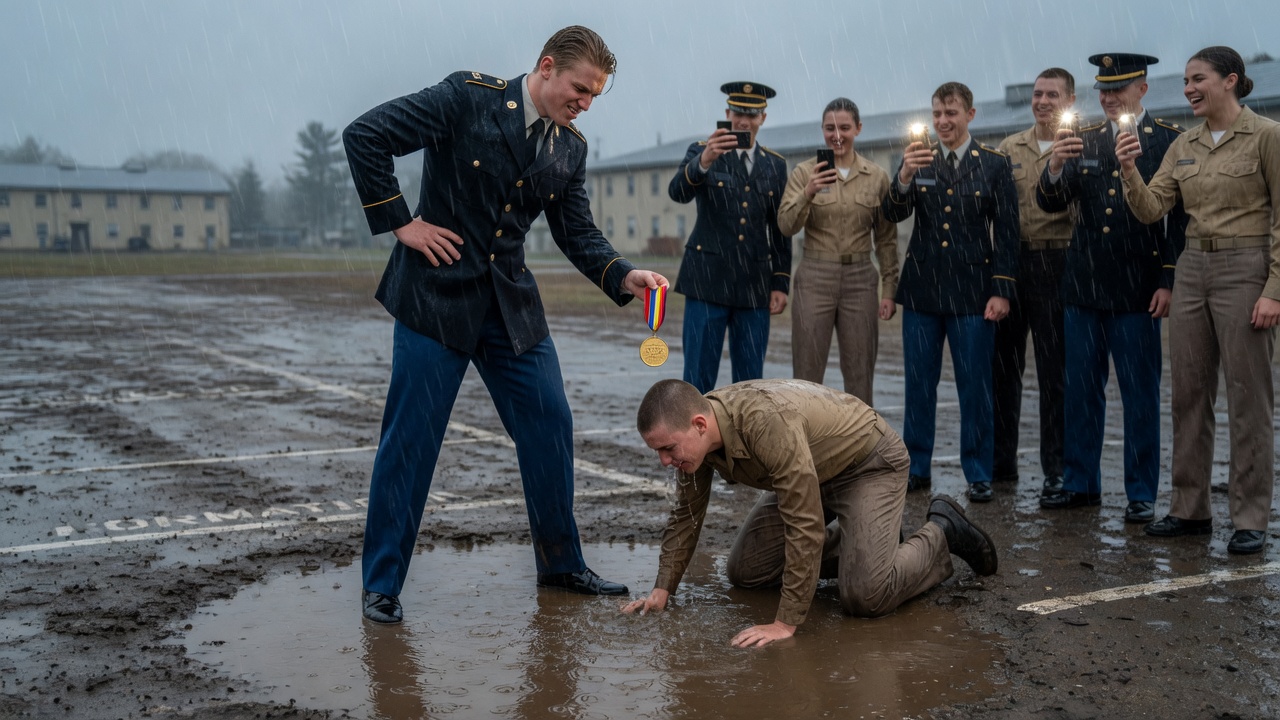
“I’m not a tactical liability, Sir,” Sam said, leaning forward. “Leo taught me that you never go into a hot zone without a secondary extraction point. The original letter is in a safe deposit box. And there are three more copies. One is with a veteran who was in the unit that day. Another is with a lawyer in the city. And the third?” Sam paused, letting the silence stretch. “The third is currently being uploaded to the same servers that hosted the video of Brooks Harrison begging for his life in a puddle.”
The Major didn’t say anything. He didn’t have to. The sound of a phone vibrating on the table between them did the talking for him. The Major looked down at the screen. It was a notification from the Academy’s internal social network—a link that was already spreading through the dorms like a virus.
“You’ve ruined yourself,” the Major whispered, looking at Sam with something that looked almost like pity. “Even if you win, you lose. You’ll never be an officer. You’ll never have a career. You’ve burned the only bridge you had.”
“I never wanted the bridge, Major,” Sam said. “I just wanted the truth to stop being an anchor around my mother’s neck.”
The Major left the room without another word. Sam was left alone again, but the air felt different. The “White Box” didn’t feel like a cell anymore; it felt like a bunker.
An hour later, the door opened again. This time, it wasn’t the Major. It was his mother.
Sarah Vance looked older than she had that morning. Her coat was damp from the rain, and her eyes were red-rimmed. She walked into the room and didn’t wait for permission. She grabbed Sam and pulled him into a hug that felt like she was trying to fuse their souls together. She was shaking—not with the fragile, broken tremors Sam was used to, but with a sharp, electric energy.
“Mom,” Sam said, his voice finally breaking. “I’m sorry. The house, the pension… I know I messed it up.”
Sarah pulled back, her hands on his face. She looked at him, really looked at him, for the first time in months. She wasn’t looking at the son who looked like Leo. She was looking at Sam.
“Miller came to the house,” she whispered. “He told me everything. He showed me the copy of the letter, Sam. I read it. I read what Leo said about that man. I read how my son died.”
Sam waited for the collapse. He waited for her to fall apart, to beg him to take it back so they could go back to their quiet, lie-filled life.
“I’ve spent three years thinking my son died because he was careless,” Sarah said, her voice growing stronger with every word. “I’ve spent three years letting that man pat my hand and tell me he’d take care of us. I felt like a beggar in my own life, Sam. I felt like I was eating the scraps of a hero’s table.”
She reached into her purse and pulled out the velvet box. She didn’t look at it with the same reverence she had before. She looked at it with a cold, clear-eyed fury.
“We don’t need his money,” she said. “We don’t need his mercy. I’ve already called the bank. We’re putting the house up for sale. We’ll go to your aunt’s in the city. We’ll find a way.”
“Mom, you don’t have to do that,” Sam said.
“Yes, I do,” she snapped. “Because I’d rather live in a tent with the truth than in a mansion built on your brother’s grave. You did the right thing, Sam. For the first time in three years, I can look at Leo’s picture without feeling like I’m apologizing for being alive.”
The door opened once more, and this time, the atmosphere changed completely. General Harrison stood there. He wasn’t in his dress blues anymore. He had stripped off the jacket, his white shirt wrinkled, his tie loosened. He looked like a man who had been hit by a train and was still trying to figure out if he was standing on the tracks.
He looked at Sarah, then at Sam. The power asymmetry that had defined their lives for years was gone. He wasn’t the benefactor. He wasn’t the hero. He was a man with a shredder full of evidence that no longer mattered.
“Sarah,” the General said. His voice was gravelly. “We need to discuss how to handle this. For the sake of the Academy. For the sake of Brooks.”
“My son’s name is Sam,” Sarah said, stepping in front of him. “And you don’t get to say my other son’s name ever again.”
“The video is out,” the General said, ignoring her, his eyes fixed on Sam. “It’s been picked up by the local news. They’re calling it a ‘hazing incident gone wrong.’ If we play this right, we can frame it as a personal dispute between two cadets. We can say the letter was a misunderstanding of field reports. I can make the assault charges go away, Sam. I can still get you into the state program.”
Sam stood up. He felt the weight of Leo’s medal in his pocket. He felt the residue of the 3-beat combo in his muscles—the memory of what it felt like to finally stop taking the hits.
“I don’t want your help, General,” Sam said. “And I don’t think you understand. I didn’t leak the letter to get a better deal. I leaked it because you’re a coward. And because everyone needs to know that when the ridge started to fall, you didn’t stay to help. You ran.”
The General’s face contorted. For a second, the mask of the officer slipped, and Sam saw the small, terrified boy underneath the stars. The man who had built a career on a lie and was now watching the foundation wash away in a rainstorm of social media and blood-stained paper.
“You’ll have nothing,” the General hissed.
“I already had nothing,” Sam said. “Now, I just have the truth. It’s a lot lighter to carry.”
The General turned and walked out. He didn’t slam the door. He didn’t have the strength left for it.
Sam and his mother stood in the quiet of the White Box. The administrative wing was buzzing now—phones ringing, footsteps running, the sound of a system trying to save itself and failing.
“Let’s go home, Sam,” Sarah said.
They walked out of the building together. As they crossed the parade grounds, Sam saw the unit. They were still in formation, but the discipline was gone. Cadets were huddled together, staring at their phones, looking up at Sam as he passed. Some looked away in shame. Some looked at him with a new, tentative kind of respect.
At the edge of the asphalt, near the flagpole, Miller was waiting. He was leaning against his old truck, a cigarette dangling from the corner of his mouth. He didn’t say a word. He just nodded—a sharp, soldierly acknowledgment of a mission accomplished.
Sam got into the truck with his mother. As they drove away from the iron gates of Harrison Military Academy, Sam didn’t look back. He looked at his hands, still stained with the mud of the parade ground. He thought about the General, about Brooks, about the scholarship he’d never use.
He felt a strange, cold peace. The weight of “True Honor” was heavy, yes. But for the first time in his life, it was a weight he had chosen to carry.
Chapter 6
The transition from “Cadet Vance” to “Sam” happened faster than he expected. Within forty-eight hours, the Academy had officially “separated” him from the program—a polite term for an expulsion they couldn’t quite justify as a disciplinary action without inviting a full-scale legal discovery. The “Command Circle” had evaporated. Brooks Harrison hadn’t returned to classes; rumors said he was being moved to a private clinic in the mountains, his jaw wired shut and his reputation permanently shattered by the ten-second clip that had been viewed three million times.
Sam spent the following week in a blur of packing boxes and phone calls. Their house, once a shrine to Leo’s memory, was becoming a shell. The military pension had been “temporarily suspended pending investigation,” a move the General had made as a parting shot, but it didn’t matter. Miller had shown up with a group of veterans from the local VFW—men with grey hair and missing limbs who had spent years hearing rumors about the Khunjerab Pass. They hadn’t just brought boxes; they’d brought a checkbook and a lawyer who worked for “pride and coffee.”
“They can’t stop the truth now, kid,” Miller told him as they loaded the last of the kitchen chairs into the truck. “The Department of the Army opened a formal inquiry yesterday. The General’s on ‘administrative leave.’ That’s officer-speak for ‘we’re finding a rug big enough to hide him under before we kick him out.'”
Sam looked at the empty living room. “He’s still going to have his pension. He’s still going to have his house.”
“Maybe,” Miller said, spitting into the dirt. “But he’ll never be able to walk into a room of soldiers and have them stand at attention without wondering if they’ve seen the video. That’s a prison of its own.”
Sam’s last day in town was a Tuesday. The rain had finally cleared, replaced by a pale, biting autumn sun. He told his mother he needed a few hours before they hit the road for the city. He took his truck and drove to the one place he hadn’t been able to face since the fight.
The Veterans’ Cemetery was a sea of white marble, perfectly aligned rows that mirrored the formations of the Academy. But here, the silence was different. It wasn’t the forced silence of a parade ground; it was the heavy, settled silence of a story that had reached its final page.
Sam walked past the grand monuments, past the statues of generals on horseback, and headed toward the back section—the “New Rows” where the grass was still trying to take root over the recent arrivals.
He found Leo’s grave. It was simple. Sergeant Leo Vance. Medal of Honor.
Sam sat down on the grass. He pulled the medal from his pocket. It was clean now, the gold gleaming in the sunlight. He looked at it for a long time.
“I got it back, Leo,” he whispered.
He thought about the “black-ops” techniques Miller had taught him. He thought about the 3-beat combo. He realized now that the training hadn’t been about the strikes. It had been about the preparation. It had been about knowing that the world was going to try to break your structure, and having the discipline to hold your ground until the moment was right.
“I’m sorry I took the scholarship,” Sam said to the headstone. “I thought I was protecting Mom. I thought I was protecting you. I didn’t realize I was just helping them bury the truth deeper.”
A shadow fell over the grave. Sam didn’t startle. He knew the gait.
Miller stood a few feet away, his empty sleeve fluttering in the breeze. He looked at the headstone, then at Sam. “He would’ve been proud of that kick, Sam. A bit heavy on the lead foot, but the hip drive was solid.”
Sam managed a small, tired smile. “I don’t think I’ll be using it much more.”
“Good,” Miller said. “A man who loves the fight is a man who eventually loses his way. But a man who fights because he has no other choice? That’s a man you can trust.”
Miller sat down next to him, his prosthetic leg clicking as he settled into the grass. “The General resigned this morning. Full retirement. No honors. No parade. He’s moving to Florida. His son is with him. The Academy is rebranding—changing the name to ‘The Heritage Institute.’ They’re trying to scrub the Harrison name off the gates before the recruitment numbers hit the floor.”
“And the inquiry?” Sam asked.
“It’ll take years,” Miller sighed. “They’ll find ‘procedural errors’ and ‘communication breakdowns.’ They’ll never call it cowardice. But the guys who were there? They know. And now, the rest of the world knows too. That’s as much justice as you get in this life, kid. It’s never a clean win. It’s just a shift in the wind.”
Sam looked at the medal in his hand. “What do I do with this? It feels like it belongs to the General’s lie as much as it belongs to Leo’s courage.”
Miller reached out and touched the gold. “The medal isn’t the honor, Sam. The honor is the fact that your brother stood his ground when everyone else ran. The gold is just a receipt. If it feels too heavy, give it to your mother. She needs something to hold onto while she builds a new life.”
They sat in silence for a while, two generations of soldiers—one broken by the system, one who had broken it back.
“What are you going to do?” Miller asked. “Your mother says you’re looking at community college in the city.”
“Engineering,” Sam said. “I like knowing how things are built. I like knowing where the stress points are.”
Miller chuckled. “Yeah. I bet you do.”
Sam stood up and wiped the grass from his jeans. He took one last look at the headstone. He didn’t feel the hollow ache in his chest anymore. He felt a quiet, disciplined resolve. He had lost his future in the military, his house, and the security of a General’s shadow. But as he looked at Miller, and thought about his mother waiting in the truck, he realized he had gained something much more valuable.
He had gained his own name.
He walked back to the truck with Miller. As they reached the gates of the cemetery, Sam saw a familiar car parked near the entrance. It was a small, silver sedan. Standing next to it was the young female cadet from his unit—the one who had watched the fight with her phone out, her face a mask of shock.
She walked toward him, her uniform crisp, her eyes searching.
“Vance,” she said.
“It’s just Sam now,” he replied.
She nodded, looking at the ground for a second before meeting his eyes. “I just wanted to say… we all saw the letter. The real one. Someone posted the full text on the battalion board before the officers could pull it down.”
“And?”
“And half the unit is resigning,” she said, her voice trembling slightly. “We didn’t join to be part of a cover-up. My dad’s a Colonel. He’s furious. He’s the one who leaked the internal report to the press.”
She reached out and shook his hand. It wasn’t a cadet’s handshake. It was a peer’s. “You were right. Rank isn’t blood. And it sure as hell isn’t valor.”
She turned and walked back to her car. Sam watched her go, feeling a final piece of the puzzle click into place. He hadn’t just saved himself. He had cracked the foundation of the whole rotten system.
He got into his truck. His mother was in the passenger seat, a map open on her lap. She looked at him and smiled—a real smile, one that reached her eyes.
“Ready?” she asked.
“Ready,” Sam said.
He shifted into gear and drove. He passed the Academy one last time. The gates were closed, the “Harrison” sign covered with a temporary tarp. In the middle of the parade ground, he could see a group of workers scrubbing the asphalt where the puddle had been. They were trying to wash away the mud, the shame, and the memory of the boy who wouldn’t bark.
But some stains don’t come out. And some truths, once spoken, can never be silenced.
Sam Vance drove toward the highway, the sun at his back and his brother’s medal in his pocket. He wasn’t a cadet. He wasn’t a hero. He was just a brother who had finally finished the mission.
The weight of “True Honor” was still there, heavy and cold. But as the miles stretched out between him and the Academy, Sam realized that the weight didn’t have to crush him. He could use it as an anchor—something to keep him grounded in a world that was always trying to blow him off course.
He turned on the radio, rolled down the window, and let the air of a new life fill the cab. It didn’t smell like floor wax or rain-soaked asphalt.
It smelled like freedom.