Chapter 5
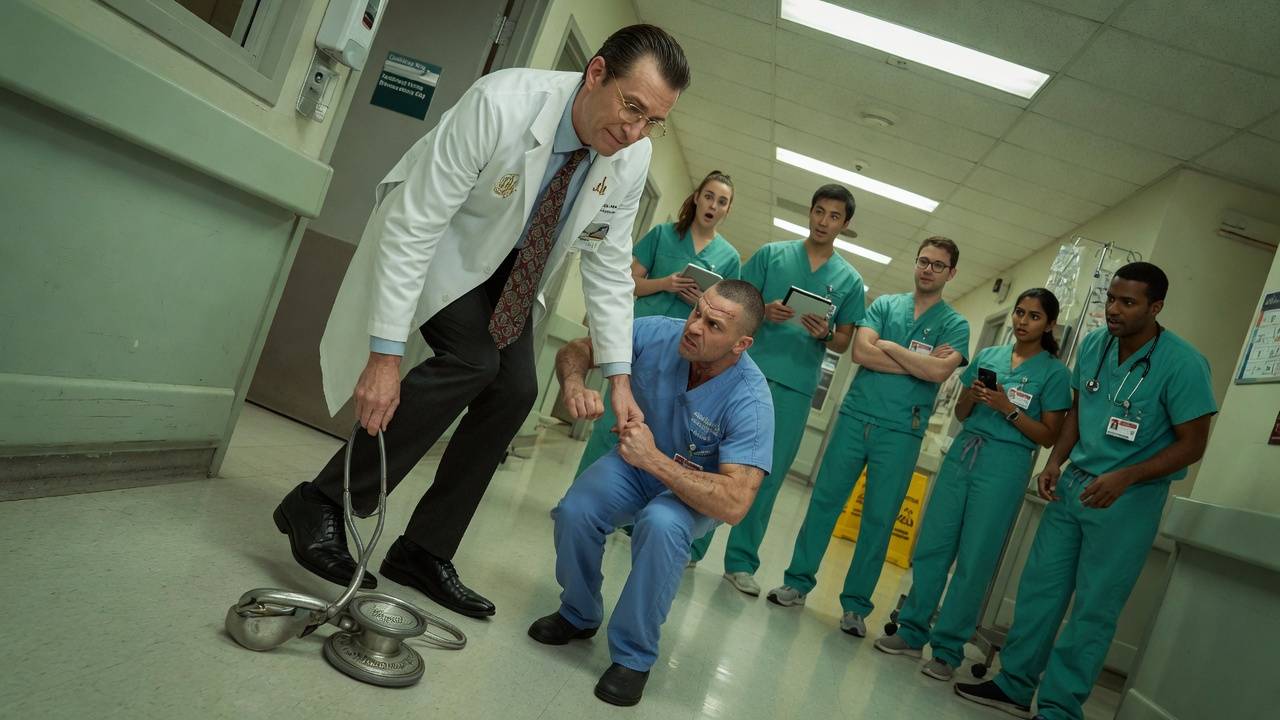
The silence that followed the arrival of hospital security was heavier than the noise of the confrontation. It was the kind of silence that lived in the wake of an explosion, where the ears ring and the brain struggles to reassemble the world. Two guards, both younger than Silas and clearly unsure of how to handle a Chief of Surgery lying on the floor, stood frozen at the end of the corridor.
Silas didn’t look at them. He was still kneeling over Evelyn Miller. His hands, the hands that had just dismantled a man’s physical and social standing in three seconds, were now moving with a terrifying, rhythmic grace. He had his vintage stethoscope pressed to Evelyn’s chest, his eyes fixed on the distant wall as he filtered out the sounds of the hospital to hear the wet, crackling struggle of her lungs.
“Get him off me!” Crane finally managed to scream. The sound was high-pitched and ragged, the voice of a man who had realized his ribs were no longer a solid cage. “He’s a lunatic! He attacked me! Security, arrest him now!”
The guards moved forward, their boots heavy on the linoleum. One of them, a guy named Rick who Silas had shared coffee with in the breakroom just two days ago, reached for his belt.
“Silas, man, just… put the thing down,” Rick said, his voice shaking. “We gotta take you downstairs.”
Silas didn’t move. He didn’t even flinch when Rick’s hand landed on his shoulder. “In forty-five seconds, this woman is going to go into respiratory arrest,” Silas said. His voice was low, devoid of the adrenaline-fueled panic that was vibrating through everyone else in the hallway. “If you move me now, she dies. If you let me finish the assessment, I can stabilize her for the ICU team.”
“He’s a janitor!” Crane shrieked from the floor. He was trying to sit up, his face a mottled purple. “He’s a high-school dropout with a mop! He’s killing her! Rick, get him out of here!”
Mia, the young nurse, stood between the guards and Silas. She was trembling, her hands gripped tightly onto the handle of the crash cart she had just wheeled into place. “He’s right,” she whispered, her voice gaining strength as she looked at the monitors. “Her O2 is at eighty-two and dropping. Dr. Crane, she’s in flash pulmonary edema. We need to intubate.”
“I am the Chief of Surgery!” Crane roared, though it ended in a painful cough. “I say she’s fine! It’s a psychogenic reaction to the stress of his assault! Get him out!”
At that moment, a door opened further down the hall. A tall woman with iron-gray hair and a lab coat that looked like it had been pressed by a laser walked into the light. Dr. Sarah Vance, the Hospital Director, didn’t run. She walked with a deliberate, lethal speed that made the residents scatter like leaves.
She took in the scene in one sweeping glance: Crane on the floor, Silas kneeling by the patient, the guards hovering, and the residents with their phones still raised.
“Lower those phones,” Vance said. It wasn’t a request. “Anyone whose camera is still active by the time I reach that cart is fired. No severance. No references.”
The phones vanished instantly.
Vance stopped three feet from Silas. She looked down at Crane, then at Silas, then at the vintage stethoscope. Her eyes stayed on the silver chest piece for a long beat. “Status,” she said.
“Miller, Evelyn. Sixty-eight,” Silas said, not looking up. “History of mitral valve regurgitation. She’s developed acute heart failure, likely triggered by the stress of the surgical prep and an undiagnosed fluid overload. Rales in all fields. She’s drowning. I’ve requested Lasix and a nitro drip, but Dr. Crane disagreed with the diagnosis.”
“Because it’s wrong!” Crane yelled, struggling to his feet with the help of a resident. “He’s an orderly, Sarah! He struck me! He’s a violent criminal!”
Vance ignored him. She stepped closer to Silas and watched his hands. “You’re holding that stethoscope like someone who knows how to use it, Silas.”
“I do,” Silas said.
“Mia, give him the nitro,” Vance ordered.
“Sarah, you can’t be serious—” Crane started.
“Julian, shut up,” Vance said without turning around. “You’re bleeding from the lip and you’re clutching your sternum. Go to the ER and get a chest CT. Now. Before I decide that your behavior tonight constitutes a breach of your contract.”
“He hit me!”
“And I saw the video before I even left my office,” Vance said, finally turning to look at him. Her face was a mask of cold professional disgust. “I saw you step on a piece of medical equipment. I saw you lay hands on an employee. And I saw you ignore a patient in clear respiratory distress. If you say one more word, I will have the police escort you out of your own hospital.”
The silence returned, but this time it was sharper. Crane looked around at the residents—the kids who usually worshipped him. They were looking at the floor, at the walls, anywhere but at him. The king was naked, and the crown was lying in the bleached footprints of the hallway.
Crane turned and stumbled toward the elevator, his hand pressed to his chest. The residents followed him, a silent, retreating army.
Silas stayed focused on Evelyn. As the nitro began to work and her breathing slowed, he felt the tension in his own shoulders start to fragment. He wasn’t a ghost anymore. He was exposed.
“She’s stabilizing,” Silas said, stepping back. He handed the stethoscope to Mia, who took it like it was a holy relic. “Keep her on five liters. Don’t let them take her to surgery until her lungs are clear.”
Vance watched him. “My office, Silas. Five minutes. Rick, stay with him.”
Silas didn’t argue. He walked to the service elevator, the guard following at a respectful distance. As the doors closed, Silas caught a glimpse of Evelyn. She was looking at him, her eyes clear for the first time. She didn’t say thank you. She just watched him, the same way she had watched him five years ago when he told her that her son was gone.
The Director’s office was a shrine to institutional power. Dark wood, leather chairs, and a view of the Boston skyline that cost more than Silas had made in the last three years. Vance sat behind her desk, the silver stethoscope lying on the blotter between them.
Silas sat in the leather chair, his back straight, his hands resting on his knees. He looked like a man awaiting a court-martial.
“I ran your prints,” Vance said. She didn’t sound angry. She sounded curious. “It took the system about four minutes to flag you. Silas Vane. Former Lieutenant Commander, US Navy. Chief of Surgery at Bagram for two tours. Fellowship in trauma surgery at Hopkins. You disappeared five years ago after a malpractice suit in Virginia.”
“I didn’t disappear,” Silas said. “I moved.”
“You took a job as an orderly at a hospital three hours away from your old life. You spent five years cleaning floors and taking abuse from men like Julian Crane who couldn’t carry your scrub sink. Why?”
Silas looked at the stethoscope. “Because I killed a kid, Dr. Vance. I made a call in a field hospital during a sandstorm. I thought I could repair a Grade IV liver lac with a field kit. I was wrong. He bled out on the table while I was still telling him he’d be fine. His name was Christopher Miller.”
Vance leaned back. “And his mother is in Room 312.”
“Yes.”
“So this was penance?” Vance shook her head. “A waste of talent is not penance, Silas. It’s a tragedy. You’ve let patients suffer under Crane’s incompetence for three years because you were too busy punishing yourself.”
“I don’t want to be a doctor,” Silas said.
“That’s too bad,” Vance said, sliding a folder across the desk. “Because Julian is already calling his lawyers. He’s going to sue you for assault, and he’s going to sue the hospital for negligence. The only way I can protect this institution—and you—is if I can prove that you were acting in a medical capacity to save a life. But you surrendered your license.”
“I let it lapse,” Silas corrected. “There’s a difference.”
“A small one. But here’s the problem. Evelyn Miller is stabilized, but she’s not fixed. Her mitral valve is shredded. She needs an emergency replacement, and the only cardio-thoracic surgeon on call tonight is Julian Crane.”
Silas felt a cold spike of dread in his stomach. “He can’t touch her. He’s compromised. He’s angry.”
“He’s the only one with the credentials,” Vance said. “Unless, of course, I find a way to fast-track a temporary reinstatement based on military reciprocity and a state of emergency. But that requires you to want it.”
Silas stood up and walked to the window. He looked out at the city, the lights of Boston blurring into a smear of gold and gray. He thought about the weight of the mop. He thought about the silence of the night shift. He thought about the way Christopher Miller’s hand had felt when the life left it.
“He’ll kill her,” Silas said softly. “Crane doesn’t see the patient. He only sees the procedure. He’ll rush the bypass and she’ll throw a clot.”
“Then do something about it,” Vance said.
The door to the office opened. An old man in a veteran’s cap and a hospital gown pushed his way past the secretary. He was leaning on a cane, his face a map of deep-set wrinkles and scars.
“Sergeant Davis?” Vance said, her voice softening. “You shouldn’t be out of bed.”
The old man ignored her. He was looking at Silas. “I was in the hallway,” he said. His voice was a low rumble, like gravel in a blender. “I saw what you did to that peacock in the white coat.”
Silas nodded once. “I’m sorry you had to see that, Sergeant.”
“Sorry?” The old man laughed. “I haven’t seen a structure break like that since I was in the Nam. You didn’t just hit him. You dismantled his center of gravity. That’s CQC, son. That’s military.”
The Sergeant turned to Vance. “I know this man. Not his name, maybe, but I know his hands. He’s the one who’s been checking my vitals every night when the regular nurses are too busy. He did a battlefield stitch on my leg when I had that infection last month. Did it with a sewing kit and a bottle of iodine while no one was looking. Saved the leg.”
Vance looked at Silas. “A battlefield stitch?”
“It was a simple debridement,” Silas said.
“It was a miracle,” the Sergeant countered. He looked at Silas, his eyes narrowing. “You’re a corpsman, aren’t you? One of the ones who stayed in the dirt with the grunts.”
“I was a surgeon, Sergeant.”
“Same thing,” the old man said. He reached out and patted Silas’s arm. “The grunts don’t care about the degree. They care about who stays when the shooting starts. That mother down in 312? She’s one of ours. You don’t leave her to that peacock.”
The Sergeant turned and limped out of the room, leaving a heavy silence behind him. Silas looked at Vance. She was holding the stethoscope out to him.
“The board meets at 8:00 AM,” Vance said. “By then, the video of you hitting Crane will be on every news station in the city. If Evelyn Miller dies on the table tonight under Crane’s hands, you’re going to prison, and I’m losing my job. But if you’re in that OR… if you save her… then we have a story about a hero who came out of hiding to protect a patient.”
Silas reached out and took the stethoscope. The metal was cold, but it felt right in his palm. The weight of it was familiar.
“I need a surgical team that isn’t loyal to Crane,” Silas said.
“You have Mia,” Vance said. “And I’ll give you the night-shift residents. They’re scared of Crane, but they’re more scared of being on the wrong side of history.”
Silas looked at the engraving: S.V. – MD.
“I need one more thing,” Silas said. “I need the original surgical report from five years ago. The one Crane said was lost. I know he has it. He’s been using it to keep me quiet.”
Vance nodded. “I’ll get into his office. You get to the scrub sink.”
Silas walked out of the office. He didn’t head for the basement. He headed for the locker room. He didn’t change into his orderly scrubs. He found a set of green surgical blues and a cap.
As he walked down the hall toward the OR, he saw the residents. They were standing in a group, whispering. When they saw him—saw the green scrubs, saw the way he carried himself—the whispering stopped.
Silas didn’t look at them. He didn’t need their approval. He just needed their hands.
“Mia,” Silas said as he passed the nurse’s station.
“Yes, Doctor?” she asked, her voice clear and bright.
“Prep the Miller woman for a redo mitral. We’re going in at 05:00.”
“But Dr. Crane—”
“Dr. Crane is no longer on the case,” Silas said. He stopped and looked at her. “And Mia? Tell the lab I need a full tox screen on the fluids Crane was using for the prep. I want to know exactly how much he overloaded her.”
He turned and walked toward the double doors of the surgical suite. For five years, he had been a ghost. But tonight, the ghost was going to perform a miracle.
Chapter 6
The Operating Room was a cathedral of glass, steel, and shadow. At 5:00 AM, the hospital was at its most vulnerable, the transition between the exhausted night shift and the frantic morning crew. Silas stood at the scrub sink, his arms dripping with antiseptic soap. He moved with a mechanical precision, the brush clicking against the stainless steel in a rhythm that felt like a heartbeat.
He could see his reflection in the glass of the OR doors. The man in the green cap wasn’t the orderly who had mopped up medical waste for three years. The slouch was gone. The hollow look in his eyes had been replaced by a cold, calculating focus. He looked like a man who was about to go to war, which, in a way, he was.
“Patient is on the table,” Mia said, stepping out of the OR. She was already scrubbed, her eyes wide behind her mask. “Vitals are holding, but barely. Her Wedge pressure is still thirty. We’re pushing more Lasix, but the lungs are still wet.”
“We don’t have time to dry her out,” Silas said, rinsing his arms. He kept them elevated, the water sheeting off his elbows. “If we don’t get that valve replaced now, she’s going to go into V-fib.”
“Silas,” Mia whispered. “Dr. Crane is in the viewing gallery.”
Silas paused. He didn’t look up. “Of course he is. A man like that can’t stay away from his own funeral.”
He kicked the door open and walked into the OR. The room was a hive of activity. The residents he had drafted were moving with a nervous energy, their eyes darting toward the darkened glass of the gallery above them. Silas could feel Crane’s presence like a physical weight—a silent, predatory glare from the shadows.
“Scalpel,” Silas said.
The instrument was in his hand before he’d even finished the word. He felt the weight of it, the balance of the blade. It felt like a part of his own body. He looked down at Evelyn Miller. She was draped in blue, only a small patch of her chest exposed. She was no longer the mother of his dead friend. She was the mission.
“I’m beginning the sternotomy,” Silas announced. The room went silent. The only sound was the rhythmic hiss of the ventilator and the steady beep-beep-beep of the heart monitor.
He made the first incision. It was a single, clean line, the skin parting with a terrifying ease. He moved with a speed that made the residents gasp—not a reckless speed, but a mastery of motion that left no room for error. He bypassed the small bleeders, his hands moving in a blur of cautery and silk.
“Dr. Vane,” a voice crackled over the intercom. It was Crane. He was leaning against the glass of the gallery, a microphone in his hand. “I hope you have a good lawyer. What you’re doing right now is a felony. You’re practicing medicine without a valid license in this state. You’re mutilating that woman.”
Silas didn’t look up. “Mia, suction.”
“You’re a failure, Silas!” Crane’s voice boomed through the room, distorted and ugly. “You couldn’t save her son, and you won’t save her. You’re just proving why you were kicked out of the military. You’re a butcher!”
“Dr. Vance,” Silas said, his voice calm and level. “Please remove the distraction from the gallery.”
“I’m on it,” Vance’s voice came over the speaker, followed by the sound of a door being forced open and a muffled argument. Crane’s voice cut out in a burst of static.
Silas didn’t blink. He was through the sternum now, the bone saw humming in his hand. He spread the ribs, exposing the heart. It was enlarged, laboring under the pressure of the failing valve. It looked tired.
“Cannulating the aorta,” Silas said. “Mia, get her on the pump.”
For the next two hours, the world ceased to exist outside the six-inch opening in Evelyn’s chest. Silas worked with a cold, calculated intensity. He removed the shredded mitral valve—the tissue was thin and scarred, a testament to years of neglect. He replaced it with a mechanical valve, his stitches so precise they looked like they had been laid down by a machine.
“She’s coming off the pump,” Silas said.
The room held its breath. This was the moment. If the heart didn’t restart, if the valve didn’t hold, Silas was finished.
The heart flickered. It shuddered once, then twice. Then, with a slow, powerful heave, it began to beat. The rhythm was steady. The monitors surged with life.
“Pressure is rising,” the anesthesiologist said, his voice thick with relief. “One-ten over seventy. Wedge is dropping. The lungs are clearing.”
Silas stepped back, his hands covered in blood. He felt a sudden, violent wave of exhaustion wash over him. He looked at the heart, beating strongly behind the ribs he had just spread.
“Close her up,” Silas said to the lead resident. “Layered closure. Use the 3-0 Prolene for the fascia.”
“You’re not finishing?” the resident asked.
“You need the practice,” Silas said. “And I have an appointment.”
He walked out of the OR, stripping off his gown and gloves as he went. He didn’t go to the breakroom. He headed straight for the administrative wing.
Dr. Sarah Vance was waiting for him in the hallway outside her office. She looked tired, but there was a sharp, triumphant light in her eyes. She was holding a manila folder.
“She’s stable?” Vance asked.
“She’s better than stable,” Silas said. “She’s going to live a long time.”
“Good. Because you were right.” Vance opened the folder. “I found the report. It wasn’t in the filing system. It was in Crane’s private safe.”
Silas took the papers. He scanned the lines he had memorized years ago. The original report from the military inquiry into Christopher Miller’s death. But there was something new—a second page, a deposition from the nurse who had been in the tent that night.
The commanding officer, Colonel Richards, ordered Commander Vane to proceed with the surgery despite Vane’s protest that the equipment was compromised by the sandstorm. Vane performed the procedure under duress and with exceptional skill given the conditions. The death was ruled an unavoidable casualty of war, exacerbated by command failure.
Silas felt the breath leave his lungs. “He knew. Crane knew I was cleared.”
“He used your guilt against you, Silas,” Vance said. “He knew that if you thought you were responsible, you wouldn’t fight back when he treated you like dirt. He didn’t just want a janitor. He wanted a ghost he could control.”
At that moment, the elevator doors at the end of the hall opened. Julian Crane stepped out. He was still in his rumpled suit, his lip swollen, his face a mask of desperation. He saw Silas and Vance, and he stopped.
“It’s over, Sarah,” Crane said, his voice shaking. “I’ve already spoken to the board members. I’ve told them everything. Silas is a fraud. He’s a criminal. And you’re an accomplice.”
Silas walked toward him. He didn’t move fast. He moved with the same tactical dominance he had shown in the hallway. Crane backed away, his hands coming up in a reflexive defensive posture.
“Don’t touch me!” Crane yelled. “I’ll have you arrested!”
Silas stopped three feet away. He didn’t hit him. He didn’t need to. He held up the report.
“This is the report you stole, Julian,” Silas said. “The one that proves I didn’t kill that boy. The one that proves I was cleared of all charges five years ago.”
Crane’s face went white. “That’s… that’s a privileged document. You can’t use that.”
“I don’t need to use it,” Silas said. “I’ve already sent a digital copy to the Boston Globe and the Medical Board. Along with the tox screen from Evelyn Miller’s prep. The one that shows you intentionally overloaded her with fluids to create a crisis you thought you could ‘solve’ in front of the donors.”
Crane stumbled back, his eyes darting around the hallway as if looking for an exit. “You’re lying. You can’t prove that.”
“I can,” Vance said, stepping forward. “Because I have the testimony of four residents and a nurse who saw you ignore her distress. And I have the security footage of you assaulting a staff member.”
Vance looked at Crane with a cold, professional finality. “Julian, you are relieved of your duties, effective immediately. Security is currently clearing out your office. If you are on hospital grounds in ten minutes, I will have you arrested for trespassing.”
Crane looked at Silas, his mouth opening and closing like a fish. He tried to speak, but no sound came out. The man who had ruled the hospital with a sneer and a polished shoe was gone. In his place was a small, terrified man who had run out of lies.
Crane turned and ran for the elevator. He didn’t look back.
Silas watched the doors close. He felt a strange, hollow sense of peace. The anger was gone. The guilt was gone. There was only the quiet, sterile air of the hospital.
“So,” Vance said, leaning against the wall. “What now? I can have your license reinstated by the end of the week. I need a new Chief of Cardio-thoracic Surgery. Someone who knows how to handle a mop and a scalpel.”
Silas looked at his hands. They were steady. “I’m not a Chief of Surgery, Sarah. I’m a trauma surgeon. I belong in the ER, in the dirt, where the decisions are fast and the consequences are real.”
“I think we can find a place for you,” Vance said with a small smile.
Two days later, Silas walked into Room 312.
Evelyn Miller was sitting up in bed. Her color was back, her breathing was easy. She looked at Silas as he entered, and for the first time, she smiled.
“They told me what you did,” she said. Her voice was thin, but it was strong. “They told me you saved my life.”
Silas sat on the edge of the bed. He didn’t hide his face. “I’m sorry about Christopher, Evelyn. I’ve spent five years being sorry.”
Evelyn reached out and took his hand. Her grip was surprisingly firm. “I know. I saw it in your eyes that night. I didn’t blame you, Silas. I blamed the war. I blamed the world. But I never blamed the man who tried to save him.”
She looked at him, her eyes clear and wise. “You’ve been hiding for a long time, Silas. It’s time to come home.”
Silas nodded. He felt a weight lift from his heart—a weight he had carried across oceans and through the dark halls of the night shift.
He stood up and checked her vitals. He did it with the precision of a surgeon and the tenderness of a man who knew the value of a single life.
“I have to go,” Silas said. “I have a shift starting.”
“A shift as what?” she asked.
Silas reached into his pocket and pulled out his stethoscope. He draped it around his neck, the silver metal gleaming in the morning light.
“As a doctor,” Silas said.
He walked out of the room and into the hallway. The hospital was waking up. The morning shift was coming in, the halls filling with the noise of a new day. Silas moved through the crowd, no longer a shadow, no longer a ghost.
He was Silas Vane. And he had a lot of work to do.
The hospital doors hissed open, and the Boston sun hit him full in the face. It was cold, and it was bright, and it was exactly where he was supposed to be. Silas took a breath, a deep, easy breath, and stepped into the light.