Chapter 5
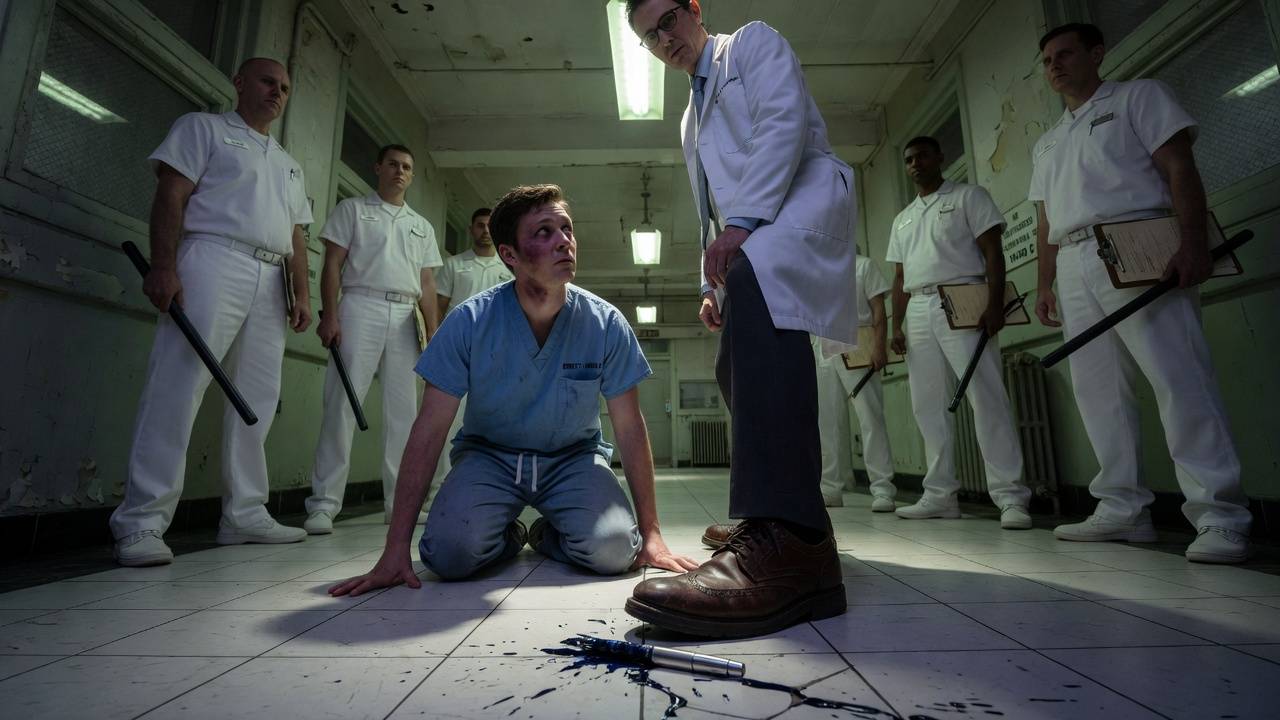
The echo of the strike was still ringing in the North Hallway long after the orderlies had swarmed Bennett. It wasn’t the usual chaotic struggle. It was a cold, efficient suppression. They didn’t hit him back—not in front of the other patients—but they pinned him with a practiced cruelty that made every joint in his body scream. Miller’s knee was buried in the small of Bennett’s back, pressing him into the cold tile right next to the silver shards of the pen.
Thorne was being helped up by two nurses. His face was a mask of pale fury, his breathing ragged and shallow. He clutched his chest where Bennett’s kick had landed, his expensive silk tie askew. For a moment, the Director of the Blackwood Institute looked like exactly what he was: a frightened man who had realized his wall of authority had a crack in it.
“Solitary,” Thorne wheezed, his voice thin and trembling. “Maximum restraint. And double the sedation. I want him under so deep he forgets his own name.”
They dragged Bennett away, his toes scraping the floor. He didn’t fight them. He didn’t have to. The fire he’d felt in the hallway hadn’t gone out; it had just settled into a low, steady coal in his gut. As they passed the communal area, he saw Calloway. The undercover agent didn’t move, didn’t even flinch, but his eyes were locked on Bennett’s, a silent acknowledgment that the clock was officially ticking.
The basement of Blackwood was a place where time died. They strapped Bennett into a weighted chair in a room that smelled of ozone and bleach. The restraints were thick leather, cinched so tight his hands began to tingle and go numb.
“You really messed up, hero,” Miller said, standing over him with a syringe. The orderly’s face was bruised where Bennett’s initial parry had clipped him. “The Doc is taking this personal. You aren’t just a patient anymore. You’re a problem that needs to be erased.”
Bennett looked at the needle. “He’s scared, Miller. You saw it. You felt it. The man who signs your checks is terrified of a prisoner in paper scrubs.”
Miller didn’t answer. He jammed the needle into Bennett’s shoulder and depressed the plunger.
The darkness didn’t come all at once. It was a slow, oily tide. Bennett fought it, reciting the code in his head. 17-44-92-01… The numbers were his anchor. He thought of Sarah. He thought of the way she used to bite her lip when she was concentrating on a crossword puzzle. He thought of the scent of the rain on the New England coast.
Hours passed. Or maybe days. The only thing that broke the haze was the occasional sound of heavy boots outside the door and the rhythmic thrumming of the industrial heaters. Bennett’s mind drifted, the drugs pulling at the edges of his memories. He saw the laboratory in Kandahar—the flickering blue lights, the rows of tanks, the soldiers who weren’t soldiers anymore. He saw Thorne standing over them, a clipboard in hand, discussing “neural plasticity” and “operational durability” as if he were talking about a fleet of trucks.
Suddenly, the heavy steel door groaned.
Bennett blinked, his vision swimming. A figure stood in the doorway, silhouetted by the harsh light of the corridor. It wasn’t Miller.
“He’s in a meeting with the Board of Governors,” a voice whispered. Calloway.
The agent moved quickly, his movements precise. He didn’t have a tray of food this time. He had a set of keys and a small electronic device.
“Thorne is trying to fast-track your ‘transfer’ to a permanent facility in the interior,” Calloway said, fumbling with the locks on the leather restraints. “They’re scared of the fallout from the hallway. Someone leaked a cell phone video of you putting him on his ass. It’s trending on the dark web. The oversight committee can’t ignore it now.”
Bennett felt the restraints slacken. His arms fell limply to his sides, the blood rushing back into his hands with a painful, stinging heat. “The code… I still have it, Calloway.”
“Good. Because the inspector isn’t coming in forty-eight hours. He’s landing on the helipad in twenty minutes. It’s a Senator named Vance. He was on the committee Sarah was reporting to before she died. He’s the only one left who isn’t on Thorne’s payroll.”
Calloway pulled Bennett out of the chair. Bennett’s legs felt like they were made of water. He leaned heavily on the agent, his breath coming in shallow hitches.
“We have to get you to the administrative wing,” Calloway said, checking the hallway. “If Thorne sees you before Vance arrives, he’ll claim you had a psychotic break and ‘neutralize’ the threat. We need you standing in that lobby when the Senator walks through the doors.”
They moved through the service tunnels, a labyrinth of rusted pipes and dripping condensation. Bennett’s head was spinning, the sedatives still fighting for control of his nervous system. Every shadow looked like an orderly; every hiss of steam sounded like Thorne’s voice.
“Why are you doing this?” Bennett asked, his voice a mere rasp. “Risking your career. Your life.”
Calloway stopped for a second, his hand on a heavy iron lever. He looked at Bennett, and for the first time, the professional mask slipped. There was a raw, jagged grief there. “I was the one who was supposed to be watching the house the night the SUV showed up. I was two blocks away getting coffee. I owe Sarah. And I owe you.”
He pulled the lever. The door opened into the back of the medical supply room, just off the main lobby. Through the glass window, Bennett could see the grand entrance of Blackwood—the marble floors, the sweeping staircase, and the tall, glass doors that looked out onto the gray, churning Atlantic.
And there, standing in the center of the lobby, was Dr. Aris Thorne. He was surrounded by his security team, his face set in a grim, determined line. He was checking his watch, his eyes darting to the glass doors every few seconds.
“He’s waiting for the Senator,” Calloway whispered. “He’s going to control the narrative. We have to interrupt him.”
Bennett looked down at his hands. They were shaking. He didn’t have his pen. He didn’t have his uniform. He was just a man in a thin blue scrub top, bruised and drugged. But he had the truth.
“Go,” Calloway said, giving him a firm nudge. “I’ll handle the security in the monitor room. You just make sure Vance hears the numbers.”
Bennett stepped out of the supply room. The transition from the dark, damp tunnels to the bright, sterile lobby was blinding. He felt like a ghost emerging into the world of the living.
Thorne turned. The moment their eyes met, the Director’s face went through a rapid-fire sequence of emotions: shock, disbelief, and finally, a cold, murderous resolve.
“Bennett,” Thorne said, his voice echoing in the vast space. “You really are a glutton for punishment.”
He signaled to Miller and Henderson, who were standing by the stairs. They began to move toward Bennett, their batons drawn.
“Stay back!” a voice boomed from the entrance.
The glass doors swung open. A tall man in a charcoal overcoat stepped in, followed by two men in dark suits with earpieces. Senator Vance. He looked older than in the photos Bennett had seen, his face lined with the weight of a decade of political warfare.
“Dr. Thorne,” the Senator said, his voice cutting through the tension. “I was told this facility was under a medical lockdown. Yet I see a patient being cornered by security in the lobby.”
Thorne smoothed his lab coat, his voice regaining its oily composure. “Senator. A misunderstanding. This patient is extremely volatile. He just escaped a high-security isolation ward. He’s a danger to himself and others.”
Vance looked at Bennett. He didn’t see a “broken variable.” He saw a man who looked exactly like the person Sarah had described in her frantic, final emails.
“Is that true, son?” Vance asked.
Bennett stood his ground, though his knees were knocking together. He looked Thorne in the eye.
“17-44-92-01,” Bennett said. His voice was quiet, but it carried in the silence of the lobby.
Thorne’s face drained of color.
“08-33-11-54,” Bennett continued, stepping toward the Senator. “That’s the encryption key for the Kandahar server, Senator. My wife died trying to get that to you. It contains the names of every soldier Thorne experimented on. It contains the financial records of the shell companies that funded this place.”
“He’s raving!” Thorne shouted, his voice cracking. “Miller, take him down! Now!”
Miller lunged, but he was stopped by the Senator’s security detail. One of the agents stepped between Miller and Bennett, his hand resting on his holstered sidearm.
“I think we’d like to hear the rest of the sequence,” Senator Vance said, pulling a small digital recorder from his pocket. “Go ahead, Bennett. The world is listening.”
Chapter 6
The transition from the lobby of Blackwood to a secure government facility in D.C. felt like waking up from a decade-long fever dream. For the first time in months, Bennett wasn’t being fed a chemical soup of inhibitors. His mind was coming back to him in sharp, painful bursts, like a limb that had fallen asleep and was now burning with the “pins and needles” of returning life.
He sat in a small, windowless room, but it wasn’t a cell. There was a carafe of water, a plate of actual food, and a stack of files. Senator Vance sat across from him, his overcoat gone, his shirtsleeves rolled up.
“The data is being decrypted as we speak,” Vance said. “The key you provided… it unlocked doors we didn’t even know existed. We found the Kandahar logs. We found the internal memos from Thorne to his backers. It’s bigger than we thought, Bennett. It wasn’t just a research project. It was a prototype for a new kind of military-industrial complex. One where the soldiers are literally property of the state.”
Bennett took a slow sip of water. His hands were still steadying, the tremors finally subsiding. “What about Thorne?”
Vance’s expression darkened. “He’s in custody. He tried to claim he was acting under orders from the Department of Defense, but the DOD is scrubbing him from their records so fast it’s making heads spin. He’s going to spend the rest of his life in a place much less comfortable than Blackwood. And the orderlies… Miller, Henderson… they’re all facing federal charges.”
Bennett closed his eyes. He thought of the hallway. He thought of the moment Thorne’s boot had crushed the pen. It felt like a lifetime ago. “And the men? The soldiers who were in those tanks?”
“We’re moving them to a specialized medical facility at Walter Reed,” Vance said. “It’s going to be a long road for them. Some might never come back. But at least now, we know what was done to them. We can try to fix it.”
Vance reached into his briefcase and pulled out a small, plastic bag. Inside were the shards of the silver fountain pen.
“My team found this in the North Hallway,” Vance said softly, sliding the bag across the table. “I know it’s not much, but I thought you’d want it.”
Bennett stared at the broken metal. The silver was scratched, the nib bent at a grotesque angle. It was a ruin. But as he looked at it, he realized he didn’t feel the same crushing weight of grief he’d felt in the asylum. The pen was broken, but the message it had protected had been delivered. Sarah hadn’t died for a secret. She had died for the truth.
“What happens to me now?” Bennett asked.
“You’re a free man, Bennett,” Vance said. “Technically, your military record has been restored. Your discharge has been changed to ‘Honorable.’ There will be a settlement, of course. For the ‘misdiagnosis.’ For the time stolen from you.”
Vance stood up and walked to the door. He paused, his hand on the handle. “There’s someone here who’s been waiting quite a while to see you.”
The door opened.
It wasn’t a soldier or a lawyer. It was a woman with kind eyes and a familiar, weary smile. It was the nurse from the ward, the one who had always tried to look away when Thorne was being cruel. She was holding a small, brown box.
“I took the liberty of packing up your things from the apartment,” she said, her voice shaking slightly. “The police had it cordoned off, but I… I have a cousin in the precinct.”
She set the box on the table. Inside were the remnants of Bennett’s old life. His watch. A few photos. A set of keys.
Bennett looked at the keys. They were simple, silver-colored, attached to a leather fob that said Home.
“Thank you,” he whispered.
The aftermath wasn’t a parade. It was a quiet series of meetings, a slow reintegration into a world that felt too loud and too fast. He spent a few weeks in a quiet clinic on the coast, watching the waves and letting the salt air wash the smell of Blackwood out of his skin.
One afternoon, a car pulled up to the clinic. Calloway got out. He looked different in civilian clothes—a simple flannel shirt and jeans. He looked like a man who had finally put down a heavy load.
“The case is closed,” Calloway said, joining Bennett on the porch. “Thorne’s backers are being subpoenaed. The whole house of cards is coming down.”
“And you?” Bennett asked.
Calloway shrugged. “I’m taking some time off. Maybe head down to Georgia. I hear the coffee is better there.” He looked out at the ocean. “I’m sorry it took so long, Bennett. I’m sorry we couldn’t get to her in time.”
Bennett looked at the silver shards of the pen, which he now carried in his pocket. “She knew the risks, Calloway. She did it because she believed someone had to. I just finished what she started.”
They sat in silence for a long time, the only sound the rhythmic crash of the Atlantic against the rocks. It wasn’t a perfect ending. There was still a hole in Bennett’s life that would never be filled. There were still nights when he woke up reaching for a pen that wasn’t there, his mind racing with a code he no longer needed to remember.
But as the sun began to set, casting a long, golden light over the water, Bennett felt a strange, quiet sense of peace. He wasn’t Patient 48 anymore. He wasn’t a ghost.
He stood up, his legs strong and steady. He pulled the leather key fob from his pocket and looked at the word Home.
He didn’t know what the future looked like. He didn’t know if he could ever truly leave the shadows of the ward behind. But as he walked toward the car, he realized that for the first time in a very long time, he was the one holding the clock.
And it was finally time to start living.