Chapter 5
The silence that followed the closing of the cabin door was heavier than the storm. Silas stood in the center of the small, dim room, his chest heaving, the silver dog tag clutched so tightly in his palm that the edges bit into his skin. Ghost sat by the door, ears pinned, his eyes tracking the red and blue light reflecting off the windowpane.
Outside, the roar of engines didn’t retreat. It stayed. It pulsed.
A heavy fist hammered on the door. “Silas! Open this door right now!” It was Sheriff Miller. His voice wasn’t the lazy drawl from the afternoon; it was shrill, vibrating with a cocktail of panic and authority.
Silas didn’t move. He looked at the Pelican case still sitting open on the bed. He looked at the shadows of his past—the files, the photos of Jax, the evidence of a life built on controlled violence. He had spent years trying to bury that man, and in ten seconds of mud and rage, he had invited him back into the house.
“Silas! I have men with rifles out here! Don’t make this a tactical situation!”
Silas took a deep breath, the cold air stinging his lungs. He walked to the door and cracked it. The rain was a curtain of grey. Beyond it, the yard was a chaotic stage. Two deputies had their sidearms drawn, though they looked more terrified than determined. Sterling Vance was being helped into the back of an Escalade, his face a mask of black mud and pure, unadulterated hatred. Miller stood on the porch, his hand hovering over his holster.
“Hand over the dog, Silas,” Miller said, his breath misting in the cold. “Now. You just assaulted a civilian. You’re going to the county lockup, and that animal is going to the shelter for a mandatory hold.”
“He didn’t touch him,” Silas said, his voice flat. “I did. The dog stayed.”
“Doesn’t matter. He’s a weapon. And you’re a menace,” Miller snapped. He signaled to the deputies. “Take him.”
As the deputies moved forward, the cabin door was pushed wider. Not by Silas, but by Sarah. She had been parked down the road, watching the trucks go up, and had arrived just as the violence ended. She stepped onto the porch, her phone held high.
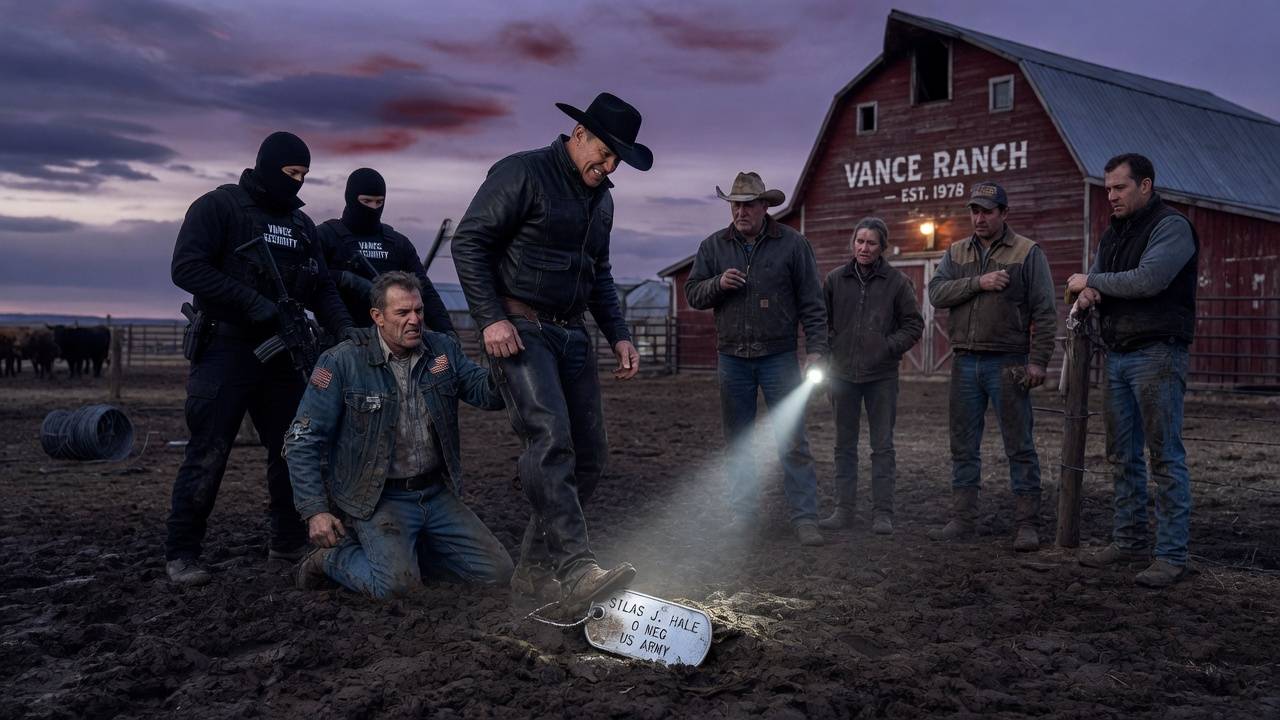
“I have the whole thing, Sheriff,” she said, her voice steady but her hands shaking. “I have the footage of Vance trespassing. I have the footage of him assaulting Silas first. I have the footage of him grinding a military service medal into the mud.”
Miller froze. He looked at the phone, then at the Escalade where Vance was watching from the darkened window.
“You think a video changes the law, Sarah?” Miller sneered.
“In this town? Maybe not,” she countered. “But I’ve already uploaded it to a private cloud. And I’m sending it to the state veteran’s affairs office and the local news in Billings. You want to explain to the governor why you’re arresting a Special Ops veteran for defending himself against a billionaire who was desecrating a war memorial?”
The standoff stretched. The rain drummed on the tin roof, the only sound in the yard. Silas looked at Sarah. She was risking everything—her clinic, her standing in the town—to stand in the mud with him.
“Get off the porch,” Miller finally hissed. He looked back at Silas. “This isn’t over. You think you won? You just started a war you can’t afford. Vance owns the banks. He owns the land records. You’ll be homeless by the end of the month.”
The trucks peeled away, tires throwing mud against the side of the cabin. When the yard was finally empty, Silas sank onto the porch steps. He felt the adrenaline receding, replaced by a crushing weight of exhaustion.
Sarah sat down next to him. She didn’t say anything at first. She just watched Ghost come out and lay his heavy head on Silas’s knee.
“He’s going to come back for the dog, isn’t he?” Silas asked.
“He doesn’t want the dog, Silas,” Sarah said quietly. “He wants to break you. The dog is just the easiest way to do it. He knows Ghost is the only thing keeping you whole.”
“I shouldn’t have hit him,” Silas whispered, looking at his bruised knuckles. “I spent three years being a ghost. I was almost there.”
“You were never a ghost, Silas,” Sarah said, reaching out and prying his fingers open to reveal the dog tag. “You were just a man holding his breath. It’s time to start breathing again.”
That night, the social pressure began to manifest. It wasn’t just Vance. The phone in the cabin rang incessantly until Silas unplugged it. On social media, the video Sarah had mentioned began to circulate, but so did a counter-narrative. Vance’s PR team was fast. They released a statement claiming Silas was a “highly trained, unstable individual with a history of violence” who had “viciously attacked a benefactor trying to settle a land dispute peacefully.”
By morning, the local grocery store had a sign in the window: NO TRESSPASSING BY UNSTABLE INDIVIDUALS. It was a direct hit at Silas. His neighbors, people he had helped during the winter thaw, turned their heads when he drove past.
The weight of the town’s collective judgment was a different kind of violence. It was a slow, suffocating exclusion. Silas sat in his kitchen, the floorboards creaking under Ghost’s weight, and realized that Vance didn’t need to win in court. He just needed to make the world too small for Silas to live in.
Chapter 6
The final move didn’t happen in the mud. It happened in the local VFW hall, a squat brick building that smelled of stale beer and old wood. Vance had called a “community meeting” to discuss the “safety risks” posed by Silas’s ranch. He had invited the press, the town council, and every rancher who owed the bank a favor.
Silas arrived late. He didn’t bring Ghost; he had left the dog with Sarah, locked in the clinic’s secure kennel. He walked into the hall wearing his best clean flannel and the dog tag tucked visibly over his shirt.
The room went silent. Vance stood on the small stage, a bandage across the bridge of his nose, looking every bit the victim.
“Mr. Sterling,” Silas said, his voice carrying to the back of the room. “You wanted to talk about safety?”
“I think the marks on my face speak for themselves, Silas,” Vance said, leaning into the microphone. “You’re a danger to this community. You’re a man who can’t distinguish between a battlefield and a neighbor’s yard.”
“You’re right about one thing,” Silas said, stepping into the center aisle. “I do have a hard time with the difference. Because on a battlefield, the enemy usually has the guts to show their face. They don’t hide behind lawyers and sheriff’s deputies to steal a man’s home.”
A murmur went through the crowd. Silas saw Miller standing by the door, looking uneasy.
“I didn’t come here to apologize for hitting you,” Silas continued. “I came here to show you what you’re actually trying to buy.”
Silas pulled a thick manila envelope from his jacket. He didn’t give it to Vance. He gave it to the oldest man in the front row, a veteran named Elias who had served in Korea and sat on the town council.
“Those are the service records for the dog you want to put down,” Silas said. “And those are the training logs for the ‘dangerous animal’ you claimed was a menace.”
Elias opened the file. He pulled out a commendation letter with a silver star embossed on the top. He read it in silence, his eyes widening. He passed it to the woman next to him.
“Ghost—his name was Jax II back then—didn’t just ‘work’ for the army,” Silas said to the room. “He saved a bus full of local contractors in the Helmand province. He found an IED that was meant for a convoy of nineteen-year-old kids from places just like Blackwood. He took a bullet in the shoulder and kept tracking until his handler was safe.”
Silas turned his gaze back to Vance. The billionaire was looking at the file as it moved through the crowd, his face pale.
“You called him a mongrel,” Silas said. “You called him a beast. But that dog has done more for this country than you’ve done with every dollar in your name. And you thought you could grind his legacy into the dirt because you wanted a mine?”
The shift in the room was palpable. It wasn’t just about Silas anymore. It was about the code of the West, the respect for service that ran deep in the mountain soil. One by one, the ranch hands who had stood in the yard and watched Silas be humiliated began to stand up. Not to support Vance, but to move away from him.
“Is this true, Sterling?” Elias asked, his voice gravelly and stern. “You tried to seize a service animal under false pretenses?”
“It’s a land dispute!” Vance shouted, his voice cracking. “The dog is a technicality! Silas is unstable—he attacked me!”
“He defended a hero’s name,” Elias said, standing up. He looked at Silas. “Son, I think we’ve heard enough.”
The meeting didn’t end with a gavel. It ended with the town walking out. Vance was left on the stage, his black leather jacket looking ridiculous in the fluorescent light, shouting into a microphone that no one was listening to.
Silas walked out into the cool evening air. Sarah was waiting by his truck, Ghost sitting in the back, his tail giving a single, heavy thud against the metal.
The aftermath wasn’t perfect. Vance’s lawyers would still tie Silas up in court for months. The mine might still happen on the adjacent land. The town wouldn’t suddenly become a paradise of understanding. Silas still had nightmares, and the mud on his boots would never quite wash off.
But as he drove back toward the mountains, the silver dog tag glinting in the dashboard lights, Silas felt a lightness he hadn’t known in years. He wasn’t hiding anymore. He wasn’t a ghost.
He arrived at the ranch and let Ghost out. The dog bolted into the tall grass, his silver fur disappearing into the dusk. Silas stood on the porch and looked up at the stars, the same stars he had watched from a foxhole ten thousand miles away.
He had lost a partner in the dirt, and he had almost lost himself in the silence. But tonight, the wind didn’t feel like it was hunting him. It just felt like the wind.
Silas reached down and patted the empty space beside him, then whistled. A moment later, Ghost emerged from the shadows, his breathing steady, his loyalty absolute.
“Come on, buddy,” Silas said, turning toward the cabin door. “Let’s go home.”
The door closed, and for the first time, the silence inside was peaceful.