Chapter 5: The Glass House
The dust from Vance’s convoy hadn’t even settled before the silence of the desert rushed back in, heavier than before. Silas stood at the edge of the rig’s perimeter, his chest heaving, his hand still white-knuckled around the dented canteen. The adrenaline was a receding tide, leaving behind a shore of jagged, broken glass. Every nerve in his body was screaming. The lack of medication was no longer a dull ache; it was a fire that threatened to consume what little composure he had left.
“Silas, sit down,” Elena said, her voice sharp with professional concern as she reached him. She grabbed his elbow, but he stiffened, pulling away.
“Not yet,” Silas rasped. He looked at the horizon, his eyes narrowed against the glare. “They aren’t gone. Vance doesn’t crawl away and hide. He regroups. He calls in favors.”
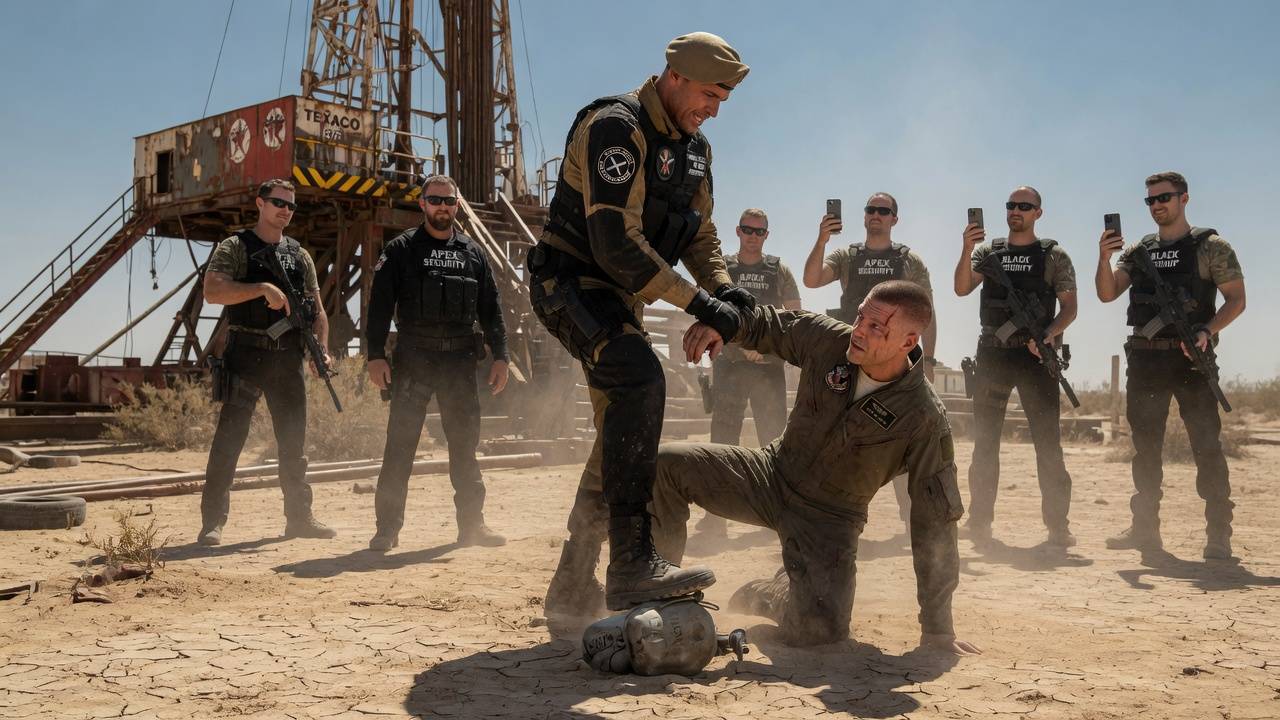
Miller stepped up beside him, his old rebar cane sinking into the sand. “He’s got the video, Silas. I saw them. At least three of those contractors had their phones out. They’re going to frame this as an unprovoked attack by a mentally unstable veteran.”
“Let them,” Silas said, though the weight of it was already settling on his shoulders. He looked back at the shack—the “glass house” that protected his brothers-in-arms. For months, they had lived in the shadows, ghosts hiding from a government that had declared them surplus. Now, the light was on. The world was watching.
The afternoon was spent in a feverish, silent preparation. They didn’t speak of the fight. They didn’t congratulate Silas on the knockdown. They knew the cost. Elena worked on Silas in the foreman’s shack, her hands steady as she prepped a fresh IV drip.
“You’ve ruptured something in your chest, Silas,” she said quietly, her eyes fixed on the clear tubing. “The force of that last kick… you don’t have the bone density for that anymore. You’re bleeding internally, and not just from the cancer.”
“Fix it enough so I can stand,” Silas replied. He was staring at the ceiling, at the water stains that looked like maps of countries he’d bled for. “If they come back tonight, I need to be at the gate.”
“If they come back tonight with a warrant and a SWAT team, Silas, there is no gate,” Elena countered. She leaned closer, her voice dropping to a whisper. “The video is already on the local news. They’re calling you the ‘Desert Madman.’ They’ve blurred Vance’s face, but yours is clear as day. They’re saying you’re armed and dangerous, holding hostages in an abandoned mine.”
Silas closed his eyes. The narrative was already written. It didn’t matter that Vance had poured his medicine into the dirt. It didn’t matter that Vance had threatened to burn the shack. In the eyes of the public, Silas was the aggressor. The hero-turned-villain was a story the media loved, and Vance knew how to feed the beast.
Outside, the sound of a radio crackled. It was Miller, keeping watch on the old military frequency they’d managed to patch into.
“Silas! We’ve got movement. Five miles out, headed north. It’s not the contractors. It’s County. Three cruisers and a transport.”
Silas sat up, the IV tugging at his skin. He ripped the tape off, ignoring Elena’s protest. He stood, his legs feeling like they belonged to someone else, and walked to the window.
The social pressure was a physical weight. Silas wasn’t just fighting Vance anymore; he was fighting the very system he had once sworn to protect. If he resisted the police, he proved Vance right. If he surrendered, his men—the refugees of a forgotten war—would be processed, identified, and disappeared into the federal system Vance controlled.
“We have to move the drive,” Silas said, turning to Miller. “If I go down, the drive has to be in someone else’s hands. Someone they won’t suspect.”
He looked at Elena. She froze, the syringe in her hand trembling slightly.
“No, Silas,” she said. “I’m a doctor. I’m here to treat you, not to carry a death warrant.”
“You’re the only one who can walk off this property without being shot on sight,” Silas said. He walked over to her, his voice low and urgent. “They think you’re a hostage. When the police get here, you tell them I let you go. You take the drive to the contact in San Antonio. You give them the names. You give them the proof.”
“And what happens to you?” she asked, her eyes filling with tears.
Silas looked out at the burning sun, the red dust, and the rusted steel. He thought of the valley, of the men he’d left behind, and the man he had become.
“I finish the watch,” he said.
The first siren wailed in the distance, a lonely, haunting sound that skipped across the flats. Silas walked out onto the porch. He didn’t pick up a rifle. He didn’t hide. He sat in his old chair, the dented canteen resting on his lap, and waited for the world to arrive at his door.
The backlash was coming. The video was the match, and the Texas desert was the tinder. As the red and blue lights crested the ridge, Silas felt a strange, cold peace. He had spent his life waiting for the end. Now, finally, the end had the decency to show up in person.
Chapter 6: The Ghost’s Last Stand
The standoff lasted six hours. The Texas sun dipped below the horizon, painting the desert in bruised purples and deep, blood-red oranges. The floodlights from the police perimeter cut through the gathering dark, turning the oil rig into a stage. Silas remained on the porch, a silhouette against the rusting machinery.
He had sent Elena out four hours ago. He’d watched her walk across the no-man’s-land, her hands raised, the drive hidden in the lining of her medical bag. He’d seen the police swarm her, seen them lead her away. She hadn’t looked back. That was good. Looking back made you a target.
“Silas! This is Sheriff Gentry!” a voice boomed over a megaphone. “We don’t want any more blood, son. You’re a decorated man. Let’s talk about how we bring this to a close.”
Silas didn’t answer. He knew Gentry. He knew the Sheriff was a good man being squeezed by a bad system. Behind Gentry’s cruisers sat two black Suburbans—Vance’s people. They weren’t there to negotiate. They were there to ensure the “Desert Madman” didn’t survive the night.
Inside the cellar, Miller and the others were quiet. They had their own escape route—an old drainage pipe that led a mile out to a dry creek bed. They’d argued about leaving Silas behind, but he’d made it an order. His final order.
“They need a distraction, Miller,” Silas had told him. “They need to think I’m the only one here. If you move while they’re focused on me, you’ve got a chance.”
Now, as the temperature dropped and the wind began to howl through the derrick, Silas felt the finality of it. The internal bleeding Elena had warned him about was making his head light. Every breath was a victory.
He saw movement in the perimeter. Not the police. The shadows were too coordinated, too low. Vance was sending in his cleaners under the cover of the police presence. They were going to end it before Gentry could talk him down.
Silas reached down and picked up a flare gun from the porch table. He didn’t have the strength for a fight, but he had enough for a signal.
“Vance!” Silas yelled, his voice surprisingly strong, carrying over the hum of the generators. “I know you’re out there! I know you can’t let me talk to a judge!”
The shadows paused.
“You want the drive?” Silas laughed, a wet, ragged sound. “It’s already gone! The doctor’s halfway to San Antonio. The world is going to see the valley, Vance! They’re going to see your face in the dirt!”
A single shot rang out. The bullet splintered the wood of the porch railing inches from Silas’s head.
“Cease fire!” Gentry’s voice screamed over the megaphone. “Nobody fires until I give the word!”
But the black shadows didn’t listen to Gentry. Three more shots followed, thudding into the foreman’s shack. Silas rolled off his chair, hitting the porch floor. The pain was an explosion in his side. He crawled toward the edge of the porch, his fingers digging into the weathered wood.
He looked toward the creek bed a mile away. A faint, green light flashed twice. Miller and the boys were clear. They were out. The ghosts had escaped the graveyard.
Silas leaned back against the shack, the dented canteen clutched to his chest. He felt cold, but the desert air was still warm. He watched as the shadows closed in, moving past the police lines. Gentry was shouting, trying to regain control, but the mercenaries were already on the stairs.
The door to the shack burst open. Vance stepped out, his face a mask of cold fury. He wasn’t wearing his beret now. He looked like a man who had lost everything and was determined to take his enemy with him.
“Where is it, Silas?” Vance hissed, standing over him. He kicked Silas in the ribs, but Silas barely felt it. The morphine Elena had left him was finally doing its job.
Silas looked up at him, a bloody smile on his face. “Gone, Vance. You’re a ghost now, too. You just don’t know it yet.”
Vance pulled his sidearm, the barrel cold against Silas’s forehead. “I’ll kill every one of them. I’ll hunt them down across the whole state.”
“You won’t have time,” Silas whispered.
From the distance, the sound of a heavy rotor blade began to throb against the sky. Not a police chopper. This was big. This was federal. Elena had made the call.
Vance froze, looking up at the sky as the searchlights of a Blackhawk began to sweep the rig. The police perimeter was falling apart as federal agents spilled out of vehicles, weapons drawn, pointing not at the shack, but at Vance’s mercenaries.
Vance looked back at Silas, his hand shaking. He had seconds left. He could pull the trigger, or he could try to run.
“The desert doesn’t forget,” Silas said, his voice fading to a whisper.
Vance looked at the dying man at his feet, then at the approaching storm of justice. He didn’t pull the trigger. He turned and ran into the dark, a man trying to outrun his own shadow.
Silas closed his eyes. The throb of the helicopter was like a heartbeat—the heartbeat of the men he’d saved. He felt the weight of the canteen, the dented, scarred piece of tin that had seen him through the worst of it.
He didn’t need the medicine anymore. He didn’t need the watch.
The wind picked up, swirling the red dust around the porch, covering the boards, the canteen, and the man who had stood his ground. Silas took one last breath of the dry Texas air, and for the first time in twenty years, it didn’t hurt.
The Sentinel was finished. The ghosts were free. And as the desert night swallowed the rig, the silence that followed was, for the first time, a peaceful one.