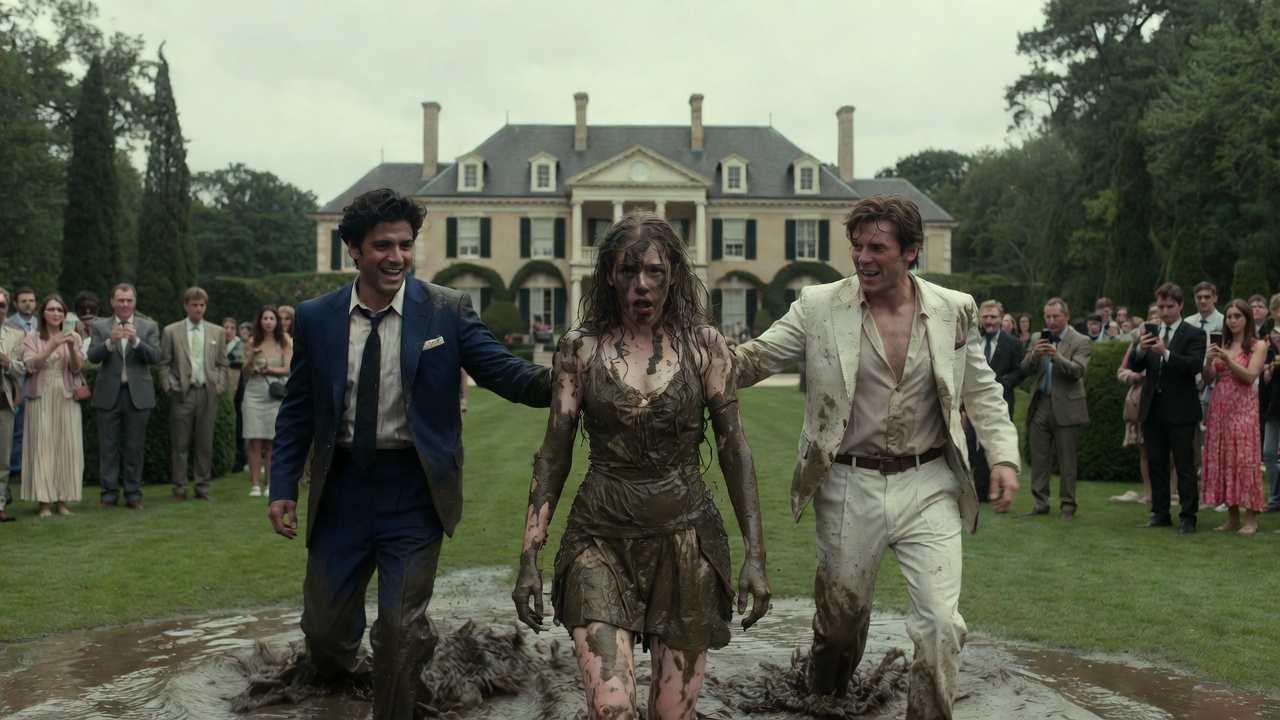
The cold, late-October rain was turning the manicured lawn of St. Jude’s Preparatory into a swamp, but the weather wasn’t nearly as cruel as the girl standing over me.
Her name was Cassandra Sterling. To the world, she was the “Suburban Princess,” the daughter of a venture capitalist who practically owned this zip code. To me, she was the person who had spent three years making sure I never forgot I was a scholarship kid from the trailer park.
“Look at you, Elena,” Cassandra laughed, her voice cutting through the sound of the rain. She gave me a sharp shove, and my boots lost their grip.
I went down hard. The mud was thick and freezing, soaking through my thrifted jeans and staining my favorite oversized sweater. The crowd of students—kids I’d sat next to in AP Bio for months—didn’t move to help. They just pulled out their iPhones.
“It suits you,” Cassandra sneered, tilting her head. “The mud. It’s where people like you belong. Why do you even try to breathe the same air as us? You’re a peasant, Elena. You’re a mistake that the admissions office forgot to fix.”
I looked up at her, my vision blurred by tears I refused to let fall. Next to her stood Leo, her brother. He was the only person who had ever been kind to me, but today, he just stared at his shoes, his varsity jacket glowing under the streetlights.
“Say something, Leo!” Cassandra prodded him, her eyes gleaming with malice. “Tell the peasant what happens to people who try to climb too high.”
Leo finally looked at me, and for a second, I saw a flash of pity. But then he looked at his sister, and the mask of the elite slid back into place. “You should probably just go home, Elena,” he said quietly. “You don’t fit in here. You never did.”
I wiped a streak of grime from my cheek, my heart hammering against my ribs. They thought they knew who I was. They thought my life began and ended with the grease-stained hands of my father, a mechanic who spent his nights coughing in a cold garage.
But they didn’t know about the letter hidden in my backpack. They didn’t know about the secret my father had kept for seventeen years—a secret involving a private jet crash, a missing infant, and the Thorne family crest.
As I sat there in the mud, the humiliation stinging worse than the cold, I realized something. This was the last time they would ever look down on me.
“You’re right, Cassandra,” I whispered, finally standing up, ignoring the mud dripping from my hair. “I don’t belong here.”
The crowd laughed, but the sound was cut short by the low, predatory hum of an engine. A black SUV—the kind that costs more than Cassandra’s house—was turning into the school driveway, cutting through the grass and heading straight for us.
Read the full story in the comments.
If you don’t see the new chapter, tap ‘All comments’.
FULL STORY
Chapter 2
The drive home felt like a descent into another world. The sleek, glass-and-steel architecture of the “Heights” gave way to the cracked asphalt and flickering streetlights of the Valley. I walked the last half-mile, the mud on my clothes having dried into a stiff, gray crust that scratched against my skin.
My house was a small, two-bedroom cottage that looked like it was being held together by hope and several coats of peeling white paint. In the driveway sat a rusted-out Ford F-150 and three other cars in various states of disassembly. This was the Vance residence. This was where “The Peasant” lived.
“Elena? That you, kiddo?”
My father’s voice came from under the chassis of a beat-up sedan in the garage. Arthur Vance rolled out on a creeper, his face smeared with oil, his gray hair wild and unkempt. When he saw me, his smile vanished. He stood up, wiping his hands on a rag that was more black than white.
“What happened?” he asked, his voice low and dangerous.
“Just some kids at school, Dad,” I said, trying to keep my voice steady. “The usual.”
“The usual don’t involve coming home covered in half the county’s topsoil,” he growled. He stepped closer, his eyes softening as he saw the bruise forming on my elbow. “It was that Sterling girl again, wasn’t it?”
I didn’t answer. I couldn’t. If I spoke, the dam would break, and I’d spent too many years being the “strong one” to fall apart now. Instead, I reached into my bag and pulled out the crumpled envelope I’d been carrying for a week.
“Dad,” I said, my voice trembling. “I found the box in the crawlspace. The one with the name ‘Thorne’ on it. And I saw the news report about the Thorne family anniversary—the one about the daughter they lost in the crash seventeen years ago. The one who would be my age today.”
Arthur went still. The air in the garage suddenly felt heavy, thick with the smell of gasoline and old secrets. He looked at the envelope, then at me, and I saw a lifetime of guilt flash across his face.
“I wasn’t trying to steal you, Elena,” he whispered, his voice cracking. “I was a first responder back then. A volunteer. The plane… it came down in the woods near the border. It was a mess. Fire everywhere. I found you in the brush, fifty yards from the wreckage. You weren’t even crying. You were just staring up at the stars.”
He sat down on a stack of tires, his shoulders sagging. “I waited for the authorities. But then I heard the radio chatter. They were saying everyone was dead. And I looked at you—this tiny, beautiful thing—and I knew if I handed you over to those lawyers and those cold, empty mansions, you’d just be a line in a ledger. I was selfish. I wanted a daughter. I wanted something good in my life.”
“You lied to me,” I said, the words feeling like lead in my mouth.
“I gave you a life where you were loved!” he shouted, then immediately slumped. “But I see now. Looking at you… covered in mud because those rich bastards think they’re better than you… I see that I kept you from your birthright. You aren’t a Vance, Elena. You’re a Thorne.”
He reached into his pocket and pulled out a small, tarnished silver locket. He handed it to me with shaking fingers. Inside was a tiny micro-chip and a photo of a woman with the same high cheekbones and stubborn chin I saw in the mirror every morning.
“That chip has the encrypted DNA records from the Thorne estate,” Arthur said. “I took it from the crash site. I figured if things ever got bad enough, it would be your way out.”
I stared at the locket. My “peasant” life was a lie. My “father” was a man who had committed a crime of love. And the people who had spent years making my life a living hell were about to find out that the girl they treated like dirt was actually the person who owned the ground they stood on.
“What do we do now?” I asked.
Arthur looked at me, a fierce, protective glint returning to his eyes. “We call Marcus Thorne’s office. And we tell them the ghost has come home.”
Chapter 3
The headquarters of Thorne International was a monolith of black glass that pierced the Philadelphia skyline like an obsidian needle. Walking into the lobby felt like entering a cathedral dedicated to the future. I was still wearing my school uniform—the one Cassandra had mocked for being a “knock-off”—but I had cleaned the mud off my shoes.
“I have an appointment with Mr. Thorne’s lead counsel, Marcus Thorne,” I told the receptionist.
She looked at me over the rim of her designer glasses, her expression shifting from professional boredom to subtle disdain. “And your name, dear?”
“Elena Vance. But tell him I’m calling about the ‘Starfall’ flight.”
The woman’s hand froze over her keyboard. Her eyes widened, and for the first time in my life, I saw someone in a position of power look at me with genuine fear. She didn’t say a word. She just picked up a phone and whispered into it.
Two minutes later, a man in a charcoal suit—the same man I would later see in the school parking lot—descended the stairs. He didn’t walk; he moved with the precision of a predator. This was Marcus Thorne, the man who had spent seventeen years managing the grief and the trillions of the Thorne family.
“In my office. Now,” he said.
We sat in a room that overlooked the entire city. Marcus didn’t offer me water. He didn’t offer me a seat. He simply held out his hand for the locket. I gave it to him.
He plugged the micro-chip into a device on his desk. A series of graphs and sequences began to scroll across a holographic display. As the data processed, Marcus’s face went from skeptical to pale. He looked at the screen, then at me, then back to the screen.
“The markers,” he breathed. “The mitochondrial sequence… it’s a 99.9% match. You… you’re Julian Thorne’s daughter. You’re the girl from the mountain.”
“I want to know who I am,” I said, my voice surprisingly firm. “But more than that, I want to know why the people in this city think they can treat anyone who isn’t ‘one of them’ like garbage.”
Marcus leaned back, his eyes narrowing. He was a man who lived for strategy. I could see the wheels turning in his head. “Your arrival is… complicated, Elena. Your father, Julian, passed away three years ago. The estate is currently being managed by a board of trustees. But according to his will, the moment a direct heir is verified, the board is dissolved, and the heir assumes full voting control of Thorne International.”
“Which includes their subsidiaries?” I asked.
“Every single one,” Marcus said. “From the tech firms in Silicon Valley to the real estate holdings right here in the Heights.”
“Does that include ‘Sterling Venture Capital’?”
Marcus smiled, and it was a cold, sharp thing. “The Sterlings? They are a minority partner. In fact, 60% of their operating capital comes directly from a Thorne-owned credit line. Why do you ask?”
I thought of Cassandra’s laugh. I thought of the mud. I thought of the way the school principal looked the other way whenever she bullied a scholarship kid.
“Because,” I said, “I think it’s time for a public announcement. The school is having their annual Founders’ Gala this Friday. It’s being televised locally for the charity auction. Cassandra Sterling is the host. I want you to be there, Marcus. With the official results.”
“You want a spectacle?” Marcus asked, raising an eyebrow.
“I want the truth,” I replied. “And I want it to be seen by everyone.”
Chapter 4
The week leading up to the Gala was a descent into a special kind of hell. Word had gotten out that I had “attacked” Cassandra at the fundraiser—a lie she had expertly crafted to cover for the fact that she’d pushed me.
The school’s administration, eager to stay on the Sterlings’ good side, had placed me on “disciplinary probation.” I was barred from the library, banned from the cafeteria, and forced to eat my lunch in the janitor’s closet.
On Wednesday, I found my locker spray-painted with the word “TRASH” in neon pink.
On Thursday, Cassandra cornered me in the gym. She was flanked by her “court”—three girls who mirrored her every move. Leo was nowhere to be seen.
“I heard a rumor, Elena,” Cassandra said, tossing her blonde hair. “I heard you were seen at the Thorne building. What were you doing? Looking for a job as a cleaning lady? Or did you think you could sue me for the mud incident?”
“I was just taking care of some family business, Cassandra,” I said, not looking up from my book.
“Family business?” She let out a peal of laughter that made my skin crawl. “Your ‘family business’ involves changing oil and living in a shack. My family business is running this town. And after tomorrow night’s Gala, I’m going to make sure your scholarship is revoked. My father already spoke to the board. You’re done, Elena. You’ll be back in the gutter where you started by Monday.”
I finally looked up at her. I didn’t feel the usual surge of fear. I felt a strange, detached kind of pity. She was so convinced of her own invincibility. She had no idea that the foundation of her entire life was about to be pulverized.
“You really think money makes you better, don’t you?” I asked.
“I don’t think it, I know it,” she snapped. “Money is the only thing that matters. It’s the difference between being a person and being… whatever you are.”
“Well,” I said, standing up. “I hope you remember that tomorrow night.”
Friday arrived with a heavy, oppressive heat. The Founders’ Gala was the event of the year for the Heights. The school gymnasium had been transformed into a ballroom, draped in white silk and lit by crystal chandeliers. Local news crews were there, filming the wealthy donors as they arrived in their gowns and tuxedos.
I arrived late. I wasn’t wearing a gown. I was wearing my school uniform, freshly pressed, and my father—Arthur—was with me. He looked uncomfortable in a suit that was twenty years out of style, but he held his head high.
“You ready for this, kid?” he whispered.
“I’ve been ready for seventeen years, Dad,” I said.
At the entrance, the security guard—a man who had seen me every day for three years—blocked our path. “Scholarship students aren’t allowed in the main hall tonight, Vance. You know the rules.”
“She’s not here as a student,” a voice boomed from behind us.
Marcus Thorne stepped forward, looking like the God of Law in his tailored suit. He flashed a black-and-gold card that made the guard’s eyes nearly pop out of his head. “She is my guest. And you will move out of her way before I have this entire security firm’s contract terminated.”
The guard stepped aside so fast he nearly tripped.
We walked into the ballroom, the music swelling, the scent of expensive perfume filling the air. At the far end of the room, on a raised stage, Cassandra was speaking into a microphone, her face projected onto two massive screens for the television audience.
“…and tonight, as we celebrate the foundation of St. Jude’s, we also celebrate the values that make us great,” Cassandra was saying, her voice honey-sweet. “Strength. Heritage. And the refusal to let anything—or anyone—diminish our standards.”
She caught my eye in the crowd. Her smile didn’t falter, but her eyes turned into chips of ice. She pointed a finger toward me.
“In fact,” she said, her voice amplified for everyone to hear, “we have a perfect example of someone who tried to diminish those standards here tonight. Elena Vance, could you please come to the stage? I think the community deserves to see the person who tried to sue their way into our school.”
The crowd turned. The cameras swung around. A thousand eyes landed on me—the “peasant” in the cheap uniform.
Chapter 5
The walk to the stage felt like it lasted a lifetime. Every step I took was a memory of a sneer, a shove, or a whispered insult. As I climbed the stairs, Cassandra leaned in close, her microphone still live.
“You’re making this so easy for me, you little rat,” she hissed. “I’m going to destroy you on live TV.”
She turned back to the audience, a mock-sorrowful expression on her face. “Elena here has been making some very… colorful claims lately. She’s been telling people she has a connection to one of our most prestigious families. It’s sad, really. A cry for attention from someone who has nothing.”
She looked at the camera. “But at St. Jude’s, we believe in the truth. So, we invited someone here to clear things up. Mr. Marcus Thorne, would you care to join us?”
The crowd cheered as Marcus walked onto the stage. Cassandra was beaming. She thought Marcus was there to debunk me, to put the “peasant” back in her place. Her father, Mr. Sterling, was in the front row, nodding approvingly.
Marcus took the microphone from Cassandra. He didn’t look at the crowd. He looked directly at the red light of the main news camera.
“Seventeen years ago,” Marcus began, his voice steady and resonant, “the Thorne family suffered an unspeakable tragedy. A plane crash took the life of Julian Thorne’s wife and, we believed, his infant daughter, Elena Thorne.”
A murmur ran through the room.
“For nearly two decades, we searched,” Marcus continued. “And tonight, I am here to present the final, verified DNA results, conducted by three independent labs and notarized by the state supreme court.”
He pulled a document from his jacket. He held it up so the camera could zoom in on the gold seal and the unmistakable Thorne family crest.
“The girl standing before you is not Elena Vance,” Marcus said, his voice rising. “She is Elena Thorne. The sole surviving heir to the Thorne estate, the majority shareholder of Thorne International, and—as of five minutes ago—the legal owner of the land this school sits on.”
The silence that followed was deafening. It was the sound of a thousand people holding their breath.
I looked at Cassandra. The “Suburban Princess” looked like she had been struck by lightning. Her face wasn’t just pale; it was a sickly, translucent gray. She looked at the screen, then at the document, then at me.
“No,” she whispered, the word caught by the microphone. “That’s… that’s impossible. She’s a peasant. She’s nobody.”
“On the contrary, Miss Sterling,” Marcus said, his voice turning cold. “She is your landlord. And considering your father’s recent ‘aggressive’ business tactics toward the Thorne subsidiaries, she is also the person who currently holds the power to call in the $200 million debt your family’s firm owes.”
I stepped forward, taking the microphone from Marcus. I looked out at the crowd—at the teachers who had ignored the bullying, at the students who had filmed my humiliation, and at Mr. Sterling, who was now clutching his chest as he stared at his phone, which was likely blowing up with news of his firm’s stock price collapsing.
“I spent three years in this school being told I didn’t belong,” I said, my voice echoing through the silent hall. “I was pushed into the mud because you thought my life had no value. You thought being ‘rich’ gave you the right to be cruel.”
I looked directly at Cassandra. She was trembling so hard her heels were clicking against the wooden stage.
“The mud is gone, Cassandra,” I said quietly. “But the stains on your soul are going to be a lot harder to wash out.”
I turned to Marcus. “End the broadcast. And tell the board of trustees I’ll be in the office at 8:00 AM on Monday. We have a lot of contracts to review. Starting with the Sterlings.”
Chapter 6
The aftermath was a whirlwind of legal filings and social earthquakes. By Saturday morning, “The Thorne Heiress” was the top trending story in the country. The video of Cassandra’s face turning gray on live TV had been viewed fifty million times.
The Sterling family didn’t survive the week. With their credit lines frozen and the public scandal driving away investors, their firm filed for bankruptcy. They had to sell their mansion in the Heights. I heard they moved into a two-bedroom apartment in the city—the kind of place Cassandra used to call a “dump.”
St. Jude’s Preparatory underwent a “restructuring.” The principal was fired, and a new scholarship program was established—one that was personally overseen by my father, Arthur Vance. I made sure he was taken care of. He didn’t have to fix cars anymore, but he still spent his weekends in the garage, teaching local kids how to build things with their hands. He was still my dad. Biology didn’t change that.
A month later, I was sitting in the back of a Thorne International sedan, heading to my first official board meeting. As we drove past the school, I saw a familiar figure standing by the gates.
It was Leo. He looked different without the varsity jacket—thinner, less confident. He saw the car and stopped. He didn’t wave. He just stood there, looking at the black glass.
I could have had the driver stop. I could have offered him a way out, or I could have rolled down the window and enjoyed the sight of his fall. But as I looked at him, I realized I didn’t feel anger anymore. I didn’t even feel triumph.
I felt free.
I realized that the “peasant” life I’d lived had given me something Cassandra and her friends would never have: the knowledge that I was worth more than my bank account. I knew how to survive. I knew how to love. And I knew that true power wasn’t about who you could push down, but who you chose to pull up.
I leaned back into the leather seat and looked at the silver locket in my hand. Inside, the photo of my mother seemed to be smiling.
The world was waiting for Elena Thorne. But in my heart, I would always be the girl who knew how to find beauty in the mud.
No matter how high you climb, never forget the feel of the earth beneath your feet, for that is where the truth truly lives.