Chapter 5
The silence that followed the departure of the guests was heavier than the storm itself. The rain had slowed to a rhythmic, mournful drip from the gutters of the Vanderbilt mansion, but the atmosphere in the garden remained charged with the ozone of a dying lightning strike. Eleanor had been moved inside by a frantic Henderson and a few remaining staff members, but the police—alerted by multiple frantic 911 calls from the fleeing socialites—arrived within twenty minutes.
Elias didn’t run. He sat on the low stone wall near the North hedge, his hands resting on his knees. His injured hand was a mess of dark blood and garden grit, but he felt a strange, cold clarity. He watched the blue and red lights sweep across the wet foliage, illuminating the “Blue Moon” roses in rhythmic flashes of emergency.
“Sergeant Miller?”
Elias looked up. It wasn’t the local patrol officers who had approached him first. It was Sam, the neighbor. He was standing just inside the Vanderbilt property line, holding a heavy yellow rain slicker. His face was unreadable, but his eyes were sharp.
“They’re going to want to talk to you, son,” Sam said quietly. “The woman in there is screaming about assault and theft. The guests… well, they’ve got video. I’ve seen it. It’s already hitting the local neighborhood watch groups. You hit her hard.”
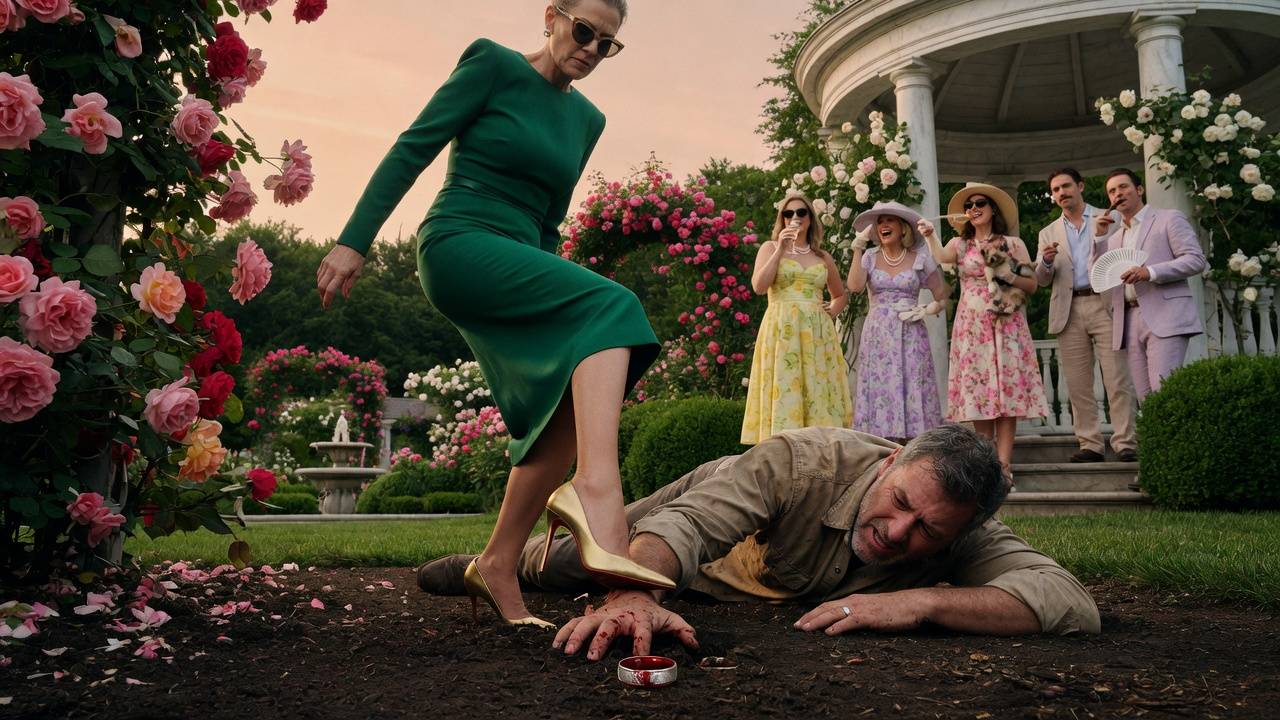
“She stepped on my hand, Sam,” Elias said, his voice sounding distant to his own ears. “She stepped on the truth.”
Sam nodded toward the house. “I called a friend. A detective I used to work with in the city who’s now a lieutenant in the Fairfield County barracks. I told him there’s a shallow grave under a purple rose bush that needs an immediate warrant. You stay calm. Don’t resist. If you’re who I think you are, your service record is going to be your shield, not your noose.”
The local police moved in then, four officers with their hands on their holsters. They didn’t treat him like a gardener; they treated him like a threat. They had seen the videos—the way he had systematically dismantled a woman of Eleanor’s status with the efficiency of a machine. They cuffed him roughly, the metal biting into his swollen wrists.
As they led him toward the patrol car, Henderson stood on the terrace, his face a mask of pale fury.
“You’re a dead man, Miller!” Henderson shouted, his voice cracking. “You’ll rot for what you did to her!”
Elias didn’t answer. He looked toward the English Oak. The police were already cordoning off the area with yellow tape. The ground he had tended for three years was finally being reclaimed by the law.
The next twelve hours were a blur of fluorescent lights and cold interrogation rooms. They didn’t charge him immediately. They held him on “suspicion of aggravated assault,” but the tone of the questioning shifted dramatically four hours in. A detective entered the room, dropping a heavy evidence bag onto the table. Inside was the silver ring Elias had found.
“We found the rest of him, Sergeant,” the detective said. His voice lacked the hostility of the earlier officers. “Arthur Vanderbilt. Or what’s left. He was wrapped in a tarp from the pool house. There’s a blunt force trauma to the back of the skull that doesn’t match a ‘fall’ in Europe.”
Elias leaned back, his eyes closing. “I told her the roses weren’t the only thing buried there.”
“The video of the incident in the garden is all over social media,” the detective continued, leaning against the wall. “It looks bad, Miller. You’re a trained soldier and she’s a socialite. But the witnesses… they’re starting to talk. Not about the fight, but about how she treated you. And about the ring. Seems she had a habit of ‘misplacing’ her husband’s things.”
The legal backlash was swift, but it wasn’t the one Elias had feared. The public outcry was divided. Half the internet saw a violent veteran attacking a woman; the other half saw a man pushed to a breaking point by a murderer who had used his past as a cage.
But the pressure was coming from elsewhere. By the second day, a representative from the JAG office arrived. The desert was finally calling its ghost home.
“Sergeant Miller,” the officer said, sitting across from him in the precinct. “We’ve been looking for you regarding the Kandahar incident. But we’ve also been looking at the statements from your unit. It seems the ‘unauthorized force’ you were accused of was actually an attempt to stop a private contractor from executing civilians. You didn’t desert because you were a criminal. You deserted because you couldn’t find anyone in the chain of command who would listen.”
Elias looked at the officer. For the first time in years, the weight in his chest shifted. “I just wanted to take care of my brother.”
“We know about Leo,” the officer said. “The Army has a way of fixing its mistakes when the PR gets this loud. We’re looking into a medical discharge with full benefits. But first, we need you to testify. Against the contractors. And against Eleanor Vanderbilt.”
Elias looked at his bandaged hand. The scars were still there, but the dirt was finally gone.
Chapter 6
Three months later, the Connecticut coast was shivering under the first true bite of winter. The Vanderbilt estate was a different world now. The roses were dormant, their thorny canes wrapped in burlap to protect them from the frost. The mansion was dark, tied up in a legal battle that would likely last a decade. Eleanor Vanderbilt was awaiting trial in a high-security facility, her emerald dresses replaced by a standard-issue orange jumpsuit.
Elias stood at the edge of the property, leaning against his old truck. He wasn’t wearing a tan work shirt anymore. He wore a clean wool coat and jeans that didn’t have mud embedded in the denim.
The passenger door opened, and Leo stepped out. He was pale, and he moved with the cautious pace of a man whose heart was still learning how to beat correctly again, but he was alive. The surgery had been a success, funded not by Eleanor’s hush money, but by the back pay and benefits the Army had finally released.
“You okay, Elias?” Leo asked, his breath misting in the cold air.
“Yeah,” Elias said, looking toward the English Oak. The yellow tape was gone, but the ground looked scarred where the investigators had been. “Just finishing a shift.”
“You don’t work here anymore, man. You don’t ever have to come back here.”
“I know,” Elias said. “But someone had to say goodbye to the old man.”
He looked toward the neighboring property. Sam was out there, clearing dead leaves from his own garden. He looked up and gave Elias a sharp, respectful nod—the kind of nod shared between men who have seen the worst of the world and decided to keep standing anyway.
The cô hầu gái trẻ—the maid who had been Eleanor’s psychological punching bag—had been the star witness in the murder trial. She had found the strength to speak once Elias had broken the spell of Eleanor’s invincibility. She was living in a halfway house now, finishing her GED, finally out from under the shadow of the emerald dress.
Elias climbed into the driver’s seat. He felt a strange, hollow peace. He wasn’t a hero. He was a man who had done what was necessary in a world that often demanded the impossible. He had protected his brother. He had given Arthur Vanderbilt his name back. And he had reminded himself that while roses might grow in the dark, they don’t belong to the people who plant them in blood.
“Where to?” Leo asked, clicking his seatbelt.
Elias started the engine. It rumbled with a healthy, steady vibration. “Away from the water, Leo. Somewhere with mountains. I think I’m done with gardens for a while.”
As they pulled away from the curb, Elias caught a glimpse of the Vanderbilt mansion in his rearview mirror. It looked smaller than he remembered. It looked like just another house, built on a foundation that couldn’t hold the weight of its own secrets.
He drove past the North hedge one last time. The snow was beginning to fall, a clean white sheet covering the thorns and the dirt, hiding the scars until the spring. But Elias didn’t need to see the ground to know what was underneath. He knew the truth was the only thing that ever truly stayed alive.
He turned the truck toward the highway, the lights of the city flickering in the distance like stars he could finally reach. He wasn’t a ghost anymore. He was just a man, driving his brother home.