“You really think the board is going to listen to a man who couldn’t even design a door that stayed shut?”
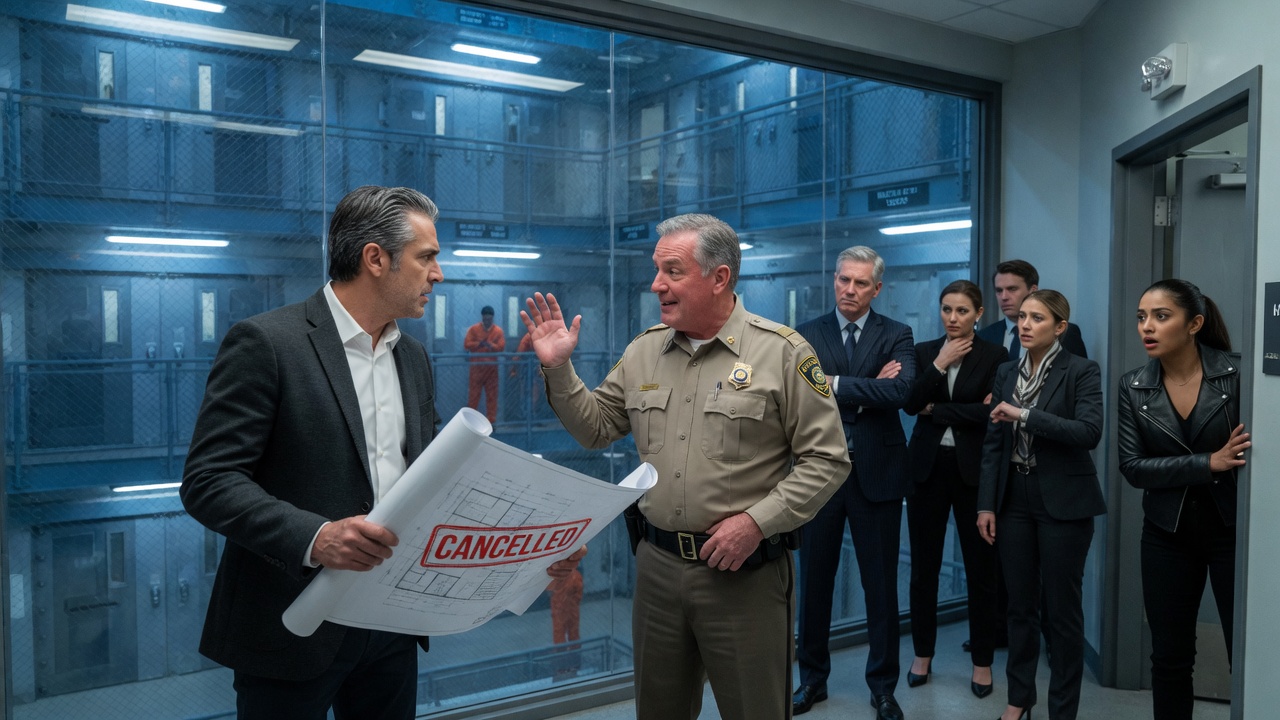
Warden Vance didn’t just say it—he spat it. He stood there in his tan tactical uniform, chest puffed out, while the wealthy investors I’d spent six months courting looked at their shoes. This was my prison. My design. The “Jewel of the State,” they called it. But I knew the truth.
I was holding the blueprint from four years ago. The one with the red ink. The one where Vance had personally signed off on “cost-savings” that removed the secondary emergency locks in Wing C. The same Wing C where my wife, Sarah, had been trapped during the riot. The same Wing C where she never made it out.
Vance stepped into my personal space, his breath smelling of stale coffee and unearned power. He grabbed my wrist, twisting it until the paper crinkled. “You’re a grieving widower, Julian. You’ve lost your edge. You’ve lost your mind. Maybe we should find a cell for you, too.”
I looked past him. My daughter, Maya, was standing in the doorway. She wasn’t supposed to be there. She was supposed to be at the hotel, safe from this place. But she saw it. She saw him break me. And she saw exactly what I was holding.
Vance thinks he’s the one holding the keys. He doesn’t realize I built a backdoor into this system he’ll never find.
Chapter 1: The Weight of Glass
The air in the offices of Blackwood & Associates was always exactly sixty-eight degrees, filtered through a three-stage purification system that made the oxygen feel expensive. Julian sat at his drafting table, a sprawling slab of matte-black steel, watching a dust mote dance in a shaft of morning sun. He didn’t look at the blueprints for the new state capitol project. He looked at the scars on his knuckles, white lines against tanned skin, earned from a life of touching things that were supposed to be indestructible.
“The cantilever on the north face is sagging in the rendering,” a voice said.
Julian didn’t turn. It was Sarah’s voice, or at least the version of it his brain kept in a velvet-lined box for emergencies. He blinked, and the voice vanished, replaced by the low hum of the high-end HVAC.
“Julian? You have a minute?”
This time it was real. Marcus, a twenty-six-year-old architect with a beard trimmed to the millimeter and a degree from a school Julian’s father couldn’t have afforded to walk past, stood in the doorway. Marcus was the “rising star,” the man the firm was grooming to take over the public works contracts that Julian had built from nothing.
“The north face,” Julian said, his voice gravelly from an hour of silence. “It’s fine, Marcus. It’s supposed to look like it’s floating.”
“The client thinks it looks… precarious,” Marcus said, stepping into the room. He didn’t wait for an invitation. He never did. He walked over to the table and tapped a manicured finger on the glass. “They’re worried about the optics. Given the history.”
Julian finally looked up. His eyes were the color of wet slate. “What history?”
Marcus hesitated, the first sign of human weakness he’d shown all week. “The… Blackwood Correctional facility. The riot report came out on the news again this morning. Some civil rights group is suing the state over the ‘lethal design flaws.’ They mentioned your name, Julian.”
The room suddenly felt much colder than sixty-eight degrees. Julian felt the familiar tightening in his chest, a sensation like a wire being wound around his ribs. He remembered the smell of the concrete at Blackwood. He remembered the way the light hit the reinforced glass—glass he had personally selected for its “optical clarity and superior tensile strength.” Glass that hadn’t been enough to save the person who mattered most.
“I’m an architect, Marcus,” Julian said, standing up. He was a head taller than the younger man, and he used every inch of it. “I design spaces. I don’t control the people who inhabit them.”
“Of course,” Marcus said, backing away slightly. “But the firm… the partners are concerned about the brand. They want you to take a few weeks. Go to the coast. Spend some time with Maya.”
Maya. The name was a physical blow. Julian’s daughter hadn’t spoken more than three consecutive sentences to him since the funeral. She lived in the same house, ate at the same table, and moved through the rooms like a ghost he was being haunted by for a crime he couldn’t stop committing.
“I’ll take the weeks,” Julian said, his voice flat. “But I’m not going to the coast.”
He shoved past Marcus, grabbing his blazer from the back of the chair. He didn’t take his laptop. He didn’t take the capitol blueprints. He walked out of the glass-and-steel cathedral of Blackwood & Associates and into the humid, gray reality of downtown.
The drive home took forty minutes. He lived in a house he had designed himself—a mid-century modern masterpiece tucked into the hills, all floor-to-ceiling windows and open floor plans. When he’d built it, Sarah had laughed and said it was like living in a lantern. Now, it felt like living in a display case.
He found Maya in the kitchen. She was twenty now, a junior at the university, majoring in social work—a choice that felt like a deliberate indictment of Julian’s career. She was leaning against the marble island, staring at her phone.
“I’m taking some time off,” Julian said, dropping his keys on the counter.
Maya didn’t look up. “Did they finally fire you, or did you just run out of things to build in the shape of a cage?”
The words were sharp, practiced. Julian didn’t flinch. He was used to the blood. “They want me to rest. I thought maybe we could go somewhere.”
Maya finally looked at him. Her eyes were Sarah’s eyes, but the warmth had been replaced by a cold, simmering resentment that Julian didn’t know how to quench. “I have a life, Dad. I have finals. And I have a meeting tonight with the survivors’ advocacy group.”
“Maya, don’t,” Julian said, his voice cracking. “That group… they don’t know what they’re talking about. They’re looking for someone to blame.”
“I’m not looking for someone to blame,” Maya said, her voice dropping to a whisper. “I found him. He’s standing in my kitchen.”
She grabbed her bag and walked out, the front door closing with a heavy, final thud that echoed through the empty house.
Julian stood in the silence, the lantern-house feeling darker than it ever had. He walked down to the basement, to the room he kept locked. Inside wasn’t a wine cellar or a gym. It was a workspace filled with every blueprint, every change order, and every architectural drawing from the Blackwood Correctional project.
He sat down at the small wooden desk and opened a heavy cardboard tube. Inside was the master layout of Wing C. He traced his finger along the line of the infirmary, where Sarah had been working that night. He knew every inch of this building. He knew the thickness of the walls, the gauge of the steel, the exact specs of the electronic locks.
And he knew something the investigators hadn’t found yet.
He had designed the prison with a fail-safe. A “backdoor” in the digital architecture of the security system. If the power failed, or if the main hub was compromised, a specific sequence of commands from a remote terminal could override the entire facility. He’d told the board it was for “unforeseen systemic failures.”
In reality, he’d built it because he didn’t trust the men who were paying him. Men like Warden Vance.
Vance had been the one to push for the “cost-savings.” He’d been the one to insist that the secondary hydraulic locks were “redundant and wasteful.” Julian had fought him, argued until he was red in the face, but the private prison corporation had the state legislature in their pocket. They’d threatened to pull the contract. They’d threatened to ruin Julian’s firm.
And Julian, the Great Architect, had blinked. He’d signed the change orders. He’d accepted the “compromise.”
He reached into the back of a drawer and pulled out a manila envelope. Inside was a single sheet of paper—a copy of a document that shouldn’t exist. It was a memo, signed by Vance, directing the installation crew to “ignore the architect’s specs on the Wing C lock-down sequence to meet the budget deadline.”
Vance had killed Sarah. He’d killed her for a budget surplus.
Julian stared at the paper until the words blurred. He didn’t want a vacation. He didn’t want to go to the coast. He wanted to walk back into that prison and see the look on Vance’s face when he realized that the man who built his cage still had the keys.
Chapter 2: The Ghost in the Machine
The diner was a relic of a different era, a place where the air smelled of burnt grease and desperation. It sat three miles from the perimeter of Blackwood Correctional, a lighthouse for the families who came to visit the men inside.
Julian sat in a corner booth, his charcoal blazer making him look like a predatory bird in a room full of pigeons. He was waiting for Leo.
Leo was a man who didn’t exist on paper. He was a tech expert who had worked for the state’s cybersecurity division until he’d been caught selling encryption keys to a gambling syndicate. Julian had kept him out of prison by hiring the best lawyers money could buy, not out of kindness, but because he knew he’d eventually need a ghost.
Leo slid into the booth, his eyes darting around the room. He was thin, pale, and looked like he hadn’t seen the sun in a decade. “You’re late, Julian. I don’t like being in this town. It feels like bad luck.”
“I have the terminal,” Julian said, ignoring the complaint. He slid a small, ruggedized laptop across the table under a napkin. “Is the bridge stable?”
Leo opened the lid an inch, his fingers dancing over the keys. “It’s as stable as a bridge made of toothpicks. The prison updated their firewall last month. They went to a closed-loop system for the main gates, but the internal door-controllers are still on the old infrastructure. Why did you design it like that, anyway?”
“I didn’t,” Julian said. “Vance did. He wanted to save forty thousand on the cabling.”
Leo whistled low. “Well, his cheapness is your lucky break. I can get you into the sub-routines, but you have to be physically within the Wi-Fi range of the administration wing to trigger the handshake. That means you have to go inside.”
“I’m going inside tomorrow,” Julian said. “Vance is hosting a tour for the new investors. He wants to show off the ‘renovations’ in the south wing.”
“You’re going to a tour? Julian, that’s suicide. If they catch you with this hardware—”
“They won’t catch me. I’m the architect of record. I’m there to answer technical questions for the board. Vance needs me there to make the investors feel safe.”
Leo closed the laptop and pushed it back. “Whatever you’re planning, make it fast. Once you trip the override, the system is going to log the anomaly. You’ll have maybe five minutes before the whole place goes into hard-manual lockdown.”
“Five minutes is plenty,” Julian said.
He left Leo in the diner and drove to a small house on the edge of the county. This was where Elias lived.
Elias was a former inmate, a man who had been a trustee in the infirmary the night of the riot. He was the last person to see Sarah alive. He was a man with a hollowed-out face and eyes that had seen too much concrete.
He was sitting on his porch when Julian pulled up. He didn’t look surprised to see him.
“You still looking for answers, Mr. Blackwood?” Elias asked, his voice a dry rasp.
“I’m looking for the truth, Elias. You told me the guards retreated before the fire reached the infirmary.”
Elias nodded slowly. “They had the keys. They could have opened the door from the control booth. But the signal didn’t go through. The system just… hung. Like it was waiting for something that wasn’t there.”
Julian felt a cold shiver. The secondary locks. Because they hadn’t been hydraulic, they’d required a manual bypass that Vance had never installed.
“Vance was in the booth that night, wasn’t he?” Julian asked.
Elias looked away. “He was on the radio. I heard him. He told them to seal the wing. Said the ‘asset loss’ was preferable to a total breach. He didn’t say her name, Mr. Blackwood. He just called her ‘personnel.'”
Julian stood there, the sound of the wind in the dry grass feeling like a chorus of accusations. Personnel. Sarah wasn’t a doctor, a wife, or a mother to the men who ran this place. She was a line item.
“I’m going back tomorrow,” Julian said.
Elias looked at him, a flicker of pity in his eyes. “Be careful. That place is a graveyard. And the dead don’t like to be disturbed.”
Julian drove back to his lantern-house in silence. He didn’t turn on the lights. He sat in the dark living room, watching the headlights of passing cars sweep across the walls.
Maya came home late. She saw him sitting there and paused, her hand on the banister.
“I’m going to the prison tomorrow, Maya,” he said.
She froze. “Why?”
“Vance invited me. There’s a tour.”
“You’re going to help him sell that place to more people?” she asked, her voice trembling with anger. “After everything?”
“It’s not what you think,” Julian said, standing up. “I’m going to make it right. I promise.”
“You can’t make it right!” Maya shouted, her voice echoing off the glass walls. “She’s gone! No blueprint is going to bring her back. You’re just obsessed with the one thing you can’t fix.”
“I can fix the lie, Maya,” Julian said, his voice quiet. “I can fix the lie that it was an accident.”
Maya stared at him for a long moment, the tears finally breaking. “I don’t care about the lie, Dad. I care that you’re still more interested in the building than you are in me.”
She ran upstairs, and Julian heard the lock on her bedroom door click into place. It was the same sound as a prison cell closing. He realized then that he hadn’t just built Blackwood Correctional. He had built a version of it around his own life, and he was the only one left with the power to tear it down.
Chapter 3: The Blueprint of Betrayal
The morning of the tour was gray and oppressive, the kind of day where the clouds seemed to sit right on top of the towers of Blackwood Correctional. Julian stood in front of his bathroom mirror, tying a silk tie with hands that felt like they belonged to someone else. He wore his most expensive suit—a charcoal gray armor designed to project competence and stability.
In his briefcase, tucked into a hidden compartment beneath the legit blueprints, was the laptop Leo had given him and the original signed memo from Vance.
When he arrived at the prison, the security was tighter than usual. Armed guards in tactical gear patrolled the perimeter, and the lobby was buzzing with men in suits worth more than a correctional officer’s annual salary.
Warden Vance was in the center of it all. He looked exactly the same as he had four years ago—thick-necked, arrogant, and wearing a tan uniform that seemed to strain against his ego. He saw Julian and a wide, fake smile spread across his face.
“Julian! The man of the hour,” Vance boomed, stepping forward and clapping a hand on Julian’s shoulder. The weight of it felt like a threat. “I wasn’t sure you’d make it. Given your… recent health leave.”
“I wouldn’t miss it, Vance,” Julian said, his voice perfectly controlled. “The board wanted the architect’s perspective on the new wing.”
Vance’s eyes narrowed for a fraction of a second. “Of course. Come, let me introduce you to the investors. This is the future of public safety, gentlemen. Efficiency, security, and profitability, all in one package.”
Julian followed the group through the series of heavy steel doors. The sound of the locks clicking behind them was a rhythmic reminder of the trap he was walking into. They moved through the administration wing, a space of beige carpets and fluorescent lights that looked like any other corporate office, if you ignored the bars on the windows.
Vance led the group into the main observation gallery. This was the nerve center of the prison, a glass-walled room that overlooked the central hub of Wing C. From here, you could see the tiers of cells, the cold blue light, and the inmates moving like ants in a glass farm.
“As you can see,” Vance said, gesturing toward the tiers. “Our new integrated security system allows for a thirty percent reduction in floor staff. Total control from a single terminal.”
One of the investors, a woman with sharp features and a notebook, looked at Julian. “Mr. Blackwood, there were reports of technical failures during the riot four years ago. How does the current design address those?”
Julian felt Vance’s eyes on him, a silent command to lie.
“The original design included a series of secondary hydraulic locks,” Julian said, his voice clear. “They were designed to function even if the digital hub failed. However, those were removed during the construction phase to… streamline the budget.”
The room went silent. The investors looked at each other. Vance’s face turned a deep, mottled red.
“What Julian means,” Vance said, his voice tight with suppressed rage, “is that we upgraded the system to a more modern, efficient digital bypass. The old hydraulics were prone to mechanical failure.”
“They weren’t,” Julian said.
Vance stepped toward him, his bulk blocking the view of the investors. He lowered his voice to a hiss. “Julian, shut your mouth. You’re here as a courtesy. Don’t ruin this.”
“I’m not ruining anything, Vance. I’m just being precise. An architect has to be precise.”
Vance grabbed Julian’s arm, his fingers digging into the expensive fabric of the blazer. “I think you’ve had enough of the tour, Julian. Why don’t you wait in my office? We’ll talk when I’m done.”
“I think I’ll stay,” Julian said. He reached into his briefcase and pulled out the rolled-up blueprint. “In fact, I have something I’d like the board to see. It’s a layout of the modifications made to the infirmary locks. The ones that didn’t open on the night of the fire.”
Vance froze. He looked at the blueprint, then at Julian’s face. The arrogance in his eyes was replaced by a cold, calculating fear. He realized then that Julian hadn’t come here to help him. He had come to bury him.
“Gentlemen, if you’ll excuse us,” Vance said to the investors, his voice straining to remain professional. “Mr. Blackwood is having a bit of an emotional moment. His wife was… well, you understand.”
The investors nodded sympathetically, looking at Julian with a mixture of pity and discomfort. They began to shuffle toward the exit of the gallery, led by a junior warden.
Vance waited until the door clicked shut. Then he turned on Julian, his face twisting into a mask of pure contempt.
“You pathetic, grieving little shit,” Vance spat. “You think that piece of paper means anything? I’ve got the state house in my pocket. I’ve got the board on payroll. You’re just a broken man looking for someone to blame for the fact that you weren’t man enough to protect your wife.”
Julian didn’t answer. He just held the blueprint, his knuckles white.
“She died because of you, Julian,” Vance said, stepping closer until their chests were almost touching. “She died because you were too busy building monuments to your own ego to notice that the world was moving on without you. Now, give me that paper.”
He reached out and grabbed Julian’s wrist, twisting it with brutal efficiency. The blueprint crinkled. Julian felt the pain shoot up his arm, but he didn’t let go.
In that moment, the door to the gallery opened again.
Maya stood there. She was pale, her dark ponytail messy, her black leather jacket looking out of place in the sterile room. She had followed him. She had used her student ID to talk her way past the front desk, claiming she was delivering forgotten documents.
She saw Vance twisting her father’s arm. She saw the look of pure, unadulterated cruelty on the Warden’s face.
“Dad?” she whispered.
Vance didn’t let go. He looked at Maya, then back at Julian, a slow, ugly smile spreading across his lips.
“Well, well,” Vance said. “The next generation of losers. Look at her, Julian. She looks just like her mother. I wonder if she’ll be just as easy to break.”
Chapter 4: The Pressure Point
The observation gallery felt like a pressurized chamber. Julian could hear the blood rushing in his ears, a rhythmic pounding that matched the blinking of the security lights on the console behind them.
“Let go of him,” Maya said, her voice stronger than Julian had ever heard it. She walked into the room, her eyes fixed on Vance’s hand.
Vance laughed, a short, dry sound. He released Julian’s wrist but didn’t back away. He smoothed his tan uniform, his fingers lingering on the gold bars on his shoulders. “I see the apple doesn’t fall far from the tree. Arrogant, entitled, and completely out of your depth.”
Julian rubbed his wrist, the skin already beginning to bruise. He looked at Maya, his heart sinking. He hadn’t wanted her here. Not for this. “Maya, go. Now.”
“I’m not going anywhere,” she said. She looked at the blueprint in Julian’s hand. “Is that it? The proof?”
“It’s a piece of trash,” Vance interrupted. “Your father is having a breakdown, girl. He’s been obsessed with this for years. He’s delusional.”
“I’m not delusional, Vance,” Julian said. He walked over to the reinforced glass, holding the blueprint up. He pointed to the red-stamped signature. “This is your handwriting. Your authorization to bypass the safety protocols. You knew the digital hub couldn’t handle the load if the secondary locks were gone. You knew it, and you did it anyway.”
Vance stepped toward the glass, his shadow falling over the tiers below. “It was a business decision. Every building has a margin of error, Julian. You know that better than anyone. You’ve built your whole career on it.”
“Not this margin,” Julian said. “Not Sarah.”
Vance leaned in, his voice dropping to a whisper that only Julian and Maya could hear. “She was a doctor in a prison, Julian. She knew the risks. If she’d stayed in that fancy office you built for her in the city, she’d still be alive. But she wanted to ‘make a difference.’ She was as stupid as you are.”
Julian’s hand flew out before he could think. It wasn’t a punch; it was a desperate, clawing grab for Vance’s throat. Vance was faster. He caught Julian’s hand and shoved him back against the glass. The heavy blueprint fell to the floor, unrolling across the sterile tile.
“Don’t touch me,” Vance growled. He looked at the door, where two guards were now standing, alerted by the sudden movement. “Mr. Blackwood is being escorted out. And his daughter with him.”
“Wait,” Julian said, his voice ragged. He looked at the console. He realized he didn’t need the paper. He had the laptop. He had the backdoor.
He reached into his briefcase, which was still sitting on the observation table. His fingers brushed the cold metal of the ruggedized laptop.
“Vance,” Julian said, his voice suddenly calm. “Do you know what the most important part of an architectural design is? It’s not the foundation. It’s the exits.”
Vance frowned. “What are you talking about?”
Julian flipped the laptop open. The screen glowed, a map of the prison’s internal network pulsing in blue lines.
“The investors are still in the building,” Julian said. “They’re in the south wing, right? The ‘jewel’ of your new empire.”
Vance’s face went white. “Julian, what did you do?”
“I built this place, Vance. I know the code. I know how the servers talk to the locks. And I know that you never bothered to update the firmware on the emergency fire doors.”
Julian’s fingers flew across the keys. He wasn’t a hacker, but he had spent the last three years memorizing the sequence Leo had taught him.
Command: Override. Security Level: Architect. Password: SARAH0412.
The sound that followed was unmistakable. It was the heavy, metallic thunk of every magnetic lock in the south wing engaging at once.
Vance lunged for the laptop, but Maya stepped in his way, her black leather jacket a blur as she shoved him back. She was smaller, but she had the momentum of four years of suppressed rage.
“Don’t you touch him!” she screamed.
Vance recovered, his face twisted in a snarl. He grabbed Maya by the shoulders and threw her aside. She hit the wall with a sickening thud and slumped to the floor.
“Maya!” Julian yelled.
He looked at the screen. The command was sent. The south wing was sealed. The investors, the board members, and the senior staff were trapped in the one area of the prison where the manual overrides had been removed to “prevent inmate tampering.”
The alarms began to wail—a high-pitched, piercing sound that cut through the silence of the gallery. On the monitors, Julian could see the panic starting. The men in suits were banging on the reinforced glass of the south wing doors.
Vance looked at the monitors, then back at Julian. He looked like a man who had just watched his house burn down.
“You’re insane,” Vance whispered. “You’ve just kidnapped half the state board.”
“I haven’t kidnapped anyone,” Julian said, standing up and walking toward Maya. He helped her to her feet, his hands shaking. “I’ve just put them in the same situation Sarah was in. They’re in a room with no exit, Vance. And the only person who can open the door is me.”
The guards at the door moved forward, their batons drawn.
“Stop!” Vance yelled at them. He looked at Julian, his eyes darting toward the laptop. “Julian… let’s be reasonable. Think about Maya. You want her to spend her life in a courtroom?”
“I want her to see the truth,” Julian said. He looked at the Warden, his voice as cold as the concrete tiers below. “Tell the guards to stay back. Or I’ll trigger the fire suppression system in the south wing. It’s a chemical halon system, Vance. You insisted on it because it doesn’t damage the equipment. But it’s not great for people.”
Vance froze. He knew the specs. He knew Julian wasn’t bluffing.
“Get back,” Vance barked at the guards. “Outside. Lock the gallery doors from the outside. Nobody comes in or out until I say so.”
The guards hesitated, then retreated, the heavy steel door of the gallery slamming shut.
Julian, Maya, and Vance were now alone in the glass box overlooking the heart of the prison. The alarms continued to scream, and below them, the inmates had begun to notice the chaos. They were shouting, banging on their cell doors, their voices a rising tide of sound that vibrated through the floor.
“Now,” Julian said, his voice steady. “We’re going to talk about that memo, Vance. And we’re going to do it while the investors are watching on the internal feed.”
He turned the laptop toward the observation cameras, his finger hovering over the ‘Execute’ key for the video broadcast.
Maya looked at her father, her face a mask of shock and a sudden, terrifying respect. She realized then that Julian hadn’t just been obsessed with the building. He had been preparing for a war.
And the first shot had just been fired.
Chapter 5: The Architecture of Truth
The alarm was a physical weight, a jagged, rhythmic pulsing that seemed to vibrate the very marrow of Julian’s bones. In the observation gallery, the air felt thick, charged with the ozone of overworked servers and the primal, electric scent of panic. Julian stood over the ruggedized laptop, his silhouette sharp against the glowing screens. Behind him, the glass-walled box hung over the central hub of Wing C like a spectator’s booth at a Roman coliseum. Below, the prison was a boiling pot of steel and shadow.
Warden Vance was backed against the reinforced observation glass, his heavy chest heaving under the tan tactical fabric of his uniform. The gold bars on his shoulders caught the red strobe of the emergency lights, flickering like dying stars. He looked at the monitors, where the investors—men and women who, an hour ago, were discussing profit margins and recidivism rates over expensive coffee—were now clawing at the seamless steel doors of the south wing.
“Julian, look at them,” Vance said, his voice straining to be heard over the klaxon. He tried to reclaim his authoritative baritone, but it came out thin, frayed at the edges. “Those are civilians. Prominent people. You’re committing a dozen felonies every second this lock stays engaged. Open the damn doors.”
Julian didn’t look up from the screen. His fingers were steady, moving with a deliberate, haunting precision. “I’m not the one who removed the manual overrides, Vance. I didn’t sign the change order that turned that wing into a vacuum seal. You did. I just turned the key you gave me.”
Maya stood five feet away, her back against the door the guards had locked from the outside. She was pale, her breath coming in short, shallow hitches. She looked at her father—really looked at him—and for the first time, she didn’t see the man who forgot to buy milk or the man who spent too many hours staring at CAD drawings. She saw the man who had designed a cage for the world and then decided to step inside it with the monsters.
“Dad,” she whispered, the sound cutting through the noise like a blade. “The investors… they’re starting to pass out. The ventilation is cycling down.”
“It’s the standard protocol for a Grade-A breach,” Julian said, his voice eerily calm. He finally looked at Vance. “The system thinks there’s a fire. It’s cutting the oxygen to starve the flames. Except there are no flames, are there, Warden? Just a lot of very important people realizing that your ‘cost-savings’ have a body count.”
Vance lunged forward, his face a mask of desperate aggression. He reached for the laptop, but Julian didn’t flinch. He just tapped a single key. A new window popped up on the gallery’s main projection screen. It was a live feed of the south wing’s internal cameras, but the audio was patched through the gallery speakers.
The screams were muffled, distant, like sound traveling through water.
“You want to be a hero, Vance?” Julian asked. “Tell them. Tell them why the doors won’t open. Tell them why the secondary locks aren’t engaging. There’s a microphone on the console. I’ve patched it into the south wing’s PA system. They can hear you. The whole prison can hear you.”
Vance stared at the microphone. His eyes darted to the guards outside the glass, who were frantically trying to bypass the gallery’s electronic lock. They were using a heavy ram, the thud-thud-thud echoing the heartbeat of the building.
“I won’t do it,” Vance hissed. “You’re a dead man anyway, Blackwood. Once they get through that door, there won’t be enough of you left to bury.”
“Then they die,” Julian said, his voice flat. “In three minutes, the halon gas will deploy. It’s designed to protect the server racks in the south wing. It displaces oxygen entirely. You told the board it was ‘the gold standard’ for high-value asset protection. You didn’t mention that it turns a human lung into a useless bag of skin in sixty seconds.”
“You wouldn’t,” Vance said, but his voice lacked conviction. He saw the timer on the screen. 02:45. 02:44.
Julian reached into his blazer pocket and pulled out a small, worn photograph. It was Sarah, taken a week before the riot. She was sitting on their back porch, a glass of wine in her hand, the sun catching the gold of her wedding band. She looked happy. She looked like she belonged to a world that didn’t include concrete and steel.
“I’ve spent four years in a room without oxygen, Vance,” Julian said, his eyes never leaving the photo. “Every morning I wake up and I can’t breathe. Every night I close my eyes and I hear her banging on the infirmary door. Do you know what she said to me on the phone? The last thing she ever said?”
Vance stayed silent, his sweat dripping onto the floor.
“She didn’t say goodbye,” Julian continued, his voice dropping to a jagged whisper. “She said, ‘Julian, the door won’t open. The code isn’t working. Why won’t the door open?’ She thought it was a glitch. She thought her husband, the Great Architect, had made a mistake. She died thinking I had failed her.”
He looked up at Vance, and the raw, howling grief in his eyes made the Warden flinch.
“But I didn’t fail her, did I? My code worked perfectly. My locks were solid. You just never installed them.”
“It was the Governor’s office!” Vance suddenly screamed, the dam finally breaking. He stepped toward the console, his hands trembling. “They wanted the project under budget by twenty percent! They told me to find the fat and cut it! I told them the secondary locks were the safety net, and they told me the net was too expensive! What was I supposed to do? Lose my job? Lose my pension?”
“So you killed her for a pension,” Maya said. She walked toward the console, her eyes burning with a cold, clear light. “You watched the feed from this gallery. You watched her bang on that glass, and you did nothing because you didn’t want to explain why the budget was over.”
“I tried to open it!” Vance cried, turning toward Maya. “I tried the digital override, but the riot had knocked out the substation! Without the manual hydraulics, there was nothing… there was nothing I could do.”
“You could have told the truth,” Julian said. “Four years ago. You could have stood at that funeral and told the truth. But you stood there and gave me a folded flag and told me she was a hero of the state.”
01:12.
The guards outside were making progress. A crack had appeared in the reinforced frame of the gallery door. In the south wing, one of the investors had collapsed. The others were huddled together, covering their mouths with their silk ties.
“Open the doors, Julian,” Vance pleaded. He was on his knees now, the transition from bully to coward complete. “I’ll sign whatever you want. I’ll testify. Just don’t let them die. Don’t be the monster you think I am.”
Julian looked at the ‘Deploy Halon’ button. His finger was less than an inch away. The power he felt wasn’t the power of an architect or a creator. It was the power of a demolitionist. He could level the lie. He could level the man. He could level the whole system that had treated his wife like a rounding error.
He felt a hand on his arm. It was Maya.
Her grip was firm, but not aggressive. She wasn’t pulling him away. She was just there, anchoring him to the ground.
“Dad,” she said. “If you do this, you’re just finishing his work. You’re just another part of the building.”
Julian looked at her. He saw the fear in her eyes, but he also saw the love—the bruised, battered love that had survived four years of his silence and his ghosts. He realized that if he pushed that button, he wouldn’t just be killing Vance’s reputation. He would be killing the last part of Sarah that still lived—the part of her that existed in Maya’s conscience.
“I’m an architect, Maya,” Julian whispered. “I’m supposed to make things that last.”
“Then make this last,” she said.
Julian turned back to the laptop. He didn’t hit the halon button. Instead, he opened a global command window. He typed in a sequence that had been buried in the firmware since the day the first stone was laid—a “God Mode” override he had built into the architecture as a final, desperate insurance policy.
Command: Total Breach Protocol. Authorization: Omega.
Across the entire Blackwood Correctional facility, every single electronic lock, every gate, every door, and every portcullis hummed with power for a split second. Then, with a sound like a single, massive intake of breath, they all opened at once.
The south wing doors slid back. The investors tumbled out into the hallway, gasping for air. But below them, in the tiers, the cells were open too.
The inmates stepped out into the galleries, stunned into a brief, flickering silence by the sudden gift of freedom.
Vance scrambled to his feet, his face pale with a new kind of terror. “What have you done? You’ve let them all out! You’ve started a massacre!”
“No,” Julian said, closing the laptop and tucking it under his arm. “I’ve just made the walls match the truth. This place was never secure, Vance. It was just a lie made of glass.”
The gallery door finally gave way. The guards burst in, their weapons raised, but they froze at the sight of the monitors. The prison was wide open. The inmates weren’t rushing for the gates—they were standing in the common areas, looking at the guards, looking at the open sky through the high windows, waiting for the next move in a game that had suddenly lost all its rules.
Julian took Maya’s hand. He didn’t look at the guards. He didn’t look at Vance, who was already screaming into his radio, trying to command a kingdom that no longer existed.
He walked toward the exit, his head held high, the blueprint of his life finally, irrevocably changed.
Chapter 6: The Residue of Steel
The trial took six months, but the fallout lasted much longer.
Julian sat in a small, windowless room in the county courthouse, the fluorescent lights humming with a low, irritating buzz that reminded him of the prison. He wasn’t wearing a charcoal blazer anymore. He was wearing an orange jumpsuit, the fabric stiff and smelling of industrial detergent.
Across from him sat Leo, his lawyer, and a man from the Attorney General’s office who looked like he hadn’t slept since the night of the “Total Breach.”
“The state is willing to drop the kidnapping charges,” the official said, sliding a thick folder across the table. “In exchange for a full confession regarding the ‘Omega’ override. They want to know exactly how you did it, Julian. They want to make sure no one else can ever do it again.”
Julian looked at the folder but didn’t open it. “I’ve already told you. The backdoor is gone. I deleted the source code from the primary server before I left the gallery. The only way to find it now is to tear the building down and read the silicon in the door-controllers. And we both know the state can’t afford to rebuild Blackwood.”
The official sighed, rubbing his temples. “Vance is going away for a long time, Julian. The memo you found, the testimony from the investors… it was enough. He’s being charged with racketeering, gross negligence, and four counts of involuntary manslaughter. You got what you wanted.”
“I didn’t want Vance in prison,” Julian said, his voice quiet. “I wanted the truth to be the only thing left standing.”
“Well, the truth has a high price tag,” Leo interjected. “You’re still looking at five to ten for the system override and the endangerment of the board members. Even with the public on your side, the law doesn’t like it when people start playing God with state infrastructure.”
“I can live with five to ten,” Julian said.
The room was cleared, leaving Julian alone with his thoughts. He thought about the lantern-house. He’d sold it three months ago to pay for the legal fees and to set up a trust for Maya. He hoped the new owners liked the light. He hoped they didn’t see the ghosts in the glass.
The door opened, and a guard nodded to him. “You have a visitor. Ten minutes.”
Julian was led to the glass partition of the visiting area. He sat down and picked up the phone. On the other side was Maya.
She looked different. The anger that had defined her for years had softened into something more complex—a kind of watchful, weary maturity. She was wearing a professional-looking blouse, and she held a notebook in her lap.
“How are you, Dad?” she asked.
“I’m fine, Maya. I’m an architect. I’m just studying the ventilation in here. It’s better than my design, actually. Don’t tell Blackwood.”
She smiled, a small, genuine thing that reached her eyes. “I finished my finals. I’m starting an internship next month. With the Public Defender’s office.”
“That’s good. They need people who aren’t afraid of the walls.”
They sat in silence for a moment, the hum of the other conversations in the room forming a dull background noise. Julian looked at his hands, the scars on his knuckles still visible. He realized he was no longer holding a blueprint. He wasn’t holding anything at all.
“Vance was sentenced this morning,” Maya said. “Fifteen years. He tried to make a speech about ‘order and discipline,’ but the judge cut him off. He looked… small.”
“He was always small,” Julian said. “He just had a big building to hide in.”
Maya leaned forward, her palm against the glass. “I went back to the house yesterday. The new people were moving in. I found something in the garden. One of Mom’s old trowels. The one with the blue handle she was always losing.”
Julian felt the familiar tightening in his throat, but this time, he could breathe through it. “She loved that trowel. She said it was the only tool that felt like it belonged in her hand.”
“I kept it,” Maya said. “I’m going to start a garden at my apartment. Nothing big. Just some herbs. Maybe some tomatoes.”
“That’s good, Maya. Growing things is harder than building them. But it’s worth more.”
The guard tapped on the glass. “Time’s up.”
Julian stood up, the phone cord stretching between them like a fragile, umbilical link. He looked at his daughter, the person Sarah had left behind to keep him human.
“I’m proud of you, Maya,” he said.
“I’m proud of you too, Dad,” she replied. “For opening the doors. Not for the reason you think, but because you let yourself out, too.”
She hung up the phone and walked away, her silhouette disappearing into the bright, unfiltered light of the lobby.
Julian was led back to his cell. He walked through the steel doors, through the reinforced hallways, through the layers of security he had once perfected. But as the door to his cell clicked shut, he didn’t feel trapped.
He lay down on the narrow cot and closed his eyes. He didn’t see blueprints. He didn’t see the fire in Wing C. He saw Sarah on the porch, the sun hitting the wine glass, the gold of her ring shining like a promise.
He thought about the “Total Breach.” He thought about the moment the locks turned and the inmates stepped out into the air. He realized that an architect’s job wasn’t just to build walls. Sometimes, the most important thing an architect could do was find the one flaw in the design that allowed the truth to escape.
The prison was quiet. The air was exactly sixty-eight degrees. And for the first time in four years, Julian slept without dreaming of cages.
The “Jewel of the State” still stood on the hill, a monument of glass and concrete. But the people inside knew the secret now. They knew that no matter how thick the walls or how complex the code, a building was only as strong as the integrity of the men who stood within it.
And Julian, the man who had built it, was finally home.