Chapter 5
The silence that followed the revelation of the encrypted map was not the silence of a gallery; it was the heavy, suffocating stillness of a tomb. The high-society guests, who moments ago were filming a security guard being bullied for sport, now stood frozen, their smartphones still raised, but their faces drained of color. On the massive security monitor, the infrared sweep continued to scroll through the data points of the northern border—coordinates, supply routes, and tactical landing zones that had been hidden under eight million dollars’ worth of oil and ego.
Elias didn’t look at the screen. He kept his eyes on Julian Thorne, who was still on the floor, his expensive charcoal tuxedo damp with spilled wine and his own sweat. Julian’s hand was still raised in that pathetic, defensive gesture, but the dominance he had worn like a second skin was gone. He looked small. He looked like a man who had finally realized that the shadow he’d been kicking wasn’t a shadow at all.
“The police are on their way, Mr. Thorne,” a voice said from the back of the wing. It was Sarah. She was standing by the restoration lab entrance, her tablet in hand. “I’ve already transmitted the raw infrared data to the Department of Defense. They’ve confirmed the encryption signature. It matches the intelligence breach from five years ago.”
Marcus, the head of security, was the first to break. He looked at the screen, then at the cowering Julian, and then at his own team of high-end guards. He didn’t reach for his gun. He did something much smarter. He took two steps back and held his hands away from his belt.
“I didn’t know about this,” Marcus said, his voice a low, hurried rasp. “I was hired to protect the assets. I didn’t know the assets were treason.”
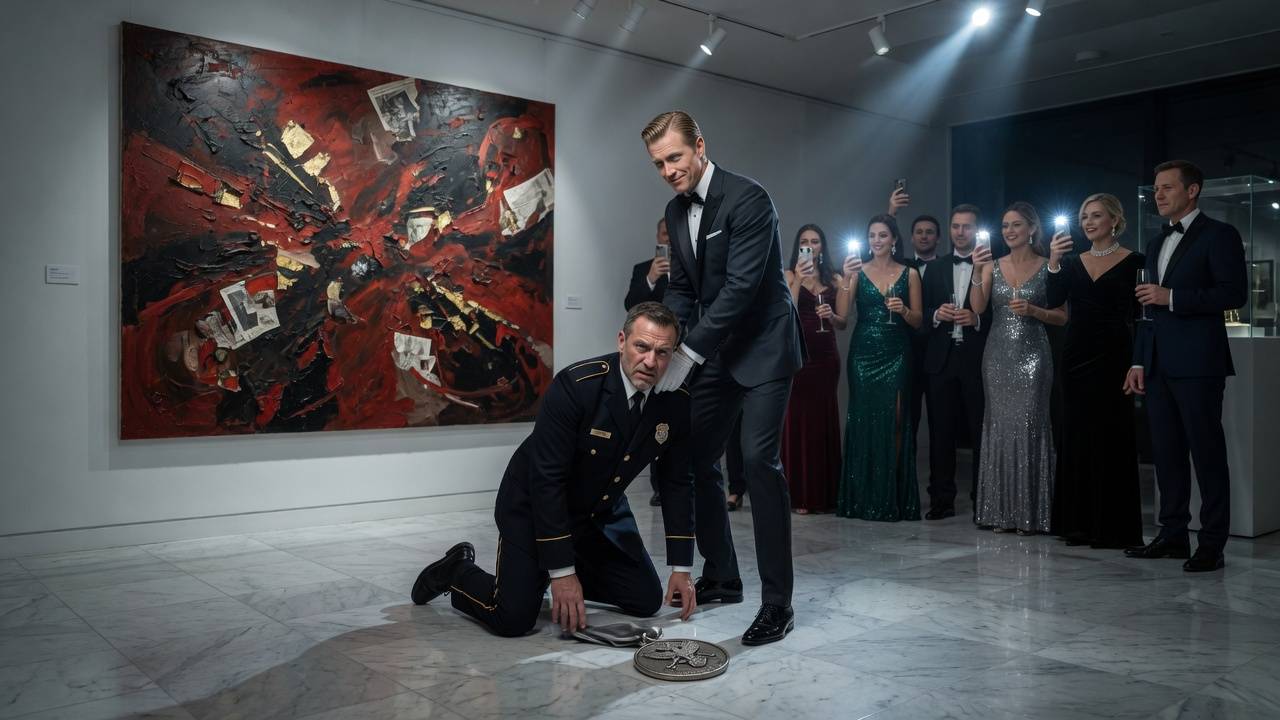
“You knew enough to watch a veteran get humiliated for doing his job,” Elias said, his voice flat and cold. He finally looked away from Julian and addressed the room. “All of you. You watched him step on a Silver Star because you thought it was part of the entertainment. You thought my life was just a backdrop for your auction.”
The socialites began to murmur, a low tide of panic rising. A few began to edge toward the exits, but the heavy steel security doors—controlled by the very system Elias had just subverted—stayed locked.
“Nobody leaves,” Elias said. “Not until the authorities arrive to secure the evidence. This isn’t an art gallery anymore. It’s a crime scene.”
Julian finally found his voice, though it was thin and cracked. “You think you’ve won? You’ve destroyed the Thorne name, but you’re still just a guard. You’re still a man with a criminal record my father wrote for you. Nobody is going to believe a ‘broken soldier’ over the evidence they’re going to find in your locker.”
“There is no evidence in my locker, Julian,” Elias said. He reached into his pocket and pulled out the broken silver medal. “And your father isn’t here to write the ending this time. He died with his secrets. You’re going to live with yours.”
For the next twenty minutes, the East Wing was a study in psychological collapse. The wealthy donors, the very people Julian had spent his life trying to impress, began to turn on him. The whispers weren’t about the art anymore; they were about the liability.
“I told you the Thornes were erratic,” a prominent lawyer whispered to his wife.
“Do you think we’ll be subpoenaed?” a gallery owner asked, clutching her pearls.
The rescue force wasn’t just Sarah; it was the truth itself, finally gaining enough mass to crush the lies. When the tactical teams finally breached the doors, they didn’t come for Elias. They moved with surgical precision toward the painting and the man on the floor.
Elias watched as Julian was hauled to his feet and handcuffed. Thorne tried to maintain his dignity, but as they led him past Elias, his eyes were full of a raw, jagged hatred.
“I’ll bury you,” Julian hissed.
Elias just stood there, the weight of twenty years finally lifting from his chest. “You already did. I’m just finally digging myself out.”
As the federal agents began to dismantle the painting, one of them—a man in a dark suit with the weary eyes of a career investigator—approached Elias. He looked at the navy blue uniform, then at the silver medal Elias was holding.
“Mr. Vance?” the agent asked. “I’m Special Agent Miller. We’ve been looking into the Thorne accounts for eighteen months. We knew there was a leak, but we couldn’t find the medium. We never thought they’d put it on a wall in the middle of a gala.”
“It was the one place nobody would look,” Elias said. “People see what they want to see. They wanted to see a masterpiece. They didn’t want to see the blood under the paint.”
“We’re going to need your statement. And your flashlight.” Miller paused, looking at the medal. “And I think we’re going to need to have a very long conversation about your service record. There are some people in D.C. who owe you an apology. And a lot more than that.”
Elias nodded, but his eyes were on Sarah. She was standing by the monitor, watching the map disappear as the agents covered the painting in protective film. She looked at him and gave a small, tired smile. The cost had been high. The gallery was ruined, her career was in limbo, and the only man she’d ever respected was currently in handcuffs. But for the first time in years, the air in the room felt like it was actually circulating.
“I’m going home,” Elias said.
“You can’t go yet, Mr. Vance,” Miller said. “There’s paperwork. Procedures.”
“I’ve spent half my life following your procedures, Miller. And look where it got me.” Elias pinned the broken silver medal back onto his navy blue tunic. It didn’t look like a piece of trash anymore. It looked like a scar. “I’ll be at my apartment. You know where to find me. I’m not a ghost anymore.”
He walked out of the East Wing, his boots echoing on the marble. He didn’t look back at the cameras. He didn’t look at the crowd. He walked through the grand foyer, past the statues and the portraits of dead men, and stepped out into the cool night air of the city.
The weight of the uniform was still there, but the man inside it was different. He wasn’t the “eye that failed.” He was the man who had seen through the paint.
Chapter 6
The aftermath was not as clean as the movies made it seem. For the next three months, Elias Vance’s name was everywhere. He was the “Guard of the Gallery,” the “Soldier who Saw the Secret,” the man who had taken down one of the most powerful families in the city with a modified flashlight and a well-placed kick.
But the media attention felt like a different kind of haunting. Reporters camped outside his small apartment in the working-class district, asking him how it felt to be a hero.
“I’m not a hero,” he told a persistent journalist from the Times. “I was just tired of being lied to.”
The legal fallout was a labyrinth. Julian Thorne’s lawyers tried every trick in the book—claiming Elias had planted the encryption, that Sarah had been a jilted lover trying to ruin the family, that the “map” was merely a coincidence of abstract brushwork. But the evidence was too heavy. The Department of Defense confirmed that the map data was live, and the polymer used in the under-layer was traced directly to a government contractor Julian’s father had bribed a decade earlier.
Elias spent most of his days in government offices and courtrooms. The “criminal record” that Thorne had held over his head was officially expunged in a closed-door hearing. The military restored his rank and back-pay, and there was talk of a civilian commendation.
One rainy Tuesday, Elias sat in a small coffee shop near the courthouse, waiting for Sarah. The city felt different now—less like a battlefield and more like a place he actually lived.
Sarah arrived looking exhausted but lighter than he’d ever seen her. She’d lost her job at the gallery, of course, but she’d been hired by the National Archives to help develop new forensic imaging techniques.
“The auction house is suing the Thorne estate for three hundred million,” she said, sitting down across from him. “And the government is seizing the gallery building. They’re turning it into a federal Annex.”
“Poetic justice,” Elias said.
“How are you holding up?” she asked, her eyes searching his face. “You’ve been quiet lately.”
“I’m learning how to be a person who doesn’t have a secret,” Elias said. “It’s harder than I thought. I keep looking for the perimeter. I keep waiting for the next threat.”
“Maybe there isn’t one,” Sarah said softly. “Maybe you finally won the war, Elias.”
He looked down at his hands. They were steady. No more tremors, no more cold sweat. “I went to see my mentor’s grave yesterday. The man who betrayed me. The man who gave Julian the tools to break me.”
“And?”
“I didn’t feel anything,” Elias said. “No anger. No forgiveness. Just… nothing. He was just a man who made a choice. And I’m the man who lived with the consequences.”
He reached into his pocket and pulled out a small velvet box. He opened it to show her the silver medal. It had been repaired—the break was still visible, a thin gold line where the jeweler had fused the pieces back together, but it was whole again.
“Kintsugi,” Sarah said, touching the gold seam. “The Japanese art of repairing broken pottery with gold. The idea is that the piece is more beautiful because it was broken.”
“I don’t know about beautiful,” Elias said. “But it’s mine again.”
The final resolution of the Thorne case came a week later. Julian Thorne took a plea deal—fifteen years in a federal facility for corporate espionage and treason. He never apologized. In his final statement, he blamed the “ungrateful nature of the country” for not understanding the “art of the deal.”
Elias didn’t go to the sentencing. He didn’t need to see Julian in a jumpsuit to feel whole.
Instead, he went back to the gallery building on the day the government officially took possession. The “Thorne” name had already been chiseled off the marble facade. The grand East Wing was empty, the paintings gone, the sensors deactivated.
Elias walked to the spot where The Crimson Veil had hung. He looked at the wall, seeing the faint outline where the frame had protected the paint from the dust. This was where he had been forced to his knees. This was where his history had been stepped on.
He stood there for a long time, the silence of the empty room wrapping around him. He wasn’t a guard anymore. He wasn’t a soldier. He was just a man standing in a room.
He reached into his pocket, took out the repaired silver medal, and laid it on the floor, exactly where Julian had dropped it.
He looked at it for a moment, the gold seam catching the afternoon light through the high windows. Then, he picked it up, pinned it to his civilian jacket, and walked out of the gallery.
He didn’t look back. The eyes of the failing soldier were finally closed, and for the first time in twenty years, Elias Vance was looking forward.
The street outside was loud, messy, and full of people who didn’t know his name. It was perfect. He blended into the crowd, a shadow among shadows, but no longer a ghost. He had his truth, he had his dignity, and he had a world that was finally, mercifully, clear.