Chapter 5
The sound of the ambulance siren was a jagged blade cutting through the heavy Dallas air, but to Gabe, it was just a distant hum. The real noise was inside his own skull—the frantic, rhythmic thud of a heart that hadn’t quite realized the fight was over. He stood by the western hoist, his hands shoved deep into the pockets of his gray hoodie. He could feel the fine grit of concrete dust on his skin, and beneath that, the cooling dampness of a sweat that felt like it belonged to a different man.
Arthur was gone, loaded onto a gurney by two paramedics who looked bored by the heat until they saw the state of the man they were carrying. Arthur hadn’t been bleeding much—just a split lip and a bruised ego—but the way he’d been clutching his chest, gasping for air that his panic wouldn’t let him catch, had made the medics move with a focused, professional urgency.
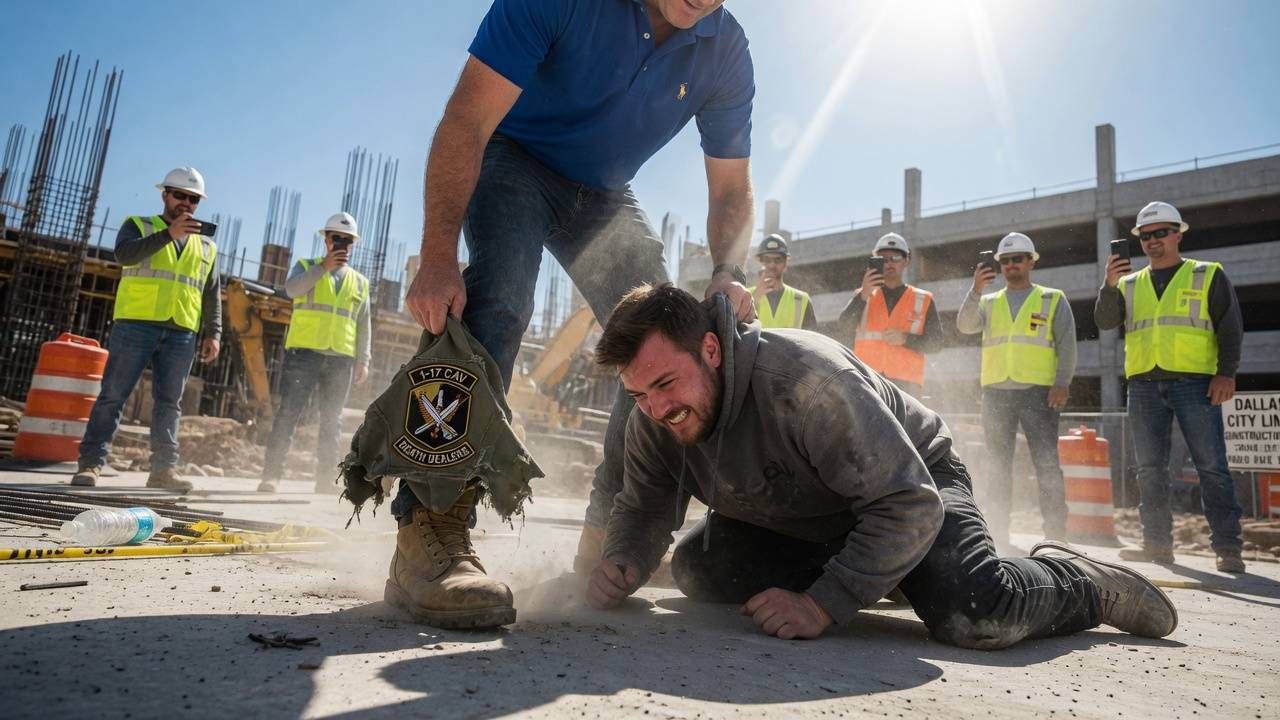
The site hadn’t gone back to work. The massive cranes were frozen against the white-blue sky, and the hundred or so men on the forty-second floor were scattered in small, whispering clusters. They didn’t look at Gabe directly. When he turned his head, eyes skittered away, landing on tool belts or distant skyscrapers. He was no longer the “Mule.” He was something else now—a predator they hadn’t realized was living in their midst, or worse, a ghost who had suddenly put on a crown.
Leo, the site foreman, stood ten feet away. He looked older than he had an hour ago. The lines around his eyes seemed to have deepened into trenches, and his orange safety vest hung off his narrow shoulders like a weight he was tired of carrying. He didn’t look like a boss; he looked like a father whose world had just collapsed in a heap of dust and rebar.
“You didn’t have to break him, Gabe,” Leo said. His voice was thin, stripped of its usual gravelly authority.
Gabe didn’t look at him. He was watching a hawk circle the top of the Bank of America Plaza. “I didn’t break him, Leo. I just stopped holding him up.”
“He’s my son,” Leo whispered.
“I know,” Gabe said. “And you’re the one who let him believe the world was made of glass just so he could feel like a hammer. You did that to him long before I got here.”
Leo flinched as if Gabe had struck him. He opened his mouth to argue, then closed it. He looked down at the dusty floor, at the spot where the Ranger patch had been ground into the dirt. The patch was gone now, tucked safely into Gabe’s hard hat, but the memory of the heel twisting into it remained, a dark stain on the afternoon.
“The corporate office is calling,” Leo said, gesturing toward the trailer downstairs. “They saw the video. One of the interns livestreamed it to a private group, and it leaked within ten minutes. They want to know why a laborer just assaulted the owner’s son. They’re talking about calling the cops, Gabe. Assault with a deadly weapon—that nail gun is going to be a problem.”
Gabe finally turned to look at Leo. His expression was as flat as a desert horizon. “The nail gun belongs to the company. Arthur pointed it at a nineteen-year-old kid, then at me. There were fifty witnesses. As for the ‘assault,’ Arthur initiated physical contact. I neutralized a threat.”
“They don’t care about the ‘threat,’ Gabe! They care about the name Pendergast!” Leo stepped closer, his voice rising in a desperate, frantic pitch. “You’re done. You know that, right? You’re blacklisted. You’ll never pull a lever or swing a hammer in this state again. They’re going to ruin you.”
Gabe reached into his hoodie and pulled out the high-security access pass again. He held it out between two fingers, the gold-leaf emblem of the Pendergast Group catching the harsh midday sun.
“Leo, look at the card,” Gabe said quietly. “Don’t look at the name on the front. Look at the clearance code on the back.”
Leo took the card with a trembling hand. He squinted at the small, embossed digits. He was a foreman; he knew the hierarchy. He knew that a ‘Blue’ level was for management, and ‘Gold’ was for the board. This card had a ‘Black-Alpha’ designation—a code Leo had only seen once in a manual, a level reserved for the primary trust holders of the Pendergast estate.
Leo’s face went the color of unbaked dough. He looked from the card to Gabe’s sweat-stained hoodie, then back to the card. “This… this isn’t real. You’re a laborer. You’ve been hauling rebar for three months.”
“Eighty-nine days,” Gabe corrected. “I wanted to see if I could build something without my name doing the work for me. I wanted to see if the world looked different from the bottom of the hoist.”
“And?” Leo asked, his voice barely audible over the wind whistling through the open steel.
“It looks the same,” Gabe said, his voice hardening. “People with power still treat people without it like dirt. And boys like Arthur still think they’re kings because they’ve never been hit.”
Gabe took the card back. “Tell the corporate office I’ll be there in an hour. Tell them I’m not coming as a laborer to apologize. I’m coming as the majority shareholder to take a look at the books.”
Gabe didn’t wait for a response. He walked toward the hoist, the crew parting before him like water. He descended the forty-two floors in silence, the mechanical rattle of the lift the only sound in his ears.
When he reached the street, the heat hit him again, but it felt different now. It didn’t feel like a weight; it felt like fuel. He walked the three blocks to his truck, a battered black F-150 that looked like it had seen every backroad in Texas.
As he approached, a low, rhythmic thumping came from the truck bed. A massive German Shepherd, his coat the color of toasted rye, was standing up, his tail hitting the side of the truck. This was Bear, Gabe’s service dog, the only thing that kept the “Beast” in the basement most nights.
Gabe opened the door and Bear immediately leaned his heavy head against Gabe’s chest, a low whine vibrating in his throat. Gabe buried his face in the dog’s fur, breathing in the scent of cedar and old blankets. The trembling in his hands finally, truly stopped.
“I know, buddy,” Gabe whispered into the dog’s ear. “I broke the streak. Eighty-nine days. We almost made it.”
He sat in the driver’s seat for a long time, the engine idling, the air-conditioning struggling against the Dallas sun. He thought about the boardroom he was about to enter. He thought about the men in three-thousand-dollar suits who had spent the last decade skimming off the top of his father’s legacy while Gabe was eating dust in the Helmand Valley.
He reached into his hard hat and pulled out the patch. It was Danny’s patch. It was the only thing Gabe truly owned—not the towers, not the billions, not the name.
He pressed the patch to his lips, then stuck it to the dashboard with a piece of electrical tape.
“Alright, Danny,” Gabe said, shifting the truck into gear. “Let’s go show them what a pack animal looks like when he stops carrying the load.”
He drove away from the site, the unfinished tower of Pendergast Plaza receding in his rearview mirror. He wasn’t going to his apartment. He was going to a storage unit in Oak Lawn, where a tailored suit and a pair of polished shoes had been waiting in a vacuum-sealed bag for three years.
The transition from “Gabe the Mule” to “Mr. Pendergast” took less than twenty minutes. In the cramped, fluorescent light of the storage unit, he stripped off the gray hoodie and the work pants. He scrubbed the concrete dust from his skin with a pack of wet wipes, the scars on his forearms standing out like white lightning against his tan.
When he caught his reflection in the small, cracked mirror on the wall, he didn’t recognize the man looking back. The beard was gone, trimmed to a sharp, aggressive stubble. The eyes were no longer hollow; they were focused, dark, and lethal. The suit fit him like armor—dark charcoal, heavy silk, the kind of clothing that didn’t just cover a man, it announced him.
He climbed back into the truck, Bear sitting upright in the passenger seat, looking confused but alert.
Gabe pulled out his phone and dialed a number he hadn’t called since the funeral.
“Blackwood,” a voice answered on the first ring. It was cold, professional, and sounded like it belonged to a man who had never lost an argument.
“It’s Gabriel,” Gabe said.
There was a long pause on the other end of the line. “The prodigal son returns. I heard there was an incident at the site today. My office is already fielding calls from the Pendergast board. They want your head on a platter, Gabriel. They’re talking about criminal charges.”
“Let them talk,” Gabe said, pulling out into traffic. “I want a full audit of the plaza project on my desk by four o’clock. I want the personnel files for every intern on the corporate floor. And I want Arthur Pendergast’s employment contract.”
“Arthur is family, Gabriel. His father is—”
“His father is a site foreman who forgot how to raise a man,” Gabe interrupted. “And Arthur is a liability. I’m done being a ghost, Blackwood. The 90 days are over. I’m coming in.”
“Very well,” Blackwood said, and Gabe could hear the faint, shark-like smile in the man’s voice. “I’ll have the vultures gathered in the boardroom. Should I tell them to bring their resumes, or their lawyers?”
“Tell them to bring both,” Gabe said. “They’re going to need them.”
Chapter 6
The Pendergast Group headquarters occupied the top three floors of a glass needle in Uptown, overlooking the very city Gabe had spent the last three months trying to disappear into. The lobby was a cathedral of white marble and hushed voices, where the air felt expensive and the people looked like they had been scrubbed clean of any human frailty.
When Gabe walked through the glass doors, the receptionist didn’t see a laborer. She saw a massive, imposing man in a suit that cost more than her car, walking with a stride that suggested he owned the gravity in the room. Bear walked at his heel, his claws clicking rhythmically on the marble.
“Sir, you can’t bring a dog in here,” she started, her voice professional but firm.
Gabe didn’t stop. He didn’t even look at her. He just held up the Black-Alpha pass.
The receptionist’s eyes widened. She tapped a few keys on her console, her face going pale as the screen flashed a high-clearance confirmation. She didn’t say another word. She just watched as Gabe and the dog entered the private elevator.
The ride to the fiftieth floor was silent. Gabe watched the numbers climb, his reflection in the polished brass doors a grim reminder of who he used to be. He could feel the Beast pacing in the back of his mind, but it wasn’t the wild, chaotic rage of the construction site. It was something colder. It was the calculated, surgical violence of a commander who had seen exactly how the world worked and decided he didn’t like the design.
The elevator dinked. The doors slid open to a reception area that looked like a war zone disguised as a luxury lounge. Three men in suits—the board of directors—were standing near the large mahogany doors of the main boardroom, talking in low, frantic tones.
In the center of the room sat Arthur. He was wearing a fresh shirt, but his face was swollen, a dark purple bruise blossoming across his chest where Gabe’s kick had landed. He looked small. He looked like a boy who had been caught playing with matches.
His mother, a woman who looked like she was made of diamonds and hairspray, was hovering over him, whispering furiously into a cell phone.
When the elevator doors opened, the room went dead silent.
Arthur looked up, his eyes widening in a mixture of shock and renewed terror. He didn’t recognize the man in the suit at first, but then he saw the eyes. The same dark, bottomless eyes that had looked at him on the forty-second floor right before the world went sideways.
“You!” Arthur’s mother shrieked, stepping forward. “You have some nerve showing up here! My husband is going to have you in a cage by sunset! You’re a common thug! A violent, unstable—”
“Sit down, Evelyn,” a voice cut through the room.
Blackwood stepped out of the boardroom. He was a man in his sixties, with silver hair and a face that suggested he had spent his life burying secrets. He looked at Gabe, then at the dog, and then at the board members.
“The majority shareholder has arrived,” Blackwood said.
The board members looked at each other, confused. “What are you talking about, Blackwood? The majority shareholder is the Pendergast Trust. We’re waiting for the trustee’s representative.”
“You’re looking at him,” Gabe said.
He walked past the woman, past the board members, and straight into the boardroom. He sat at the head of the table—his father’s chair—and Bear lay down at his feet, a silent guardian.
The board members scrambled after him, their faces a kaleidoscope of confusion and dawning horror. Arthur and his mother lingered at the doorway, Arthur looking like he wanted to vanish into the carpet.
“This is a joke,” one of the board members, a man named Henderson who had been his father’s CFO, stammered. “Gabriel? You’ve been… you’ve been missing for three years. We thought you were in a clinic. Or dead.”
“I was in the dirt,” Gabe said, leaning forward. He didn’t look at Henderson; he looked at Arthur. “I was learning what happens when a company like this forgets that its foundations are built by men, not spreadsheets.”
Gabe tapped a thick folder on the table. “I’ve spent the last hour reviewing the audit Blackwood prepared. The Pendergast Plaza project is six months behind schedule and twenty million over budget. Why?”
“The supply chain, the labor costs—” Henderson started.
“No,” Gabe cut him over. “It’s the waste. It’s the three dozen ‘interns’ who are actually just the sons and daughters of your golf partners, drawing six-figure salaries to do nothing but harass the men actually doing the work. It’s the kickbacks to the suppliers. It’s the rot.”
Gabe stood up, his presence filling the room. He looked at the board members one by one.
“As of five minutes ago, the Pendergast Group is under new management. Henderson, you’re retired. Effective immediately. You can keep your pension, but you’ll never set foot in this building again. The rest of you have forty-eight hours to justify your positions. If I find one more cent of waste, you’re gone.”
“You can’t do this!” Arthur’s mother shouted from the doorway. “My husband has been the face of this company for years! Leo is—”
“Leo is a good man who forgot how to be a father,” Gabe said, his voice softening just a fraction. “He’ll keep his job as site foreman. He’s the only one of you who actually knows how to build something. But his son…”
Gabe looked at Arthur. The boy was shaking now, the reality of his situation finally sinking in. He wasn’t the prince anymore. He was a liability being liquidated.
“Arthur Pendergast is terminated,” Gabe said. “For cause. Assault, harassment, and creation of a hostile work environment. I’ve already sent the video of the incident to the police. They’ll be at your house by evening to take a statement, Arthur. I suggest you get a better lawyer than the ones on our payroll.”
“Gabriel, please,” Arthur whispered, his voice cracking. “I didn’t know. I didn’t know it was you.”
“That’s the problem, Arthur,” Gabe said, stepping around the table. He stopped inches from the boy, the same way Arthur had stopped inches from him on the high-rise. “You only treat people with respect when you think they have the power to hurt you. That makes you a coward. And I don’t have room for cowards in my company.”
Gabe turned back to the board. “The Pendergast Plaza project will continue. But the culture changes today. We’re doubling the safety budget. We’re raising the hourly wage for the labor crew by twenty percent. And we’re firing every intern who hasn’t swung a hammer in the last month.”
“You’ll ruin the margins,” Henderson groaned.
“I don’t care about the margins,” Gabe said. “I care about the men. I care about the kid on the forty-second floor who was terrified of a nail gun because he thought he was alone. He’s not alone anymore.”
Gabe whistled softly. Bear stood up, his ears alert.
The boardroom was silent as Gabe walked out. He didn’t look at the luxury lounge or the white marble. He took the elevator back down to the street, the air-conditioning of the building feeling like a cage he was glad to leave.
When he reached his truck, he saw a familiar figure waiting by the bumper. It was Jamie, the nineteen-year-old worker from the site. He looked nervous, his hands stuffed into his pockets, his brand-new boots still covered in Dallas dust.
“Gabe,” the kid said, then corrected himself. “Mr. Pendergast.”
“Just Gabe, Jamie,” Gabe said, opening the driver’s side door.
“I… I saw the news. My phone’s been blowing up. Everyone on the crew knows.” Jamie looked up at the glass towers of Uptown, then back at Gabe. “Is it true? About the wages? About Arthur?”
“It’s true,” Gabe said. “Go back to the site tomorrow. Leo will have the new contracts ready. And Jamie… if anyone ever points a tool at you again, you don’t back up. You call me.”
Jamie nodded, a slow, tentative smile spreading across his face. “Thanks, Gabe. For… everything.”
Gabe watched the kid walk away, then climbed into his truck. He took the Ranger patch off the dashboard and held it in his hand. The 90 days were over. The peace he’d tried to build with silence had been a lie. True peace, he realized, wasn’t the absence of conflict. It was the presence of justice.
He looked at the patch—at Danny’s legacy. He tucked it back into the secret pocket of his hard hat, but he didn’t put the hard hat on. He left it on the passenger seat.
He didn’t need the gray hoodie anymore. And he didn’t need the billionaire’s suit.
He started the engine and drove toward the sunset, the Dallas skyline a jagged, beautiful line of steel and sin. He had a tower to finish, a name to rebuild, and a beast that finally knew how to stay in the light.
The Mule was gone. The Ghost was dead.
Gabriel Pendergast was finally home.