Chapter 5
The drive from the hairpin turn to the Gable place felt like crossing a border. Behind him, on the sun-scorched gravel of Route 44, Silas had left a version of himself he hadn’t seen since a dusty ridge in Afghanistan. In front of him was the only person on the mountain who might actually know what to do with the war he’d just started.
Ranger sat rigid in the passenger seat, his nose twitching at the vent. The dog knew the scent of adrenaline. He’d lived in it for years before the VA deemed him surplus. Silas gripped the steering wheel, his knuckles white against the cracked black plastic. His right leg was vibrating, a fine tremor he couldn’t stop. It wasn’t just the pain from the shrapnel site; it was the realization that the world he’d carefully constructed—the quiet life, the predictable route, the proximity to a pension—was likely dissolving in the rearview mirror.
He pulled the LLV into Mrs. Gable’s dirt driveway. The old schoolteacher was no longer on her porch. The screen door was shut, the house looking as though it were bracing for a storm. Silas turned off the engine. The silence that rushed into the cab was deafening. He reached into the back, his fingers trembling slightly as he pulled out the manila envelope.
He climbed out of the truck, his limp more pronounced now that the initial surge of combat clarity was fading. Every step toward the porch felt like dragging an anchor. He wasn’t just carrying a letter; he was carrying the catalyst for a fire he couldn’t put out.
The screen door creaked open before he could knock. Mrs. Gable stood there, her face a map of deep-set lines and hard-earned wisdom. She didn’t look at the envelope. She looked at the dust on his uniform and the way he was favoring his left side.
“You did it, didn’t you?” she asked. Her voice was steady, but there was a flicker of something—fear or pride, Silas couldn’t tell—in her eyes.
“He wouldn’t move, Mrs. Gable. And then he touched the mail.” Silas stepped inside. The house smelled of old books and dried lavender, a stark contrast to the diesel and grease of the road.
“I saw the truck fly past a few minutes ago,” she said, gesturing toward the ridge. “Buck was driving like the devil was on his bumper. He looked pale, Silas. I’ve never seen that boy look pale.”
“He’ll be back. And he won’t be alone.” Silas laid the envelope on the kitchen table. “I need you to look at this. It’s addressed to Judge Miller from Calhoun Land and Timber. I think… I think it’s the legal paperwork for the easement. The one that lets Big Waylon take the ridge timber.”
Mrs. Gable sat down, her spectacles perched on the end of her nose. She reached for the envelope, her hand hovering over the seal. “You know what this is, Silas. This is mail theft. A federal felony. If you open this, they’ll have you before the sun goes down.”
“I’m already gone, ma’am,” Silas said, pulling out a chair. The wood groaned under his weight. “The second I put him on the ground, I traded the pension for something else. I might as well know what I’m trading it for.”
She looked at him for a long moment, then picked up a dull butter knife from the table. She slid it under the flap with the precision of a surgeon. Silas watched as she pulled out a stack of legal documents, the pages crisp and white, bearing the official seal of the county.
She read in silence for ten minutes. The only sound in the kitchen was the ticking of a grandfather clock in the hallway and the distant, rhythmic thumping of Ranger’s tail against the porch floor outside. Silas watched her eyes move back and forth. He saw her jaw tighten. He saw her face go from academic interest to a cold, simmering rage.
“It’s not just an easement, Silas,” she said, her voice dropping to a whisper. “It’s a quiet title action. They’re claiming that the original surveys from the 1930s were flawed. They’re claiming the entire ridge line—everything above the four-hundred-foot mark—belongs to the Calhoun estate through a grandfathered deed.”
“What does that mean for you? For the Gables?”
“It means we’re squatters,” she said, her voice trembling slightly. “It means Big Waylon can clear-cut the entire ridge, and we don’t get a dime. More than that, we lose the houses. The Judge is set to sign this on Monday. There’s a note here, Silas. A handwritten one.”
She slid a yellow legal slip across the table. The handwriting was bold, aggressive—Big Waylon’s script.
Miller—Everything is in order. The ‘incentive’ we discussed has been moved to the offshore account. Make sure this doesn’t go to public hearing. The mountain people are predictable. They won’t fight what they don’t understand. Get it done.
Silas felt a cold stone settle in his chest. It was the “smoking gun.” The proof of bribery, of a conspiracy to steal the heritage of an entire community. And it was sitting on a kitchen table in a house that was technically being stolen while they sat in it.
“This is why the Postmaster is so scared,” Silas muttered. “He’s been handling the correspondence. He knew.”
“Miller is a man who would sell his mother for a quiet life,” Mrs. Gable said. She looked up at Silas, her eyes wet but fierce. “You can’t deliver this, Silas. But if you keep it, you’re a criminal. If you show it to the Sheriff, he’ll just hand it back to Waylon. He’s on the payroll, too.”
Before Silas could answer, the peace of the afternoon was shattered. The sound of a heavy engine—not the Raptor, but something bigger—thundered up the driveway. Silas stood up, his hand reflexively going to his hip where his holster used to be.
He looked through the window. It was the Postmaster’s personal sedan, a silver Buick that looked out of place on the mountain. Behind it was a white Jeep with “County Sheriff” stenciled on the door.
“They’re here,” Silas said.
“Ranger!” he called out. The dog was already at the door, his hackles raised.
Silas turned to Mrs. Gable. “Hide that paperwork. Put it in the stove, the freezer, anywhere they won’t look. I’ll buy you time.”
“Silas, don’t do anything foolish,” she warned.
“I’m a mail carrier, Mrs. Gable,” he said, a grim smile touching his lips. “I’m just here to make sure the delivery is completed.”
He stepped out onto the porch just as Miller, the Postmaster, climbed out of the Buick. Miller was a small, frantic man in a sweat-stained short-sleeve dress shirt. His tie was crooked, and he was wringing his hands as if he were trying to wash off a layer of invisible filth. Behind him, Deputy Vance stepped out of the Jeep. Vance was a local, a man who had grown up in the shadow of the Calhouns and had learned early on which side of the bread was buttered.
“Silas!” Miller shouted, his voice cracking. “What have you done? My God, Silas, do you have any idea what’s happening? The phone hasn’t stopped ringing for an hour! Waylon Calhoun is at the station! He’s talking about assault, about federal interference, about… about murder!”
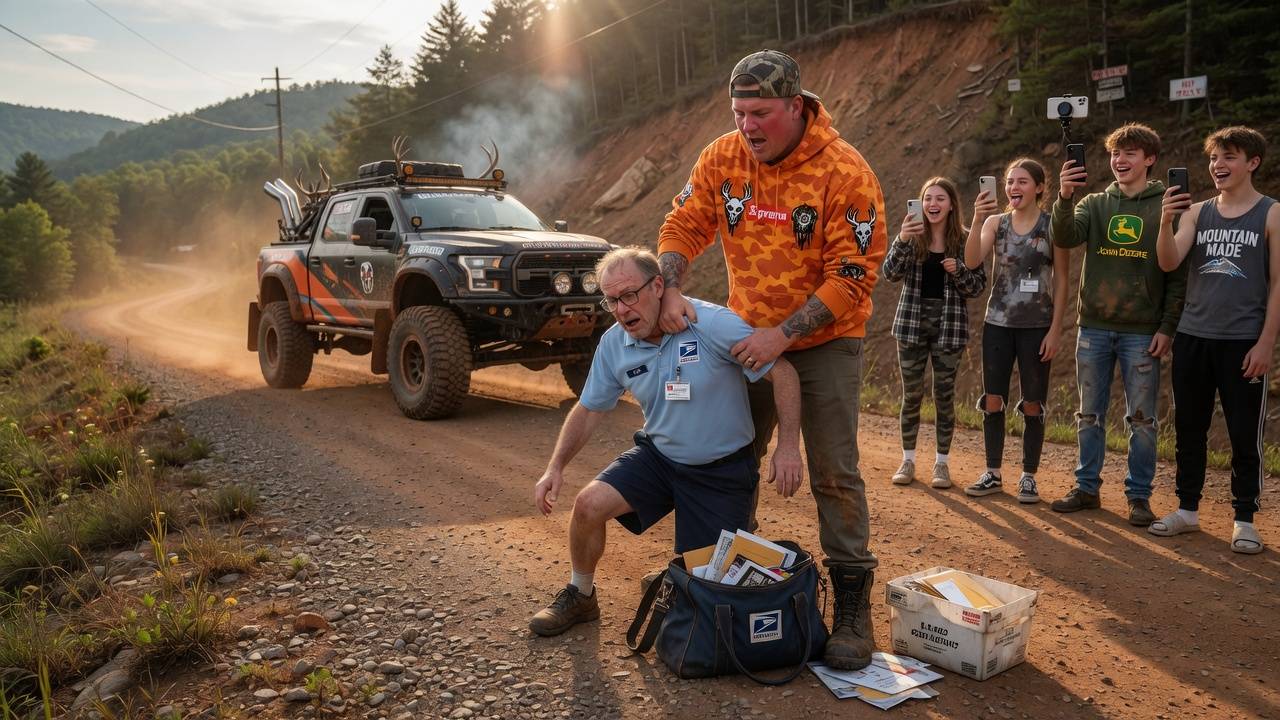
“Assault?” Silas asked, leaning against a porch post. “The boy swung first, Miller. You can check the kids’ phones for that.”
“I don’t care who swung first!” Miller screamed, his face turning a dangerous shade of purple. “You’re a federal employee! You laid hands on a private citizen on your route! You’re done, Silas. You’re finished. Your pension is gone. Your career is over. I’m here to take your satchel and your keys. You’re under administrative suspension, effective five minutes ago.”
Vance stepped forward, his hand resting on the grip of his sidearm. He didn’t look at Silas; he looked at the mail truck parked in the yard. “The satchel, Silas. And the envelope. We know you have it.”
“The envelope is mail, Vance,” Silas said, his voice dropping an octave. “You’re a deputy, not a postal inspector. You don’t have jurisdiction over that truck or what’s inside it.”
“I have jurisdiction over an assault suspect,” Vance said, finally meeting Silas’s eyes. “And I have a report of stolen property. Now, you can make this easy, or I can take you into town in the back of the Jeep. Buck’s in the hospital, Silas. He says his ribs are broken. He says you attacked him without provocation.”
“Buck’s a liar,” Silas said. “And you know it.”
Miller was pacing now, kicking at the dirt. “Silas, please. Just give us the envelope. Waylon just wants the paperwork. If you give it back, he might—and I mean might—agree not to press charges. We can call it a mental breakdown. PTSD from the war. We can get you a medical discharge. You might even keep a portion of the pension.”
Silas looked at Miller. He saw the man’s soul laid bare—the cowardice, the complicity, the sheer exhaustion of being a puppet. Then he looked at the mountain ridge behind them, the ancient trees that were about to be slaughtered for the sake of an offshore account.
“The mail is sacred, Miller,” Silas said softly. “That’s what you told me on my first day. You said the mail carries the lifeblood of the country. You said we don’t look inside, we just get it where it’s going.”
“This is different!” Miller shrieked.
“No, it isn’t,” Silas said. “It’s exactly the same. The mail is going where it needs to go. But it’s not going to the Judge.”
Vance moved, his boots crunching on the gravel as he stepped toward the porch. “That’s enough talk. Silas, you’re under arrest. Turn around and put your hands on the rail.”
Ranger let out a roar—a sound that didn’t come from a pet, but from a predator. He stepped in front of Silas, his teeth bared, his body a coiled spring of black and tan muscle. Vance froze, his hand tightening on his holster.
“Easy, dog,” Vance whispered, his face pale.
“He won’t hurt you if you stay back,” Silas said. “But he knows a threat when he sees one.”
The standoff hung in the humid air, thick as the mountain mist. Silas could see the sweat beads on Miller’s forehead. He could see the hesitation in Vance’s eyes. They were used to bullying the mountain people, the ones who were afraid of the law. They weren’t prepared for a man who had already accepted that he had nothing left to lose.
“What are you going to do, Silas?” Miller asked, his voice shaking. “You can’t stay here forever. Waylon is coming. He’s coming with his own men, and they don’t care about postal regulations.”
“Then I guess I’d better finish my route,” Silas said.
He turned and looked back into the house. Mrs. Gable was standing in the shadows of the hallway. She held a small, black object in her hand—her phone.
“Silas,” she called out. “I just sent the photos of the yellow slip to the state police in Asheville. And to the editor of the Mountain Press.”
Miller’s face went white. Vance looked at the Postmaster, his confidence visibly crumbling.
“You did what?” Miller gasped.
“The mail is out, Miller,” Silas said, turning back to him. “And you can’t stop the delivery now.”
The silence that followed was different than the one before. It wasn’t the silence of an ambush; it was the silence of a structure collapsing. The Calhoun empire had been built on secrets and the silence of the mountain people. But once the light hits a secret, it starts to die.
Silas stepped down from the porch, Ranger at his side. He walked past Vance, who didn’t move to stop him. He walked to the mail truck and climbed into the driver’s seat.
“Where are you going?” Miller cried out, running after the truck.
Silas looked at the bobblehead shepherd on his dashboard. He looked at the “U.S. MAIL” stenciled on his door.
“I have a delivery to make,” Silas said. “And for the first time in twelve years, I know exactly what I’m carrying.”
He put the truck in gear and pulled out of the driveway, leaving the Postmaster and the Deputy standing in the dust. The war had moved off the mountain road and into the world, and Silas was the only one who knew the terrain.
Chapter 6
The sun was beginning to dip behind the jagged peaks of the Blue Ridge, casting long, bruised shadows across the valley. Silas drove the LLV with a steady hand, despite the fire in his leg. The truck felt heavier than usual, as if the weight of the truth he carried had a physical mass. Beside him, Ranger was quiet, his head resting on the edge of the window, watching the trees go by.
He knew where he was going. He wasn’t going to the post office, and he wasn’t going to his cabin. He was going to the town square, to the courthouse where the statue of a Confederate soldier stood watch over a town that had forgotten the meaning of duty.
As he approached the town limits, he saw them. The mountain people. They weren’t on their porches anymore. They were in their trucks, parked along the shoulder of the road. They were standing in small groups near the general store. They were watching him pass, their faces unreadable, but their presence undeniable.
The video had done its work. The clip of the “Gimpy Ghost” dismantling the Calhoun heir had spread through the county like a brushfire. It wasn’t just about the fight; it was about the sight of someone finally standing up to the family that had owned their lives for generations.
Silas pulled the mail truck into the center of the square. A crowd had already begun to gather—a mix of locals in work boots and a few reporters from the Asheville stations who had been tipped off by Mrs. Gable.
He saw Big Waylon’s black Escalade parked directly in front of the courthouse steps. Waylon was standing there, a man who looked like he had been carved out of the mountain granite. He was tall, broad-shouldered, wearing a suit that cost more than Silas’s truck. Beside him was Buck, his arm in a sling, his face still pale and swollen.
Silas turned off the engine. He grabbed the mail satchel—the bruised, muddy leather that had started it all—and stepped out. Ranger followed, a silent shadow at his heel.
The crowd went quiet as Silas limped toward the courthouse. The only sound was the rhythmic scritch-thud of his uneven gait and the soft click of Ranger’s claws on the pavement.
Waylon stepped forward, his eyes narrowed. “You’ve got a lot of nerve showing your face here, Silas. You’re lucky my son is still alive. You’re lucky I haven’t had the Sheriff burn your cabin to the ground.”
Silas stopped at the base of the steps. He looked up at Waylon, then at the courthouse doors.
“I’m here to deliver the mail, Waylon,” Silas said. “There’s an envelope for Judge Miller. I believe you’ve been waiting for it.”
“Give it to me,” Waylon said, reaching out a hand. “I’ll see that the Judge gets it. Then you can go back to your hole and wait for the Marshals to pick you up.”
“I don’t think so,” Silas said. He reached into the satchel and pulled out the manila envelope. But he didn’t hand it to Waylon. He held it up so the crowd—and the cameras—could see it.
“This envelope contains a quiet title action,” Silas said, his voice projecting across the square. “It’s a legal maneuver to steal the timber rights and the homes of the people on Route 44. And it contains a handwritten note from Waylon Calhoun to Judge Miller, discussing a bribe.”
The crowd erupted into a low, angry murmur. Waylon’s face didn’t change, but his eyes flared with a sudden, sharp panic.
“You’re lying,” Waylon said, his voice booming. “You’ve tampered with federal mail! You’ve opened a private document! You’re the criminal here, Silas!”
“I am a mail carrier,” Silas said. “And the mail has already been delivered. Mrs. Gable has the copies. The state police have the photos. And the world is about to see the real Waylon Calhoun.”
He turned to the crowd, to the men and women who had lived in fear for so long.
“This mountain doesn’t belong to him,” Silas said, gesturing toward Waylon. “It doesn’t belong to the Judge. It belongs to the people who live on it. The ones who work it. The ones who protect it.”
Vance and the Sheriff stepped out of the courthouse, looking at Waylon for instructions. But Waylon was no longer looking at them. He was looking at the crowd. He was looking at the people he had spent his life controlling, and he saw something in their eyes he had never seen before: contempt.
“Sheriff, arrest him!” Waylon shouted, pointing at Silas. “He’s a thief! He’s a lunatic!”
The Sheriff looked at Silas, then at the cameras, then at the angry faces of his own neighbors. He didn’t move. He knew the wind had changed. He knew that the Calhoun name was no longer a shield.
Silas walked up the steps, limping past Waylon as if the man were nothing more than a ghost. He reached the courthouse doors and handed the envelope to a clerk who was standing there, wide-eyed.
“For the Judge,” Silas said. “Make sure he reads the yellow slip.”
He turned back and looked at Buck. The boy was staring at him, his face a mixture of fear and confusion. He had been taught that power was a thing you inherited, a thing you used to crush others. He was seeing for the first time that real power is the thing that remains when you have nothing left to lose.
“You still want me to bark, Buck?” Silas asked softly.
Buck looked away, his shoulders slumped.
Silas walked down the steps, his leg screaming in protest. He didn’t look back at the Calhouns. He didn’t look at the cameras. He walked back to his truck and climbed in.
Ranger sat beside him, his tail thumping once.
Silas drove out of the square, past the trucks and the people, and headed back toward the mountain. He didn’t go to the post office. He went to his cabin, the one at the end of the winding road where the air was clean and the trees were still standing.
The fallout was massive. Within a week, Judge Miller had resigned under the threat of a state investigation. Waylon Calhoun was indicted on charges of bribery and conspiracy. The quiet title action was dismissed, and the people of the ridge kept their land.
Silas lost his job. He lost his pension. The USPS terminated him for “conduct unbecoming of a federal officer” and “intentional interference with mail delivery.” He didn’t fight it. He didn’t have the energy, and he didn’t care.
A month later, Silas was sitting on his porch, a glass of iced tea in his hand. Ranger was asleep at his feet. The mountain was quiet, the only sound the wind through the pines.
A truck pulled into his driveway. It was an old, beat-up Ford, the kind that had been on the mountain for decades. Mrs. Gable climbed out, holding a small, heavy box.
“Silas,” she said, limping up to the porch. “I have something for you.”
She set the box on the table. It was filled with jars of honey, fresh eggs, and a small, hand-knitted blanket for Ranger.
“The people on the ridge,” she said. “They wanted to say thank you. They know what you lost. They know you won’t take their money, so they sent this.”
Silas looked at the box, then at the old teacher. “I didn’t do it for them, Mrs. Gable. I did it because I couldn’t live with the silence.”
“I know,” she said. She reached into her pocket and pulled out a small, shiny object. It was a brass key.
“What’s this?” Silas asked.
“It’s the key to the old schoolhouse library,” she said. “We need someone to watch over it. Someone who knows the value of the truth. It doesn’t pay much, but the community has decided to take up a collection every month. It’s not a federal pension, Silas, but it’s ours.”
Silas looked at the key, then at the mountain ridge he had saved. He felt the ache in his leg, a permanent reminder of the price he had paid. But for the first time in twelve years, the pain didn’t feel like a burden. It felt like a foundation.
“I think I can handle that,” Silas said.
He stood up, his limp steady and sure. He looked out at the road—the long, winding stretch of Route 44. The ghost of the highway was gone. In his place was a man who had finally delivered the only message that mattered.
The mountain was silent, but it was no longer the silence of fear. It was the silence of a place that had found its voice again. And Silas, the mailman who had walked through the fire, was finally home.