They called it “The Baptism.”
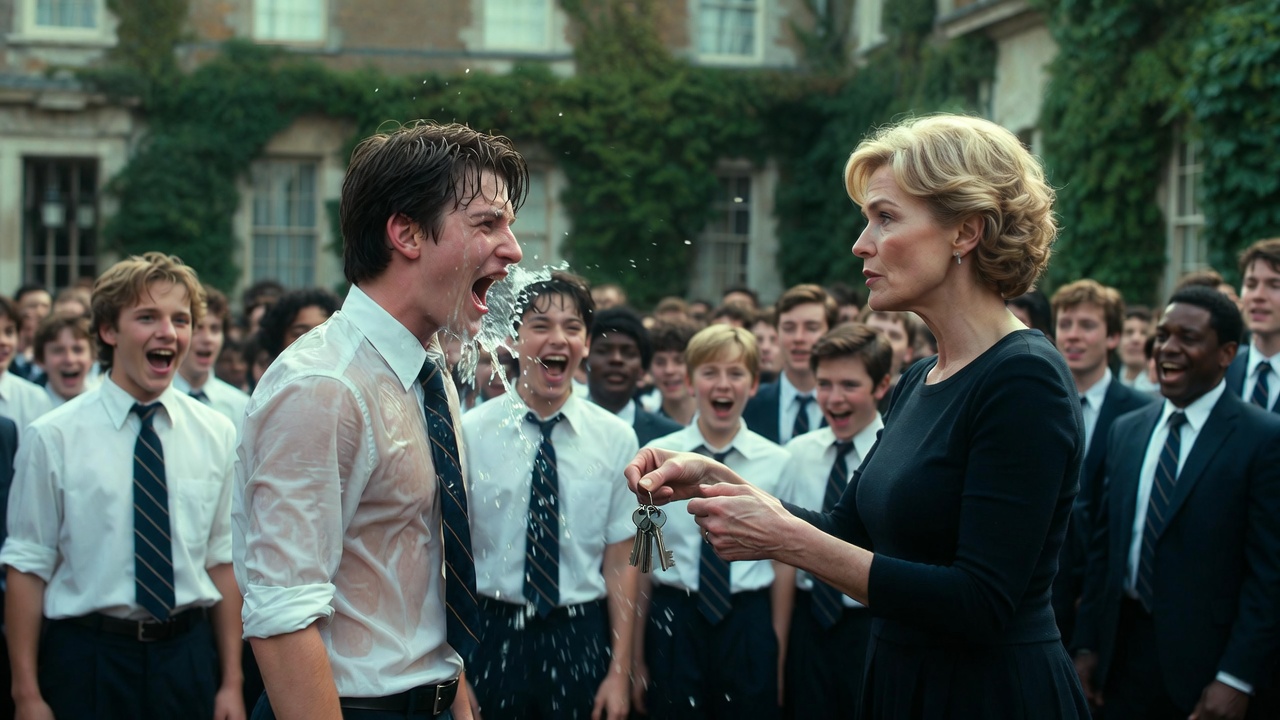
It wasn’t holy. It was ice-cold bottled water mixed with the spit of a guy who had never worked a day in his life.
I stood there in the center of the Sterling Academy courtyard, my thrift-store blazer heavy and dripping, while the “Golden Circle” laughed until they couldn’t breathe.
“Know your place, Scholarship,” Bryce hissed, his breath smelling like expensive espresso and unearned confidence. “You’re a guest in our world. Don’t forget who pays the bills here.”
I didn’t wipe the water from my eyes. I didn’t ball my fists. I just watched the sunlight catch the diamond on his pinky ring—a ring that cost more than my mother made in a year of cleaning hotel rooms.
The crowd of two hundred students waited for me to cry. They waited for me to beg.
But then, the heavy iron gates groaned open.
A black sedan pulled in, and the laughter died like a snuffed candle.
Mrs. Eleanor Sterling didn’t look at the buildings she owned. She didn’t look at the principal who was scurrying toward her.
She walked straight to me—the wet, shivering “charity case”—and reached into her silk pocket.
“The locks have been changed, Leo,” she said, her voice carrying across the silent courtyard like a localized thunderstorm. “And these belong to you.”
She dropped the heavy brass keys into my palm.
In that second, Bryce’s face didn’t just change—it disintegrated.
Because he didn’t just realize I wasn’t poor. He realized I was now his boss.
Read the full story in the comments.
If you don’t see the new chapter, tap ‘All comments’.
FULL STORY
Chapter 1: The Cold Reality
The water hit me with the force of a physical punch. It was October in Connecticut, and the wind whipping through the stone arches of Sterling Academy was already sharp enough to draw blood. The ice-cold liquid soaked through my shirt, sticking the fabric to my ribs, making me look even smaller than I already felt.
“Whoops,” Bryce Vanderbilt said, his voice dripping with a fake, honeyed concern that fooled absolutely no one. He tossed the empty plastic bottle at my feet. “I thought you looked a little thirsty, Leo. You know, from all that ‘working’ you do.”
The circle of students around us erupted. It was a practiced, rhythmic laughter—the sound of the elite reminding the intruder that he didn’t belong. I was the “Scholarship Kid.” The one who took the bus two towns over. The one whose mother worked the night shift at the very hospital Bryce’s father sat on the board of.
“Look at him,” whispered Chloe, Bryce’s girlfriend, her eyes scanning my scuffed shoes with a mixture of pity and disgust. “He’s actually shaking. It’s just water, Leo. It’s not like it’s the first time you’ve been washed.”
I looked at Bryce. I wanted to see the person behind the wealth, but there was nothing there. Just a hollow shell fueled by a trust fund and the desperate need to feel superior.
“Is that it?” I asked quietly. My voice didn’t shake. That was the one thing I had that they couldn’t buy: composure.
Bryce’s smile flickered. He didn’t like the lack of a reaction. He wanted a scene. He wanted me to swing at him so he could have me expelled and keep his record clean.
“No,” Bryce said, stepping into my personal space. He smelled like expensive cologne and arrogance. “That’s not it. Stay away from the West Wing today. My father is meeting with the Founder. We’re discussing the new athletic center. People like you shouldn’t be seen near people who actually matter.”
He shoved my shoulder—just enough to be an insult, not enough to be an assault. As he turned to walk away, leading his entourage like a king leading a parade of fools, I felt the keys in my pocket. Not the keys Mrs. Sterling would give me later, but the key to the janitor’s closet where I kept my change of clothes.
I was invisible to them. And as I watched them walk away, I realized that being invisible was the greatest power I had. Because when you’re invisible, you see everything. You see the cracks in the foundation. You see who is actually loyal and who is just afraid.
I turned toward the main gates, the water still dripping from my hair, and saw the black sedan idling at the entrance. The game was about to change.
Chapter 2: The Double Life
Most people at Sterling Academy thought my life started at 8:00 AM when I walked through the gates and ended at 3:00 PM when I left. They had no idea about the other twelve hours of my day.
To them, I was Leo Vance: the quiet kid in the back of AP Calculus who always had the right answer but never raised his hand. They didn’t see me at 5:00 PM, wearing a stained apron at ‘Sal’s Diner,’ flipping burgers for the commuters who didn’t care about my GPA. They didn’t see me at 9:00 PM, sitting in a hospital waiting room while my mother finished her shift, doing my Latin homework by the glow of a vending machine.
“You look tired, honey,” my mom said that Tuesday night, her hand resting on my shoulder. Her skin was rough from years of cleaning chemicals, but her touch was the only thing that kept me grounded.
“I’m fine, Mom. Just a long day,” I lied. I didn’t tell her about the water. I didn’t tell her about the “Legacy” kids who made it their mission to remind me I was a budget line item in the school’s diversity report.
“You’re going to be someone, Leo,” she whispered. “The Sterlings… they see something in you. Eleanor wouldn’t have hand-picked you for that scholarship if she didn’t.”
I nodded, but inside, I was doubting everything. Eleanor Sterling was a ghost. She hadn’t been seen on campus in three years. She was a legend—the woman who built a real estate empire from a single apartment building in Queens. She was the one who had funded my education after seeing an essay I wrote for a local competition about the “Architecture of Poverty.”
But at school, her name was just a weapon Bryce used. “My dad is Eleanor’s right hand,” he’d brag. “She doesn’t do anything without his sign-off.”
I spent that night staring at the ceiling of our cramped apartment. I thought about the way Bryce had looked at me—like I was a bug he had accidentally stepped on. I thought about the anger bubbling in my chest, a dark, hot thing that I usually kept locked away.
In this world, you were either the hammer or the nail. For eighteen years, I had been the nail. I was tired of the cold. I was tired of the silence.
The next morning, I arrived at school early. I didn’t go to the library. I went to the Founder’s Garden, a private patch of land that was strictly off-limits to students. I sat on the stone bench and waited.
I knew she was coming. I had received a private email three days ago, from an encrypted address, telling me to be there.
“You’re wet,” a voice said from behind me.
I turned. Eleanor Sterling stood there, draped in a coat that cost more than our car. She didn’t look like a ghost. She looked like a wolf.
“It rained,” I said simply.
She smiled, a sharp, knowing thing. “It didn’t rain today, Leo. I know what happened in the courtyard. I saw the video on the school’s ‘confessions’ page.”
“Then you know I didn’t fight back,” I said.
“I know,” she replied, stepping closer. She reached out and touched the damp fabric of my blazer. “And that is exactly why you’re the only one I can trust. The hammers are loud, Leo. But the nails… they’re the ones holding the whole house together.”
She pulled out a small, leather-bound book and a heavy brass ring.
“My health is failing, and the vultures are circling,” she said, her eyes boring into mine. “The Vanderbilts think they’re inheriting an empire. They think this school is their private playground. They’ve forgotten that I don’t care about bloodlines. I care about the foundation.”
She pressed the keys into my hand. “Go to the assembly this afternoon. Let them have their fun. Let them laugh. And then, when I walk in… you show them what a nail can do.”
Chapter 3: The Gathering Storm
The atmosphere in the Great Hall was electric. Usually, the mid-term assembly was a bore—a series of speeches about “excellence” and “integrity” that most students tuned out while checking their crypto portfolios.
But today was different. Rumors had spread that the Sterling-Vanderbilt Athletic Center was being officially announced. Bryce was sitting in the front row, his chest puffed out like a peacock. He was wearing a custom-tailored suit, his hair slicked back with military precision. He looked like the future of the American Dream, provided that dream involved stepping on everyone else to get to the top.
I sat in the very back row, the cold water from the morning still making my skin itch. I felt Marcus, one of Bryce’s cronies, staring at me from a few seats away. Marcus was different; he didn’t laugh as hard as the others. Sometimes, I saw him looking at me with something that looked like regret, but he was too deep in the circle to ever speak up.
“Hey, Leo,” Marcus whispered, leaning over. “You should probably leave. Bryce is planning something for the Q&A. He wants to ‘ask’ you about your scholarship status in front of everyone. He wants to make it a public debate about school funding.”
“Thanks for the heads up, Marcus,” I said, my voice flat.
“I’m serious, man. Just go. He’s got the Principal on his side. They want to make an example out of you to show that ‘standards’ are dropping.”
I looked at Marcus. “Why are you telling me this?”
He looked away, his eyes scanning the room to make sure no one saw him talking to me. “Because my dad works for Bryce’s dad. I know what it’s like to have to say ‘yes’ to people you hate. I just… I don’t think you deserve this.”
“None of us do,” I said.
The lights dimmed, and Principal Higgins took the stage. He was a man who had perfected the art of the “corporate smile”—wide, bright, and completely empty.
“Today is a historic day for Sterling Academy,” Higgins beamed. “We are honored to welcome members of our Board of Trustees, and specifically, the Vanderbilt family, who have been instrumental in our growth.”
Bryce stood up and waved, soaking in the applause. He looked back at me and winked. It was the wink of a man who thought he had already won the game.
“But more importantly,” Higgins continued, his voice dropping to a reverent whisper, “we are joined today by a rare guest. The woman who made all of this possible. Please welcome, Mrs. Eleanor Sterling.”
The room went dead silent. This was the moment. I felt the keys in my pocket grow heavy, as if they were made of lead.
Eleanor walked onto the stage. She didn’t use a cane. She didn’t need one. Her presence alone seemed to suck the air out of the room. She stood at the podium, ignored the microphone, and looked out at the sea of privileged faces.
“I’ve spent fifty years building things,” she began. “Skyscrapers, hospitals, and this school. And in fifty years, I’ve learned one thing: a building is only as strong as its quietest part.”
She looked directly at Bryce. “Mr. Vanderbilt, stand up.”
Bryce stood, a confused but arrogant smile on his face. “Yes, Mrs. Sterling?”
“I saw what you did this morning,” she said. Her voice wasn’t loud, but it cut through the room like a blade. “I saw you pour water on a student. I saw you tell him to ‘know his place.'”
The smile on Bryce’s face didn’t just fade—it vanished. The students around him began to whisper. Principal Higgins started to sweat visibly under the stage lights.
“I’ve decided,” Eleanor continued, “that the person who knows their place best… is the person who has earned it. Principal Higgins, please bring the endowment papers.”
Higgins hesitated, his hands shaking. “Mrs. Sterling, I thought we were discussing the Vanderbilt Center…”
“The Vanderbilt Center is cancelled,” she snapped. “The endowment has been restructured. The majority share of the Sterling Estate, including the deed to this land and the voting rights of the board, is being transferred today.”
She turned toward the back of the room.
“Leo Vance. Come down here.”
Chapter 4: The Breaking Point
The walk from the back row to the stage felt like it took a lifetime. Every eye in the room was a physical weight on my skin. I could hear the heartbeat in my ears—a steady, rhythmic thrum.
As I passed Bryce, I saw his father, Arthur Vanderbilt, standing up in the VIP section. His face was a deep, dangerous shade of purple.
“Eleanor, what is this madness?” Arthur barked. “You can’t give an estate of this magnitude to a… to a child! To a nobody!”
Eleanor didn’t even look at him. She kept her eyes on me as I stepped onto the stage. I was still wet. I still looked like the scholarship kid they all despised.
“He isn’t a nobody, Arthur,” Eleanor said softly. “He is the only person in this room who didn’t ask me for a favor when we met. He is the only person who worked forty hours a week while maintaining a 4.0 GPA. He is the person you tried to break this morning.”
She turned to me and handed me a fountain pen. “Sign the transfer, Leo. And then, as the new Chairman of the Board, you have your first order of business.”
I looked at the papers. It was all there. The millions of dollars, the properties, the future of the school. I looked at the crowd. I saw Chloe hiding her face. I saw the Principal clutching his chest.
And I saw Bryce. He was shaking. Not from the cold, like I had been, but from the sudden, terrifying realization that the world he lived in had just dissolved.
“Leo,” Bryce stammered, stepping toward the stage. “Leo, listen… it was a joke. We were just messing around. We’re friends, right? I can help you manage all this. You don’t know the systems… you don’t know how it works…”
I looked down at him. For a moment, I thought about the “Life Lesson” stories my mom used to tell me. She always said that kindness was a choice, but justice was a requirement.
“You’re right, Bryce,” I said into the microphone. My voice sounded different—deeper, steadier. “I don’t know your systems. Because your systems are built on hurting people. And those systems end today.”
I signed the papers.
The silence that followed was absolute.
“Principal Higgins,” I said, turning to the man who had watched me get bullied for three years and done nothing. “I noticed the school’s ‘Code of Conduct’ has a zero-tolerance policy for harassment. Why hasn’t it been enforced?”
Higgins opened his mouth, but no sound came out.
“Effective immediately,” I continued, “Bryce Vanderbilt is suspended pending an expulsion hearing for the assault this morning. And since the Vanderbilt family no longer holds a seat on the board, their ‘Legacy’ tuition discount is revoked. If you want to stay here, Bryce, you’ll have to apply for a scholarship. But I hear the standards are very high.”
Arthur Vanderbilt roared in anger and tried to storm the stage, but the security guards—men who had been paid by Eleanor for decades—stepped in his way. They didn’t work for the Vanderbilts anymore. They worked for me.
Chapter 5: The Fall of the Golden Circle
The next forty-eight hours were a blur of legal meetings and chaos. The story had gone viral. Someone had leaked the video of the water splashing incident alongside a clip of the announcement. The headlines were everywhere: “The Janitor’s Son Who Inherited the Academy.”
I was staying at the Sterling Estate now. It was a cold, cavernous place, filled with art that felt like it was watching me.
“You don’t look happy,” Eleanor said, sitting across from me in the library.
“I’m tired,” I admitted. “I spent my whole life wanting to be seen. Now that everyone is looking, I just want to go back to the diner.”
“You can’t go back,” she said. “Power isn’t a gift, Leo. It’s a burden. You have the chance to change the lives of a thousand kids like you. Are you going to throw that away because Bryce Vanderbilt’s feelings are hurt?”
“It’s not about him,” I said. “It’s about the fact that I had to become a millionaire for people to treat me like a human being. That’s not a victory. That’s a tragedy.”
She smiled sadly. “You’re smarter than I was at your age. But use that tragedy. Use it to build something better.”
A knock came at the door. It was Marcus. He looked terrified.
“Leo… I mean, Mr. Vance,” he began, twisting his cap in his hands.
“Just Leo, Marcus. What are you doing here?”
“Bryce is outside,” he whispered. “He’s… he’s not doing well. His dad lost his position at the hospital after the video went viral. They’re losing the house. He wanted to see you. He wants to beg.”
I walked to the balcony and looked down. Bryce was standing at the iron gates. He wasn’t wearing a suit. He was wearing a plain hoodie, looking small and defeated. He looked exactly like I had looked two days ago.
“Let him in,” I said.
Bryce walked into the library, his eyes darting around the room. He didn’t look at Eleanor; he only looked at me.
“Leo,” he said, his voice cracking. “My mom… she’s sick. If we lose the insurance from the hospital board… if I get expelled… I won’t get into college. I’ll have nothing. Please. I’ll do anything. I’ll clean the floors. I’ll be your assistant. Just don’t take everything.”
I looked at him. I saw the genuine terror in his eyes. For the first time, he wasn’t a bully. He was just a kid who had realized his actions had consequences.
“You told me to know my place, Bryce,” I said quietly.
“I was wrong!” he sobbed. “I was a jerk. I was stupid.”
“No,” I said. “You weren’t stupid. You were comfortable. You thought the world was designed to protect you no matter who you hurt.”
I stood up and walked toward him. I reached into my pocket and pulled out a single key—not to the school, but to the small office in the library.
“I’m not going to expel you,” I said.
Bryce gasped, hope flooding his face. “Thank you! Thank you, Leo!”
“But,” I interrupted, “you are going to lose your car. You’re going to lose your luxury dorm. You’re going to work thirty hours a week in the school cafeteria to pay for your tuition. And every morning, you’re going to be the one who mops the courtyard where you poured that water.”
His face fell. “Work? In the cafeteria?”
“It’s a great job, Bryce,” I said, a small, genuine smile appearing on my face. “The people there are amazing. They’re the ones who actually run this world. It’s time you met them.”
Chapter 6: The New Foundation
One year later.
The Sterling Academy courtyard looked the same, but the energy was different. The “Golden Circle” had been broken. The school was now 40% scholarship students, and the “Legacy” admissions had been replaced by a rigorous merit-based system.
I stood on the balcony of the main building, watching the new freshmen arrive.
I saw Bryce. He was wearing a hairnet and carrying a heavy tray of food toward the dining hall. He stopped for a second, wiped sweat from his forehead, and waved at one of the janitors. The janitor laughed and patted him on the back. Bryce didn’t look miserable. He looked… tired. But he looked real. He had friends now—not people who feared him, but people who actually knew him.
My mother was standing next to me, wearing a dress she had picked out herself. She didn’t clean hotels anymore. She ran the “Vance Foundation,” which provided housing for the families of scholarship students.
“You did good, Leo,” she said, squeezing my hand.
“We did good, Mom,” I corrected.
Eleanor Sterling had passed away peacefully three months prior. Her final letter to me was tucked into my vest pocket. It only had one sentence written in her sharp, elegant script: “The house is standing because of the nails; never forget the feel of the hammer.”
I looked down at the courtyard. A young girl, a new scholarship student from the city, was standing by the fountain, looking overwhelmed and lost.
I walked down the stairs, out into the sunlight. I approached her and handed her a bottle of water.
She looked up at me, startled. “Oh, thank you. I’m just… I’m a little nervous. I don’t think I belong here.”
I smiled at her, the kind of smile that only comes from knowing exactly how she felt.
“Trust me,” I said, looking around at the empire I now commanded. “This place was built for people like us. Welcome home.”
I walked away, feeling the sun on my back. I wasn’t the scholarship kid anymore. I wasn’t the billionaire, either. I was just Leo. And for the first time in my life, I knew exactly where I belonged.
Humility isn’t about thinking less of yourself; it’s about thinking of yourself less. And when you finally stop trying to be the loudest person in the room, you realize that the world is finally ready to listen.