Chapter 5
The drive back to the small cottage on the edge of town was a blur of salt-streaked windshields and the rhythmic, mechanical thud of Elena’s own heart. The tavern stayed behind her, but the residue of the impact—the way Silas’s sternum had yielded under her palm—clung to her skin like a film of oil. She could still feel the vibration in her heel from the push-kick. It wasn’t the adrenaline of a fighter; it was the cold, clinical assessment of a bookkeeper who had just closed a particularly messy file.
She pulled into the gravel driveway, the headlights catching the swirling snow. For two years, this house had been a sanctuary of silence. No phones ringing with threats, no black SUVs idling at the curb, no ledgers filled with the price of human lives. Now, that silence felt hollow, a drum skin stretched too tight.
“Mom?”
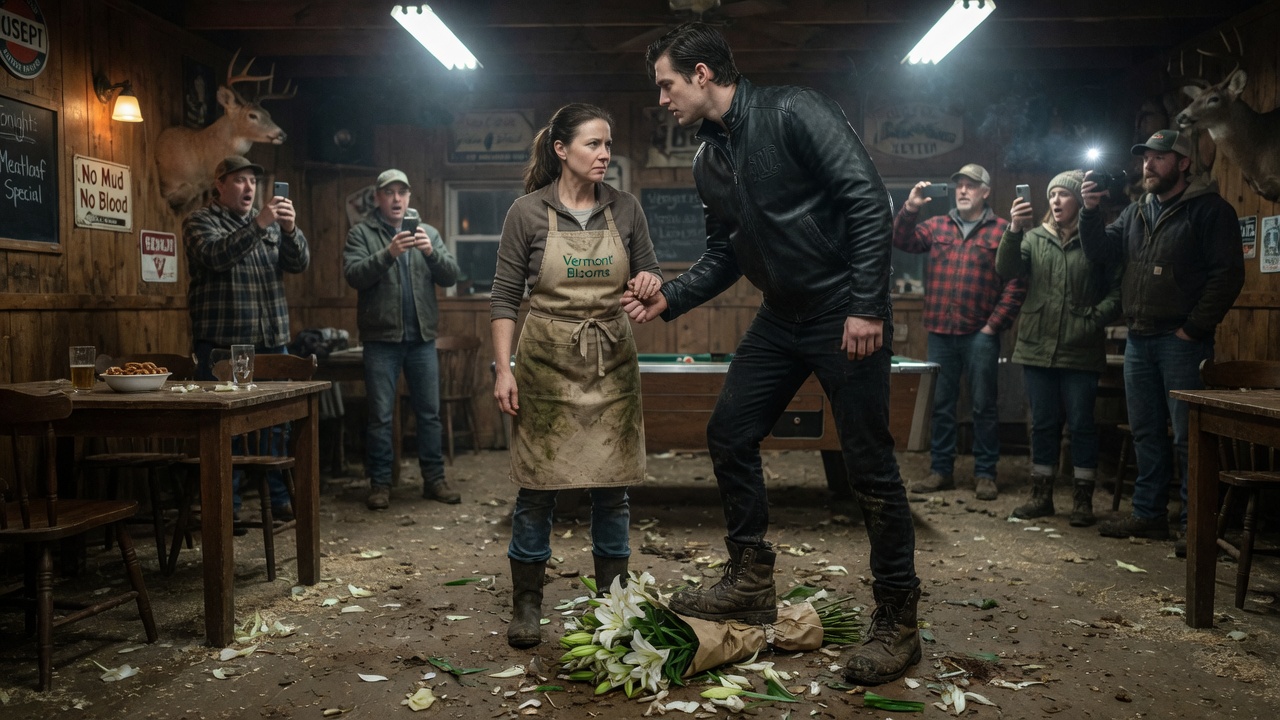
Sophie was at the kitchen table, a half-eaten bowl of cereal in front of her and a math textbook open. She looked up, her brow furrowed. Elena realized she was still wearing her florist’s apron, now stained with the green ichor of crushed lily stems and the grey sawdust of the tavern floor.
“You’re late,” Sophie said, her eyes drifting to Elena’s hands. Elena reflexively tucked them into the pockets of her apron. “And you look… weird. Did something happen at the shop?”
Elena forced a breath into her lungs, trying to find the “Lena” voice—the soft, maternal tone she’d cultivated to bury the ghost of the Chicago mob accountant. “Just a long day, Soph. A lot of orders for the weekend. I had to stop by the tavern to handle a delivery issue.”
Sophie went still. She picked up her phone from the table, her thumb hovering over the screen. “Is that why this is on the Oakhaven Community page?”
She turned the phone around. The video was grainy, shot from a low angle near the bar. It started with Silas grabbing Elena’s collar. It ended with Elena’s final warning. The comments were already a landslide: Who is this woman?, Finally someone stood up to him, She’s going to get run out of town, Did you see that kick? That wasn’t a florist.
Elena felt the room go cold. The one thing she had traded her life for—anonymity—was evaporating in a cloud of digital pixels. In Chicago, being seen meant being a target. In Oakhaven, it meant the same thing, just a different kind of hunter.
“Mom,” Sophie whispered, her voice cracking. “How did you do that? You always told me you were just… a nerd. That you worked in an office.”
“I did work in an office, Sophie,” Elena said, moving toward her, her mind already calculating the variables of their exit. Do we have enough gas? The emergency cash is in the crawlspace. The Marshals… if I call the Marshals, we lose everything again. “But people are complicated. Sometimes you have to protect yourself.”
“That wasn’t ‘protecting yourself,'” Sophie said, standing up. “That was like a movie. You didn’t even look scared. You looked… bored. Like you were just doing chores.”
The phone on the counter buzzed. Then it buzzed again. And again. Elena didn’t have to look to know it wasn’t customers.
The first real blow came thirty minutes later. It wasn’t a fist; it was a heavy knock on the front door that didn’t wait for an invitation.
Deputy Miller stood on the porch, the snow matted into the wool of his uniform jacket. He didn’t look like the friendly local lawman. He looked like a man who had just been handed a problem he couldn’t ignore.
“Elena,” he said, stepping into the mudroom without being asked. He smelled of cold air and peppermint. “We need to talk. And Sophie should probably go to her room.”
“I’m not a kid, Miller,” Sophie snapped, though she was shaking.
“Upstairs, Soph,” Elena said, her voice leaving no room for argument.
Once the girl was gone, Miller turned to Elena. He didn’t sit down. He leaned against the doorframe, his hands resting on his belt, near his service weapon.
“The tavern was full of witnesses, Elena. Silas is at the clinic. He’s got two cracked ribs and a collapsed lung. His father is screaming for an assault charge. Aggravated. He’s claiming you used a weapon.”
“My hands were empty,” Elena said flatly.
“I know that. I’ve seen the video. Half the town has seen the video.” Miller stepped closer, dropping his voice. “The problem isn’t the assault, Elena. The problem is the technique. I spent six years in the Corps, most of it in MARSOC. I know a professional structure-break when I see one. You didn’t swing a purse. You dismantled a man twenty years younger and fifty pounds heavier than you in four seconds.”
“I took a self-defense class in Chicago,” Elena lied. It was a weak lie, a bookkeeper’s error.
“Don’t,” Miller said, and for a second, the frustration broke through his professional mask. “Arthur Blackwood owns the judge in this county. He owns the DA. He’s going to come for you with everything the law allows, and when that doesn’t work, he’s going to use the things the law doesn’t cover. He’s already asking questions about where you came from. He’s got people looking into your ‘Moretti’ name.”
Elena felt the old, familiar weight of the Black Ledger in her mind. Every name she’d ever hidden, every dollar she’d ever moved. She looked at the Deputy, searching for the Marine behind the badge.
“What are you saying, Miller?”
“I’m saying you have about six hours before the paperwork is filed to have you detained for questioning. Once you’re in the system, your fingerprints go to the feds. If you’re running from what I think you’re running from, that’s a death sentence.”
He reached into his pocket and pulled out a small, folded piece of paper. “This is a contact for a friend of mine in Burlington. He does private security. He can get you across the border into Canada tonight. No questions asked.”
Elena looked at the paper, then at the stairs where her daughter was hiding. “If I run, I prove I’m a criminal. Sophie grows up thinking her mother is a monster. And Arthur Blackwood keeps taking ‘taxes’ from people like Martha Gable and Jim.”
“Arthur Blackwood is a shark in a birdbath,” Miller said. “He’s dangerous here, but he’s nothing compared to whatever made you learn how to fight like that. Protect your daughter, Elena. Get out.”
He left as quietly as he’d arrived, leaving the scent of peppermint and the chill of the North Woods behind.
Elena didn’t look at the paper. She walked to the kitchen and pulled a heavy iron skillet from the cupboard. She didn’t cook. She sat at the table and began to map the Blackwood family. Not their muscles, but their marrow.
Arthur Blackwood owned the mill. He owned the local construction firm. He owned the tavern. On paper, he was a pillar of the community. But Elena had seen the box meant for the mill. She had seen the “tax” list.
A man like Arthur didn’t just bully for the sake of it. Bullying was a tool for control, and control was a tool for profit. He was skimming. He was laundering. He was doing exactly what the Chicago families did, just on a smaller, more arrogant scale.
She went to the back room and pulled up the floorboard. She ignored the Chicago ledger. That was her past. Instead, she grabbed a thick stack of bank statements and property records she’d been quietly collecting for months—the “just in case” file she’d built the moment she realized Oakhaven had its own set of lords.
She spent the next four hours doing what she did best. She followed the numbers. She looked at the mill’s utility bills vs. their reported output. She looked at the construction firm’s “consulting fees.” She mapped the flow of the “tax” money Martha and Jim paid. It didn’t go into a business account. It disappeared into a series of shell companies registered to a PO Box in Delaware.
By 2:00 AM, she had it. The Blackwood empire wasn’t a fortress; it was a house of cards held together by local fear.
The phone rang. It was an unknown number. Elena answered it, her voice cold.
“Moretti.”
“I hope you’re packing, Lena.” The voice was deeper than Silas’s, more controlled, but with the same rot at the core. Arthur Blackwood. “Because the state troopers will be there at seven. And I’ve made sure they know you’re ‘armed and dangerous.’ It’d be a tragedy if something happened during the arrest. Especially with that little girl of yours in the house.”
“You’re making a mistake, Arthur,” Elena said, her eyes fixed on the spreadsheet she’d hand-drawn on the kitchen table.
“The mistake was thinking you could lay a hand on a Blackwood and stay in this town,” Arthur said. “You’re a guest here. And your invitation just got revoked.”
“I’m not a guest,” Elena said. “I’m an accountant. And I’ve just finished auditing your books.”
There was a long silence on the other end of the line. The arrogance didn’t vanish, but it flickered. “I don’t know what you’re talking about.”
“I’m talking about the thirty-two percent discrepancy in the mill’s timber exports,” Elena said, her voice a calm, rhythmic drone. “I’m talking about the ‘consulting fees’ you’ve been paying to a company called Blue Spruce Holdings—which, interestingly, shares a tax ID with your private hunting lodge. I’m talking about the four hundred thousand dollars in ‘community contributions’ that never made it to the town council’s ledger.”
“You’re bluffing,” Arthur hissed, but the sound of his breathing had changed.
“I don’t bluff with numbers, Arthur. Numbers are the only thing in this world that don’t lie. I have the routing numbers. I have the signatures. And I have a very good relationship with a few people who would love to see where that money actually went.”
“If you release that, you’re dead,” Arthur said. “I’ll make sure of it.”
“If you send those troopers at seven, I send this file to the IRS and the FBI at six-forty-five,” Elena said. “I might go down, Arthur. I might have to run. But you? You’ll spend the rest of your life in a federal prison in Pennsylvania. And Silas? Silas won’t last a week in general pop.”
“What do you want?”
“I want the assault charges dropped. I want a signed statement from Silas admitting he initiated the physical contact. And I want the ‘tax’ to stop. For everyone. Martha, Jim, all of them. You’re going to announce a ‘debt jubilee’ for the local businesses.”
“You’re insane.”
“I’m a mother who just wants to be left alone to sell flowers,” Elena said. “You have four hours. I’ll be at the shop at dawn. Bring the paperwork yourself. No associates. No guns. Just you and the truth.”
She hung up before he could answer.
She looked up. Sophie was standing in the doorway, wrapped in a blanket, her eyes wide.
“Mom?”
“Go back to sleep, Soph,” Elena said, her voice softening. “I’m just finishing the books.”
But she didn’t sleep. She sat by the window, watching the snow fall, the Chicago ledger still heavy under the floorboards, a reminder that some debts are never truly paid, only managed.
Chapter 6
The dawn was a bruised purple, the kind of light that made the snow-covered streets of Oakhaven look like a graveyard. Elena stood inside Prickly Peace, but she didn’t turn on the lights. She sat behind the counter, the smell of damp earth and refrigerated carnations surrounding her.
She had her shears on the counter. Next to them was the folder—the audit of the Blackwood family’s soul.
At 6:15 AM, a black Mercedes pulled up to the curb. It didn’t idle. The engine cut out, and a man stepped out. Arthur Blackwood was in his late fifties, silver-haired and tailored, the kind of man who looked like he belonged on the cover of a bank’s annual report. He didn’t look like a mobster. He looked like a success story.
He pushed the door open, the bell chiming with a hollow, lonely sound. He didn’t look at the flowers. He looked at Elena.
“You have a very dangerous set of skills for a florist, Ms. Moretti,” Arthur said, his voice tight.
“Everyone has a hobby, Arthur,” Elena replied. “Did you bring the papers?”
He tossed a thick manila envelope onto the counter. Elena opened it. A signed affidavit from Silas, witnessed by a notary, stating he had slipped on the floor and that Elena had acted in a ‘defensive, non-combative manner’ to steady him. A formal withdrawal of the police report. And a letter, addressed to the business owners of Oakhaven, stating that the ‘marketing fees’ were being suspended indefinitely due to a restructuring of Blackwood interests.
Elena scanned them with the eyes of a woman who had checked ten thousand lines of code for a single misplaced decimal.
“This is a good start,” she said.
“It’s the end,” Arthur countered, stepping closer. “You think you’ve won? You’ve just made yourself the most visible person in this county. People don’t like it when the status quo changes. They might be happy to stop paying me today, but tomorrow? Tomorrow they’ll wonder why a woman with your… background… is hiding in their town.”
“I’m not hiding anymore,” Elena said. “That was my mistake. I thought if I was quiet enough, the world would forget I existed. But the world doesn’t forget. It just waits.”
“My son is in a hospital bed because of you,” Arthur said, his voice trembling with a controlled, cold rage. “He’ll never be the same. He’s afraid of his own shadow.”
“Good,” Elena said. “Maybe now he’ll understand what it feels like to be Martha Gable. Or my daughter.”
Arthur leaned over the counter, his eyes boring into hers. “You’re a ghost, Elena. I can smell the Chicago on you. I did some digging last night. Moretti isn’t a florist’s name. It’s a witness name. You’re a rat.”
Elena didn’t blink. The word didn’t hurt. She’d heard it shouted in courtrooms; she’d seen it scrawled in blood on her brother’s doorstep. “The thing about rats, Arthur, is that they’re survivors. And they know where all the holes are. If you ever come near me or my daughter again—if you even look at my shop from across the street—I won’t just audit you. I’ll liquidate you.”
Arthur stared at her for a long beat, searching for a crack, a flicker of the ‘Target’ he had expected to find. He found nothing but the cold, methodical resolve of a woman who had already lost everything once and had nothing left to fear.
He turned and walked out without another word. The bell chimed. The Mercedes pulled away.
Elena sat in the silence for a long time. She felt a strange, hollowed-out lightness. The local threat was neutralized, but the cost was absolute. She was visible now. The video was out there. The name “Moretti” was being whispered.
She went to the back room and pulled up the floorboards one last time. She took the Black Ledger—the Chicago one—and walked to the small woodstove in the corner of the shop.
She opened the book. She looked at her brother’s name on the first page. Tomaso Moretti. Account Closed.
She fed the pages into the fire, one by one. The names of senators, the routing numbers of hitmen, the secrets that had kept her alive and imprisoned for ten years. The leather cover curled and hissed in the heat, the smoke smelling of old paper and bitter ink.
By the time the sun was fully up, the ledger was ash.
She spent the morning cleaning. She threw away the ruined lilies. She polished the glass of the display cases. She moved with a slow, deliberate grace, reclaiming the space.
Around noon, the bell chimed. It was Martha Gable. She was holding a tray of cinnamon rolls, her hands still shaking, but her eyes were different. They were bright.
“Elena,” Martha whispered, looking around the shop as if expecting Silas to jump out from behind a fern. “I got the letter. We all did. Jim called me, crying. He said he can finally afford the surgery for his hip.”
“That’s good news, Martha,” Elena said, her voice steady.
Martha set the tray on the counter and reached out, covering Elena’s hand with her own. “They’re saying you’re a hero. But they’re also saying… they’re saying you’re dangerous. People are scared, Elena. They’re grateful, but they’re scared.”
“I know,” Elena said. “People usually are when they see the truth.”
“Are you going to stay?”
Elena looked out the window. Across the street, Deputy Miller was parked in his SUV. He caught her eye and gave a single, sharp nod—a soldier’s acknowledgment.
“For a while,” Elena said. “As long as the flowers grow.”
When Sophie came to the shop after school, she didn’t ask about the video. She didn’t ask about the Blackwoods. She walked behind the counter and hugged Elena, burying her face in the tan apron.
“Mom?”
“Yeah, Soph?”
“Can you teach me?”
Elena pulled back, looking at her daughter’s face—the face of a girl who was no longer a child, who lived in a world where florists had to be warriors.
“Teach you what? How to trim roses?”
“No,” Sophie said, her voice firm. “How to not be afraid.”
Elena looked at the empty space under the floorboards, then at the ashes in the woodstove, then at the daughter who was the only ledger that ever mattered.
“Okay,” Elena said. “But first, we’re going to learn how to count. Every cent, Sophie. Every debt. Because in this world, if you don’t know the numbers, someone else will always own the sum.”
They stood together in the quiet shop, the scent of Prickly Peace thick in the air. Outside, the snow continued to fall, burying the tracks of the Mercedes and the tavern’s sawdust, covering the small town in a layer of white that looked like a fresh start, even if they both knew the thorns were still there, waiting just beneath the surface.
Elena picked up her shears and reached for a fresh stem of eucalyptus. Her hands were steady. The mask was gone, replaced by a face that was finally, painfully, her own.
The account was balanced. For now.