Chapter 5
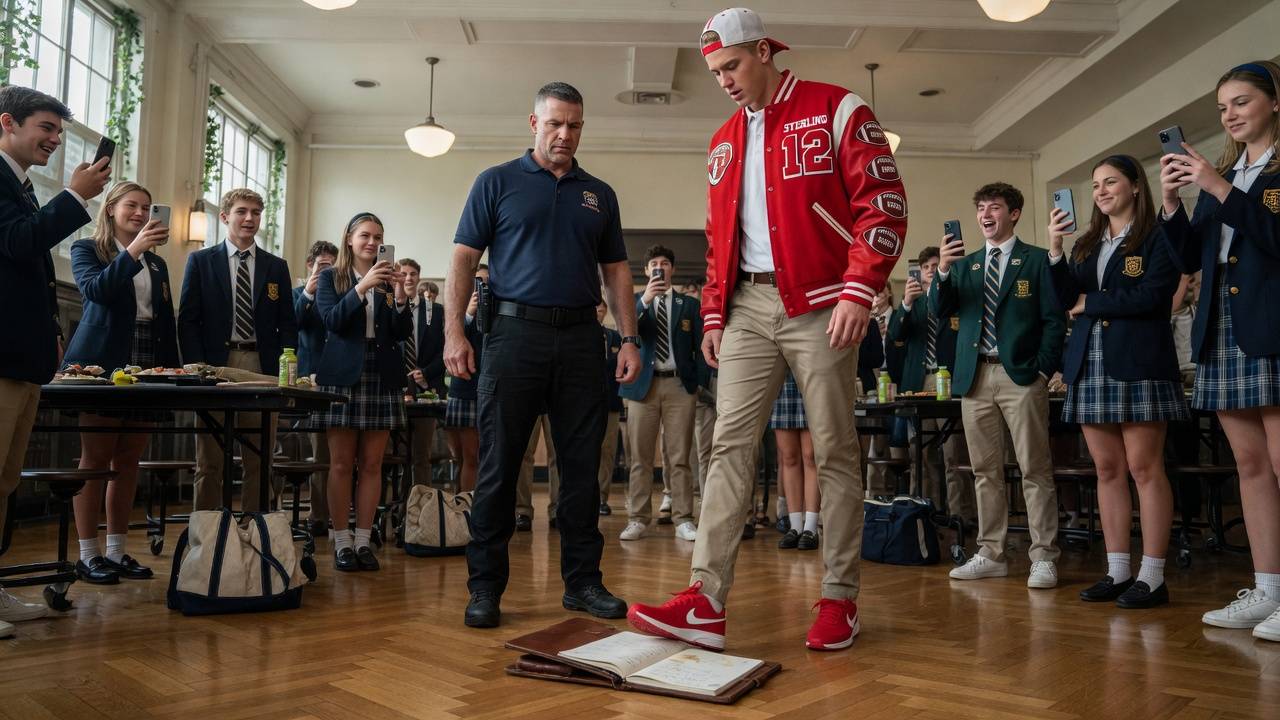
The silence that followed the lockdown announcement was a physical weight, heavier than the humid, lasagna-scented air of the cafeteria. Marcus didn’t look at the students. He didn’t look at the flashing smartphones that were surely already transmitting the image of St. Jude’s golden boy weeping on a linoleum floor to every corner of the internet. He stood in the center of the room, a pillar of navy blue polyester and cold, professional intent. His heart rate, which had spiked to 110 during the three-beat engagement, was already sliding back down to a resting sixty.
“Everyone stay where you are,” Marcus said. It wasn’t a shout. It was the voice of a man who expected to be obeyed, a voice that had navigated firefights in Mosul and extraction zones in the dark corners of the world. The students, children of CEOs and senators, children who had never been told no without a negotiation, found themselves frozen. They weren’t staying still because of the rules; they were staying still because the man standing over Hunter Sterling had suddenly become the only real thing in their sanitized universe.
Principal Vance was the first to move, his polished loafers clicking erratically as he rushed toward the center of the room. He looked at Hunter, then at Marcus, his face a frantic mask of terror and calculation. “What have you done?” Vance hissed, his voice cracking. “Marcus, do you have any idea what you’ve just done? This is… this is assault! I told you to be invisible! I told you—”
“I am invisible, Arthur,” Marcus said, calling the Principal by his first name for the first time. He didn’t look at him. His eyes were on the cafeteria doors. “The man you hired to be your punching bag is gone. The man who is currently securing your perimeter is the man you actually paid for.”
The heavy oak doors of the cafeteria swung open with a synchronized bang. Three men in tactical black, wearing “VALIANT SECURITY CONSULTING” patches on their vests, entered the room. They didn’t run; they moved with the rhythmic, sweeping grace of professionals. They ignored the students, fanning out to the exits. One of them, a man named Miller who had served with Marcus in the 75th, approached Marcus and gave a crisp nod.
“Perimeter secure, Boss. Local PD has been notified of a ‘controlled training exercise’ at this coordinates. They’re holding at the gate as per the contract,” Miller reported.
“Good,” Marcus said. He looked down at Hunter. The boy was still on the floor, his breathing ragged, his red varsity jacket stained with blue Gatorade and the dust of his own humiliation. “Get him up. Take him to the Principal’s office. Call his father. Tell Mr. Sterling that the audit is complete, and the results are ready for review.”
The “Clean-up crew” moved with terrifying efficiency. The students were ushered out of the cafeteria in an orderly line, their phones still clutched in their hands, their faces pale. The “Varsity Elite,” the wolves who had spent the week nipping at Marcus’s heels, looked like sheep being led to the slaughter. They wouldn’t look him in the eye. They couldn’t.
Marcus stayed in the cafeteria for a moment after it emptied. He looked at the mess on the floor—the spilled food, the ruined notebook, the discarded tray. He felt the old wound in his shoulder throb, a phantom reminder of the high-value target he’d failed to protect in a city halfway across the world. He had succeeded here, in a way. He had proven that the school’s security was a joke and its social structure a liability. But the success tasted like ash.
An hour later, Marcus sat in the Principal’s office. He had changed out of the lasagna-stained polo into a crisp, charcoal-grey suit that fit his frame like armor. He sat across from Arthur Vance and a man who looked like a more weathered, more dangerous version of Hunter: Richard Sterling.
Sterling Sr. didn’t look like a man whose son had just been humiliated. He looked like a man who was deciding which part of the room to set on fire first. He paced the small office, his expensive watch catching the light. Hunter sat in the corner, wrapped in a school blanket, his eyes red-rimmed and fixed on the floor.
“You touched my son,” Sterling said, his voice a low, vibrating growl. He stopped pacing and leaned over the desk, his face inches from Marcus’s. “I don’t care who you work for. I don’t care what ‘audit’ the Board signed off on. You laid hands on a Sterling. I will own you by the end of the week. I will strip that firm of yours until there isn’t enough left to buy a cup of coffee.”
Marcus didn’t blink. He reached into his pocket and pulled out a small, high-definition body-camera. He placed it on the desk between them.
“This has been recording since 07:00 Monday morning,” Marcus said. His voice was flat, devoid of the gravelly guard-persona he’d been wearing. “It recorded your son nearly hitting me with his vehicle on Monday. It recorded the verbal abuse on Tuesday. It recorded him destroying proprietary security documentation on Wednesday. And it recorded the incident in the cafeteria today—specifically, the part where your son initiated physical contact and I responded with the minimum force required to neutralize a threat.”
“Minimum force?” Sterling roared. “He’s a child!”
“He’s seventeen,” Marcus countered. “In six months, he could be in uniform. If he acted like that in the field, he wouldn’t be crying on a floor; he’d be in a body bag. Your son isn’t a child, Richard. He’s a liability. And because you’ve spent seventeen years teaching him that the world belongs to him, you’ve made him the single greatest security risk this school has.”
Vance tried to intervene. “Now, Marcus, let’s be reasonable. The audit was supposed to be about the fence, the cameras—”
“The ‘fence’ was bypassed on Monday night, Arthur,” Marcus said, turning his gaze to the Principal. “I let a team of three ‘intruders’ walk right past my desk. They were in your server room for twenty minutes. They could have taken every social security number, every bank routing number, every private medical record in this building. But they didn’t. They just left a note. You were so worried about keeping the donors happy that you didn’t notice the house was already on fire.”
Marcus leaned back, his eyes returning to Sterling. “The footage from this camera is already on a secure server at Valiant headquarters. It’s also been copied to a legal firm in D.C. If you try to ‘own’ me, or my firm, that footage goes to every major news outlet in the country. ‘Billionaire’s Son Assaults Undercover Security Expert.’ How does that play for the Board of Trustees, Richard? How does that look for your next round of funding?”
The room went silent. The threat was a clean, surgical strike. Sterling Sr. looked at the camera, then at his son. For a moment, a flash of genuine shame crossed the older man’s face—not for his son’s behavior, but for the weakness of being caught.
“What do you want?” Sterling asked, his voice tight.
“I want my contract paid in full,” Marcus said. “And I want a letter of recommendation for the guard who actually will be taking this post next week—a young man named Leo, who’s currently a student here. He’s the only one in this entire building who saw me for what I was. He’s got more tactical awareness than your entire security staff combined.”
“Leo?” Vance stammered. “The scholarship boy?”
“The boy your son has been using for target practice,” Marcus said. He stood up, the chair scraping against the floor. He looked at Hunter one last time. The boy looked up, and for a split second, there was no anger in his eyes—only the crushing realization that the world didn’t actually belong to him.
“The audit is over,” Marcus said. “The gate is closed.”
He walked out of the office, the weight of the suit feeling heavier than the tactical vest ever had. He passed through the hallways, which were now eerily quiet. The students watched him from the doorways of their classrooms, their expressions a mix of awe and fear. He was no longer the rent-a-cop. He was the man who had broken the untouchable.
He found Leo in the library, sitting at the same back table. The boy looked up as Marcus approached. He didn’t look surprised.
“You’re leaving,” Leo said.
“Mission’s over,” Marcus replied. He reached into his pocket and pulled out a small, silver coin—a challenge coin from his old unit. He placed it on the table in front of the boy. “You saw me, Leo. You saw the movement. Why didn’t you say anything?”
Leo looked at the coin, his fingers tracing the embossed eagle. “Because I wanted to see if someone like you could actually win in a place like this.”
“Did I win?” Marcus asked.
Leo looked around the expensive library, at the glass walls and the students who were already whispering about the video. “You changed the gravity. That’s enough for now.”
Marcus nodded. He walked out of the school and into the crisp Connecticut afternoon. He climbed into his F-150 and sat there for a long time, looking at the photo of Caleb on the dashboard. He had protected the “kids” this time. He had done the job. But as he started the engine, the silence of the cab felt like a question he didn’t know how to answer. He pulled out his phone and stared at a number he hadn’t dialed in three years. His thumb hovered over the “call” button.
He wasn’t a ghost anymore. But he wasn’t home yet, either.
Chapter 6
The drive away from St. Jude’s felt like an ascent from a deep-sea dive. The pressure of the elite preparatory world—the artificial politeness, the simmering class warfare, the sheer, unadulterated arrogance of the Sterling family—slowly bled away as Marcus hit the interstate. He kept the truck at a steady sixty-five, his eyes scanning the horizon not for threats, but for the sense of peace that always seemed to elude him.
He stopped at a diner forty miles south, a place where the air smelled of burnt coffee and the patrons wore clothes that hadn’t been dry-cleaned in a decade. He sat at the counter, his suit jacket draped over the stool next to him. The waitress, a woman with tired eyes and a name tag that read Bev, set a mug of black coffee in front of him without asking.
“Rough day at the office, honey?” she asked, her voice a comforting rasp.
“Testing the fence,” Marcus said, his voice sounding strange even to himself. “Turns out, the fence was made of glass.”
He took a sip of the coffee. It was bitter and hot, and it felt more real than anything he’d touched in that Connecticut prep school. He pulled out his phone again. The screen glowed with the unsent call to Caleb.
His son was twenty-three now. A man. Probably finishing his own training, probably wearing a uniform that Marcus had once worn with pride and now viewed with a complicated sense of mourning. Marcus remembered the last time he’d seen him—the shouting match in the driveway, the way Caleb had looked at him with a mix of hero-worship and pure, unadulterated disgust. “You’re not a father, Marcus. You’re a handler. You don’t love people; you secure them.”
Marcus closed his eyes. The words still cut deeper than any shrapnel. He thought about Hunter Sterling, a boy who had been loved too much and taught too little. He thought about Leo, a boy who had been taught too much and loved not at all. He had spent his life securing the perimeter, but he’d left the center of his own world undefended.
The bell above the diner door chimed. Marcus’s hand instinctively moved toward his waist, checking for a weapon that wasn’t there. He forced himself to relax. He was a civilian now. Sort of.
He finished his coffee and left a twenty on the counter. “Keep the change, Bev.”
“God bless you, sugar,” she called out as he walked toward the door.
Back in the truck, Marcus pulled out a thick manila folder from under the passenger seat. It was the final report for the Board of Trustees. He flipped through the pages, his own handwriting stark and clinical.
Recommendation 1: Immediate termination of current security protocols. Recommendation 2: Social sensitivity training for faculty and staff. Recommendation 3: Implementation of a merit-based social reset.
He added a final note at the bottom of the last page. The greatest vulnerability of St. Jude’s is not the lack of cameras or guards. It is the belief that status is a shield. A shield of glass is only clear until it shatters.
He mailed the folder from a post office in a town whose name he didn’t bother to read. As the envelope slid into the slot, he felt a sudden, sharp release. The Gatekeeper was officially off-duty.
He drove for three more hours, heading toward a small cabin in the woods of Pennsylvania—the only place he truly owned. It was a place of woodsmoke and silence, a place where he didn’t have to be a ghost or a hero. He arrived as the sun was dipping below the tree line, casting long, orange shadows across the clearing.
He stepped out of the truck and stood in the grass, listening to the wind in the pines. It was a different kind of silence than the one in the cafeteria. This silence didn’t have expectations.
He walked onto the porch and sat in an old wooden rocker. He pulled out his phone one last time. He didn’t hesitate this time. He hit the button.
The phone rang three times. Four. Marcus was about to hang up, his heart thudding against his ribs like a trapped bird, when the line clicked open.
“Hello?” The voice was deeper than Marcus remembered. Stronger.
“Caleb,” Marcus said. His voice caught in his throat.
There was a long pause on the other end of the line. Marcus could hear the sound of traffic in the background, a distant siren. He could almost see Caleb standing on a street corner somewhere, his brow furrowed, his jaw set in that same stubborn line Marcus saw in the mirror every morning.
“Dad?” Caleb asked. The word was hesitant, layered with years of unfinished business.
“Yeah,” Marcus said. He cleared his throat, looking out at the darkening woods. “It’s me.”
“I… I didn’t think you had this number anymore,” Caleb said.
“I kept it,” Marcus said. “I kept it the whole time.”
Another silence, but this one felt less like a wall and more like a bridge.
“I heard about the St. Jude’s thing,” Caleb said. “It’s all over the news. The video of you taking down that quarterback. The internet is calling you the ‘John Wick of Security Guards.'”
Marcus let out a short, dry laugh. “They got the name wrong. I was just the guy testing the fence.”
“You did more than that, Dad,” Caleb said, his voice softening. “I saw the way you stood there after. You didn’t look like a machine. You looked… tired.”
“I am tired, Caleb,” Marcus admitted. The confession felt like a physical weight leaving his chest. “I’m very tired.”
“Where are you?” Caleb asked.
“I’m at the cabin. The one your mother used to like.”
“I remember,” Caleb said. “I remember the smell of the pine needles. And the way the stars looked.”
“The stars are still here,” Marcus said. He took a breath, the cold night air filling his lungs. “I was thinking… if you’re not too busy with your deployment prep… maybe you could come down for a weekend. I’ve got some wood to chop. And I think I still have that old fishing gear in the shed.”
The silence on the other end of the line lasted so long that Marcus thought the connection had dropped. He was about to speak again, to apologize, to offer a way out, when Caleb spoke.
“I can be there by Friday night,” Caleb said.
“Friday,” Marcus repeated. “I’ll have the fire going.”
“Dad?”
“Yeah, son?”
“Don’t secure the perimeter. Just… be there.”
“I’ll be there,” Marcus said.
He hung up the phone and sat in the dark for a long time. The stars were beginning to poke through the canopy of the trees, bright and uncaring. He looked at the cabin, a small, sturdy structure against the vastness of the woods. It wasn’t a fortress. It didn’t have high-definition cameras or motion sensors or a state-of-the-art security system.
But for the first time in his life, Marcus felt safe.
He stood up and walked into the cabin, the floorboards creaking under his weight. He didn’t check the locks. He didn’t scan the corners. He just walked to the kitchen, poured a glass of water, and watched the moonlight spill across the table.
The Gatekeeper had finished his audit. The results were in. And as Marcus lay down to sleep, the only sound in the room was the steady, rhythmic beat of a heart that was no longer trying to be a machine.
He had protected the kids. He had shattered the glass. And now, finally, he was going home.