Chapter 5
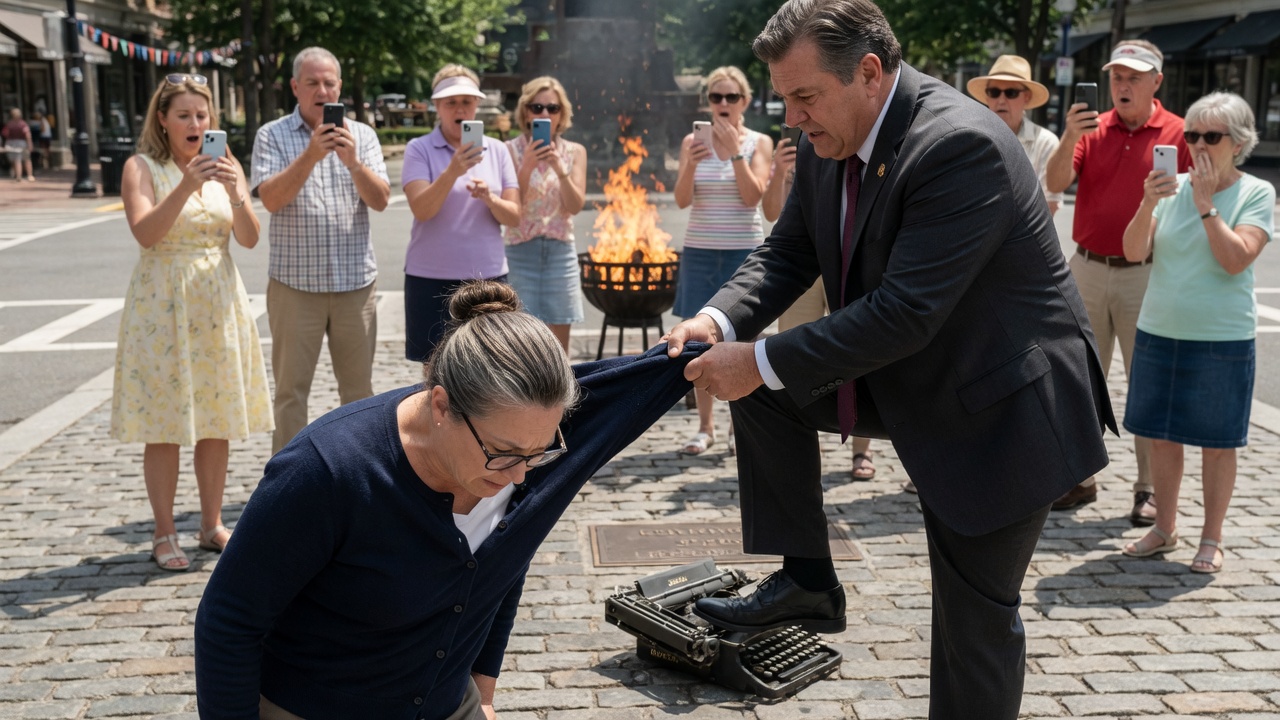
The silence in the Oakhaven town square didn’t last. It was replaced by a low, rhythmic sound—the frantic tapping of five hundred fingers on five hundred screens. The video was already out. Before Julian Vane even managed to pull himself into a seated position, his collapse had been uploaded, shared, and tagged. The Mayor of Oakhaven, the man who had held the town in a velvet-gloved fist for two decades, was on the ground, his expensive suit coated in the ash of the very history he had tried to burn.
Mark moved first. He didn’t move like a son; he moved like a Sheriff. He stepped between Diane and Julian, his hand hovering near his holster, his face a mask of professional neutrality that Diane knew was a lie. His jaw was so tight she could see the muscle jumping in his cheek.
“Mom,” he said, his voice a low, warning vibration. “Step back. Right now.”
Diane didn’t move. She felt a strange, cold clarity. The adrenaline that had fueled the three-beat strike was gone, replaced by a crystalline stillness. She looked at Julian, who was finally finding his feet. He looked diminished. His hair, usually a perfect silver wave, was mussed, and a dark smudge of ash marked his cheek. But it was his eyes that had changed. The arrogance was gone, replaced by a raw, naked hatred that made him look older than fifty-two.
“You’re under arrest,” Julian wheezed, pointing a shaking finger at Diane. “Mark, arrest her. Assault on a public official. Now!”
Mark didn’t look at Julian. He looked at the crowd. He saw the phones. He saw the way people were looking at him—waiting to see if the Sheriff was a lawman or a Vane loyalist.
“I’m taking her to the station, Julian,” Mark said, his voice flat. “Everyone else, go home. The festival is over.”
“It’s not over!” Julian shouted, but his voice lacked its usual resonance. It sounded thin, like a reed. “I want her in handcuffs, Mark. I want her in a cell!”
“I said go home,” Mark repeated, and this time, the authority in his voice was real.
He didn’t put Diane in handcuffs. He took her by the elbow—a firm, guiding grip—and led her toward the patrol car parked near the clock tower. As they passed the crowd, Diane saw Sarah Miller. The girl was pale, her hands shaking as she clutched the thumb drive, but she nodded once. She was already moving toward her car. The fuse was lit.
The drive to the station was silent. Oakhaven passed by the windows like a movie Diane had seen too many times. The historic houses with their manicured lawns, the boutiques, the library sitting on the hill like a silent sentinel.
Once inside the station, Mark led her not to a cell, but to his private office. He slammed the door shut and stood with his back to it, his chest heaving.
“What were you thinking?” he whispered. The neutrality was gone. He looked like a boy who had just seen his world catch fire. “In front of everyone, Mom? You attacked the Mayor.”
“I defended myself, Mark. He put his hands on me. He destroyed my property.”
“He was making a point! It was a ceremony!” Mark threw his hat onto his desk. “Do you have any idea what they’re going to do to you? Julian is already calling the county prosecutor. They’re going to take your house. They’re going to bury you under so many lawsuits you won’t be able to afford a lawyer, let alone the library’s pension.”
“They were going to do that anyway,” Diane said. She sat in the hard plastic chair across from his desk. “Julian told me yesterday. He’s clearing out the basement. He’s erasing your father, Mark. He’s erasing the truth.”
Mark leaned over the desk, his face inches from hers. “The truth? You mean the ‘secrets’ you’ve been obsessed with for twenty years? The ones that turned you into the ‘crazy librarian’? Mom, Dad died in an accident. It’s over. It’s been over.”
“It was an easement,” Diane said softly.
Mark paused. “What?”
“A back-dated easement. For the highway project. Julian’s father signed it three days after the project was finalized. It was illegal. It was worth millions in kickbacks. Your father found it, and three days later, his car went off a dry road in the middle of the night. Julian knows where the signatures are. He’s been protecting them ever since.”
Mark straightened up, a look of profound weariness crossing his face. “This is what I mean. You’ve lived in this conspiracy for so long you can’t see reality anymore. Even if that’s true, it was twenty years ago. It doesn’t justify what you did today.”
“I didn’t just give Sarah the easement, Mark. I gave her everything. Every conversation Julian ever had in that library. Every deal. Every threat. I gave her the recording of Julian telling me he’d have you served with an eviction notice if I didn’t play along.”
Mark’s face went bloodless. “You recorded him? In the library?”
“I bugged the study rooms twenty years ago. I’ve heard everything, Mark. I know who Julian’s wife is having an affair with. I know which Council members are taking money from the developer. I know why the old janitor, Abe, has a limp. It’s all on that drive.”
The weight of it finally seemed to hit him. He sat down heavily in his chair. “You’ve been a spy. My whole life… you weren’t just at work. You were building a bomb.”
“I was building a shield,” Diane corrected him. “But today, Julian decided he wanted a war. So I gave him one.”
The phone on Mark’s desk began to ring. It didn’t stop. It rang, went to voicemail, and rang again. Through the window of the office, Diane could see the deputies in the squad room. They were gathered around a computer, their faces illuminated by the blue light of the monitor. They weren’t working. They were watching the video.
The backlash began within the hour.
Evelyn Vane arrived at the station first. She didn’t come to see Diane; she came to see Mark. Through the glass, Diane watched as Julian’s wife stormed into the room, her pastel cashmere now looking like a uniform of war. She was shouting, her face contorted. Mark stood up to meet her, his hands out in a placating gesture, but Evelyn wasn’t there to be placated.
She pointed a finger at Diane, her mouth moving in a silent snarl.
Mark opened the door and stepped out, closing it behind him, but Diane could still hear the muffled echoes of the conversation.
“—contract is terminated as of five minutes ago!” Evelyn was screaming. “The Council held an emergency vote. She is no longer an employee of the town. She is a trespasser. We want her out of that house by midnight, Mark. If you don’t serve the papers, we’ll find a Sheriff who will.”
“Evelyn, calm down,” Mark’s voice was a low rumble. “You can’t evict someone in six hours. There’s a process.”
“The process is whatever Julian says it is! She assaulted the Mayor! She’s a criminal! And that girl, that reporter—Julian’s lawyers are already filing an injunction to stop her from publishing anything. If you don’t arrest your mother right now, Mark, you’re finished in this town. Your father’s name won’t save you this time.”
Diane watched her son. She saw the way his shoulders slumped. He was being forced to choose, and the choice was impossible. If he stood by her, he lost his career, his standing, and the only life he knew. If he arrested her, he became the very thing his father had died fighting.
Evelyn stormed out, and Mark returned to the office. He looked older. He didn’t look at Diane. He went to his filing cabinet and pulled out a stack of forms.
“I can’t keep you here, and I can’t let you go,” he said, his voice trembling. “Julian is filing a formal complaint. The judge—Judge Miller, Julian’s golf partner—is already signing the warrant for the library archives. They’re going to seize everything, Mom. Every box. Every scrap of paper.”
“They won’t find it,” Diane said. “I moved the Encyclopedia.”
“Where?”
“In the books, Mark. In the ones they wanted to throw away. They’re sitting in the donation crates by the back door.”
Mark looked at her, and for a second, a flicker of something that might have been pride—or perhaps just sheer disbelief—crossed his face. “You hid the truth in the books they wouldn’t read.”
“It’s the safest place in Oakhaven,” she said.
The door to the station opened again, and this time, it wasn’t a Vane. It was Abe. The old janitor was limping faster than usual, his face pale. He was carrying a small transistor radio.
“Mark! Diane!” he called out. “You gotta hear this.”
He set the radio on Mark’s desk and turned up the volume. It was the local news station out of Portland, but they weren’t talking about the weather.
“—viral footage out of Oakhaven has sparked a massive investigation by the State Attorney General’s office,” the announcer was saying. “The video, which shows Mayor Julian Vane in a physical altercation with a local librarian, has been linked to a series of leaked documents and audio recordings detailing decades of systemic corruption, bribery, and potential foul play in the death of a county investigator twenty years ago. We are receiving reports that state police are currently en route to Oakhaven to secure the town’s records…”
The room went silent. The phone on Mark’s desk stopped ringing.
“Sarah,” Diane whispered. “She didn’t wait for the injunction. She went to the state.”
Mark looked at the radio, then at the squad room where his deputies were now standing at attention, watching the front door. The social pressure of the town was being eclipsed by a much larger force. The Vanes had owned Oakhaven, but they didn’t own the state.
“They’re coming for the library,” Abe said. “The Council… they’re at the library now. They’ve got a truck. They’re loading the boxes, Diane. They’re trying to get them out before the state police arrive.”
Diane stood up. “The Encyclopedia. If they get those crates, they’ll burn them. They’ll burn everything.”
Mark looked at his mother. He looked at his badge. He looked at the door.
“Mark,” Diane said, her voice soft but firm. “You asked me why I couldn’t let it go. This is why. Because they think they can just load the truth into a truck and drive it away. They think we’re small enough to disappear.”
Mark didn’t answer. He grabbed his hat and walked out of the office.
“Deputy Miller!” he shouted to the squad room. “Get the cars. We’re going to the library.”
“On whose authority, Sheriff?” one of the deputies asked. He was a younger man, someone Julian had personally recommended for the job.
Mark stopped at the door. He turned back, and for the first time in his life, he looked exactly like Leo Thorne.
“On the authority of the law,” Mark said. “And if anyone has a problem with that, they can take it up with the State Police when they get here.”
The drive to the library felt like a funeral procession. The sun was setting, casting long, bloody shadows over the town. When they arrived, the scene was chaos. A large moving truck was backed up to the library’s delivery entrance. Julian Vane was there, his charcoal suit jacket gone, his shirt sleeves rolled up. He was shouting at a group of men who were tossing boxes into the back of the truck.
Evelyn was there too, directing the operation like it was a charity gala. When the patrol cars pulled up, she didn’t stop. She pointed at the truck.
“Faster!” she screamed. “Get it all!”
Mark stepped out of the car, his hand on his belt. “Stop! This is a crime scene!”
Julian turned, his face purple with rage. “This is town property, Mark! I’m the Mayor! I’m securing the records!”
“The state has issued a freeze on all town records, Julian,” Mark said, walking toward him. “Step away from the truck.”
“You’re done, Mark!” Julian roared. “I made you! I gave you that badge! You’d be nothing without me!”
“I’d be a man who knew how his father died,” Mark said.
Diane stepped out of the car. She felt the eyes of the town on her—the neighbors who had whispered behind her back, the women of the Auxiliary who had treated her like a nuisance. They were all there, gathered at the edge of the library lawn, watching the final collapse.
She saw the crates. They were already at the edge of the truck bed. One of the men, a local contractor who owed Julian his livelihood, picked up a crate—the one labeled Modern Labor.
“Drop it,” Diane said.
The man looked at Julian, then at Mark, then at Diane. He looked at the crowd of people with their phones out. He saw the flicker of blue and red lights in the distance—the state police, coming down the main highway.
He set the crate down on the pavement.
“Coward!” Julian screamed. He lunged for the crate himself, his hands grasping the wooden edges. He tried to heave it into the truck, but his feet slipped on the damp asphalt. He fell again, the crate spilling open.
Books tumbled out. Old, dusty books.
Julian grabbed one—The History of Modern Labor—and tried to throw it back into the truck, but a sheaf of papers slid out from between the pages. A legal document, yellowed with age, with a signature that was unmistakable.
Abe stepped forward and picked it up. He looked at it, then at the crowd.
“It’s the easement,” Abe said, his voice cracking. “It’s the one Leo found.”
Julian looked at the paper, then at Diane. He looked like a man who was drowning in a sea of his own ink. The public humiliation of the square had been a bruise; this was an autopsy.
The state police cars pulled into the library lot, their sirens a deafening wail. Men in dark jackets with STATE POLICE in gold letters stepped out, their faces grim.
“Julian Vane?” the lead officer asked.
Julian didn’t answer. He was looking at the books scattered on the ground. He was looking at the twenty years of secrets that were finally, irrevocably, in the light.
Diane walked over to the crate. She picked up a book—a worn copy of Environmental Ethics. She felt the weight of the pages inside, the residue of her husband’s life, and her own long, silent war.
“It’s over, Julian,” she said.
She looked at Mark. He was standing near the patrol car, his badge gleaming in the harsh light of the police cruisers. He looked back at her, and for the first time, the rift between them felt like it might finally start to close.
The fire had started, but Diane wasn’t holding the match anymore. The whole town was watching it burn.
Chapter 6
The aftermath of Founder’s Day didn’t feel like a victory. It felt like a fever break—the kind that leaves you shivering and weak, wondering how you ever survived the heat.
Oakhaven didn’t change overnight. The corruption was a root system, deep and gnarled, and pulling it up meant tearing up the sidewalk. For weeks, the town was a construction zone of a different kind. The State Attorney General’s office set up a temporary headquarters in the town hall. Julian Vane was under house arrest, his lawyers fighting a losing battle against a mountain of audio evidence that Sarah Miller was systematically releasing to the press.
Diane sat in her kitchen, the silence of her house feeling heavy. She had been evicted from the library, but the Council had been dissolved, replaced by an interim board appointed by the state. The house was still hers, for now. Sarah’s story had turned Diane into a national hero, the “Librarian of Justice,” but Diane didn’t feel like a hero. She felt like a woman who had spent twenty years holding her breath and had finally forgotten how to breathe normally.
The door opened, and Mark walked in. He wasn’t in uniform. He had resigned as Sheriff two days after the state police arrived. He said the badge was tainted by the man who had given it to him, and he needed to decide if he wanted to earn it back on his own terms.
“How are you doing, Mom?” he asked, sitting at the table. He looked tired. The shadows under his eyes were permanent now, a legacy of the truth.
“I’m fine, Mark. Just… thinking.”
“The state police finished the inventory of the ‘Thorne Collection’ today,” he said. “They found the recording of the night Dad died. Not the accident. The conversation Julian had with his father in the study room an hour after it happened.”
Diane felt her heart skip. “I didn’t know that was on there. I thought… I thought I’d missed it.”
“Julian’s father was panicking,” Mark said, his voice hollow. “He told Julian that the ‘problem was handled.’ He said they’d never find the files because they were ‘buried with the man.’ Julian didn’t say anything for a long time. Then he just said, ‘Good. Let’s go to dinner.'”
Diane closed her eyes. The coldness of it, the absolute lack of remorse, was a weight she had felt for two decades, but hearing it confirmed by her son made it real in a way that nearly broke her.
“I’m sorry, Mark,” she whispered. “I’m sorry you had to hear that.”
“I needed to hear it,” Mark said. He reached across the table and took her hand. His grip was the only thing holding her in the room. “I spent my whole life thinking you were the one who was broken. I thought you were the one who couldn’t let go of a tragedy. I didn’t realize you were the only one who was actually awake.”
“I was a ghost, Mark. I lived in the stacks. I didn’t raise you the way I should have.”
“You protected me,” he said. “Even from the truth. I don’t know if I can forgive you for the silence, Mom. But I know I can’t blame you for the war.”
The conversation was interrupted by a knock at the door. It was Sarah Miller. She looked different—older, her caffeinated intensity replaced by a grim, professional focus. She had a laptop bag over her shoulder and a stack of papers in her hand.
“The final piece is going live tomorrow,” she said, stepping into the kitchen. “The one about the toxic dump site behind the school. The soil samples from your ‘Encyclopedia’ matched the ones the state took yesterday. The developers are being indicted. All of them.”
“And Julian?” Diane asked.
“He’s being charged with racketeering, embezzlement, and as an accessory to the murder of Leo Thorne,” Sarah said. “They found the man who drove the car, Diane. An old deputy who’s been living on a Vane-funded pension in Florida for twenty years. He flipped the second he saw the audio transcript.”
The room went still. The last piece of the puzzle had clicked into place. The “accident” was no longer an accident. It was a murder.
“What happens to the library?” Diane asked.
“The town is voting on a new charter next month,” Sarah said. “They want to rename it. The Thorne Memorial Library. And they want you to come back, Diane. Not as a librarian. As the Director of Archives.”
Diane looked out the window at the trees. The Maine winter was coming, the air turning sharp and clean. “I don’t know if I can go back there, Sarah. I’ve spent enough time in the dark.”
“Then don’t,” Sarah said. “Come to the city. Help me write the book. We have two thousand pages of secrets, Diane. We could teach the world how to keep a receipt.”
Diane looked at Mark. He was watching her, waiting to see what she would choose. For twenty years, her choices had been dictated by fear and the need to protect him. For the first time, she was free.
“I think I’d like to stay here for a while,” Diane said. “I want to see the town breathe without the Vanes. I want to see what happens when the truth isn’t something we hide in the basement.”
A week later, Diane walked down to the town square. The bunting was gone. The stage had been dismantled. The ceremonial fire pit was a patch of blackened earth, already being reclaimed by the grass.
She saw Julian Vane one last time. He was being led into the county courthouse in handcuffs, a sea of reporters swarming around him. He looked small. He looked like a man who had finally realized that his power was just an illusion built on paper and lies.
He saw her standing on the sidewalk. He stopped, the deputies nudging him forward, and for a second, the two of them were back in high school, back before the money and the blood.
“You should have left, Diane,” he hissed, his voice a ghost of the man who had ruled the town. “You could have had a life.”
” I have a life, Julian,” Diane said, her voice steady and clear. “I have the truth. And it turns out, that’s the only thing you couldn’t buy.”
He was led away, the courthouse doors swinging shut behind him.
Diane walked up the hill to the library. The building looked different in the autumn light—less like a tomb, more like a sanctuary. She went to the back entrance, to the delivery dock where the crates had been spilled.
Abe was there, sweeping the pavement. He looked up and smiled, his limp less pronounced than it had been a month ago.
“The heat’s finally gone, Diane,” he said.
“It is, Abe.”
She went inside, her footsteps echoing on the marble floors. She went to the circulation desk and looked at the spot where her Royal typewriter used to sit. It was gone, but the town had replaced it. On the desk was a new machine—a vintage Underwood, restored to perfection, with a single sheet of paper already in the carriage.
Diane sat down. She felt the keys beneath her fingers—cold, honest, and ready.
She didn’t start with a secret. She didn’t start with a list.
She began to type.
The Oakhaven Public Library smells of things that are finally being remembered. It is a scent of salt air, fresh ink, and the distinct, metallic tang of a future that no longer has to be afraid.
She typed for hours, the sound of the keys filling the room, a rhythmic, steady heartbeat in the silence. She wasn’t just a librarian anymore. She was a witness.
As the sun set over the town, casting a long, golden light through the stained-glass windows, Diane Thorne realized that the “Encyclopedia of Secrets” was finished. The war was over. The residue of the past was still there, in the cracks of the walls and the memories of the people, but it was no longer a weight. It was just history.
She stood up, grabbed her cardigan, and walked out of the library. She didn’t lock the door. For the first time in twenty years, Oakhaven was open.
And Diane Thorne was no longer silenced.