Chapter 5
The holding cell at the D.C. Metropolitan Police Department smelled of industrial-grade bleach and the lingering, sour scent of communal anxiety. It was a sensory profile Ben knew by heart, a smell that had followed him through half a dozen shelters and three different precinct houses since the records fire turned him into a ghost. He sat on the narrow metal bench, his hands still feeling the ghost-weight of the zip-ties. They’d replaced them with steel cuffs for the transport, then took those off once he was behind the bars.
His knuckles throbbed—a dull, rhythmic ache that reminded him of the impact against Sterling’s sternum. It wasn’t the clean, righteous satisfaction he’d imagined during the long nights under the Key Bridge. It was heavy. It was the kind of physical residue that made his skin feel too tight.
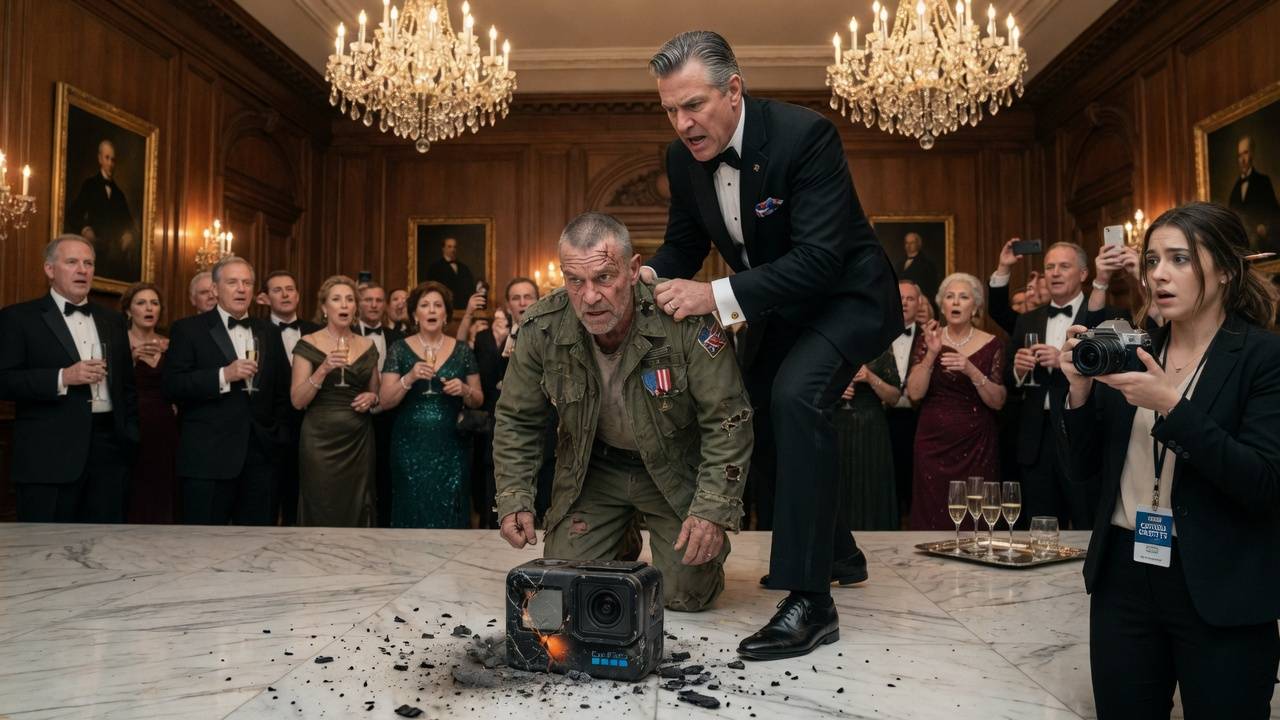
Across the hall, a young officer sat at a scarred wooden desk, pretending to fill out paperwork while repeatedly glancing at the television mounted in the corner of the room. The volume was low, but Ben didn’t need to hear the words. He could see his own face—the grainy, handheld footage Sarah Jenkins had captured. He saw himself in the olive field jacket, looking like a discarded piece of the past, and he saw the “Hero of the Highlands” sprawling into a puddle of lilies and expensive scotch.
The door at the end of the corridor hissed open. A man in a dark suit walked in—not a cop, but not one of Sterling’s private security, either. He had the weary, cynical posture of a public defender who had seen the bottom of the ocean too many times to be surprised by the salt.
“Mr. Thorne?” the man asked, stopping in front of the bars. He held a legal pad like a shield. “I’m David Aris. I’ve been appointed to represent you for the next few hours, at least until the paperwork catches up with the circus.”
Ben didn’t stand up. “How bad is it?”
“Which part?” Aris leaned against the bars, his voice dropping to a level that wouldn’t carry to the desk. “The assault on a sitting United States Senator? The trespassing? Or the fact that the Department of Justice is currently trying to figure out why your military file is a collection of empty folders and redacted black lines?”
“I told them. I’m a ghost.”
“Well, you’re a very famous ghost right now,” Aris said, gesturing toward the TV. “That video has been viewed six million times in the last three hours. The hashtags are… well, they aren’t helping the Senator’s gubernatorial campaign. But they aren’t helping you, either. Sterling’s legal team is already filing for a protective order, claiming the footage is a deep-fake and that you’re a mentally unstable stalker with a history of violent outbursts.”
Ben felt a familiar coldness settling in his gut. “He’s good at that. Turning the truth into a symptom.”
“He’s the best,” Aris agreed. “But he has a problem. Sarah Jenkins isn’t at a shelter. She’s at the Chronicle offices with three lawyers and a tech team that’s currently verifying the metadata on that SD card. If that card is what you say it is—if it’s the raw, unedited footage from Kunar—then assault charges are going to be the least of your worries. The Pentagon is going to want to talk to you about ‘theft of classified data.’ That’s a federal prison, Ben. Not a city jail.”
“If it gets the truth to Mrs. Miller, I don’t care about the prison,” Ben said.
Aris looked at him for a long moment, his eyes searching for a crack in the veteran’s resolve. He didn’t find one. “I believe you. Which is why I’m going to tell you that you have a visitor. Someone who isn’t a lawyer and isn’t a cop.”
The lawyer stepped aside, and the door opened again. It wasn’t Sarah. It was a young man Ben recognized from the gala—the idealistic staffer who had been standing near the Senator during the speech. His name was Leo, if Ben remembered the lanyard correctly. He looked like he hadn’t slept, his tie pulled loose and his face pale under the fluorescent lights.
“I’m not supposed to be here,” Leo said, his voice cracking. He looked at the cop at the desk, then back at Ben.
“Then why are you?” Ben asked.
“I saw the way he looked at you before the camera started rolling,” Leo said, stepping closer to the bars. “I’ve worked for the Senator for two years. I believed the story. I told the story. I wrote the press releases about his courage. But tonight… when he stepped on that camera… that wasn’t a hero. That was a man trying to kill a memory.”
“He’s been trying to kill it for fifteen years,” Ben said. “He’s just getting desperate.”
“The office is in a frenzy,” Leo whispered, his hands gripping the metal bars. “They’re shredding things, Ben. Not digital files—paper. Old correspondence from the 2011 deployment. I saw a folder with your name on it. It wasn’t empty. It was full of letters you wrote to the VA that never got processed. He was intercepting them. He used his committee seat to keep you ‘dead’ so you could never testify.”
The room seemed to tilt. Ben had known Sterling was powerful, but the sheer scale of the erasure—the systematic removal of his humanity—was a new kind of wound. He wasn’t just a victim of a bad night in a valley; he was a victim of a decade of deliberate, cold-blooded paperwork.
“Why are you telling me this, Leo?” Ben asked. “You lose everything if you flip.”
“I already lost it,” Leo said, a bitter laugh escaping him. “I looked in the mirror after we got back from the gala and I didn’t recognize the person looking back. I have the folder, Ben. I took it before they could get to the shredder. It’s in my car.”
“Give it to Sarah,” Ben said. “Don’t bring it here. Give it to the journalist.”
“I can’t just give it away,” Leo said, his eyes darting toward the door. “Sterling’s security… Vance and his guys… they’re following me. I think they know I took something. If I go to the Chronicle, they’ll stop me before I get through the lobby.”
Ben stood up then, the metal bench creaking. He moved to the bars, his presence filling the small space. “Listen to me, kid. You’re not a soldier, but you’re in a war now. You don’t go to the front door. You go to the side. You find a way to get that folder to someone who can make it loud. If you don’t, then everything that happened tonight—the gala, the camera, the arrest—it’s just noise. Do you understand?”
Leo nodded, but his eyes were wide with a terror that Ben knew all too well. It was the terror of realizing the person you trusted is the one who will destroy you to save themselves.
As Leo hurried out, David Aris turned to Ben. “If he’s telling the truth, and if you have that folder… you’re not just a ghost anymore. You’re a witness in a federal corruption case.”
“I just want to be a man again,” Ben said. “That’s all I ever wanted.”
The night dragged on. The sounds of the precinct—the shouting of drunks, the rhythmic thud of the door, the constant hum of the televisions—became a blur. Ben slept fitfully, his dreams haunted by the smell of wild sage and the sight of Tommy Miller’s face in the moonlight.
In his dream, Tommy wasn’t dying. He was just sitting on the tailgate of a Humvee, cleaning his rifle. You late for the party, Sarge? Tommy asked, his voice clear and young. Sterling’s got the scotch. We got the dirt.
Ben woke up to the sound of the cell door sliding open. It was morning, the grey light of a D.C. dawn filtering through the high, barred windows.
“You’re being transferred, Thorne,” the officer said. He didn’t look at the TV this time. He looked at Ben with a mixture of fear and respect. “Federal Marshals are here. Someone higher up the food chain wants a piece of you.”
Ben stood, his joints screaming, his heart a steady, heavy drum in his chest. He didn’t ask where he was going. He didn’t ask about Sarah or Leo. He just walked out of the cell, his head held high, the olive field jacket still draped over his shoulders like a shroud he was finally ready to burn.
As he was led through the lobby, he saw a woman sitting on one of the plastic chairs. She was older, her hair a shock of white, her hands trembling as she clutched a worn canvas bag. It was Mrs. Miller.
She saw him, and for a moment, the entire precinct seemed to vanish. She stood up, her eyes wet, her face a map of fifteen years of unanswered questions. She didn’t say a word. She just reached out and touched his arm, her fingers grazing the fabric of his jacket.
“Ben,” she whispered.
“I have it, Mrs. Miller,” Ben said, his voice breaking for the first time. “I have the truth. It’s coming home.”
She nodded, a single, sharp movement of her head, and as the Marshals led him toward the waiting black car, Ben knew that the ghost of Echo Company was finally finding its way back to the world of the living.
Chapter 6
The federal courthouse in Alexandria was a temple of cold marble and echoing silence, a place designed to make the individual feel small and the Law feel eternal. Ben sat in a small conference room on the fourth floor, the fluorescent lights humming overhead. He was wearing a suit now—a cheap, charcoal-grey thing Sarah Jenkins had scrounged from a thrift store—but he still felt like he was wearing the olive M65 jacket. The suit felt like a costume; the jacket felt like skin.
Sarah sat across from him, her laptop open, her face lit by the blue glow of the screen. She looked exhausted but electrified. Beside her sat David Aris and a woman from the U.S. Attorney’s office who had spent the last six hours looking at the contents of the ruggedized SD card.
“It’s all there,” the U.S. Attorney, a woman named Brennan, said. Her voice was flat, professional, but there was a hardness in her eyes that gave Ben a sliver of hope. “The metadata is intact. The timestamp matches the mission logs. And the audio… well, the audio is the nail in the coffin. Lieutenant Sterling’s voice is very clear when he tells the squad to ‘adjust the narrative’ regarding the source of the fire.”
“And the folder?” Ben asked.
Sarah reached into her bag and pulled out a thick, stained manila envelope. “Leo made it. He didn’t go to the Chronicle. He went to my apartment and waited in the stairwell for four hours. He was terrified, Ben. But he handed it over.”
She opened the folder, spreading the papers across the table. They were copies of VA claim denials, internal memos from Sterling’s Senate office, and—the most damning piece—a handwritten note from Sterling to a contact at the National Archives, asking for the “expedited disposal” of certain Echo Company records due to “clerical redundancy.”
“He didn’t just lie about the night,” David Aris said, tapping the note. “He spent fifteen years actively suppressing your existence. That’s not just a cover-up. That’s a conspiracy to defraud the government and the veterans under his command.”
“What happens now?” Ben asked. He felt a strange hollowness. The truth was out, the evidence was gathered, but the world didn’t feel different. The sun was still shining through the window, the traffic was still humming on the George Washington Parkway.
“Now,” Brennan said, standing up, “we go to the grand jury. And the Senator is going to receive a very public invitation to explain himself. His campaign for Governor ended about twenty minutes ago when the Chronicle broke the story online. He’s currently holed up in his estate, surrounded by lawyers and the few donors who haven’t fled yet.”
The door to the conference room opened, and a Marshal stepped in. “Mr. Thorne? There’s someone here to see you. We’ve cleared it with the U.S. Attorney.”
Ben followed the Marshal down the hall to a quiet waiting area. Standing by the window, looking out at the city he had tried to claim for himself, was Mark Sterling.
He wasn’t the man from the gala. He looked smaller, his silver hair uncombed, his expensive suit rumpled. He didn’t have his security detail. He didn’t have his microphone. He just had the look of a man who had finally run out of road.
“They told me you were here,” Sterling said, not turning around. “My lawyers said I shouldn’t come. They said it would look like witness tampering.”
“Then why did you?” Ben asked, stopping ten feet away. He didn’t feel the rage anymore. He just felt a profound, heavy pity.
Sterling turned. His eyes were bloodshot, the ice gone, replaced by a flickering, desperate panic. “I wanted to see you. One last time. Before the world turns me into the monster you think I am.”
“I don’t think you’re a monster, Mark,” Ben said. “I think you’re a coward. And cowards are much more dangerous, because they’ll do anything to keep from being seen.”
“I was twenty-four!” Sterling suddenly shouted, his voice cracking the silence of the hall. “It was dark! The village was a nightmare! I saw movement, I saw flashes, and I fired! It was an accident, Ben! A mistake!”
“The fire was an accident,” Ben said, his voice low and steady. “The lie was a choice. The fifteen years of burying Tommy, burying Miller, burying me… those were choices you made every single morning when you put on your tie. You didn’t just kill Tommy. You killed the truth.”
Sterling slumped against the window sill, the fight draining out of him. “I thought I could make it up. I thought if I became Governor, if I did enough good, if I passed enough bills for veterans… it would balance out. I thought I could buy my way back to being the man I was supposed to be.”
“You can’t buy back a life, Mark. Not Tommy’s. And not mine.”
Ben walked closer, until he was standing right in front of the man who had erased him. He reached into his pocket and pulled out a small, heavy object. It was the charred GoPro, the one Sterling had crushed on the marble floor. Ben had picked up the pieces before he was led away.
He held it out. “You wanted to destroy this. But you forgot something. The camera was just the tool. The memory… that’s mine. And you can’t step on that.”
Sterling looked at the broken camera, then back at Ben. For a split second, the old Senator flashed in his eyes—the pride, the entitlement. But it vanished, replaced by the crushing weight of the coming storm.
“What are you going to do now?” Sterling asked, his voice a whisper.
“I’m going to go to a funeral,” Ben said. “A real one.”
Ben turned and walked away. He didn’t look back as the Marshals stepped in to escort Sterling toward the interrogation rooms. He walked through the marble lobby, through the heavy glass doors, and out into the crisp Virginia air.
Two days later, the sun was bright and unforgiving at the Quantico National Cemetery. It wasn’t a lavish gala. There were no donors, no cameras, no silk gowns. There was just a small group of people standing around a fresh plot of land.
Mrs. Miller stood at the head of the grave. She looked older, but her back was straight. Beside her stood the real Miller, his tremors stilled for a moment as he looked at the casket. Sarah Jenkins was there, standing a respectful distance away, her camera tucked in her bag.
And there was Leo, the staffer, looking lost but present.
Ben stood at the edge of the group. He wasn’t wearing the suit. He was wearing a clean flannel shirt and work pants Sarah had bought him. He felt the weight of the air, the solidity of the ground.
The chaplain said the words—the old, familiar words about service and sacrifice and the peace that passes all understanding. But the real service happened when the ceremony was over.
Mrs. Miller walked over to the headstone. It was simple, white marble, pristine in the afternoon light. It had Tommy’s name, his rank, his dates of birth and death. And at the bottom, in small, clear letters, it said: Echo Company. The Truth Shall Set You Free.
She touched the stone, her fingers tracing the letters. Then she turned to Ben.
“Thank you,” she said. She didn’t cry. She didn’t need to. The long, hollow ache of the unknown had finally been replaced by the heavy, solid weight of the truth.
“He was a good soldier, Mrs. Miller,” Ben said. “He deserved to be remembered.”
“They all do,” she said.
As the others drifted away, Ben stayed behind. He sat on a nearby bench, watching the shadows of the oaks lengthen over the rows of white stones. He didn’t have a home to go back to yet. He didn’t have a job. He didn’t have his records back in the system—that would take months of legal wrangling.
But he had his name.
He pulled a small notebook from his pocket and a pen. He began to write—not a report, not a letter of grievance, but a list. A list of the men who had been in the valley. A list of the things they had talked about before the world went loud.
He was the last one left who remembered the sound of Tommy’s laugh or the way the dust tasted in Kunar. He was the keeper of the archive now.
The ghost of Echo Company was gone. In its place was a man named Ben Thorne, sitting in the sun, finally ready to tell the story of the living.
He looked up at the sky, the vast, blue American sky that had seen so many lies and so much hidden pain. He took a deep breath, the air clean and cold in his lungs.
“I’m here, Tommy,” he whispered to the wind. “I’m still here.”
The world went on, the cars humming on the distant highway, the birds calling in the trees. It wasn’t a perfect ending. It was just a beginning. And for a man who had been dead for fifteen years, that was more than enough.