Riley Vance grew up in the shadow of Blackwood Steel, listening to the town whisper that her father’s death was his own fault.
They said he was careless. They said he was intoxicated. They used those lies to strip her mother of every dime they were owed.
Now, Riley is an apprentice in the same shop, working under the man who watched her father fall and did nothing but laugh.
Foreman Miller has made it his mission to break her, reminding her every day that a “drunk’s daughter” doesn’t belong on his floor.
But Riley isn’t just there to weld. She’s there to find the truth he buried in the floorboards years ago.
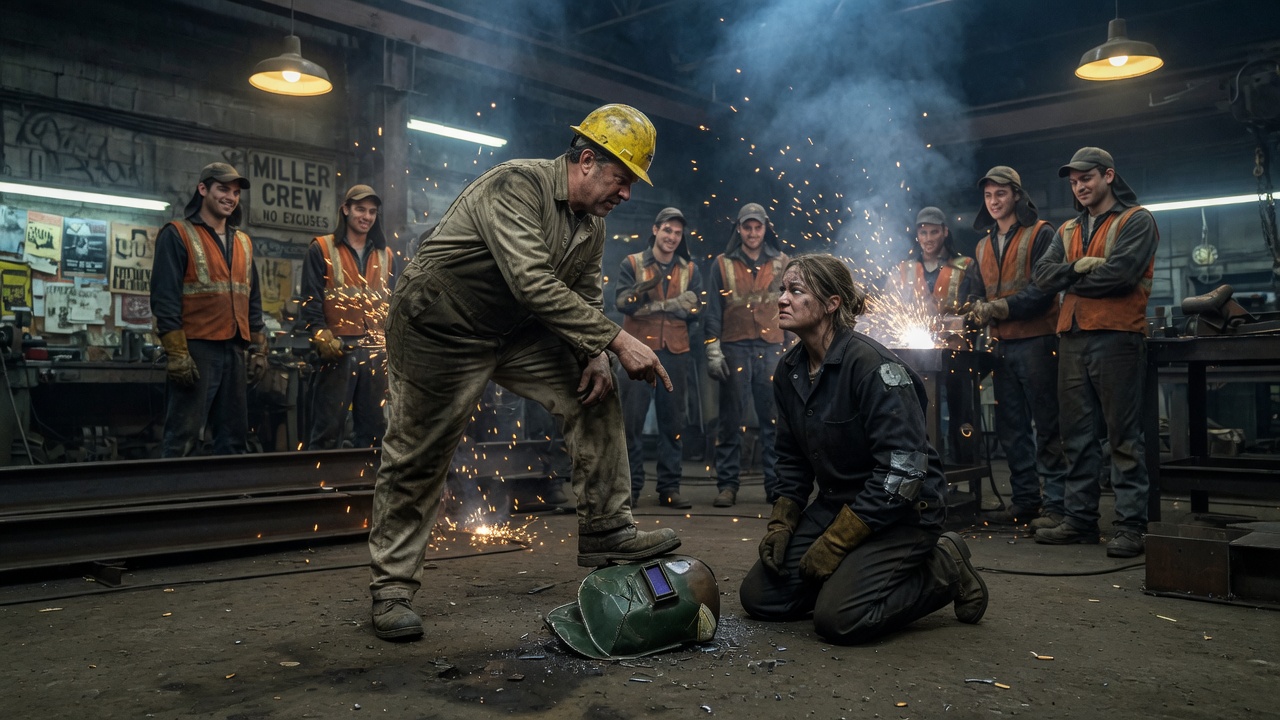
When Miller finds her father’s old welding mask and decides to crush it under his boot in front of the whole crew, he thinks he’s finally won.
He thinks she’s the same scared little girl who cried at the funeral while the company lawyers smirked.
He doesn’t realize that Riley has been practicing more than just her beads in the dark of the shop.
The moment he puts his hands on her, the silence of the Vance family finally ends in a way the shop will never forget.
The full story is in the comments.
Chapter 1
The air in Blackwood Steel & Iron didn’t just smell like ozone and burnt metal; it tasted like history—the kind that gets stuck in your throat and stays there. Riley Vance adjusted her bandana, pulling the black fabric tight against her brow. At nineteen, she was the youngest apprentice on the floor and the only one who didn’t get a “Good morning” or a “Get to work” from the older men. She got the Iron Silence.
“Vance! You’re on the scrap bins today,” a voice boomed, cutting through the rhythmic thrum-hiss of the welding bays.
Riley didn’t look up. She knew the voice. Foreman Miller was a man built like a rusted boiler—wide, immovable, and full of pressurized heat. He’d been the lead foreman when Riley’s father, Jack, had fallen from the high-gantry four years ago. The company had called it an accident caused by Jack’s blood-alcohol level. Riley knew her father hadn’t touched a drop in five years, but the company’s word was law in a town that lived and died by the furnace.
“I’m scheduled for the TIG line today, Miller,” Riley said, her voice low and steady. She didn’t stop her hands, which were busy organizing her lead cables. “Silas put me on the manifold project.”
Miller stepped into her peripheral vision, his heavy work boots crunching on the metal shavings that littered the floor. He leaned over her, his shadow swallowing her small frame. “Silas is a dinosaur who’s one eye away from a disability check. I’m the one who signs your hours. You go to the bins, or you go home. And if you go home, don’t bother coming back. Zero tolerance, remember?”
Riley’s grip tightened on her welding lead. The “zero-tolerance” clause was a special addition to her probationary contract, a leash the company used to ensure the daughter of the “town drunk” didn’t cause any trouble. If she so much as raised her voice, she’d lose the apprenticeship, her mother would lose the meager company-controlled housing they still occupied, and her younger brother, Leo, would lose any hope of the surgery he needed for his worsening hip dysplasia.
“The bins. Got it,” Riley muttered.
“What was that? I don’t speak mumble,” Miller sneered.
Riley looked up, her blue eyes meeting his bloodshot ones. “I said I’m on it, sir.”
Miller let out a short, sharp laugh that sounded like gravel in a blender. He turned to the group of third-year apprentices standing by the coffee station—boys not much older than Riley who had spent the last six months sabotaging her gas lines and “accidentally” knocking over her jigs.
“Hear that, boys? The girl knows her place,” Miller shouted. “Must be that Vance DNA. They’re real good at following orders when they’re sober enough to stand.”
A few of the boys chuckled. Riley felt the heat rise in her neck, a searing flush that had nothing to do with the nearby torches. She turned and walked toward the back of the shop, where the massive industrial scrap bins sat.
She spent the next four hours hauling jagged shards of carbon steel, her muscles screaming under the repetitive weight. Every time she passed a welding bay and smelled the sweet, sharp scent of the arc, her heart ached. She was better than any of them. Silas had told her she had “the touch”—a steady hand that could lay a bead as clean as a surgical stitch. But on the floor of Blackwood, she was just a ghost haunting a graveyard.
During her fifteen-minute lunch, Riley sat on a crate in the darkened corner of the shop, far from the breakroom. She pulled a small, leather-bound book from her internal jacket pocket. The edges were charred, and the pages were stiff with old grease. It was her father’s safety logbook—the one he’d been carrying the day he died.
She opened to a page dated three days before the fall. Gantry 4. Support bracket C-12 showing hairline stress. Reported to Miller. He told me to weld over it and shut up. Won’t shut up.
“Riley.”
She jumped, nearly dropping the book. Silas stood there, his one good eye squinting at her through the haze. He was a gnarled man, his skin a roadmap of burn scars.
“Don’t let them see you with that,” Silas whispered, his voice a raspy friction.
“They killed him, Silas. They lied and then they killed his name,” Riley said, her fingers tracing the charred leather.
“I know,” Silas said, sitting heavily on an adjacent crate. “I was there, remember? But Miller is looking for a reason to cut you. He hates that you have Jack’s eyes. He hates that you’re still here, reminding everyone of what happened.”
“I’m not just here to remind them,” Riley said, looking at the massive, groaning machinery of the shop. “I’m here to finish what he started.”
“Then keep your head down,” Silas warned. “The forge is getting hot, Riley. Don’t be the one who gets burned.”
Chapter 2
The second week of the month always brought the heaviest social pressure. It was the “Safety Audit” week, a performance the company put on to satisfy the state inspectors while changing absolutely nothing about the crumbling infrastructure of the shop.
Miller was on a rampage. He spent the morning screaming at the floor, his frustration manifesting as a direct assault on Riley’s dignity.
“Vance! This floor is a disgrace! Get the power scrubber,” Miller yelled across the shop during the mid-morning shift change.
Riley was in the middle of a delicate repair on a hydraulic pump—a job Silas had sneaked to her while Miller was in the office. “I’m almost finished with this, Miller. Silas needs it for the afternoon assembly.”
“I don’t care if Silas needs it for his funeral,” Miller barked. He walked over and, with a casual flick of his wrist, knocked her toolbox off the workbench. Wrenches and sockets clattered across the concrete, sliding into the oily gutters. “Scrubber. Now. Or you can spend the rest of the day in the HR office explaining why you can’t follow a direct order.”
The shop went quiet. Twenty men stopped their work to watch. This was the ritual—the public reminder of Riley’s status.
One of the apprentices, a tall, thick-necked boy named Garrett, stepped forward. He kicked a 10mm socket further into the drain and grinned. “Hey Riley, I think you missed a spot. Or maybe you’re just too weak to push the machine?”
Riley didn’t respond. She knelt, her knees hitting the cold, hard concrete, and began picking up her tools one by one. Her hands were shaking, not from fear, but from the sheer, agonizing effort of holding her tongue. She thought of Leo’s medical bills. She thought of her mother’s tired eyes.
Stay small. Stay silent. Survive.
“That’s it,” Miller said, standing over her as she crawled to reach a stray pliers. “Look at her. Just like her old man, groveling in the dirt. At least she’s not face-down in a gutter yet.”
Riley’s fingers closed around the pliers. She squeezed the steel handles until they bit into her palm. She could feel the collective weight of the crew’s gaze. Some looked away in shame; most just watched, glad the lightning wasn’t hitting them.
She spent the next three hours pushing the heavy industrial scrubber over the same three hundred square feet of floor. The vibrations of the machine traveled up her arms and settled in her teeth.
That night, after the lights were dimmed and the night shift had settled into the far end of the plant, Riley didn’t go home. She hid in the shadows of the tool crib until the floor was mostly empty.
She made her way to Gantry 4.
The machinery was old, a hulking beast of Victorian-era iron and poorly integrated modern hydraulics. She climbed the access ladder, her breath hitching as she reached the height where her father had taken his last step.
She pulled a portable ultrasonic tester from her bag—a piece of equipment she’d spent six months’ worth of “lunch money” to buy second-hand online. She placed the sensor against the main support bracket, the one her father had marked in his log.
The screen flickered. The digital readout showed a jagged red line.
“Internal fracture,” she whispered.
The bracket wasn’t just stressed; it was hollowed out by decades of vibration and neglect. A weld-over—the very thing Miller had ordered her father to do—had only hidden the rot. It was a ticking bomb. If this bracket failed, the entire overhead crane system would collapse, likely taking half the floor with it.
“What are you doing up there?”
The voice echoed through the rafters. Riley nearly lost her footing. She looked down to see Silas standing at the base of the ladder, his face pale in the emergency lighting.
“Silas, it’s worse than he thought,” Riley said, scrambling down the ladder. “The whole gantry is failing. If they put a full load on that crane tomorrow for the audit demo, it’s going to go.”
Silas looked at the tester in her hand, then at the massive iron beams above. “You have to tell them, Riley.”
“Tell them? I’m a nineteen-year-old girl on probation. Miller will just say I tampered with it to get back at the company. He’ll destroy the evidence and fire me before I can even finish the sentence.”
“Then what’s the plan?” Silas asked, his voice trembling.
Riley looked at the heavy leather logbook tucked into her belt. “I have the proof of what they knew four years ago. And I have the proof of what’s happening now. I’m going to document it all. And then, I’m going to make sure they can’t look away.”
Chapter 3
By Wednesday, the tension in the shop was thick enough to choke on. The state inspectors were arriving at noon, and Miller was sweating through his tan jumpsuit. He was desperate for the shop to look like a high-functioning machine, but the equipment was screaming.
Riley worked with a grim focus. She had spent the previous night recording the ultrasonic data and cross-referencing it with her father’s logs. She had it all on a thumb drive tucked into her boot.
She was at her station, finishing a small weld on a safety railing, when she saw Miller heading her way. He wasn’t alone. He had Garrett and two other apprentices with him.
Miller looked frantic, his eyes darting to the front office where the inspectors were being treated to coffee.
“Vance! Give me that mask,” Miller snapped, pointing to the vintage leather welding mask sitting on her bench.
Riley instinctively reached for it. “No. This is mine. It’s personal property.”
“I don’t give a damn about your property,” Miller said, his voice rising. “The inspectors are coming through, and that thing looks like it survived a house fire. It’s a liability. It doesn’t meet current ANSI standards. Give it here.”
“It’s my father’s,” Riley said, her voice cracking for the first time. “I’ve checked the filters. It’s safe. I use it because—”
“Because you’re a sentimental brat who thinks she’s special,” Miller interrupted. He stepped forward, reaching for the mask.
Riley pulled it back, holding it to her chest. “Don’t touch it.”
Miller stopped. A slow, predatory smile spread across his face. He looked at the boys behind him, then back at Riley. “You’re refusing a safety directive? During an audit? That’s a breach of contract, Vance. That’s immediate termination.”
“It’s not a safety directive,” Riley said, her heart hammering against her ribs. “You’re just trying to take the last thing I have of him.”
“I’m trying to clean up this shop,” Miller said. He lunged forward, his large hand clamping onto Riley’s shoulder. He was twice her size, his grip like a vise. “Give. It. To. Me.”
“No!” Riley yelled.
The sound of her voice carried across the floor. The grinding wheels stopped. The hammers went silent. The Iron Silence returned, but this time, it was expectant.
Miller wrenched the mask from her hands. He held it up like a trophy, the scarred leather catching the overhead light. “Look at this piece of junk. Just like the man who wore it. Broken. Useless. A danger to everyone around it.”
“Give it back, Miller,” Riley said, her voice dropping to a dangerous, vibrating whisper.
“You want it?” Miller asked. He walked toward the center of the shop, toward the massive scrap melter that was currently idling at a low simmer, sending orange light flickering against the ceiling. “Go get it.”
He didn’t toss it into the melter. Not yet. He dropped it onto the concrete floor in the center of the main aisle, right in front of the gantry ladder.
“Miller, don’t,” Silas called out from his station, his voice pleading.
Miller ignored him. He looked at Riley, then at the mask on the floor. He lifted his heavy work boot and placed it directly over the leather eye-piece.
“You think you’re a welder, Vance? You think you’re one of us?” Miller sneered. “You’re nothing but a ghost story. And it’s time we put this ghost to rest.”
He shifted his weight, and the sound of the vintage leather cracking under his boot echoed through the silent shop.
Chapter 4
The sound of the leather eye-piece shattering was the loudest thing Riley had ever heard. It wasn’t just the mask; it was the four years of suppressed rage, the hundreds of hours of hauling scrap, the nights of Leo crying from his hip pain, and the memory of her father’s broken body being loaded into an ambulance while Miller stood by and joked about a flask that didn’t exist.
Riley stood in the center of the shop aisle. The crew had formed a loose semicircle, their orange vests vivid against the grey industrial backdrop. Phones were out—the modern version of witnesses.
Miller ground his heel into the mask, a cruel, satisfied grin on his face. He reached out and grabbed Riley by the collar of her navy welding jacket, yanking her forward until she was inches from his face.
“Your old man was a drunk, and you’re just a mistake,” Miller hissed, his breath smelling of stale coffee and malice. He yanked her harder, forcing her to stumble and sink lower toward the ground.
Riley looked at the mask under his boot. She felt a cold, crystalline clarity settle over her. The fear was gone, burned away by a sudden, violent focus.
“Take your foot off his mask. Now,” Riley said. Her voice wasn’t a scream. It was a command.
Miller laughed, a wet, jagged sound. “Or what? You’re going to tell the inspectors? You’re done here, Vance. I’m firing you the second they leave. But first, I think I’ll finish what I started.”
He shoved her back with a heavy, dismissive force, but his hand stayed clamped on her shoulder, his fingers digging into her collarbone. He leaned in to grab her again, his other hand coming up to shove her face.
Riley didn’t wait.
She planted her lead foot, the rubber sole barking against the concrete. As Miller’s hand reached for her, she snapped her left forearm upward, a sharp, mechanical strike that caught Miller’s wrist and sent his arm flying off-line.
The move was so fast, Miller’s shoulder turned off-axis. His chest was wide open, his balance leaning precariously over his back heel.
Riley stepped into the gap. She didn’t use a fist. She used the hard, calloused heel of her palm. She drove it straight into Miller’s sternum, putting every ounce of her frustration and body weight into the strike.
CRACK.
The sound of her hand hitting his chest was like a sledgehammer hitting a sandbag. Miller’s jumpsuit jolted. His eyes went wide as the air was forced out of his lungs. He scrambled backward, his boots sliding through the grit, but he couldn’t find his footing.
Riley didn’t give him the chance. She planted her standing foot firmly, lifted her right knee, and drove a front push kick directly into the center of Miller’s chest.
It wasn’t a snap kick. It was a driving force. Her boot sole made full, crushing contact. Miller was lifted off his feet for a fraction of a second before he was launched backward. He slammed into a heavy steel tool chest, the metal groaning under the impact, and then he collapsed onto the floor.
Miller lay there, gasping for air, his face turning a panicked shade of purple. He scrambled to his knees, one hand clutching his chest while the other rose in a trembling, defensive gesture.
“Wait—Riley, stop! Don’t!” Miller wheezed, his voice high and thin, the bully replaced by a terrified man on the ground.
Riley stepped forward. She didn’t look like a nineteen-year-old girl anymore. She looked like the inevitable consequence of a decade of lies. She stood over him, her shadow long and dark across his cowering form. The shop was so quiet you could hear the distant whistle of the wind through the rafters.
“Don’t ever touch my family again,” Riley said.
She reached down and picked up her father’s mask. The leather was crushed, the glass was gone, but she held it like it was made of gold.
Behind her, the door to the front office creaked open. The state inspectors stepped onto the floor, their clipboards held high, their eyes landing directly on the foreman cowering at the feet of the apprentice he had tried to break.
Riley didn’t look at them. She looked at Miller, who was still begging with his eyes.
“The audit is starting, Miller,” Riley whispered, just loud enough for the phones to catch it. “And I have a lot to show them.”