Bennett was one of the best nurses in the ward until he saw something he wasn’t supposed to see. Now, he’s a patient in his own hospital, drugged into silence and stripped of his dignity.
Dr. Thorne thinks he has won. He spends every morning shift reminding Bennett that he is nothing but a “broken machine” in a blue jumpsuit.
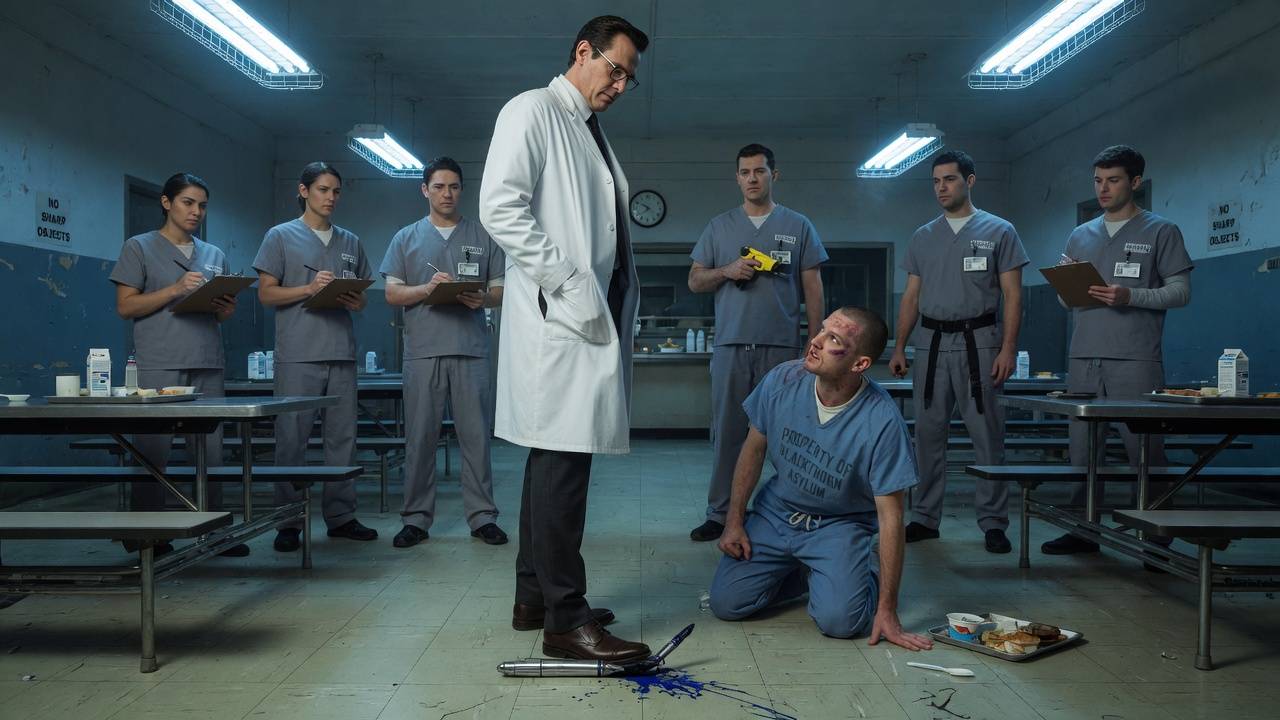
Today, Thorne went too far. In front of the entire morning staff, he took the only thing Bennett had left—the silver fountain pen his wife gave him before the military “experiment” took her life.
He dropped it on the floor and ground his heel into the metal. He wanted to see Bennett break. He wanted a reaction to justify more “treatment.”
The orderlies stood by, clipboards ready, waiting for the “crazy” man to snap. They didn’t realize that Bennett wasn’t just a nurse.
Beneath the drugs and the institutional haze, the soldier was still there, counting every second, waiting for the fog to clear.
When Thorne grabbed his collar to finish the humiliation, the room went dead silent. Bennett didn’t scream. He didn’t cry.
He just moved. And in three seconds, the power in the ward shifted forever.
Thorne is on the floor now, and the truth is finally coming out.
I put the full story link in the comments.
Chapter 1
The air in Ward 4 tasted like lemon bleach and unwashed skin. It was a thick, institutional scent that stuck to the back of Bennett’s throat, a constant reminder that he was no longer the man who administered the medication, but the man forced to swallow it.
“Open up, Bennett. Don’t make this difficult,” Miller said. He was a lead orderly with a neck like a bull and a temperament to match. He stood over Bennett’s cot, holding a small plastic cup containing two chalky white pills and a sedative kicker.
Bennett sat on the edge of the thin mattress, his hands tucked under his thighs to hide the tremors. He looked at the window, which wasn’t really a window—just a thick pane of reinforced glass overlooking the grey Atlantic waves crashing against the cliffs of Blackwood Isle.
“I’m not being difficult, Miller. I’m just wondering if Dr. Thorne knows the dosage is up twenty percent today,” Bennett said. His voice was raspy, the result of weeks of forced silence and chemical dehydration.
Miller chuckled, a wet, unpleasant sound. “The Doctor knows everything. That’s why he’s the Director and you’re the guy who thinks he’s a secret agent. Now, tongue up.”
Bennett complied. He had learned early on that resistance led to the “quiet room,” a windowless box where time dissolved into a blur of cold tile and screams. He let the pills sit under his tongue until Miller turned away, then he tucked them into the secret fold he’d picked into the seam of his blue patient trousers. It was a dangerous game. If they searched him, he was dead. If he didn’t take them, his mind stayed sharp, but his body felt like it was vibrating out of its own skin.
He waited for the heavy steel door to click shut before he stood up. He walked to the small, scratched mirror bolted to the wall. He didn’t recognize the man looking back. The buzzed hair was jagged where Miller had used dull clippers. The eyes were sunken, rimmed with the red of chronic exhaustion. But behind the haze of the half-dose he’d managed to fake, the memory remained.
Project 10S.
He could still see Sarah’s face in the lab, the way her eyes had rolled back when they injected the serum. She had been a doctor, too. She had believed in the work until the work started killing people. Bennett had tried to pull the data, to get her out, but the military police had been waiting. They didn’t court-martial him. That would have left a paper trail. Instead, they’d handed him over to Thorne, a man whose specialty was making inconvenient people disappear into their own minds.
Bennett reached up, feeling the back of his neck. Under the short, bristly hair, he could feel the faint ridges of the tattoo. It wasn’t ink; it was a series of microscopic scars, a code xammified into his skin that held the encryption key to the 10S server. Sarah had put it there the night she died.
“Bennett!” a voice hissed from the vent.
Bennett knelt by the floor grate. “I’m here, Elias.”
Elias was in the next cell over. He was sixty, a former CIA asset who had spent twenty years in Blackwood. Most of the staff thought he was a vegetable, but Elias was the only reason Bennett hadn’t lost his mind in the first week.
“The transport arrives tomorrow,” Elias whispered. “Thorne is moving the data. If he gets it off the island, the 10S casualties become ‘unfortunate accidents’ and the project goes dark forever. Do you have the counter-code?”
“I have it,” Bennett said, his heart hammering against his ribs. “But I can’t get to the terminal in the basement. The orderlies stay in the halls, and the drug… I can barely stand, Elias.”
“You’re a combat medic, kid. Your body remembers things your brain wants to forget,” the old man said. “Thorne is going to try to break you today. He needs that key, and he’s losing patience. He’ll come for you in the cafeteria. Don’t let him see the soldier. Let him see the ghost.”
The heavy latch on the door groaned. Bennett scrambled back to his cot just as the door swung open. It wasn’t Miller this time. It was Dr. Aris Thorne.
Thorne looked like a man who spent his life in the sun, despite being trapped on an island of fog. He was tan, fit, and wore a white lab coat that cost more than Bennett’s old car. He walked into the room with the casual grace of a landlord inspecting a property he intended to demolish.
“Bennett,” Thorne said, his voice smooth and cultured. “You look… unwell. I told Miller to keep an eye on your hydration.”
“I’m fine, Doctor,” Bennett said, staring at Thorne’s polished black shoes.
“Are you? Because your charts suggest a man who is still clinging to a very dangerous fantasy. You still think you’re a hero, don’t you? You still think there’s a world out there waiting for you to save it.”
Thorne stepped closer, his presence filling the small cell. He reached out and tipped Bennett’s chin up with a cold finger. “There is no world, Bennett. There is only this island, and the truth I choose to write. Now, give me the key, and I can move you to a facility on the mainland. You could see the sun again. You could have a life.”
“I don’t know what you’re talking about,” Bennett whispered.
Thorne’s smile didn’t reach his eyes. “We’ll see. The cafeteria is serving lunch in ten minutes. I think a change of scenery will do you good. Just remember, Bennett—everyone is watching. And nobody is coming to save a crazy man.”
Thorne turned and walked out, leaving the door open. It was an invitation to the gallows. Bennett stood up, his legs heavy like lead, and followed the shadow of the man who had stolen his life.
Chapter 2
The cafeteria was a sea of grey and blue. Patients sat at long, bolted-down tables, staring into plastic trays of lukewarm mash. The orderlies stood along the walls like statues, their hands resting on their belts. In the corner, a small group of medical students from the mainland stood with clipboards, taking notes on the “behavioral ecosystem” of the damned.
Bennett felt the weight of every eye in the room. He walked the line, his tray trembling in his hands. He felt a sudden, sharp pinch in his side.
“Keep moving, crazy,” a voice muttered. It was Graves, one of the younger orderlies who took particular delight in testing the patients’ reflexes. He’d nudged Bennett with the tip of his baton.
Bennett didn’t react. He found a seat at the end of a table near the back. Across from him sat a woman named Clara who spent the entire meal staring at a spot three inches above Bennett’s head. She had been a whistleblower for a pharmaceutical company once. Now, she just hummed to herself.
He looked down at his tray. Nestled next to a scoop of grey mashed potatoes was a small, silver fountain pen.
Bennett’s breath hitched. His fingers hovered over the metal. It was Sarah’s pen. It was supposed to be in the evidence locker in the administration wing. He had used it to sign their marriage license. It was the only physical piece of his former life that hadn’t been burned.
“Looking for this?”
Thorne was standing behind him. The cafeteria went silent. Even the humming Clara stopped. The medical students leaned forward, sensing a “demonstration.”
Thorne reached down and snatched the pen from the tray. He held it up, the silver catching the harsh overhead light. “A sentimentalist. That’s your primary defect, Bennett. You value objects over outcomes. You value a dead woman over your own survival.”
“Give it back,” Bennett said. He tried to keep his voice level, but the tremor was there.
Thorne circled the table. “This pen represents the man you think you were. The nurse. The husband. The citizen. But that man is dead, Bennett. He died the moment he stepped onto this island.”
Thorne looked around at the orderlies and the students. He was performing now. This was the public degradation Elias had warned him about.
“Tell me, Bennett,” Thorne said, leaning in close so the room could hear his stage whisper. “Do you think Sarah would be proud of you right now? Cowering in a jumpsuit, hiding pills under your tongue like a common addict?”
Bennett flinched. The mention of the pills sent a jolt of panic through him. Thorne saw it. He smiled.
“Oh, I know about the pills, Bennett. I’ve always known. I let you keep them because I wanted to see how long you could maintain the illusion of control. It’s fascinating, really. The way the mind clings to a lie even when the body is failing.”
Thorne dropped the pen. It clattered onto the floor, sliding a few feet away toward the center of the aisle.
“Pick it up,” Thorne commanded.
Bennett looked at the pen. It lay there, a small, silver sliver of hope in a room designed to crush it. He moved to stand, but Miller’s heavy hand landed on his shoulder, shoving him back down.
“On your knees, Bennett,” Thorne said, his voice dropping the mock-gentleness. “If you want your toy, you crawl for it. Show our guests how far the ‘hero’ has fallen.”
Bennett looked at the medical students. They were scribbling furiously. One of them looked away, a flicker of shame crossing her face, but she didn’t speak. The social pressure in the room was a physical weight, a suffocating blanket of cold observation.
Bennett looked at the pen. Then he looked at Thorne. He could feel the soldier inside him—the one who had carried men through mortar fire in the Korengal—screaming to be let out. But he was weak. The drugs he had swallowed were still working, slowing his heart, dulling his edges.
He slid off the bench. His knees hit the hard tile with a dull thud.
“That’s it,” Thorne said, gesturing to the crowd. “Witness the regression. When the mind can no longer process reality, it returns to a state of subservience.”
Bennett began to crawl. Every inch felt like a mile. The floor was cold and smelled of floor wax and failure. He reached for the pen, his fingers trembling.
Just as his hand closed around the cool metal, a heavy black shoe came down.
Crunch.
The sound of the silver casing buckling under Thorne’s weight echoed through the cafeteria. Bennett’s heart stopped.
“Oops,” Thorne said, though his face remained a mask of arrogant triumph. “It seems your past is as fragile as your future.”
Thorne didn’t move his foot. He pressed down harder, grinding the pen into the tile, directly over Bennett’s knuckles.
“Now, Bennett,” Thorne said, looking down with pure contempt. “Admit it. Admit you’re a broken machine. Admit you’re exactly where you belong.”
Bennett looked up. His eyes were no longer hollow. They were burning. The humiliation had reached its peak, and in the center of that shame, something had finally snapped. Not his mind, but the lock on his restraint.
“I’m not the one who belongs here, Doctor,” Bennett whispered.
“What was that?” Thorne asked, leaning down, his hand reaching for Bennett’s collar to haul him up for more mockery.
“I said,” Bennett’s voice was suddenly clear, the rasp gone, “you’re standing on the only thing I had left. And that’s a mistake you won’t live to regret.”
Chapter 3
The tension in the cafeteria was a live wire, humming with the threat of violence. Thorne laughed, a sharp, dismissive sound that signaled to the orderlies to stay back. He wanted to enjoy this. He wanted to be the one to finally break the “Ghost of the Ward” in front of his staff.
“A threat?” Thorne said, his hand tightening on Bennett’s collar, pulling him upward until Bennett was forced onto his toes, his face inches from the Doctor’s. “You’re a patient in a high-security asylum, Bennett. You’re malnourished, over-medicated, and utterly alone. What are you going to do? Bleed on my shoes?”
The orderlies laughed. The medical students looked on with a mixture of horror and clinical fascination.
Bennett felt the cold metal of the crushed pen beneath Thorne’s heel. He felt the sting of the fabric cutting into his neck. But more than that, he felt the adrenaline finally overriding the inhibitors. His training hadn’t been in a classroom; it had been in the dirt, under fire, where seconds were the difference between a pulse and a corpse.
He knew he could kill Thorne. He knew the pressure points, the weak joints, the way a man’s throat collapses under a focused strike. But if he killed him now, he’d never get to the terminal. He’d be shot or tased before he reached the door.
“Let go of my shirt, Thorne,” Bennett said. His voice was a low, dangerous vibration.
“Or what? You’ll tell the Board? You’ll call your dead wife?” Thorne’s face twisted into a snarl. He shoved Bennett backward, hard.
Bennett stumbled, his heels catching on the uneven tile. He hit the edge of a table, a tray of food sliding off and clattering to the floor. The grey mash splattered against his blue trousers.
“Look at you,” Thorne said, stepping into Bennett’s space, crowding him, forcing him to look up. “You’re pathetic. You’re a footnote in a project that is going to change the world, and you’re crying over a pen. You want to be a hero? Heroes have something to fight with. You have nothing.”
Thorne reached out again, his fingers clawing into Bennett’s shoulder, a dominating grip designed to remind Bennett of his physical inferiority.
“One last chance, Bennett,” Thorne hissed. “The code. Give me the key, and I’ll let you die with some dignity. Keep it, and I’ll make sure you live long enough to forget your own name.”
Bennett looked around the room. He saw Miller moving in from the left, Graves from the right. The semicircle was closing. The “witnesses” were no longer just observers; they were the walls of a cage.
He saw Clara, the humming woman. For the first time, she wasn’t looking at the ceiling. She was looking at him. Her eyes were wide, clear, and filled with a silent, desperate plea. Do something.
Bennett looked back at Thorne. He thought about the 10S data. He thought about the thousands of soldiers who had been used as lab rats, their lives discarded like the silver pen on the floor. He thought about Sarah’s final breath, and the way Thorne had checked his watch while she died.
The moral choice was no longer a choice. It was an inevitability. If he stayed quiet, the truth died here. If he fought, he might die, but the truth would have a chance to breathe.
“You’re right, Doctor,” Bennett said. He relaxed his shoulders, letting his arms hang limp at his sides. He looked like a man who had finally given up.
Thorne’s grip loosened slightly, a flicker of triumph crossing his face. “Finally. I knew you were rational beneath the delusions.”
“I’m very rational,” Bennett said. He leaned in, as if to whisper the code into Thorne’s ear. “That’s why I know that a man like you only understands one kind of language.”
Thorne frowned. “What?”
“The language of the dirt,” Bennett whispered.
He looked down at the floor, at the crushed pen. Then he looked Thorne dead in the eye.
“Take your foot off the pen, Thorne. Last warning.”
Thorne’s eyes went wide with a mix of shock and rage. He didn’t move his foot. Instead, he pulled his hand back, forming a fist, his face contorting as he prepared to strike a patient in front of a dozen witnesses. He didn’t care anymore. He was the king of Blackwood Isle, and Bennett was just a bug under his boot.
“You’re done, Bennett!” Thorne roared, swinging his arm.
The soldier woke up.
Chapter 4
The cafeteria froze.
Time didn’t slow down—it became crystalline. Bennett saw the arc of Thorne’s fist, a slow, clumsy movement born of arrogance rather than skill. He saw Miller’s hand move toward his taser. He saw the medical student’s mouth open in a silent gasp.
Thorne’s fist lunged toward Bennett’s jaw.
Bennett didn’t flinch. He didn’t retreat.
He moved like a spring that had been compressed for months.
MOVE 1: ARM SNAP / STRUCTURE BREAK
As Thorne’s fist swung, Bennett stepped forward, closing the distance. He planted his left foot firmly, rotating his body. His left hand shot up, not to block, but to intercept. He caught Thorne’s forearm with a sickeningly sharp snap, his palm driving Thorne’s limb outward and away from his face.
Thorne’s momentum was his undoing. With his arm shoved off-line, his shoulder twisted violently, pulling his entire chest open and exposing his centerline. His balance shifted onto his back heel, his eyes widening as he realized he was no longer the one in control.
MOVE 2: SHORT BODY-WEIGHT STRIKE WITH VISIBLE CONTACT
Bennett didn’t wait. He drove his right hand forward in a short, compact palm-heel strike. He didn’t punch with his arm; he drove with his legs, his hip snapping forward, funneling his entire weight through his shoulder and into the base of his palm.
THUD.
The strike connected squarely with Thorne’s sternum. The pristine white lab coat compressed under the force, the fabric jolting as the impact rippled through Thorne’s chest. Thorne’s breath left him in a sharp, wet wheeze. His shoulders snapped backward, his head jerking as the kinetic energy traveled through his spine.
Thorne stumbled back, his feet scrambling on the tile, his arms windmilling as he tried to regain his footing. He was a man drowning on dry land.
MOVE 3: DRIVING FRONT PUSH KICK KNOCKDOWN WITH VISIBLE CONTACT
Bennett followed him. He planted his lead foot and brought his right knee up to his chest. With a controlled, violent extension, he drove his foot into the center of Thorne’s chest.
It wasn’t a snap kick. It was a push.
Bennett’s heel made solid contact with the middle of Thorne’s white coat. The force was enough to lift the Doctor off his feet for a fraction of a second. Thorne’s chest absorbed the blow, his torso snapping back while his hips lagged behind.
He hit the floor hard.
CRASH.
Thorne’s back slammed into a heavy cafeteria table, sending it sliding three feet across the floor. Trays rattled, silverware clattered, and a plastic pitcher of water overturned, drenching the Doctor as he collapsed into a heap on the cold tile.
The silence that followed was absolute.
Bennett stood in the center of the aisle. His chest was heaving, his blue uniform splattered with food and water, but he stood straight. The tremor was gone. The haze was gone.
Thorne scrambled backward on his elbows, his slicked-back hair falling over his face, his glasses missing. He looked up at Bennett, his face a mask of primal terror. He raised one hand, the palm trembling.
“Wait! Don’t… please!” Thorne begged, his voice a pathetic, high-pitched scrape. “I’m the Director! Orderlies! Help me!”
The orderlies didn’t move. Miller and Graves stood frozen, their tasers drawn but un-aimed. They looked at the man on the floor—the man who had promised them power and protection—and then they looked at Bennett, who looked like he could dismantle the entire room with his bare hands.
Bennett stepped forward, his shadow falling over Thorne. He reached down and picked up the crushed silver pen. He didn’t look at it. He looked at Thorne.
“The countdown just hit zero, Doctor,” Bennett said.
His voice wasn’t loud, but it carried to every corner of the room. It was the voice of a man who had already been through hell and had decided to bring back a souvenir.
“You thought you could bury the truth in here,” Bennett said, gesturing to the grey walls. “But you forgot one thing. Truth doesn’t need a mind to live. It just needs a witness.”
Bennett turned his gaze to the medical students. They were standing, their clipboards forgotten. The girl who had looked away earlier was now staring directly at Thorne, her phone held up, the red recording light blinking like a heartbeat.
“Get him up,” Bennett said to Miller. It wasn’t a request.
Miller hesitated, then moved forward, grabbing Thorne by the arm. The Doctor was sobbing now, a soft, mewling sound that stripped away the last of his authority.
Bennett looked at the pen in his hand, the metal cold and ruined. He felt a sudden, sharp ache in his chest—a residue of Sarah’s presence—but he pushed it down. The fight wasn’t over. It had just moved from the mind to the hallway.
“Elias,” Bennett called out.
The old man stood up from his table, a grin splitting his weathered face. “Ready when you are, Captain.”
Bennett turned toward the cafeteria doors. The consequences were already forming. He could hear the sirens from the mainland—the coast guard, or perhaps something else. The video was already out. The power structure of Blackwood Isle had fractured, and through the cracks, the light was finally starting to bleed.
Bennett didn’t look back at Thorne. He walked toward the exit, the silver pen gripped tight in his fist. He wasn’t a patient. He wasn’t a ghost.
He was the man who was going to burn this place down.