Everyone in this town knows the story of the “Titan” who ran. They say Andre’s dad took the dive, took the money, and vanished into a bottle of cheap bourbon.
For three years, Andre has kept his head down in his uncle’s grease-stained garage. He’s taken the insults, the shoved shoulders, and the “mongrel” comments from the Mayor’s son without saying a word.
He promised his father he wouldn’t be a weapon. He promised they’d stay invisible. Because if the world finds out the Titan is still alive, the people who want him dead will find them both.
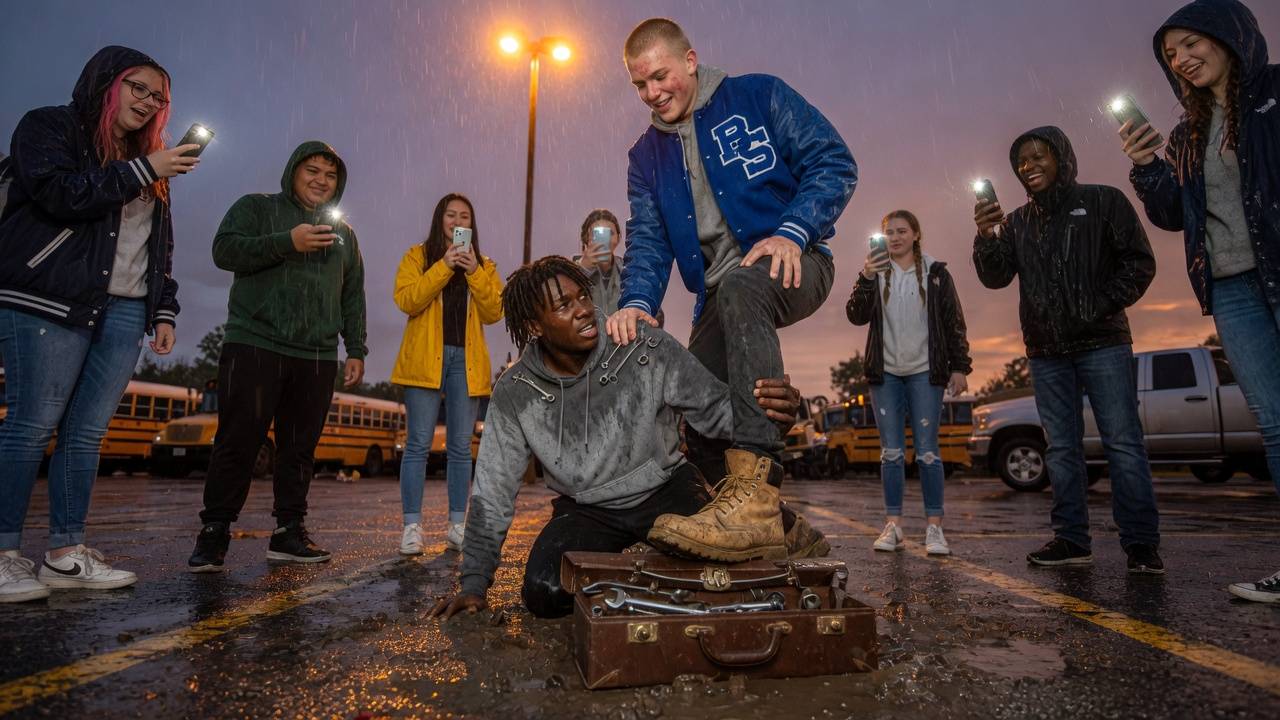
But today, Brody went too far. He didn’t just push Andre. He found the one leather toolkit Andre’s father left behind—the only piece of a legacy that wasn’t covered in shame.
Brody put his heavy boot on that leather and started to grind. He told Andre to bark like a dog if he wanted his “trash” back.
The crowd had their phones out, laughing, waiting for Andre to crawl. They didn’t see the way Andre’s feet planted. They didn’t notice the way his breathing went cold and surgical.
In five seconds, the hierarchy of this town didn’t just shift. It shattered.
The video is already everywhere. But the real story? It’s just beginning.
Read the full story in the comments.
Chapter 1
The smell of 10W-30 motor oil and stale winter air was the only thing that felt honest in Oakhaven, Ohio. It was a town built on the bones of a steel mill that had folded in the late nineties, leaving behind a skyline of rusted smokestacks and a population that treated bitterness like a local delicacy.
Andre wiped his hands on a rag that was already more grease than fabric. He was nineteen, lean in a way that suggested wiry strength hidden under layers of oversized thrift-store hoodies, and possessed a gaze that tended to find the floor more often than people’s faces. He worked at Miller’s Auto, a three-bay garage owned by his uncle, Silas. It was honest work, and more importantly, it was quiet.
“Andre, you finish that alternator on the Chevy?” Silas called out from the small, glass-partitioned office. Silas was a man who looked like he’d been carved out of an old oak stump—gnarled, tough, and perpetually smelling of Menthol cigarettes.
“Five minutes, Silas,” Andre replied, his voice a low, steady baritone. He didn’t look up. He liked the mechanical certainty of the alternator. Parts fit or they didn’t. Electricity flowed or it was blocked. It was a much simpler logic than the one that governed the streets outside the bay doors.
In Oakhaven, Andre was known by a different name: The Coward’s Kid.
Ten years ago, his father, David “The Titan” Hawthorne, had been the undisputed king of the regional MMA circuit. He was a powerhouse, a man who fought with a controlled savagery that made people believe in something larger than life. Then came the championship bout in Vegas. David had walked out of the cage before the first bell even rang. He hadn’t just lost; he’d surrendered without a scratch on him. The rumors said he’d taken a massive payout from a betting syndicate. Others said he’d just lost his nerve. Either way, the “Titan” disappeared, and the Hawthorne name became synonymous with a very specific kind of localized shame.
The bell above the shop door chimed, a tinny sound that usually meant a local needing a patch on a tire. But the air in the garage changed instantly. The heavy, rhythmic thumping of bass from a high-end sound system vibrated through the concrete floor before a pristine, midnight-blue Raptor truck pulled into the lot, taking up three spaces.
Silas let out a long, weary sigh as he stepped out of the office. “Great. The Prince of Oakhaven is here.”
Brody Vance hopped out of the truck. He was a mountain of a kid, wearing a blue-and-yellow varsity jacket that seemed a size too small for his gym-inflated shoulders. Behind him, three other boys piled out, laughing and holding their phones like they were recording a reality show. Brody was the Mayor’s son, a kid who had been told ‘yes’ by the world since the day he’d learned to walk.
“Hey, Silas,” Brody shouted, his voice echoing off the corrugated metal ceiling. “My dad said the alignment on the truck feels soft. Fix it.”
“You got an appointment, Brody?” Silas asked, crossing his arms.
“I’m the Mayor’s kid, Silas. My life is an appointment,” Brody sneered. His eyes drifted over to the bay where Andre was working. A slow, predatory grin spread across his face. “Oh, look. It’s the mongrel. Still hiding under car hoods, Hawthorne?”
Andre didn’t look up. He focused on the bolt. Righty-tighty. Don’t listen. Just the bolt.
“I heard your old man was spotted behind the liquor store on 4th,” one of Brody’s friends chirped, leaning against the frame of the bay door. “Looking for scrap metal to trade for a pint. Is that where you get your work ethic, Andre?”
The bolt snapped. Andre’s hand jolted, his knuckles barking against the engine block. He felt the sting, the hot throb of blood beginning to well up under the skin, but he didn’t make a sound. He just reached for the rag.
“Leave him be, Brody,” Silas said, his voice dropping an octave. “The boy’s working.”
“I’m a customer, Silas. I can talk to the help,” Brody said, walking into the bay. He kicked a stack of used tires, sending them tumbling into Andre’s workspace. “Hey, Hawthorne. I’m talking to you. You gonna run away like your dad, or you gonna look at me?”
Andre stood up slowly. He wiped his hands, his movements deliberate. He was shorter than Brody by several inches, and fifty pounds lighter. To the kids with the phones, he looked like easy prey.
“The truck needs to be on the lift for an alignment,” Andre said, his voice flat. “It’ll take an hour. You can wait in the lobby.”
Brody laughed, a harsh, jagged sound. “The lobby? It smells like piss and old magazines in there. I think I’ll stay here. Maybe watch you work. Make sure you don’t steal anything to pay off your dad’s gambling debts.”
Brody stepped closer, crowding Andre’s space. The smell of expensive cologne and arrogance filled the air. Brody reached out and flicked Andre’s ear—a small, demeaning gesture designed to provoke.
“What’s the matter, mongrel? No bite?”
Andre felt the heat rising in his chest, a familiar, dangerous vibration. It was the same rhythm he felt when he spent his nights in the basement of their small, dilapidated house, hitting the heavy bag under his father’s silent, watchful eye. Control the breath, Andre, his father would say. The moment you lose your temper, you’ve already lost the fight.
“I’m just doing my job, Brody,” Andre said, stepping back.
“Your job is to be the town’s punching bag,” Brody said, his voice dropping to a whisper so Silas couldn’t hear. “My dad runs this town. Your dad is a ghost. Remember that.”
Brody turned and walked away, his friends following like a pack of jackals. They left a trail of mud and insults in their wake.
Silas walked over to Andre once the Raptor had roared out of the lot. He put a heavy hand on Andre’s shoulder. “You did good, kid. Keeping your head down… it’s the only way to survive a place like this.”
Andre looked at his knuckles. The skin was broken, the blood mixing with the black grease. “How long do we have to survive, Silas? When do we actually start living?”
Silas didn’t have an answer. He just went back to his office and lit another cigarette.
Chapter 2
The Hawthorne house was a two-bedroom ranch at the edge of the woods, where the pavement turned to gravel and the streetlights didn’t reach. It was a house defined by what was missing—no photos on the walls, no rugs on the creaking floorboards, and no laughter in the hallways.
In the basement, the air was thick with the scent of dried sweat and old leather. A single industrial bulb flickered overhead, casting long, jerky shadows.
Andre was mid-motion, his shin connecting with a heavy bag that looked like it had been through a war. Whack. Whack. Whack. The sound was like a gunshot in the small space.
“Too much shoulder,” a voice said from the shadows.
David Hawthorne stepped into the light. At forty-five, he still carried the frame of a titan, though his hair was shot through with grey and his eyes held a weariness that no amount of sleep could fix. He was wearing a faded sweatshirt and track pants. He didn’t look like a coward. He looked like a man who was carrying the weight of a mountain and refused to set it down.
“I was frustrated,” Andre said, dropping his hands.
“Frustration is a leak in your gas tank,” David said, his voice like gravel. “It burns through your energy and leaves you empty when the real work starts. What happened today?”
Andre leaned against the bag, his chest heaving. “Brody Vance came by the shop. He… he talked about you. Again. Called me a mongrel. Flicked my ear like I was a dog.”
David didn’t flinch. He didn’t even blink. “And what did you do?”
“I stayed quiet. Like you told me. I let him say whatever he wanted. I let him kick my tools.”
“Good,” David said, though there was a flicker of something painful in his eyes. “The world thinks I’m a coward, Andre. Let them. If they think we’re weak, they don’t look closer. If they don’t look closer, they don’t find out why we’re really here.”
“Why are we here, Dad? Really?” Andre stepped away from the bag, his voice rising. “We’ve been hiding for ten years. You train me like a pro every night, but you tell me I can never use it. I’m getting tired of being the town’s joke so you can protect a secret you won’t even tell me.”
David walked over to a workbench in the corner. He picked up a small, leather-bound toolkit—the one he’d used since he was a kid, the one his own father had given him. He ran a thumb over the initials D.H. embossed in the worn leather.
“There are people in this town, Andre… people connected to the Mayor, connected to the betting rings in Columbus. They didn’t just want me to lose that fight. They wanted me to own me. When I walked out of that cage, I took their money and their pride. They’ve been looking for a reason to crush us ever since. If you fight back, you give them that reason. You become a target they can’t ignore.”
“I’m already a target, Dad. I’m just a target that doesn’t swing back.”
“You swing back when it matters,” David said, his voice turning cold. “Not for a flick on the ear. Not for a varsity jacket. You swing back when they try to take your soul. Until then, you are a ghost. You understand?”
“I understand,” Andre muttered, though the resentment was a bitter pill in the back of his throat.
The next few days were a blur of greasing joints and dodging Brody’s escalating cruelty. It started small—a missing lunch, a “kick me” sign taped to his back—but it was growing. Brody was bored, and in a town like Oakhaven, a bored bully was a dangerous thing.
On Thursday, Andre was walking to his locker after his shift when he saw them. Brody and his crew were standing in the hallway, surrounded by a dozen other students. They were laughing, their phones out.
In the center of the circle was Andre’s backpack. It had been emptied onto the floor. His notebooks were torn, his gym clothes scattered. But that wasn’t what made Andre’s blood run cold.
Brody was holding the leather toolkit.
“Look at this piece of junk,” Brody shouted, holding it up for the crowd. “It’s got ‘D.H.’ on it. Did your daddy steal this from a real mechanic before he ran away, Hawthorne?”
Andre pushed through the crowd, his heart hammering against his ribs like a trapped bird. “Give it back, Brody.”
“Oh, the mongrel speaks!” Brody grinned, tossing the toolkit into the air and catching it. “Why do you care about this old leather bag? It smells like failure.”
“It’s my father’s. Give it back.”
“Come and get it,” Brody said, stepping back. He tossed the toolkit to one of his friends. Andre turned, but the friend tossed it back to Brody. They were playing keep-away, the crowd cheering like it was a halftime show.
“Please,” Andre said, the word tasting like ash. “Just give it back.”
“Say it like you mean it,” Brody said, his eyes gleaming with malice. “On your knees, Hawthorne. Ask me like a good little dog.”
The hallway went silent. The weight of the witness pressure was suffocating. Andre could see the faces of people he’d known since kindergarten—some looked away in shame, but most were leaning in, their eyes wide, waiting for the crack.
Andre didn’t go to his knees. He just stood there, his hands trembling at his sides.
“I’m not doing that,” Andre said quietly.
Brody’s smile vanished. “Wrong answer.”
Brody dropped the toolkit onto the floor and ground his heel into it. The sound of the leather stitching snapping was the loudest thing Andre had ever heard.
“Pick it up, dog,” Brody said, stepping back. “Or I’ll see what else of yours I can break.”
Andre knelt down, his fingers shaking as he touched the ruined leather. He felt the eyes on him, the heat of a hundred judgments. He felt like he was drowning in the middle of a dry hallway.
He didn’t fight back. Not then. But as he tucked the broken toolkit under his arm and walked away, the vibration in his chest wasn’t a leak anymore. It was a flood.
Chapter 3
The following Saturday was the Oakhaven Founder’s Day Festival—a depressing affair of fried dough, rigged carnival games, and the entire town trying to pretend they weren’t one plant-closing away from total collapse.
Andre didn’t want to be there, but Silas needed help running the garage’s promotional booth near the old town square. It was mostly just handing out coupons for oil changes and trying to look approachable, which Andre was failing at spectacularly.
The ruined toolkit sat in his locker at the shop, but the image of Brody’s boot on the leather was burned into his retinas. Every time he closed his eyes, he heard the snap of the stitching.
“You’re a thousand miles away, kid,” Silas said, leaning against the booth’s counter. “You okay?”
“Fine,” Andre said.
“You’re not fine. You’re vibrating like a loose belt. Look, I know about the hallway. People talk.” Silas looked out at the crowd, his expression darkening. “Brody Vance is a cancer. But his father is the one who signs the checks for the police department and the school board. You can’t win a fight against a family that owns the referee.”
“I don’t want to win a fight, Silas. I just want to be left alone.”
“Then stay in the booth. Don’t go looking for him.”
But Brody found him. He always did.
As the sun began to dip below the horizon, casting the square in a bruised purple light, the “Prince of Oakhaven” arrived with his entourage. They were loud, smelling of cheap beer and expensive privilege. Brody was carrying a trophy from the afternoon’s wrestling exhibition—a gold-plated plastic figure he held like it was an Olympic medal.
“Hey, look! It’s the garage gopher!” Brody shouted, leaning over the booth’s counter. He slammed the trophy down, narrowly missing Andre’s hand. “Hey, Hawthorne. I need some specialized service. My truck has a scratch. I think you should come out to the parking lot and buff it out. Right now.”
“We’re closed for service, Brody,” Andre said, his voice tight.
“I didn’t ask if you were open. I told you what I wanted.” Brody leaned in closer, his breath hot and sour. “I saw you crying over that leather bag the other day. It was pathetic. You looked just like your dad did in the videos. A quitter. A nobody.”
Andre looked at Silas. Silas’s eyes were pleading. Don’t do it. Not here.
“I’m not going to the parking lot, Brody,” Andre said.
Brody reached over the counter and grabbed a stack of oil change coupons, throwing them into the air like confetti. “You really don’t learn, do you? I guess I have to be the one to teach you.”
Brody turned to the crowd of onlookers. “Hey everyone! Who wants to see the Coward’s Kid do a trick?”
A few people laughed nervously. Most just watched, the familiar Oakhaven silence settling in—the silence of people who were glad it wasn’t them.
Brody walked around the booth and grabbed Andre by the arm. He was significantly larger, his grip like a vice. Andre didn’t resist. He let Brody pull him toward the center of the square, near the fountain where the lights were brightest.
“You know, my dad says the Hawthornes are a stain on this town,” Brody said, his voice booming so everyone could hear. “He says you’re like a stray dog. And stray dogs need to be put in their place.”
He shoved Andre, hard. Andre stumbled back, his sneakers skidding on the brick. The crowd formed a circle, a wall of denim and flannel and glowing phone screens.
“Brody, stop!” a girl’s voice called out—it was Maya, a girl from Andre’s history class who had always been kind. “He didn’t do anything!”
“He exists,” Brody snapped, not looking at her. He turned his attention back to Andre. “On your knees, Hawthorne. Apologize for being a stain. Apologize for your coward father. Do it, and I might let you go back to your grease pit.”
Andre felt the pressure. It wasn’t just Brody. It was the town. It was the years of whispers. It was the weight of his father’s secret. He looked at the faces in the crowd. He saw pity. He saw boredom. He saw the hunger for a spectacle.
He thought about the basement. The smell of the heavy bag. His father’s voice: The moment you lose your temper, you’ve already lost the fight.
But his father wasn’t here. His father was hiding in a dark house at the edge of the woods, waiting for a world that didn’t care about him to finally forget him.
“I’m not apologizing for my father,” Andre said. His voice wasn’t flat anymore. It was sharp. It was a blade being drawn.
Brody’s face twisted into a mask of pure, unadulterated rage. He stepped forward, his chest bumping into Andre’s. “What did you say to me?”
“I said no.”
Brody reached out and grabbed Andre’s hoodie, twisting the fabric into a knot under his chin. He pulled Andre close, forcing him onto his tiptoes. “You’re nothing. Your dad is a joke. And you’re just a smaller version of the punchline.”
Brody pulled back his other hand, balled into a massive, clumsy fist.
The air in the square seemed to thin. The phones were all raised now, a dozen electronic eyes witnessing the moment the Coward’s Kid was finally going to break.
Andre looked at Brody’s eyes. He didn’t see a monster. He saw a boy who had never been told no. A boy who thought power was something you inherited, not something you earned through blood and restraint.
Control the breath, Andre thought. But he wasn’t controlling it to stay quiet anymore. He was controlling it to strike.
Chapter 4
The neon lights of the “Fun Land” sign flickered behind Brody, casting a rhythmic, sickly green glow over his sneer. He held Andre’s hoodie in a death grip, the fabric straining and cutting into Andre’s neck.
“Last chance, mongrel,” Brody hissed, his voice carrying over the murmurs of the crowd. “Bark. Bark for the keys. Just like your coward old man did when he ran from the cage.”
Brody reached into his pocket with his free hand and pulled out Andre’s shop keys—the ones he’d swiped off the booth counter. He held them over the grimy, trash-filled water of the fountain.
“Bark, or they go in the drink. And then I’ll go find that little leather bag and finish the job.”
The crowd leaned in. Andre could see Maya’s face, pale and horrified. He could see Silas at the edge of the circle, his face buried in his hands. The witness pressure was a physical weight, a crushing force that demanded submission.
“Take your hand off me, Brody,” Andre said. His voice was low, devoid of the tremor that had lived there for years. “And give me the keys. This is your only warning.”
Brody’s eyes widened in mock surprise, then narrowed into slits of pure contempt. “A warning? From you?”
Brody laughed, a jagged, ugly sound. He didn’t just drop the keys; he threw them over his shoulder, where they clattered onto the brick. Then, he turned his attention back to Andre. He reached down and grabbed the front of Andre’s grey hoodie with both hands, lifting him nearly off the ground.
“You think because you work on cars you’re tough? You’re a grease monkey. You’re a nobody.”
Brody shoved Andre backward. Andre’s heels skidded on the wet brick, but he kept his balance, his center of gravity low and rooted. Brody stepped in again, his space-crowding aggression turning into a physical escalation. He reached out to slap Andre—a demeaning, open-handed strike meant to humiliate rather than hurt.
Andre didn’t flinch.
As Brody’s hand swung toward his face, the world seemed to slow into the surgical clarity of the basement training sessions. The years of “too much shoulder” and “control the breath” snapped into a single, cohesive intent.
Brody swung again, a heavy-handed shove meant to send Andre into the fountain.
MOVE 1: ARM SNAP / STRUCTURE BREAK
Andre didn’t back up. He planted his lead foot and snapped his left forearm down hard against Brody’s extended arm. The sound of the contact—bone on muscle—was sharp and percussive. Andre didn’t just block; he used the momentum to pull Brody forward while stepping deep into Brody’s guard.
Brody’s shoulder wrenched off-axis. His massive frame tilted, his balance shattered as he was forced onto his back heel. His mouth fell open in a silent O of confusion.
MOVE 2: SHORT BODY-WEIGHT STRIKE
Before Brody could even process the loss of balance, Andre drove his right palm-heel directly into Brody’s sternum. It wasn’t a long, swinging punch. It was a compact, six-inch explosion of force that started in Andre’s back foot and traveled through his rotating hip.
The impact was sickeningly solid. Brody’s varsity jacket compressed as the air was driven out of his lungs in a violent wheeze. His upper body jolted backward, his head snapping back as his torso followed the momentum of the strike. His feet scrambled, his heavy boots squeaking uselessly on the damp brick.
MOVE 3: DRIVING FRONT PUSH KICK
Andre didn’t give him a second to recover. He planted his left foot firmly and drove his right sole into the center of Brody’s chest. It was a textbook push-kick, delivered with the full weight of Andre’s body behind it.
The sole of Andre’s sneaker made full, visible contact with the blue-and-yellow fabric. Brody didn’t just stumble; he was launched. He flew backward three feet, his arms flailing as he tried to catch the air. He hit the ground hard, his back slamming into the brick with a heavy, wet thud that made the onlookers flinch.
The silence that followed was absolute. Even the carnival music seemed to fade into the background.
Brody lay in the mud and trash at the base of the fountain, clutching his chest, his face a mask of agony and disbelief. He gasped for air, a ragged, whistling sound. He looked up at Andre, and for the first time in his life, the “Prince of Oakhaven” looked terrified.
He raised a trembling hand, palm out, as Andre stepped toward him.
“Wait—stop!” Brody wheezed, his voice high and cracking. “I think my ribs… I think they’re broken! Please!”
Andre stood over him. He didn’t look angry. He didn’t look triumphant. He looked like a man who had finally stopped pretending. The neon green light caught the sweat on his forehead and the cold, steady focus in his eyes.
“Keep my father’s name out of your mouth,” Andre said, his voice carrying to every person holding a phone. “And if you ever touch my things again, I won’t stop at the ribs. Do you understand?”
Brody nodded frantically, his face pale, a smear of mud across his cheek.
Andre looked at the crowd. The phones were still up, but the laughter was gone. He saw the shift in their eyes—the realization that the “Coward’s Kid” was the most dangerous person in the square.
He walked over, picked up his keys from the brick, and tucked them into his pocket. He didn’t look at Silas. He didn’t look at Maya. He just turned and walked into the shadows, leaving the square and the broken hierarchy of Oakhaven behind.
But as he walked, he felt the vibration in his chest again. It wasn’t frustration. It was the knowledge that the secret was out. The ghost was gone. And the people his father had been running from now had a new name to look for.