Chapter 5
The silence inside the 2012 Honda Civic was heavier than any sound Zion had ever heard. It wasn’t a peaceful silence; it was the kind of quiet that follows a car crash, where the air is still thick with the smell of burnt rubber and the ringing in your ears won’t stop. He kept both hands on the steering wheel, his knuckles still stinging, the skin split across the bones of his right hand. He didn’t look at his father. He couldn’t.
Ezekiel sat in the passenger seat, clutching the ruined leather headgear. He was staring out the window at the flickering neon of the North Las Vegas strip, his lips moving silently. Every few miles, he would glance down at the twenty-dollar bill still crumpled in his lap—the price of his dignity, the money he thought he’d earned for “the medicine.”
“Zion?” Ezekiel’s voice was small, stripped of the booming resonance that used to command arenas.
“I’m here, Dad.”
“Why are we leaving? The mats… the mats aren’t finished. Rich will be mad. He’ll take the hours away.”
Zion swallowed a lump of dry heat. “It’s okay, Dad. We’re done for the day. Rich knows.”
It was a lie, and they both knew it. Zion’s phone, shoved into the cup holder, was vibrating so violently it was rattling against the plastic. He’d seen the name RICH – APEX flash on the screen six times before he’d flipped it face down. He didn’t need to answer to know what was being said. He was fired. He was likely banned. And given the way Colton had been gasping for air on the mat, there was a very real chance the police were currently standing in the center of Cage Two, taking statements from a dozen witnesses with smartphone footage.
They pulled into the gravel lot of their apartment complex, a sun-bleached collection of stucco buildings where the air always smelled like asphalt and frying oil. Zion helped his father out of the car. Ezekiel’s legs were shaky, his coordination frayed by the stress of the afternoon.
“Go inside, Dad. Get some water. I’ll be up in a minute.”
Zion watched his father limp toward the stairs, the old man’s shoulders hunched as if he were trying to disappear into his oversized sweatshirt. Once the door clicked shut, Zion leaned against the Civic and finally looked at his phone.
The notifications were a landslide.
Rich (4:12 PM): You’re done. Don’t ever show your face here again. I’m calling the cops. You assaulted a professional athlete. You’re lucky if you don’t end up in Clark County tonight.
Rich (4:28 PM): The video is everywhere, Zion. What were you thinking? You just ruined everything for your father. Who’s going to pay for his sessions now? Not me.
Zion scrolled past the texts. He opened a social media app. It was already there. The video was titled JANITOR KID KILLS COLTON “THE KING” COVALSKY. In less than an hour, it had three hundred thousand views. The comments were a battlefield—half the people were cheering for the underdog, but the other half, Colton’s fanatical “Crown Club,” were calling for Zion’s head. They’d already tracked down his name. Someone had posted a picture of their apartment building.
A cold, sharp fear pierced Zion’s chest. He wasn’t afraid of Colton. He wasn’t even afraid of jail. He was afraid of the vacuum. Without the gym job, there was no money. Without money, the slow-release neurological meds that kept Ezekiel’s brain from turning into a complete fog would stop. The medical debt was already a predator at their door; now, the door was wide open.
“Hey.”
Zion spun around, his hands coming up in a defensive posture.
It was Sarah, the receptionist from the Apex. She was standing near the edge of the gravel, still in her gym polo, her car idling behind her. She looked pale, her eyes darting toward the apartment windows.
“Sarah? What are you doing here?”
“Rich is losing his mind,” she said, her voice low and hurried. “Colton’s manager is talking about a lawsuit. They’re saying you used ‘illegal combative techniques’ on a non-consenting person. They want to make an example out of you to save Colton’s brand.”
She stepped closer, reaching into her bag. She pulled out a small, heavy envelope and a plastic grocery bag.
“What’s this?” Zion asked.
“Your final check. Rich told me to mail it, but I knew you’d need it now. And I went into the locker room and grabbed Ezekiel’s other things. His jacket, his spare shoes. I didn’t want them throwing them in the trash.”
Zion took the envelope. He felt a sudden, sharp prick of moisture in his eyes. “Thank you, Sarah. You didn’t have to do that.”
“The way they treated him… the way Colton treated your dad… it was sick, Zion. Everyone saw it. But nobody said anything because Colton brings in the sponsorships. I’m quitting tomorrow.” She looked at his hands. “You should get out of town for a few days. Colton’s friends—the guys from the gym—they aren’t like him. They aren’t just influencers. They’re hitters. And they’re pissed that a ‘mop-boy’ embarrassed their meal ticket.”
“I can’t leave,” Zion said, looking up at his window. “My dad can’t handle a move like that. He gets confused if we change the brand of milk we buy.”
“Then lock your doors,” Sarah said. She reached out and touched his arm, a brief, fleeting pressure. “That move you did… the kick… I’ve seen five hundred pro fights from behind that desk. I’ve never seen anything move that fast. Where did you learn that?”
“Watching a king,” Zion whispered.
After Sarah left, Zion sat on the stairs of the apartment for a long time. The desert wind started to pick up, carrying the scent of rain that would never fall. He felt the “residue” Miller had talked about—the emotional weight of the violence. He’d defended his father’s honor, but in doing so, he had burned the only bridge that kept them fed. He felt a crushing sense of guilt. He had acted out of pride, and Ezekiel was the one who would pay the price.
He finally went inside. The apartment was dark, except for the flickering light of the television. Ezekiel was sitting on the sofa, but the TV wasn’t on. He was just staring at the blank screen, the leather headgear sitting in his lap like a dead pet.
“Dad? Why are the lights off?”
Ezekiel didn’t look up. “They’re talking about me, Zion. On the little boxes everyone holds. They’re saying I’m a joke.”
Zion felt his heart crack. “No, Dad. They’re not.”
“I remember the lights, Zion,” Ezekiel said, his voice suddenly clear and terrifyingly sober. “I remember the way the canvas felt under my feet. I remember how it felt to be the man everyone was afraid of. And then I look at my hands, and I don’t know whose they are. I don’t know how to be that man anymore. I just wanted to help you. I signed the paper because I thought he was my friend.”
Zion knelt at his father’s feet. “He wasn’t your friend, Dad. He’s a small man. A very small man.”
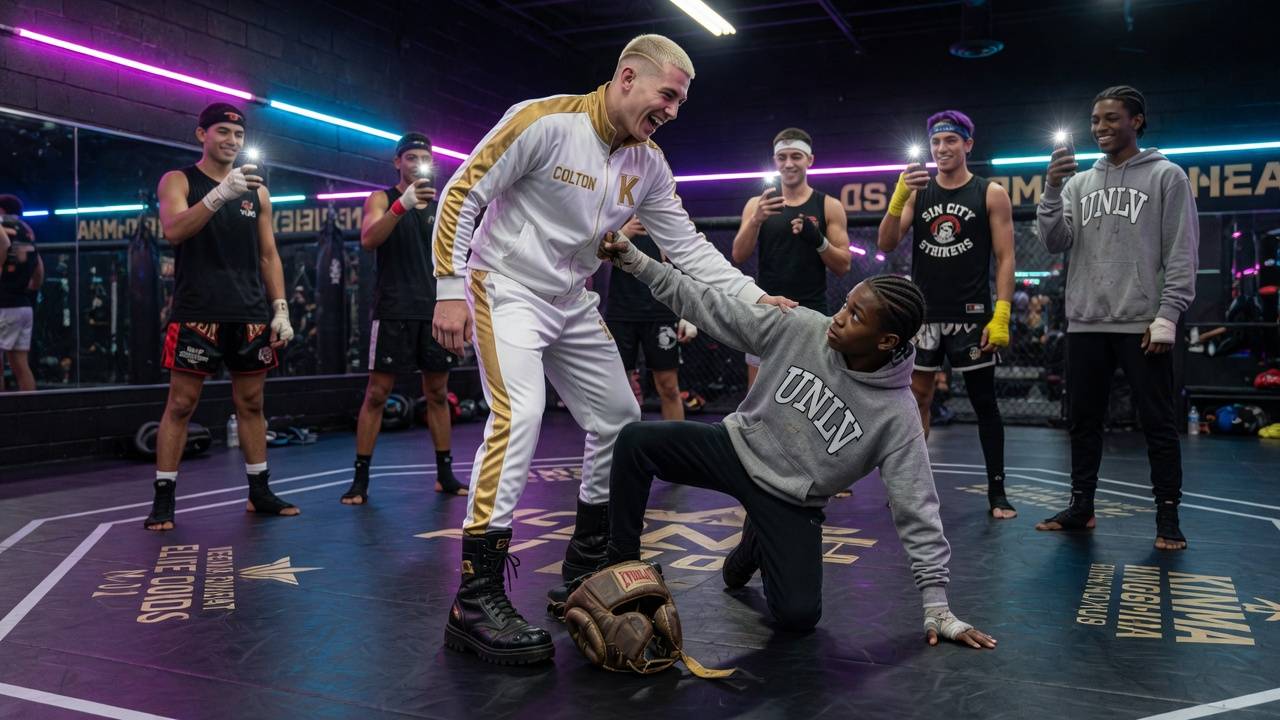
“He stepped on it, Zion. He stepped on the leather.” Ezekiel’s voice broke. “That was the last thing that still smelled like the night I won. Now it just smells like his boot.”
Zion took his father’s shaking hands in his. “We’ll fix it, Dad. I promise.”
A heavy knock at the door made them both flinch. Zion stood up, his body instantly tensed, his mind racing through the possibilities: the police, Colton’s crew, a process server.
He moved to the door and looked through the peephole.
It was Miller. The old referee was standing in the dim hallway, wearing a worn denim jacket and carrying a heavy gym bag. He looked tired, but his eyes were sharp.
Zion opened the door. “Mr. Miller? How did you find us?”
“Referees find everything, kid. It’s the job,” Miller said, stepping into the apartment without waiting for an invitation. He nodded to Ezekiel. “Evenin’, Champ.”
Ezekiel blinked, a slow smile spreading across his face. “Miller? Is it time for the weigh-in?”
“Not yet, Ezekiel. Soon,” Miller said gently. He turned to Zion, his expression hardening. “We have a problem. The video has four million views now. It’s gone past the MMA world. It’s on the morning news cycles. And Colton’s people are doing exactly what I thought they’d do. They’re filing an assault charge, and they’ve frozen the gym’s insurance payout for your dad’s treatment, claiming ‘hostile environment’ violations.”
Zion leaned against the kitchen counter, feeling the world closing in. “I have a thousand dollars in an envelope. That’s all we have.”
“It won’t be enough,” Miller said. “But there’s a way out. A way to kill the lawsuit and get your dad what he needs.”
“How?”
Miller sat down at the small, laminate kitchen table. “The owners of the Apex—the big money behind the gym—they don’t care about Colton’s ego. They care about their reputation. Right now, they look like bullies who let a legend get humiliated by a TikTok star. They’re terrified of the PR fallout.”
Miller leaned forward. “They want a closed-door session. No cameras. No phones. Just you, Colton, and a board of directors. They want to call it ‘demonstration sparring.’ If you can prove that what you did wasn’t an assault—that it was a controlled, technical response to his escalation—they’ll drop the charges and set up a trust for Ezekiel’s care to make the whole story go away.”
“They want me to fight him again?” Zion asked, his voice rising. “In front of a board? Like a circus animal?”
“They want to see if you’re a fluke, Zion,” Miller said. “Colton is telling them you got lucky. He’s telling them he tripped. He’s demanding a chance to ‘set the record straight.’ If you win, you get the trust for your dad. If you lose, or if you refuse, they go ahead with the police report.”
Zion looked at his father. Ezekiel was back to staring at the blank TV, his fingers tracing the cracks in the headgear.
“He’s afraid of the violence, Mr. Miller,” Zion whispered. “He doesn’t want to see me fight. He thinks it’ll make him forget me.”
“He won’t be there,” Miller said. “It’ll just be us. But Zion, you have to understand. Colton won’t be playing this time. He’s going to try to hurt you. He’s going to try to break you to prove that the hierarchy still exists.”
Zion looked at his split knuckles. He thought about the mop, the bleach, the blue Gatorade on the floor, and the weight of the boots on his father’s headgear. He thought about the “Crown of Dust”—the glory that was gone, and the dignity that was all they had left.
“When?” Zion asked.
“Tomorrow night. Midnight. Back at the Apex.”
Chapter 6
The Apex at midnight was a different beast than it was during the day. The neon lights were off, replaced by the sterile, white hum of the overhead security banks. The gym felt vast and hollow, the sound of Zion’s footsteps echoing off the high ceilings as he walked toward Cage One.
He wasn’t wearing a hoodie tonight. He was wearing his father’s old training shorts—black with a simple white stripe—and his hands were wrapped perfectly, the white gauze tight and professional, thanks to Miller.
Miller was already there, standing near the cage door. Beside him were three men in expensive suits—the “Board”—looking deeply uncomfortable to be in a gym at this hour. And in the center of the cage, leaning against the chain-link, was Colton.
Colton didn’t look like a star tonight. He looked like a man who hadn’t slept. His chest was heavily taped under his rash guard, the purple bruising from Zion’s kick visible at the edges. His eyes were bloodshot, and he was vibrating with a frantic, desperate energy.
“You actually showed up,” Colton spat as Zion stepped through the cage door. “I figured you’d be halfway to Arizona by now.”
Zion didn’t answer. He walked to the center of the mat and began to shadow box, his movements small and internal. He was finding his breath, finding the rhythm his father had taught him in the quiet hours of the night.
“Gentlemen,” Miller said, his voice echoing. “This is a private evaluation. The terms are clear. Three rounds of five minutes. Full contact. If Zion Silva demonstrates technical proficiency and control, all legal actions are vacated, and the Silva Trust is established. If Mr. Covalsky wins by stoppage, the assault charges proceed. Are we agreed?”
The suits nodded solemnly. One of them held up a tablet, recording the session for their legal team.
“Fight,” Miller said.
Colton didn’t wait. He exploded across the mat, a high-level wrestler’s shot aimed directly at Zion’s hips. He wanted to take the fight to the ground, to use his weight and his years of elite training to smother the “janitor kid.”
But Zion was already gone. He stepped to the left, his footwork a mirror image of Ezekiel’s 2008 title defense. He didn’t just avoid the shot; he used Colton’s momentum to pivot, placing a hand on Colton’s head and guiding him into the fence.
Colton hit the chain-link with a rattle that shook the room. He spun around, his face twisted in rage. He threw a massive overhand right, a punch designed to end the night.
Zion saw it coming before Colton’s shoulder even turned. He ducked, the air from the punch whistling over his ear, and delivered two sharp, stinging jabs to Colton’s nose.
Pop-pop.
Colton’s head snapped back. Blood began to leak from his nostrils.
“That’s it?” Colton screamed, lunging forward again. “That’s all you got, Mop-Boy?”
The next four minutes were a masterclass in psychological demolition. Zion didn’t try to knock Colton out. He did something much worse. He dismantled him. Every time Colton threw a strike, Zion was an inch out of range. Every time Colton tried to clinch, Zion was already behind him.
Zion was moving with a terrifying, silent efficiency. He was using the “structure” Miller had talked about—finding the points where Colton was weak and tapping them. A leg kick that knocked Colton off-balance. A shoulder bump that broke his posture. A clinch break that left Colton gasping.
By the end of the first round, Colton was leaning against the cage, his chest heaving, his face a mask of blood and confusion. He looked at the Board members, looking for help, but they were staring at Zion with a kind of awe.
“He’s… he’s cheating,” Colton wheezed. “He’s using something… he’s not human.”
“He’s a Silva, Colton,” Miller said quietly from the corner. “Maybe you should have studied the history books instead of your follower count.”
Round two began, and the desperation in Colton turned into something dangerous. He knew his career was on the line. If he lost to the janitor in front of his bosses, he was finished. He stopped trying to box and started trying to kill. He threw a spinning back-fist, then a flying knee, and finally, a reckless, head-down charge.
Zion waited. He waited for the moment when Colton’s ego finally overrode his training.
It happened three minutes into the round. Colton threw a wild left hook, his entire body leaning into the strike, his lead leg heavy and stuck.
Zion didn’t move away this time. He moved in.
He caught Colton’s arm, snapped it downward, and drove his shoulder into Colton’s chest. In one fluid motion, Zion transitioned to a standing rear-naked choke. His arm wrapped around Colton’s neck like a steel cable.
He didn’t squeeze. Not yet.
“My father’s name is Ezekiel Silva,” Zion whispered into Colton’s ear, his voice calm and terrifying. “He is a King. And you are just a guest in his house.”
Zion applied the pressure. Colton’s eyes rolled back. His hands clawed at Zion’s arms, but there was no escape. The “janitor” was a vise. The room went silent as Colton’s knees hit the mat.
Zion let go just before Colton lost consciousness.
Colton slumped forward, his forehead hitting the canvas—the same canvas Zion had scrubbed every day for two years. He lay there, sobbing, a broken boy in expensive gear.
Zion stepped back. He looked at the Board.
“Is that enough?”
The lead suit stood up. He looked at the tablet, then at Colton, and then at Zion. “The trust will be funded by noon tomorrow, Mr. Silva. And the police report has been withdrawn. We… we apologize for the misunderstanding.”
Zion didn’t wait for a handshake. He walked out of the cage, past Miller, and into the locker room.
He sat on the wooden bench and began to unwrap his hands. The adrenaline was fading, replaced by a deep, hollow ache. He had won, but the “residue” was there. He realized he didn’t want this. He didn’t want the lights, the cage, or the violence. He had fought to protect his father’s past, but now he had to protect his father’s future.
He walked out of the gym for the last time. Miller was waiting by the Civic.
“You’re leaving?” Miller asked.
“We’re moving to Colorado,” Zion said. “My aunt has a place near the mountains. It’s quiet. No gyms. No neon.”
“You have a gift, Zion. You could be the next PFP Number One. The owners… they’ll want to sign you.”
“Tell them the janitor retired,” Zion said, a small, tired smile touching his lips. “I’m going to go take care of the Champ.”
Zion drove home. The sun was starting to rise over the desert, a pale, golden light that made the sand look like silk.
When he entered the apartment, Ezekiel was awake. He was sitting at the kitchen table, and for the first time in months, he had a clear, bright look in his eyes. He was holding the leather headgear.
“Zion?”
“Yeah, Dad?”
“I had a dream last night,” Ezekiel said. “I dreamed I was in the arena. I was wearing the crown. But then I looked up, and I saw you in the front row. And I realized… the crown wasn’t the leather. It wasn’t the belt.”
Ezekiel reached out and took Zion’s hand—the bruised, split hand. He looked at the knuckles, then up at his son’s face.
“The crown was you,” Ezekiel whispered. “You’re the only thing I have that didn’t turn to dust.”
Zion leaned his head against his father’s shoulder. The medical bills were gone. The lawsuit was dead. The silence in the room was finally, truly peaceful.
“Let’s go, Dad,” Zion said. “The car is packed.”
They left Las Vegas as the city was waking up, a father and a son in a rusted Honda, driving away from the lights and into the quiet, cool shadow of the mountains. Zion didn’t look in the rearview mirror. He kept his eyes on the road ahead, his hands steady on the wheel, finally carrying the weight of a legacy that no longer felt like a burden.
Behind them, the Apex Gym would find a new janitor. Colton would find a new brand. But in a small apartment in Colorado, a King would sit on a porch and watch the sunset, and he would never have to sign his name for a stranger again.