FULL STORY
CHAPTER 3
The heavy oak door of the grand council hall shuddered under the impact of the northern gale outside, but the silence inside the room was far more suffocating. I stood trembling at the base of the massive stone pillars, the Admiral’s fur coat still draped over my small, shivering shoulders. The room was packed with the elite of the Iron Anchor fleet—captains with faces scarred by sea fire, navigation masters wrapped in heavy wool, and aristocratic officers whose polished armor gleamed under the light of a dozen massive iron chandeliers.
Every single eye was fixed on me. Some looked at me with a deep, unsettling confusion; others glared with open hostility. To them, I was still the filthy cabin boy who had spent the last five years sweeping maggot-infested grain from the cargo holds. They could not accept that the blood of the sea throne was running through my veins.
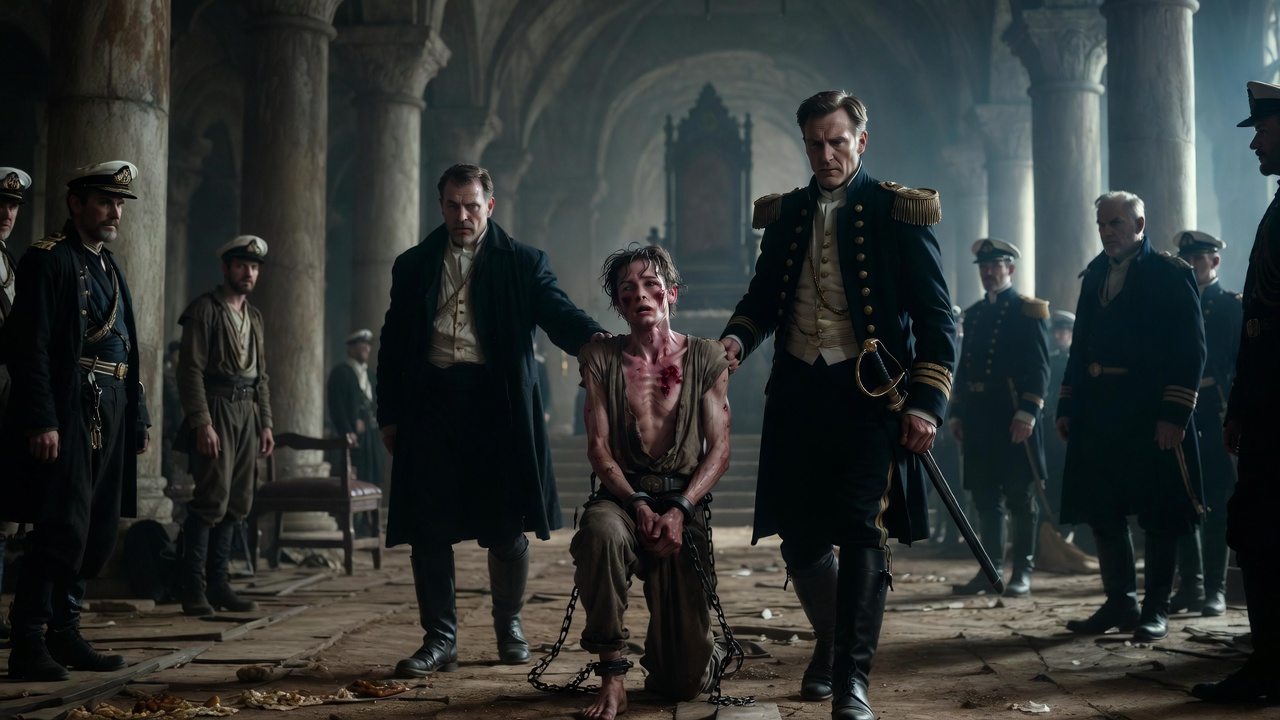
In the center of the hall, Lord Charles stood with his hands tightly clenched behind his back, his face a mask of aristocratic fury. His twenty royal guards formed a wall of steel between us, their halberds held at perfect attention. Chained to the iron ring in the center of the floor, Barnaby was breathing heavily, his eyes darting frantically from Lord Charles to my father, searching for a single crack in the wall of authority that had suddenly surrounded him.
“This is madness, Admiral Vance,” Lord Charles hissed, his voice cutting through the damp chill of the hall. “You expect this council, and the High King himself, to believe that a nameless, thieving galley rat is the lost heir to the greatest naval bloodline in the empire? You are shielding a criminal from royal justice by fabricating a fairy tale!”
My father stepped forward, his heavy leather boots echoing against the stone floor like the slow, deliberate beat of a war drum. He did not draw his sword this time, but the sheer aura of his presence made the royal guards instinctively tighten their grip on their weapons.
“I do not fabricate stories, Charles,” my father said, his voice dangerously low, vibrating with a cold intensity that made the flame of the torches flicker. “I know the blood of my blood. I know the silver that hangs around his neck. And I know the laws of the sea throne. If you challenge my word, you challenge the authority of every warship in this harbor.”
“I challenge the law!” Charles countered, stepping closer, his silk robes rustling. “The law states that any artifact bearing the crest of the burning star belongs to the High King’s treasury unless held by a recognized lord of the realm. This boy is a beggar from the slums of Oakhaven. Even if he is your bastard, he has no legal standing here. He is property of the fleet’s labor force, bought and paid for. If he cannot prove his lineage through the sacred trials of the naval register, he is a thief, and the penalty for stealing imperial silver is death by the plank.”
A low murmur of agreement passed through the back rows of the council. Many of these captains had achieved their ranks through blood and brutality; they had no love for a boy who had been handed a legacy overnight. They wanted proof. They wanted to see if the cabin boy would break under the weight of the iron.
My father stopped just inches from Lord Charles. The contrast between them was absolute—the slender, powdered noble in his imported silks, and the massive, battle-hardened warlord whose hands had broken the hulls of a hundred ships.
“You want proof, Charles?” my father whispered, a dark, terrifying smile touching his lips. “You want the naval register? Then we shall open the Book of the First Fleet. We shall see what names were written in the sacred ink before you were even old enough to wear a dagger.”
He turned toward the high dais at the front of the hall, where the oldest officer of the fleet sat behind a massive, iron-bound desk. The old man was Captain Horgath, a veteran whose legs had been taken by a cannon blast twenty years ago, leaving him to serve as the keeper of the fleet’s secrets. His eyes were milky with cataracts, but his hands were steady as he reached for a massive, dust-covered ledger that lay locked inside a bronze cage beneath his desk.
“Horgath,” my father commanded. “Bring forth the register of the Year of the Great Siege. Open the records of the Western Clan alliances.”
The hall fell so silent you could hear the scratch of the iron key as Horgath unlocked the bronze cage. The old man lifted the heavy ledger, his breath wheezing in his throat as he blew a thick layer of grey dust from the leather cover. The dust danced in the torchlight like tiny spirits of the dead.
Barnaby shifted his weight in his chains, his links rattling loudly. “He’s a fraud!” the deckhand shouted, his voice cracking with a desperate malice. “I watched that boy for two years! He doesn’t know how to read the stars! He doesn’t know the language of the high ships! He’s nothing but a gutter rat who found a dead man’s token in the mud! Ask him about his mother! Ask him how she died like a dog in the dirt!”
The words felt like a knife twisting in my chest. The memory of my mother’s final days—her small, fragile hand holding mine as the winter wind screamed through the cracks of our hovel—flooded my mind. I remembered the hunger, the shame of begging at the harbor gates while the grand carriages of the naval elite splashed muddy water over our tattered clothes.
“Silence!” my father roared, the sound so loud it caused several officers to flinch. He did not look at Barnaby; his eyes remained fixed on Lord Charles. “Let the record speak.”
Old Horgath wetted his thumb, slowly turning the yellowed, brittle pages of the ancient ledger. The sound of the paper turning felt like the ticking of a clock counting down to my execution. He stopped at a page marked with a large, fading seal of red wax—the seal of the High King’s ancestral court.
“Grand Admiral Vance,” Horgath’s raspy voice echoed through the hall. “The records of the Year of the Great Siege are clear. There is a entry here regarding the Western Clan alliance. It states that a marriage was recorded between yourself and Lady Elena of the Western Isles. But… there is a secondary note here, written in the hand of the High King’s personal scribe.”
Lord Charles leaned forward, his eyes gleaming with a malicious triumph. “Read the secondary note, Horgath. Read it loud so the entire fleet can hear the truth.”
Horgath swallowed hard, his old eyes squinting at the faded ink. He looked up at my father with a sudden, profound sorrow before reading the words aloud.
“The note states that following the rebellion of the Western Clans, the marriage was declared null and void by royal decree. Any offspring resulting from said union is stripped of all titles, names, and rights of inheritance. They are branded as outlaws of the sea throne, to be executed upon discovery to ensure the purity of the naval lineage.”
The words struck the hall like a physical blow. A collective breath was drawn by the hundreds of sailors and officers packed into the space. The law was absolute. The High King had written my death sentence twelve years before I had even learned how to tie a sailor’s knot.
Lord Charles burst into a loud, mocking laugh, turning around to face the assembly of captains. “You see! You see the truth now! The boy is not an heir—he is a condemned outlaw! By the very laws of the High King, his existence is a crime against the realm! Admiral Vance, you have brought a condemned traitor into the high council of the fleet. If you do not hand him over to my guards this instant, you are committing treason against the sea throne yourself!”
The royal guards immediately advanced, their heavy boots clanking against the stone as they raised their weapons, directing the sharp iron tips toward my chest. I shrank back, my small hands grabbing the edge of my father’s heavy fur coat. The warmth of the room seemed to vanish, replaced by the freezing terror of the plank. I looked at the faces of the captains—the men who had looked confused before were now nodding in agreement. They were loyal to the King’s law, and the King’s law demanded my blood.
“Barnaby was right,” a captain shouted from the back. “The boy must go to the water! We cannot harbor a rebel’s seed on the flagship!”
“Throw him to the Stalkers!” another yelled, the crowd beginning to surge forward, their voices building into a terrifying crescendo of bloodlust.
Barnaby began to laugh hysterically in his chains, his blackened teeth bared in a grin of pure, vindictive joy. “Yes! Throw him down! Let me push him off myself this time! Let the sea have its garbage!”
I looked up at my father, expecting to see the pale, broken look of defeat on his face. But what I saw froze the blood in my veins.
Grand Admiral Vance was not trembling. He was not backing down. His face had turned into something completely inhuman—a mask of cold, ancient fury that belonged to the primordial sea kings of old. He slowly reached down and unbuckled the heavy gold chain of office that hung around his neck—the chain that marked him as the commander of the fifty warships. He dropped it onto the floor. It hit the stone with a heavy, metallic clang that seemed to echo louder than the shouts of the crowd.
“You think you can take him from me with a piece of paper, Charles?” my father said, his voice so quiet it was terrifying. “You think I care about the laws of a King who sits on a gold chair three hundred miles away while my men die in the salt water?”
He slowly drew his massive broadsword. The iron blade caught the light of the torches, gleaming with a deadly, cold sharpness.
“Twelve years ago, I let that King dictate my life. I let him burn the world I loved because I was loyal to his laws. I spent twelve years living with the ghost of my wife and the shame of my ambition. I will not let him take my son.”
He pointed the tip of his sword directly at Lord Charles’s throat.
“Every captain in this hall knows that the High King does not command the Iron Anchor fleet. I command it. Every ship out there belongs to the men who bleed on the decks, not the politicians who live in the stone palaces. If you want to take this boy, Charles, you will have to step over my corpse—and I promise you, before my heart stops beating, every single one of your royal guards will be swimming in their own blood on this floor.”
The hall erupted into absolute chaos. The royal guards formed a defensive circle around Lord Charles, their weapons clashing against each other as they prepared for a battle they knew they could not win. The fleet captains were throwing their chairs back, their hands flying to their swords, divided between their loyalty to the King and their terror of the Admiral.
“This is mutiny!” Charles shrieked, his voice cracking with a high-pitched panic as he hid behind the shields of his guards. “Vance, you are destroying everything you built! The King’s grand armada will hunt you to the ends of the earth! They will burn your ships and salt your harbors!”
“Let them come,” my father roared, his voice shaking the timber beams above. “Horgan! Sound the drums! Lock the harbor gates! If the High King wants a war for my son’s life, I will give him a storm that will drown his entire empire!”
But before the first blow could be struck, before the hall could turn into a slaughterhouse, Old Horgath stood up from his heavy desk. He did not use his crutches; he held himself up by his hands, leaning heavily against the iron-bound table, his raspy voice screaming with a desperate, supernatural strength that caught everyone by surprise.
“Wait! Look at the register! Look at the bottom of the page!” the old man screamed, his finger shaking violently as he pointed to the brittle paper. “There is another mark! A mark written in the ancient blood-ink of the First Fleet! It was not written by the King’s scribe—it was written by the High King’s father, the old Sea Emperor himself before his death!”
The tension in the room hung on a razor’s edge. My father did not lower his sword, but his eyes shifted slightly toward the old keeper of the secrets. Lord Charles peered over the shields of his guards, his breath coming in short, ragged gasps.
“What does it say, Horgath?” my father demanded, his voice like iron.
Horgath rubbed his old eyes, his fingers tracing the faint, purple lines of an ancient script that had been hidden beneath the heavy red wax of the royal seal.
“The old Emperor’s decree states… that the lineage of the silver amulet cannot be broken by a political law. It states that if an heir of the burning star should ever return to the fleet, and if that heir possesses the three sacred scars of the maritime bloodline… the royal decree of nullification is void, and the boy shall be recognized as the Sovereign of the Northern Fleet, holding an authority equal to the King himself.”
Lord Charles straightened up, his fear turning back into an arrogant sneer. “The three sacred scars? That is a myth from the old legends! Nobody carries those marks! The boy has a scar on his forehead from a loose rigging block—that is one! What of the others? He is a smooth-skinned cabin boy! He has nothing but the marks of Barnaby’s whip on his back!”
“He has the second,” a low, gravelly voice spoke from the shadows near the pillars.
It was the ship’s surgeon, the old man who had bound my wounds in the private cabin. He stepped forward into the torchlight, his hands stained with the green salve he had used on my skin. He looked at Lord Charles with a cold, professional certainty.
“When I washed the filth from the boy’s body,” the surgeon said, his voice echoing clearly through the silent hall, “I found an old, faded burn mark on the sole of his left foot. It is the shape of a perfect anchor—the mark given to the children of the high naval houses during the traditional salt-baptism of the First Fleet. He has carried it since he was a babe.”
The captains looked at each other, their faces filled with a growing, religious awe. The ancient traditions of the sea were sacred to these men—far more sacred than the laws of the land-bound King.
“Two marks,” my father whispered, his sword lowering just a fraction as he looked down at me, his eyes wide with a desperate hope. “Two marks of the Sovereign. But what of the third? Horgath, what is the third mark of the maritime bloodline?”
Old Horgath looked down at the ledger, his face turning completely pale as he read the final, hidden line of the ancient script. He looked up at me, his milky eyes filled with a sudden, paralyzing terror that made the entire room hold its breath.
“The third mark,” Horgath whispered, his voice trembling so badly he could barely form the words. “The third mark is not a scar of the flesh. It is a mark of the soul. The legend states that the true Sovereign of the sea throne will possess the ability to summon the ancient guardians of the deep—and that the Sea Stalkers will never strike his flesh, but will bow before his presence as their natural master.”
Barnaby let out a loud, mocking laugh from the floor. “He’s a liar! The boy was terrified of them! He was crying on the plank! He looked down at them like they were his executioners! If you throw him into that water, they will tear him apart in seconds!”
Lord Charles saw his opportunity to regain control. He stepped out from behind his guards, a cruel, calculating look in his eyes. “An excellent test! The law of the old Emperor is clear! If the boy is the true Sovereign, the sea will protect him. If he is a fraud and a thief, the stingrays will feed. Admiral Vance, if you believe your own myth, let the boy step back onto the plank. Let the sea decide his fate. If he survives, my guards will kneel before him. If he dies, justice is served, and your mutiny is avoided.”
My father looked down at me, his large hand gripping my shoulder. I could feel the tension in his fingers, the terrible agony of a choice that no father should ever have to make. He looked at the sword in his hand, and then he looked at the hundreds of men who were waiting for his answer. If he fought, the ship would turn into a bloodbath, and we would likely both die in the chaos. If he let me go to the water, he was risking my life on an old legend written in a dusty book.
I looked down at the silver amulet hanging against my chest. I remembered my mother’s voice—the sea will always claim its own. I remembered the cold water touching my toes on the narrow wooden plank, and how, for a brief second before the whip struck my back, the giant shapes beneath the surface had seemed to stop their frantic thrashing, their massive, dark wings gliding through the water in a strange, silent pattern.
I stepped forward, pulling myself out from behind my father’s protective frame. My voice was small, but it carried clearly through the silent hall.
“I will go to the water,” I said.
My father turned to me, his eyes wide with horror. “Kaelen, no! You do not know what you are doing! The sea is ruthless—it does not care for the desperation of men!”
“The sea knows me, Father,” I whispered, using the word for the first time. The word felt warm, giving me a strange, sudden strength I had never felt before in my life. “Let them see the truth.”
Lord Charles grinned, a look of pure, sadistic satisfaction on his face. “Prepare the main deck! Bring the torches! Let us see if this galley rat is a king, or if he is just meat for the monsters of the deep!”
The crowd erupted into a frantic rush, turning out of the grand hall and surging back onto the storm-battered main deck of the flagship. The cold wind howled through the rigging, spraying salt water across our faces as we gathered at the ship’s railing. The iron torches cast long, flicking shadows over the dark ocean below, where the giant stingrays were still swarming, their massive, flat bodies rippling under the surface like living night.
The narrow wooden plank extended out over the pit of death, shaking violently with every movement of the ship.
Barnaby was dragged out by the guards, still chained but laughing maniacally, his eyes fixed on me as I walked toward the base of the plank. Lord Charles stood by the quarterdeck stairs, his arms crossed over his silk robes, a smug confidence radiating from his posture. He believed he had won. He believed that in less than sixty seconds, the inconvenient heir to the Iron Anchor fleet would be nothing but a memory in the bellies of the sea monsters.
My father stood at the base of the plank, his hand resting on his sword, his face looking as if it had been carved from stone. He did not speak, but his eyes were locked onto mine, filled with a silent, agonizing prayer.
I took a deep breath, the cold air burning my lungs. I stepped onto the narrow wooden plank. The wood was slick with ice and salt water, freezing my bare feet instantly. With every step I took away from the ship, the wood bent and shook, the black water churning violently beneath me.
Directly below the edge of the plank, a massive stingray—the largest I had ever seen, its body wider than a rowboat—breached the surface. Its slimy, dark skin glistened in the torchlight, its long, jagged tail whipping through the air with a terrifying hiss, its poisoned barb glinting with a deadly sharpness.
“Jump, rat!” Barnaby screamed from the deck. “Jump and let them tear you apart!”
The entire crew held their breath, hundreds of men leaning over the railing, their eyes wide with a sick curiosity. I reached the very end of the plank. The wind caught my hair, blowing it across my face. I looked down into the dark, swarming abyss of the sea.
I closed my eyes, took one final step forward, and plunged into the freezing, pitch-black water.
The impact was a shock of absolute ice that knocked the remaining air from my lungs. The dark water swallowed me whole, pulling me down into the deep, silent belly of the ocean. For a second, everything was darkness and freezing pain. I could hear the distant, muffled sound of the crew cheering above the surface, celebrating my death.
Then, the shadows moved.
Through the murky, black water, I saw them—dozens of giant stingrays, their massive, flat wings rippling as they turned their bodies, swimming directly toward me from every direction. Their long, poisoned tails trailed behind them like whips of death. The largest monster, the giant patriarch of the pack, was leading the charge, its dark mouth opening as it glided through the water straight toward my unprotected chest.
I could not breathe. My lungs were burning. I held my hands out, the silver amulet floating in the water before me, its ancient engraving catching a faint, unnatural glint of light from the deep.
The massive stingray reached me. Its cold, slimy wing brushed against my bare leg. I braced for the agonizing strike of its poisoned barb, closing my eyes as I waited for the darkness to take me completely.
But the strike never came.
Instead, the giant monster stopped its momentum just inches from my chest. Its massive, flat body began to vibrate with a low, deep hum that pulsed through the water, vibrating directly into my bones. The other stingrays arrived, forming a tight, protective circle around my body, their long tails moving in a slow, rhythmic dance that created a warm, calm current amidst the freezing ocean.
The giant patriarch glided closer, its smooth snout gently pressing against the silver amulet hanging from my neck. It did not bite. It did not strike. It nudged the metal softly, as if recognizing an old master who had returned from a long journey.
A sudden, overwhelming warmth flooded through my veins, washing away the freezing chill of the sea and the throbbing pain in my back. My lungs no longer burned for air. I felt a strange, deep connection to the water around me, a sense of absolute power that I had never imagined possible. The sea was not my executioner. It was my kingdom.
With a powerful stroke of my arms, I began to swim upward, the giant stingrays moving with me, rising through the water like a royal escort protecting their sovereign.
Above the surface, the crew’s cheers had died down into a tense, uncertain silence. Lord Charles was leaning over the railing, a nervous frown beginning to wrinkle his brow as he stared into the black water.
“He’s gone,” Charles muttered, trying to convince himself. “The monsters have finished him. Admiral Vance, the judgment of the sea is clear. Your son is—”
SPLASH!
The water exploded outward as my head broke the surface. I let out a loud, gasping breath of fresh air, my hand grabbing the thick hemp rope that hung from the side of the ship.
But I was not alone.
As I pulled myself up onto the lower wooden platform of the hull, the water around me began to churn with an unprecedented intensity. The giant stingrays did not sink back into the deep. They rose with me, their massive wings breaking the surface, their long, jagged tails lifting out of the water in a terrifying formation, creating a defensive wall of poisoned steel around my body.
The patriarch of the pack stood directly beside me, its massive head resting on the wooden platform, its dark eyes fixed on the ship above, waiting for my command.
The entire flagship erupted into a state of absolute, paralyzing panic. Sailors fell to their knees, their swords dropping from their hands as they stared at the impossible sight. The older captains were weeping, throwing themselves onto the deck, their voices shaking as they cried out the ancient prophecy.
“The Sovereign!” they shouted. “The Sovereign of the First Fleet has returned! The seas have spoken!”
Lord Charles staggered backward, his face completely green with a mortal terror, his thin legs shaking so violently he had to grab a wooden pillar to keep from collapsing. His royal guards were retreating, their halberds shaking in their hands as they looked at the wall of sea monsters protecting a twelve-year-old boy.
My father stood at the railing, his eyes wide with a mixture of profound shock and a father’s intense, overwhelming pride. A massive grin broke across his weathered face, and he raised his broadsword high into the stormy sky, his voice roaring louder than the thunder above.
“Kneel!” my father commanded his fleet. “KNEEL BEFORE THE SOVEREIGN OF THE SEA THRONE!”
CHAPTER 4
Every single man on the main deck of the flagship dropped to their knees as if a heavy iron weight had been placed upon their shoulders. From the highest officers on the quarterdeck to the lowest rowers who had crawled up from the dark belly of the ship, hundreds of battle-hardened sea killers pressed their foreheads against the damp, salt-encrusted timbers. The only sounds remaining on the open ocean were the howling of the winter wind through the rigging and the heavy, rhythmic splashing of the giant stingrays that still formed a protective ring around the lower platform where I stood.
I climbed up the wooden sea-ladder, my bare feet steady against the rungs. The cold wind no longer made me shiver; the strange, deep warmth that had filled my veins in the dark water remained, a solid core of strength that made the heavy wolf-fur coat feel light around my shoulders. As my feet hit the main deck, the crowd of sailors parted before me like the waves before a warship’s hull. They did not look at me with the cruel, mocking eyes of a crew looking for entertainment; they looked at the deck, their bodies trembling in absolute submission.
I walked past them slowly, the silver amulet swinging openly against my chest, catching the orange glow of the iron torches. I stopped in the center of the deck, right in front of the chained figure of Barnaby.
The chief deckhand was no longer laughing. He was curled into a pathetic, trembling ball on the rough wood, his heavy iron chains clanking loudly against each other as his body shook with a terrifying panic. The large, muscular monster who had lifted me by my hair and spat upon my face was now smaller than a beaten dog. He looked up at me through his greasy, tangled hair, his eyes wide with a frantic, sweating desperation.
“Master Kaelen… My Lord…” Barnaby whimpered, his voice a broken, high-pitched squeak that carried no trace of his former arrogance. “I didn’t know… I swear by the high gods, I didn’t know who you were! I was only following the rules of the galley! I was told you were just a stray from the Oakhaven docks! Please… have mercy on a poor sailor!”
I looked down at him, my face expressionless. The memory of his heavy boot breaking my ribs, the foul taste of his spit on my forehead, and the agonizing fire of his whip on my back rose in my mind. But I did not feel the blind, chaotic rage of a victim; I felt the cold, measured justice of a ruler.
“You told me that mercy was a commodity you did not carry on this vessel, Barnaby,” I said, my voice surprisingly steady, carrying clearly across the silent deck. “You told me that a boy as weak as me did not deserve the King’s rations. You wanted to see if my tears tasted sweeter than the sea.”
“I was wrong! I was mad!” Barnaby shrieked, throwing his head against the wood, weeping openly as his tears mixed with the salt water on the deck. “Please, My Lord! Do not throw me to the Stalkers! Do not let them tear my flesh!”
My father stepped forward, his massive hand coming to rest on my shoulder. His presence was a solid, reassuring wall of iron beside me. He looked down at Barnaby with a cold, murderous detachment.
“The judgment belongs to the Sovereign,” my father said, his voice echoing across the deck. “Speak your sentence, Kaelen. The fleet is waiting for your word.”
I looked from Barnaby to Lord Charles, who was still standing near the quarterdeck stairs, surrounded by his trembling royal guards. The high noble had lost all of his aristocratic pride; his silk robes were stained with salt water, and his face was pale and slick with sweat as he stared at me, realizing that his political authority had completely evaporated in the face of the ancient sea law.
“Lord Charles,” I called out, my eyes locking onto the emissary.
Charles flinched as if he had been struck with a whip. He stepped forward hesitantly, his hands shaking as he held them out in a defensive gesture. “My… My Lord Kaelen… we were merely seeking the truth of the lineage. The High King’s court must ensure the legal standing of the fleet’s commands… there was no personal malice meant toward your noble house…”
“You wanted to see if the legend was true, Charles,” I said, stepping closer to him, the crew watching every movement with bated breath. “You wanted to use the King’s paper to sentence a child to death because his existence was inconvenient to your politics. You stood there and smiled while a helpless boy was driven out onto the death plank.”
“It was the law!” Charles stammered, his eyes darting toward his guards, but the guards kept their heads bowed, refusing to raise their weapons against the boy who commanded the monsters of the deep. “The law of the realm demands—”
“The sea does not care for your realm, Charles,” I interrupted, my voice dropping to a dangerous, icy tone that mirrored my father’s command voice. “And on this ship, the law belongs to the blood of the burning star. You came here to strip my father of his command and execute his son. Instead, you will return to your High King with a message.”
I reached down and picked up the heavy gold chain of office that my father had dropped onto the deck earlier. I stepped up the stairs of the quarterdeck, holding the chain out toward my father. He looked at me, his eyes filled with a deep, emotional pride, and he bowed his head as I placed the golden links back around his neck, restoring his absolute command over the fifty warships.
“Tell the High King,” I said, turning back to face Lord Charles, “that the Iron Anchor fleet no longer answers to the stone palaces of the land. Tell him that the Sovereign of the First Fleet has reclaimed his name, and if his grand armada ever crosses into our waters to enforce his illegal decrees, the sea itself will swallow his ships until not a single splinter of his empire remains.”
Lord Charles swallowed hard, nodding frantically as he backed away toward the tender vessel that was moored to the side of the flagship. “I… I will deliver the message, My Lord. I will leave your waters immediately.”
“Take your guards and go,” I commanded. “Before I decide to let the guardians of the reef taste the blood of a noble.”
Charles did not wait for another word. He turned and scrambled down the side-ladder into his boat, his royal guards tumbling in after him in a frantic, undignified panic, their oars hitting the water with a chaotic splashing as they fled into the gathering darkness of the northern night.
The crowd of sailors watched them go, a low rumble of satisfaction passing through the ranks. They had watched their warlord and his new heir defy the high noble who had threatened their independence, and their loyalty to our bloodline was now absolute.
I turned my eyes back toward the trembling figure of Barnaby, who was still weeping on the deck, his iron chains rattling with his shivers.
“Now, for the chief deckhand,” I said slowly.
The crew leaned forward, a tense excitement rippling through the men. They expected to see a brutal execution; they expected to see me order the guards to throw Barnaby over the side so they could watch the giant stingrays tear him apart in a frenzy of blood and bone.
“Barnaby,” I said, standing at the top of the quarterdeck stairs, looking down at the monster who had ruled my nightmares for years. “You spent two years treating the children of this ship like animals. You believed that because you held the leather whip and the keys to the galley, your power was absolute. You believed that nobody could ever call you to account for the blood you took from the helpless.”
“I was a fool, My Lord! A wicked, broken fool!” Barnaby cried, his hands clasped together in a desperate prayer. “Save me from the water! Please!”
“I will not throw you to the water, Barnaby,” I declared.
A sudden murmur of confusion passed through the crew. Barnaby looked up, a faint, pathetic glimmer of hope breaking through his tear-stained face.
“The sea is too sacred to be used as a graveyard for a coward like you,” I continued, my voice cutting through the murmurs like an iron blade. “Death by the plank is too swift a punishment for the years of torment you inflicted on the weak. You will stay on this flagship.”
Barnaby blinked, his mouth open. “I… I will stay, My Lord? Thank you… thank you—”
“You will stay,” I interrupted, my voice turning to pure ice, “but you will no longer carry the leather whip. You will no longer hold the keys to the grain stores. Guards, strip him of his vestments. Strike his name from the officers’ ledger.”
The two large guards who had previously carried me to the quarterdeck stepped forward, their iron plates clanking. They didn’t hesitate this time. They reached down and tore the heavy leather vest from Barnaby’s shoulders, throwing it into the sea puddles. They unlocked his heavy iron chains from the ring on the deck, but they did not set him free.
“From this day forward,” I announced to the entire assembly, “Barnaby will occupy the lowest place in the cargo hold. He will sleep on the freezing, waterlogged timbers where I slept. He will sweep the maggot-infested grain that I swept. He will clean the copper pots and scrub the blood from the decks after every battle, using his own hands until they bleed.”
The crew began to grin, a cruel, satisfied amusement spreading through the ranks as they realized the absolute irony of the punishment.
“And if he ever fails to clean a single bucket,” I added, looking directly into Barnaby’s hollow eyes, “or if he ever raises his hand against another cabin boy on this fleet, any child on this ship has the legal right to take the leather whip and strike his back until the debt is paid in full. You will live the life you gave to me, Barnaby. You will know the hunger, the cold, and the absolute helplessness of the gutter.”
Barnaby’s face collapsed into a look of complete, devastating despair. He realized that death would have been a mercy compared to the living hell of the life he had just been sentenced to live—a life where he would be surrounded by the very children he had tortured, now holding the absolute authority of the Sovereign over his head.
“Drag him away,” my father commanded the guards.
The guards grabbed Barnaby by his collar, dragging his heavy, weeping body across the slippery deck toward the dark hatch that led to the lower holds—the exact same way he had dragged me by my hair hours before. The crew jeered and spat upon him as he passed, his screams of despair fading into the deep, echoing hollows of the ship’s belly.
The main deck fell silent once more. The giant stingrays beneath the ship let out one final, deep hum that vibrated through the hull—a silent salute to their master—before turning their massive, flat bodies and disappearing into the dark, fathomless depths of the open ocean. The water became calm, reflecting the cold, purple twilight of the northern sky.
My father turned to me, his large, battle-worn face softening with an emotion that no warlord had ever shown to his fleet. He fell to his knees before me on the high quarterdeck, his massive broadsword held across his palms in a gesture of absolute allegiance.
The hundreds of captains and sailors below followed his movement, pressing their faces back against the wooden deck, their voices rising in a single, thunderous chant that echoed across the entire harbor, carrying the name of the new dynasty to the ends of the sea empire.
I looked down at the silver amulet resting against my chest, feeling its ancient warmth beating in sync with my own heart. The scars on my back still throbbed with a dull pain, but the cold fear that had ruled my existence for five long years had vanished forever into the black water.
And for the first time in many years, nobody knelt on my back again.