Chapter 5
The silence that followed the chime of the bakery door was heavier than any sound Gabe had ever heard in a combat zone. It wasn’t the silence of peace; it was the vacuum left behind after a detonation. The flour dust was still settling in the shafts of morning light, and the smell of scorched sugar and yeast felt like a mockery of the violence that had just transpired.
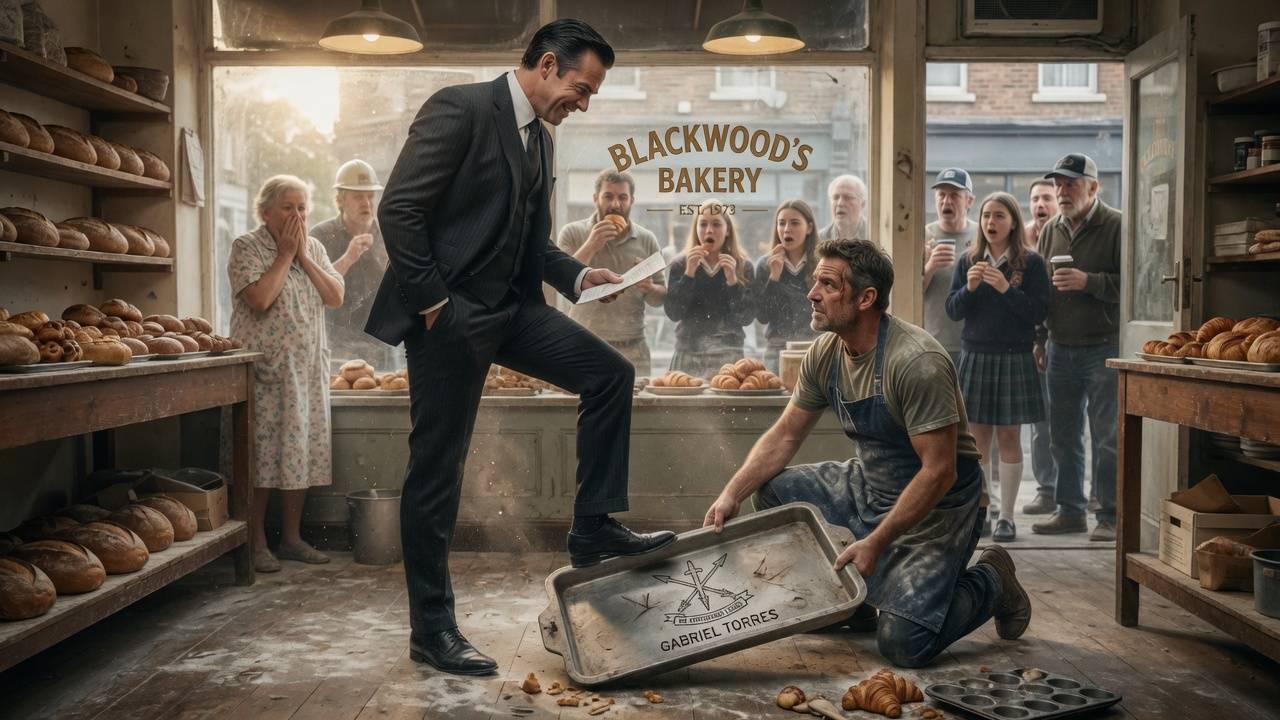
Gabe stood in the center of his shop, his chest heaving, the steel mold clutched so tightly in his right hand that the edges bit into his scarred palm. He didn’t look at the crowd. He didn’t look at Detective Vance, who was still standing by the glass with an expression that shifted from professional neutrality to something approaching grim respect. He looked at the floor, where the white dust was smeared and dragged by Blackwood’s expensive Italian leather shoes.
“Everyone out,” Gabe said. His voice didn’t sound like his own. it was the hollow, metallic rasp of a man who had just stepped back across a line he’d promised himself he would never cross again.
The regulars moved. Mrs. Higgins clutched her purse to her chest, her eyes wide as she scurried past him, not meeting his gaze. The young couple followed, the man’s phone still clutched in his hand, his thumb likely already hovering over the ‘post’ button. They didn’t offer thanks. They didn’t cheer. They left as if escaping a burning building.
Only Detective Vance remained. She stepped inside, the bell over the door giving a lonely, pathetic tink. She looked at the spilled trays, the bruised rolls, and the distinct indentation in the flour where Blackwood’s body had hit the tiles.
“You shouldn’t have done that, Gabe,” she said quietly. She wasn’t reaching for her cuffs, but she wasn’t smiling either.
“He was stepping on my life, Sarah,” Gabe replied, using her first name for the first time in years. “He was stepping on Mark’s name.”
“I know,” she sighed, glancing at the street where the black SUV was screeching away. “But men like Blackwood don’t take a beating and move on. They litigate. They call the commissioner. They send people who don’t care about neighborhood optics. You just gave him the one thing he didn’t have: a reason to call the law on you.”
“He attacked me first,” Gabe said, though even he could hear the weakness in the defense. The escalation had been his. The efficiency of the violence had been his.
“I saw it. I’ll write it that way in the report. But Gabe… the video is already online. I can see three people across the street holding phones. By tonight, you aren’t the local baker anymore. You’re the ‘unhinged vet’ who assaulted a prominent developer.” She stepped closer, her voice dropping. “Get the kids. Get them out of the building for a few days. My sister has a place in Jersey. Go.”
Gabe shook his head. “If I leave, the shop is empty. If the shop is empty, it’s gone. I’m staying.”
Vance looked at him for a long beat, then nodded slowly. “I’ll do what I can. But my reach stops at the precinct door. Watch your back.”
She left, and Gabe was alone with the mess. He began to clean, the mechanical repetition of the task grounding him. He picked up the spilled rolls, one by one. He wiped the floor. He straightened the table. But the air in the bakery had changed. It felt thin, cold.
An hour later, the stairs creaked. Maya and Leo were standing there. They had seen everything through the banister. Leo looked terrified, but Maya was different. She looked at Gabe with a terrifying clarity.
“Is he coming back?” Leo whispered.
“No, Leo. Not today,” Gabe said, wiping his flour-stained hands on his apron. He walked over and knelt in front of them, but as he reached out to touch Leo’s shoulder, the boy flinched.
It was a small movement, barely a twitch, but it hit Gabe harder than any of Blackwood’s insults. The monster he had kept caged, the one Mark had died to help him bury, had finally looked out through his eyes. And the children had seen it.
“I had to protect the shop,” Gabe said, the words feeling like ash in his mouth.
“You looked like you wanted to kill him,” Maya said. There was no judgment in her voice, only an observation that felt like a sentence.
Gabe didn’t have an answer. He stood up and went to the counter, picking up the phone. He dialed a number he hadn’t called in three years.
“Miller,” Gabe said when the line picked up. “It’s started. I need the Net. All of them.”
By evening, the fallout began to crystallize. The local news had picked up the grainy cell phone footage. They didn’t show Blackwood stepping on the mold. They showed the ‘3-beat’ combo—the snap, the strike, the kick. They showed the “Baker of 4th Street” becoming a weapon.
Then came the “emergency” health inspection. Two city vehicles pulled up at 6:00 PM, accompanied by a police cruiser that wasn’t Vance’s. The men who stepped out didn’t look like they were there to check for rats. They looked like they were there to seal a tomb.
“Mr. Reese,” the lead inspector said, holding a clipboard like a shield. “We’ve received a formal complaint regarding the structural integrity of the oven venting system following a… disturbance this morning. We’re here to conduct a mandatory safety audit. You’ll need to vacate the premises immediately.”
Gabe stood in the doorway, his arms crossed. Behind him, in the shadows of the bakery, Miller, Silas, and four other men sat at the corner tables, drinking coffee. They didn’t say a word. They just watched.
“The venting was inspected six months ago,” Gabe said.
“Policies change, Mr. Reese,” the inspector said, not meeting his eyes. “Step aside.”
“No,” Gabe said. “I have two children upstairs. This is their home. You have a warrant, or you have a conversation with my attorney. Which is it?”
The inspector hesitated, looking back at the police officer. The officer stepped forward, his hand resting on his belt. “Don’t make this a thing, Gabe. You’re already in enough trouble for the Blackwood assault. Just go for the night.”
“He stays,” Miller’s voice boomed from the back. The old veteran stood up, his posture straightening into a ghost of his former rank. “And so do we. This is private property. If you want in, you bring the Sheriff and a court order. Until then, the bakery is closed to everyone but friends.”
The standoff lasted twenty minutes before the city workers retreated, citing “obstruction” in their logs. It was a small victory, but Gabe knew it was a stay of execution.
That night, Gabe sat in the basement with Miller. The Pelican case was open on the table. The flash drives gleamed under the bare lightbulb.
“If you use this, Gabe, there’s no going back,” Miller said, his voice low. “Blackwood isn’t just a builder. He’s the money behind the mayor’s re-election. This ledger… it shows the kickbacks, the shell companies used to buy up the district. It’ll take him down, but it’ll burn the whole neighborhood down with him. The city will seize everything as evidence. The condos won’t be built, but the bakery won’t survive the legal firestorm either.”
Gabe looked at the steel mold sitting next to the flash drives. He thought about the flinch in Leo’s shoulders. He thought about the smell of bread he could no longer perceive, and the hands that were only good for kneading or destroying.
“I’m not saving the bakery anymore, Miller,” Gabe said. “I’m saving the block. And I’m showing those kids that you don’t let a bully own the air you breathe, even if the price is the roof over your head.”
The phone rang. It was a blocked number.
“Gabe,” Blackwood’s voice was strained, thick with a cocktail of pain medication and pure, unadulterated malice. “I’m sitting in a hospital bed with two cracked ribs and a ruptured spleen. My lawyer is sitting next to me. He’s currently drafting a civil suit for three million dollars. But I’m a generous man. Sign the deed by midnight, and I’ll tell the D.A. I don’t want to press criminal charges. You can walk away with your ‘Badge’ and your brats. If not… I’ll see you in a jumpsuit by Monday.”
Gabe looked at the ledger. He looked at the names of the veterans Blackwood had already displaced.
“I’ve tasted the mud, Richard,” Gabe said, his voice a calm, terrifying silk. “The jumpsuit doesn’t scare me. But you should be very, very afraid of the bakery’s morning delivery.”
He hung up and looked at Miller. “Upload the files. All of them. Send the copies to the Feds and the Tribune. Now.”
Chapter 6
The morning didn’t bring the smell of bread. For the first time in fifteen years, Gabe hadn’t fired up the ovens at 4:00 AM. Instead, the bakery was filled with the hum of laptops and the low murmur of men who hadn’t slept.
By 8:00 AM, the street outside was a circus. The news of the “Blackwood Leaks” had hit the wires at dawn. The ledger was a roadmap of corruption—illegal demolition permits, laundered campaign funds, and the systematic intimidation of elderly tenants. It wasn’t just a local story anymore; it was a systemic collapse.
Gabe stood by the window, watching as two black sedans—FBI, not local PD—pulled up to Blackwood’s corporate headquarters across the plaza. He watched as the “consultants” in the SUV were zip-tied on the sidewalk.
But there was no joy in it.
The bakery was silent. The flour on the floor was gone, swept away by Maya and Leo earlier that morning. The shelves were empty. The “Closed” sign was turned to the street, and this time, Gabe knew it was for good. The city had already issued a freeze on all properties connected to the investigation, including Gabe’s lease, which Blackwood had illegally transferred to a holding company months prior.
“We did it, Gabe,” Miller said, clapping him on the shoulder. “He’s done. He’ll be in court for a decade.”
“Yeah,” Gabe said, his eyes fixed on the empty pastry case. “He’s done.”
“What are you going to do?” Silas asked. “The Net is already looking for a new spot. We can find a kitchen, maybe over in Kensington.”
Gabe looked up at the apartment stairs. Maya was standing there, a small suitcase in each hand. Leo was holding his favorite stuffed dog, looking around the only home he remembered with a confused, quiet sadness.
“I’m going to be a father,” Gabe said. “The bakery was a fort. It was a place to hide. But you can’t raise kids in a fort forever.”
He walked to the wall and took down the framed guidon. He took the steel mold—the Badge—and tucked it into his jacket pocket. It felt lighter now. The names etched into it didn’t feel like a debt anymore; they felt like a blessing.
As they walked out the front door, a crowd had gathered. It wasn’t the voyeurs with the phones this time. It was the neighbors. Mrs. Higgins was there, holding a thermos. The young couple was there, looking ashamed.
“Gabe,” Mrs. Higgins called out. “Where are you going?”
“Away for a while,” Gabe said. “But the neighborhood is yours again. Make sure you keep it that way.”
He didn’t look back as he loaded the kids into his old truck. He didn’t look back as he pulled away from the curb, leaving the smell of cold stone and old flour behind.
He drove two blocks and pulled over in front of the community park. He looked at Maya in the rearview mirror.
“I’m sorry,” Gabe said. “I’m sorry you saw that man in the shop. I’m sorry we lost the house.”
Maya looked at him, and for the first time in a week, she smiled. It wasn’t a big smile, but it was real.
“You didn’t lose it, Uncle Gabe,” she said. “You gave it back to everybody else. Dad would have done the same thing.”
Gabe felt a tightness in his throat—a sensation he hadn’t felt since before the war. It wasn’t the smell of bread, but it was something just as sharp, just as nourishing.
He put the truck in gear and headed toward the bridge. He didn’t know where they were going to sleep that night, or where he would find his next bag of flour. But for the first time in his life, his hands weren’t shaking.
The “Baker’s Badge” was in his pocket, but the soldier was finally, truly, out of the war. He reached over and turned on the radio, catching a song the kids liked. He didn’t need to smell the air to know that for the first time in years, the world tasted like something new.