Chapter 5
The air in Principal Miller’s office smelled of expensive lemon polish and the stale, ionized scent of a high-end air purifier that was working too hard. Marcus sat in a chair that was designed to make the occupant feel small—low-slung, leather-backed, positioned directly across from a mahogany desk that felt like a fortress. He didn’t lean back. He sat with his hands resting on his knees, his spine a straight line, his eyes fixed on a framed degree from Yale that hung just over Miller’s left shoulder.
Miller wasn’t sitting. He was pacing a rug that probably cost more than Marcus’s truck, his hands fluttering near his throat like trapped birds. He was a man built of soft edges and panicked compromises, a man who had spent twenty years navigating the delicate egos of Connecticut’s elite, and Marcus had just dropped a tactical nuke into the middle of his carefully managed ecosystem.
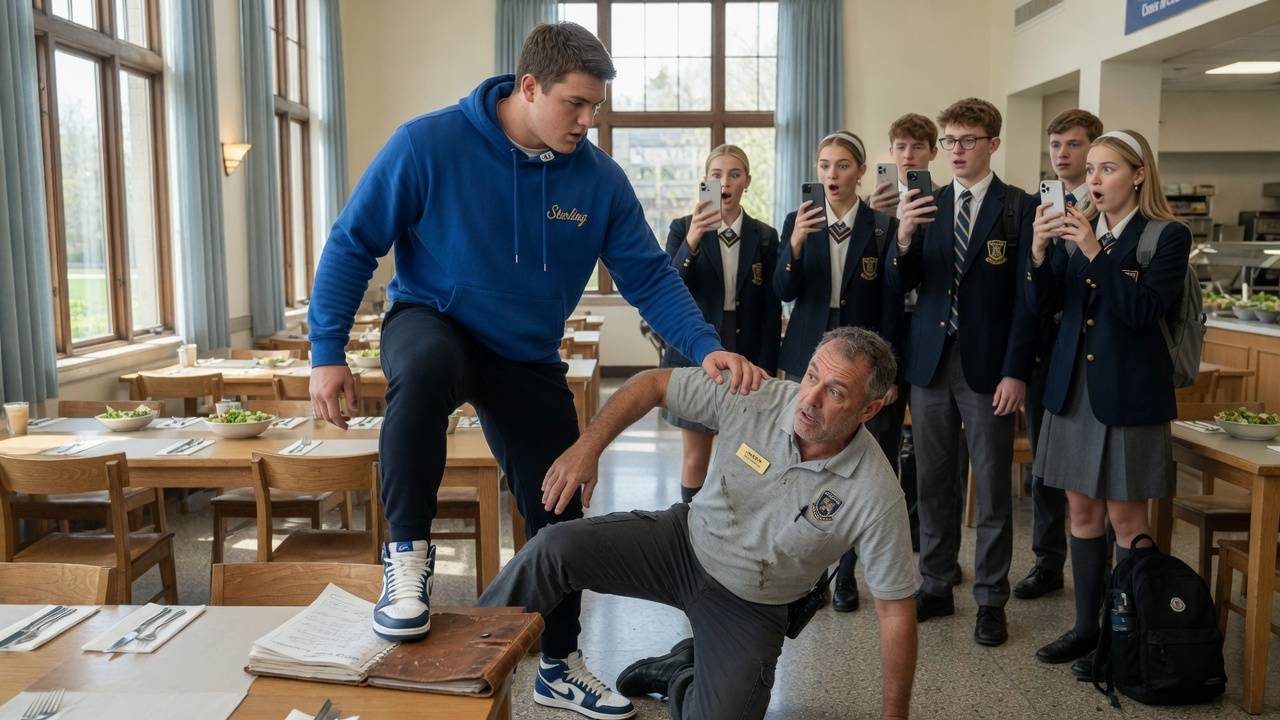
“Do you have any idea,” Miller started, his voice cracking on the final word, “any inkling at all, of the sheer magnitude of the disaster you’ve just created? You didn’t just hit a student, Marcus. You hit a Sterling. In front of the entire junior class. There are videos. My phone hasn’t stopped vibrating for ten minutes. It’s a digital wildfire.”
“He was the aggressor,” Marcus said. His voice was flat, devoid of the adrenaline that usually followed a physical confrontation. He was already in the ‘after-action’ headspace, the cold clarity that comes when the threat has been neutralized and the paperwork begins. “He crossed the perimeter of my personal space. He initiated physical contact by seizing my collar. He attempted to seize a piece of sensitive security equipment. I used the minimum force necessary to ensure he didn’t escalate further.”
Miller stopped pacing and stared at Marcus as if he were speaking a dead language. “Minimum force? You kicked him across the cafeteria! The boy is in the infirmary with a suspected cracked rib and the kind of psychological shock that will have three different law firms at our gates by sunset. He’s the quarterback, for God’s sake. His father is the reason we have a new performing arts center.”
“His father’s donations don’t change the laws of physics or the rules of engagement,” Marcus replied. He reached into his pocket and pulled out the ruined notebook. He laid it on the mahogany desk. The leather was scuffed, the pages bent where Hunter’s heel had ground into them. “This is why I was here. This book contains a roadmap for anyone who wants to hurt these kids. Hunter Sterling tried to destroy it because he wanted to play a game of social dominance. If I hadn’t stopped him, that information could have been scattered across the floor for anyone to photograph.”
Miller looked at the notebook as if it were a poisonous snake. He didn’t touch it. “You’re a security guard, Marcus. A low-rent, temporary hire. You were supposed to check badges and wave at the parents. You weren’t supposed to be… whatever this is. Tactical notebooks? Rules of engagement? You sound like you’re still in the desert.”
Marcus felt the old wound throb—not the physical one, but the Sarajevo memory. The client he’d lost there had been just like Miller: a man who thought money and status created a literal shield against the world’s ugliness. He had tried to tell that man that the sniper didn’t care about his bank account. He’d been ignored then, too.
“I am exactly what the board hired me to be,” Marcus said softly. “The fact that you didn’t know the specifics of my contract was part of the test. You failed, Miller. Your security culture is a joke. Your students believe they are untouchable, which makes them the biggest vulnerability you have.”
The office door slammed open before Miller could respond.
Arthur Sterling didn’t enter a room; he annexed it. He was a man in his late fifties, wearing a suit that cost five figures and a face that was currently a mask of cold, litigious fury. He didn’t look at Miller. He looked at Marcus with the kind of focused hatred usually reserved for a business rival who had just stolen a billion-dollar merger.
“Where is he?” Arthur’s voice was a low, controlled vibrato.
“Arthur, please,” Miller began, moving forward with his hands out in a placating gesture. “Hunter is in the infirmary. The school nurse is with him. We’ve called Dr. Aris—”
“I don’t care about the nurse,” Arthur snapped. He turned his gaze to Marcus, stepping into the space between the desk and the chair. “I want to know why this man is still in the building. I want to know why he isn’t in handcuffs. And I want to know exactly what kind of hell I have to rain down on this institution to make sure he never sees the sun again.”
Marcus didn’t stand. He knew that standing would be seen as an escalation, and he wanted Arthur to feel the weight of his own noise. “Mr. Sterling. I’m Marcus. I was the officer on duty.”
“You’re a common thug,” Arthur said, leaning over him. He smelled of expensive tobacco and the kind of confidence that only comes from never being told ‘no.’ “You laid hands on my son. You think because you have a badge and a polyester shirt, you’re someone? You’re a footnote. I could buy your life and forget I owned it by dinner.”
“Your son attacked a security consultant while he was performing a state-mandated vulnerability assessment,” Marcus said, his gravelly voice cutting through Arthur’s heat. “He attempted to steal and destroy classified security data. I have the entire interaction recorded on a body camera that is currently streaming to a secure off-site server. If you want to talk about handcuffs, we can start with the harassment and assault charges I’ll be filing against Hunter if you don’t take a step back.”
The room went silent. Even Miller seemed to stop breathing.
Arthur Sterling’s eyes flickered. He looked at the small, inconspicuous button on Marcus’s chest that he hadn’t noticed before. It wasn’t just a name tag. It was a lens.
“A body-cam?” Miller whispered. “In a private school? That’s a massive privacy violation.”
“The Board of Trustees signed the waiver,” Marcus said, finally standing up. He was shorter than Arthur, but he felt twice as heavy. “They wanted to know why their twenty-million-dollar security budget wasn’t working. I found the answer. It’s not the cameras or the gates. It’s the culture. It’s people like you, Arthur, who teach your kids that the world belongs to them, and people like you, Miller, who are too afraid of the checkbook to tell them otherwise.”
Arthur sneered, though the confidence was starting to fray at the edges. “You think a video changes anything? I own the board. I own the police chief in this town. You’ll be lucky if that video even makes it to a courtroom before it’s deleted.”
“It’s already at the firm,” Marcus said. “And a copy went to Leo.”
“Who the hell is Leo?” Arthur barked.
“The kid your son has been terrorizing for three years,” Marcus replied. “The one who’s been tracking Hunter’s ‘incidents’ on a private server because he knew no one in this office would ever listen to him. He’s my rescue force, Arthur. He’s the witness you can’t buy.”
Marcus picked up his notebook. He felt a strange sense of relief. The secret was out, the ‘test’ was over, and for the first time in a decade, he didn’t feel like a ghost. He felt like a man who had finally finished a job.
“I’ll be in the guard shack for the next hour,” Marcus said, looking at Miller. “I expect my final paycheck and a formal termination letter. Make sure the letter mentions that I was fired for defending myself against a physical assault. My lawyer likes it when the details are specific.”
He walked out of the office, leaving the two powerful men standing in the silence of their own crumbling illusions.
As he crossed the quad, the students were huddled in small groups, their voices hushed. They didn’t mock him. They didn’t call him ‘Rent-a-Cop.’ They watched him with a mixture of awe and genuine fear. The hierarchy had been shattered, and the vacuum it left behind was palpable.
He found Leo sitting on a stone bench near the gate. The boy looked smaller than usual, his laptop closed on his lap. He looked like he was waiting for the world to end.
“Did you do it?” Leo asked as Marcus approached.
“I did,” Marcus said. He sat down next to the boy. “The video is secure. The board has the preliminary report. Hunter isn’t going to be bothering you for a while, Leo. Maybe never.”
Leo looked at the ground. “They’re going to hate me now. Even more than before. I’m the kid who helped the guard.”
“They don’t hate you,” Marcus said. “They’re afraid of you. Because you’re the only one who saw through the mask. That’s a lonely place to be, but it’s the only place where you can actually see the truth.”
Marcus reached into his pocket and pulled out a small, silver coin—a challenge coin from his old unit. He pressed it into Leo’s hand.
“What’s this?”
“A reminder,” Marcus said. “That being the one who sees the weak points doesn’t make you weak. It makes you the most dangerous person in the room. Use it well.”
Marcus stood up and walked toward the gate. He didn’t look back at the expensive buildings or the manicured lawns. He was thinking about a phone call he needed to make. He was thinking about a twelve-year-old boy in a different state who hadn’t heard his father’s voice in too long.
The humidity was still there, but as the gates of St. Jude’s clicked shut behind him, Marcus felt like he could finally breathe.
Chapter 6
The diner was three towns over, far enough from Greenwich that the name ‘Sterling’ didn’t carry any weight. It was a place of vinyl booths, burnt coffee, and people who worked for their skin to be that tired. Marcus sat in the back corner, the ruined tactical notebook open on the table in front of him. He was crossing out the names of the board members one by one. They had all called his firm within the last twelve hours—some to threaten him, some to bribe him, and one, a woman named Sarah Van Ness, to thank him.
The formal termination had come via courier at 3:00 AM. It was exactly as Marcus had requested: cold, legalistic, and inadvertently admitting that the school’s ‘safety’ was secondary to its ‘reputation.’
He was on his third cup of coffee when the bell over the door chimed and Leo walked in. The boy looked exhausted. He was still wearing his St. Jude’s blazer, but he’d ripped the crest off the pocket. He sat down across from Marcus without being asked.
“My dad is furious,” Leo said by way of greeting. “He says I’ve ruined my chances at an Ivy League recommendation. He says the Sterlings are going to blacklist our family from the country club.”
“Do you care about the country club, Leo?” Marcus asked.
Leo looked at his coffee, then up at Marcus. A small, sharp smile touched the corners of his mouth. “I never liked the pool anyway. It always smelled too much like chlorine and fake smiles.”
“Good,” Marcus said. “Status is a cage. People like Hunter and his father spend their whole lives building the bars, thinking they’re protecting themselves. They never realize they’re the ones who can’t leave.”
“Hunter’s not coming back,” Leo whispered. “The video… it didn’t just stay with the board. Someone leaked it. Probably one of the ‘Varsity Elite’ who wanted to see him fall. It’s everywhere now. Not just the school. The whole state. The ‘Golden Boy’ is the ‘Bully of Greenwich.’ His father is pulling him out and sending him to a military academy in Virginia.”
Marcus didn’t feel the surge of victory he expected. He felt a dull, familiar sadness. He’d seen it a hundred times—the way violence, even justified violence, just moved the pieces around the board without ever ending the game. Hunter would go to Virginia, he would be broken down by men who didn’t care about his father’s money, and he would either become a better man or a much more dangerous one.
“What about you?” Leo asked. “What’s next for the ‘Gatekeeper’?”
“The firm is moving me to a contract in D.C.,” Marcus said. “Government work. More gates, more codes, fewer teenagers. It’s what I’m good at.”
“You’re good at more than that,” Leo said. He reached into his bag and pulled out a manila envelope. He slid it across the table. “I went into the school’s archival server last night. Before they changed my admin password.”
Marcus opened the envelope. Inside were copies of psychological reports, disciplinary records, and internal memos dating back five years. They all had one thing in common: the name Hunter Sterling. Every time the boy had crossed a line, every time he’d hurt someone, the school had buried it.
“Why are you giving me this?” Marcus asked.
“Because the board isn’t going to fix the school,” Leo said. “They’re just going to hire a new security firm and hope everyone forgets. But if this gets to the state accreditation board… if it gets to the press… they’ll have to change. Not just the gates. The whole thing.”
Marcus looked at the boy. Leo wasn’t just a math geek anymore. He was a whistleblower. He was taking a tactical strike against a system that had tried to crush him.
“You realize if you do this, you can’t go back there,” Marcus warned. “They’ll make your life a living hell.”
“I’m already in hell, Marcus,” Leo said, his voice steady. “At least this way, I’m the one holding the match.”
Marcus felt a rare moment of pride. He reached out and tapped the envelope. “I have a friend at the New York Times. She owes me a favor from a lifetime ago. I’ll make sure this gets to the right desk.”
They sat in silence for a long time, watching the rain start to smear against the diner’s windows. For Marcus, the residue of the last week was starting to settle. He still felt the phantom weight of the job, the constant need to scan the room for exits and threats. But for the first time, he didn’t feel the Sarajevo wound as a sharp pain. It was just a scar—a reminder that he had failed once, but he hadn’t failed this time. He had protected the person who actually mattered.
“Marcus?”
“Yeah, kid?”
“Why did you really take the job? The firm has hundreds of operators. Why the low-rent guard gig in a prep school?”
Marcus looked at his phone. The screen was dark, but he knew the number by heart.
“I wanted to see if I could still stand in the middle of the noise and not get swept away,” Marcus said. “I wanted to see if I was more than just a man who knows how to break things.”
“And are you?”
Marcus stood up and pulled a twenty-dollar bill from his wallet, dropping it on the table. He picked up his notebook—the ruined, beautiful book of vulnerabilities.
“I’m working on it,” he said.
He walked out of the diner and into the cool Connecticut rain. He climbed into his truck, the engine turning over with a familiar, mechanical growl. He sat there for a moment, the wipers clearing the glass, and then he picked up his phone.
He dialed the number he’d been afraid of for four years.
It rang three times. Four. Marcus felt his breath hitch in his chest. He was a man who had faced down warlords and snipers, but the sound of a ringing phone was making his hands shake.
“Hello?” The voice was young, uncertain, and carried a trace of a Southern accent Marcus hadn’t heard in ages.
“Toby?” Marcus said. He had to clear his throat. “It’s… it’s Dad.”
There was a long, agonizing silence on the other end. Marcus closed his eyes, leaning his head back against the seat. He prepared himself for the click of the line, for the anger, for the rejection he probably deserved.
“Dad?” Toby’s voice was a whisper now. “Where have you been?”
“I was at work, Toby,” Marcus said, and for the first time in his life, the words felt like the truth. “But I’m done now. I’m coming home.”
He put the truck in gear and pulled out of the parking lot. He didn’t look at the map. He didn’t check the rearview mirror for Sterlings or lawyers or ghosts. He just drove south, toward the only perimeter that actually mattered.
The story of St. Jude’s was over. The gates were closed, the secrets were out, and the ‘Gatekeeper’ was finally off-duty. He was just a man in a truck, driving through the rain, trying to find his way back to being human.
As he crossed the state line, the sun started to break through the clouds in the distance. It wasn’t a clean ending. There would be lawsuits, there would be headlines, and there would be a long, difficult road ahead with a son who barely knew him. But as Marcus watched the road unfold in front of him, he realized that for the first time in his life, he wasn’t looking for the weak points.
He was looking for the way home.