Chapter 5
The silence in the black town car on the ride back to the trailer park was worse than the screaming had been.
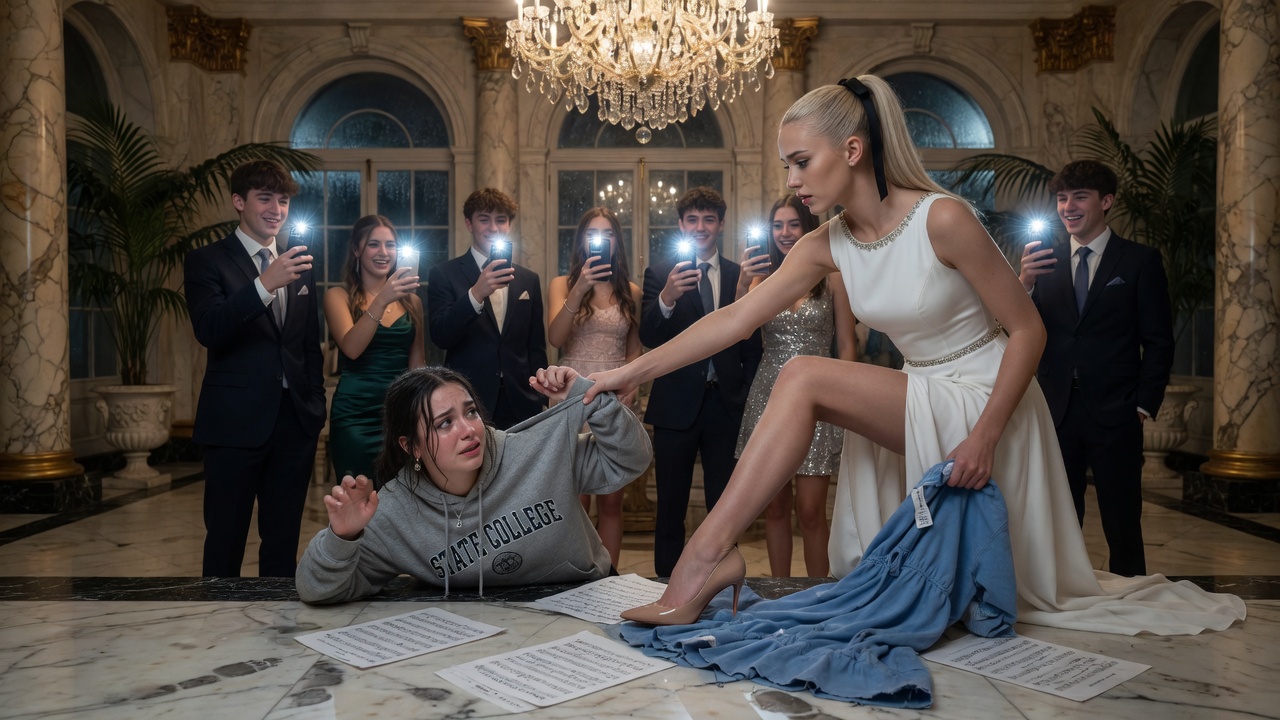
Back in the lobby, Mrs. Sterling’s voice had reached a pitch Mia didn’t know humans could produce—a jagged, vibrating frequency of pure, litigious hate. She hadn’t even checked on Isabella first. She had looked at the red wine stain on the marble, then at Mia, and then at the phone in a donor’s hand. The realization that the Sterling name was being captured in a moment of physical collapse had transformed her from a patron of the arts into a predator protecting its territory.
Elena sat in the passenger seat, her hands gripped so tightly in her lap that her knuckles looked like polished stones. She hadn’t looked at Mia once since they’d been shoved out the service entrance. The driver, a man named Marcus who usually gave Sofia sticks of gum, wouldn’t even check the rearview mirror. He drove with a stiff, professional detachment, as if he were transporting radioactive waste rather than a housekeeper and her daughter.
“Mom,” Mia whispered as the car turned onto the gravel road of the trailer park.
“Don’t,” Elena said. The word was flat, dead, and utterly final.
When the car stopped in front of their unit, Elena didn’t wait for Marcus to open the door. She scrambled out, her movements jerky and frantic. Mia followed, the midnight blue silk of her ruined dress catching on the metal doorframe, the fabric tearing further. She didn’t care. The dress was a corpse now.
Inside the trailer, the air was stagnant and smelled of old grease. Sofia was asleep on the sofa, her thumb hooked into the corner of her mouth. Elena didn’t wake her. She went straight to the kitchenette and began pulling plastic grocery bags from under the sink.
“What are you doing?” Mia asked, her backpack still clutched to her chest. The scores—the stolen ones she’d snatched back—were a heavy weight against her ribs.
“We have to move,” Elena said, her voice rising into a frantic, rhythmic chant. “We have to move tonight. She’s going to call the police, Mia. She’s going to call the landlord. She’s going to call CPS. I saw her face. I saw her looking at that phone.”
“She won’t call the police,” Mia said, trying to find a core of logic in the panic. “The video shows Isabella hitting me first. It shows her spilling the wine. If she calls the cops, it becomes a public record. She wants this to go away.”
Elena spun around, a handful of mismatched socks in her hand. Her face was a mask of grief and terror. “It doesn’t matter who hit who! Look at us, Mia! Look at where we live! You think the law cares about the ‘truth’ when it’s up against a woman who owns half the city? You struck her. You humiliated her in front of her peers. She will burn this whole park to the ground just to make sure you’re under the ash.”
Elena began shoving Sofia’s clothes into a bag. The violence of the movement woke the ten-year-old. Sofia sat up, blinking against the harsh overhead light, her eyes darting between her mother’s frantic packing and Mia’s ruined, wine-stained dress.
“Mia? Why are you blue?” Sofia asked, her voice small and thick with sleep.
“It’s okay, Sof,” Mia said, stepping toward her. “We’re just… we’re going to stay with a friend for a few days.”
“We don’t have friends, Mia!” Elena shrieked. She dropped the bag and slid down the front of the refrigerator, her face buried in her hands. “I have forty-eight dollars in my account. I lost my job. I lost my references. Who is going to hire a thief’s mother? Who is going to hire someone whose daughter is a ‘thug’ on the internet?”
Mia felt the sting of the word thug. It was the word the Sterlings would use. It was the word the “Old Money” gatekeepers would use to describe a girl from a trailer park who refused to be a punching bag.
She walked over to her mother and knelt on the linoleum. “I have the scores, Mom. The ones Isabella was going to use. The ones she said were hers. I have proof that she’s been cheating.”
“Proof?” Elena looked up, her eyes red-rimmed and hollow. “You think a few sheets of paper are going to stop them? They’ll say you stole them from her. They’ll say you’re obsessed. They have lawyers, Mia. We have a car with a bad transmission.”
A heavy knock sounded on the aluminum door.
Elena gasped, her entire body flinching. Sofia scrambled off the couch and hid behind Mia. The knock came again—three slow, deliberate thuds that made the thin walls vibrate.
Mia stood up. She felt a strange, cold calm settling over her. This was the moment she had been afraid of her entire life, and now that it was here, the fear had nowhere left to go. It had turned into something else—a jagged, utilitarian resolve.
She opened the door.
It wasn’t the police. It wasn’t the landlord.
Standing on the cinderblock step was a man in a charcoal suit that cost more than their trailer. He was in his late sixties, with a shock of white hair and a face that looked like it had been carved out of granite. Mia recognized him instantly. He was Arthur Vance, the lead judge of the National Scholarship Committee. He was the one who had been watching Isabella with that look of detached suspicion for months.
“Miss Rossi?” he said. His voice was a rich, cultivated baritone.
Mia didn’t move. She didn’t let him in. “If you’re here to talk about the ‘assault,’ you should talk to my lawyer. If I had one.”
Vance didn’t smile, but something in his eyes softened. “I’m not here about the altercation, though your technique was… remarkably efficient. I’m here because of what you said before you left the lobby.”
Mia stiffened. You’re nothing without my notes.
“I’ve been listening to Isabella Sterling for three years,” Vance continued, ignoring the cold wind blowing past him into the trailer. “She has the technical proficiency of a well-oiled machine, but her compositions—the ones she’s debuted recently—had a different thumbprint. They had a grit to them. A specific kind of sorrow that doesn’t grow in a mansion on a hill. I’ve been looking for the source of that sorrow for a long time.”
He looked past Mia at the kitchenette, where the cardboard keyboard still sat on the small table. He stared at the Sharpie-drawn keys, the smudges, and the way the edges were curled from the humidity.
“May I come in?” he asked.
Mia stepped aside. Elena had scrambled to her feet, trying to wipe the tears from her face, looking at Vance as if he were an executioner.
Vance walked to the table. He touched the cardboard keyboard with a gloved hand. He pressed a “key”—the C-sharp—and for a moment, the room was silent.
“My father taught me that every room has a resonance,” Vance said, not looking at them. “Some rooms are built for echoes. This room… this room is built for truth. Miss Rossi, I have seen the video. It has currently been viewed by three hundred thousand people. The Sterlings are in a full-scale panic. They are attempting to have it scrubbed, claiming it’s a ‘deep-fake’ or a targeted harassment campaign.”
“It’s not,” Mia said.
“I know it’s not. But the committee cannot award a scholarship to a girl who engages in brawls at donor galas, regardless of the provocation. It would be a PR disaster.”
Mia felt the floor drop out from under her. “So that’s it? She wins because she’s rich, and I lose because I fought back?”
“Not necessarily,” Vance said, finally turning to face her. “The committee values integrity above all else. If Isabella Sterling is a fraud, she cannot hold the scholarship. But we need more than a ‘messy’ score in a backpack. We need a confession, or we need a demonstration of authorship that cannot be refuted.”
“I wrote every note,” Mia said, her voice shaking. “I wrote them on this table. I wrote them while my sister was sleeping and my mother was cleaning Isabella’s toilets. I wrote them because they were the only thing I had that they couldn’t touch.”
“Then show me,” Vance said. He looked at the cardboard. “Play the third movement of the concerto she performed last week. The one with the rubato section in the bridge.”
Mia looked at the cardboard. She looked at her mother, who was holding Sofia’s hand so tight the girl’s fingers were turning white.
“I can’t play it here,” Mia whispered. “It doesn’t make a sound.”
“I don’t need to hear it with my ears, Mia. I’ve been a judge for forty years. I can see the music in your hands. I can see the ‘C-sharp’ in your wrists. Play it.”
Mia sat at the small, wobbly table. She closed her eyes. She blocked out the smell of the grease, the sound of the interstate, and the terrified breathing of her family. She imagined she was back at Henderson’s shop, back at the battered upright.
She began to play.
Her fingers flew over the cardboard. She hit the imaginary keys with a ferocity that made the table rattle. She felt the reach of the octaves, the delicate, hesitant trills of the bridge, the crashing, dissonant chords of the finale. Her right wrist screamed—the RSI flare-up felt like a hot iron—but she didn’t stop. She poured every ounce of her fury, her shame, and her secret genius into the flat, silent surface.
When she finished, her breath was ragged. She didn’t open her eyes. She waited for the dismissal. She waited for him to tell her that cardboard wasn’t enough.
“The phrasing,” Vance said softly. “The way you lingered on the minor seventh… Isabella always rushed that part. She didn’t understand that the pause is where the grief lives.”
Mia opened her eyes. Vance was looking at her with a profound, terrifying respect.
“The Sterling family is going to offer you money tonight,” Vance said. “A lot of it. They will offer you enough to move out of this park, enough to put your sister in a private school, enough to buy back your father’s piano. All they want in exchange is your silence. They want you to sign a non-disclosure agreement and disappear. They want the video to be ‘explained’ as a misunderstanding between friends.”
Elena made a sound—a small, desperate gasp of hope. “Mia… that’s the answer. We could be safe.”
Mia looked at her mother. She saw the relief in Elena’s eyes, the possibility of an end to the bleach and the ladders. Then she looked at Vance.
“And if I don’t sign?” Mia asked.
“Then tomorrow morning, the committee will hold a public hearing at the conservatory. You will be invited to testify. You will be asked to play. If you can prove the music is yours, Isabella will be stripped of her standing. The Sterlings will be disgraced. But you… you will have no money. You will have no home. The Sterlings will sue your mother for breach of contract, and they will make sure you are blackballed from every conservatory in the country for the ‘violence’ of your actions tonight. You will have the truth, Mia. But you will have nothing else.”
Vance walked toward the door. He paused with his hand on the frame. “The Sterlings’ lawyer will be here within the hour. The choice is yours. A comfortable lie, or a devastating truth.”
He stepped out into the night, leaving the door hanging open.
The silence that followed was heavy. Sofia looked at Mia, then at the cardboard keyboard. “Can we really buy Dad’s piano back?”
Mia looked down at her hands. The ink smudges were dark against her skin. She could almost feel the “Old Money” gates closing, the weight of the keys she was born to turn for others. She looked at the scores in her backpack, the pages crinkled and stained with a single drop of red wine.
“Mom,” Mia said, her voice barely a whisper. “What do we do?”
Elena didn’t answer. She just looked at the grocery bags on the floor, the mismatched socks, and the forty-eight dollars in her bank account. She looked at the life she had tried to build out of scraps, and for the first time, Mia saw a flicker of something in her mother’s eyes that wasn’t fear. It was a cold, quiet embers of the same fury that had driven Mia’s palm into Isabella’s chest.
“They think they can buy your soul for the price of a trailer,” Elena said, her voice low and vibrating. “They think my daughter is a ‘charity case’ they can pay to go away.”
“We’ll be on the street, Mom.”
“Then we’ll be on the street,” Elena said, her jaw setting into a line that mirrored Mia’s. “But we won’t be their ghosts anymore.”
The knock came again twenty minutes later. It was sharper this time, more entitled.
Mia didn’t open the door. She sat at the table and began to write. Not a confession, and not a signature. She began to write a new piece—a finale. One that didn’t have any pauses for grief. One that was built entirely of C-sharps and crashing, undeniable thunder.
Chapter 6
The Grand Conservatory Hall was a tomb of white marble and gold leaf, illuminated by chandeliers that cost more than a year of Mia’s life.
The air was thick with the scent of lilies and nervous sweat. The scholarship committee sat at a long, mahogany table on the stage, their faces as impassive as the busts of Beethoven and Bach lining the walls. In the center of the room sat the Fazioli grand, its black finish so deep it looked like an opening into another dimension.
Isabella Sterling was there, sitting in the front row. She was wearing a different dress—this one a modest, charcoal gray that screamed “victim.” Her mother sat beside her, her hand resting on Isabella’s shoulder in a display of maternal protection that felt as choreographed as a ballet. They didn’t look at Mia when she walked in. They didn’t have to. The “Old Money” gatekeepers had already decided the narrative.
Mia was wearing her gray hoodie again. The blue silk dress was in a dumpster behind a gas station three miles away. She hadn’t slept. Her eyes were sunken, and her right wrist was wrapped in a compression bandage that she’d hidden under her sleeve.
“The committee will come to order,” Arthur Vance said. He sat in the center of the table, his white hair a beacon under the stage lights. “This hearing is to determine the authorship of the ‘Vesper Concerto’ and to address the allegations of misconduct surrounding the Sterling family and Miss Mia Rossi.”
The Sterling lawyer, a man who looked like he’d been manufactured in a factory for expensive suits, stood up. “Mr. Chairman, this is a farce. My client, Isabella, has been a victim of a coordinated harassment campaign by a disgruntled employee’s daughter. The video from the gala shows a physical assault—one that we are currently filing criminal charges for. This girl is a thief and a thug. To suggest she wrote a masterpiece is like suggesting a street performer wrote Mozart.”
A murmur of agreement rippled through the gallery. The donors were there, the same ones who had filmed the humiliation. They looked at Mia with a mixture of disgust and fascination, the way people look at a car wreck.
“Miss Rossi,” Vance said, his voice cutting through the whispers. “You claim these scores are yours. You claim you have been ‘ghost-writing’ for Miss Sterling for six months. Do you have any proof other than the handwritten notes you recovered?”
Mia stood up. Her legs felt like water, but her heart was a steady, rhythmic drum. “The proof isn’t in the paper. The proof is in the music. Isabella can play the notes, but she doesn’t know why they’re there. She doesn’t know what the bridge in the second movement is about. She thinks it’s about ‘the tragedy of the underprivileged.'”
Isabella shifted in her seat, her face turning a blotchy, uneven red.
“And what is it about, Miss Rossi?” a woman on the committee asked, her voice dripping with skepticism.
“It’s about a man who sold his daughter’s future for a bottle of gin,” Mia said. “It’s about the sound of a piano being wheeled out of a house while a five-year-old watches from the stairs. It’s about the silence that follows when the music is gone.”
The room went quiet. Even the lawyer looked uncomfortable.
“That’s a very touching story,” Mrs. Sterling said, her voice sharp as a razor. “But sentiment isn’t authorship. My daughter has been in lessons since she was four. She has the pedigree. This girl has… what? A cardboard keyboard in a trailer? It’s offensive to the very idea of classical music.”
“Then let us play,” Mia said.
She walked toward the stage. The crowd bristled. Two security guards stepped forward, their hands on their belts.
“Let her through,” Vance commanded.
Mia stopped at the edge of the stage. She looked at Isabella. “We’ll play the same piece. The ‘Vesper Concerto.’ The committee can decide who the author is. If you wrote it, Isabella, you should be able to play the ‘C-sharp’ finale. The one I gave you yesterday.”
Isabella stood up, her face pale. “I… I haven’t rehearsed the new finale yet. It was messy. It wasn’t finished.”
“It’s finished now,” Mia said. She reached into her hoodie and pulled out a single sheet of paper. She laid it on the music stand of the Fazioli. “Go ahead. It’s your music. Show them how it ends.”
Isabella walked onto the stage like a woman heading toward a gallows. She sat at the piano. She looked at the score. Her fingers touched the keys—the perfect, weighted, ivory keys. She began to play the opening bars of the concerto.
She was good. She was technically flawless. But as she moved into the bridge—the part Mia had described—the music felt hollow. It was a sequence of sounds, a mathematical arrangement of frequencies. There was no hesitation. There was no ghost in the room.
When she reached the finale—the new piece Mia had written the night before—Isabella faltered. The rhythm was complex, a syncopated, aggressive tempo that demanded a specific kind of physical commitment. Isabella’s fingers tangled. She missed a chord. Then another. She stopped, her chest heaving, her eyes darting toward her mother.
“It’s… it’s unplayable,” Isabella whispered, her voice cracking. “The notation is wrong. It’s garbage.”
“It’s not garbage,” Mia said. She stepped up to the piano. “Move.”
Isabella scrambled off the bench, her “victim” mask finally shattering. She looked small. She looked like a girl who had spent her life wearing clothes that didn’t fit her soul.
Mia sat down. She didn’t look at the committee. She didn’t look at the donors. She looked at the keys. She thought of Henderson’s shop. She thought of the red wine on the blue silk. She thought of her mother’s red, swollen hands.
She began to play.
The sound that erupted from the Fazioli was a physical force. It wasn’t a confession anymore; it was an execution. Mia played the concerto with a savagery that made the donors in the front row flinch. She hit the rubato section with a lingering, agonizing sorrow that made the woman on the committee cover her mouth with her hand.
And then she hit the finale.
It was a wall of sound. The C-sharps rang out like bells in a storm. Mia’s fingers were a blur, her body swaying with the weight of the music. She didn’t care about her wrist. She didn’t care about the scholarship. She was claiming her throne in the only way she knew how—by being undeniable.
The final chord echoed in the hall for what felt like an eternity.
When the silence returned, it was different. It wasn’t the silence of privilege or the silence of shame. It was the silence of a room that had just seen a ghost become flesh.
Mia stood up. She was shaking, her right arm hanging limp at her side. She looked at Arthur Vance.
“Is that proof enough?” she asked.
Vance looked at the committee. He looked at the Sterlings, who were already whispering to their lawyer, their faces tight with the realization of a coming ruin. Then he looked at Mia.
“The scholarship,” Vance said, his voice heavy, “is awarded for excellence and integrity. It is clear to this committee that the ‘Vesper Concerto’ belongs to Mia Rossi. It is also clear that the Sterling family has engaged in a pattern of coercive exploitation that violates every ethic of this institution.”
Mrs. Sterling stood up, her eyes blazing. “You can’t do this! We have donated millions to this hall! We will pull our funding! We will ruin you!”
“You already have, Mrs. Sterling,” Vance said, his gaze cold. “You’ve ruined the only thing money can’t buy: the music.”
The fallout was immediate. The Sterlings were escorted out through a side door to avoid the press that was already gathering outside. The “Old Money” gatekeepers began to slip away, their loyalty to the Sterlings evaporating the moment the power shifted.
Mia walked down the stairs. Her mother was waiting at the bottom. Elena didn’t look afraid anymore. She looked at Mia with a fierce, quiet pride. She reached out and took Mia’s hand—the good one.
“We have to go, Mia,” Elena said. “The press… they’re going to want to talk to you.”
“I don’t want to talk to them,” Mia said. “I just want to go home.”
“We don’t have a home, remember?” Sofia said, tugging on Mia’s hoodie.
Mia looked at her sister. Then she felt a hand on her shoulder. It was Mr. Henderson. He had been sitting in the back of the hall, his hearing aid turned up to the maximum.
“I have a room above the shop,” he said, his voice gruff. “It’s not much. It smells like sawdust and old felt. But the piano in the corner is tuned. And the door has a lock that only you have the key to.”
Two weeks later, the trailer was gone.
The Sterlings had tried to sue, but the viral video and the committee’s findings had turned them into social pariahs. They were tied up in a dozen countersuits from other “charity cases” they had exploited. Isabella had disappeared to a “wellness retreat” in Europe, her name a punchline in the conservatory halls.
Mia sat in the back of a moving truck, her feet dangling over the edge. They were moving the last of their things into the apartment above Henderson’s shop.
Elena had found a job at a local library—a quiet place where the only thing she had to clean were the tables where children read. She looked ten years younger. Sofia was enrolled in a music program for kids, her nails finally growing out, her laughter no longer a rare thing.
But there was one more stop to make.
Mia jumped down from the truck as they pulled up to a small, dusty warehouse on the edge of town. An estate auction was being held.
She walked into the dimly lit space, her heart pounding. In the center of the floor, under a layer of dust and a “LOT 402” sticker, was a 1920s Steinway grand. The wood was scratched. The ivory was yellowed. But Mia knew the resonance of that wood. She knew the way the C-sharp would sound before she even touched it.
She walked over to the piano. She reached into her pocket and pulled out a check. It wasn’t the millions the Sterlings had offered for her silence. It was the first installment of the scholarship’s living stipend and the royalties from the “Vesper Concerto,” which was now being performed by symphonies across the country.
She laid the check on the lid of the piano.
“I’m here for my father’s piano,” she told the auctioneer.
The man looked at the check, then at the girl in the gray hoodie with the scarred wrists. “It’s a heavy piece, kid. You sure you can handle it?”
Mia sat at the bench. She touched the keys. They weren’t cardboard. They weren’t silent. They were hers.
“I’ve been carrying it my whole life,” Mia said.
She played a single chord—a pure, resonant C-major. The sound filled the warehouse, vibrating through the floor, through the dust, and into the marrow of her wrists. It was a confession, a finale, and a beginning all at once.
The kingdom was gone, the gates were open, and for the first time in seventeen years, Mia Rossi wasn’t a ghost. She was the music.