Chapter 5
The drive back to the post office was the longest four miles of Silas’s life. The adrenaline, which had acted as a chemical splint for his leg, began to recede, leaving behind a cold, hollow throb that made his vision swim. He kept his hands at ten and two on the Jeep’s oversized wheel, his knuckles white against the grime. He didn’t turn on the radio. He didn’t need the noise. The sound of Buck Calhoun’s ribs yielding under his palm was still echoing in the small, humid cabin of the vehicle.
He pulled into the loading dock at 4:57 PM. The sun was a bruised purple behind the ridge, casting long, skeletal shadows across the asphalt. Miller was standing by the back door, but he wasn’t leaning this time. He was pacing. His white button-down shirt was untucked at the waist, and his face was the color of unbaked dough.
As Silas killed the engine, Miller was already at the driver’s side door, wrenching it open.
“What did you do, Silas?” Miller’s voice was a frantic, high-pitched whisper. He looked like a man watching a fuse burn toward a powder keg. “What in the name of God did you do?”
Silas eased himself out of the seat. His right leg buckled as it hit the pavement, and he had to grab the door frame to keep from sprawling. He didn’t look at Miller. He reached back inside for the mail satchel.
“I finished the route,” Silas said. His voice was gravelly, his throat dry from the mountain dust.
“You finished the route?” Miller let out a hysterical bark of a laugh. He pulled a smartphone from his pocket and thrust it toward Silas’s face. The screen was bright, flickering with a graininess that didn’t hide the violence. “It’s been online for twenty minutes, Silas. ‘Local Hero Wipes Out Rich Kid.’ ‘Mailman Goes Postal.’ It’s already got fifty thousand views. Buck’s father called me ten minutes ago. He didn’t use words, Silas. He used threats. Legal, professional, personal threats.”
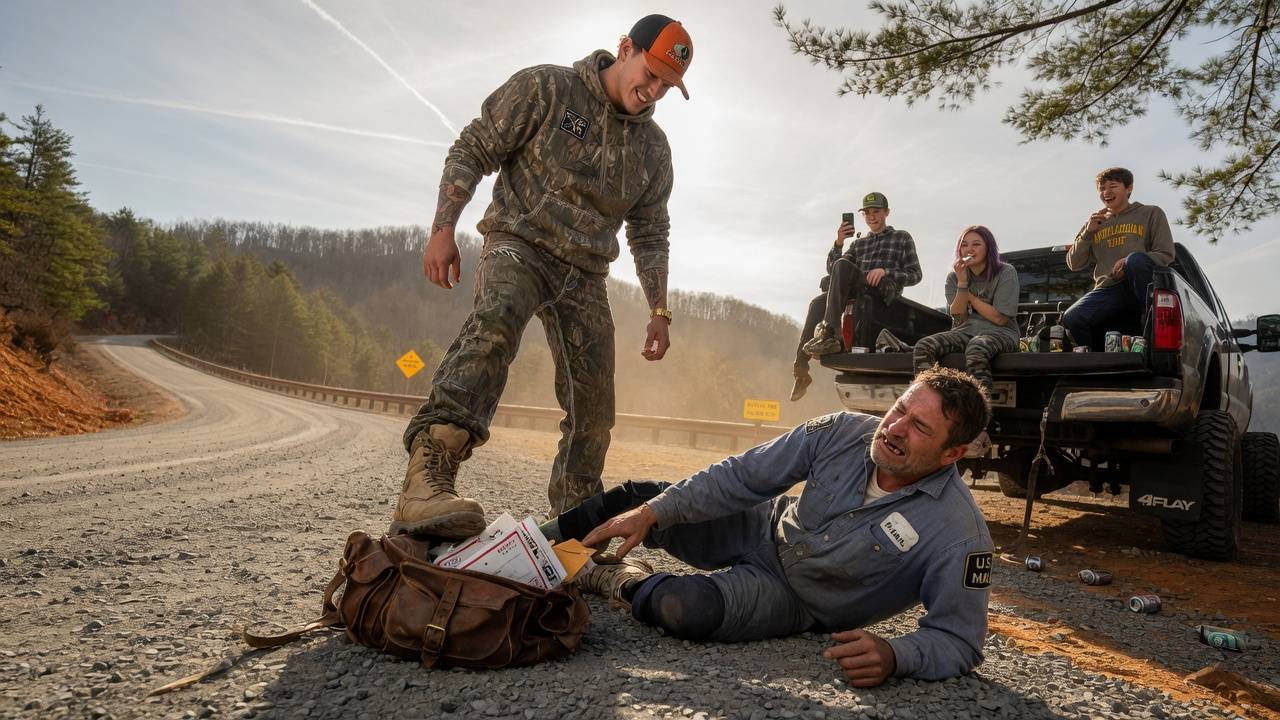
Silas looked at the screen. He saw himself—or a version of himself. A weathered man in a blue uniform, moving with a mechanical, terrifying efficiency. He watched the front push-kick launch Buck into the truck. Even on the small screen, the contact looked brutal. It looked like the work of a professional.
“The video shows him stepping on the mail,” Silas said, pushing the phone away. “It shows him grabbing me. It shows him blocking a federal route.”
“Nobody cares about the mail, Silas!” Miller was shouting now, his face turning a blotchy red. “They care that you put the son of the richest man in the county in the hospital! Buck has a cracked sternum and two broken ribs. They’re calling it aggravated assault. They’re saying you used ‘specialized military training’ on a civilian. The District Manager is already drafting the emergency suspension. You’re not just losing the pension, Silas. You’re going to jail.”
Silas walked past him into the sorting room. The fluorescent lights hummed, a sharp, sterile sound. He went to his locker, his limp heavy and rhythmic. Thump-drag. Thump-drag.
He felt the eyes of the night-shift clerks on him. They weren’t cheering. They were terrified. They were looking at him the way people look at a car wreck—fascinated by the carnage but desperate not to be part of the wreckage. In these mountains, the Calhouns weren’t just neighbors; they were the environment. You didn’t fight the environment. You just tried to survive it.
“I need to log the registered mail,” Silas said, his voice flat.
“Registered mail?” Miller followed him, his hands fluttering. “Silas, listen to me. Maybe we can fix this. If you go to the hospital right now, if you apologize to Big Jim Calhoun, if you tell them you had a… a PTSD episode… maybe we can keep the feds from stepping in.”
Silas stopped at the logbook station. He pulled the cream-colored envelope from his satchel. He held it out, the “C. Calhoun – Private” return address facing Miller.
Miller’s eyes dropped to the envelope. He went silent. The color drained from his face until he looked like a ghost in a USPS shirt. He knew that handwriting. Everyone in the county office knew Big Jim’s heavy, aggressive scrawl.
“Mrs. Gable sent this,” Silas said. “Registered. To Judge Thorne. I picked it up an hour before the ‘accident’ on the bridge.”
Miller took the envelope as if it were a live grenade. He looked at the poorly sealed flap. He looked at the ledger paper peeking out—the list of payments, the escrow dates, the Thorne property easement notes.
“Oh, Silas,” Miller whispered, his voice trembling. “Why didn’t you just throw this in the river?”
“Because it’s the mail, Miller,” Silas said. “And because it’s the truth. I spent three years in a desert protecting a ‘truth’ that turned out to be a lie. I’m not doing it again for a quarry owner and a crooked judge.”
“They will kill you for this,” Miller said, and for once, he didn’t sound like a coward. He sounded like a man stating a mathematical fact. “They won’t just fire you. They’ll erase you. They’ll frame you for theft, they’ll put you in a cell, and they’ll make sure you never walk out. Big Jim has the Sheriff, he has the Judge, and now he has the video of you nearly killing his boy.”
“He has a video of a man defending federal property,” Silas corrected him. He leaned heavily against the counter, the pain in his leg finally beginning to nauseate him. “Log the letter, Miller. Give me the receipt.”
Miller hesitated, his hand hovering over the timestamp machine. The clock on the wall ticked—a slow, deliberate count. If he stamped that letter, it was in the system. It was a matter of record. The paper trail would begin, and it wouldn’t stop until it reached the state auditor’s office.
“Silas, don’t do this,” Miller pleaded. “Just… take it home. Think about it. We can say it was lost in the mud when the Jeep went into the ditch.”
“Log the letter.”
Miller’s shoulders slumped. He looked older than Silas in that moment—broken by the weight of a life spent avoiding the wind. He slid the envelope into the machine. Chunk. The red ink bit into the paper. He tore off the receipt and handed it to Silas. His fingers were shaking.
“I can’t protect you,” Miller said.
“I know,” Silas replied.
He turned and walked out of the post office for the last time. He didn’t take his personal belongings. He didn’t say goodbye to the clerks. He just walked to his old truck—a battered Chevy that didn’t belong to the government—and climbed in.
He drove toward his cabin, a small cedar-shingle structure tucked into the shadow of Blackwood Ridge. The rain had started again, a fine, cold mist that clung to the windshield.
When he pulled into his gravel driveway, the headlights caught a pair of glowing eyes on the porch. Scout, his retired K9—a German Shepherd whose hips were as shot as Silas’s leg—stood up slowly. The dog didn’t bark. He just waited.
Silas climbed out of the truck, his movements slow and agonizing. He sat on the top step of the porch and pulled Scout’s head into his lap. The dog’s fur was coarse and smelled of pine and old age.
“We’re in it now, boy,” Silas whispered.
He sat there for an hour, watching the road. He knew they wouldn’t come tonight. Big Jim Calhoun was a man who liked a stage. He’d wait for the morning, when the sun was up and the mountain people were watching. He’d want the arrest to be a lesson. He’d want to show the county what happened to the ‘hero’ who forgot his place.
Silas went inside and closed the door. He didn’t lock it. He knew locks wouldn’t matter.
He went to his small kitchen table and pulled out the receipt for the registered mail. He laid it next to a small, framed photograph of his Scout team. Five men in desert tan, grinning in front of a Humvee. Three of them were dead. One was in a wheelchair in Ohio. And Silas was here, in a cabin in the Appalachians, waiting for a storm he had invited.
He went to the cupboard and pulled out the bottle of rye he’d been saving for fifteen years. He broke the seal. The scent of charred oak and spice filled the room. He poured a single finger into a cracked glass, but he didn’t drink it.
He sat in the dark, listening to the rain on the roof. He thought about the mountain people on their porches. He thought about Mrs. Gable and her grandson. He thought about the silence that had gripped the bridge after he’d dropped Buck Calhoun.
He realized then that he wasn’t waiting for the Sheriff. He was waiting for himself. He was waiting to see if the man who had survived the ambush in Iraq was still there, or if he had truly become the ‘ghost’ Miller wanted him to be.
He looked at his leg. The scar tissue was purple and angry. He rubbed it, feeling the hard ridges where the metal still lived.
“Consequences,” he murmured.
He fell asleep in the chair, the glass of rye untouched on the table, while the mountain fog swallowed the cabin and the world waited for the morning to break.
Chapter 6
The dawn didn’t break so much as it bled through the mist, a dull, grey light that offered no warmth. Silas was awake before the first bird called. He’d spent the last few hours of darkness cleaning his boots. It was a habit from the service—when the world was going to hell, you made sure your gear was tight. You controlled the things you could.
He dressed in his best civilian clothes: a pair of dark jeans and a flannel shirt that was worn thin at the elbows. He didn’t put on the uniform. He wasn’t a mail carrier today. He was just a man with a receipt.
Scout sensed the change in the air. The old dog paced the small living room, his claws clicking on the hardwood, his ears perpetually pricked toward the driveway.
At 7:30 AM, the sound of multiple engines began to climb the ridge. It wasn’t the high-pitched scream of a Raptor; it was the heavy, low-frequency rumble of diesel.
Silas stood up. He felt the ache in his tibia, but it was a familiar companion now, like a dull toothache you’ve learned to live around. He walked to the door and stepped out onto the porch.
Two white SUVs with “County Sheriff” emblazoned on the doors pulled into the gravel circle, flanking a black Cadillac Escalade that looked like a sleek, predatory shark in the mountain mist.
Sheriff Miller—no relation to the Postmaster, but cut from the same weak cloth—stepped out of the lead vehicle. He was a man who wore his authority like a suit that was two sizes too big. He looked at Silas, his hand resting on his belt, near his holster.
“Silas,” the Sheriff said, his voice echoing in the quiet morning. “We’ve got a warrant for your arrest. Aggravated assault and interference with a private citizen. You want to make this easy, or you want to make it hard?”
Before Silas could answer, the rear door of the Escalade opened.
Jim Calhoun stepped out. He was sixty, with silver hair and a face that looked like it had been carved out of the very limestone his quarry produced. He wore a tailored suit that cost more than Silas’s truck, and his eyes were cold, flat discs of power. He didn’t look angry. He looked offended—like Silas was a piece of equipment that had malfunctioned and needed to be scrapped.
“Where is it, Silas?” Calhoun asked. He didn’t wait for the Sheriff to speak. He didn’t acknowledge the legal process. To him, the Sheriff was just an expensive prop.
“Where is what, Jim?” Silas replied. He stayed on the top step, his hands visible and empty.
“The letter. My son tells me you were ‘inspecting’ my private mail on the bridge yesterday. He says you stole a registered envelope addressed to Judge Thorne.”
The Sheriff stepped forward, his face tightening. “Mail theft is a federal felony, Silas. On top of the assault charges, you’re looking at twenty years. Give Mr. Calhoun his property, and maybe we can talk to the DA about leniency.”
Silas looked at the Sheriff, then at Calhoun. He saw the structure of the county laid out in front of him. The money, the muscle, and the law, all twisted into a single rope designed to hang anyone who stood in their way.
“I didn’t steal anything,” Silas said. “I delivered it.”
Calhoun’s eyes narrowed. “Miller said you left the post office without logging it. He said you took it home.”
“Then Miller lied to you, Jim,” Silas said, and he saw the first flicker of doubt cross Calhoun’s face. “The letter was logged at 4:59 PM yesterday. I have the receipt. It’s currently in a locked, timestamped bin at the county branch. By 10:00 AM, the regional courier will have it. By noon, it’ll be in the hands of the state auditor’s office in the capital.”
The silence that followed was absolute. Even the birds seemed to stop.
“You’re lying,” Calhoun hissed, but his voice lacked conviction. He turned to the Sheriff. “Get inside. Find it.”
“He doesn’t have a search warrant for the cabin, Jim,” Silas said calmly. “He has an arrest warrant. And if he goes inside without a search warrant, after I’ve just told him the evidence is in a federal facility, he’s going to have a very hard time explaining that to the FBI when they start looking into why a County Sheriff is acting as a private investigator for a quarry owner.”
The Sheriff hesitated. He looked at Calhoun, then at Silas. He wasn’t a brave man, and he wasn’t a smart man, but he was a man who knew when the ground was shifting beneath his feet. The word ‘FBI’ had a way of clearing the fog in a corrupt mind.
“I’m a Scout, Jim,” Silas said, stepping down one stair. “In my world, we don’t just wait for the ambush. We map the terrain. I know about the escrow account. I know about the Thorne property easement. I know that letter contains the ledger of every bribe you’ve paid to the courthouse in the last three years.”
Calhoun took a step toward the porch, his face reddening. “You think you’re a hero? You’re a crippled mailman in a dying town! I’ll crush you. I’ll burn this cabin to the ground with you in it.”
“Maybe you will,” Silas said. “But you won’t do it today. Because there’s a crowd watching.”
Silas nodded toward the road.
Calhoun and the Sheriff turned.
Coming up the ridge, a slow procession of vehicles was appearing through the mist. Old Ford F-150s, battered sedans, a tractor, and in the lead, Mrs. Gable’s ancient Buick. They didn’t honk. They didn’t scream. They just pulled up to the edge of Silas’s property and stopped.
Thirty people got out. The mountain people. The ones who had watched from their porches for fifteen years. Men in work clothes, women with their arms folded, Mrs. Gable standing at the front, her grandson holding a phone, the camera recording everything.
They didn’t say a word. They just stood there. A silent, living wall of witnesses.
“What is this?” Calhoun demanded, his voice cracking. “Sheriff, clear these people out! This is private property!”
“Actually, Jim,” Mrs. Gable called out, her voice clear and sharp as a school bell. “We’re on the county easement. We’re just watching the law work. That is what you’re doing, isn’t it, Sheriff? Working for the law?”
The Sheriff looked at the crowd. He saw thirty voters. He saw thirty witnesses with thirty phones. He saw the viral video from the bridge being multiplied by thirty. He looked back at Silas, and for the first time, there was no authority in his eyes. Only fear.
“Silas,” the Sheriff muttered, his voice barely audible. “Turn around. I have to take you in.”
“I know,” Silas said.
He walked down the stairs. He stopped in front of Scout and knelt, ignoring the agony in his leg. He scratched the dog behind the ears one last time.
“Stay, boy,” he whispered.
He stood up and turned around, holding out his hands. The Sheriff pulled the cuffs from his belt. The metallic click-click was the only sound in the clearing.
As the Sheriff led Silas toward the SUV, Calhoun stepped into his path. The rich man looked small now, his expensive suit rumpled, his power leaking out of him like air from a punctured tire.
“You’ve ruined yourself, Silas,” Calhoun hissed. “You’ll never see that pension. You’ll never walk free in this county again.”
Silas stopped. He looked at the crowd of mountain people. He saw Mrs. Gable nod to him. He saw the way the Sheriff was avoiding his eyes. He looked at his own truck, at his cabin, and at the dog waiting on the porch.
“I’ve spent fifteen years carrying other people’s words, Jim,” Silas said, his voice quiet and steady. “Today, I finally delivered my own. That’s worth more than a pension.”
The Sheriff pushed Silas into the back of the SUV. The door slammed shut.
As the vehicles began to pull away, the crowd didn’t move. They stayed there, a silent sentry on the ridge, watching until the tail-lights disappeared into the morning fog.
The fallout lasted for months. The letter, as Silas had promised, reached the state capital. The ledger it contained triggered a federal investigation that stripped Judge Thorne of his robes and sent Big Jim Calhoun to a minimum-security prison for five years on racketeering and bribery charges.
Buck Calhoun’s “content” career ended that day on the bridge. The video of him begging on the ground became a permanent stain on the family name, a digital ghost that followed him every time he tried to reinvent himself.
Silas lost his job. The post office, under pressure from the district, cited “conduct unbecoming of a federal employee” and “violation of safety protocols.” He lost the pension he’d worked fifteen years to secure.
But the mountain people didn’t forget.
Every morning, when Silas stepped out onto his porch, he’d find something left on the top step. A crate of fresh eggs. A basket of garden tomatoes. A cord of split hickory for the winter.
One afternoon, six months after the arrest, Silas was sitting on his porch, rubbing his leg. The charges against him had been dropped to a misdemeanor after the mountain people had provided dozens of statements about Buck’s harassment, and the “assault” was ruled as a justified response to the interference of a federal officer.
A blue USPS Jeep pulled into the driveway.
A new carrier stepped out—a young woman with a bright smile and a quick step. She walked up to the porch, her satchel heavy with the day’s deliveries.
“Afternoon, Mr. Silas,” she said, handing him a stack of letters.
“Afternoon,” Silas replied.
She looked at the old dog sleeping at his feet, then at the man with the heavy limp and the steady eyes.
“The folks in town… they talk about you,” she said, hesitating. “They call you the man who broke the weather.”
Silas looked out over the ridge. The sun was setting, casting a warm, golden glow over the Appalachians. The mountains looked peaceful, the shadows deep and soft.
“I just delivered the mail,” Silas said.
He watched her drive away, the red dust settling slowly behind her. He picked up the top letter. It was a thank-you card from Mrs. Gable’s grandson, who had just started college on a scholarship the Calhouns could no longer block.
Silas leaned back in his chair and opened the letter. The shrapnel in his leg hummed, a quiet, rhythmic pulse that didn’t feel like a warning anymore. It just felt like life.
He closed his eyes, listening to the wind in the pines, a free man in a mountain that finally belonged to itself.