Leo King grew up in the shadow of a lie. In the grimy basements of Detroit, he watched his father—a man once called ‘The King’—fade into blindness and disgrace.
Everyone in the neighborhood knew the story. They said his father threw the biggest fight in MMA history for a payout that never came.
Jax and his crew made sure Leo never forgot it. Every day at the court, it was the same routine: the insults, the “protection” money, the public shamed.
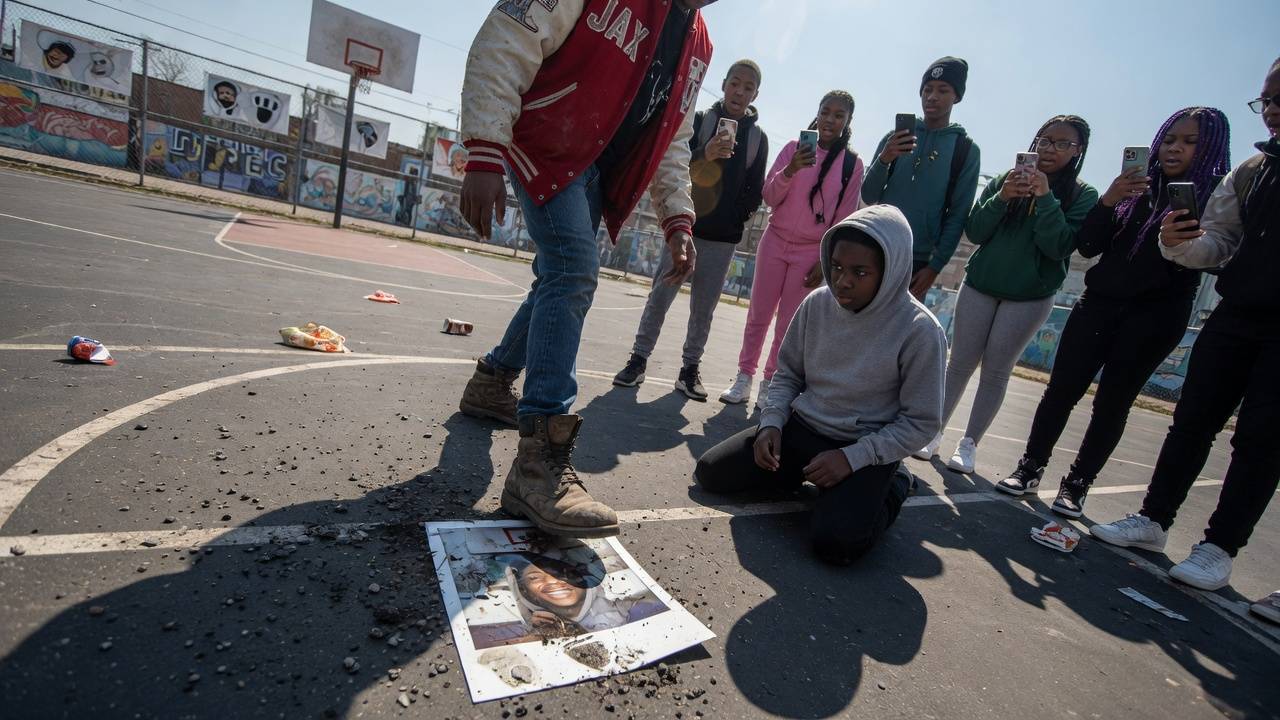
But today, Jax went too far. He found the one thing Leo had left—a torn photo of his father in the ring—and he dropped it in the dirt.
Leo didn’t scream. He didn’t cry. He just asked Jax to move his foot. When Jax laughed and shoved him instead, the air in the court changed.
In three seconds, the “neighborhood king” was on his back, begging for mercy in front of the same people who used to cheer for his cruelty.
Leo stood over him, not with rage, but with a cold, terrifying clarity that proved the King’s pedigree hadn’t disappeared—it had just been waiting.
The neighborhood saw everything. Now, the people who ruined his father are starting to realize that the debt is finally coming due.
I put the full story link in the comments.
Chapter 1
The air in the basement smelled like damp concrete, ancient sweat, and the metallic tang of a space heater that had been running since 1994. It was a basement in a part of Detroit where the streetlights stayed dark more often than they stayed on, and the only thing thicker than the humidity was the silence.
Leo King stood in the center of the room, his feet shoulder-width apart, his toes gripping the worn, duct-taped edge of a wrestling mat. His eyes were closed. He wasn’t looking at the man standing three feet in front of him, because looking didn’t matter.
“Left,” his father whispered.
Leo didn’t think. He felt the shift in the air, the subtle displacement of oxygen as his father’s hand moved. Leo’s head slipped two inches to the right. The wind of the punch brushed his ear.
“Late,” Elias King said. His voice was a low rumble, like gravel being turned in a drum.
Elias stood six-foot-two, a mountain of a man whose skin was the color of dark mahogany, etched with the scars of a hundred wars. His eyes were wide, milky-white orbs that saw nothing of the physical world, but he moved with a precision that made the sightless state feel like an advantage. Ten years ago, he had been “King” Cobra, the undisputed light-heavyweight champion of the world. Then came the scandal. Then came the “accident” that took his sight and his dignity in the same week.
“Again,” Elias commanded.
Leo reset. He was seventeen, lean and corded with the kind of muscle that didn’t come from a gym, but from thousands of hours of repetitive, grueling labor. He wore a grey hoodie with the sleeves cut off, his knuckles wrapped in frayed white gauze.
This was their secret. While the rest of the world thought Elias King was a broken man living on disability and a tarnished reputation, he was spent every night forging his son into a weapon. Not for the ring—Elias hated the ring now—but for survival.
“You’re thinking about the money again,” Elias said, his sightless eyes fixed somewhere over Leo’s shoulder.
“The pharmacy called, Pop,” Leo said, his voice tight. “They won’t refill the drops until we clear the back balance. Two hundred and eighty bucks.”
Elias snorted, a sharp, bitter sound. “They can wait. The world always waits for a man who knows how to stand his ground. If you’re thinking about the pharmacy, you’re not thinking about the distance between your chin and my fist.”
“I can’t just ignore it,” Leo snapped, his frustration boiling over. He hated this basement. He hated the smell of it. He hated the way they lived like ghosts in their own city. “The bills don’t stop just because we’re ‘standing our ground.’ Jax was at the store today. He told me if I don’t have the protection money by Friday, they’re going to start taking it out of the shop’s windows. And then they’ll come for you.”
Elias went still. The mountain didn’t move. “Jax is a boy playing at being a monster. His father is the one you should worry about. But you? You don’t give them anything. Not a cent. Not a flinch.”
“It’s easy for you to say,” Leo muttered. “You stay down here. I’m the one who has to walk past them every day. I’m the one they call the ‘Blind King’s Bastard.'”
The strike was so fast Leo didn’t even have time to slip. Elias’s open palm caught him square in the chest, not a blow meant to injure, but a shove that sent Leo stumbling back into the heavy bag. The bag groaned on its rusted chain.
“You are a King,” Elias said, his voice dropping to a dangerous, vibrating register. “Not because of a belt. Not because of a title. But because you control the space you occupy. If you let their words move you, you’ve already lost the fight before it starts. Now, reset.”
Leo climbed off the bag, his chest stinging. He wanted to scream. He wanted to tell his father that “controlling space” didn’t pay for glaucoma medication or keep the gang off their porch. But he saw the way his father’s hands were shaking—just a tremor, hidden in the folds of his oversized shirt. The old man was scared, too. He just didn’t have any other way to show it except through the fist.
Leo wrapped his hands tighter. “Fine. Again.”
They worked for another three hours. By the time Leo climbed the stairs to the cramped kitchen, his limbs felt like lead. The house was cold. The pilot light on the stove was out again, and the scent of old wood and poverty hung heavy in the air.
He sat at the small linoleum table and pulled a torn Polaroid from his pocket. It was his father, ten years younger, standing over a fallen opponent in Vegas. He looked invincible. He looked like a god.
Leo touched the corner of the photo, where the image was beginning to peel. He had spent his whole life trying to reconcile the man in this photo with the man in the basement. One was a hero; the other was a ghost. And Leo was trapped somewhere in the middle, a shadow trying to find a way to be real.
He heard the low thud of a car bass outside. A high-end SUV, out of place in this neighborhood, idling near their curb. Leo didn’t need to look to know who it was. Jax.
He didn’t go to the window. He just sat there in the dark, clutching the photo, listening to the rhythm of his own heart. It was a fast, frantic beat, the sound of a cornered animal.
“Just a few more weeks,” Leo whispered to the empty kitchen. “I’ll find a way.”
But as the SUV roared away, leaving a cloud of expensive exhaust in the cold Detroit night, Leo knew he was lying. The pressure was building, a physical weight in his chest, and he knew that soon, something was going to have to break.
Chapter 2
The morning light in Detroit was never bright; it was a bruised purple that faded into a dull, industrial grey. Leo walked down Linwood Avenue, his hands shoved deep into his hoodie pockets. Every crack in the sidewalk, every boarded-up storefront, felt like a personal insult.
He stopped at Miller’s Pharmacy. The bell above the door chimed with a pathetic, tinny sound. Behind the counter, Mrs. Gable looked up from a stack of invoices. She’d known Leo since he was five, back when his father would bring him in and buy him a pack of baseball cards after a win. Now, she wouldn’t even meet his eyes.
“I have eighty toward the balance,” Leo said, placing the crumpled bills on the counter.
Mrs. Gable sighed, a sound of genuine pity that made Leo’s skin crawl. “Leo, honey. I’ve told you. The owner… he’s tightening everything. I can’t release the latanoprost until the balance is under fifty. Your father needs those drops, I know, but my hands are tied.”
“It’s eighty dollars,” Leo said, his voice dropping an octave. “That covers the cost of the vials. You’re holding his sight hostage over thirty dollars of profit?”
“It’s not about profit, Leo. It’s about the books. This neighborhood… people don’t pay. I can’t be the one who makes the exception.”
Leo stared at the eighty dollars. It was his entire paycheck from the warehouse where he spent his afternoons hauling crates of spoiled produce. He felt a surge of heat behind his eyes. He wanted to reach over the counter and grab the medicine. He knew exactly where it was kept. He could be over the plexiglass and out the door in four seconds.
“Leo? Don’t,” Mrs. Gable said softly, as if she could read his thoughts.
He pulled the money back. “Right. I’ll get the rest.”
He walked out, the bell chiming behind him like a mocking laugh.
He was halfway to the basketball courts—the shortcut to the warehouse—when he saw them. Jax was leaning against a rusted chain-link fence, surrounded by three of his usual hangers-on. Jax was nineteen, built like a linebacker, wearing a red varsity jacket that cost more than Leo’s house. He was tossing a basketball up and catching it with one hand, a bored, predatory rhythm.
The neighborhood called Jax’s father “The Landlord,” even though he didn’t own any property. He just owned the people who lived on it.
“Yo, Leo!” Jax called out.
Leo kept walking. He didn’t speed up. He didn’t slow down. He followed his father’s voice in his head: Control the space.
“I’m talking to you, Ghost,” Jax said, stepping into the middle of the sidewalk. The basketball hit the pavement with a loud thwack.
Leo stopped two feet away. He could smell the expensive cologne on Jax, a sharp, citrus scent that didn’t belong in a place that smelled like old oil.
“I’m late for work, Jax,” Leo said.
“Work? You mean moving rotten cabbage for five bucks an hour?” Jax laughed, and his friends joined in. It was a practiced, ugly sound. “My old man’s asking about his tribute, Leo. Friday’s coming. And I hear your dad’s eyes are getting worse. Shame if he couldn’t see the guys who come to collect.”
Leo’s jaw tightened so hard he felt a muscle twitch near his ear. “I don’t have it.”
“See, that’s the wrong answer,” Jax said. He stepped closer, invading Leo’s space. He was four inches taller and fifty pounds heavier. He reached out and flicked Leo’s hood. “Your dad was a great man once. A king. Now he’s just a blind cheat hiding in a hole. Why are you protecting him? Come work for us. My dad needs runners. You’re fast. You’re quiet. You could make that two hundred in an afternoon.”
“I’m not a runner,” Leo said.
“No, you’re a charity case,” Jax spat. He reached into Leo’s hoodie pocket.
Leo’s hand shot up, grabbing Jax’s wrist. It was a reflex, a move born of a thousand basement sessions. The speed of it surprised them both. For a second, the world went quiet. Leo could feel the pulse in Jax’s arm. It was fast.
Jax’s eyes narrowed. “Let go of me.”
“Don’t touch me,” Leo said, his voice a whisper.
Jax ripped his arm away. He looked at his friends, his face flushing a deep, angry red. “You think you’re tough because your daddy used to hit people for money? You’re nothing, Leo. You’re a footnote. By Friday, you’ll be on your knees.”
Jax stepped back and kicked the basketball hard. It soared over the fence and bounced into the weeds. “Don’t be late on Friday, Ghost. I’d hate to have to visit your house while you’re at work.”
They walked away, hooting and shoving each other. Leo stood there, his hand still vibrating from the contact. He looked down at his palm. He had almost done it. He had almost snapped the wrist.
But he knew the cost. If he fought Jax, he wasn’t just fighting a bully. He was fighting The Landlord. He was fighting the system that kept his father in the dark.
He continued to the warehouse, but the walk felt different. The air felt heavier. The “King” legacy he carried wasn’t a shield; it was a target. And as he hauled crates of half-rotten onions for the next eight hours, all he could think about was the look in Jax’s eyes.
Jax wasn’t going to stop. Bullies like Jax didn’t want the money; they wanted the submission. They wanted to see the King’s son broken.
When Leo got home that night, he didn’t go to the basement. He went to his room and sat in the dark. He thought about the eighty dollars. He thought about his father’s shaking hands. And for the first time in his life, he felt a spark of something that wasn’t fear and wasn’t duty. It was a cold, hard desire for a reckoning.
He pulled the photo of his father out and looked at it.
“What would you do, Pop?” he whispered.
But the blind man in the basement didn’t have an answer. Only the ghost in the photo did, and he was long dead.
Chapter 3
Wednesday came with a freezing rain that turned the Detroit streets into a slick, grey mess. Leo was at the community center, a crumbling brick building that smelled of floor wax and desperation. He was there for the “Youth Employment Workshop,” which was really just a way for the city to keep kids off the street for two hours a week.
He was sitting in the back, staring at a flyer for a local MMA tournament, when a man sat down next to him.
The man was white, in his late fifties, with a nose that had been broken at least three times and eyes that looked like they’d seen everything and liked very little of it. He wore a faded gym jacket with Gleason’s stitched on the chest.
“You’re Elias’s kid,” the man said. It wasn’t a question.
Leo stiffened. “Who are you?”
“Marcus Thorne. I used to corner for your dad. Before the Vegas mess.”
Leo looked away. “I don’t talk about Vegas.”
“Neither does he, I bet,” Marcus said, leaning back in the plastic chair. “I saw you at the warehouse last week. Saw the way you move when you’re just carrying boxes. You have his hips. You have his footwork.”
“I move boxes, Marcus. That’s it.”
“I’ve been looking for him,” Marcus continued, ignoring Leo’s dismissal. “I heard he was still in the city. I heard he was training someone. I didn’t realize it was you.”
“He’s not training me,” Leo lied. “He’s blind. He sits in the dark and remembers things that didn’t happen.”
Marcus leaned in closer, his voice dropping. “Listen to me, Leo. I know what happened in Vegas. I know your father didn’t throw that fight. I was there. I saw the guys in the locker room afterward. I saw the look on Elias’s face. He was set up by people a lot bigger than a neighborhood gang boss.”
Leo felt a jolt of electricity run down his spine. “What are you talking about?”
“There’s a reason he’s hiding. There’s a reason he won’t let you fight. If the ‘King Cobra’ lineage shows up on a sanctioned card, the people who took his eyes will come back to finish the job.”
“Then why are you telling me this?” Leo asked, his heart hammering against his ribs.
“Because Jax’s father, the guy they call The Landlord? He’s small-time, Leo. But he works for the people who aren’t. He’s squeezing you to see if Elias will break. He wants to know if the King is really dead, or if he’s just waiting.”
Marcus reached into his pocket and pulled out a card. “I have a gym over on 12th. It’s private. No cameras. No crowds. If you want to learn how to actually use what your father is teaching you—how to end a fight before the other guy knows it started—come see me.”
“I can’t,” Leo said. “I have to work.”
“You have to survive,” Marcus corrected. “Jax isn’t going to let you just walk away, Leo. He’s building to something. He needs a trophy. And a King’s son is the best trophy in this zip code.”
Marcus got up and walked away, leaving the card on the chair. Leo stared at it. Survival.
That evening, the training in the basement was more intense than ever. Elias was relentless. He pushed Leo until his lungs burned and his vision blurred.
“Why do you keep me down here, Pop?” Leo asked during a break, his voice raw. “Why teach me all this if I’m never allowed to use it?”
Elias sat on a wooden stool, wiping sweat from his brow with a tattered towel. “Because violence is a debt, Leo. Once you spend it, you can never get it back. You think you’re fighting Jax? You’re fighting the ghost of every man I ever put in the hospital. You’re fighting the greed that took my sight. I’m teaching you to be a shield, not a sword.”
“A shield eventually shatters,” Leo said. “Jax is coming on Friday. If I don’t have the money, he’s going to hurt someone. Maybe you. Maybe Mrs. Gable at the pharmacy. He doesn’t care about ‘debts,’ Pop. He just cares about winning.”
“Then let him win the small things,” Elias said firmly. “Let him have the pride. Let him have the noise. As long as you have the space, you have the power.”
Leo looked at his father’s sightless eyes. He realized then that Elias wasn’t just protecting Leo from the world; he was protecting himself from the truth. Elias couldn’t admit that his “power” had left them in a basement with no heat and no medicine.
The next day, Thursday, the tension in the neighborhood felt like a physical pressure. Leo saw Jax everywhere—at the corner store, outside the warehouse, circling the block in his SUV. It was a psychological siege.
Leo went to the pharmacy one last time. Mrs. Gable looked tired.
“I’ll have the money tomorrow,” Leo said.
“Leo, please,” she whispered. “Jax was here. He… he told me not to give you anything. He said if I helped you, he’d find out.”
The betrayal stung more than any punch. “And you listened?”
“I have a family, Leo. I’m sorry.”
Leo walked out of the store. He didn’t feel angry anymore. He felt cold. A deep, crystalline cold that started in his chest and spread to his fingertips.
He walked to the basketball courts. It was a grey, desolate afternoon. The court was empty, except for a few pieces of trash blowing across the asphalt. He sat on the bleachers and pulled out the photo of his father.
He looked at the face of the man who was a King. He looked at the muscles, the confidence, the absolute lack of doubt.
“I’m not like you, Pop,” Leo whispered. “I can’t just stand my ground. I have to take it back.”
He heard the sound of footsteps on the asphalt. Not one person. Four.
He didn’t look up. He knew the rhythm. He knew the scent of the cologne. He knew the weight of the air.
Friday had come early. And Leo King, the son of a ghost, was finally ready to stop being a shadow.
Chapter 4
The basketball court was a cage of rusted chain-link and cracked concrete, the kind of place where dreams went to die and reputations were forged in blood. The sun was hanging low, casting long, skeletal shadows across the ground.
Leo sat on the bottom bleacher, his hood up, his hands tucked into his sleeves. He was the only person sitting. Surrounding him was a loose semicircle of seven or eight guys from the block—some he’d grown up with, others he’d only seen in passing. They all had their phones out. This wasn’t just a confrontation; it was content.
Jax stood in the center, his red varsity jacket gleaming like a fresh wound. He was bouncing a basketball, but his eyes never left Leo.
“Where’s the money, Ghost?” Jax asked. The ball hit the ground with a rhythmic, hollow thud.
“I don’t have it, Jax,” Leo said. He kept his voice low, steady. Control the space.
Jax laughed, a sharp, ugly sound that drew a few chuckles from the crowd. “See, that’s what you said yesterday. And the day before. I’m starting to think you don’t take me seriously. I’m starting to think you think you’re still royalty.”
Jax stepped closer, stopping only when his designer sneakers were inches from Leo’s worn-out Nikes. He reached out and grabbed the edge of Leo’s hood, pulling it back. Leo didn’t resist. He just looked up, his eyes flat and dark.
“Look at you,” Jax sneered. “The prince of the basement. You know what your dad is, Leo? He’s a cautionary tale. He’s what happens when you think you’re bigger than the people who pay the bills.”
“Leave my father out of this,” Leo said.
“Why? Everyone else talks about him. Why shouldn’t I?” Jax reached into Leo’s hoodie pocket. This time, Leo didn’t stop him. He let Jax pull out the torn, faded Polaroid.
Jax held it up for the crowd to see. “Look at this. The ‘King’ in his prime. Before he became a blind beggar.”
“Give it back,” Leo said. The coldness in his chest was expanding, turning into a hard, sharp edge.
“You want it?” Jax asked, a cruel smile spreading across his face. He looked at the photo, then looked at Leo. Slowly, deliberately, he let the photo slip through his fingers. It fluttered to the ground, landing face-up on the grimy asphalt.
Jax raised his right boot—a heavy, polished timberland—and brought it down hard on the center of the photo. He twisted his heel, the sound of the paper tearing and the grit of the asphalt grinding into the image of Leo’s father.
A collective “Ooh” went up from the crowd.
“Your old man’s a fraud, Leo,” Jax said, leaning down so his face was inches from Leo’s. “Just like you. He’s nothing. You’re nothing.”
Leo looked at the boot. He looked at the ruined face of the man who had taught him how to breathe, how to stand, how to survive. The memory of the basement, the smell of the damp concrete, the shaking of his father’s hands—it all crashed together into a single, white-hot point of focus.
“Take your foot off the photo, Jax,” Leo said. His voice wasn’t a threat. It was a statement of fact. “Last time.”
Jax barked a laugh. He reached out, grabbing Leo by the collar of his hoodie, and yanked him upward. Leo went with the movement, rising to his feet, but his center of gravity stayed low, his feet finding the exact position they had found ten thousand times on the basement mat.
“Or what?” Jax challenged, shoving Leo’s head back with his free hand. “What are you going to—”
Jax didn’t finish the sentence. He moved to shove Leo again, his right hand coming up in a heavy, arrogant arc.
In the time it took Jax to blink, the world shifted.
Leo didn’t punch. Not yet. He planted his left foot and used a sharp, downward snapping motion with his forearm, catching Jax’s reaching arm at the wrist and elbow. Move 1: The Structure Break.
There was a sickening pop as Jax’s shoulder was jerked out of its natural alignment. Jax’s chest flew open, his balance completely evaporated as he was forced onto his heels. His face transformed from arrogance to pure, unadulterated shock.
Leo didn’t hesitate. He stepped deep into the space Jax had left vacant. He rotated his hips, driving all the weight from his legs through his core and into his right hand. He delivered a short, compact palm-heel strike directly into the center of Jax’s sternum. Move 2: The Body-Weight Strike.
The sound was like a sledgehammer hitting a side of beef. Jax’s lungs emptied in a single, violent wheeze. His varsity jacket compressed under the force, and his entire upper body jolted backward as if hit by a car. He tried to scramble, his feet sliding uselessly on the asphalt, but his brain couldn’t keep up with the trauma his body was experiencing.
Leo didn’t stop. He planted his right foot, chambered his left knee high to his chest, and drove his heel straight through Jax’s centerline. Move 3: The Driving Front Push Kick.
It wasn’t a flick. It was a mountain moving. The sole of Leo’s shoe caught Jax square in the chest, the impact snapping Jax’s torso back so hard his head whipped. Jax was launched off his feet, flying three feet backward before slamming into the asphalt with a heavy, wet thud.
The crowd went dead silent. The only sound was the wind whistling through the fence and the ragged, gasping breath of a boy who had never known he could be broken.
Jax lay on his back, his face pale, his chest heaving as he fought for air. He tried to push himself up, but his right arm collapsed under him. He looked up at Leo, his eyes wide and leaking tears of pure panic. He raised his left hand, palm out, a gesture of pathetic, desperate surrender.
“Stop! Please!” Jax wheezed, his voice cracking. “I’m done! Please!”
Leo walked over to him. He didn’t rush. He didn’t look angry. He looked like a man finishing a chore. He stopped two feet from Jax’s head. He looked down at the boy who had spent weeks terrorizing his life, and he felt nothing but a deep, hollow pity.
He reached down and picked up the ruined photo. It was creased and stained with dirt, but his father’s eyes were still visible.
Leo leaned over Jax, his shadow falling across the bully’s terrified face.
“Don’t ever speak his name again,” Leo said.
His voice was quiet, but it carried to the back of the crowd. He stood up, tucked the photo into his pocket, and walked away.
He didn’t look back at the phones recording him. He didn’t look at the crowd parting like the Red Sea. He just walked toward the exit of the court, the adrenaline beginning to recede, leaving behind a cold, hard residue of what was to come.
He had defended the King. But as he reached the street, he saw a black SUV pull up at the far end of the block. The Landlord’s car.
Leo didn’t run. He just kept walking, his knuckles throbbing, knowing that the basement was no longer a sanctuary. The war had moved above ground.