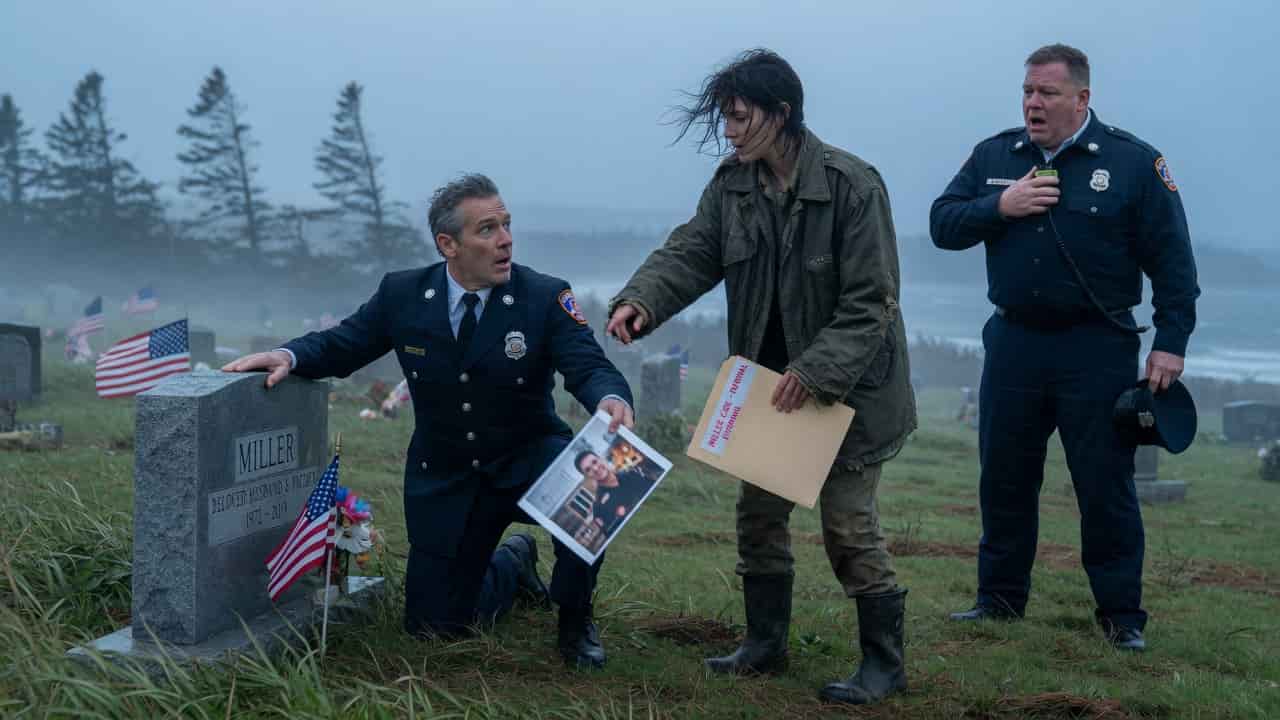
“Stop crying over a stranger, Chief. It’s embarrassing.”
David Miller didn’t move. He couldn’t. He was on his knees in the mud of the Oakhaven cemetery, the same place he’d come every Sunday for five years to talk to a piece of granite. He was the town’s tragic hero—the Fire Chief who went into the inferno of his own home and pulled out his wife’s remains. He’d carried that weight until it bent his spine.
But the girl standing over him didn’t look impressed. She looked like she wanted to spit on him.
“What are you talking about?” David’s voice was a rasp, the sound of a man whose lungs were still full of old smoke.
“Look at the picture, David.” Jess, a girl with hollow eyes and a jacket that smelled like cheap cigarettes, pointed at the mud.
David looked. It was a photo, fresh and crisp. It showed Laura—his Laura—sitting at a sun-drenched cafe in Paris, laughing over a glass of red wine. She looked older, her hair a different shade of blonde, but the mole on her neck was unmistakable.
“That’s impossible,” David whispered. “I pulled her out. I felt the ring on her finger. I buried her.”
“You buried my mother,” Jess snapped, her voice cracking the heavy silence of the graveyard. Behind them, David’s deputy, Harris, turned as white as a sheet. “Your wife didn’t burn. She locked my mother in that bedroom, slipped her wedding ring onto a dead woman’s hand, and lit the match so she could run away with your money.”
The manila folder she dropped contained the dental records. The proof that the hero of Oakhaven had been guarding a murderer’s secret for half a decade.
The fire wasn’t an accident. And his wife wasn’t a ghost.
Chapter 1: The Weight of the Badge
The air in the Oakhaven Fire Station always smelled the same: a base layer of diesel exhaust, the sharp tang of floor wax, and the faint, permanent ghost of wet soot that never quite left the turnout gear. It was a smell that David Miller had lived in for twenty-four years, but lately, it felt like it was suffocating him.
David sat at the scarred oak desk in the Chief’s office, his fingers tracing the edge of a silver commemorative coin. It was the five-year anniversary. Outside the window, the Maine sky was the color of a bruised plum, heavy with the threat of a coastal storm.
“Chief?”
David didn’t look up. He knew the voice. It was Harris, his second-in-command, a man who had stood by him while the rafters of David’s own home came crashing down five years ago.
“We’re heading out to the memorial,” Harris said softly. He was leaning against the doorframe, his helmet tucked under his arm. “The guys… they want to show their respects. We can take the ladder truck if you want. Give her a proper salute.”
“No,” David said, his voice flat. “Just a private visit today, Ben. Tell the guys I appreciate it. But I need the air.”
Harris lingered. That was the problem with being the town’s resident martyr. Everyone gave you too much room, but they never stopped watching to see if you were finally going to break. Oakhaven was a town of four thousand people; everyone knew David Miller had been the one to find his wife, Laura, in the master bedroom after the wires in the old Victorian had supposedly shorted out. They knew he’d refused to leave her side until the coroner arrived. They saw him as the gold standard of tragic loyalty.
“You okay, Dave? You look… thin,” Harris remarked.
“I’m fine, Ben. Get the rigs checked. The storm’s going to bring down some lines tonight.”
David stood, his joints popping. He was forty-eight, but his body felt sixty. He pulled on his dress tunic, the wool heavy and stiff. He spent five minutes in front of the mirror, adjusting his tie, making sure his badges were level. It was a ritual of armor. If he looked like the Chief, he didn’t have to feel like the man who had failed to save the only person who mattered.
He drove his red department SUV through the winding streets of Oakhaven. The town was beautiful in a jagged, unforgiving way. The houses were mostly saltboxes with peeling paint, and the harbor was filled with lobster boats that looked like they were held together by spite and rust. People waved as he passed. Old Mrs. Gable outside the bakery tipped her hat. Young kids on bikes stopped and watched the Chief go by.
It was a cage of pity.
He reached the cemetery on the cliffside, where the grass was kept short by the salt spray and the wind. He parked and walked toward the Miller plot. He carried a bouquet of lilies—Laura’s favorite, or at least, the ones she’d always pointed out in magazines.
He knelt by the stone. Laura Anne Miller. 1979–2021. Forever in the Light.
The guilt hit him exactly where it always did, right under the sternum. He’d been at the station when the call came in. He’d driven the engine himself, pushing it faster than the old diesel was meant to go. He remembered the orange glow against the night sky, the way his heart had hammered against his ribs like a trapped bird. He remembered the heat—how it had melted the plastic on his mask. And he remembered the moment he found the body near the window, the gold wedding band glinting in the embers.
“I’m sorry, Laura,” he whispered into the wind. “I’m still sorry.”
He’d said it ten thousand times. It never changed anything. He sat there for a long time, the cold seeping through his trousers, until the sound of boots on the gravel disturbed him.
He didn’t turn. He assumed it was Harris coming to check on him again. “I said I wanted to be alone, Ben.”
“I’m not Ben,” a voice said.
It was a girl’s voice. Sharp. Brittle. It sounded like glass breaking under a boot.
David stood up, brushing the mud from his knees. He turned to see a young woman he didn’t recognize. She was in her early twenties, dressed in a oversized army jacket that looked three sizes too big for her. Her hair was dark and stringy, her face pale and wind-burned. But it was her eyes that stopped him. They weren’t full of the usual Oakhaven pity. They were full of a hot, shimmering rage.
“Can I help you?” David asked, slipping back into his official tone.
The girl looked at the grave, then back at David. She let out a short, jagged laugh. “Help me? No, Chief. I think I’m the one helping you. Though I suspect you’re going to hate me for it.”
“Look, if you’re looking for the fire station, it’s back in town. This is a private moment.”
“A private moment for a public lie,” she said. She reached into her jacket and pulled out a glossy photograph.
David felt a strange prickle at the back of his neck. The girl stepped forward, invading his personal space. She didn’t look at him with respect; she looked at him with something that felt like disgusted pity.
“You’re David Miller, right?” she asked. “The hero? The man who lost everything in the big fire?”
“That’s me,” David said, his jaw tightening.
“Then you should see this.”
She held out the photo. David didn’t want to take it. Every instinct he had as a first responder told him that this girl was a live wire—unstable, dangerous. But the wind caught the photo, and for a split second, he saw the face.
His heart stopped. It didn’t skip a beat; it simply ceased to function for a full three seconds.
He snatched the photo from her hand. It was a picture of a woman sitting at an outdoor cafe. She was laughing, holding a glass of wine. The sunlight was bright, hitting the blonde hair and the familiar curve of her jaw. She was older. There were lines around her eyes that hadn’t been there five years ago. But it was her. It was Laura.
“Where did you get this?” David’s voice was a ghost of itself.
“Paris,” the girl said. “Three weeks ago. I’ve been tracking her for two years, Chief. Ever since I realized the woman the state of Maine buried in this hole didn’t have the right teeth.”
David looked at the grave, then back at the photo. The world began to tilt. The solid ground beneath his boots felt like it was turning to water.
“Who are you?” he gasped.
“My name is Jess,” the girl said. She reached into her jacket again and pulled out a heavy manila folder. She didn’t hand it to him; she let it drop onto the lilies he’d just placed on the grave. “And the woman you pulled out of that fire? The one you’ve been crying over for five years? That was my mother.”
David felt his knees buckle. He reached out to steady himself on the headstone—the stone he’d paid three thousand dollars for.
“That’s impossible,” he whispered. “I… I felt the ring. It was her ring.”
“Of course it was,” Jess said, her voice dropping to a whisper that cut deeper than a blade. “She put it on my mother’s finger after she killed her. Then she lit your house on fire and walked out the back door while you were busy being a hero.”
Chapter 2: The Dental Records of a Ghost
The sound of the Atlantic crashing against the cliffs was the only thing filling the silence for a long time. David stared at the manila folder resting on the white lilies. The edges of the paper were already starting to curl in the damp Maine air.
“Chief?”
It was Harris. David hadn’t heard the truck pull up, but the Deputy Chief was standing ten yards away, his face a mask of confusion and growing alarm. He’d clearly seen the girl, seen the folder, and seen his boss crumbling in the dirt.
“Chief, is everything okay?” Harris asked, taking a cautious step forward.
Jess didn’t flinch. She turned her head slightly, acknowledging Harris with a look of pure venom. “Oh, look. The sidekick is here. Did he help you cover it up, too? Or was he just too stupid to notice the accelerant?”
Harris stopped dead. His hand went to his belt, a reflexive gesture. “Excuse me? Miss, I don’t know who you are, but you need to back off. Chief Miller is in mourning.”
“He’s in a delusion,” Jess snapped. She looked back at David. “Open the folder, David. Or should I call the State Police and let them open it? I’ve got my mother’s dental records from the clinic in Portland. And I’ve got the autopsy photos from your wife’s ‘remains.’ They don’t match. Not even close. My mother had two molars pulled in 2019. The woman in that grave? She had a perfect set of teeth.”
David’s hands were shaking so violently he could barely grip the folder. He fumbled with the clasp, his vision blurring. He finally ripped it open. Inside were grainy black-and-white images of dental molds and a medical report.
He didn’t need to be a doctor to see the discrepancy. He remembered the fire marshal’s report—he’d read it a thousand times, looking for some detail he’d missed. The report had mentioned the skeletal remains were too charred for a visual ID, but the presence of the wedding ring and the location of the body had been enough for a local coroner who wanted to close a tragic case for a grieving friend.
David looked at the dental molds. Then he looked at the photo of Laura in Paris.
The woman in the photo was wearing a silk scarf. She looked happy. She looked free.
“My mother was a transient,” Jess said, her voice lose the edge of rage and softening into something more painful—raw, unadulterated grief. “She was schizophrenic. She wandered off from the shelter in Bangor six years ago. I spent years looking for her. I finally tracked her to Oakhaven. People saw her. They saw a blonde woman in a big house talking to her on the porch the day of the fire. They thought your wife was being a Good Samaritan.”
David’s mind raced back. Five years. The day of the fire. He’d left for a double shift. Laura had kissed him at the door. She’d been wearing that same silk scarf—or one just like it. She’d complained about the draft in the old house.
The house smelled like accelerant.
The thought surfaced from the dark basement of his memory. He’d suppressed it. He’d told himself it was just the smell of the old floor wax or the furnace kicking on. But as a fireman, he knew what Kerosene smelled like. He’d ignored his nose because his heart couldn’t accept the alternative.
“She killed her,” David whispered, the words tasting like ash.
“She found someone no one would miss,” Jess said. “A woman who looked enough like her in height and build. She drugged her, dressed her in her own clothes, put that ring on her, and burned the world down to get away from you.”
“Why?” David looked up at her, his eyes pleading. “Why wouldn’t she just leave? I would have given her a divorce. I would have given her everything.”
Jess laughed, a cold, hollow sound. “And lose the life insurance? The half-million dollar policy you had on her? The one that paid out to a ‘widower’ who then spent it on a fancy new fire engine for the town?”
David felt like he was being stripped naked in the middle of the cemetery. The town’s hero. The man who had used his ‘tragedy’ to buy a new truck for the department, earning the eternal gratitude of every citizen in Oakhaven.
Harris stepped closer, his face pale. “David… she’s lying. She has to be. I was there. I saw you pull her out.”
“You saw me pull out a body, Ben,” David said, his voice rising. He stood up, clutching the folder. “Did you check the dental records? Did the coroner actually run the tests, or did he just take my word for it because he didn’t want to put me through a formal ID?”
Harris looked away. The silence was his confession.
“We all wanted it to be over, Dave,” Harris whispered. “You were a wreck. The whole town was hurting for you.”
“You let me bury a stranger!” David roared, lunging at Harris. He grabbed the stocky man by the lapels of his dress uniform. “You were my friend! You were the Deputy Chief! Your job was to find the truth, not protect my feelings!”
Harris didn’t fight back. He just let David shake him, his eyes full of shame. “I didn’t know, Dave. I swear. I just… I didn’t look too hard. Nobody did.”
Jess watched them, her arms crossed over her army jacket. “Touching. The two heroes of Oakhaven, realizing they’ve been guarding a murderer’s exit path for five years.”
David let go of Harris. He felt a cold, hard clarity beginning to settle over him. The grief wasn’t gone, but it had changed shape. It wasn’t a weight anymore; it was a weapon.
He looked at the photo of Laura again. She was smiling. She was thousands of miles away, living a life bought with the blood of a woman who had nobody to speak for her.
Until now.
“Where is she, Jess?” David asked.
“I don’t have an address,” Jess said. “But I have a lead. She’s not in Paris anymore. That photo is three weeks old. She’s moving. She’s coming back to the States. I think she’s running out of money.”
“Or she’s coming back for more,” Harris muttered.
David looked at the headstone. Laura Anne Miller. He reached out and kicked the bouquet of lilies. They scattered across the mud, white petals staining brown. He felt a surge of something he hadn’t felt in five years: purpose.
“I’m going to find her,” David said.
“No,” Jess corrected him, stepping forward. “We are going to find her. You have the resources. I have the evidence. And if you try to go to the cops before I get my justice, I’ll tell the world that the great Chief Miller was in on it the whole time.”
David looked at the girl. She was a wreck, a drifter, a girl who had lost everything. She was exactly like he was, only she knew who to blame.
“Fine,” David said. “We do it your way.”
Chapter 3: The Ghost in the Ledger
The fire station was quiet when David and Jess returned. It was the shift change, and the usual banter of the men was absent, replaced by the heavy, expectant silence that followed the Chief’s annual disappearance on the anniversary.
David led Jess through the back entrance to his private office. Harris followed them, looking like a man walking to his own execution.
“Close the door, Ben,” David commanded.
Harris shut it and leaned against it. “Dave, we need to think about this. If this gets out… the department is finished. The town’s trust, the funding—everything we’ve built since the fire—it’s all based on the story of your recovery.”
“The story was a lie,” David said. He sat at his desk and cleared away the paperwork. He spread out the contents of Jess’s folder. “I don’t care about the department’s reputation, Ben. I care about the fact that I spent five years talking to a stone while the woman I loved was probably laughing at me from across the ocean.”
Jess sat in the guest chair, her muddy boots resting on the edge of David’s rug. She looked out of place in the clean, professional office, a reminder of the grime that David had been trying to scrub off his life.
“The insurance money,” Jess said. “Where did it go?”
“I told you,” David said. “I donated the bulk of it. The ‘Laura Miller Memorial Fund.’ We bought the new Pierce Enforcer engine. I kept enough to pay off the mortgage on the new place and… some for the funeral.”
“Check the accounts, Chief,” Jess said. “The ones you didn’t donate. Was there anything left? Anything she could have accessed?”
David frowned. “No. I closed our joint accounts months after the… the fire. There wasn’t much in them anyway. We were struggling. That’s why I was working the double shifts.”
He opened his laptop and began navigating through his personal banking history. He’d kept the records, archived in a folder he never opened because it was too painful. He scrolled back to 2021.
He found the joint savings account. He remembered the balance being around four thousand dollars—hardly enough to fund a life in Europe.
“Wait,” David whispered.
He clicked on the transaction history for the month preceding the fire.
There were dozens of small deposits. Five hundred dollars here, three hundred there. All cash. The balance had climbed to nearly forty thousand dollars in the space of six weeks. And then, three days before the fire, the entire amount had been withdrawn in a single cashier’s check made out to ‘L.A. Associates.’
“L.A. Associates,” Harris read over his shoulder. “Who the hell is that?”
“Her initials,” David said, his stomach turning. “Laura Anne. She was skimming. She must have been doing it for months. But forty thousand isn’t enough to live on for five years. Not in Paris.”
“She had a partner,” Jess said.
David looked at her. “What?”
“Think about it, Chief. A woman like that? She didn’t just wake up one day and decide to become a master arsonist and murderer. She needed someone to help her with the logistics. Someone to set up the accounts, someone to get her the fake ID, someone to scout for the victim.”
David looked at Harris. The Deputy Chief’s face was unreadable.
“Ben,” David said, his voice dangerous. “Is there anything else you didn’t look too hard at?”
Harris held up his hands. “Dave, I swear on my life, I didn’t know about any accounts. I was the one who helped you pull the boards off the windows! I was the one who held you back when the roof started to sag!”
“Maybe you were holding me back so I wouldn’t see she wasn’t there,” David said, standing up.
“That’s enough!” Harris snapped. “I’ve been your best friend for twenty years. I’ve carried you through the drinking, the night terrors, the whole damn thing. If I was in on it, would I still be here, rotting in this town for fifty grand a year?”
David stared at him. Harris looked exhausted, his eyes watering. He looked like a man who was telling the truth, or at least his version of it.
“He’s right,” Jess said, surprisingly. “If he were part of it, he’d be with her. Or he’d be dead. Laura doesn’t seem like the type to leave witnesses.”
She stood up and walked to the window, looking out at the rain-slicked street. “She’s coming back because the money did run out. Or because she thinks she’s safe now. Five years is the magic number for a lot of people. They think the trail is cold.”
David went back to the computer. He searched for ‘L.A. Associates.’
Nothing came up in Maine. He expanded the search.
He found a filing in Delaware. A shell company. Registered to a law firm in Portland.
“I know this firm,” Harris said, squinting at the screen. “They handled the town’s land acquisition for the new park. They’re high-end. Pricey.”
“How did a woman who claimed we couldn’t afford a new dishwasher pay for a Portland law firm?” David asked.
He reached for his phone. He dialed a number he hadn’t called in years.
“Who are you calling?” Jess asked.
“The only person Laura hated more than my mother,” David said. “Her sister.”
The phone rang four times before a woman picked up. “Hello?”
“Sarah. It’s David.”
There was a long silence on the other end. Sarah had moved to Florida shortly after the funeral. She hadn’t even stayed for the reception. She’d told David she couldn’t look at him without seeing the smoke.
“David,” she said, her voice guarded. “It’s been a long time. Is everything okay?”
“I need to ask you something, Sarah. And I need you to be honest with me. Did Laura ever talk to you about a man named Miller?”
“Miller? That was your name, David.”
“No. A different Miller. Or someone she was seeing? Someone she knew before we got married?”
Sarah sighed. “David, why are you doing this? It’s the anniversary, isn’t it? You’re obsessing again.”
“Sarah, I have a photograph of her. Alive. In Paris. Two weeks ago.”
The line went dead quiet.
“Sarah?”
“She told me you’d never find out,” Sarah whispered. “She told me if I said anything, she’d make sure I ended up just like that poor woman in the house.”
David felt the room go cold. “You knew? You knew she was alive?”
“I didn’t know until a year ago,” Sarah sobbed. “She called me. She needed money. She told me she’d faked it. She said you were suffocating her, David. She said Oakhaven was a tomb and she just wanted to breathe.”
“She murdered a woman, Sarah! She burned our home down!”
“She said it was an accident!” Sarah cried. “She said the woman was already dead when the fire started! She told me she just panicked and used the opportunity!”
David looked at Jess. The girl’s face was a mask of stone.
“Where is she, Sarah?” David asked, his voice a low, terrifying growl.
“She’s in Portland,” Sarah said, her voice trembling. “She’s staying at the Harbor View Hotel. She’s using the name Elena Vance. She… she’s meeting someone there tomorrow. Someone she said was going to ‘finish the job.’”
Chapter 4: The Harbor View
The drive to Portland took two hours of white-knuckled silence. David drove, his hands locked at ten and two, his eyes fixed on the taillights of the cars ahead. Jess sat in the passenger seat, staring out at the darkened woods of the Maine interior. Harris was in the back, his head down, looking through the forensic file Jess had provided.
“I checked the arson reports again on my tablet,” Harris said, his voice low. “The point of origin was the master bedroom. But there were secondary scorch patterns in the hallway. I flagged them at the time, but the Fire Marshal said it was likely ‘flashover.’”
“It wasn’t flashover,” David said. “She trailed it. She wanted to make sure the body was unrecognizable. She wanted to make sure I couldn’t get to her in time.”
The realization that his wife had calculated his own response—knowing he would risk his life to save her, and using that very heroism to ensure her escape—was a poison in his veins. She had used his love as a timer.
They reached Portland as the rain turned into a freezing drizzle. The Harbor View Hotel was a modern glass-and-steel building overlooking the Casco Bay. It was the kind of place where people with money stayed when they wanted to pretend they were still in New York or Boston.
David parked the SUV in a dark corner of the parking garage. He turned off the engine, but he didn’t get out.
“We go in, we find the room, we call the cops,” Harris said. “That’s the move, Dave. We do this by the book.”
“The book is burned, Ben,” David said. He looked at Jess. “You want to see her, don’t you?”
“I want her to look at me,” Jess said. “I want her to see the face of the girl whose life she erased.”
David reached into the glove box and pulled out his service pistol. He’d carried it for years, a requirement for the Chief in a town that didn’t have a full-time police force. He checked the magazine.
“Dave, put that away,” Harris pleaded. “Don’t do this. You’re the Chief. You’re a good man.”
“I’m a man who’s been living in a graveyard for five years, Ben. I’m not sure how much ‘good’ is left.”
They entered the lobby. It was decorated for an upcoming gala, with white ribbons and silver bells. The clerk behind the desk looked up, her smile faltering when she saw the three of them. David in his dress uniform, looking like a vengeful spirit; Harris, looking like he was about to vomit; and Jess, looking like a storm cloud in an army jacket.
“Can I help you, officers?” the clerk asked.
“We’re looking for Elena Vance,” David said. “She’s a guest here.”
The clerk checked the system. “Yes, Room 412. But she left word she wasn’t to be disturbed until her guest arrived.”
“We’re the guests,” David said.
They took the elevator to the fourth floor. The hallway was carpeted in a thick, silent navy blue. Every step felt like a mile.
They reached Room 412. David signaled for Harris and Jess to stand back. He didn’t knock. He took his master key—a tool every fire chief carried for emergencies—and slotted it into the lock.
The light on the handle turned green.
David pushed the door open.
The room was a suite, overlooking the harbor. The curtains were open, and the lights of the boats in the bay danced on the ceiling. A woman was standing by the window, her back to them. She was wearing a cream-colored silk robe. She was holding a glass of wine.
“You’re early, Marcus,” she said, her voice smooth and melodic. The same voice that had whispered I love you every night for fifteen years.
David stepped into the room. “Marcus isn’t coming, Laura.”
The woman froze. The glass of wine slipped from her hand, shattering on the hardwood floor. The red liquid spread like a wound.
She turned slowly.
It was her. The photo hadn’t lied. She was beautiful, even with the years and the fear etched into her face. She looked at David, and for a second, he saw the woman he had adored. And then, he saw the monster behind the eyes.
“David,” she whispered.
“You missed a spot, Laura,” David said, gesturing to the room. “You didn’t burn this one down.”
Jess stepped into the light. “Remember me? Or do you only remember my mother’s teeth?”
Laura’s eyes darted to Jess, then back to David. She didn’t scream. She didn’t cry. She did something much worse.
She smiled.
“I knew you’d find me eventually, David,” she said, her voice regaining its composure. “You were always so… dogged. So loyal. It was your most annoying trait.”
“You murdered a woman,” David said, his voice trembling with the effort not to pull the trigger. “A helpless, sick woman.”
“I gave her a better end than she was going to get on the street,” Laura said, stepping over the broken glass. “She was a ghost already. I just made it official.”
“Who is Marcus?” Harris asked, stepping into the room.
Laura looked at Harris, her smile widening. “Oh, Ben. You still haven’t figured it out? Marcus is the man who’s been handling the insurance investments. The man who’s been making sure David never looked too closely at the reports.”
She looked back at David. “Did you really think Ben was just being a good friend, David? He’s been on the payroll since the day of the fire. Who do you think scouted the girl’s mother for me?”
David turned to look at Harris. His best friend. His brother.
Harris was backing toward the door, his face pale. “Dave, she’s lying. She’s trying to turn us against each other!”
“Am I, Ben?” Laura asked. She walked to the dresser and picked up a tablet. She tapped a few icons and turned it toward David.
It was a bank statement. A series of wire transfers from ‘L.A. Associates’ to an offshore account.
The name on the account wasn’t Harris.
It was Miller.
“I didn’t just set myself up, David,” Laura said softly. “I set us up. I’ve been sending half the money to an account in your name for five years. If I go down for murder, you go down for conspiracy and insurance fraud. The hero of Oakhaven, the man who killed his wife for the payout.”
David looked at the screen. The numbers swam before his eyes. He looked at Jess, who was staring at him with a new kind of horror.
“I didn’t know,” David whispered.
“It doesn’t matter if you knew,” Laura said, walking toward him, her hand reaching out to touch his cheek. “The paper trail is perfect. We’re in this together, David. Just like we always were.”
Suddenly, the door to the suite burst open.
A man in a dark suit stepped in, a silenced pistol in his hand. He didn’t look at David or Harris. He looked straight at Laura.
“The client wants the ledger, Elena,” the man said.
David realized then that Laura wasn’t the top of the food chain. She was just another piece of the fire.
The man turned the gun toward David. “And he wants no witnesses.”