
The Millionaire Poured Boiling Coffee On A Bleeding Child. When My Husband Walked Out, His Wealth Couldn’t Save Him.
The silver Porsche didn’t just speed down Oakcrest Avenue; it tore through it like a bullet ripping through silk.
It was a quiet Tuesday afternoon in our suburban neighborhood, the kind of day where you expect nothing more dramatic than the hum of a lawnmower or the distant barking of a dog.
My eight-year-old son, Leo, was riding his red bicycle along the edge of the asphalt, his feet pedaling with the pure, innocent joy that only summer vacation can bring.
Then came the roar of an engine. A sound too loud, too violent for a street where children played.
I was standing by the kitchen window, rinsing a glass, when the flash of silver caught my eye. The car didn’t brake. It didn’t swerve until the very last second.
Leo, terrified by the sudden wall of metal bearing down on him, jerked his handlebars. His front wheel caught the curb, and he went flying.
The sound of metal scraping against concrete was followed instantly by a sharp, piercing scream that tore right through my chest.
I dropped the glass. It shattered in the sink, but I didn’t care. I was already sprinting toward the front door, my heart hammering against my ribs like a trapped bird.
By the time I burst onto the front porch, a man had already stepped out of the low-slung sports car. He didn’t look worried. He looked furious.
His name was Julian Vance. I knew his face from the local business journals—a thirty-four-year-old tech executive who had just sold his startup for hundreds of millions. He wore a tailored grey suit that probably cost more than our monthly mortgage, and his hair was slicked back perfectly. In his right hand, he held a steaming paper cup from the upscale café downtown.
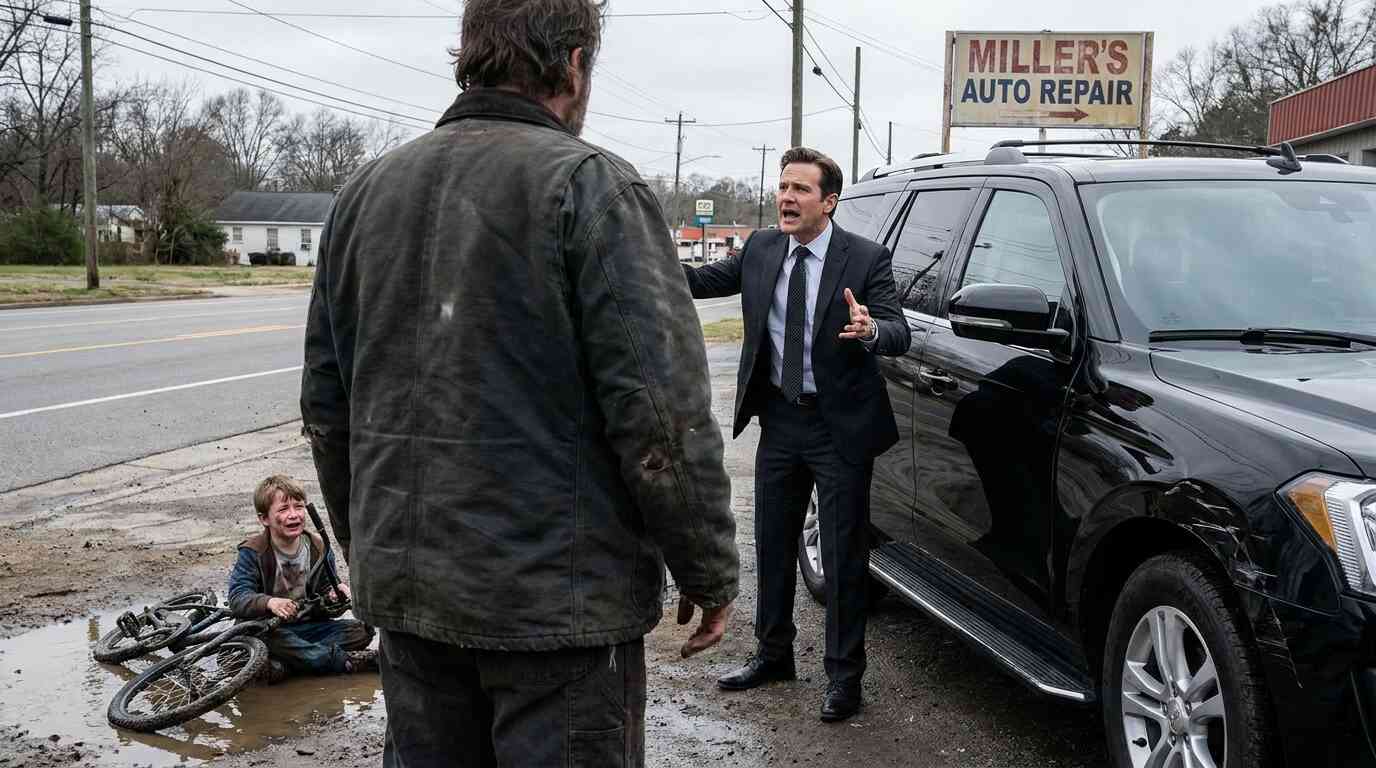
Leo was on the ground, his bicycle tangled around his legs. His left knee was badly scraped, a bright crimson trail of blood already smearing down his shin. He was sobbing, his small chest heaving as he clutched his leg.
“Look what you did to my car, you little idiot!” Julian barked, his voice carrying clearly across the manicured lawns. He didn’t even look at Leo’s bleeding leg. Instead, he was staring at a microscopic scuff mark on his front bumper.
“I’m sorry… I’m sorry,” Leo sobbed, trembling on the hot concrete.
Julian walked over, standing directly over my terrified son. The height difference made him look like a monster looming over a helpless prey. “Sorry doesn’t fix a custom paint job, brat. Your parents probably can’t even afford the insurance deductible on this vehicle.”
“Please,” Leo cried, trying to pull his ruined sneakers away from the man’s shadow.
What happened next made my blood run entirely cold.
Julian looked down at Leo’s sneakers—the ones we had saved up to buy him for his birthday—and sneered. With a deliberate, casual flick of his wrist, he tilted his paper cup.
A stream of boiling, dark coffee poured directly out of the lid, splashing heavily over Leo’s canvas shoes and his exposed, scraped ankle.
Leo let out a shriek of pure agony, a sound so raw it made the neighbors who had started gathering on their porches gasp in horror.
“Maybe that’ll teach you to keep your eyes on the road,” Julian sneered, a cruel, self-satisfied chuckle escaping his lips. He actually laughed.
My feet froze on the porch steps for a fraction of a second, paralyzed by the sheer, unadulterated malice of the act. I opened my mouth to scream, to run down the driveway, but before a sound could leave my throat, the heavy screen door of our garage slammed open.
Marcus walked out.
My husband. A man who rarely spoke above a quiet murmur, whose shoulders carried the invisible, crushing weight of three tours as a combat medic in the Army. A man whose right arm and neck were a roadmap of jagged, silver shrapnel scars—reminders of the day his convoy was hit, the day he lost his entire squad and barely saved himself.
Marcus didn’t run. He walked. But there was a terrifying, heavy precision to his footsteps that made the air in the neighborhood instantly grow heavy. He was wearing his old, grease-stained grey work shirt and heavy steel-toed boots, his hands still black with motor oil from fixing our lawnmower.
Julian heard the heavy footsteps and turned around, his smug smile still plastered across his face. “Hey, man, your kid just—”
Julian didn’t get to finish his sentence.
The moment Marcus’s eyes locked onto Julian’s face, something shifted. It wasn’t just a father defending his son. It was something deeper. Something ancient. A dark, forgotten ghost had just walked out of the shadows, and Julian’s wealthy, protected world was about to fracture into a million pieces.
Full story in the first comment…
👇If you don’t see the new chapter, tap “All comments”.
FULL STORY
Chapter 1: The Scars We Carry
The silver Porsche didn’t just speed down Oakcrest Avenue; it tore through it like a bullet ripping through silk. It was a quiet Tuesday afternoon in our suburban neighborhood, the kind of day where you expect nothing more dramatic than the hum of a lawnmower or the distant barking of a dog. My eight-year-old son, Leo, was riding his red bicycle along the edge of the asphalt, his feet pedaling with the pure, innocent joy that only summer vacation can bring.
Then came the roar of an engine. A sound too loud, too violent for a street where children played.
I was standing by the kitchen window, rinsing a glass, when the flash of silver caught my eye. The car didn’t brake. It didn’t swerve until the very last second. Leo, terrified by the sudden wall of metal bearing down on him, jerked his handlebars. His front wheel caught the curb, and he went flying.
The sound of metal scraping against concrete was followed instantly by a sharp, piercing scream that tore right through my chest. I dropped the glass. It shattered in the sink, but I didn’t care. I was already sprinting toward the front door, my heart hammering against my ribs like a trapped bird.
By the time I burst onto the front porch, a man had already stepped out of the low-slung sports car. He didn’t look worried. He looked furious. His name was Julian Vance. I knew his face from the local business journals—a thirty-four-year-old tech executive who had just sold his startup for hundreds of millions. He wore a tailored grey suit that probably cost more than our monthly mortgage, and his hair was slicked back perfectly. In his right hand, he held a steaming paper cup from the upscale café downtown.
Leo was on the ground, his bicycle tangled around his legs. His left knee was badly scraped, a bright crimson trail of blood already smearing down his shin. He was sobbing, his small chest heaving as he clutched his leg.
“Look what you did to my car, you little idiot!” Julian barked, his voice carrying clearly across the manicured lawns. He didn’t even look at Leo’s bleeding leg. Instead, he was staring at a microscopic scuff mark on his front bumper.
“I’m sorry… I’m sorry,” Leo sobbed, trembling on the hot concrete.
Julian walked over, standing directly over my terrified son. The height difference made him look like a monster looming over a helpless prey. “Sorry doesn’t fix a custom paint job, brat. Your parents probably can’t even afford the insurance deductible on this vehicle.”
“Please,” Leo cried, trying to pull his ruined sneakers away from the man’s shadow.
What happened next made my blood run entirely cold. Julian looked down at Leo’s sneakers—the ones we had saved up to buy him for his birthday—and sneered. With a deliberate, casual flick of his wrist, he tilted his paper cup. A stream of boiling, dark coffee poured directly out of the lid, splashing heavily over Leo’s canvas shoes and his exposed, scraped ankle.
Leo let out a shriek of pure agony, a sound so raw it made the neighbors who had started gathering on their porches gasp in horror.
“Maybe that’ll teach you to keep your eyes on the road,” Julian sneered, a cruel, self-satisfied chuckle escaping his lips. He actually laughed.
My feet froze on the porch steps for a fraction of a second, paralyzed by the sheer, unadulterated malice of the act. I opened my mouth to scream, to run down the driveway, but before a sound could leave my throat, the heavy screen door of our garage slammed open.
Marcus walked out.
My husband. A man who rarely spoke above a quiet murmur, whose shoulders carried the invisible, crushing weight of three tours as a combat medic in the Army. A man whose right arm and neck were a roadmap of jagged, silver shrapnel scars—reminders of the day his convoy was hit, the day he lost his entire squad and barely saved himself. Marcus didn’t run. He walked. But there was a terrifying, heavy precision to his footsteps that made the air in the neighborhood instantly grow heavy. He was wearing his old, grease-stained grey work shirt and heavy steel-toed boots, his hands still black with motor oil from fixing our lawnmower.
Julian heard the heavy footsteps and turned around, his smug smile still plastered across his face. “Hey, man, your kid just—”
Julian didn’t get to finish his sentence. The moment Marcus’s eyes locked onto Julian’s face, something shifted. It wasn’t just a father defending his son. It was something deeper. Something ancient. A dark, forgotten ghost had just walked out of the shadows, and Julian’s wealthy, protected world was about to fracture into a million pieces.
Marcus closed the distance between them in three massive, deliberate strides. He didn’t yell. He didn’t hesitate. He reached out with a hand that had pulled dying soldiers out of burning Humvees, wrapped his thick fingers around the lapels of Julian’s expensive designer suit jacket, and lifted the multi-millionaire clean off his feet.
“What the hell do you think you’re doing?!” Julian shrieked, his voice cracking as his leather briefcase slipped from his hand and clattered onto the pavement. His legs dangled uselessly, his expensive Italian leather shoes kicking at the empty air.
“Look at me,” Marcus commanded. His voice wasn’t loud, but it possessed the terrifying, low frequency of a rumbling earthquake.
Julian sputtered, his face turning a mottled red as the collar of his shirt choked him. “Let go of me! Do you know who I am? I will buy this miserable block and have you thrown on the street! I have lawyers who will ruin your life before the sun goes down!”
“I don’t care about your money, Julian,” Marcus said, his eyes drilling into the younger man’s pupils. “And I know exactly who you are. The question is… do you remember me?”
Julian froze. His eyes, previously filled with arrogant rage, narrowed as he finally looked past Marcus’s grease-stained clothes and focused on the jagged, silver shrapnel scars carving up the right side of Marcus’s neck. A sudden, violent tremor ran through Julian’s frame. The color drained from his face so fast it looked as though he had seen a ghost. Because he had.
“No…” Julian whispered, his voice suddenly stripped of all its venom, leaving behind nothing but a hollow, childish terror. “It can’t be you.”
“Yeah,” Marcus said, dropping Julian roughly to the concrete. The billionaire stumbled, his knees buckling as he hit the hard asphalt, tearing his pristine suit pants and scraping his palms against the very ground where my son’s blood was pooling. “It’s me.”
Chapter 2: The Price of Silence
Ten years ago, before we bought this small house on Oakcrest Avenue, before Leo was even a thought in our minds, Marcus was a sergeant in the US Army. Julian Vance was a twenty-four-year-old civilian contractor working for his father’s massive logistics firm, fetching coffee and managing digital manifests in the safety of a heavily fortified green zone.
But one afternoon, a severe lapse in scheduling caused a supply convoy to take a wrong turn into a hostile sector. Julian had been riding in the armored command vehicle, a privilege bought by his father’s wealth. When the first IED exploded, tearing through the lead vehicle, Julian had panicked. He had locked the heavy, reinforced doors of the command vehicle from the inside, ignoring the desperate screams of the wounded soldiers outside, terrified that opening the door would expose him to sniper fire.
Marcus was the medic who had crawled through the dirt, bleeding from his own shrapnel wounds, begging Julian through the bulletproof glass to open the door so they could load the critically injured men inside. Julian had covered his ears, staring blankly ahead, letting men bleed to death on the hot sand just to ensure his own survival.
The military court-martial had cleared Julian on a technicality—civilian contractors couldn’t be held to the same code of military justice—and his father’s high-priced legal team had buried the incident under a mountain of non-disclosure agreements. Marcus had been honorably discharged with a purple heart, a shattered spirit, and a vow of silence he had never broken. Until today.
“Marcus, please,” Julian stammered, scrambling backward on his hands and knees like a crab, his expensive suit ruined, his hands coated in road dust. “That was ten years ago. It was an accident. The tribunal cleared me!”
“The tribunal didn’t see the look in your eyes today, Julian,” Marcus said, stepping forward, his shadow completely enveloping the shivering executive. “You haven’t changed. You still think the rest of the world exists just to be trampled under your feet.”
I ran past them, collapsing onto the concrete next to Leo. My hands were shaking violently as I pulled off his canvas sneakers. The boiling coffee had already caused angry, red blisters to erupt across his tender skin, mixing with the dark blood from his scraped knee. Leo was hyperventilating, burying his face into my shoulder.
“Look at what you did to my son,” I screamed at Julian, my voice cracking with a mother’s fury. “He’s eight years old! What kind of monster are you?!”
The neighbors were fully out now. Arthur Pendelton, a retired high school principal from across the street, was recording everything on his phone, his face grim. Clara Higgins, an elderly nurse who lived next door, rushed over with a first-aid kit and a bottle of cold water, kneeling beside me to treat Leo’s burns.
Julian looked around, realizing for the first time that his money couldn’t shield him from the eyes of thirty disgusted working-class people. He tried to regain his footing, smoothing out his torn jacket with trembling hands. “Look, I’ll pay for it. Alright? I’ll write a check right now. Ten thousand dollars. Twenty thousand. Whatever it takes to make this go away. Just… don’t call the police.”
“The police?” Marcus let out a short, hollow laugh that contained absolutely no mirth. “The police are the least of your worries, Julian. You brought your circus into my neighborhood. You hurt my boy.”
“It was a mistake! He darted out!” Julian lied, his voice rising in panic as he looked at Arthur’s recording phone. “Delete that! I’ll pay you to delete that video!”
“Keep recording, Arthur,” Marcus said quietly, never taking his eyes off Julian. “Let the whole world see what a hundred million dollars buys you. A suit, a fast car, and the soul of a coward.”
Chapter 3: The Gathering Storm
Within an hour, the quiet of Oakcrest Avenue was shattered by the flashing red and blue lights of two police cruisers. The officers, local cops who knew Marcus from his volunteer work at the local VFW, didn’t look at Julian’s luxury car with admiration. They looked at the long, dark skid marks on the asphalt and the crying child being loaded into the back of an ambulance.
Julian’s demeanor changed the moment the badges appeared. The terrified coward vanished, replaced once again by the arrogant executive. He stood by his car, speaking into his sleek smartphone, his voice sharp and demanding. “Yes, Richard. Get the firm’s top criminal defense attorney down here. Some local grease monkey is trying to extort me. And call the mayor’s office. I want this handled immediately.”
An older officer, Officer Vance—no relation to Julian, ironically—walked over to Marcus, his notepad out. “What happened here, Marcus?”
Marcus gave a calm, precise account of the incident, his voice steady, devoid of the rage that had consumed him moments prior. He pointed to the skid marks, then to Leo’s bicycle, which was bent at a sickening angle. He didn’t mention the war. He didn’t mention the green zone. He kept it strictly to the crime committed against our son.
Julian marched over, his phone still pressed to his ear. “Officer, this man assaulted me! He grabbed me by my collar and threatened my life. I want him arrested immediately. Look at my suit! Look at my hands!”
Officer Vance looked at Julian’s scraped palms, then at Marcus’s calm, steady stance. Then he turned to Arthur Pendelton, who was standing on his porch holding his phone.
“Mr. Pendelton,” Officer Vance called out. “Did you witness the incident?”
“I filmed the whole thing, Officer,” Arthur said, his voice ringing out clearly. “I saw Mr. Vance speed down the street at twice the limit. I saw the boy crash. And then I saw this monster pour hot coffee on a bleeding child and laugh about it. I have it all right here in high definition.”
Julian’s face went entirely pale. “That video is private property! You don’t have my consent to record me!”
“This is a public street, sir,” Officer Vance said, his tone dropping into a cold, professional register. “And right now, you’re looking at charges of reckless driving, child endangerment, and assault with a hazardous substance. Step away from the vehicle and put your hands behind your back.”
“Do you know who my father is?!” Julian yelled, backing away toward his car. “I pay more taxes in a month than you make in a year! You can’t touch me!”
The second officer didn’t waste words. He stepped around Julian, grabbed his right arm, and twisted it behind his back with a swift, practiced motion. The handcuffs clicked into place with a sharp, metallic finality. Julian shrieked, his pristine forehead pressed against the hot hood of his own Porsche as he was searched.
As they poured him into the back of the police cruiser, Julian caught Marcus’s eye through the tinted glass. Marcus didn’t look triumphant. He looked exhausted. He looked like a man who had finally dragged a heavy, rotting secret out into the light, only to realize how much it still stank of death.
Chapter 4: The Viral Reckoning
By midnight, the neighborhood was quiet again, but the digital world was turning into an absolute inferno. Arthur Pendelton had uploaded the raw, unedited video to his Facebook page with a simple caption: This is Julian Vance, CEO of Vance Tech, pouring boiling coffee on an 8-year-old boy after almost running him over on Oakcrest Ave. Share this until his board sees it.
The internet did exactly that.
By the time I came home from the hospital with Leo, whose ankle was wrapped in thick layers of white gauze and soothing burn creams, the video had over two million views. By Wednesday morning, that number had jumped to fifteen million. It was the top trending topic on every major social media platform.
The backlash was swift and catastrophic. Vance Tech’s stock price began a terrifying, vertical nosedive the moment the markets opened. The company’s public relations department tried to issue a statement claiming the video was “taken out of context” and that Mr. Vance was “deeply sorrowful for the accidental spill,” but the internet wasn’t buying it. The visual of Julian laughing while my son screamed was undeniable.
Marcus sat at our kitchen table, a mug of black coffee between his calloused hands, staring at the television screen. A national news anchor was showing a blurred version of the video, discussing the growing public outrage and the calls for Julian’s immediate resignation.
“You okay?” I asked softly, placing my hand over his scarred arm.
Marcus didn’t look up immediately. When he did, his eyes were bloodshot, carrying the weight of a decade of sleepless nights. “I thought I left him in the desert, Sarah. I thought if I never said his name again, the ghosts would stay where they belonged.”
“He hurt our son, Marcus. You didn’t invite him here. His own arrogance brought him to our door,” I said, squeezing his hand.
Before Marcus could answer, the loud, intrusive chime of the doorbell rang through the house. I frowned, checking the clock. It was barely nine in the morning.
When I opened the front door, I didn’t find a reporter or a neighbor. Standing on our porch was an older man, his face lined with deep crevices of stress and authority. He wore a dark navy blue wool suit that practically radiated wealth, but his posture was stooped, defeated. Beside him stood a slick, younger man holding a heavy leather briefcase.
It was Harrison Vance. Julian’s father. The billionaire logistics tycoon who had buried Marcus’s squad ten years ago.
“Mr. and Mrs. Miller,” Harrison said, his voice raspy and devoid of the power it usually held in boardrooms. “My name is Harrison Vance. May we come in? We need to talk about my son.”
Marcus appeared behind me, his massive frame completely filling the doorway. The moment Harrison’s eyes met Marcus’s, the older man flinched. He recognized the shrapnel scars. He recognized the man his money had silenced a decade ago.
“You have five minutes, Harrison,” Marcus said, his voice dropping into that terrifying, low register. “And your lawyer stays on the porch.”
Chapter 5: The Ultimate Price
The billionaire sat on our modest plaid sofa, looking entirely out of place among Leo’s scattered toys and the modest decorations of our living room. His lawyer waited outside, pacing the driveway under the watchful, judgmental eyes of our neighbors.
“I know who you are, Sergeant Miller,” Harrison began, his hands resting on his knees, trembling slightly. “I know what happened in Sector 4 ten years ago. I know what my son did. Or rather… what he failed to do.”
“He didn’t just fail, Harrison,” Marcus said, standing by the fireplace, his arms crossed over his chest. “He locked the door. He watched men die through bulletproof glass because he was too terrified to save them. And yesterday, he poured boiling liquid on a child because he thought his wealth made him a god.”
Harrison bowed his head, looking suddenly very old, very fragile. “Julian is… he is broken. He has been spoiled by a wealth he didn’t earn, protected by a father who loved him too much to let him face the consequences of his cowardice. But the world has caught up to him. The board of Vance Tech voted unanimously an hour ago to strip him of his title. The stock has crashed forty percent. His career is over.”
“Good,” I said, my voice sharp as broken glass. “He deserves to be ruined.”
“He is facing jail time, Mrs. Miller,” Harrison said, looking up at me with pleading eyes. “The district attorney is making an example of him because of the internet outrage. They are pushing for maximum sentences on the felony child endangerment charges. I am here to offer you a settlement. Five million dollars. In exchange, you sign a non-disclosure agreement, you ask the DA to drop the charges, and you release a statement saying it was a misunderstanding.”
Marcus let out a low, dangerous growl. “You still don’t get it, do you? You think everything has a price tag. You think you can buy my son’s pain just like you bought your son’s freedom ten years ago.”
“I am trying to save my boy!” Harrison cried out, his voice cracking with a genuine, pathetic desperation. “He won’t survive prison, Marcus. You know what happens to men like him in there. I am begging you, father to father.”
“You should have let him face the consequences ten years ago, Harrison,” Marcus said, stepping toward the sofa. “If you had let him feel the weight of his cowardice back then, maybe he would have grown a soul. Maybe he wouldn’t have sped through a neighborhood where children play. Maybe he wouldn’t have laughed while my son bled.”
“Please,” Harrison whispered, tears finally escaping his old eyes. “Name your price. Anything.”
Marcus walked over to the front door and threw it open, pointing out toward the street where the faint white chalk outline of Leo’s bicycle crash was still visible on the asphalt.
“The price was paid ten years ago in the dirt, Harrison. And yesterday, your son ran out of credit,” Marcus said, his voice final and unyielding. “Get out of my house.”
Chapter 6: The Weight of Justice
The trial of Julian Vance didn’t take long. With fifteen million people watching the evidence on their phones and Arthur Pendelton’s high-definition video anchoring the prosecution’s case, there was nowhere for Julian’s expensive defense attorneys to hide.
Marcus took the stand on the third day of the trial. He didn’t speak of vengeance. He didn’t bring up the past contract work or the desert convoy, respecting the legal boundaries of the current case. But he spoke with the quiet, devastating authority of a father who had watched his child be intentionally harmed by a man who felt untouchable.
When the judge handed down the sentence—three years in a state penitentiary with no possibility of early parole, alongside a mandatory five hundred hours of community service at a juvenile burn recovery center—Julian didn’t scream. He didn’t threaten anyone. He just collapsed back into his leather chair, weeping softly, his hands trembling as the bailiffs led him away in cheap, orange institutional clothing.
A month after the sentencing, the neighborhood of Oakcrest Avenue threw a block party to celebrate the end of the summer. The street was blocked off with orange cones, but this time, the children rode their bicycles safely, their laughter filling the warm afternoon air.
Leo was among them, his ankle fully healed, his new red bicycle—bought with money the neighbors had raised for him—gleaming under the golden sunlight. He didn’t look afraid anymore. He looked like an eight-year-old boy who knew his father would always keep him safe.
Marcus and I sat on our front porch steps, holding hands, watching Leo race Arthur’s grandson down the sidewalk. The heavy, invisible cloud that had hung over Marcus’s shoulders for ten long years seemed to have finally lifted, replaced by a deep, quiet peace.
“You did the right thing,” I murmured, leaning my head against his shoulder, smelling the familiar, comforting scent of motor oil and clean laundry.
Marcus looked out at our son, a soft, genuine smile finally touching his lips, clearing away the harsh lines of his old scars.
“Money can build a fortress to hide a coward,” Marcus said softly, his voice filled with a profound, lingering truth that echoed across the quiet street, “but it can never purchase a clean conscience or a father’s forgiveness.”



