The Scratch on My $90,000 Mercedes Cost Me Nothing, But the Tiny Star Tattoo on the Broken Bicycle Rider’s Wet Neck Just Demolished My Entire Empire and Left Me Begging on My Knees in the Pouring Rain.
The rain in downtown Chicago didn’t just fall; it punished the pavement. It was 5:15 PM, peak rush hour, and the sky was the color of a bruised twilight. I was sitting inside the insulated, leather-scented sanctuary of my Mercedes-Benz S-Class, cursing the gridlock.
My name is Arthur Vance. In this city, that name means corporate acquisitions, relentless litigation, and a net worth that keeps me insulated from the messy realities of ordinary life. I had a dinner meeting at six with three venture capitalists who didn’t tolerate lateness, and my patience was wearing dangerously thin.
Then came the sound. A sickening, metallic scrape that vibrated right through the frame of my car.
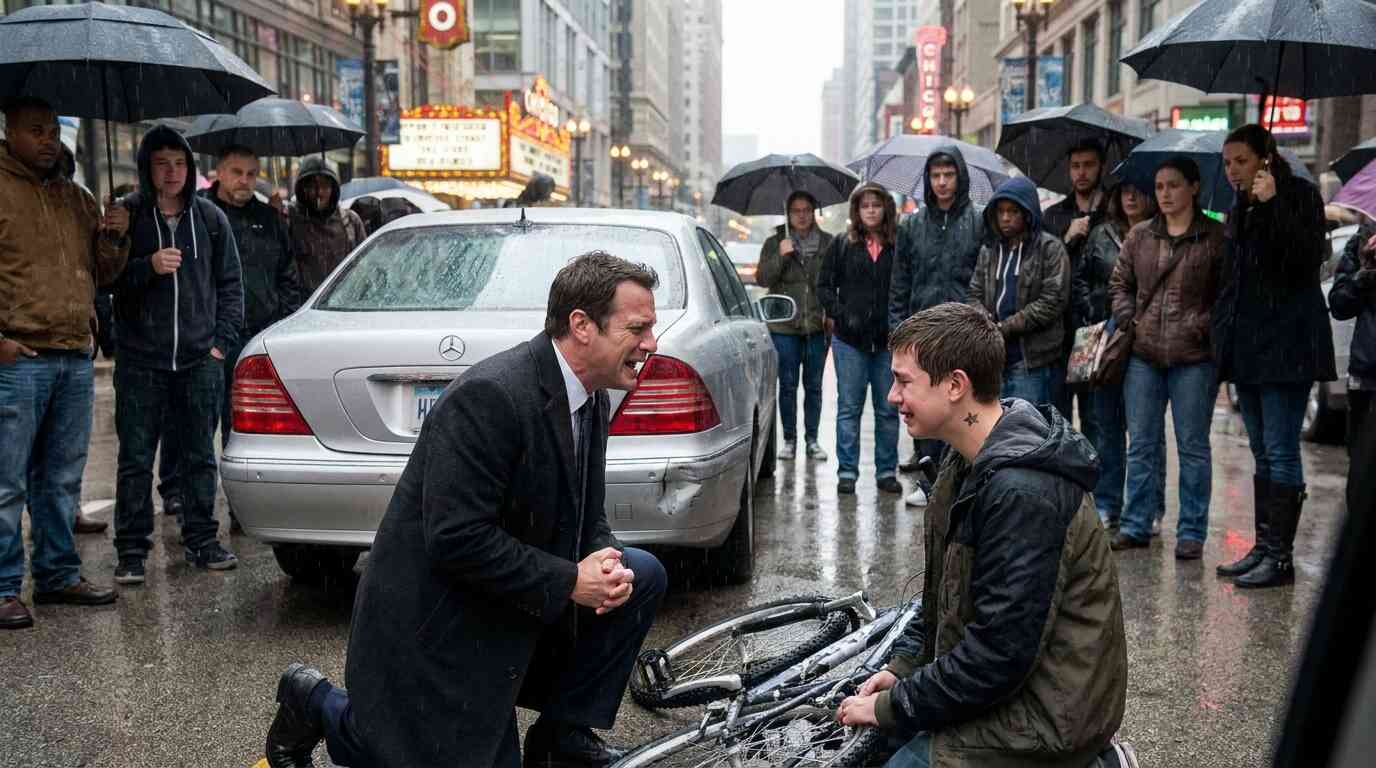
My eyes flew to the passenger-side mirror. A teenage boy on a rusted, oversized mountain bike had skidded on the slick asphalt, losing control. He had collapsed onto the sidewalk, but not before his handlebars sliced a deep, jagged line right through the pristine obsidian paint of my front fender.
Rage, hot and instantaneous, blinded me. That car wasn’t just transportation; it was a testament to my status. It was a shield I wore against a past I spent twenty years trying to bury.
I threw the door open, ignoring the torrential downpour that instantly soaked through my custom-tailored charcoal suit.
“Hey! What the hell is wrong with you?” I roared, my voice cutting through the heavy thrum of the rain and the blaring horns of Michigan Avenue.
The boy was scrambling backward on the wet concrete, trying to pull his mangled bike with him. He looked about fourteen, drowning in an oversized, faded blue Champion hoodie that was soaked through to his skin.
“I-I’m sorry, sir! The brakes, they didn’t hold in the wet—” his voice cracked, high-pitched and trembling.
“Do you have any idea what you just did?” I stepped onto the curb, towering over him, deliberately using my size to pin him against the cold brick wall of a closed storefront. “You useless street punk! Look at this! Look at what you did to my paint!”
I pointed a trembling, manicured finger at the scratch, then stabbed it back toward his chest. Pedestrians began to slow down, holding their umbrellas high, forming a silent, judgmental perimeter around us. I didn’t care. I wanted him to feel the weight of his insignificance.
“People like you think you can just drift through life breaking things that belong to people who actually matter!” I shouted, the rain dripping from my hair into my eyes, blurring my vision but not my fury. “You can’t even afford the tire on this vehicle! You’re a blight on this city!”
The boy shrunk deeper into his soggy hoodie, his shoulders shaking violently. He wasn’t just crying; he was sobbing, a desperate, gasping sound that should have made me pause. His face was smudged with city grime and tears, his lips turning a faint shade of blue from the piercing October chill.
“I didn’t mean to,” he choked out, pressing his back hard against the bricks, his hands raised in front of his face as if expecting a blow. “Please, mister. I don’t have any money. I was just trying to get home before the streetlights came on.”
“Home? A kid like you doesn’t have a home, you have a harbor for delinquency,” I spat, leaning down, bringing my face mere inches from his to ensure he felt every ounce of my venom. “I should call the police and have them lock your pathetic life away.”
I grabbed the fabric of his wet hoodie near his collar, intending to pull him up to force him to look at the damage he had caused.
But as the heavy cotton shifted, exposing the left side of his neck under the harsh, flickering neon sign of the storefront, the words died in my throat.
The air left my lungs as if I had been struck by a physical blow.
There, just beneath his jawline, half-faded but unmistakably distinct against his pale, shivering skin, was a tiny, five-pointed star tattoo. It wasn’t professional work; it was a amateurish, slightly crooked mark, dark blue ink embedded deep into the flesh.
My heart stopped beating. The roaring of the traffic, the pounding of the rain, the murmurs of the crowd—all of it vanished into a deafening, terrifying silence.
…Full story in the first comment…
👇If you don’t see the new chapter, tap “All comments”.
FULL STORY
Chapter 2: The Ghost in the Blueprint
The world didn’t just slow down; it fractured into a thousand sharp, agonizing pieces.
I let go of the boy’s hoodie as if the fabric had turned into white-hot coals. My hands began to shake, a violent, uncontrollable tremor that started at my fingertips and raced up my arms. I stared at the tiny star tattoo, my vision tunneling until nothing else existed in the universe.
Fourteen years ago. A cramped, suffocating apartment in Southside Chicago. A life I had violently torn myself away from.
“Arthur, please, he’s just a baby, don’t do this,” a woman’s voice echoed from the deepest, darkest vault of my memory. It was Sarah.
Back then, I wasn’t Arthur Vance, the corporate titan. I was Artie Miller, a desperate, broke twenty-two-year-old kid drowning in debt, working two dead-end jobs, and suffocating under the weight of an unexpected infant son. One night, after a screaming match with Sarah about missing rent, I packed a single duffel bag. I looked down at our six-month-old baby boy, Leo, sleeping in a crib held together by duct tape.
On the left side of Leo’s neck, he had a distinct, star-shaped birthmark. Sarah had always laughed and said it meant he was destined for stardom. The night before I abandoned them, in a state of manic, toxic despair, I had taken a sterile needle and Indian ink, foolishly tracing over that birthmark, darkening it so I would “never forget him.” Then, I walked out into the night and never looked back. I changed my name, fabricated a pedigree, and built an empire on the lie that I was a self-made man with no family ties.
And now, fourteen years later, the ghost had found me on a rainy sidewalk.
“What’s your name?” I whispered, my voice sounding hollow, stripped of all its previous authority.
The boy wiped his nose with the sleeve of his wet hoodie, looking at me with a mixture of profound terror and confusion. He tried to shuffle further away, his sneakers squeaking against the wet concrete. “Why do you care? Just call the cops if you’re gonna. My foster mom can’t pay for that car anyway.”
“Your name,” I repeated, the word tearing out of my throat like jagged glass. I reached out, my hand hovering near his shoulder, terrified to touch him, terrified he would vanish. “Tell me your name. Please.”
The sudden shift from predatory rage to desperate begging caught him off guard. He swallowed hard, his jaw trembling from the cold. “Leo. Leo Miller.”
The name hit me like a physical punch to the solar plexus. I stumbled backward, my expensive leather dress shoes slipping on the wet asphalt.
Leo.
“Who… who is your mother?” I choked out, the rain washing over my face, mingling with the hot tears that were suddenly blinding me. “Where is Sarah?”
Leo’s eyes widened slightly, a flicker of guarded recognition crossing his features. “How do you know my mom’s name? She passed away when I was five. I don’t remember her much. Just… just that she used to sing some song about stars.”
My knees suddenly gave out.
The billionaire, the man who had ruthlessly fired hundreds of employees without blinking, the man who owned a penthouse overlooking Lake Michigan, fell hard onto his knees right into a filthy puddle of street water.
“Oh my god,” I sobbed, covering my mouth with both hands. “Oh my god, Leo.”
The crowd around us gasped. The wealthy man in the three-piece suit was kneeling in the dirt before a homeless-looking kid and a broken bicycle.
“Hey, mister, are you okay?” Leo asked, his anger entirely replaced by fear at my sudden psychological collapse. He took a hesitant step toward me, his hands still trembling. “I’m sorry about your car. I really am. I didn’t mean to scratch it.”
“No, no, no,” I wept, grabbing the lapels of my own suit, tearing at them in a sudden fit of suffocating guilt. “Fuck the car. Leo… look at me. Look at my face.”
He looked, his young brow furrowed, scanning my features—the sharp jawline, the distinct hazel eyes, the slight cleft in the chin. Features he saw in the mirror every single day.
“Who are you?” Leo whispered, his voice dropping to a fragile, frightened thread.
“I’m your father,” I choked out, the truth tearing through the carefully constructed armor of my life, shattering it into dust. “I’m Artie. I’m the man who left.”
Chapter 3: The Ghost of Michigan Avenue
The silence that followed was louder than the thunder rolling across the Chicago skyline.
Leo stared at me, his eyes darting from my expensive watch to my tear-streaked face, and then to the Mercedes idling smoothly in the background. The shock on his face slowly hardened into something ugly, something heavy and sharp. It was an expression no fourteen-year-old should ever wear—the expression of a child who had learned too early that the world was entirely untrustworthy.
“You’re lying,” he said, his voice flat, devoid of the tears from moments before. He took two steps backward, dragging his twisted bicycle with him. “My dad died before I can remember. That’s what the social workers told me.”
“They told you that because I let them,” I cried, remaining on my knees, the cold rain soaking through my trousers, chilling me to the bone. “I ran away, Leo. I was a coward. I was twenty-two, we had no money, and I thought… I thought I could build a life and come back for you. But I got greedy. I got lost.”
I reached into my breast pocket, my fingers clumsy and wet, and pulled out my leather wallet. I fumbled through the credit cards and business cards until I found the one thing I had kept through three relocations and a total identity reinvention: a tiny, water-damaged, black-and-white hospital photo of a newborn baby with a dark star-shaped mark on his neck.
I held it out into the rain, the paper instantly softening under the downpour. “I kept it. Every single day for fourteen years, Leo. I kept it.”
Leo didn’t step forward to take it. He glanced down at the ruined photograph, then back up at me. His lower lip quivered, not from the cold this time, but from an avalanche of suppressed grief.
“You kept a picture,” Leo said, his voice rising, cutting through the murmurs of the gathered onlookers. “You kept a piece of paper, but you left me? Do you know where I’ve been for the last nine years? Do you know what foster care is like in this city?”
Every word he spoke felt like a physical lash across my back.
“I lived in six different houses, mister! Six!” Leo screamed, the rage finally erupting from his small frame. He dropped his bicycle, the metal clanging loudly against the concrete. “I slept on floors! I wore clothes that didn’t fit me! I got beaten up because I didn’t have a family to protect me! And you… you were driving around in a ninety-thousand-dollar car, yelling at me for a stupid scratch?!”
“Leo, please—”
“Don’t call me that! You don’t get to call me that!” he yelled, tears spilling over his cheeks again, hot and angry. “You called me a street punk. You told me I was a blight on this city. You didn’t know I was your son when you said that. You just thought I was a nobody who didn’t deserve to breathe your air!”
The crowd was completely still now. A few people had pulled out their phones, recording the scene. My PR team would have had a stroke if they were here, but I didn’t give a damn about my reputation anymore. The empire I had built felt like a house of cards, and my son’s words were the hurricane blowing it all away.
“You’re right,” I whispered, my head bowing until my forehead almost touched the wet pavement. “You’re entirely right. I am a monster. I became the exact kind of man I used to hate. I can’t undo the last fourteen years, Leo. I can’t fix the pain I caused you. But please… let me help you now. Let me be your father now.”
“I don’t need a father anymore,” Leo said, his voice dropping into a cold, hollow register that terrified me more than his shouting. “I learned how to grow up without one. Keep your fancy car. Keep your money.”
He grabbed his broken bicycle by the handlebars, lifting the front wheel off the ground because it wouldn’t roll. He turned his back on me and began to limp away down the crowded sidewalk, disappearing into the sea of umbrellas and the gray Chicago fog.
I stayed on my knees in the rain, watching the blue hoodie recede into the distance, completely paralyzed by the realization that the greatest casualty of my success was my own soul.
Chapter 4: The Currency of Regret
By midnight, the rain had stopped, leaving the city slick and reflective under the harsh yellow glow of the streetlights.
I sat in the dark of my high-rise penthouse office, the panoramic view of Lake Michigan looking less like a triumph and more like a gilded cage. The charcoal suit was still damp, hanging heavily on my frame. On my desk lay a thick, leather-bound folder—the dossier my private investigator had delivered just two hours after I called him from the side of the road.
It took Marcus, my investigator, less than ninety minutes to trace Leo’s current placement.
His current residence was a dilapidated multi-family home in the Austin neighborhood on the West Side. His foster mother was a woman named Marcus’s report described as “overburdened, underfunded, and checked out.” There were four other foster children in the house. Leo’s school records showed a brilliant kid who was slowly slipping through the cracks—frequent absences, failing grades in the last year, but standardized test scores in mathematics that were in the top ninety-ninth percentile.
He was me. He had my brain, my stubbornness, and my isolation. But he had none of my privileges.
The door to my office clicked open. My current wife, Evelyn, stepped in. She was dressed in a silk robe, her face smooth and perfect, devoid of the lines of worry that ordinary life carved into people. We had been married for five years, a strategic alliance of high society and corporate influence. We had no children; Evelyn had made it clear early on that a baby would disrupt her lifestyle.
“Arthur, what on earth is going on?” she asked, her voice laced with an aristocratic annoyance. “Marcus called the house line looking for you. And someone sent me a link to a video on Twitter. It looks like you having some sort of psychotic break on Michigan Avenue with a homeless kid. It’s already got fifty thousand views.”
I didn’t look up from the folder. “He’s not a homeless kid, Evelyn. He’s my son.”
The silence in the room became heavy. I heard the soft rustle of her silk robe as she walked closer to the desk.
“What did you just say?”
“His name is Leo,” I said, my voice dead and flat. I finally turned my head to look at her. “Fourteen years ago, before I met you, before I went to business school, I had a family. I had a son. And I abandoned him because I was a coward who wanted to be rich more than I wanted to be a father.”
Evelyn stared at me, her expression shifting from confusion to disgust. “Are you out of your mind? You have a pristine reputation in this city. We are on the board of the art institute! If the press gets hold of this—if they find out you’re some… some deadbeat dad from the slums—the stock price for Vance Holdings will plummet by morning!”
“I don’t care about the stock price,” I said softly.
“Well, I do!” she snapped, slamming her manicured hand onto the mahogany desk. “We built this life, Arthur. I didn’t marry a man who kneels in the mud for a street rat. If this kid wants money, have the lawyers write a check. Give him a million dollars to go away. Buy his silence and get yourself into therapy.”
I looked at Evelyn, really looked at her, for what felt like the first time in years. Her beauty was undeniable, but beneath it was a profound, icy void. She was exactly the kind of person I had spent my life trying to become—someone who believed that every human tragedy could be solved with a line item on a ledger.
“A check won’t fix this,” I said, standing up from my chair. “A check is what a coward uses to hide his sins. I’m done hiding.”
“If you go after that boy, if you bring that trash into our lives, I will file for divorce by Monday,” she threatened, her eyes narrowing into cold slits. “And I will take half of everything you own.”
I looked out the window at the city lights, then back at the woman I had spent five years with. The fear that would have gripped me yesterday—the fear of losing my wealth, my status, my empire—was entirely gone. It had been washed away by the sight of a little star tattoo on a wet neck.
“You can have the half you want, Evelyn,” I said, reaching into my pocket and pulling out my car keys. “In fact, you can have the penthouse too. I won’t be needing it.”
Chapter 5: The Cost of a Clean Slate
The Austin neighborhood at two in the morning was a different world from the Gold Coast. The streets were cracked, the streetlights flickered with an irregular, nervous pulse, and the sound of distant sirens replaced the gentle hum of luxury traffic.
I parked the scratched Mercedes outside a two-story frame house with peeling gray paint and a sagging front porch. A single, low-wattage yellow light bulb illuminated the house number: 5412.
I stepped out of the car, no longer caring about the rain-soaked suit or the mud that caked my shoes. I walked up the wooden steps, each one groaning under my weight, and knocked firmly on the door.
It took several minutes before the lock clicked. The door opened a few inches, held by a rusty chain. A tired-looking African-American woman in her late fifties peered out at me, her eyes heavy with sleep and suspicion.
“Can I help you? It’s two AM,” she said, her voice raspy.
“Are you Ms. Jenkins?” I asked, keeping my hands visible. “My name is Arthur Vance. I’m… I’m Leo Miller’s biological father.”
The woman’s expression changed instantly. The fatigue vanished, replaced by a sharp, defensive anger. She unhooked the chain and swung the door open wide. She didn’t look at my expensive clothes with awe; she looked at them with profound contempt.
“So you’re the one,” she said, stepping onto the porch, crossing her arms over her chest. “Leo came home tonight soaking wet, his bike ruined, locking himself in the bathroom for three hours crying his eyes out. He wouldn’t tell me nothing except that some rich man yelled at him on the street. I see that rich man was you.”
“I didn’t know—”
“Of course you didn’t know!” she interrupted, her voice a sharp whisper to keep from waking the other children inside. “Because you weren’t there! You weren’t there when he had a fever of 104 and I had to sit with him in the county ER for twelve hours. You weren’t there when he won the regional math competition and looked at the audience, hoping someone was there just for him, only to see an empty seat. You think you can just show up here in your fancy car and claim him because your conscience woke up?”
“No,” I said, my voice cracking. “I know I don’t deserve him. I know I have no rights here. But I want to do it right this time. I want to give him everything he’s ever been denied.”
“He doesn’t want your money, Mr. Vance,” she said, her eyes softening just a fraction, revealing the deep exhaustion of a woman who spent her life catching the children society threw away. “He wanted a father. When he was little, he used to sit by the window on his birthday, convinced his dad was just stuck in traffic. Eventually, he stopped sitting by the window. He locked that part of his heart away. You can’t just buy your way back into a room you locked him out of.”
“Can I please just see him?” I begged, the tears returning, hot and shameful. “Just for five minutes. If he tells me to leave, I’ll leave. I swear.”
Ms. Jenkins looked at me for a long, agonizing moment. She scanned my face, searching for the lie, but found only the raw, bleeding truth of a broken man. She sighed heavily, stepping aside to let me into the narrow, dimly lit hallway that smelled of old wood and pine cleaner.
“He’s in the basement room,” she said softly. “Don’t wake the others.”
I nodded, my heart hammering against my ribs like a trapped bird. I walked down the narrow, creaking stairs into the basement. The air was cool and damp. At the far end of the room, under a single exposed rafter, was a small twin mattress on a metal frame.
Leo was sitting up, his back against the wall, his knees pulled to his chest. He was still wearing the blue hoodie, though it was dry now. In the dim light of a small desk lamp, I could see his eyes were red and swollen.
He didn’t look surprised to see me. He just looked tired.
“You found me,” he whispered.
“I have a good investigator,” I said, staying near the bottom of the stairs, refusing to crowd him. “Leo… I’m not here to force you into anything. I’m not here to play the hero.”
“Then why are you here?”
“Because I realized something tonight,” I said, the tears slipping down my face. “I spent fourteen years building an empire so I would never feel small or helpless again. But tonight, when I looked at you, I realized that my empire is just a pile of ashes. I have nothing, Leo. If I don’t have you, I have absolutely nothing.”
Chapter 6: The Broken Mosaic
Leo didn’t move for a long time. The small desk lamp flickered slightly, casting long, dancing shadows across the concrete floor of the basement.
“You left a note,” Leo said suddenly, his voice cracking slightly. He reached into the front pocket of his hoodie and pulled out a crumpled piece of yellowed notebook paper, carefully unfolding it. “When you left my mom… you left a note on the kitchen table. She kept it in her jewelry box until the day she died. Then I took it.”
I felt my breath catch. I remembered writing that note. I had been drunk on cheap whiskey and blind panic.
“Do you remember what you wrote?” Leo asked, looking up at me, his hazel eyes piercing through the dim light.
“I told her I was sorry,” I whispered. “I told her I would send money when I made it.”
“No,” Leo said, shaking his head, a single tear cutting through the dirt on his cheek. “You wrote: ‘I’m not cut out for this. I can’t be a father to a kid who’s just going to hold me back from being someone.'”
The words echoed in the small basement like a death knell. Hearing my own youthful arrogance read back to me by the boy I had discarded was a punishment more severe than any prison sentence.
“I was a monster,” I choked out, falling to my knees for the second time that night, right there on the cold concrete. “Leo, I was a twenty-two-year-old idiot who didn’t understand that the only thing that makes a person ‘someone’ is the people they love. I ran away from the best thing that ever happened to me because I was terrified of failing. But by running away, I committed the greatest failure of all.”
I pulled my wallet out again, took out my driver’s license, my corporate ID, and my black American Express card, and threw them onto the floor between us. “I am relinquishing everything. Tomorrow, I am stepping down as CEO of Vance Holdings. I’m giving half the assets to Evelyn, and the other half is being placed into an irrevocable trust for you and the other kids in this house. I don’t want the name Arthur Vance anymore. It’s a curse.”
Leo looked down at the cards on the floor, then back at me. “If you don’t have your money and your name… who are you?”
“I’m just Artie,” I wept, extending my trembling hands toward him, palms upward, completely defenseless. “I’m just a broken man who wants to spend the rest of his life earning the right to sit on the bottom step of your porch. I don’t expect you to call me dad. I don’t expect you to forgive me. I just want to be near enough to make sure you never have to ride a bicycle with broken brakes in the rain ever again.”
Leo stared at my open hands. For a minute that felt like a century, he didn’t move. Then, slowly, he slid off the edge of the mattress. He walked over to where I knelt on the floor.
He didn’t hug me. He didn’t offer a dramatic movie reconciliation. He simply knelt down in front of me, reached out, and picked up the water-damaged baby picture I had left on the floor earlier. He looked at it, then carefully folded it and placed it back into his hoodie pocket.
“The brakes really did fail,” Leo said softly, his voice thick with a vulnerability that tore through my heart. “I wasn’t trying to mess up your car.”
“I know,” I sobbed, pulling my hands back to wipe my face. “I know, Leo. The car doesn’t matter. Nothing matters but you.”
He looked at me for a long moment, the hard armor around his eyes softening just a tiny fraction, revealing a glimmer of the little boy who used to sit by the window on his birthday, waiting for a man who never came.
“It’s going to take a long time,” Leo whispered.
“I have nothing but time,” I replied.
The rain had long since stopped outside, but as I sat on that cold basement floor across from my son, I knew the storm that had raged inside my soul for fourteen years had finally passed, leaving behind a landscape of ruin, but also, for the very first time, a fragile ray of light.
True wealth isn’t measured by the pristine paint on a luxury car, but by the scars we are willing to bear to heal the pieces of the hearts we broke.