The Scratched Phantom
The sound of tearing metal is something you don’t forget, but it wasn’t metal that broke on 16th Street that Tuesday afternoon. It was a kid’s spirit, or at least, that’s what Marcus thought he was breaking.
Marcus didn’t see people; he saw assets. He saw the world through the pristine, polarized lens of his 2026 Mercedes-Maybach S-Class, a vehicle that cost more than the collective net worth of the entire block he was currently idling on. To Marcus, the city was just a grid of obstacles between his penthouse and his hedge fund office.
Then came the thud. A sickening, hollow plastic thud against his front passenger bumper.
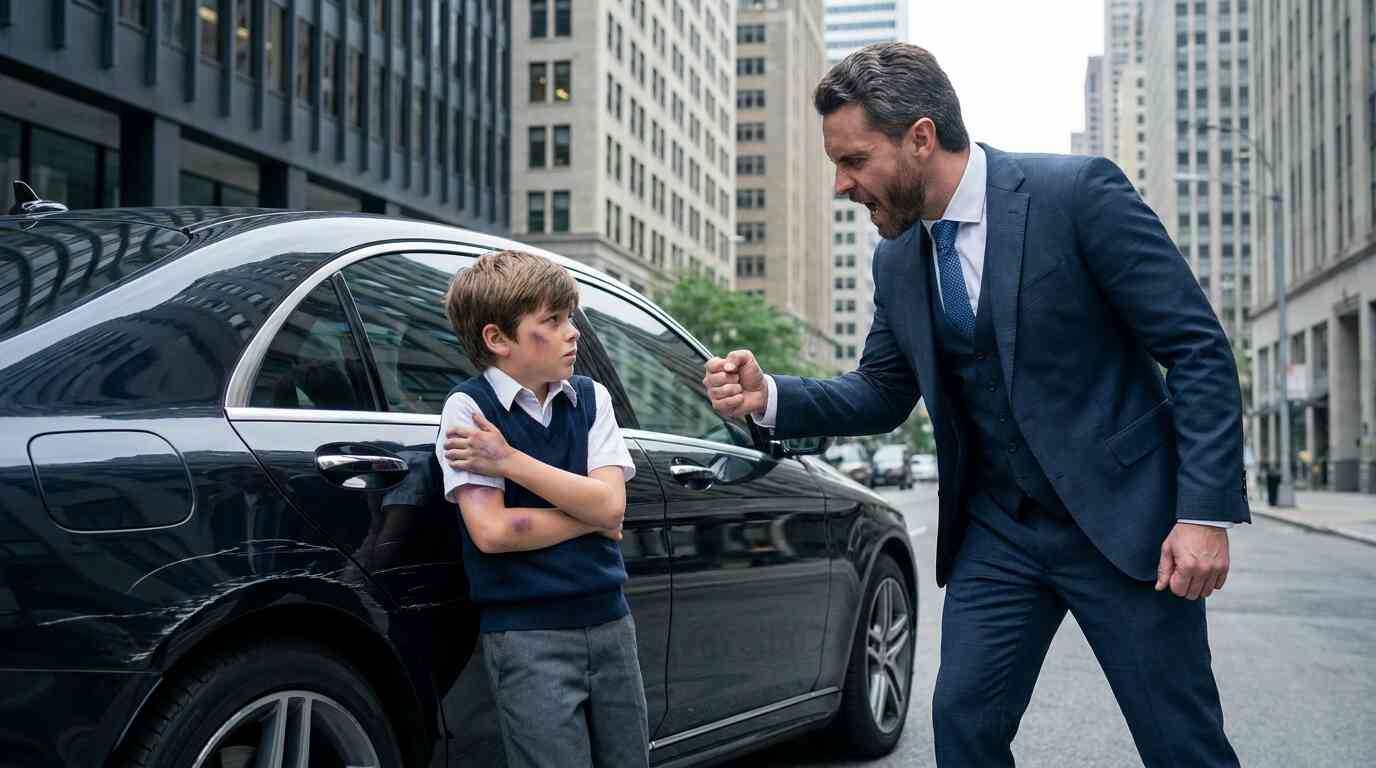
Marcus hit the brakes so hard the seatbelts locked. His heart didn’t leap out of fear for human life; it surged with pure, unadulterated venom. He threw the door open, the humid summer air hitting his face like a wet towel, and stormed to the front of his car.
There, sitting on the hot asphalt, was a boy. He couldn’t have been older than twelve. He was wearing a faded blue Jansport backpack, one of its straps held together by a safety pin, and a pair of scuffed sneakers. But Marcus’s eyes didn’t linger on the boy. They locked onto the bumper.
A three-inch silvery scratch gouged the immaculate obsidian paint.
“Are you completely blind, you little piece of trash?!” Marcus’s voice tore through the downtown noise, sharp and violent.
The boy, Leo, scrambled backward, his hands scraping against the rough concrete. “I’m sorry, sir! I didn’t mean to, I just tripped over the curb—someone bumped into me—”
“Do you have any idea what this car costs?!” Marcus closed the distance between them in two terrifying strides. He didn’t see the dark, ugly bruise already forming on Leo’s left cheekbone from where he’d hit the concrete. He didn’t see the terror in the kid’s wide brown eyes. He just saw a bill he shouldn’t have to pay.
Marcus reached down, grabbed the boy by the collar of his faded hoodie, and violently shoved him backward. Leo tumbled, his backpack hitting the ground first with a heavy thud, his phone flying out of his hand and skidding across the pavement, its screen shattering into a spiderweb of glass.
“Get up!” Marcus roared, towering over him, his expensive charcoal suit stretching tightly across his shoulders. “You’re going to call your parents right now. They’re going to sell whatever shack you live in to fix my car, you hear me? Look at me!”
The surrounding sidewalk went dead silent. In Philadelphia, people usually mind their own business, but this was different. A grown man, six feet of tailored arrogance, screaming at a bruised, trembling child. Passersby slowed down. A woman in a nursing uniform stopped, her mouth agape. Several teenagers pulled out their phones, the lenses catching the bright afternoon sun, recording every second.
Leo was weeping now, deep, chest-heaving sobs that made his shoulders shake. His knees were scraped raw, blood trickling down his shins. With trembling fingers, he reached for his cracked phone, his vision blurred by tears. He didn’t look at Marcus. He couldn’t. The sheer malice radiating from the man was paralyzing.
Leo tapped the screen, the glass cutting into his thumb, and pressed the speed dial. He held the phone to his ear, his voice breaking into a desperate, high-pitched plea.
“Dad… please. Dad, I’m at the corner of 16th and Market. A man… he pushed me. He’s hurting me, Dad. Please come.”
Marcus let out a cruel, mocking laugh, crossing his arms over his chest. “Oh, cry to your daddy all you want, kid. Unless your dad owns a fortune 500 company, he’s going to be working off this scratch for the next five years. You think you can just ruin my property and walk away? In this city? With your kind?”
The venom in the last phrase made a few people in the crowd murmur angrily, but no one stepped forward. Marcus was rich, he was aggressive, and in America, a suit like that usually meant a team of lawyers who could ruin a normal person’s life before breakfast.
Leo shrank against the front tire of the Maybach, pulling his knees to his chest, burying his face in his arms. He looked so incredibly small against the backdrop of the massive, looming city.
Marcus checked his gold watch, completely indifferent to the boy’s agony. “He’d better get here fast. I have a three o’clock meeting, and I don’t have time to waste on street rats.”
He raised a finger, pointing it directly at Leo’s face, stepping even closer until his polished leather shoe was inches from the boy’s bleeding knee. “If you move a single inch before he gets here, I swear to God, I’ll make sure the police lock you up for vandalism. You hear me?”
Then, a sound cut through the murmurs of the crowd.
It wasn’t the distant, routine wail of a city siren. It was a sharp, aggressive, dual-tone screech of a high-output V8 engine tearing down Market Street.
A heavy, pitch-black Ford Explorer with tinted windows and no markings blew through the intersection, its hidden red and blue strobe lights bursting to life behind the front grille and the windshield, casting a frantic, strobing glow over the entire block. The tires shrieked as the massive SUV swerved, cutting off a yellow cab, and slammed to a halt directly parallel to Marcus’s Maybach, effectively boxing it in.
The driver’s side door didn’t just open; it flew back with a force that rocked the entire vehicle.
A man stepped out.
He was easily six-foot-three, broad-shouldered, and built like an NFL linebacker. He wore a crisp, dark navy suit that fit his massive frame perfectly. But it wasn’t the suit that drew every eye on the street. It was the heavy, gleaming gold special agent badge pinned prominently to his left breast pocket, and the tactical holster secured tightly under his jacket.
His face was a mask of absolute, terrifying stillness.
Marcus blinked, his arrogant smirk faltering for a fraction of a second. He adjusted his tie, trying to regain his footing. “Officer, thank God. This delinquent just vandalized my—”
The massive man didn’t look at Marcus. He didn’t look at the Maybach. His eyes went straight to the boy huddled against the tire, bleeding and covered in dirt.
“Dad,” Leo whispered, his voice cracking as a fresh wave of tears spilled over his bruised cheek.
The heavy, measured footsteps of the detective echoed on the pavement. He closed the distance between them in three slow, deliberate strides. The air on the street grew so cold you would have thought it was December, not June.
The detective stopped right in front of Marcus. He didn’t yell. He didn’t lose his temper. He just stood there, towering over the hedge fund manager, a force of nature in a dark suit.
He placed a single, heavy hand on Marcus’s shoulder—a grip that felt like a steel vice compressing the bone—and pushed him back three full steps, completely clearing the space around the boy.
“Step away from my son, Marcus.”
Marcus froze. The name—his name—had come out of the detective’s mouth not as a question, but as a statement of absolute ownership. The predator had just realized he was standing in the den of something much, much bigger.
Full story in the first comment…
👇If you don’t see the new chapter, tap “All comments”.
FULL STORY
Chapter 2
The silence that settled over the intersection of 16th and Market was absolute, the kind of heavy, suffocating quiet that precedes a lightning strike. The ambient noise of Philadelphia—the distant roar of the subway, the hiss of bus brakes, the chatter of hundreds of pedestrians—seemed to vanish, sucked into the vacuum of the confrontation.
Marcus felt the blood drain from his face, a cold, prickly sensation that started at the crown of his head and rushed down to his fingertips. The hand on his shoulder felt like a lead weight. He looked at the gold badge, then up at the man’s face.
The detective’s eyes weren’t just angry; they were dead. They were the eyes of a man who had spent twenty years staring down the worst humanity had to offer, and Marcus, with his tailored suit and pristine Maybach, didn’t even register as a threat. He registered as a nuisance. An insect that had made the fatal mistake of biting the wrong person.
“I… I didn’t,” Marcus stammered, his voice losing its sharp, dictatorial edge, dropping an octave into a defensive whine. “He ran into my car. Look at the bumper. That’s a custom factory paint job. It’s thousands of dollars of damage.”
Detective Raymond Vance didn’t look at the bumper. He didn’t take his eyes off Marcus. He slowly reached down, never breaking eye contact, and unclipped a pair of heavy steel handcuffs from his belt. The metallic clink-clink of the chain links was loud enough to make Marcus flinch.
“Do you know what I see when I look at that bumper, Marcus?” Raymond’s voice was dangerously low, a quiet rumble that vibrated in Marcus’s chest. “I see a piece of plastic. And do you know what I see when I look at you?”
Marcus swallowed hard, his throat dry. He tried to pull his shoulder back, but Raymond’s grip tightened, the large fingers digging into the muscle beneath the expensive fabric of his suit.
“I see a grown man who just committed a felony assault on a minor,” Raymond said.
“Assault? That’s absurd!” Marcus’s voice cracked, his eyes darting to the crowd of onlookers, searching for a sympathetic face, an ally, anyone who would validate his status. But the crowd was completely unified against him. The teenagers with their phones were moving closer, framing the shot perfectly. The nurse who had stopped was now glaring at him with pure disgust.
“He’s lying!” Marcus yelled, pointing a trembling finger at Leo. “He’s faking it! He tripped! I barely touched him!”
“Dad,” Leo’s voice was small, trembling, but it cut through Marcus’s frantic denials like a knife.
Raymond finally broke eye contact with Marcus, dropping his hand from the man’s shoulder. The moment the pressure left, Marcus took a staggered step back, his chest heaving. Raymond knelt on the dirty concrete, completely unconcerned with staining his own custom suit. He placed his large, calloused hands gently on Leo’s shoulders, his entire demeanor shifting from a lethal weapon to a protective shield.
“Hey, buddy,” Raymond murmured, his voice thick with an emotion he was fighting to control. “Look at me. You’re okay. I’m right here.”
Leo leaned into his father’s chest, burying his face in the dark navy wool of Raymond’s jacket. Raymond wrapped his arms around his son, his eyes closing for a brief second as he felt the boy’s chest heaving against his own. When Raymond looked down at Leo’s face, his thumb gently tracing the edge of the purple bruise on the boy’s cheekbone, his jaw clenched so hard the muscles in his neck strained against his collar.
“Did he do this to your face, Leo?” Raymond asked, his voice deadly quiet.
Leo shook his head, wiping his nose with the sleeve of his hoodie. “No… I fell. Yesterday, at practice. But he… he pushed me down just now. He broke my phone, Dad. He said we’d have to sell our house.”
Raymond looked at the shattered smartphone lying a few feet away, its screen glinting in the harsh sunlight. Then he looked at the raw, bleeding scrapes on his son’s knees.
Slowly, Raymond stood up. The transition from the tender father back to the apex predator was instantaneous. He turned to face Marcus, who was now backed up against the driver’s side door of his Maybach, looking smaller by the second.
“Marcus Vance,” Raymond said, his voice carrying across the entire block.
Marcus blinked, his eyes widening. “How do you know my last name?”
“Because I know exactly who you are,” Raymond said, stepping forward. “You’re the senior partner at Vance & Sterling Capital. You live in the Rittenhouse penthouse. You think because your name is on the building, you own the city. But you don’t own me. And you damn sure don’t own my son.”
The crowd murmured. The irony wasn’t lost on anyone. Two men with the same last name, living in two entirely different worlds. One who thought money gave him the right to crush the weak, and one who used his strength to protect them.
“Listen to me, Officer—” Marcus started, his hands raised in a placating gesture.
“Detective,” Raymond corrected him, his voice clipping the air. “Federal Task Force. And you’re about to have a very bad day.”
Chapter 3
The holding cell at the Central Detective Division smelled of old bleach, stale sweat, and despair. It was a stark contrast to the climate-controlled, leather-scented interior of Marcus’s Maybach.
Marcus sat on the hard metal bench, his charcoal suit jacket draped over his knees. The fabric was wrinkled, and there was a dark smudge of oil on the cuff from where he’d been pressed against his own car during the arrest. His tie was undone, hanging loosely around his neck like a noose.
For three hours, he had been left alone. No phone. No lawyer. Just the ticking of a cheap plastic clock on the wall and the occasional sound of heavy boots echoing down the hallway.
Every time Marcus closed his eyes, he saw the crowd. He saw the glowing screens of fifty smartphones, recording his humiliation. By now, he knew, the video was online. In the digital age, three hours was an eternity. His clients, his partners, his investors—they had all seen it. They had seen Marcus Vance, the financial wizard, screaming at a bleeding child and being thrown against a police cruiser like a common street thug.
The heavy iron door clicked, the sound echoing sharply in the small room.
Marcus bolted upright, his heart hammering against his ribs. He expected his lawyer, Arthur, a man he paid ten thousand dollars a month to keep him out of trouble. Instead, the door swung open to reveal Detective Raymond Vance.
The detective wasn’t wearing his jacket anymore. His white shirt sleeves were rolled up to his forearms, revealing thick, scarred skin. He carried a manila folder under his arm. He didn’t look angry anymore; he looked exhausted, a deep, bone-weary fatigue that only comes from dealing with the absolute worst aspects of human nature day in and day out.
Raymond walked into the room, kicked a metal chair out from under the table, and sat down opposite Marcus. He laid the folder flat between them.
“Where is my lawyer?” Marcus demanded, trying to inject some of his old authority into his voice, but it came out reedy and thin. “I have a right to a phone call. I’ve been holding here for hours. This is a civil matter, at best. A property dispute. Your kid damaged my car—”
“Shut up, Marcus,” Raymond said. It wasn’t a shout. It was a directive, spoken with the calm certainty of a man who held all the cards.
Marcus choked on his next word, his jaw snapping shut.
Raymond opened the folder. Inside were several glossy printouts. He slid the first one across the table. It was a screenshot from a social media platform. It showed Marcus’s face, distorted with rage, hovering over Leo. The caption read: Rittenhouse Billionaire Assaults Bruised Child Over Car Scratch.
“Four million views,” Raymond said quietly, tapping the paper with a thick finger. “In three hours. It’s the number one trending topic in the state. The Mayor’s office has already called my captain twice. They wanted to know why a federal detective was handling a street assault. When I told them the kid was mine, and that you shoved a twelve-year-old boy to the ground because of a scratch on a car you don’t even fully own yet, the Mayor told us to handle it by the book.”
Marcus swallowed hard, his eyes glued to the image of himself. He looked monstrous. In the heat of the moment, he had felt completely justified. The boy had ruined his perfect thing. But looking at it now, through the cold lens of a stranger’s camera, he looked like a bully. A monster.
“I didn’t know he was your son,” Marcus whispered, the first genuine admission of regret slipping past his lips, though it was born out of fear rather than empathy.
“That’s the problem, isn’t it?” Raymond leaned forward, resting his forearms on the table. “If he was anyone else’s son, you wouldn’t care. If his dad was a bus driver, or a short-order cook, or a janitor, you’d still be out there on that street, tearing his life apart. You only care because I have a badge.”
Marcus didn’t answer. He couldn’t. Raymond was entirely right.
“Let me tell you a story about that boy,” Raymond said, his voice dropping into a soft, reminiscent tone that felt completely out of place in the sterile holding cell. “Two years ago, his mother—my wife, Elena—died of cancer. We spent every dime we had on her treatments. We lost the house in Cherry Hill. We had to move into a two-bedroom apartment in West Philly, right off the train tracks. Leo had to change schools, leave his friends, leave everything he knew.”
Raymond leaned closer, his eyes locking onto Marcus’s. “That bruise on his face? He didn’t get that from a fight. He got it because he stays late after school every day practicing baseball, trying to get a scholarship so I don’t have to worry about paying for his college. He was walking home from the subway station, carrying a bag full of dirty gear, exhausted, and he tripped. He tripped, Marcus. And instead of helping him up, instead of asking if he was okay, you looked at your three-hundred-thousand-dollar car and decided that a piece of metal was worth more than his dignity.”
A heavy weight seemed to settle in the room. Marcus looked down at his hands. For the first time in his life, his money felt entirely useless. It couldn’t buy him out of this room. It couldn’t erase the video. It couldn’t undo the look of absolute terror he had put on that boy’s face.
“I’m sorry,” Marcus whispered.
Raymond let out a dry, humorless laugh. “You’re sorry you got caught. You’re sorry your stock price is going to crater tomorrow morning when the board of directors sees this video. You’re not sorry for what you did to Leo.”
Raymond stood up, picking up the folder. “The District Attorney is filing charges. Aggravated assault on a minor, reckless endangerment, and harassment. Your lawyer is outside, by the way. He’s been there for an hour. I just wanted to make sure you understood exactly what you took from my son today before you leave.”
Raymond walked to the door, his hand resting on the heavy iron handle. He paused, looking back over his shoulder.
“The scratch on your car?” Raymond said softly. “It’ll buff out. But my son is going to look at every white man in a suit for the next ten years and wonder if he’s about to get hit. You can’t buff that out, Marcus.”
Chapter 4
The fallout was swifter and more brutal than Marcus could have ever anticipated.
By Thursday morning, Vance & Sterling Capital had issued a formal statement on their website and social media channels. The language was cold, corporate, and absolute: The board of directors does not condone behavior that contradicts our core values of respect, integrity, and community responsibility. Effective immediately, Marcus Vance has been suspended from his duties as Senior Partner pending an internal investigation.
It was a polite way of saying he was radioactive.
Marcus spent the next three days confined to his penthouse, the blinds drawn, the city he once thought he owned looming outside his floor-to-ceiling windows like a judgmental audience. His phone rang incessantly—calls from reporters, angry investors, and former friends who were suddenly “checking in” but really just scouting the wreckage of his life.
He spent hours watching the video. It had been remixed, shared, and commented on by millions. The comment sections were a wasteland of vitriol directed at him. They called him a symptom of a broken system, a symbol of arrogant wealth, a monster.
But it was the silent moments in the video that began to haunt him.
He watched the way Leo had fallen. In the rush of adrenaline on Tuesday, Marcus had remembered the boy as aggressive, defiant, a threat to his property. But looking at the footage, he saw the truth. The boy had been terrified from the moment he lost his balance. He had tried to twist his body in mid-air to avoid hitting the car, which was why he had landed so hard on the concrete.
Marcus saw himself. He saw the way he had lunged forward, the way he had grabbed the kid’s hoodie. He saw the sheer, unbridled malice on his own face. It was a face he didn’t recognize. Is that who he was? Had the money, the success, the years of looking down on the world from thirty stories up turned him into a predator?
On Friday evening, his phone buzzed with a text from Arthur, his lawyer.
DA is offering a plea. Misdemeanor assault. No jail time, but three years of probation, 500 hours of community service, and a mandatory public apology. If we take it to trial, the DA is going for the felony. With that video, a Philly jury will crucify you. Think about it.
Marcus dropped the phone onto the leather sofa. A misdemeanor. He wouldn’t go to jail. His freedom was secure. A year ago, he would have celebrated this as a win, a testament to the power of a good legal team.
But as he looked out over the Philadelphia skyline, watching the lights of the city flicker to life in the twilight, he felt a profound, hollow emptiness. He wasn’t going to jail, but he had already lost his life. His reputation was gone. His company was pushing him out. The people he had spent his life trying to impress were deleting his number from their phones.
He walked over to the mirror in the hallway. He looked at his reflection. He was still wearing a custom shirt, still wearing his gold watch. But the man inside the clothes looked fragile. Broken.
He thought about Raymond’s words in the holding cell: You’re not sorry for what you did to Leo.
Marcus closed his eyes, a single, hot tear slipping down his cheek. For the first time in his life, he realized that the worst punishment wasn’t a prison sentence. It was having to live with the person he had become.
Chapter 5
The West Philadelphia Recreation Center was a sprawling, concrete building that had seen better days. The paint was peeling around the window frames, and the chain-link fence surrounding the baseball field was rusted and sagging. It was a world entirely removed from the manicured parks of Rittenhouse Square.
Marcus stood by the entrance, holding a heavy cardboard box in his arms. He wasn’t wearing a suit. He wore a plain grey sweatshirt, jeans, and a pair of simple sneakers. Without the armor of his wealth, he felt exposed, vulnerable, like a man walking into a storm without a coat.
It had taken him a week to build up the courage to come here. He had found out through Arthur that Raymond volunteered at the center on Saturday mornings, coaching the local youth baseball team—the team Leo played for.
The sound of laughter and the sharp ping of an aluminum bat echoed from the field. Marcus walked slowly toward the bleachers, his heart pounding a frantic rhythm against his ribs. Every instinct told him to turn around, to run back to his penthouse, to let the lawyers handle the rest of his life. But he knew that if he did, he would never be able to look in the mirror again.
He saw them on the field. Raymond was standing near home plate, hitting ground balls to a group of kids. He looked relaxed, a wide, genuine smile on his face as he shouted encouragement to a kid who had just missed a catch.
And there was Leo, standing at shortstop. The bruise on his face had faded to a light yellowish-green. He was laughing, tossing a baseball back and forth with another boy. He looked happy. He looked safe.
Marcus stopped at the edge of the dugout, his arms shaking slightly under the weight of the box. He didn’t want to interrupt, but as he stood there, Raymond’s eyes swept across the field and locked onto him.
The smile instantly vanished from the detective’s face. The warmth on the field evaporated, replaced by a sudden, protective tension. Raymond handed the bat to another coach, murmured a few words, and began walking toward the dugout. His stride was long, purposeful, and dangerous.
Marcus didn’t back away this time. He stood his ground, though every nerve in his body was screaming at him to flee.
Raymond stopped five feet away, his arms crossed over his chest, his eyes boring into Marcus. “You’ve got a lot of nerve showing up here, Marcus. Your lawyer should have told you to stay away from my family.”
“He did,” Marcus said, his voice surprisingly steady, though his hands were trembling against the cardboard box. “He told me it was a terrible idea. But I didn’t come here for the case. The case is over. I’m taking the plea.”
Raymond didn’t blink. “Then why are you here?”
Marcus slowly lowered the box to the bench inside the dugout. He opened the flaps, revealing its contents. Inside were a dozen brand-new, professional-grade leather baseball gloves, three boxes of high-quality baseballs, and a stack of gift cards to a local sporting goods store.
“I know it doesn’t change anything,” Marcus said, keeping his eyes on the box, unable to meet Raymond’s gaze. “And I know you don’t want my money. But I… I wanted to replace Leo’s phone. The gift card in there is for the Apple store. It’s enough to buy the newest one, and whatever else he needs. The rest of the gear… it’s for the team. I noticed the equipment out here looked a little worn.”
Raymond looked down at the box, then back up at Marcus. His expression remained unreadable, a wall of stone. “You think you can buy your way out of a conscience, Marcus?”
“No,” Marcus said, finally looking up, his eyes meeting Raymond’s. There was no defiance in his gaze now, no arrogance. Only a deep, aching humility. “I know I can’t. I don’t expect you to forgive me. I don’t expect Leo to forgive me. I just… I needed to see the damage I did. I needed to see the boy I hurt, not just the video on a screen.”
Marcus took a deep breath, his chest tightening. “I’ve spent my whole life thinking that success meant leaving people like you behind. Thinking that because I had a higher net worth, my time, my life, my feelings were more important than anyone else’s. But when I pushed Leo… I didn’t see a kid. I just saw an obstacle. And that’s a horrible way to live.”
Raymond stood perfectly still, studying Marcus’s face. He was looking for the angle, the hidden motive, the trick that a man like Marcus would usually play. But as the seconds ticked by, the detective’s posture softened, just a fraction. He recognized genuine brokenness when he saw it.
“Leo!” Raymond called out, his voice echoing across the field.
Marcus’s stomach dropped. “Raymond, please, you don’t have to—”
“Leo, come here for a second,” Raymond repeated, ignoring Marcus.
Leo trotted over from shortstop, his glove tucked under his arm, his face flushed from the heat. As he neared the dugout and saw Marcus standing there, he froze, his eyes widening in a flash of that familiar, heartbreaking fear. He instinctively moved closer to his father, his hand reaching out to touch Raymond’s arm.
Marcus felt a sharp, physical pain in his chest. Seeing that fear up close, knowing that he was the architect of it, was worse than any public humiliation.
Marcus slowly knelt down, bringing himself to Leo’s eye level. He kept his hands at his sides, making himself as non-threatening as possible.
“Hi, Leo,” Marcus said softly, his voice thick with emotion.
Leo didn’t answer. He just watched him, his small fingers tightening on his father’s sleeve.
“I came here to say I’m sorry,” Marcus said, looking directly into the boy’s eyes. “What I did to you on Tuesday was wrong. It was completely my fault. You didn’t do anything wrong. You were just walking home, and you tripped, and I should have helped you up. I was angry about my car, but a car is just a thing. You are a person, and you are much more important than any car in the world.”
Marcus pointed to the box on the bench. “I brought some new gear for your team, and a card to get you a new phone. But more than anything, I wanted to tell you that I am truly, deeply sorry. I promise you that I will never hurt anyone like that again.”
Leo looked at the box of pristine leather gloves, then at Marcus. The boy’s face was a canvas of confusion. Kids don’t understand the complex corporate politics or the legal strategies that drive adults; they only understand kindness and cruelty. And right now, the cruel man from Tuesday looked very small, and very sad.
Leo looked up at his dad. Raymond met his son’s gaze, giving him a small, almost imperceptible nod, leaving the choice entirely up to him.
Leo looked back at Marcus. He took a small step forward, away from his father’s side.
“Is the phone really the new one?” Leo asked, his voice small but curious.
A wet, startled laugh escaped Marcus’s throat, a single tear spilling over his eyelashes. “Yeah, buddy. It’s the newest one. With the best camera. You can take all the videos you want.”
Leo nodded slowly, the tension finally leaving his small shoulders. “Okay. Thank you. I accept your apology.”
He turned and ran back toward the field, shouting to his friends about the new gloves in the dugout, his childhood resilience swallowing the trauma of the past week, leaving it behind in the dust of the diamond.
Marcus stood up, wiping his face with the back of his hand. He looked at Raymond, who was watching his son run back to the game.
“He’s a good kid, Raymond,” Marcus said quietly. “You’re a good father.”
Raymond turned his gaze back to Marcus. The coldness was gone, replaced by a quiet, solemn understanding. He didn’t offer his hand to shake. They weren’t friends, and they never would be. The gap between their worlds was still vast. But the war was over.
“Take care of yourself, Marcus,” Raymond said softly. “Make sure you mean those words you just said. Because the world is full of cars, but we only get one shot at being human.”
Marcus nodded, his throat too tight to speak. He turned and walked away from the recreation center, leaving the box behind. As he walked down 16th Street toward his empty penthouse, the city around him didn’t look like a grid of obstacles anymore. It looked like a collection of stories, a gathering of people, each one fragile, each one fighting their own battles, each one worthy of grace.
The scratch on his Maybach was still there, catching the light of the setting sun as he passed the garage, a thin, silvery scar on the black paint. But for the first time in his life, Marcus realized that the scars we carry aren’t things to be hidden or erased with money; they are the markers of where we broke, and where we finally learned how to heal.
Chapter 6
Six months later, the winter wind was biting sharp as it swept across the Delaware River, rattling the bare branches of the trees lining the waterfront.
Marcus sat in a small, crowded diner on the edge of South Philadelphia, wrapped in a thick wool coat. The air smelled of burnt coffee and maple syrup. In front of him was a stack of legal documents and a cheap plastic pen.
His life looked entirely different now. The internal investigation at Vance & Sterling had concluded three months ago. He hadn’t been fired; he had resigned. He had realized that he couldn’t go back to the world of hedge funds and high-stakes asset management. The drive, the cutthroat ambition that had defined his entire adult life, was gone, replaced by a quiet, steady desire for something simpler.
He had sold the Maybach. The money from the sale had been split entirely between three youth sports programs in West Philadelphia and a fund for children of families affected by medical bankruptcies. He now drove a ten-year-old SUV that had a dent in the rear door and smelled vaguely of dog hair from the shelter mutt he had adopted two months ago.
He had also completed his five hundred hours of community service. He had spent his weekends painting community centers, clearing trash from abandoned lots, and working the soup kitchen on 12th Street. He had met people he would have previously looked past—people with incredible stories of survival, humor, and dignity. He had learned to listen.
The diner door jingled, and a blast of cold air swept into the room.
Marcus looked up to see Raymond Vance walking toward his booth. The detective was wearing a heavy leather jacket over a flannel shirt. He looked less like a federal agent now and more like a tired father on his day off.
“Marcus,” Raymond said, sliding into the booth opposite him.
“Raymond. Thanks for coming,” Marcus said, pushing a hot mug of coffee toward him.
Raymond took a sip, his eyes scanning the documents on the table. “Arthur said you wanted to see me before the final probation hearing next week. He said you had some paperwork for me to sign.”
Marcus nodded, pulling one specific document from the stack. It was a certified bank letter, bearing the seal of a trust company.
“I set up a trust fund for Leo,” Marcus said quietly, sliding the paper across the table. “It’s completely independent of me. I can’t touch it, and my old firm has no connection to it. It’s a fully funded scholarship. It covers his tuition, housing, books, and living expenses for four years at any university he chooses to go to. If he doesn’t go to college, it converts into a business start-up loan for him when he turns twenty-four.”
Raymond stared at the document. He didn’t pick it up. His brow furrowed, his jaw tightening slightly. “Marcus, I told you before. We don’t want your money. I can take care of my son.”
“I know you can,” Marcus said quickly, his voice earnest. “This isn’t about charity, Raymond. And it’s not about buying my way into your good graces. I know we’re not friends. But I spent six months looking at my life, looking at the wealth I accumulated by stepping on other people, by focusing entirely on profit. I don’t want that money anymore. I’m downsizing my entire life. I’m moving out of the penthouse next month.”
Marcus looked out the window at the gray, churning waters of the river. “I want to know that something good came out of that terrible afternoon. I want to know that the boy I hurt is going to have every opportunity the world can offer him, because he deserves it. Not because of who his father is, and certainly not because of who I am. Just because he’s Leo.”
Raymond was silent for a long time. The only sound was the clinking of silverware and the low murmur of the diner’s midday rush. He looked at the document, his large thumb tracing the embossed seal of the trust. He thought about his late wife, Elena. He thought about the nights he had sat up late at the kitchen table, staring at a stack of bills, wondering if he’d ever be able to give Leo the life they had promised him before she got sick.
Slowly, Raymond pulled the cheap plastic pen toward himself. He signed his name at the bottom of the document with a steady, deliberate hand.
He slid the paper back to Marcus, his eyes softened by a deep, unspoken gratitude.
“Thank you, Marcus,” Raymond said, his voice thick. “This… this changes everything for him.”
“It changes everything for me, too,” Marcus said, his voice barely a whisper.
They sat in the booth for another hour, talking not about the past, not about the assault or the Maybach or the court case, but about baseball, about the city, about the simple, everyday struggles of living a life that mattered.
When they finally stood up to leave, Raymond reached across the table. His hand was massive, his grip firm and steady. Marcus took it. It wasn’t the grip of a cop arresting a criminal, or a hunter holding down a prey. It was the handshake of two men who had looked into the worst parts of each other and managed to find a sliver of peace.
Marcus walked out of the diner into the crisp winter air. The wind was still cold, but it didn’t feel hostile anymore. It felt clean. He climbed into his dented SUV, started the engine, and merged into the flow of Philadelphia traffic.
He didn’t have a corner office anymore. He didn’t have a pristine, three-hundred-thousand-dollar car. He didn’t have the status that had once been his entire identity. But as he looked at his reflection in the rearview mirror, he didn’t see a stranger anymore. He saw a man who was finally learning that true wealth isn’t measured by what we own, but by the lives we touch and the grace we choose to give.