I felt the icy sludge seep through my shirt before I even heard their laughter.
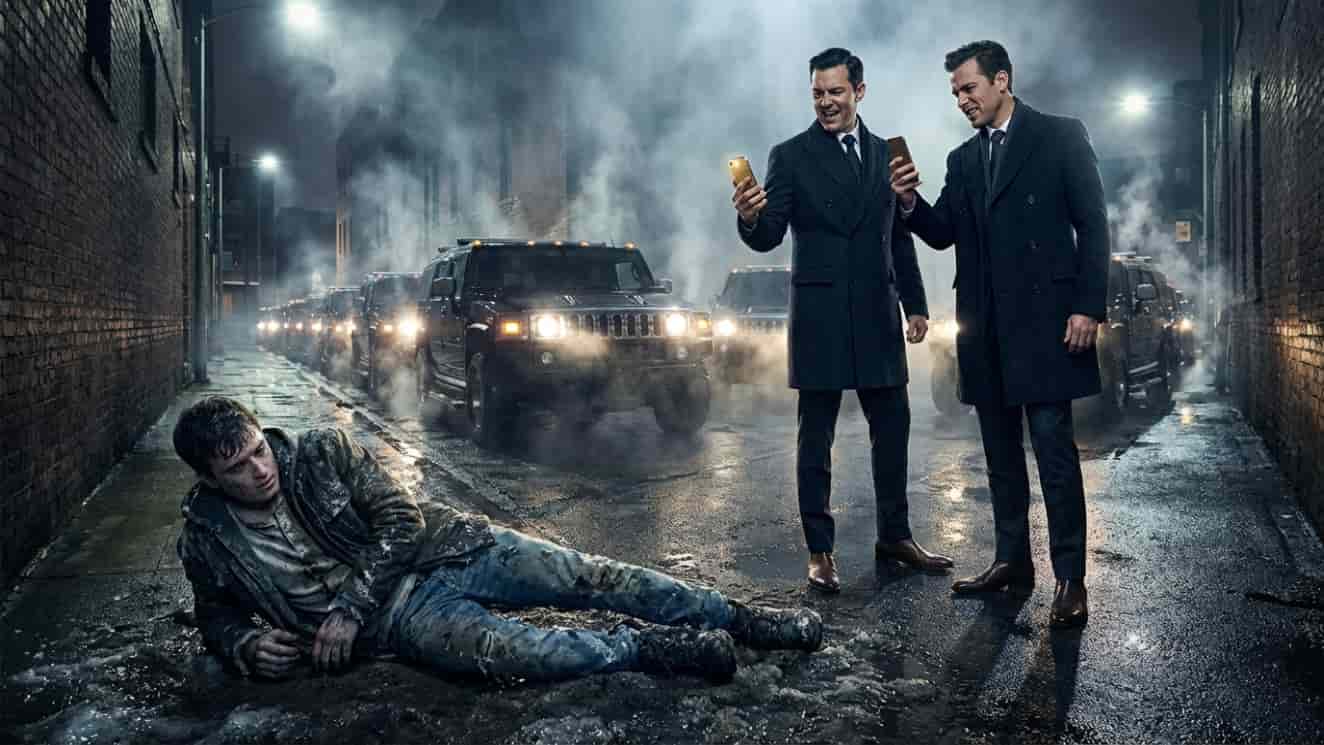
Brad Sterling’s designer boot was still hovering near my chest, the polished leather a cruel contrast to the grey filth of the alleyway.
“Look at you, Caleb,” Brad sneered, his voice dripping with the kind of Ivy League arrogance that only comes from never having worked a day in your life. “You’re a stain. You’re the dirt we walk on.”
His brother, Chad, stood behind him, recording the whole thing on a gold-plated iPhone. “Post it,” Chad chuckled. “Let the whole town see what happens to the ‘charity case’ when he forgets his place.”
I didn’t say a word. I couldn’t. The wind had been knocked out of me, and the cold was starting to turn my skin blue. I was twenty-two years old, working three jobs to pay for my sister’s chemo, and today, I had lost the only jacket I owned.
“You’re nothing,” Brad spat, leaning down until I could smell the expensive bourbon on his breath. “You’re a nobody born from nobodies, and you’ll die in a hole just like this one.”
He raised his foot again, ready to ground me further into the muck. I closed my eyes, bracing for the impact.
But the blow never came.
Instead, a sound like low thunder began to vibrate through the pavement. It wasn’t thunder. It was the synchronized roar of high-performance engines.
One. Ten. Twenty. Fifty.
Fifty black SUVs, windows tinted like ink, swarmed the mouth of the alley, cutting off the street. The screech of tires was the only thing that silenced the Sterling brothers’ laughter.
Then, the doors opened.
What happened next didn’t just change my life. It ended the world as I knew it.
FULL STORY
Chapter 1: The Weight of the Mud
The rain in Oak Ridge didn’t feel like water; it felt like needles. It was that mid-March slush that turned the world into a monochromatic nightmare of grey slush and brown mud. I was walking home from my double shift at the warehouse, my legs feeling like lead pipes, when I saw the headlights of the Range Rover.
I knew those lights. Everyone in Oak Ridge knew those lights. They belonged to the Sterling brothers, the “princes” of our gated community-adjacent town. Their father owned the bank, the local mall, and half the city council.
“Hey, Trash-man!” Brad’s voice echoed off the damp brick walls of the shortcut alley I usually took.
I didn’t look up. I kept my head down, pulling my thin, thrift-store jacket tighter around my frame. I just wanted to get home. I had a bottle of generic ibuprofen and a heating pad waiting for me, and I needed to check Sarah’s fever.
A sudden, violent shove from behind sent me sprawling. I didn’t even have time to put my hands out. I landed face-first in a deep puddle of freezing mud. The impact knocked the breath out of my lungs, leaving me gasping for air that tasted like wet earth and exhaust fumes.
“I asked you a question, Caleb,” Brad said, his shadow looming over me. He was wearing a camel-hair coat that probably cost more than my annual rent. “Why are you walking in my alley? I thought we told you to stay on the other side of the tracks.”
I pushed myself up, my hands sinking deep into the sludge. My jacket—the only thing keeping me from pneumonia—issued a sickening rip as it caught on a piece of jagged rebar near the dumpster.
“I’m just going home, Brad,” I croaked.
“Home?” Chad, the younger and meaner of the two, stepped forward. He kicked a spray of muddy water onto my face. “You mean that shack by the refinery? The one that smells like failure? You aren’t going anywhere until you apologize for breathing our air.”
They laughed. It was a bright, hollow sound that made my blood boil, but I buried the rage. I had been burying it for years. I was a “nobody.” My father had vanished when I was ten, leaving behind nothing but a mountain of debt and a mother who worked herself into an early grave. All I had was Sarah, and Sarah needed me alive and employed.
“I’m sorry,” I whispered, the words tasting like ash.
“Not good enough,” Brad said, his face twisting into something ugly. He grabbed the collar of my torn jacket and hauled me up halfway, only to shove me back down with even more force. “You’re nothing, Caleb. Do you understand that? You’re a footnote. A glitch in the system. You could disappear tomorrow and the only thing people would notice is that the trash smells slightly better.”
Chad held up his phone, the lens reflecting my humiliation. “Say it for the camera. Say ‘I am a piece of trash.'”
I looked at them, and for a second, the fear vanished. It was replaced by a cold, numbing clarity. I looked at their perfect teeth, their expensive haircuts, and their complete lack of empathy.
“No,” I said.
The laughter stopped. Brad’s eyes narrowed. “What did you say?”
“I said no.”
Brad stepped forward, his heavy boot raised to crush my hand into the pavement. “I’m going to make sure you never work in this town again. I’m going to make sure your little sister gets kicked out of that clinic. I’m going to—”
He stopped.
The ground began to shake.
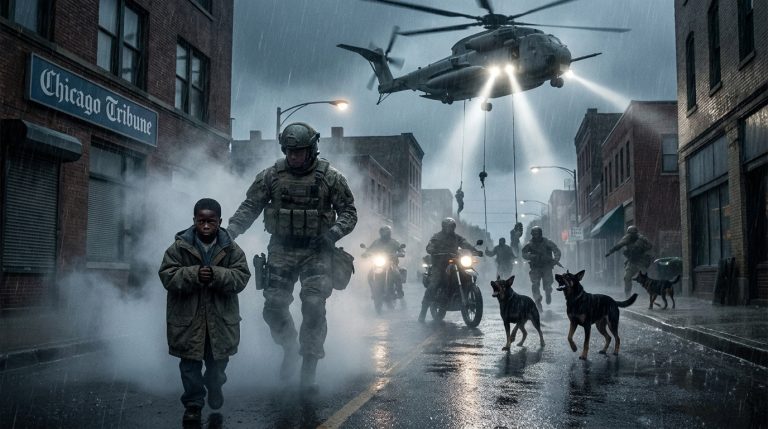
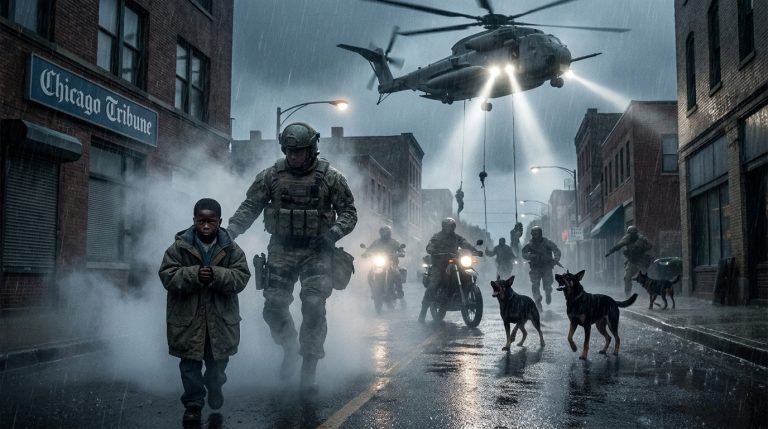
At first, I thought it was an earthquake. Then I saw the lights. Not two, not four, but a literal wall of LED white light flooding the alleyway. The roar of fifty V8 engines acting in unison was a physical force, a vibration that rattled the teeth in my head.
One by one, the massive black SUVs—vehicles that looked like they belonged to a presidential motorcade—slid into position. They blocked the street. They blocked the sidewalk. They surrounded the Sterling brothers’ Range Rover like sharks circling a rowboat.
The silence that followed the engines cutting out was more terrifying than the noise.
Brad and Chad froze. They looked around, their bravado evaporating like mist. “What is this? Is this the cops?” Brad asked, his voice shaking.
The doors of the SUVs opened with a synchronized click.
A sea of black fabric and white shirts spilled out. Men—hundreds of them, then more from the SUVs further down the block—stepped into the rain. They didn’t look like soldiers; they looked like executives. Sharp suits, earpieces, faces carved from stone.
They didn’t look at Brad. They didn’t look at Chad.
A thousand men formed two perfect lines, creating a corridor from the lead vehicle directly to the puddle where I sat.
A man stepped out of the lead SUV. He was older, with a silver mane of hair and a suit that made Brad’s look like a rag. He walked with a mahogany cane, the tip clicking against the asphalt with the precision of a metronome.
He stopped three feet from me.
“Arthur?” I whispered, my voice cracking. The name came from a memory so old I thought I had dreamed it. A man in a dark study. A man who had handed me a peppermint when I was five years old while my father signed papers.
The silver-haired man looked down at me. His eyes softened for a fraction of a second before hardening into diamonds as he looked at the Sterling brothers.
“Young Master Caleb,” Arthur said, his voice carrying like a bell through the rain.
Then, he did something that caused Brad Sterling to actually stumble backward and fall into the trash.
Arthur Vane, the man who managed the world’s largest private equity firm, bowed. Deeply.
And like a wave crashing against the shore, the thousand men behind him followed suit. A thousand heads bowed. A thousand voices spoke in a low, terrifying unison that shook the very walls of the alley.
“Welcome back, Sir.”
Brad’s shivering wasn’t from the cold anymore. It was the sound of a man watching his entire world catch fire. And me? I was still in the mud, but for the first time in twelve years, I wasn’t the one who was afraid.
Chapter 2: The Ghost of Ashford House
The silence that followed that collective greeting was heavy, pressing against my eardrums like deep-sea water. I sat there, my torn jacket soaked through, my hands trembling as I stared up at Arthur Vane.
“Young Master,” Arthur said, extending a hand clad in a leather glove that probably cost more than my apartment’s yearly heating bill. “It has been far too long. We have searched every corner of the hemisphere for you.”
I looked at his hand, then at the thousand men still bowed in the rain. Behind them, Brad Sterling was hyperventilating. He had crawled backward until his back hit a dumpster, his $2,000 coat now smeared with the same grime he’d forced me into. Chad was white as a sheet, the gold iPhone he’d been using to film my humiliation lying forgotten in the dirt.
“Search?” I managed to say, my throat feeling like it was full of glass. “I’ve been right here, Arthur. In the mud. Just like my father left me.”
Arthur’s expression didn’t change, but his eyes flickered with a brief, sharp pain. “Your father did many things, Caleb. Some were cowardly. Some were… strategic. But he is gone now. The Regency has spent the last three years settling the estate. As of midnight last night, the Ashford Trust has been fully restored. And you are the sole beneficiary.”
“The Ashford Trust?” Chad squeaked from the background. “You mean… the Ashfords? Like, the international conglomerate Ashfords?”
Arthur didn’t even turn his head. He didn’t acknowledge Chad’s existence. To Arthur Vane, the Sterling brothers were less than insects; they were atmospheric noise.
“Sir,” Arthur continued, his voice lowering to a confidential tone. “We have a medical team waiting. We have a wardrobe. And most importantly, we have your sister, Sarah, being moved to the Mayo Clinic as we speak via private transport. Her treatment has already been paid for in full.”
The mention of Sarah broke the dam. The anger, the exhaustion, the fear—it all collapsed. I took Arthur’s hand. He pulled me up with surprising strength, steadying me as my legs threatened to give way.
“She’s okay?” I asked, my voice breaking.
“She will be, Sir. She has the best doctors in the world now. You gave her the greatest gift a brother could give—time. Now, we provide the cure.”
I stood there, a mud-covered kid in the middle of a billion-dollar motorcade. I looked at Brad. He was looking up at me, his eyes wide, his mouth hanging open. The power dynamic hadn’t just shifted; it had inverted so fast it had created a vacuum.
“Brad,” I said quietly.
He flinched. “Caleb… hey, man. Look, we were just… we were just joking around. You know how it is. Neighborhood stuff. Right, Chad?”
Chad nodded frantically. “Yeah! Totally. We’re bros, really. We just—”
“You kicked me into the mud,” I said, stepping forward. The thousand men in suits shifted slightly, a subtle movement that suggested they were ready to tear the alley apart if I so much as blinked. “You laughed while you did it. You told me I was a glitch in the system.”
“I didn’t mean it!” Brad cried, his voice hitting a high, pathetic register. “I’ll pay for the jacket! I’ll buy you ten jackets! A hundred!”
I looked at my ripped sleeve. “This was the only thing I had that belonged to my dad. You can’t buy that, Brad.”
Arthur stepped closer, his presence looming like a shadow. “Sir? Would you like us to… handle the Sterling family? Their father’s bank has several outstanding loans with our subsidiaries. I could have their foreclosure notices printed before the sun comes up.”
Brad’s face went from pale to grey. He knew exactly what that meant. In Oak Ridge, the Sterlings were gods. But in the world Arthur Vane lived in, they were just another line on a spreadsheet that could be deleted.
“No,” I said, my voice surprised even me with its coldness. “Not yet. I want them to watch.”
“Watch what, Sir?” Arthur asked.
“I want them to watch me become the person they said I’d never be.” I turned to the car. “Let’s go. I need to see my sister.”
Arthur nodded and opened the door to the lead SUV. The interior was a sanctuary of cream-colored leather, polished wood, and the scent of expensive cigars. As I climbed in, I looked back one last time.
The thousand men were beginning to stand up. They moved with a terrifying, silent efficiency, returning to their vehicles.
“Caleb!” Brad shouted, his voice desperate. “Please! Don’t do this! We can make it right!”
I didn’t answer. Arthur shut the door, sealing out the sound of the rain and the pathetic pleas of a bully who had finally met something he couldn’t buy.
As the SUV pulled away, I caught a glimpse of myself in the tinted window. I was covered in filth, my face was bruised, and I looked like I’d crawled out of a grave.
But as the motorcade roared through the streets of Oak Ridge, lights flashing, the townspeople stopping on the sidewalks to stare in awe, I realized something.
The mud would wash off. But the look on Brad’s face? That was going to stay with me forever.
Chapter 3: The Price of a Soul
The “Ashford Estate” wasn’t just a house; it was a fortress of glass and steel perched on a cliffside three hours north of Oak Ridge. For the first two days, I lived in a daze. I was scrubbed clean by silent attendants, dressed in silks and wools that felt like air against my skin, and fed meals that looked like art.
But every time I closed my eyes, I felt the cold mud of the alleyway.
“You’re brooding, Sir,” Arthur said, stepping into the library. The room was three stories tall, filled with books that smelled of history.
“I’m thinking about the warehouse,” I said, staring out at the ocean. “I’m thinking about how my boss, Mr. Henderson, used to give me an extra five dollars under the table because he knew I wasn’t eating lunch. I’m thinking about Elena, the waitress at the diner who’d ‘accidentally’ bring me a slice of pie she said was a mistake.”
“Loyalty in poverty is the purest form of currency,” Arthur remarked, setting a leather folder on the desk. “Which is why I’ve already taken the liberty of purchasing Mr. Henderson’s warehouse. He is now the CEO of our regional logistics wing. And Miss Elena? She’s been offered a full scholarship to the culinary institute of her choice, with a stipend for her family.”
I looked at him, stunned. “You did that?”
“You are an Ashford, Caleb. We don’t just reward loyalty; we institutionalize it.” Arthur tapped the folder. “However, we also institutionalize… corrections.”
I opened the folder. Inside were photos of the Sterling family. Brad, Chad, and their father, Thomas Sterling. They looked smug in the photos—taken at a country club gala.
“Thomas Sterling has been frantically calling every contact he has,” Arthur explained. “He knows his empire is built on a foundation of sand. We own 60% of his bank’s debt. If we call it in, he loses the house, the cars, the reputation. Everything.”
“Why haven’t you done it yet?” I asked.
“Because,” Arthur said, a predatory glint in his eye, “I thought you might want to be there for the final signature.”
A knock at the door interrupted us. It was a young woman, no older than twenty-five, with sharp features and a no-nonsense bun. This was Maya, my newly appointed chief of security.
“Sir,” she said, nodding to me. “The Sterling brothers are at the gate. They’ve been there for six hours. They brought… a gift.”
I felt a surge of cold fire in my chest. “A gift?”
“Brad Sterling claims he has something that belongs to you,” Maya said.
I looked at Arthur. He simply bowed his head, leaving the decision to me.
“Bring them up,” I said. “But not to the house. Bring them to the stables. I want them to walk the distance.”
Thirty minutes later, I stood in the doorway of the massive limestone stables. I was wearing a charcoal grey suit, my hair styled, my posture straight. Beside me stood Maya and two of her team.
Brad and Chad looked like they had aged ten years. They were drenched in sweat, their expensive shoes ruined by the long gravel driveway. Brad was carrying a small, wooden box as if it were an unexploded bomb.
When they saw me, they stopped. The arrogance was gone. In its place was a primal, shivering terror. They didn’t see Caleb the “trash-man.” They saw the man who held the leash of the monster that was devouring their father’s life.
“Caleb,” Brad gasped, his voice thin. “Thank you. Thank you for seeing us.”
“Master Ashford,” Chad corrected him, his voice trembling.
I didn’t say anything. I just watched them.
Brad stepped forward, tripping over his own feet before regaining his balance. He held out the box. “We… we went back. To the alley. We looked through the… the trash. We found it.”
I opened the box. Inside was a small, tarnished silver locket. It was the only thing my mother had left me, something I’d lost months ago during a shift at the warehouse. I’d thought it was gone forever.
“We also found this,” Chad added, pulling out my old, ripped jacket. It had been cleaned, the tear mended with gold thread—a pathetic, ostentatious attempt at an apology.
I looked at the locket. Then I looked at the jacket.
“You think this fixes it?” I asked quietly.
“No!” Brad cried, dropping to his knees. “No, we know it doesn’t. We were wrong. We were stupid. Please, Caleb. Our dad… he’s losing his mind. He’s going to lose the bank. He told us if we don’t fix this, he’s going to disown us. We’ll have nothing.”
“Nothing,” I repeated. The word felt heavy. “You mean you’ll have to live like I did? You’ll have to choose between a bus pass and a meal? You’ll have to watch someone you love get sicker because you can’t afford the ‘good’ hospital?”
“Please,” Chad sobbed. “We aren’t like you. We can’t survive that.”
I stepped closer to them. Maya moved with me, a silent threat. I looked down at Brad, the boy who had kicked me into the mud.
“You’re right,” I said. “You aren’t like me. You’re weak. You only felt big because you were standing on top of people who couldn’t fight back. Well, now I’m standing on top of you.”
I took the locket and handed the wooden box to Maya.
“Arthur told me I should destroy you,” I said. “He told me it would be ‘efficient.’ But I think there’s something worse than being poor.”
Brad looked up, a glimmer of hope in his tear-streaked eyes. “What?”
“Being a servant,” I said. “I’m buying your father’s bank. I’m keeping him on as a consultant—at a tenth of his current salary. And as for you two? You’re going to work for Mr. Henderson at the warehouse. Minimum wage. No cars. No trust funds. You’ll live in the company housing by the refinery.”
Brad’s face fell. “The refinery? But that place is a dump!”
“It’s home,” I said. “And if I hear one complaint—one single word of disrespect to Mr. Henderson or any of the workers—Arthur calls in the rest of the debt, and your father goes to prison for the ‘irregularities’ we found in his books.”
I turned my back on them.
“Caleb, wait!” Brad screamed.
“It’s Mr. Ashford to you,” I said without looking back. “Clock in starts at 5:00 AM. Don’t be late. I hear the boss is a real stickler for discipline.”
As I walked back toward the house, the sound of their sobbing followed me. It should have felt better. It should have felt like a victory. But as I clutched my mother’s locket in my hand, I realized that revenge was just another kind of mud. It was cold, it was messy, and it stayed with you long after the rain stopped.
Chapter 4: The Shadow of the Father
The transition from a warehouse worker to the head of the Ashford Trust was a baptism by fire. For the next month, I was submerged in a world of high-frequency trading, geopolitical influence, and the sheer, crushing weight of responsibility. Arthur was always there, a silent shadow at my shoulder, guiding my hand.
But there was one thing Arthur wouldn’t talk about: my father.
“He died in a car accident in Zurich,” was all Arthur would say. “The records are sealed for your protection.”
I didn’t buy it. My father didn’t just ‘disappear’ because of debt. He was a man who moved mountains. Why would a man like that let his son rot in a suburban slum for twelve years?
I was sitting in my office—a room that overlooked the private airfield—when Sarah walked in. She looked beautiful. The color had returned to her cheeks, and her hair, which had been thinning from the stress and poor nutrition, was thick and glossy again.
“Caleb,” she said, her voice soft. “You haven’t slept in three days.”
“I have a lot to catch up on, Sarah,” I said, trying to smile.
“You’re obsessed,” she said, sitting across from me. “You’ve turned the Sterlings into your personal project. You’ve bought half of Oak Ridge. You’re trying to rewrite the past with money, but you’re losing yourself in the process.”
“I’m protecting us,” I snapped.
“Are you? Or are you just building a bigger cage?” She looked at the locket on my desk. “I saw Elena yesterday. She’s at the culinary school in Paris now. She sent a letter. She said she’s grateful, but… she said she misses the Caleb who used to share his sandwich with her. She said she doesn’t recognize the man in the news.”
I felt a pang of guilt, sharp and cold. I hadn’t spoken to Elena since the day in the alley. I’d sent her money, a career, a future—but I hadn’t sent her a single word.
“She doesn’t understand,” I whispered.
“Maybe she understands better than you do,” Sarah said. She stood up to leave, but paused at the door. “By the way, Arthur is in the sub-basement. He thinks I don’t know about the ‘Red Room,’ but I saw him going down there with a digital key he didn’t want me to see. If you want the truth about Dad, I’d start there.”
I waited until the house was silent. At 2:00 AM, I made my way to the elevators. My thumbprint cleared the primary levels, but when I reached the bottom floor, the panel turned red.
ACCESS RESTRICTED: REGENCY LEVEL ONLY.
I pulled out the master key Arthur had given me on my first day. I’d never used it for anything other than my bedroom. I pressed it against the sensor.
The doors hissed open.
The sub-basement wasn’t a storage room. It was a command center. Servers hummed in the dark, their blue lights blinking like eyes. In the center of the room was a single, massive screen.
And sitting in front of it was Arthur.
He didn’t turn around. “I wondered how long it would take Sarah to find this. She always was the more observant of the two of you.”
“What is this, Arthur?” I asked, my heart hammering against my ribs.
Arthur turned his chair. He looked tired. Truly tired. “This is the Ashford surveillance network. We don’t just manage money, Caleb. We manage information. We have eyes in every major city, every government office, every… alleyway.”
He hit a key. The screen flickered to life.
It was a video. Black and white, grainy. The timestamp said: Twelve Years Ago.
I saw my father. He was standing in a rain-slicked street, talking to a man whose face was obscured by an umbrella.
“I can’t do it anymore,” my father’s voice rang out, clear and desperate. “The Trust is becoming a weapon. I want my son to grow up with a soul, not a ledger.”
The man with the umbrella spoke, his voice distorted. “The Trust is the world’s stability, Julian. If you walk away, we will have to ensure the boy is… properly prepared. He needs to know what it means to be at the bottom. He needs to know the hunger. Otherwise, he will be a weak king.”
My father lunged at the man, but he was caught by two guards.
“If you kill me,” my father screamed, “Arthur will protect him!”
The man with the umbrella stepped into the light.
It was Thomas Sterling.
Not the broken man I had seen in the stables. This was a younger, sharper Thomas Sterling. A man who was clearly taking orders from someone even higher up.
“Arthur will do exactly what we tell him to do,” Thomas said. “He knows the rules.”
The screen went black.
I looked at Arthur. My vision was blurring with rage. “You knew. You knew Thomas Sterling helped kill my father. You knew he was the one who kept us in that slum. And you let me rot there for twelve years?”
Arthur stood up, his cane clicking on the floor. “I didn’t just let you rot, Caleb. I protected you. Thomas wanted you dead. He wanted the Ashford line extinguished so he could seize the assets. I struck a bargain with the Regency. I told them that if they let you live in the shadows, I would personally oversee your ‘education’ through the Sterlings. I knew Brad would be a monster. I knew he would push you to the breaking point.”
“You used me,” I whispered. “You used my life as a training simulation.”
“And look at the result,” Arthur said, his voice cold and devoid of apology. “You are hard. You are calculated. You have successfully neutralized the Sterling threat without firing a single shot. You are exactly what the Ashford Trust needs to survive the coming century.”
“I was a kid, Arthur! My mother died because we couldn’t afford the medicine!”
“A necessary sacrifice,” Arthur said.
I didn’t think. I swung. My fist connected with Arthur’s jaw, sending the older man sprawling against the servers. He didn’t fight back. He just wiped a smear of blood from his lip and looked at me with something that looked suspiciously like pride.
“Good,” he whispered. “The king has teeth.”
I backed away, the walls of the high-tech bunker closing in on me. I realized then that the alleyway had never ended. The SUVs, the suits, the bowing—it was all just a different kind of mud.
“Get out,” I said, my voice shaking.
“Sir?”
“Get out of my house, Arthur. You’re fired. The Regency is dissolved. I’m taking the Trust, and I’m tearing it down piece by piece.”
Arthur stood up slowly, leaning on his cane. “You can try, Caleb. But you’ll find that the mud doesn’t just wash off. It’s part of you now.”
He walked toward the elevator, pausing at the doors. “Oh, and Caleb? Check the Sterling warehouse. Brad and Chad just received a shipment they weren’t expecting. I thought you’d want to be the one to call the police.”
The doors closed, leaving me alone in the blue light of a billion-dollar lie.
Chapter 5: The Reckoning
The warehouse smelled of wet concrete and old grease—the familiar scent of my old life. But as I pulled up in a non-descript black sedan, I felt like a stranger.
I stayed in the shadows, watching.
Through the cracked window of the foreman’s office, I saw them. Brad and Chad Sterling. They looked pathetic. They were wearing orange high-visibility vests over grimy t-shirts. Their hands, once manicured, were covered in blisters and dirt.
They were arguing over a crate that had “Medical Supplies” stamped on the side.
“Just open it!” Chad hissed. “If there’s something valuable inside, we can sell it. We can get out of here. We can go to Mexico.”
“Shut up, Chad!” Brad snapped. “Caleb has eyes everywhere. If he finds out we’re stealing—”
“He already took everything!” Chad yelled, his voice echoing in the empty warehouse. “He’s a monster, Brad! He’s worse than we ever were!”
Brad hesitated, then grabbed a crowbar. He pried the lid off the crate.
His face went white.
Inside weren’t medical supplies. Inside were kilos of white powder, neatly wrapped in plastic.
“What the hell is this?” Brad whispered.
“It’s a set-up,” I said, stepping out of the shadows.
The brothers jumped, nearly knocking over the crate. When they saw me, they didn’t beg. They just looked tired.
“Caleb,” Brad breathed. “We didn’t do this. We swear. This crate just showed up on the morning manifest.”
“I know,” I said, walking over to the crate. I looked at the powder. It was high-grade. Enough to put someone away for several lifetimes. “Arthur sent it. He wanted me to call the police. He wanted me to finish you.”
Brad looked at the crowbar in his hand, then at me. For a second, I saw a flash of the old Brad—the one who would have used that bar to crack my skull. But the light died out as quickly as it appeared. He dropped the tool.
“Then do it,” Brad said, his voice flat. “Call them. We’re done anyway. Our dad… he had a stroke this morning. The doctors say he’ll never speak again. The bank is gone. We’re working for the guy we used to kick. Just… just end it.”
I looked at them. I saw the fear, the pain, and the absolute exhaustion. I saw myself.
I realized then that Arthur was right. He had turned me into a version of himself. He wanted me to be the cold, calculating king who eliminated his enemies with a phone call. He wanted me to enjoy the “shivering terror” of those beneath me.
But if I called the police, I wasn’t winning. I was just proving him right.
I pulled out my phone.
“Caleb, please—” Chad started to sob.
I ignored him and dialed a number. “Maya? I need a clean-up crew at the North Warehouse. I need a disposal team and a complete scrub of the security footage for the last six hours. And Maya? Find Arthur Vane. I don’t care where he’s hiding. Bring him to me.”
I hung up and looked at the Sterling brothers.
“Get out,” I said.
They blinked, confused. “What?”
“The SUV outside has two passports and fifty thousand dollars in the glove box. It’s enough to get to South America and start a life where nobody knows your name. If you’re ever seen in this country again, I’ll let the law take its course. But today? Today I’m tired of the mud.”
Brad stared at me, a single tear carving a path through the dirt on his cheek. “Why? After everything we did to you?”
“Because,” I said, turning toward the exit. “My father wanted me to have a soul. And I’d like to keep at least a piece of it.”
I walked out into the night air. The rain had started again, but it didn’t feel like needles anymore. It just felt like water.
As I drove away, I saw the headlights of the SUV pull out of the warehouse lot, heading toward the border. I didn’t feel the rush of power I expected. I just felt a profound, echoing silence.
The reckoning wasn’t about the Sterlings. It was about me. It was about deciding which ghost I was going to follow: the father who wanted to save me, or the “Regency” that wanted to own me.
I picked up the locket from the center console. I opened it. Inside was a tiny, faded picture of my mother and father. They were smiling, oblivious to the storm that was coming for them.
“I’m coming home, Sarah,” I whispered into the dark. “For real this time.”
Chapter 6: The King of No Man’s Land
Six months later.
The Ashford Trust still existed, but it was unrecognizable. I had liquidated the surveillance wings, donated the “shadow” assets to global healthcare initiatives, and turned the Ashford Estate into a recovery center for families who had been displaced by the very corporate greed my family had perfected.
I was sitting in a small, quiet café in the heart of Oak Ridge. It wasn’t a billionaire’s club. It was Elena’s place.
She had come back from Paris, not as a student, but as an owner. The “Ashford Scholarship” had been enough to get her started, but she’d refused any more help. She wanted to build something of her own.
“You look different,” Elena said, setting a cup of coffee in front of me. She didn’t bow. She didn’t call me “Sir.” She just looked at me with those same kind eyes that had seen me through my darkest days.
“I feel different,” I admitted. “I think the mud finally washed off.”
“It leaves a tan,” she joked, sitting across from me. “I heard you sold the black SUVs.”
“All fifty of them,” I said. “I kept one for Sarah’s school runs. The rest were auctioned off. The proceeds went to the refinery housing project. We’re tearing down the shacks and building real homes.”
She reached across the table and squeezed my hand. Her skin was warm, a stark contrast to the cold, gloved hands of the world I’d just left. “You did good, Caleb. Your dad would be proud.”
“I hope so,” I said.
My phone buzzed. It was a message from Maya.
Arthur Vane spotted in Singapore. He’s retired. He sent a message: ‘The mud is the foundation of the world. Build wisely.’
I deleted the message. Arthur was a relic of a world I no longer inhabited.
As I walked out of the café, the sun was setting over Oak Ridge. The town looked different now. The divide between the “haves” and the “have-nots” was still there, but the bridge was being built, brick by brick.
I stopped by the alleyway. The one where it had all started.
It was clean now. The dumpsters were gone, replaced by a small mural painted by the local kids. In the center of the mural was a figure standing in the rain, holding an umbrella over someone else.
I realized then that the bullies hadn’t just given me an inheritance. They had given me a perspective that no amount of money could buy. I knew what it felt like to be nothing, which meant I finally knew what it meant to be everything.
I took a deep breath of the evening air. My phone rang.
“Hey, Sarah. Yeah, I’m on my way. I’ve got the pizza. Yes, with the extra cheese.”
I hopped into my modest sedan—not an SUV, not a tank, just a car.
As I drove toward the refinery district to meet my sister for dinner, I looked in the rearview mirror. I didn’t see a “Master Ashford.” I didn’t see a victim.
I saw a man who had been shoved into the dirt and found a kingdom waiting in the soil.
The world would always have its bullies, and it would always have its mud. But as long as there were people willing to stand up and pull each other out of the muck, the SUVs would never have the final word.
Power isn’t about how many people bow to you; it’s about how many people you refuse to let fall.