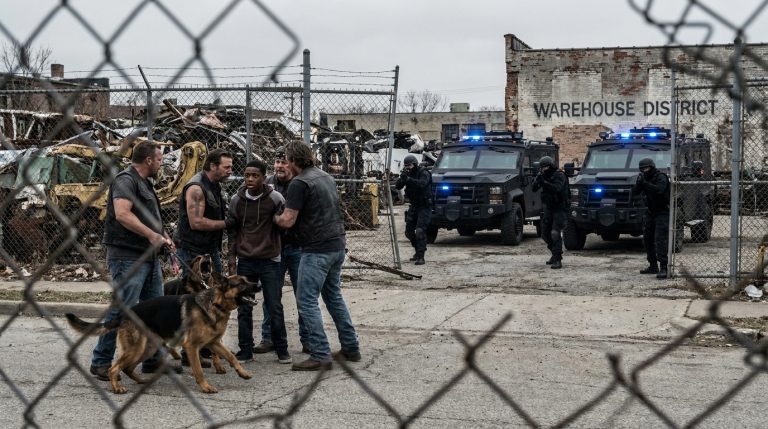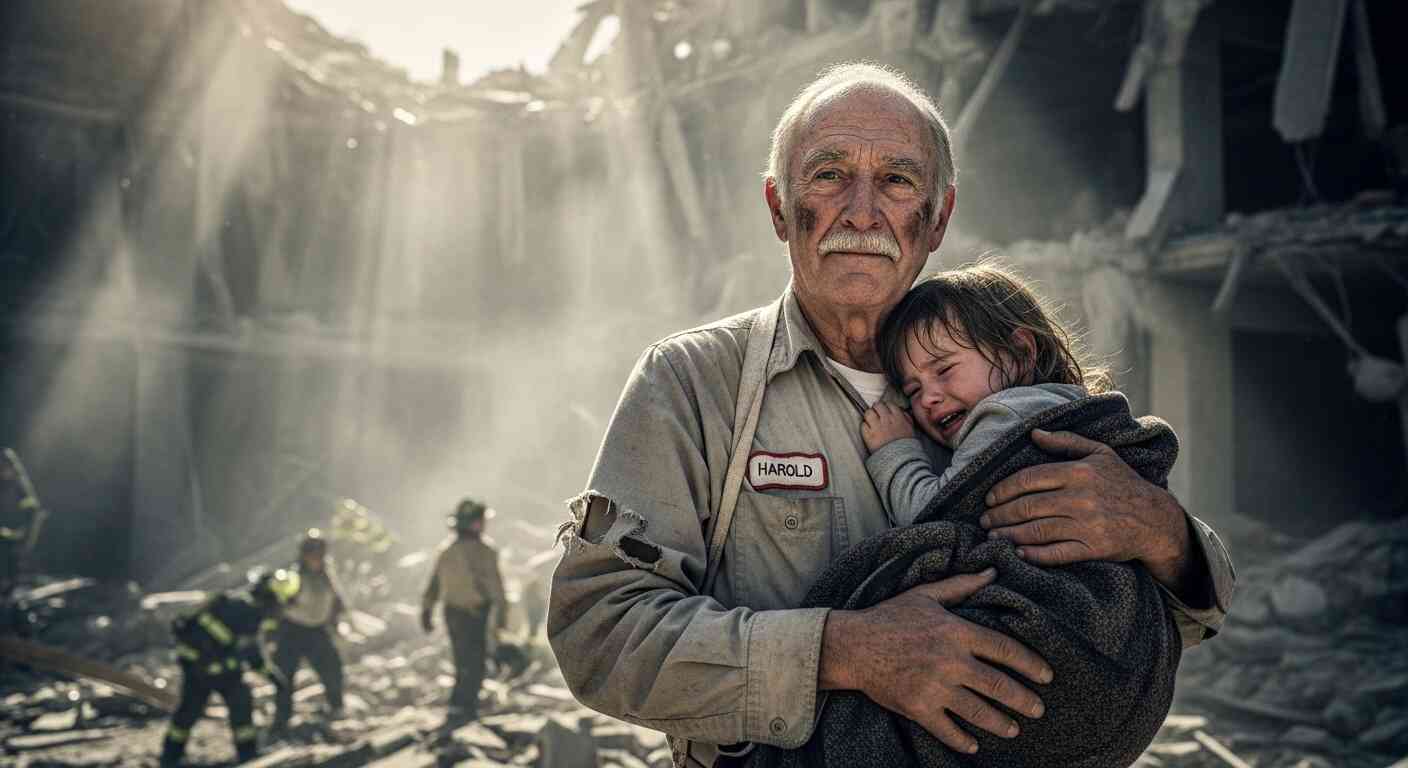
Three rich bullies thought they could break an old man’s dignity. They thought their parents’ money made them untouchable.
They didn’t know the new substitute teacher was the little girl this janitor pulled out of a roaring inferno twenty years ago.
I watched from the doorway of the faculty lounge, my heart shattering into a million jagged pieces.
Old Artie was on his knees. His knuckles were raw, and his breath was coming in ragged hitches.
Julian Thorne, the “golden boy” of Oakwood High, stood over him with a smirk that felt like a physical blow to my chest.
“I said clean it, Artie. Use your hands if the mop isn’t working. My shoes are worth more than your life, don’t get them wet.”
The other students were filming. They were laughing.
They saw a “nobody” in gray coveralls.
I saw the man who ran into a collapsing apartment complex when everyone else was running out.
I saw the man who lost his own wife and daughter in that same fire because he stopped to pull me from the wreckage first.
They didn’t know I still had the scars on my back. And they didn’t know I was about to burn their perfect little world down.
FULL STORY
Chapter 1: The Ghost in the Hallway
The air in Oakwood High smelled of expensive floor wax and privilege. It was the kind of school where the parking lot looked like a luxury car dealership and the students carried backpacks that cost more than my first car. Stepping through those glass doors as the new substitute English teacher felt like walking into a lion’s den, but I wasn’t the one who should have been afraid.
I adjusted the collar of my blazer, making sure it sat high enough to cover the faint, jagged line of scar tissue that climbed up the base of my neck. It was a permanent map of a night I tried to forget, and a man I had spent twenty years trying to find.
“Ms. Vance?” A voice snapped me out of my thoughts.
It was Principal Sterling. He was a man who looked like he’d been pressed in a book—flat, stiff, and utterly colorless. He shook my hand with a grip that lacked any real warmth.
“Welcome to Oakwood. We pride ourselves on excellence here. The students can be… spirited, but they are the future leaders of this country. Treat them with the respect their status deserves, and you’ll do just fine.”
I nodded, swallowing the bitter taste in my mouth. “Status” wasn’t a word I usually associated with teenagers, but at Oakwood, it was the only currency that mattered.
I was heading toward Room 302 when I heard the commotion. It started as a low chant, punctuated by the sharp, rhythmic clapping of hands. It was coming from the junior hallway, right outside the cafeteria.
I rounded the corner and stopped dead.
A circle of students had formed. In the center was an old man. He was wearing the signature charcoal-gray coveralls of the maintenance staff. His back was hunched, his hair a thin halo of white, and his hands—large, calloused, and trembling—were gripped tightly around the handle of a mop.
Opposite him stood Julian Thorne. Even if I hadn’t seen his picture on the “Wall of Benefactors” next to his billionaire father, I would have known who he was. He had that look of unearned confidence, the kind that only comes from never being told “no.”
Julian had just kicked over a bucket of gray, soapy water. It was spreading across the floor, soaking into the old man’s work boots.
“You’re getting slow, Artie,” Julian said, his voice dripping with a casual, terrifying cruelty. “My dad pays a lot of taxes to keep this place clean. You’re making us look like a public school.”
The crowd erupted in “Oohs” and snickering.
The old man—Artie—didn’t look up. He just stared at the puddle. “I’m sorry, Mr. Thorne. I’ll get the wet-vac. It’ll just take a moment.”
“No,” Julian said, stepping forward. He placed a hand on Artie’s chest and gave a sharp, mocking shove. The old man stumbled back, his heels catching on the bucket. He went down hard. “The wet-vac is too loud. It’s distracting me from my conversation. Clean it up now. Use your hands. Scrub it until I can see my reflection in the tile.”
“Julian, please,” Artie whispered. His voice was a rasp, a sound I recognized deep in the marrow of my bones. It was a voice that had once whispered, “Don’t cry, little one. I’ve got you. Just breathe the air near the floor.”
My breath hitched. I moved closer, my vision tunneling.
Artie slowly lowered himself to all fours. He took a rag from his belt and began to wipe the dirty water, his fingers scraping against the hard linoleum.
“Faster,” Julian’s friend, a thick-necked boy named Caleb, barked. “And smile for the camera, Artie! This is going on the ‘Gram.”
I felt the heat rising in my chest—the same heat from twenty years ago. Not the heat of the fire, but the heat of the rage that follows a grave injustice. I looked at Artie’s face. He looked broken. Not just tired, but hollowed out.
I remembered the man from the newspaper clippings I’d hidden under my bed for two decades. Arthur Penhaligon. A decorated captain of the FDNY. A man who had lost his wife, Sarah, and his seven-year-old daughter, Lily, because he stayed behind to save a neighbor’s child.
That child was me.
And here he was, twenty years later, being humiliated by a boy who hadn’t worked a day in his life.
I didn’t think. I just moved.
“Is there a problem here?” My voice was cold, vibrating with a frequency that made the students nearest to me flinch.
Julian turned, his smirk only faltering for a fraction of a second when he saw my teacher’s ID badge. “Just helping the staff with their efficiency, Ms… Vance, is it?”
I didn’t look at Julian. I looked down at Artie. Our eyes met for the briefest of moments. His were a faded, watery blue, filled with a deep, crushing exhaustion. He didn’t recognize me. Why would he? I was six years old the last time he saw me, covered in soot and blood.
“Stand up, Arthur,” I said softly.
He blinked, startled by the use of his full name. “I… I have to clean this, ma’am. Principal Sterling doesn’t like a mess.”
“The only mess here is the behavior of these students,” I said, finally turning my gaze to Julian.
Julian laughed, a sharp, ugly sound. “Careful, Ms. Vance. You’re new here. You don’t want to start your first day by offending the people who pay your salary. My father is the head of the school board.”
I stepped into his personal space. I’m not a tall woman, but in that moment, I felt like a giant. “Your father’s bank account doesn’t give you the right to treat a human being like a dog. Pick up that bucket.”
The hallway went silent. You could hear the hum of the vending machines.
Julian’s eyes narrowed. “What did you say?”
“You heard me,” I whispered, my voice lethal. “Pick up the bucket. Apologize to Mr. Penhaligon. Or I will take this video”—I pointed to Caleb’s phone—”and I will make sure it is the first thing the local news plays tonight. I wonder what the ‘Thorne Brand’ thinks about viral videos of their heir bullying senior citizens?”
Julian’s face turned a mottled red. He looked at his friends, then back at me. For a moment, I thought he might actually swing. But the mention of the news—of his father’s reputation—hit home.
“This isn’t over,” Julian hissed. He kicked the empty bucket toward Artie, turned on his heel, and stormed off, his entourage following like a pack of loyal curs.
I waited until they were gone before I knelt down next to Artie.
“Are you okay?” I asked, reaching out to touch his arm.
He flinched away, his eyes darting around as if looking for the next blow. “You shouldn’t have done that, ma’am. They’ll make it hard for you now. They’re powerful families.”
“I don’t care about power, Arthur,” I said, my heart aching. “I care about what’s right.”
He sighed, a long, rattling sound. “Right doesn’t pay the rent, Miss. But thank you.”
He stood up stiffly, his joints popping, and began to gather his things. He still didn’t see me. He saw a teacher. He saw a stranger.
I watched him walk away, his limp more pronounced than before. I touched the scar on my neck, the skin hot under my fingers.
I hadn’t just come to Oakwood for a job. I had come because I’d finally tracked him down after years of dead ends. I wanted to thank him. I wanted to help him.
But as I watched Julian Thorne disappear into the crowd, I realized that just saying “thank you” wasn’t going to be enough. Arthur had saved my life. Now, I was going to save his soul—and I was going to make sure the boys who tried to break him learned exactly what happens when you play with fire.
FULL STORY
Chapter 2: The Smoke of Memory
My first class was a blur of distracted faces and the heavy, lingering tension from the hallway incident. Julian wasn’t in my first period, but his influence was. The students whispered, casting furtive glances at me as I wrote my name on the whiteboard. I could feel the invisible wall they’d built—a barrier of wealth and indifference.
During my lunch break, I didn’t go to the faculty lounge. Instead, I headed down to the basement.
The basement of Oakwood High was a different world. Gone were the skylights and the polished marble. Here, the pipes hissed, and the air was thick with the smell of cleaning chemicals and old boiler heat.
I found Artie in a small, cramped room tucked behind the furnace. It was barely more than a closet, filled with mops, industrial-sized soap containers, and a single, rickety wooden chair.
He was sitting there, eating a sandwich wrapped in wax paper. He looked up, his eyes widening in surprise.
“Ms. Vance? You shouldn’t be down here. It’s not… it’s not for teachers.”
“I think I can manage a few stairs, Arthur,” I said, pulling over a crate to sit on.
He looked uncomfortable. “Principal Sterling saw the hallway. He’s already called me into his office. He said I should have ‘de-escalated’ the situation. That I shouldn’t have provoked the boys.”
“Provoked them?” I felt the anger flare again. “By existing? By doing your job?”
Artie shrugged, a tired, defeated motion. “It’s how it works. I’m seventy-two years old, Miss. I’ve got no pension, no family. This job is all I have. I can’t afford to be a ‘provocation.’”
“You had a family once,” I said, my voice dropping to a whisper.
He froze. The sandwich stayed halfway to his mouth. “How do you know that?”
“I know who you are, Arthur. I know you were the Captain of Engine 24. I know about the fire on 86th Street. Twenty years ago.”
The color drained from his face, leaving him looking like a ghost. He set the sandwich down with trembling hands. “That was a long time ago. A different life. A different man.”
“A man who was a hero,” I countered.
“A hero?” He let out a dry, hacking laugh that turned into a cough. “A hero saves his family, Ms. Vance. A hero doesn’t come home to two empty caskets because he was too busy being a martyr for someone else’s kid.”
The words hit me like a physical punch. I looked at him—really looked at him—and saw the rotting core of his grief. He didn’t just feel old; he felt guilty. He’d spent two decades punishing himself for the choice he’d made that night.
“The girl you saved,” I said, my voice shaking. “She didn’t ask you to choose. She was just a child.”
“It doesn’t matter,” he whispered, staring at a stain on the floor. “The world is a cold place. It takes the good things and leaves the trash. That’s why I’m here, cleaning up after kids who think they’re gods. It’s what I deserve.”
I wanted to tell him then. I wanted to pull back my hair and show him the scar. I wanted to say, “I’m the reason you lost everything, and I’ve spent every day trying to be worth that sacrifice.”
But I couldn’t. Not yet. He wasn’t ready to hear it. He was too deep in the darkness. If I told him now, he might just see me as another reminder of his pain.
“You don’t deserve to be treated like dirt,” I said instead.
“Julian Thorne is his father’s son,” Artie said, his voice regaining some of its flatness. “His father, Richard Thorne… he was the developer of that building on 86th Street. The one that burned.”
My heart stopped. “What?”
Artie nodded slowly. “The investigation said the wiring was faulty. Substandard materials. Richard Thorne was a rising star back then. He had the money to make the investigation go away. He didn’t just build a firetrap; he made sure the man who tried to report it—me—looked like a drunk who’d fallen asleep with a cigarette.”
The room seemed to spin. I remembered the news reports. The “Hero Fireman” who had been dishonorably discharged six months after the fire due to “internal investigations.” I’d always thought it was a tragedy. I never realized it was a hit job.
“He took your family, and then he took your honor,” I whispered.
“And now I clean his son’s school,” Artie said. “It’s a funny world, isn’t it?”
I left the basement with a cold, hard knot in my stomach. The connection wasn’t a coincidence. Richard Thorne had probably placed Artie here, keeping him close, keeping him under his thumb, ensuring the man he’d ruined stayed broken and silent.
I walked back up to the bright, sunny hallways of Oakwood High, but all I could see were the flames.
Julian Thorne was sitting in my next class. He was leaning back in his chair, his feet on the desk, looking at me with a smirk that said he knew exactly what he’d done.
“Welcome back, Ms. Vance,” he drawled as the bell rang. “I hope you had a nice lunch. The basement is a bit damp, isn’t it?”
The other students snickered.
I didn’t say a word. I just walked to my desk, opened my laptop, and began to search for the Thorne Group’s public records.
If Julian wanted to play, we would play. But he was forgetting one thing about fire: it doesn’t care how much money you have. It burns everyone the same.
FULL STORY
Chapter 3: The Breaking Point
The week progressed like a slow-motion car crash. Julian and his friends didn’t stop. In fact, my intervention seemed to have emboldened them. They knew I was just a substitute, a temporary fixture in their world of permanent wealth.
They started leaving “gifts” for Artie.
A bag of trash ripped open in the middle of the hallway.
Graffiti on the bathroom mirrors that read “Artie the Arsonist.”
Once, I found his locker—the small, battered metal box in the basement—drenched in bleach, destroying the few personal photos he kept there.
Every time I tried to report it, Principal Sterling gave me the same weary look. “Ms. Vance, kids will be kids. Julian is under a lot of pressure. His father expects a lot from him. Let’s not escalate things into a legal matter over a few pranks.”
“Pranks? They are destroying a man’s dignity!” I shouted in his office on Wednesday.
“They are donors, Elena,” Sterling said, his voice dropping to a warning low. “And you are a guest. Don’t forget that.”
I walked out, my hands shaking. I felt powerless, just like I had when I was six years old, trapped behind a jammed door while the smoke filled my lungs.
That afternoon, I saw Maya, a quiet girl in the front row of my English class, lingering by the door. She looked terrified, her eyes darting toward the hallway where Julian and Caleb were holding court.
“Maya? Is everything okay?”
She hesitated, then stepped into the room, closing the door behind her. “They’re going to do something tonight,” she whispered. “At the pep rally. They’re talking about a ‘grand finale’ for the janitor.”
“What kind of finale?”
“I don’t know,” she said, her voice trembling. “But Julian… he’s really mad that you stood up to him. He says he’s going to show everyone that ‘the trash belongs in the incinerator.'”
My blood ran cold.
The pep rally was held in the massive, state-of-the-art gymnasium. The entire school was there, a sea of blue and gold. The noise was deafening—cheers, drums, the rhythmic stomping of feet on the bleachers.
I stood by the exit, scanning the floor. I saw Julian. He was at the center of the gym floor, holding a microphone. He was the “Spirit Captain,” a role that gave him the stage.
“Alright, Oakwood!” Julian shouted, his voice amplified by the massive speakers. “We’ve had a great season. But greatness isn’t just about the players. It’s about the people who keep this place running. Let’s bring out our most… dedicated staff member!”
My heart hammered against my ribs.
Caleb and another boy emerged from the locker room, dragging Artie between them. They’d forced him into a ridiculous costume—a giant, moth-eaten mascot head of an old man with a mop. He looked confused and humiliated as they pushed him toward the center of the court.
The students roared with laughter.
“Artie here has been feeling a little sluggish lately,” Julian said, pacing around him like a predator. “So we thought we’d give him a little ‘spark’ to get him moving.”
Julian pulled a small, silver lighter from his pocket. He flicked it open.
The flame was tiny, but in that gym, it looked like a sun.
“They say you like fire, Artie,” Julian mocked, leaning in close. “They say you’re an expert. Let’s see how fast you can run when things get a little warm.”
He moved the lighter toward the hem of the mascot costume. It was made of cheap, highly flammable synthetic fur.
The laughter in the gym faltered. A few people stood up. The silence began to spread like a shadow.
“Julian, stop!” I screamed, but my voice was swallowed by the sudden, sharp whoosh of the flame catching the fabric.
It happened in an instant. A small orange bloom on the bottom of the costume.
Artie froze. He didn’t run. He didn’t scream. He just stared at the flame, his eyes wide and vacant. He was back in 1996. He was back in the hallway of the burning building, hearing the screams of his wife.
He was paralyzed by the very thing that had defined his life.
“It’s just a joke!” Julian yelled, his voice cracking as the flame grew faster than he expected. “Artie, move!”
But Artie didn’t move.
I didn’t think about the crowd. I didn’t think about my job. I grabbed the heavy wool blazer from my shoulders and sprinted across the polished wood.
I tackled Artie, slamming him to the ground. I wrapped the blazer around his legs, smothering the flames with my own body, beating at the sparks with my bare hands.
The smell of singed hair and chemicals filled the air.
“Get back!” I roared at Julian, who was standing there, the lighter still in his hand, looking horrified.
I pulled the heavy mascot head off Artie. He was shaking, his face deathly pale, his breath coming in short, terrifying gasps.
“Arthur, look at me!” I shouted, grabbing his face. “Look at me! You’re okay. I’ve got you.”
His eyes slowly cleared. He looked at me, then down at my hands. They were blistered, the skin red and angry.
“You…” he whispered.
The gym was silent now. The kind of silence that precedes a storm. Principal Sterling was running toward us, his face a mask of panic.
I stood up, pulling Artie with me. I turned to face the bleachers, to face the “future leaders” of the country.
“Is this what you wanted?” I yelled, my voice cracking with raw emotion. “Is this the ‘excellence’ you were taught? You’re laughing at a man who has given more to this world than any of you will ever understand!”
I looked at Julian. He was trying to hide the lighter, but everyone had seen it.
“His name is Arthur Penhaligon,” I said, my voice dropping to a deadly, resonant tone. “He was a Captain in the FDNY. He is a hero. And twenty years ago, he saved my life.”
I reached back and pulled my hair away from my neck, exposing the thick, white scar for everyone to see.
“He chose me over his own family,” I said, tears finally spilling over. “And you… you treated him like trash because you have money and he has a mop.”
I looked at Julian, then at the principal.
“The fire is out,” I said, my voice cold as ice. “But the reckoning? That’s just getting started.”
FULL STORY
Chapter 4: The Truth in the Ashes
The aftermath of the pep rally was chaotic. Artie was taken to the hospital for observation—not for burns, but for the shock that had nearly stopped his heart. Julian Thorne was suspended “pending investigation,” a slap on the wrist that felt like another insult.
I spent the night in the emergency room waiting area, my hands bandaged and throbbing. I didn’t care about the pain. I cared about the folder sitting in my lap.
Earlier that evening, after the gym had cleared, I’d gone to Artie’s locker in the basement. It had been pried open by the school’s security during the “incident report.” Inside, tucked behind a stack of old rags, was a thick, yellowed envelope.
It was addressed to “The Girl in Room 4B.”
Me.
He’d kept it all these years. He didn’t know who I was, but he’d been waiting for me.
I opened it. Inside were blueprints, handwritten notes, and a series of photos from the 1996 fire. There were also copies of internal memos from the Thorne Group, dated weeks before the disaster.
“Cost-cutting measures approved for 86th St. project. Replace Grade-A wiring with Type-C. Adjust fire suppression specs to minimum city requirements. Estimated savings: $4.2 million.”
The signature at the bottom was Richard Thorne.
Artie hadn’t just been a witness; he’d been a whistleblower. He’d found these documents in the rubble of the office on the first floor that night. He’d tried to use them, but Richard Thorne had used his influence to frame Artie before the documents could ever see a courtroom.
Artie hadn’t stayed silent because he was broken. He’d stayed silent because he was protecting me.
There was a final note in the envelope, written in Artie’s shaky hand: “If they find these, they’ll destroy them. If they find the girl, they might hurt her to get to me. Better to be a drunk janitor than a dead hero. Stay safe, little one.”
I let out a sob that tore through my chest. He’d lived in the shadows for twenty years, enduring humiliation and poverty, just to make sure the “loose end”—the child who could prove the building was a death trap—was never targeted by a man as powerful as Richard Thorne.
“Ms. Vance?”
I looked up. It was Maya. She was standing in the hospital corridor, looking small and fragile. She was holding a flash drive.
“I found this,” she said. “Caleb tried to delete it, but I… I have the whole video from the gym. Not just the fire. I have the part where Julian talked about his father. About how his father told him that ‘men like Artie are meant to be used until they’re empty.'”
I took the drive. “Thank you, Maya. This is more important than you know.”
“Are you going to stop them?” she asked.
“No,” I said, standing up, the pain in my hands fueling my resolve. “I’m going to finish what Arthur started.”
The next morning, I didn’t go to school. I went to the Thorne Group headquarters.
It was a glass-and-steel monolith in the heart of the city. I walked past the security, my bandaged hands clenched at my sides. I didn’t have an appointment, but I had something better.
I walked into Richard Thorne’s executive suite. His secretary tried to stop me, but I pushed past her.
Richard Thorne was a man who screamed power. He was silver-haired, tanned, and wore a suit that probably cost more than Artie’s house. He looked up from his mahogany desk, his expression shifting from annoyance to a cold, calculating curiosity.
“You’re the teacher,” he said. “The one who caused the scene yesterday. My son told me about you.”
“Your son is a reflection of you, Richard,” I said, tossing the yellowed envelope onto his desk. “And you are a murderer.”
He didn’t flinch. He opened the envelope, scanned the documents, and then looked at me with a bored smile. “This is ancient history, Ms. Vance. Faulty wiring? A tragic accident. These documents prove nothing. They’re old, unverified, and frankly, quite easily destroyed.”
He picked up a heavy silver lighter—the same model Julian had used—and held it near the corner of the blueprints.
“I expected more from you,” he sighed. “Blackmail is such a… common tactic.”
“I’m not here to blackmail you,” I said, leaning over his desk. “I’m here to tell you that the video of your son trying to light a hero on fire is currently being uploaded to every major news outlet in the country. Along with a detailed history of Arthur Penhaligon. And these documents? They aren’t the only copies.”
Thorne’s smile faltered.
“You think you’re the only one who can play the long game?” I continued. “I’ve spent twenty years living with the ghost of that fire. I’ve studied every law, every building code, every loophole you’ve ever used. I’m not just a teacher, Richard. I’m the girl from Room 4B. And I’m the one who survived.”
He stared at me, the lighter flickering in his hand. For the first time, I saw a flicker of genuine fear in his eyes.
“What do you want?” he hissed.
“I want everything,” I said. “I want a full confession. I want Arthur’s pension restored. I want his record cleared. And I want you to look your son in the eye and tell him that the man he mocked is the only reason he’s not a pauper. Because by the time I’m done with your company, there won’t be enough left to buy a mop.”
FULL STORY
Chapter 5: The Reckoning
The fallout was swifter than I could have imagined. In the age of social media, a video of a billionaire’s son harassing a hero firefighter was the kind of fuel that didn’t need much help to burn.
By that evening, the video was everywhere. #JusticeForArtie was trending worldwide.
The Thorne Group’s stock plummeted. Richard Thorne tried to release a statement, but it was drowned out by the roar of public outrage. Other survivors from the 86th Street fire began to come forward, their voices joining together in a chorus that couldn’t be ignored.
I returned to the school one last time. Principal Sterling met me at the door, his face pale and sweat-beaded.
“Ms. Vance, we need to talk about your… employment status. We can reach a settlement. There’s no need for further—”
“I quit, Sterling,” I said, walking past him. “I wouldn’t want to work for a man who values a donor’s check over a human soul anyway.”
I went to the basement. It was empty. The lights were off.
I sat on the rickety wooden chair in Artie’s “office.” I thought about the girl I had been, and the woman I had become. I thought about the man who had lost everything to give me a chance.
A shadow fell over the doorway.
It was Julian. He looked different. The varsity jacket was gone. He looked small. Defeated. His eyes were red, as if he’d been crying.
“My dad is going to jail,” he said, his voice a flat, hollow whisper.
“He belongs there,” I said.
Julian leaned against the doorframe. “I didn’t know. I thought… he told me Artie was a loser. He told me that people like him were just background noise. That we were the ones who mattered.”
“Everyone matters, Julian. That’s the lesson you missed.”
“I’m sorry,” he whispered.
“Don’t tell me,” I said. “Tell him.”
I stood up and walked out, leaving Julian in the dark.
I drove to the hospital. Artie was sitting up in bed, looking at the television. The news was showing a photo of him from twenty years ago—strong, handsome, standing in front of his fire truck.
He looked at me as I entered the room. The confusion was gone. He looked at my hands, still bandaged, and then at my face.
“The girl in Room 4B,” he said softly.
“Her name is Elena,” I said, sitting on the edge of the bed.
He reached out a trembling hand and touched the scar on my neck. A single tear rolled down his cheek. “You grew up. You grew up so well.”
“I had a good start,” I said, taking his hand. “A hero gave me a second chance.”
“I’m so sorry about your family, Arthur,” I whispered. “I’ve felt the weight of them every day.”
“Don’t,” he said, his voice surprisingly firm. “Sarah and Lily… they would have wanted this. They would have wanted me to save you. They loved life, Elena. And seeing you now… it makes it feel like they didn’t die for nothing. It makes the sacrifice mean something.”
We sat there for a long time, the quiet hum of the hospital around us. For the first time in twenty years, the air didn’t smell like smoke. It smelled like fresh rain. It smelled like a beginning.
FULL STORY
Chapter 6: A Life Worth Living
Six months later.
The Thorne Group was no more. Richard Thorne had been sentenced to fifteen years for corporate manslaughter and obstruction of justice. Julian had disappeared from the public eye, reportedly working at a construction site in another state, finally learning the value of a day’s labor.
Oakwood High had a new wing—The Penhaligon Center for Civil Service.
But Arthur wasn’t there for the ribbon-cutting.
He was in a small, sunlit house on the coast, a house paid for by the restitution he’d finally received. There was a garden in the back, and a porch that looked out over the ocean.
I visited him every weekend.
I had a new job now, teaching at a public school in the city. It was loud, chaotic, and underfunded, and I loved every second of it.
I pulled into Artie’s driveway, the sound of the waves providing a peaceful soundtrack to the afternoon. He was sitting on the porch, a book in his lap. He looked younger. The gray in his hair seemed brighter, and the lines on his face were no longer etched with pain, but with the quiet dignity of a man who had reclaimed his name.
“Elena,” he smiled, standing up to greet me. He didn’t limp as much anymore.
“Hey, Artie. How are the tomatoes?”
“Coming along,” he said, hugging me. “Though I think the squirrels are plotting a heist.”
We sat together on the porch, watching the sun begin its slow descent toward the horizon.
“I got a letter today,” Artie said, reaching into his pocket. “From the Department. They’re restoring my rank. Posthumously for the retirement, but… they’re holding a ceremony next month. They want me to wear the uniform.”
I felt a lump in my throat. “Are you going to do it?”
He looked out at the water. “I think so. For Sarah and Lily. So they can see their father for who he really was.”
He looked at me, his eyes clear and bright. “And for you. So you can see that the fire didn’t win.”
I leaned my head on his shoulder. We were both survivors. We were both scarred. But we were both whole.
The world is a place where bullies might win the first round, and where money can buy a lot of silence. But it’s also a place where a six-year-old girl can grow up to be a shield, and where a broken old man can find his way back to the light.
As the sun dipped below the waves, painting the sky in shades of orange and violet, I realized that the greatest lesson I ever taught wasn’t in a classroom. It was in a hallway, over a puddle of dirty water.
It’s a lesson about the weight of a life, and the power of a promise kept.
“I love you, Artie,” I whispered.
He squeezed my hand, his grip strong and sure. “I know, little one. I know.”
The embers of the past had finally gone cold, leaving behind something much stronger than what the flames had taken: a bond forged in fire, and a love that was finally, beautifully, free.
True wealth isn’t found in a bank account, but in the courage to stand up for those who once stood up for you.