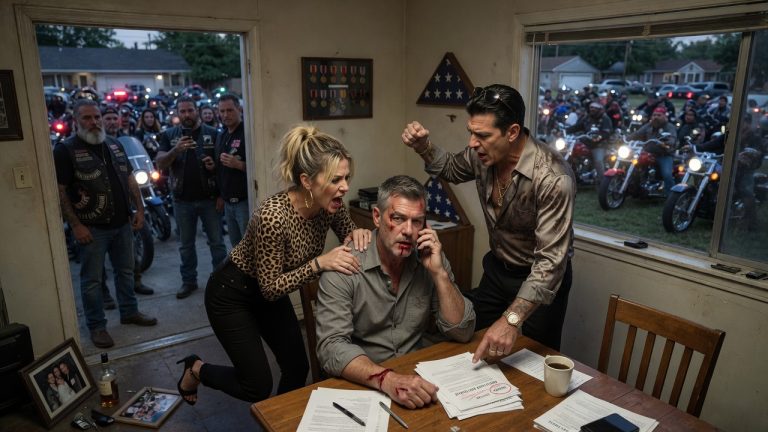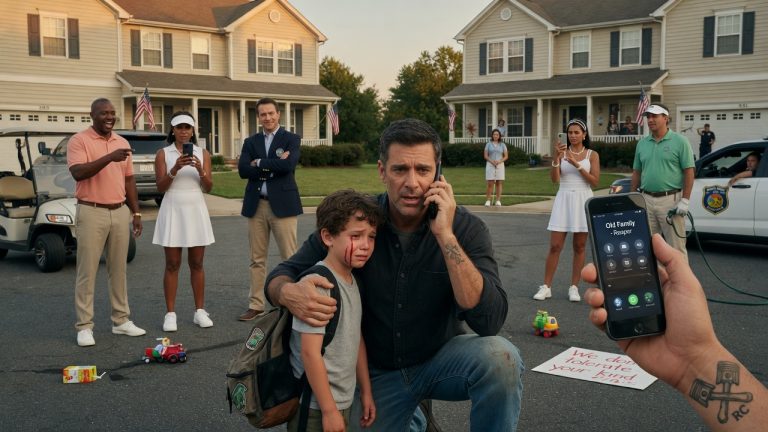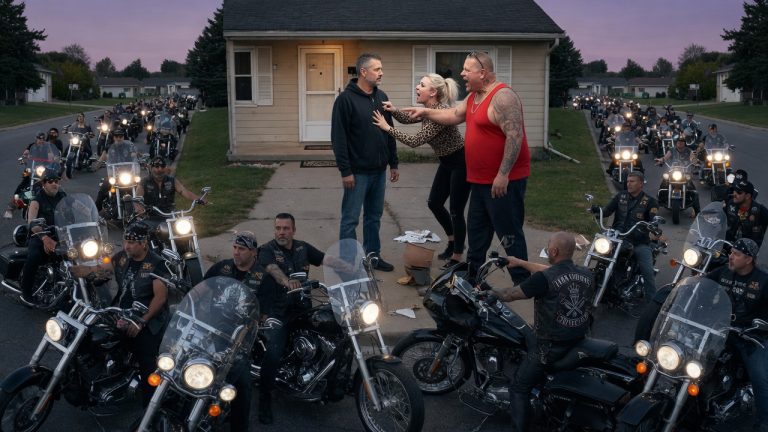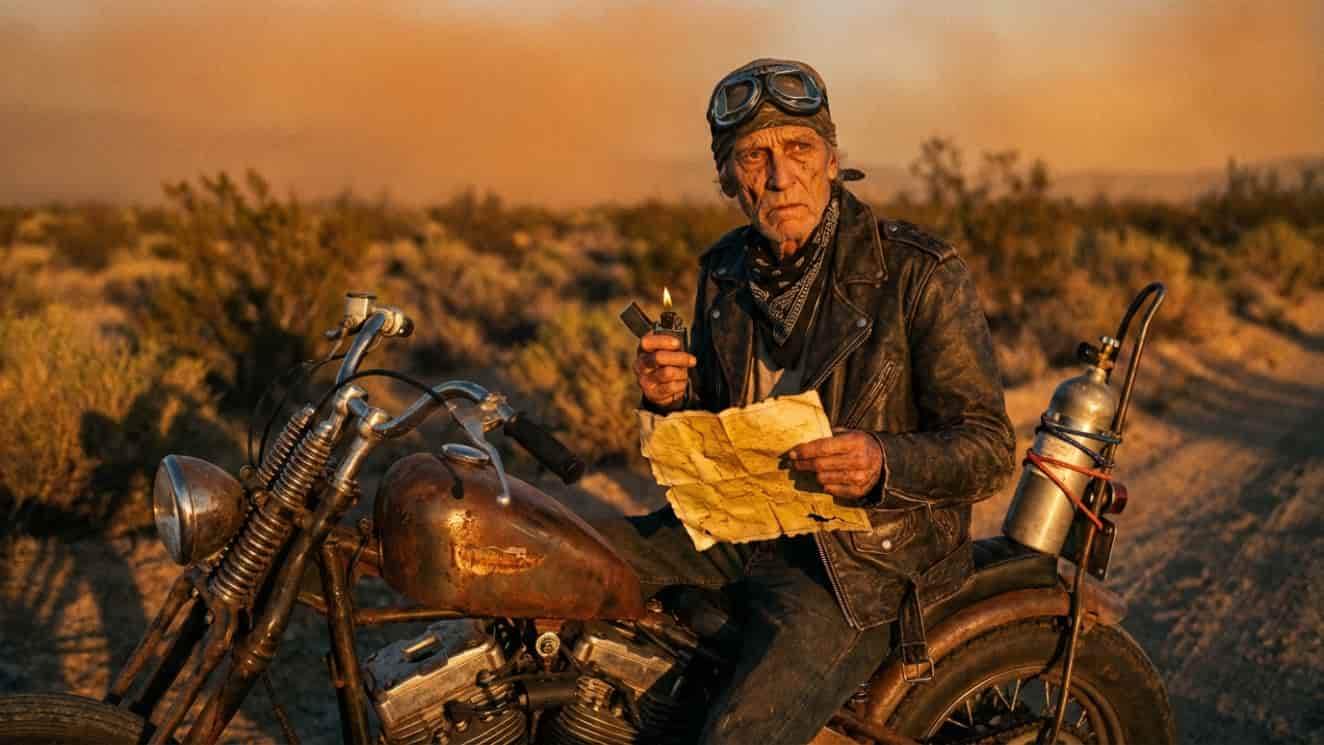
Dutch spent forty years running from the law, but he couldn’t outrun the rattle in his chest. At seventy, with a terminal diagnosis and an oxygen tank strapped to his bike, he’s the only man left alive who knows where the “500” buried the take from the 1974 interstate heist.
His old brothers are dying in poverty. The new generation of the club is breathing down his neck with a serrated edge. And the young nurse checking his vitals every morning? She looks exactly like the man Dutch killed to keep the secret forty years ago.
Now, Dutch has to make one final choice: give the club the money and spark a war, or burn the map and die a traitor to the only family he has left.
FULL STORY
Chapter 1
The oxygen concentrator hummed on the floor of the garage, a steady, mechanical wheeze that competed with the rhythmic tink-tink-tink of a cooling engine. Dutch sat on a milk crate, his grease-stained hands trembling as he tried to adjust the plastic tubing around his ears. He hated the smell of it—the sterile, processed scent of medical-grade air. It didn’t belong here. This place should smell like 90-octane, burnt oil, and the desert dust that blew in through the gaps in the corrugated tin walls.
He looked at the 1976 Shovelhead sitting on the lift. It was stripped down, its chrome dulled by a layer of fine Arizona grit. It was the only thing he had left that wasn’t a medical bill or a regret.
“You’re supposed to be resting, Dutch.”
He didn’t turn around. He knew the voice. Sarah, the hospice nurse the county sent out three times a week. She was thirty-something, wore sensible scrubs, and had a way of looking at him that felt like she was reading a map he’d spent decades trying to fold up and hide.
“Resting is for people who aren’t finished yet,” Dutch said, his voice a gravelly rasp. He reached for a pack of Camels on the workbench before remembering his lungs were mostly scar tissue and tumors. He pulled his hand back, settling for a rusted wrench instead.
Sarah stepped into the light of the garage. She didn’t look like a nurse today. She looked like a ghost. There was something in the set of her jaw, the slight squint of her eyes against the glare of the setting sun, that made Dutch’s stomach do a slow, sick roll. It was a look he’d seen in a rearview mirror in 1974, just before the world went to hell.
“The doctor said the morphine should be helping with the agitation,” she said, stepping closer. She didn’t touch him. She knew better. Dutch didn’t like being handled.
“I ain’t agitated. I’m busy.”
“Busy doing what? You haven’t turned a bolt on that bike in a month.” She gestured to the Shovelhead. “You’re just sitting here, staring at the floor. What are you looking for, Dutch? You looking for a way out?”
Dutch finally looked at her. He felt the weight of the pocket watch in his heavy canvas vest. It was a dull pressure against his ribs, a secret that had stayed quiet for nearly half a century. “I’m looking at the property taxes I can’t pay. I’m looking at a club that wants me to sell ’em a fairy tale so they can buy another round of meth and chrome.”
The sound of heavy tires on gravel cut through the hum of the oxygen machine. Two bikes, maybe three. Big twins. He knew the cadence. It wasn’t the steady, soulful lope of the old Panheads. These were newer, louder, more aggressive. The “New Guard” of the 500.
A blacked-out Street Glide swung into the driveway, followed by two others. The riders didn’t pull all the way in; they hovered at the edge of the garage, the sunlight glinting off their high-gloss helmets. The man in the lead was Mace. He was forty, wore a vest that looked too clean, and had a tattoo of a coiled viper on his throat.
“Afternoon, Dutch,” Mace shouted over the idle of his engine. He didn’t kill the power. It was a power move—staying on the bike, ready to move, making Dutch wait for the silence.
Dutch didn’t move from his milk crate. “Driveway’s private, Mace. Club business happens at the hall.”
“Club’s moving, Dutch. You know that. Landlord sold the lot out from under us. We need a win. We need that rainy day fund the old-timers used to talk about.” Mace leaned forward, his eyes shielded by dark lenses. “The legends say you were the one who drove the van. The legends say you’re the only one who didn’t spend his cut.”
“Legends are for kids and liars,” Dutch said. He felt Sarah’s gaze on the side of his face. She was too still. A normal nurse would be nervous, maybe even scared. She just watched, her arms crossed over her chest.
“We ain’t asking for a handout,” Mace said, finally clicking the kill switch. The silence that followed was heavy, filled only with the click of hot metal. “We’re asking for the coordinates. The brothers are hurting. Sal’s got a kid with a bad heart. Jax is looking at five to ten. We need the 500’s legacy, Dutch. Give us the map.”
Dutch felt a coughing fit building in his chest. He fought it down, his face turning a dark, bruised purple. “There is no map, Mace. There’s just holes in the ground and dead men. Go home.”
Mace hopped off his bike, his boots crunching on the dry earth. He walked to the threshold of the garage but didn’t enter. He looked at Sarah, then back to Dutch. “You’re dying, old man. You can’t take it with you. If you don’t give it to us, we’re gonna have to start looking for it ourselves. And we might start by digging up the clubhouse floor while you’re still sitting on it.”
“Get off my property,” Dutch whispered.
Mace smiled, a cold, thin line. “See you Friday, Dutch. Have that memory ready.”
As the bikes roared away, Dutch let the cough out. It racked his frame, doubling him over. Sarah was there in an instant, her hand firm on his shoulder, holding the oxygen mask to his face. He breathed in, the cool air burning his throat.
“Who was that?” she asked quietly once his breathing leveled out.
“A mistake,” Dutch rasped. He reached into his vest and pulled out the pocket watch. He flipped the latch. It didn’t tell time; the hands were frozen at 4:12. But inside the back cover, behind a scratched piece of brass, was a series of numbers and a crudely drawn landmark.
He looked at Sarah. Up close, the resemblance was undeniable. The same nose. The same stubborn set of the chin.
“You’re not here for the hospice check, are you?” Dutch asked.
Sarah reached into her pocket and pulled out a faded polaroid. It showed a young man in a denim jacket, standing next to a bike very much like the one on the lift. The man was laughing. He looked like he owned the world.
“That was my father,” she said. “His name was Caleb. He was a member of the 500. He went missing in 1974. The same night you got back from the desert.”
Dutch felt the garage getting smaller. The secret wasn’t under the clubhouse. It was right here, in the eyes of a girl who had spent her whole life waiting for a man who was never coming home.
“I didn’t kill him, Sarah,” Dutch said, the lie tasting like copper in his mouth.
“I didn’t say you did,” she replied, her voice flat. “I just said you were the last one to see him. And I think you know exactly where he is. Along with the money.”
Chapter 2
The desert night was a different kind of cold. It didn’t just bite; it soaked into your bones, especially when your bones were as brittle as Dutch’s. He sat in the cab of his 1994 Ford F-150, the heater blowing a lukewarm, dusty breeze at his knees. Beside him on the bench seat sat the oxygen concentrator, plugged into the cigarette lighter with a frayed adapter.
He was parked a quarter-mile down the road from the Old 500 Clubhouse. It was a squat, cinderblock building that used to be a roadside tavern back when Route 66 meant something. Now, it was surrounded by chain-link and rusted-out car frames. A single light flickered over the door.
He wasn’t supposed to be driving. He wasn’t supposed to be out of bed. But the walls of his house had started to feel like a coffin, and Sarah’s eyes had felt like a jury.
He’d left her at the garage. She hadn’t pushed him further, didn’t demand a confession. She had just tucked the polaroid back into her pocket and told him she’d be back tomorrow at eight to check his stats. The restraint was worse than an accusation. It meant she was patient. It meant she knew he was running out of time.
Dutch looked at the clubhouse. The “500” wasn’t just a number. It was the distance of the run they used to make from the valley to the border and back. They were a small club, tight-knit, mostly veterans who couldn’t handle the quiet of civilian life. Then came the heist. A federal transport van, a tipped-off route, and three million dollars in untraceable cash.
It was supposed to be the end of their troubles. It ended up being the end of them.
A shadow moved near the clubhouse. A man stepped out from behind a stack of tires. It was Silas. Silas was eighty if he was a day, his back curved like a question mark, his hands gnarled by a lifetime of welding and arthritis. He was the only other one left from the original crew.
Dutch flashed his high beams once. Silas began the slow, painful walk toward the truck.
When Silas opened the door, the smell of stale beer and Ben-Gay filled the cab. He climbed in, grunting with the effort, and slammed the door.
“You look like hell, Dutch,” Silas said, his voice a dry wheeze.
“You’re a goddamn oil painting yourself,” Dutch retorted. He handed Silas a thermos of coffee. “Mace came by today.”
Silas took a sip, his hands shaking so much the liquid splashed over the rim. “He came by my place too. Asked if I remembered where the floorboards were loose. I told him I couldn’t remember where I put my teeth, let alone some ghost story from forty years ago.”
“He’s gonna dig, Silas. He said they’re losing the lease. They’re desperate. If they find what’s under there…”
“They won’t find money,” Silas snapped, his eyes flashing in the dashboard light. “They’ll find a goddamn nightmare. You know what happens if that bag comes up. The feds never closed that file. And the families… Jesus, Dutch. If they find Caleb…”
Dutch gripped the steering wheel. “His daughter is my nurse.”
The silence in the truck became absolute. Silas slowly turned his head. “What?”
“Sarah. The girl from the county. She showed me a picture of him tonight. She knows, Silas. She doesn’t have proof, but she knows.”
Silas let out a long, shuddering breath. “We should have burned it all. The money, the van, the whole damn thing. We thought we were being smart, keeping it as a ‘pension.’ Some pension. Caleb’s dead, Miller’s dead, and we’re sitting here waiting for the cancer or the club to finish us off.”
“I’m going to move him,” Dutch said.
“You’re what? Dutch, you can’t walk to the bathroom without a machine. You think you’re gonna dig up a dead man and a duffel bag in the middle of the night with Mace and his thugs prowling around?”
“I have to. If Mace finds the body, he’ll use it. He’ll blackmail us, or he’ll pin it on us to keep the heat off himself. But if the body’s gone, and the money’s gone, there’s nothing for them to hold onto.”
“And where are you gonna put him?”
Dutch looked out the windshield at the vast, empty expanse of the Mojave. “In the ground where he belongs. Not under a bar-room floor where bikers piss and fight.”
“You’re gonna get caught,” Silas said, but he reached into his jacket and pulled out a heavy set of keys. “The back gate still uses the old padlock. I never changed it when I was treasurer. But Dutch… if you go in there, you aren’t coming back out the same. You know that.”
“I ain’t coming back out at all, Silas. I’m a dead man walking. I just want to do one thing that doesn’t feel like a goddamn crime.”
Dutch took the keys. His heart was hammering against his ribs, a frantic, uneven beat. He drove Silas back to his trailer in silence. As Silas got out, he leaned back into the cab.
“Dutch?”
“Yeah?”
“Caleb was your best friend. Don’t forget that when you’re down there. He wasn’t just a mistake. He was us.”
Dutch nodded and pulled away. He didn’t go home. He drove to a 24-hour hardware store on the edge of town and bought a shovel, a tarp, and two cans of lighter fluid. He moved slowly, every step a calculated risk against his oxygen levels.
By the time he got back to the clubhouse, it was 2:00 AM. The moon was a sliver of white bone in the sky. He parked the truck in the shadows of a neighboring scrap yard and began the long, agonizing trek across the sand, dragging the shovel behind him like a crutch.
The weight of the secret was finally manifesting as a physical burden. Every breath felt like inhaling broken glass. He reached the back door, the keys cold in his palm. He looked at the lock—the same one he’d clicked shut in 1974 after the screaming stopped.
He turned the key. The door groaned open, releasing a cloud of stale air that smelled of ancient smoke and old, sour sins.
Chapter 3
The interior of the clubhouse was a graveyard of bad decisions. Tattered leather sofas, a pool table with a torn felt top, and the lingering stench of spilled cheap whiskey. Dutch flicked on a heavy-duty flashlight, the beam cutting through the gloom. He didn’t need the light to find the spot; he could have found it blindfolded, guided by the cold chill that had lived in his marrow for forty-six years.
Behind the bar, under a stack of rotted beer crates, was a trapdoor leading to a crawlspace that didn’t exist on any city plans.
He moved the crates one by one. Each one felt like a mountain. By the third crate, he had to stop, leaning against the bar, gasping for air as the oxygen concentrator whirred frantically on his back. He’d swapped the large home unit for a portable one, but the battery life was a ticking clock.
“Come on, Dutch,” he hissed to himself. “Don’t die on the floor. Not yet.”
He cleared the floor and pried up the heavy wooden lid. The smell hit him first—not the smell of decay, but the smell of damp earth and something metallic. He lowered himself into the hole, his boots finding the dirt three feet down.
He began to dig.
The ground was packed hard, but it was sandy. He worked in a feverish, stumbling rhythm. Half an hour in, the shovel struck something that wasn’t a rock. It was a dull, thudding sound.
He dropped to his knees, using his hands to clear the dirt. First, he saw the corner of a heavy canvas duffel bag—the “pension.” Then, he saw the bone.
A humerus. White, clean, and terrifying.
Dutch sat back on his heels, his flashlight rolling onto the dirt, illuminating the remains of Caleb. They had buried him in his colors. The leather of the vest was still intact, the “500” patch a dark shadow against the soil.
“I’m sorry, kid,” Dutch whispered. “We were scared. We were so goddamn scared of the heat.”
The heist had gone wrong from the start. A guard had pulled a hidden sidearm. Caleb had panicked and fired. In the chaos of the getaway, the club had split. Half wanted to turn themselves in; the other half, led by a younger, more ruthless version of Dutch, wanted to disappear. Caleb had been the conscience. He’d wanted to take the money back.
In the heat of the Mojave, under the pressure of a looming manhunt, a shove had turned into a fight. A fight had turned into a tragedy. Caleb hadn’t died from a bullet; he’d died from a fall, his head striking the sharp edge of the van’s bumper.
And Dutch, the “brother,” had chosen the money over the man.
“What are you doing, Dutch?”
The voice came from above, echoing in the cramped space. Dutch froze. He looked up.
Sarah was standing at the edge of the trapdoor. She wasn’t wearing scrubs. She was wearing a heavy jacket and jeans, her face pale in the spill of his flashlight. Behind her, Mace stood with a grin that didn’t reach his eyes.
“I followed her,” Mace said, his voice dripping with satisfaction. “I figured she knew more than she was letting on. And look at that. The legend is real.”
Mace jumped down into the hole, shoving Dutch aside. The old man hit the dirt wall hard, the oxygen tubing ripping from his nose. He gasped, his lungs seizing instantly.
Mace didn’t care. He was already pulling at the duffel bag. “Look at this! The old guard sitting on a gold mine while we’re scraping for gas money. You selfish old bastard.”
Mace hauled the bag out of the dirt, but as he did, Caleb’s skeletal hand came with it, snagged on a strap. Mace cursed and kicked the bones away.
“Stop,” Dutch wheezed, clawing at the dirt, trying to reach his oxygen mask. “Don’t… don’t touch him.”
Sarah stepped down into the hole. She ignored the money. She ignored Mace. She knelt in the dirt next to the remains of her father. She didn’t scream. She didn’t cry. She just reached out and touched the tarnished silver ring still clinging to a finger bone.
“It was a fall,” Dutch gasped, finally finding the mask and pressing it to his face. “It wasn’t… it wasn’t a murder, Sarah. I swear to God.”
“You buried him under a bar,” she said, her voice a low, vibrating hum of rage. “You let us think he ran out on us. My mother died thinking he didn’t love her enough to stay.”
“We had to,” Dutch pleaded. “The feds… they would have taken everyone.”
Mace was unzipping the bag. His face fell. He reached in and pulled out a handful of what looked like gray mulch.
“What the hell is this?” Mace screamed. He dumped the bag out.
It wasn’t money. It was pulp. Forty-six years of desert moisture, rot, and insects had turned three million dollars into a disgusting, moldy paste. The “pension” was gone.
Mace kicked the pile of rot, his face contorted in fury. “All this time? All these stories? For nothing?” He turned on Dutch, his boot drawing back. “You let the club rot for a bag of dirt?”
“No,” Sarah said, standing up. She looked at Mace, then at Dutch. “He let it rot for a lie.”
She looked at the bones of her father, then at the man she had been nursing for weeks. “I should let him kill you, Dutch. I should let him beat the last of the air out of you.”
Mace stepped toward Dutch, his hand reaching for a knife at his belt. “He’s right. If there’s no money, there’s no reason to keep the old man around. He’s a liability.”
“If you touch him,” Sarah said, her voice sharp as a razor, “you’ll never get out of here. I called the sheriff’s department ten minutes ago. I told them there were prowlers at the old clubhouse. They’ll be here any second.”
Mace paused. He looked at the trapdoor, then back at the pile of moldy cash. “You’re bluffing.”
The distant, rhythmic wail of a siren drifted through the desert air.
Mace spat on the floor. “He ain’t worth the prison time anyway.” He climbed out of the hole, his boots heavy on the wooden stairs. “The 500 is done with you, Dutch. You’re dead to the club. Don’t show your face at the hall again.”
He disappeared into the night, the roar of his bike fading into the distance.
Dutch lay in the dirt, the oxygen machine humming weakly. Sarah stood over him, the silver ring held tight in her hand.
“Help me move him,” Dutch whispered.
“I’m not helping you do anything,” she said. But she didn’t leave. She sat down in the dirt next to the remains of the father she never knew, and for the first time, she started to cry.
Chapter 4
The sheriff’s deputy was a kid named Miller, whose grandfather had probably shared drinks with Dutch forty years ago. He looked at the bones, then at the moldy money, then at the dying old man slumped against the wall of the crawlspace.
He didn’t make an arrest. There was no point. Dutch was yellow-skinned and trembling, barely clinging to consciousness. Instead, the deputy called an ambulance and stayed with Sarah while she watched the coroners bag the remains.
Dutch was taken to the county hospital, but he didn’t stay long. He signed himself out against medical advice six hours later. He had a debt to pay, and he didn’t have six hours to waste in a sterile room.
He drove his truck back to his garage. His hands were steady now, a strange, terminal calm settling over him. He knew exactly what he had to do.
He spent the morning in the garage. He didn’t work on the engine. He worked on the frame. He took the pocket watch—the one with the map that led to nothing but rot—and he welded it onto the gas tank of the Shovelhead. A permanent reminder of the time that had stopped.
Around noon, a car pulled into the driveway. It wasn’t Sarah. It was Silas.
The old man looked even more fragile in the daylight. He walked into the garage and sat on the milk crate Dutch had occupied for years.
“They found him,” Silas said. It wasn’t a question.
“Yeah. They found him.”
“And the money?”
“Trash. Just paper and mold.”
Silas gave a dry, hacking laugh. “Seems right. We spent our whole lives protecting a pile of garbage.” He looked at Dutch, his eyes watery. “What now? The club is out for blood. Mace is telling everyone you spent the money and buried the evidence. He’s looking to make an example of you to keep his own power.”
“Let him try,” Dutch said. He was strapping a set of leather saddlebags to the bike. Inside were the two cans of lighter fluid he’d bought. “I’m taking a ride, Silas.”
“You can’t ride, Dutch. You’ve got an IV bruise the size of a dinner plate on your arm and you’re breathing through a tube.”
“I’m going to the border. The place where we were supposed to meet after the heist. The place Caleb wanted to go to turn it all in.”
“That’s two hundred miles of desert, Dutch. You won’t make it to the county line.”
“Then I’ll die trying. It’s better than dying in a bed waiting for Mace to burn my house down.” Dutch climbed onto the bike. It groaned under his weight. He kicked the starter.
The engine roared to life—a deep, guttural throb that shook the very foundations of the garage. For a second, the years fell away. He wasn’t a dying man with a failing heart; he was the lead rider of the 500, the man who owned the road.
He pulled out of the garage, the oxygen concentrator strapped to the sissy bar, the long plastic tubing trailing behind him like a tether to a world he was leaving behind.
He didn’t get far. At the end of his long, gravel driveway, a white sedan was idling.
Sarah stepped out. She looked tired, her eyes rimmed with red. She looked at the bike, then at the oxygen tank, then at Dutch.
“You’re an idiot,” she said.
“Probably,” Dutch agreed, the engine idling beneath him.
“The sheriff said they’re not filing charges yet. They’re waiting for the autopsy. They want to know if there’s a bullet in his skull.”
“There isn’t,” Dutch said. “I told you. It was a fall. I’ve lived with the sound of his head hitting that bumper every night for forty years.”
Sarah walked up to the bike. She reached out and touched the pocket watch welded to the tank. “Where are you going?”
“To finish the run. For him.”
She looked at him for a long time. Then, she did something Dutch didn’t expect. She went to the passenger side of her car and pulled out a small, wooden box.
“The coroner released the personal effects this morning,” she said. “The ring. The buckle. A pocketknife.” She held the box out to him. “If you’re going to do this, take him with you. Real this time.”
Dutch took the box and tucked it into his jacket, over his heart. “I’m sorry, Sarah. For everything.”
“Don’t be sorry,” she said, her voice cracking. “Just don’t come back. I don’t want to be the one who finds you on the side of the road.”
Dutch nodded. He kicked the bike into gear and roared past her, the desert wind hitting his face like a slap. He didn’t look back. He couldn’t. If he looked back, he might see the life he could have had if he’d been a better man.