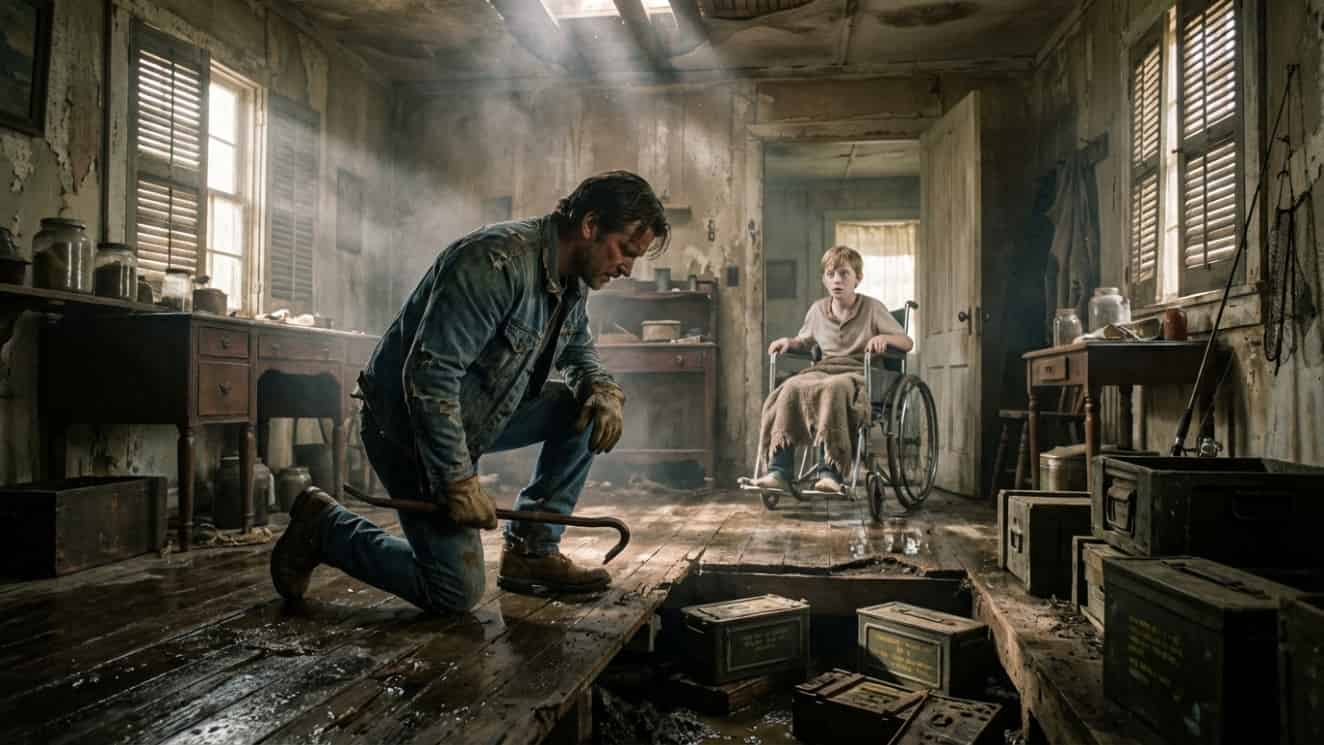
Cole thought he’d buried his life with The 500. He thought the crates of military hardware under his house were just ghosts. But ghosts don’t stay buried in the swamp—they just rot until they’re toxic.
Now, his son Toby is fading, the medical bills are a mountain he can’t climb, and the men who want those guns are at the door. It’s a choice between a clean conscience and a son who can walk again. In the Louisiana heat, blood is cheaper than air, and the debt is finally due.
FULL STORY
Chapter 1: The Rust in the Floorboards
The humidity in the Atchafalaya Basin didn’t just sit on you; it owned you. It was a thick, wet wool blanket that smelled of diesel, rotting cypress, and the slow-motion decay of things that used to be alive. Cole sat on the edge of his porch, his back against the peeling grey siding of a house that was slowly sinking into the mud. He was fifty-four, but in this light, with the sun dying behind the moss-draped trees, his face looked like a topographical map of every bad decision he’d ever made.
Inside, the rhythmic thump-clack of Toby’s wheelchair hit the transition strip between the kitchen and the living room. It was a sound Cole heard in his sleep.
“Dad? The generator’s surging again,” Toby called out. His voice was thin, pitched higher than a nineteen-year-old’s should be. It lacked the chesty resonance of a man who spent his days upright.
“I’ll get to it, Tobes,” Cole said, not moving. He was looking at his hands. The knuckles were swollen, scarred from years of wrenching on Panheads and, occasionally, on people’s faces.
He worked as a freelance mechanic for the local shrimpers and the occasional weekend warrior who broke a belt on the levee road. It paid for the canned soup. It paid for the generator gas. It didn’t pay for the $140,000 spinal reconstruction surgery that a specialist in Houston said could give Toby a thirty percent chance of standing on his own two feet.
Cole stood up, his knees popping like dry kindling. He walked into the house, the floorboards groaning under his weight. He tried not to step too hard on the section near the woodstove. To anyone else, it was just a patch of mismatched pine. To Cole, it was the lid of a coffin.
“The doctor called today,” Toby said. He was sitting by the window, a book open on his lap that he hadn’t turned a page of in an hour. The boy had his mother’s eyes—wide, observant, and far too forgiving.
Cole stopped at the fridge, grabbing a lukewarm bottle of water. “Which one?”
“Dr. Aris. The one from the clinic. She said the state-funded physical therapy is getting cut. Something about a budget reallocation.” Toby didn’t sound angry. He sounded like he was apologizing for being a burden. “She said there’s a private facility in Baton Rouge, but—”
“I know what she said, Tobes. I’ll figure it.”
“You can’t figure everything, Dad. We’re living in a swamp on three-cylinder engines and luck. It’s okay to say we’re stuck.”
Cole didn’t answer. He couldn’t. He walked over to the woodstove and stood on the mismatched pine. He felt the slight give of the boards. Twenty years ago, he’d been the quartermaster for The 500—a chi-town biker club that had moved south to monopolize the Gulf trade. He was the man who counted the inventory. The man who knew where every crate of “special interest” hardware went.
When the ATF raid happened in ’06, the club leaders thought Cole had flipped. They’d run his bike off a bridge into the Bayou Teche and left him for dead. They didn’t know he’d already moved the final shipment. Three crates of military-grade M4s, two dozen crates of armor-piercing rounds, and twelve experimental launchers that had “fallen” off a truck headed to Fort Polk.
He’d dragged himself out of the water, broken and bleeding, and he’d buried that shipment under the foundation of the house he’d built with his own hands. He’d kept it as insurance. Then he’d kept it out of fear. Now, he kept it because it was the only thing of value he had left, and the thought of touching it made his stomach turn to lead.
“I’m going out to the shed,” Cole said, his voice gravelly. “Don’t wait up.”
He didn’t go to the shed. He went to the crawlspace access at the back of the house. He crawled through the spiderwebs and the damp earth until he was directly under the living room. He pulled back a heavy tarp.
The crates were still there. They were olive drab, sealed with heavy-duty wax, and looked as indifferent as the day he’d stolen them. He ran a hand over the cold plastic. This was the weight he carried. Not the weight of the house, but the weight of what the house sat on.
He heard a car engine—not a local truck, but something high-end, the turbo whine cutting through the evening chorus of frogs. He froze. Nobody came out this far unless they were lost or looking for trouble.
He crawled out from the foundation, wiping the mud on his jeans. A black SUV was idling at the end of his gravel drive. A man stepped out. He was tall, wearing a tactical jacket that didn’t hide the military posture. He wasn’t a biker. He was something much more professional.
The man walked toward Cole, stopping just outside the circle of the porch light.
“Cole ‘The Count’ Vance?” the man asked. His voice was midwestern, flat, and dangerous.
“Nobody calls me that anymore,” Cole said, reaching for the wrench in his back pocket. “And the shop’s closed.”
“I’m not here for a tune-up,” the man said. He held up a hand, showing he was unarmed. “My name is Miller. I work for people who have very long memories and very short tempers. We’re looking for a specific ledger of inventory that went missing two decades ago. Along with the inventory itself.”
Cole felt a cold sweat break across his neck. “You’re at the wrong house, Miller.”
“Am I?” Miller smiled, a thin, clinical expression. “Because the math says otherwise. The 500 is gone, Cole. Most of your old ‘brothers’ are in Huntsville or in the ground. But the people who paid for those crates… they’re still in business. And they’re willing to offer a very generous finders fee. Or a very painful alternative.”
Miller looked past Cole, toward the window where Toby’s silhouette was visible.
“That’s a nice boy you got there,” Miller said softly. “Shame about his legs. I hear there’s a surgery that could fix that. Costs about what a crate of M4s goes for on the black market these days.”
Cole’s hand tightened on the wrench. The world narrowed down to the space between him and this man. The past wasn’t a ghost. It was a debt collector.
Chapter 2: The Price of Oxygen
The next morning, the swamp felt different. The mist didn’t just hang; it loomed. Cole stood in the kitchen, the smell of burnt coffee thick in the air. Toby was already up, sitting at the table with a bowl of oatmeal he wasn’t eating.
“Who was that last night, Dad?” Toby asked. He didn’t look up.
“Just a guy looking for directions, Tobes. I told you, don’t worry about it.”
“You don’t talk to guys looking for directions for twenty minutes in the dark with a wrench in your hand,” Toby said. He finally looked at Cole. His eyes were red-rimmed. “He looked like a soldier. Or a cop.”
“He was neither,” Cole said, his voice harder than he intended. He softened it with a sigh. “Look, I’m headed into town to see if Elias has those parts for the winch. Stay inside. Keep the door locked.”
“Dad, it’s 90 degrees out. I’m not going anywhere.” Toby gestured to his legs with a bitter flick of his wrist.
Cole flinched. He walked out before he could say something he’d regret. He drove his rusted ’98 Silverado toward the clinic, the engine knocking in a way that told him the main bearing was on its last legs. Everything was failing at once.
At the clinic, Dr. Sarah Aris was waiting for him. She was a woman in her late thirties who had moved from Chicago to “make a difference” in the rural South. She’d stayed five years longer than anyone expected. She was the only person who treated Cole like a human being instead of a swamp-dwelling relic.
“He’s getting worse, Cole,” Sarah said, closing the door to her small office. She didn’t offer him a chair. She knew he wouldn’t sit. “The muscle atrophy in his lower back is starting to affect his core stability. If we don’t get him into that intensive program in Houston within the next six months, the damage will be irreversible. He won’t just be paralyzed; he’ll be bedridden.”
“I’m working on it,” Cole said.
“How? By fixing outboard motors?” Sarah leaned against her desk, her face softened by a genuine, painful pity. “I checked your insurance again, Cole. Or what passes for it. They won’t cover the ‘experimental’ nature of the reconstruction. You need cash. A lot of it.”
“I know the number, Sarah. $140,000. I’m not deaf.”
“I’m not trying to be a bitch, Cole. I’m trying to be a doctor. Toby is a bright kid. He’s got a future if we can get him out of that chair. But you… you’re drowning, and you’re pulling him down with you.”
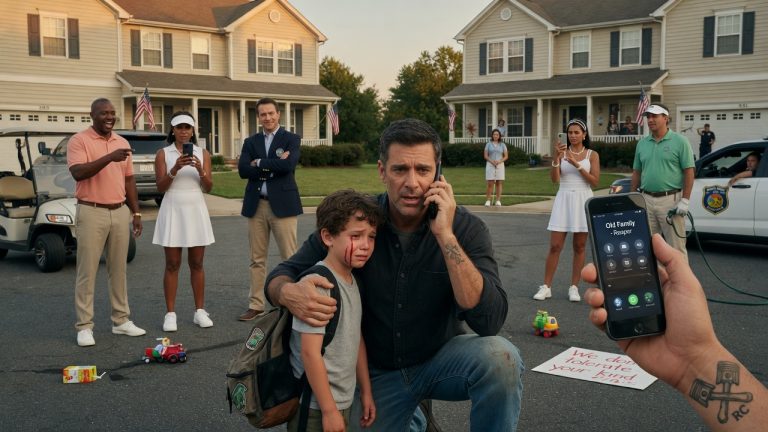
Cole walked out without a word. He drove to the hardware store, but instead of going inside, he sat in the truck and watched the people of the town. They were good people, mostly. Hard-working, broke, and tired. He felt like a predator among them. He was a man with a basement full of death, living in a house built on a lie.
On the way back, he stopped by Old Man Elias’s place. Elias was a scrapper who lived in a trailer surrounded by rusted hulks of cars. He was also the town’s primary source of gossip.
“Had a fella by here this morning,” Elias said, spitting a stream of tobacco juice into the dirt. “Drivin’ a fancy black rig. Askin’ ’bout you, Cole. Askin’ if you ever had any ‘unusual’ deliveries back in the day.”
Cole’s heart hammered against his ribs. “What’d you tell him, Elias?”
“Told him you was a mechanic and a recluse,” Elias said, squinting at Cole. “But he didn’t seem satisfied. He had a way of lookin’ at a man, Cole. Like he was measurin’ him for a hole in the ground. You in some kind of trouble?”
“Just the usual,” Cole lied.
When he got home, the black SUV was gone, but the front door was ajar.
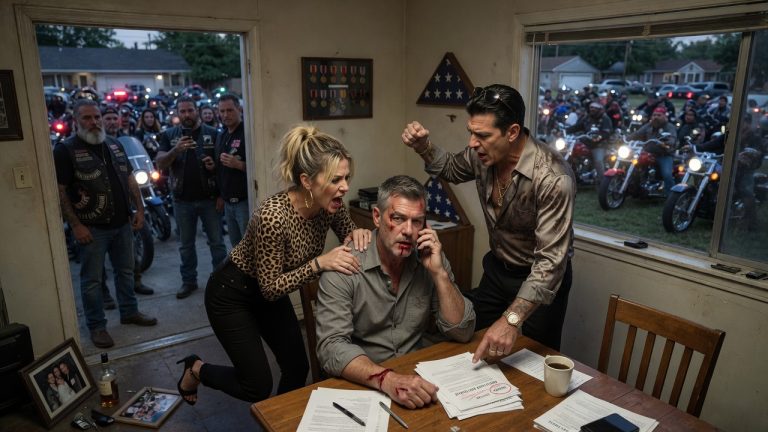
Cole drew the .45 from under his seat and ran toward the house. He burst through the door, his heart in his throat. Toby was in the kitchen, but he wasn’t alone. Miller was sitting at the table, eating a bowl of Toby’s oatmeal.
“Toby was just telling me about his interest in mechanical engineering,” Miller said, looking up with a pleasant smile. “Smart kid. He’s got your hands, Cole. But better brains.”
Toby was frozen, his hands gripping the armrests of his wheelchair so hard his knuckles were white.
“Get out,” Cole said, the gun steady in his hand.
“Now, now,” Miller said, standing up slowly. “Is that any way to treat a guest? I was just telling the boy that I might have a job for his father. A very lucrative job. One that could pay for that fancy surgery he needs.”
“I said get out,” Cole repeated.
Miller walked toward the door, stopping inches from the muzzle of Cole’s gun. He leaned in, whispering so Toby couldn’t hear. “The buyer is arriving in forty-eight hours. They don’t want the ledger anymore, Cole. They want the crates. All of them. If they aren’t ready for pickup, I won’t be the one coming back. It’ll be the men who pay my salary. And they don’t like oatmeal.”
Miller winked at Toby and walked out.
Cole lowered the gun, his breath coming in ragged gasps. He looked at Toby, who was staring at him with a mix of fear and a dawning, horrible realization.
“Dad?” Toby whispered. “What did he mean? What crates?”
Cole looked at the mismatched pine boards by the woodstove. The secret was no longer under the floor. It was in the room.
Chapter 3: The Mirror’s Edge
The rain started that night—a relentless, drumming downpour that threatened to turn the swamp into a lake. Cole sat in the living room, the .45 on the coffee table. Toby hadn’t spoken to him since Miller left. He’d locked himself in his room, the silence coming from behind the door more accusing than any shout.
Around midnight, there was a knock. Not the heavy, rhythmic knock of a man like Miller, but a frantic, uneven beat.
Cole opened the door to find a man he hadn’t seen in fifteen years. It was Roy “Ratchet” Simmons. Roy had been a sergeant-at-arms for The 500. Back then, he’d been a wall of muscle and tattoos. Now, he was a hollowed-out ghost in a tattered army surplus coat, his eyes darting with the frantic energy of an addict.
“Cole,” Roy wheezed, stumbling inside. “I heard… I heard Miller found you. I had to come.”
“How did you find me, Roy?” Cole asked, closing the door and locking it.
“I’ve been following him,” Roy said, collapsing into a chair. “He’s been hitting every old member. Looking for the ‘Ghost Shipment.’ He killed Marcus. He killed Big Pete. They didn’t know anything, but he didn’t believe them.”
Roy looked at Cole, his gaze falling on the floorboards by the woodstove. A slow, twisted smile spread across his face. “But you… you always were the smart one, Cole. You kept it, didn’t you? All this time, you been sitting on the motherlode.”
“I don’t have anything, Roy. Get out of here before you bring them down on me.”
“They’re already down on you!” Roy shouted, then lowered his voice, glancing toward Toby’s room. “Miller’s working for the cartel, Cole. The guys the 500 used to supply. They’re rebuilding their network, and they need that military hardware to clear out the competition. They aren’t gonna pay you. They’re gonna kill you and take it.”
Roy leaned forward, the smell of stale beer and desperation rolling off him. “But I got a contact. A guy in New Orleans. He’ll buy half the shipment, no questions asked. We take the money and we run. You can get the kid his surgery, and I can get… I can get clean.”
Cole looked at Roy. He saw himself in a parallel life—a man who had never left the club, who had let the rot consume him until there was nothing left but the hunger for the next score. Roy was the mirror, reflecting the man Cole had tried so hard to kill.
“I’m not selling to you, Roy,” Cole said quietly.
“Then you’re a dead man!” Roy hissed. “Miller’s got a team coming. Black-ops rejects. They’re gonna burn this shack with you and the boy inside just to see if the guns survive the heat.”
“Why are you telling me this?”
Roy’s face crumbled for a second, the mask of the outlaw slipping. “Because you’re the only one who didn’t flip, Cole. When they ran you off that bridge, I was in the car. I didn’t stop them. I just watched. I’ve been seeing you go over that rail every time I close my eyes for twenty years.”
The confession hung in the air, heavy and pathetic. Cole felt a surge of rage, but it died quickly. He was too tired for hate.
“Go, Roy,” Cole said. “Get out of the basin. Don’t come back.”
Roy stood up, his movements shaky. “You’re making a mistake, Cole. You can’t fight them alone.”
“I’m not alone,” Cole said, though he didn’t know if he believed it.
After Roy left, Cole went to Toby’s room. He knocked softly and went in. Toby was sitting up in bed, staring at the wall.
“I heard him,” Toby said. “The ‘Ghost Shipment.’ Is that why I’m in this chair, Dad? Because of those guns?”
Cole felt like he’d been punched in the solar plexus. “No, Tobes. That was an accident. The bike—”
“The bike you were riding because you were running guns!” Toby finally snapped, his voice cracking. “I spent my whole life thinking we were just unlucky. That the world was just mean. But it wasn’t the world, was it? It was you. You brought this on us.”
“I was trying to build something,” Cole said, his voice a whisper. “I was trying to make sure we were never hungry.”
“I’d rather be hungry and able to walk,” Toby said. He looked at Cole with a coldness that was worse than anger. “Get out. I don’t want to look at you.”
Cole walked out, the weight of the house suddenly unbearable. He went to the kitchen and grabbed a crowbar. He went to the mismatched pine boards and began to pry. He didn’t stop until all three crates were sitting in the middle of the living room, the black steel of the weapons catching the pale moonlight.
They were beautiful in their own terrible way. They represented everything he had lost and everything he could potentially buy back. He sat on the floor, surrounded by the tools of death, and waited for the morning.
Chapter 4: The Sound of the Tide
The morning brought a temporary reprieve from the rain, but the swamp was flooded. The water level had risen to within inches of the porch. It was a world of grey and brown, the trees standing like skeletons in the rising tide.
Cole was in the shed, working with a feverish intensity. He wasn’t fixing an engine. He was prepping. He’d spent the night opening the crates, cleaning the cosmoline off the rifles, and checking the seals on the ammunition. If he was going to be a monster, he was going to be a prepared one.
Sarah, the doctor, pulled up in her old Jeep, her tires churning through the mud. She climbed out, holding a medical bag.
“I came to check on Toby’s breathing,” she said, walking into the shed. She stopped dead when she saw what was on the workbench. “My god, Cole.”
Cole didn’t look up from the M4 he was reassembling. “You should leave, Sarah.”
“Where did you get these?” She walked closer, her face pale. “Are these what I think they are?”
“They’re $140,000,” Cole said. “They’re a ticket to Houston. They’re a future for my son.”
“They’re murder, Cole!” Sarah shouted. “You think you can just sell these and go back to being a mechanic? You think the people who buy these are going to use them for target practice? They’ll end up in the hands of kids in the city, or cartels at the border. You’re trading lives for Toby’s legs.”
“And what would you have me do?” Cole stood up, the rifle heavy in his hands. “Watch him rot? Watch him turn into a ghost while I wait for a state that doesn’t care about us to ‘reallocate’ some funds? I’m his father. It’s my job to fix this.”
“Not like this,” Sarah said, her voice trembling. “Toby is a good man, Cole. He’s better than you. If he finds out his life was bought with blood, it’ll kill him anyway. He’ll never forgive you.”
“He already doesn’t forgive me,” Cole said. “At least this way, he can walk away from me.”
Sarah looked at him for a long time, the silence between them filled with the sound of the rising water. “I can’t be part of this, Cole. If I see those men come here, I’m calling the Sheriff.”
“The Sheriff is forty miles away and the roads are washed out,” Cole said. “By the time he gets here, it’ll be over. One way or the other.”
Sarah turned and walked out, her shoulders slumped. Cole watched her go, feeling a profound sense of isolation. He was an island in a rising sea.
He went back into the house. Toby was in the living room, staring at the crates.
“You’re really going to do it,” Toby said. It wasn’t a question.
“I don’t have a choice, Tobes.”
“There’s always a choice, Dad. You told me that when I was a kid. When I didn’t want to do my homework or when I wanted to quit the baseball team. You said the only thing a man truly owns is his choice.”
“I was wrong,” Cole said. “A man owns his debts. And I’ve been a debtor for too long.”
Cole spent the rest of the day moving the crates to the back porch. He rigged a pulley system to lower them into his skiff. If the buyers were coming, he wasn’t going to let them inside the house. He would meet them on the water, in the dark, where the swamp was his ally.
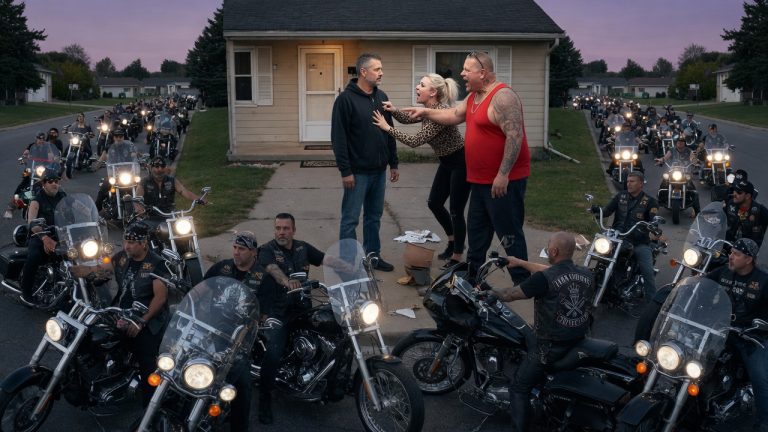
As the sun began to set, the black SUV appeared at the end of the drive. It didn’t stop. It was followed by two more—dusty, nondescript trucks filled with men who didn’t look like they were there for a negotiation.
Miller stepped out of the first vehicle. He wasn’t smiling anymore. He was wearing a tactical vest and carrying a submachine gun.
“Time’s up, Cole!” he yelled over the sound of the idling engines. “Bring the crates out!”
Cole stepped onto the porch, holding a flare gun in one hand and his .45 in the other.
“I have the crates, Miller!” Cole shouted back. “But the price just went up! I want the money in a locked account, transferrable to the Houston Medical Center. Now!”
Miller laughed, a dry, barking sound. “You’re in no position to negotiate, old man. We have the perimeter. We have the hardware. And we have all night.”
A shot rang out from one of the trucks, shattering the porch light above Cole’s head. He dove for cover as a hail of bullets tore into the siding of the house.
“Dad!” Toby screamed from inside.
“Stay down!” Cole yelled. He crawled toward the skiff, the weight of his secret finally breaking into the light.