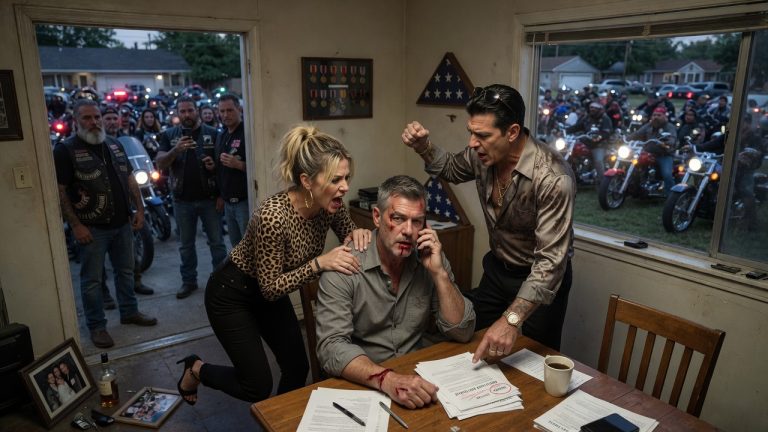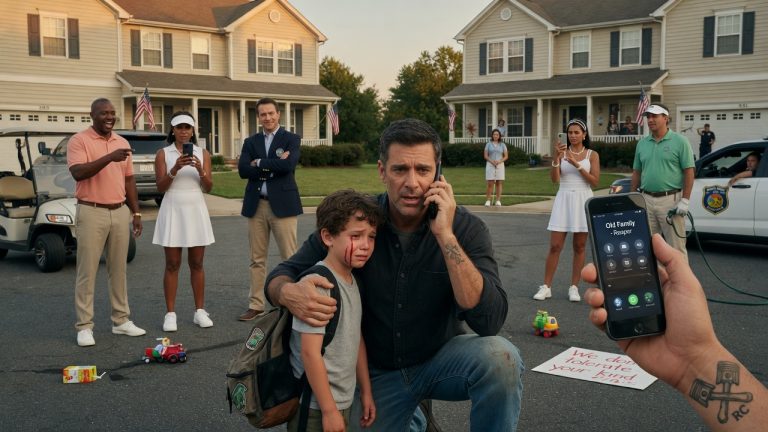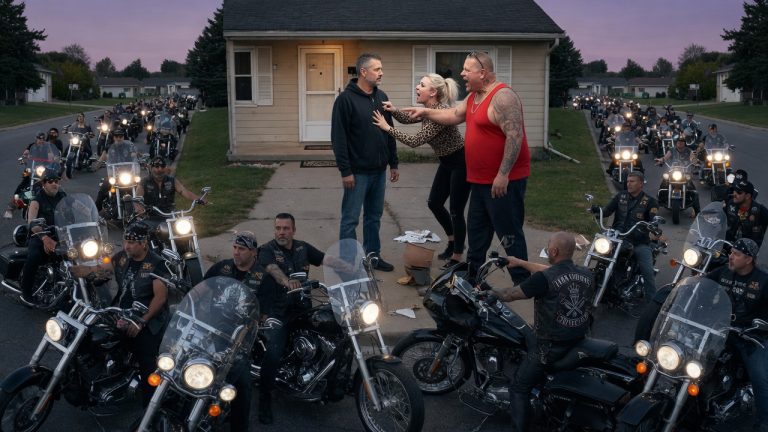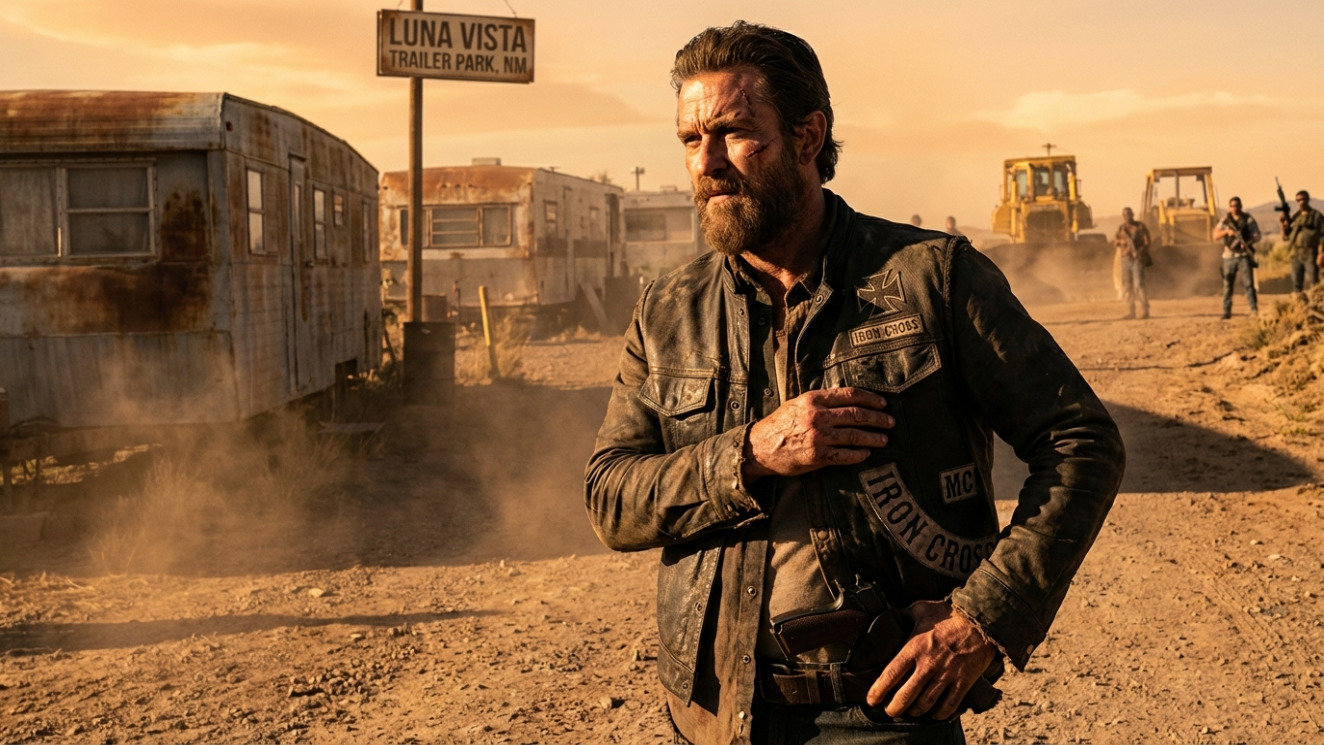
Cane Cassidy is a ghost in a leather vest. To the five hundred men of the Iron Cross MC, he’s the legend who took a bullet and a federal rap to keep them out of prison. They say they owe him their lives. They say they’d die for him.
But they don’t know about the three days Cane spent in a windowless room in Albuquerque, wearing a wire and trading their names for his brother’s freedom.
Now, ten years later, the desert is calling in its own debts. Cane is limping through the dust of a New Mexico trailer park called Luna Vista, watching a private militia try to bulldoze the only home these people have left.
He has a choice to make. He can use the “500-man debt” to finally kill the man who murdered his brother. Or he can use it to save a town that doesn’t even know his real name.
One secret could save the park. The same secret will get him buried in the sand.
FULL STORY
Chapter 1: The Heat in the Chrome
The heat in Otero County didn’t just sit on you; it pressed. It was a physical weight, thick with the smell of creosote and baked caliche, the kind of heat that made the horizon shimmer until the mountains looked like they were underwater. Cane Cassidy felt it in his left knee first. The old break, the one that never quite knitted right after the heist in ’14, throbbed in time with the pistons of his Shovelhead. He shifted his weight, his boot dragging slightly in the gravel as he pulled into the entrance of Luna Vista.
It wasn’t much of a vista. It was thirty-odd trailers arranged in a horseshoe, most of them skirted with rusted corrugated metal and guarded by sun-bleached plastic flamingos or dead Ford F-150s up on blocks. But it was quiet. Or it should have been.
Cane killed the engine. The silence that followed was punctured by the tink-tink-tink of the cooling metal and the distant, rhythmic thud of a pile driver coming from the north end of the property. He dismounted, his gait hitched, a rhythmic reminder of a night in Albuquerque he tried every day to forget. He adjusted his vest—the denim was thin at the shoulders, the patches long gone, leaving only the ghost-dark outlines of where his colors used to be.
“You’re late,” a voice said.
Cane looked up. Sarah was standing on the porch of the double-wide that served as the park office. She looked like the desert itself—tough, dry, and frayed at the edges. She had a cigarette tucked behind her ear and a stack of legal papers in her hand that she was gripping tight enough to white-out her knuckles.
“Road was washed out near Tularosa,” Cane said. His voice was like two pieces of sandpaper rubbing together. He didn’t tell her he’d spent three hours sitting in a gas station parking lot, staring at the phone, wondering if this was the day he finally called the number written on the inside of his boot heel.
“They’re coming back today, Cane,” she said, stepping down into the dust. She pointed toward the north fence line. “The Vanguard boys. They’ve already started the clearing on the Aris Thorne side. They say the eviction notices were served, but half these people didn’t even get a knock. Old Man Miller’s been in that trailer forty years. Where’s he supposed to go? The moon?”
Cane looked toward the dust cloud on the horizon. Two black SUVs were kicking up plumes of white sand, moving fast toward the entrance. “Is Thorne himself here?”
“No. Just his dogs. Led by a guy named Miller—not the one in the trailer. A younger one. Ex-military. Thinks he’s still in Kandahar.”
Cane felt a cold prickle in his gut that the New Mexico sun couldn’t touch. Aris Thorne. The name was a splinter in his mind. Thorne had been the money behind the Albuquerque job. He’d been the one who promised the getaway driver wouldn’t spook. He’d been the one who let Cane’s brother, Tommy, bleed out on a warehouse floor because the “timeline was compromised.”
The SUVs screeched to a halt ten feet from Cane’s bike. The doors opened in sync, and four men stepped out. They weren’t wearing police uniforms, but they had the look: tan tactical trousers, black polo shirts with “Vanguard Security Solutions” embroidered in silver, and the kind of mirrored sunglasses that made a man look like a machine.
The one in the lead was Miller. He was lean, built like a whip, with a high-and-tight haircut and a scar that ran from his ear to the corner of his mouth. He didn’t look at Sarah. He looked at Cane. Specifically, he looked at Cane’s leg, then at the vintage Harley.
“This a private road, buddy,” Miller said. His voice was thin and precise. “You looking for the museum?”
Cane didn’t move. He leaned back against his bike, his hands hooked into his belt loops. “I’m looking at a bunch of guys who look like they’re playing dress-up. This is a residential community. You’re trespassing.”
Miller chuckled, a dry sound that didn’t reach his eyes. He stepped closer, entering Cane’s personal space, the scent of expensive gun oil and peppermint gum trailing after him. “It’s a construction site. Or it will be by Monday. These people have been notified. We’re just here to ensure the transition is… orderly.”
“Orderly,” Cane repeated. He looked past Miller at one of the trailers. An eight-year-old girl was peeking through the blinds, her face pale. “Is that what you call burning down the community garden last night? An orderly transition?”
Sarah stepped forward, her face flushed. “You have no right to touch that fence line until the court hears the injunction, Miller. I told your boss that. I told Thorne.”
Miller finally looked at her, his expression one of bored pity. “Mr. Thorne doesn’t care about your injunction, Sarah. He cares about the resort. And he cares about the fact that this land is worth ten times what these tin cans are sitting on.” He turned back to Cane. “You. Pops. Take your antique and move on. This isn’t your fight.”
Cane felt the familiar heat rising in his chest—the old Cassidy temper that Tommy used to say would be the death of them both. He stood up straight, his limp more pronounced as he took a half-step toward Miller. He was shorter than the security lead, but he had the breadth of a man who’d spent thirty years wrestling iron.
“I don’t move well,” Cane said softly. “Especially not when someone’s telling me where to go. It’s a habit I picked up in a place with much higher fences than this.”
Miller’s eyes narrowed behind the reflectors. He saw the faded tattoos on Cane’s forearms—the eagle, the piston, the blurred ink of a life spent on the road. He recognized the type. Not just a biker. An old-schooler. A man who knew how to take a hit.
“You’re Cassidy,” Miller said, the realization clicking. “I heard about you. The guy who saved all those guys in the ’12 sting. The Legend of the Iron Cross.” He spat into the dust near Cane’s boot. “You look smaller than the stories, Cane. And a lot more broken.”
“Stories usually are,” Cane said.
One of the other Vanguard guys moved, his hand hovering near the zip-ties on his belt. The tension in the lot tightened like a bowstring. Sarah held her breath. A dog barked somewhere in the back of the park, a lonely, frantic sound.
Miller stared at Cane for a long beat, then tapped his sunglasses. “We’re leaving for today. But we’ll be back at sunrise. With the dozers. If you’re still standing in the way, Cassidy, we’ll see how much that legend of yours is worth when it’s under six inches of concrete.”
He turned on his heel and signaled his men. They piled back into the SUVs, the engines roaring as they backed out, kicking a fresh layer of grit over Cane and his bike.
Sarah let out a long, shaky breath. “They aren’t kidding, Cane. Thorne has the sheriff in his pocket. He has the land. He has the money. All we have is a pro-bono lawyer in Las Cruces who won’t return my calls.”
Cane looked down at his hands. They were steady, but the ache in his knee was a dull roar now. He looked at the trailer where the little girl had been watching.
“I have something else,” Cane said.
“What?”
Cane didn’t answer. He reached into his vest pocket and pulled out a worn, leather-bound notebook. Inside was a list of names. Not the names he’d almost given the feds ten years ago—those were burned into his memory, a different kind of scar. This was a list of men who had stood in a courtroom in 2013 and watched a judge dismiss their charges because “Cane Cassidy” had refused to testify, despite the deals, despite the pressure, despite the fact that they’d left his brother to die.
Every one of those five hundred men owed him. Not for a favor. For their lives. For their freedom.
“I need to go to the diner,” Cane said, tucking the notebook away. “I need to see someone.”
“Cane, if you’re thinking about calling in the club… you know what that means. This place will become a war zone.”
“It’s already a war zone, Sarah,” Cane said, mounting his bike. “The only difference is right now, only one side is fighting.”
He kicked the Shovelhead to life, the roar of the engine drowning out her response. As he rode out of Luna Vista, he didn’t look back at the trailers. He looked at the horizon, where the dust of the Vanguard SUVs was still settling.
He rode five miles down the county road to a place called The Dusty Spoon. It was a sagging building with a neon sign that had given up on the ‘S’ years ago. He parked in the back, away from the street.
Inside, the air smelled of burnt coffee and floor wax. There was only one customer—an old man in a John Deere cap—and one waitress.
Elena.
She was wiping down the counter, her movements efficient and joyless. When the bell above the door chimed, she didn’t look up. “Sit anywhere. Coffee’s fresh, but the pie’s from Tuesday.”
Cane sat at the far end of the counter. He took off his sunglasses, his eyes adjusting to the dim light. Elena moved toward him, the pot in her hand. She stopped mid-stride.
She recognized him. Not as the legend. Not as the man who saved the Iron Cross.
She recognized him as the man who had been standing over her father’s body in a warehouse in Albuquerque, his hands covered in blood, his eyes wide with a terror that matched her own.
“You shouldn’t be here,” she said, her voice a whisper.
“I know,” Cane said. “But the debt’s coming due, Elena. And I think I’m finally ready to pay it.”
She didn’t pour the coffee. She just stared at him, the weight of ten years sitting between them on the Formica counter like a loaded gun.
Chapter 2: The Ghost at the Counter
Elena didn’t move. The coffee pot stayed hovered in the air, a thin wisp of steam rising between them. Her face was a map of hard years; she had her father’s high cheekbones and a mouth that looked like it had forgotten how to smile somewhere around the age of nineteen.
“You’re ten years late, Cane,” she said. Her voice wasn’t loud, but it had a jagged edge that cut through the low hum of the refrigerator.
“I wasn’t sure I’d ever be ready,” Cane replied. He kept his hands flat on the counter, palms down. He didn’t want her to see the slight tremor in his fingers. “Is there somewhere we can talk? Not here.”
“I’m on shift. And I don’t talk to ghosts.” She finally set the pot down, the clack of the glass against the burner sounding like a hammer fall. “You shouldn’t have come back to this part of the state. People remember. Thorne remembers.”
“I know Thorne remembers. I just saw his people out at Luna Vista.”
Elena’s eyes shifted, a flicker of concern breaking through the frost. “You’re staying at the park? Why? That place is a graveyard with a zip code.”
“Sarah’s a friend. Or as close to one as I get these days. She told me what’s happening. Thorne’s trying to sweep the whole place into the dirt.”
Elena let out a short, bitter laugh. “That’s what Thorne does. He clears the land, he builds something shiny, and he moves on. He did it to my father’s shop, didn’t he? Only he used you and Tommy to do the dirty work.”
Cane flinched. The name Tommy always felt like a physical blow. “It wasn’t supposed to go that way. The shop was supposed to be empty. Thorne told us—”
“I don’t care what he told you,” Elena hissed, leaning over the counter. Her voice dropped to a low, dangerous register. “My father was working late because the taxes were overdue—taxes Thorne had hiked through the development board. You and your brother walked in with masks and adrenaline, and my father died on a pile of oily rags. And then Tommy died. And you… you just vanished into the ‘legend’ of the MC. You became the guy who saved five hundred bikers from the feds, while I became the girl who cleans up egg yolks for five dollars an hour.”
Cane looked down at the counter. There was a scratch in the Formica, a deep gouge that someone had tried to fill with wax. It didn’t work. The damage was still there.
“I didn’t vanish,” Cane said. “I went to prison. I sat in a cell for three years because I wouldn’t give the feds the names they wanted. I thought that was the penance.”
“Prison is just a place you sit,” she said. “Penance is what you do when you get out. And you’ve done nothing but ride that bike and hide behind your reputation.”
She turned away from him, grabbing a rag and scrubbing at a spot that was already clean. The silence stretched, heavy and suffocating. Cane knew he should leave. He should get on the Shovelhead and ride until the desert turned into the mountains of Colorado. But he saw the way her shoulders were hunched, the way she was holding back the weight of everything she’d lost.
“I’m going to stop him,” Cane said.
Elena stopped scrubbing. She didn’t turn around. “Stop who?”
“Thorne. He’s the one who sent us into that shop. He’s the one who tipped the cops when things went south so he could tie up the loose ends. He’s the one trying to bulldoze Luna Vista. I’m going to call it in, Elena. All of it.”
“Call what in?”
“The debt.”
She finally turned back, her eyes narrow. “The 500-man debt? You think a bunch of aging outlaws are going to stop a private security firm with corporate lawyers and state-of-the-art surveillance? This isn’t the seventies, Cane. You’ll just get more people killed.”
“It’s not just about the club,” Cane said. He reached into his vest and pulled out a small, tarnished silver ring. He set it on the counter. It was a man’s ring, a heavy band with a simple blue stone. “This was your father’s. I found it in the gravel that night. I’ve carried it for ten years because I was too much of a coward to bring it to you.”
Elena stared at the ring. Her breath hitched, a small, broken sound that she tried to swallow. Her hand reached out, her fingers hovering over the silver, but she didn’t touch it.
“Get out,” she whispered.
“Elena—”
“Get out, Cane! Now!”
Her voice cracked, and the old man in the John Deere hat looked up, his brow furrowed. Cane didn’t push it. He stood up, his leg screaming as he put weight on it. He left the ring on the counter and walked toward the door.
As he pushed it open, the bell chiming one last time, he heard her voice, low and trembling.
“If you bring those men here, Thorne will kill you. He’s not the man he was ten years ago. He’s worse. He has a system now.”
Cane didn’t look back. “So do I,” he said.
He rode back toward Luna Vista, the sun dipping lower in the sky, casting long, distorted shadows across the road. His mind was spinning. Elena was right—Thorne was a different beast now. Vanguard wasn’t just a security firm; it was a paramilitary force.
As he turned into the trailer park, he saw a campfire burning near the community center. A group of residents were gathered around it, their faces grim in the flickering light. Sarah was there, talking to an older man in a wheelchair—Old Man Miller.
Cane parked and limped over. The air was cooler now, but the tension was higher.
“They were back,” Sarah said as he approached. “An hour ago. They didn’t come to talk this time. They cut the water line to the north trailers. Said it was an ‘accidental severance’ during the clearing. We can’t get it back on without a plumber, and no one will come out here because Vanguard told them the site is hazardous.”
Cane looked at the residents. These weren’t soldiers. They were retirees, single mothers, and guys working two jobs just to keep the lights on. They looked exhausted. They looked defeated.
“Where’s Tiny?” Cane asked.
“Who?” Sarah blinked.
“A friend,” Cane said. “He should be here soon. I sent a message from the gas station.”
Just then, the low, rhythmic thrum of a heavy engine echoed from the highway. It wasn’t the high-pitched whine of a sportbike or the muffled roar of a truck. It was a deep, guttural vibration that you felt in your teeth.
A single headlight appeared at the entrance, followed by another, and another.
The residents backed away, fear crossing their faces. Sarah stepped closer to Cane, her hand gripping his arm. “Cane? What is that?”
“That’s the down payment,” Cane said.
A massive bike, a custom-built chopper that looked like it was made of solid lead, rolled into the center of the park. The rider was a giant of a man, easily six-foot-five and three hundred pounds, wearing a leather vest with “IRON CROSS – MOTHER CHAPTER” emblazoned across the back.
This was Tiny. And behind him were three more riders. They didn’t look like the Vanguard boys. They looked like they had been forged in a furnace and quenched in motor oil.
Tiny killed his engine and kicked the stand down with a heavy thud. He pulled off his helmet, revealing a bald head covered in intricate tattoos and a beard that reached his chest. He looked at the trailers, then at the campfire, and finally at Cane.
“You look like hell, Cassidy,” Tiny said, his voice a deep rumble.
“I feel like hell, Tiny,” Cane replied.
Tiny climbed off his bike, his presence seemingly shrinking the entire park. He walked over to Cane and pulled him into a brief, crushing hug. When he pulled back, his eyes were serious.
“Preacher got your message. He’s on his way from El Paso with twenty more. But he wanted me to ask you something before the rest of the brothers get the word.”
“Ask me what?”
Tiny leaned in, his voice dropping so the residents couldn’t hear. “He wants to know if this is about the park, or if this is about the three days you spent in Albuquerque before the trial. The three days the feds won’t talk about.”
Cane felt the world tilt. He looked at the fire, the orange flames reflecting in Tiny’s dark eyes. The secret he’d carried for a decade, the one he thought was buried under his silence, was out.
“It’s about both,” Cane said, his voice steady despite the hammer in his chest. “It’s about all of it.”
Tiny nodded slowly. “Then you better be ready, Cane. Because if the brothers find out you’re using them to wash your soul, they won’t just leave. They’ll help Thorne bury the place.”
Chapter 3: The Weight of the Wire
The night at Luna Vista was thick with the smell of woodsmoke and the low, constant murmur of men who weren’t used to being quiet. Preacher had arrived at midnight with twenty riders. They didn’t set up tents; they just leaned against their bikes or sat in the dirt, their presence a dark, jagged fence around the perimeter of the trailers.
Cane sat on the porch of Sarah’s office, watching the shadows. His knee was a dull, throbbing ache, a constant reminder of the gravity of his choices.
“You haven’t slept,” a voice said.
It was Preacher. He was a lean man, older than the others, with silver hair tied back in a neat ponytail and a calm, scholarly face that belied the “Chaplain” patch on his vest. He carried a thermos of coffee and sat down next to Cane without being asked.
“I don’t sleep much in the desert,” Cane said, taking the cup Preacher offered. “Too much noise.”
“It’s the silence that gets you, Cane,” Preacher said. He looked out at the line of bikes. “The brothers are restless. They like a fight, but they like to know why they’re fighting. They think they’re here because a legendary nomad called in a blood-debt to save some folks who got dealt a bad hand. It’s a good story. It’s the kind of story that keeps an MC together.”
Cane took a sip of the coffee. It was bitter and strong. “But you don’t believe it.”
“I believe you want to save these people,” Preacher said. “I also believe you’ve been carrying a ghost on your back since 2014. And I think that ghost has a name.”
Cane looked at the older man. Preacher had always been the one who saw through the bravado. In the club, he was the confessor, the one who handled the things that couldn’t be settled with a fist or a chrome pipe.
“I spent three days in a room with a Fed named Vance,” Cane said, his voice barely a whisper. “Three days. They had Tommy on a respirator in the next room. They told me if I signed the papers, if I gave them the leadership of the Mother Chapter, they’d move him to a private facility. They said he’d live.”
Preacher didn’t move. He just listened, his gaze fixed on the horizon.
“I signed,” Cane continued, the words feeling like shards of glass in his throat. “I wore the wire for one afternoon. I sat in a bar with the President and the VP. I listened to them talk about the Albuquerque heist, about the money, about Thorne. And then… I went to the bathroom, and I ripped the wire off. I flushed it. I walked out the back door and I went back to the Feds and told them to go to hell.”
“And Tommy?”
“He died an hour later. The Feds didn’t move him. They let him go right there in the county ward.” Cane’s hand tightened on the coffee cup. “I went to trial. I sat there and let them call me a hero because the wire didn’t produce anything usable and I wouldn’t testify. The Feds couldn’t admit they’d had an informant who flipped back, because it made them look like amateurs. So they let the ‘Legend of Cane Cassidy’ grow. And I let it happen, because it was the only thing I had left of my brother.”
Preacher sighed, a long, weary sound. “A lie that big doesn’t just sit there, Cane. It grows roots. It chokes everything it touches.”
“I know. That’s why I’m here. Thorne is the one who put us in that position. He’s the one who knew the Feds were watching that warehouse. He used us to clear out the shop and then he used the law to clear us out. He’s doing the same thing here, Preacher. He’s using Vanguard to do the dirty work while he sits in a glass office in Santa Fe.”
“The brothers won’t see it that way,” Preacher warned. “To them, an informant is an informant. Doesn’t matter if you changed your mind. Doesn’t matter if you did it for your brother. If they find out you had a wire on the President, even for an hour… they’ll kill you, Cane. And they’ll leave these people to the dozers.”
“Then don’t tell them,” Cane said, looking Preacher in the eye. “Not until this is over. Let me do this one thing right. Let me settle the score with Thorne. Then you can tell them whatever you want.”
Before Preacher could answer, a loud pop echoed from the north end of the park. It sounded like a firecracker, followed by a sudden, brilliant flash of orange light.
“Fire!” someone screamed.
Cane was on his feet in an instant, his limp forgotten in the rush of adrenaline. He ran toward the north fence line. One of the abandoned trailers—a rusted silver Airstream that Sarah used for storage—was engulfed in flames. The fire was climbing high into the dry night air, the heat radiating in waves.
“Tiny! Get the extinguishers!” Cane yelled.
The bikers moved with practiced precision. They weren’t just outlaws; many of them were veterans or former blue-collar workers. They formed a line, grabbing buckets of sand and the few fire extinguishers the park had.
Cane saw Sarah running toward the blaze, her face pale with terror. “Cane! The propane tanks! There are two of them behind that trailer!”
Cane looked at the roaring inferno. If the tanks blew, the fire would jump to the next trailer, and the next. It would be a domino effect that would level the entire park in minutes.
“Stay back!” Cane shouted to the others.
He grabbed a heavy wool blanket from his bike, doused it with a gallon of water from a nearby spigot, and threw it over his head. He ran toward the back of the burning Airstream. The heat was staggering, searing the hair on his arms, the roar of the fire filling his ears.
He reached the tanks. The valves were hot, the metal hissing as the heat increased. He struggled with the first one, his fingers burning as he twisted the heavy iron wheel. It wouldn’t budge. He kicked it, his bad leg screaming in protest, and finally, it gave. He dragged the heavy tank away from the heat, the metal scraping against the gravel.
He went back for the second. The flames were licking at the side of the tank now. He could hear the internal pressure building, a high-pitched whistle that meant it was seconds from exploding.
“Cane! Get out of there!” Tiny’s voice was a roar from somewhere in the dark.
Cane didn’t listen. He grabbed the second tank. His hands were blistered, the skin peeling, but he didn’t feel the pain. He felt only the singular, driving need to not fail again. He hauled the tank backward, his boots sliding in the dirt, just as a section of the Airstream’s roof collapsed, sending a shower of sparks and burning debris onto the spot where he’d been standing seconds before.
He collapsed in the dirt twenty feet away, gasping for air that didn’t burn. Tiny and Preacher were there in an instant, dragging him further back.
“You’re a damn fool, Cassidy,” Tiny grunted, but there was a flicker of respect in his eyes.
The fire department arrived twenty minutes later—a single, aging pumper truck from the county. By then, the bikers had the flames contained. The Airstream was a blackened skeleton, but the rest of the park was safe.
As the sun began to bleed over the horizon, painting the desert in bruised purples and oranges, a black SUV pulled up to the entrance.
Miller stepped out. He looked at the charred remains of the trailer, then at the line of thirty motorcycles parked in the center of the lot. He looked at the bikers, who were standing silent, watching him with cold, predatory eyes.
His smirk didn’t reach his face this time. He looked at Cane, who was sitting on the ground, his hands bandaged with strips of an old T-shirt.
“You’ve got some friends, Cassidy,” Miller said, his voice tight. “But friends can’t stop a demolition order. The dozers roll in two hours. Sheriff’s department will be here to enforce it. If your… associates… interfere with a court-ordered eviction, they’ll all be going to state. Is that what you want?”
Cane stood up slowly, leaning on Tiny’s shoulder for support. He looked past Miller at the road.
“It’t not just my friends you should be worried about, Miller,” Cane said.
From the direction of the highway, another sound began to rise. It wasn’t the roar of engines. It was the sound of a community.
Dozens of cars—beaten-up sedans, old work trucks, a school bus—were pulling onto the shoulder of the road. People were getting out. They were carrying signs. They were carrying cameras.
In the lead was Elena. She was walking toward the entrance, her face set in a hard, determined line. She looked at Cane, a brief, silent acknowledgment passing between them.
“The news is on its way, Miller,” she said, her voice carrying across the lot. “And so is the ACLU. You want to bulldoze this place? You’re going to do it in front of the whole state.”
Miller looked at the growing crowd, then at the bikers, then back at the highway. He pulled out his phone, his thumb tapping the screen with agitated speed.
“This isn’t over,” he muttered, retreating to his SUV.
Cane watched him drive away. He felt a moment of triumph, but it was fleeting. He knew Thorne. Thorne didn’t lose; he just changed tactics.
“He’s going to come for me now,” Cane whispered to Preacher.
“He was always coming for you, Cane,” Preacher replied. “The only question is, who’s going to be standing with you when he gets here?”
Chapter 4: The Price of Redemption
The standoff at Luna Vista had turned the dusty trailer park into a temporary fortress. The “500-man debt” was no longer a metaphor; word had spread through the Southwest MC circuit like a brushfire. By noon, fifty more riders had arrived from chapters as far away as Tucson and Amarillo. The sound of their engines was a constant, low-frequency hum that seemed to vibrate the very air.
But the atmosphere wasn’t celebratory. It was tense. The bikers stayed in their own circles, their eyes scanning the horizon for the sheriff’s deputies or the Vanguard SUVs. The residents of the park moved among them like ghosts, offering water and sandwiches, their fear replaced by a bewildered kind of hope.
Cane sat in the shade of a rusted awning, his hands throbbing beneath the bandages. He was watching Elena. She was talking to Sarah, her gestures sharp and animated. She hadn’t spoken to him since she arrived with the crowd, but her presence was a weight he felt in his chest.
“She has her father’s eyes,” a voice said.
Cane turned. It was Tiny. He was leaning against a support post, his massive arms crossed.
“Yeah,” Cane said. “She does.”
“The brothers are starting to talk, Cane,” Tiny said, his voice dropping. “They see her. They remember the Albuquerque job. They remember that it was her father’s shop that got hit. And they’re starting to ask why a legend like you is so concerned with the daughter of a civilian who got caught in the crossfire.”
“She’s a victim, Tiny. Just like the people in this park.”
“Maybe. But the club doesn’t protect victims. We protect our own. And right now, some of the younger guys are wondering if we’re here to protect the club’s honor, or if we’re here to help you sleep at night.”
Cane didn’t answer. He couldn’t. Tiny was right, and the truth was a stone in his stomach.
Before the conversation could go further, a sleek, silver Mercedes pulled up to the gate. It was out of place in the dust and grit of Luna Vista, a gleaming symbol of the world that was trying to erase them.
The bikers surged forward, a wall of leather and denim blocking the path. Tiny moved to the front, his hand resting on the hilt of the knife at his belt.
The driver’s side window rolled down. It wasn’t Miller. It was a man in his fifties, wearing a crisp linen suit and expensive sunglasses. His hair was perfectly coiffed, and he smelled of sandalwood and power.
Aris Thorne.
Cane pushed himself up, his leg groaning. He limped through the crowd of bikers, who parted for him with a mixture of reverence and suspicion. He stopped three feet from the car.
Thorne didn’t get out. He looked at Cane with a small, amused smile. “Cassidy. I should have known you were behind this. You always had a flair for the dramatic.”
“Get out of the car, Aris,” Cane said.
Thorne chuckled and stepped out. He stood in the dust, his polished Italian loafers instantly coated in white silt. He looked around at the bikers, his expression one of mild curiosity, as if he were visiting a zoo.
“Quite a collection you’ve gathered. It’s a shame, really. All this effort for a lost cause. The demolition order is valid, the land is mine, and the sheriff is merely waiting for the media to lose interest before he moves in.”
“The media isn’t losing interest,” Cane said, gesturing toward the line of cars at the entrance. “And neither am I.”
Thorne stepped closer, his voice dropping so only Cane could hear. “Let’s be honest, Cane. You’re not doing this for these people. You’re doing this because you’re still trying to apologize to a dead man. You think if you save this little patch of dirt, Tommy will forgive you for letting him die in that warehouse.”
Cane’s jaw tightened. “Tommy’s dead because of you. You set that job up to fail. You wanted the shop cleared, and you wanted the MC out of the way so you could buy up the block. You played us.”
Thorne shrugged, a graceful, indifferent movement. “In business, one uses the tools available. You and your brother were very effective tools. Until you weren’t.” He leaned in further, his eyes cold behind the shades. “I know about the three days, Cane. I know about the wire. I have friends in the DOJ who are very talkative when the price is right.”
Cane felt the blood drain from his face.
“I have the transcript,” Thorne continued. “The one where you agreed to give up the National President. I haven’t released it because, frankly, you were more useful as a ‘legend’ who kept the club quiet. But if you persist in this… if you stay in my way… I will send that transcript to every chapter in the country. Your ‘brothers’ won’t just leave, Cane. They’ll tear you apart.”
Thorne patted Cane on the shoulder, a condescending gesture that felt like a brand. “You have one hour. Disperse this crowd, tell your friends to ride home, and I might just let you keep your little myth. Otherwise… well, I’ve always wondered what a 500-man debt looks like when it’s paid in blood.”
Thorne got back into his car and backed away, the Mercedes disappearing into the heat haze.
Cane stood frozen in the dust. The weight of the threat was a physical pressure, crushing the air out of his lungs. He looked back at the bikers. They were watching him, waiting for a signal, for a command, for the truth.
He saw Preacher standing near the office, his expression unreadable. He saw Elena, standing by the community center, her eyes fixed on him.
He had an hour.
Cane turned and walked toward the community center, his limp more pronounced than ever. He found Elena sitting on a bench, a bottle of water in her hand.
“He was here, wasn’t he?” she asked.
“Yeah. He was here.”
“What did he say?”
Cane sat down next to her. He looked at his bandaged hands. “He has the truth, Elena. The real truth about why I didn’t testify. About what I did in that room in Albuquerque.”
Elena looked at him, her gaze sharp. “I already know, Cane.”
Cane blinked. “What?”
“My father’s shop had cameras,” she said softly. “Hidden ones. Thorne didn’t know about them. After the heist, after the police cleared out, I went back. I found the drive. I saw you and Tommy. I saw you trying to stop him. I saw the look on your face when the bullet hit my father.”
She took a shaky breath. “And I saw the Feds take you. I followed the case. I knew you were talking. I waited for the arrests. I waited for Thorne to go down. But then… nothing happened. You went to prison, the club stayed free, and Thorne got richer.”
“Why didn’t you say anything?” Cane asked.
“Because I was scared,” she said, a tear finally escaping and tracking through the dust on her cheek. “I was a nineteen-year-old girl with no father and no money. Thorne threatened me, Cane. He told me if I ever released that footage, I’d end up like my father. So I buried it. Just like you buried your secret.”
Cane felt a strange, hollow sense of relief. The secret wasn’t just his; it was a shared burden, a tether that had kept them both trapped in the past.
“He’s going to tell the club,” Cane said. “If I don’t move these people, he’s going to give them the transcripts. They’ll kill me, Elena.”
“Then let them,” she said, her voice suddenly fierce. “Let them see who you really are. A man who tried to save his brother and then spent ten years trying to save everyone else. If they can’t handle that, they aren’t your brothers.”
Cane looked out at the sea of leather and chrome. He thought about the men who had spent their lives following a code that was as brittle as old bone. He thought about the “500-man debt.”
“They won’t understand,” Cane said. “But it doesn’t matter. I’m not doing this for the club anymore.”
He stood up and walked toward the center of the lot. He climbed onto the back of a flatbed truck that had been brought in to block the entrance. He looked out at the seventy-odd bikers and the hundred residents of Luna Vista.
“Listen up!” he roared.
The crowd went silent. The only sound was the wind whistling through the dry brush.
“An hour ago, Aris Thorne told me he’d destroy me if I didn’t walk away from this park,” Cane began, his voice carrying across the desert. “He told me he’d tell you a secret I’ve been keeping for ten years. A secret that would make you hate me.”
He saw Tiny stiffen. He saw Preacher bow his head.
“The secret is this: I was an informant. For three days, I wore a wire for the Feds. I was going to give them the Mother Chapter to save my brother’s life.”
A collective gasp went through the bikers. A low, dangerous rumble began to grow, a sound like an approaching storm.
“But I didn’t do it!” Cane shouted over the noise. “I chose the club! I chose you! And because I chose you, my brother died! I sat in a cell for three years to protect a brotherhood that I wasn’t even sure I believed in anymore!”
He pointed toward the highway. “Thorne thinks that secret is a weapon. He thinks he can use it to make you leave these people to the dozers. He thinks your ‘code’ is more important than the lives of the people standing behind you!”
Cane stepped down from the truck, walking right into the middle of the bikers. He looked at Tiny, then at the others.
“If you want to kill me for those three days, do it. I’m right here. I’m not running anymore. But if you’re the men you say you are… if you’re really the ‘brothers’ who owe me a debt… then you’ll stand your ground. Not for me. For them.”
He turned his back on the club and walked toward the entrance, alone. He stood in the middle of the road, his limp heavy, his shadow long.
For a long, agonizing minute, nothing happened.
Then, he heard the sound of a kickstand being retracted. Then another.
Cane didn’t look back. He heard the engines start—not the sound of men leaving, but the sound of men moving.
Tiny’s massive chopper roared to life and pulled up alongside him. Then Preacher. Then the others, one by one, until a wall of seventy motorcycles was lined up across the entrance of Luna Vista, a barrier of steel and bone that no dozer could cross.
“We’ll settle our business later, Cassidy,” Tiny said, his eyes hidden behind his goggles. “But today, we’re collecting on the debt.”