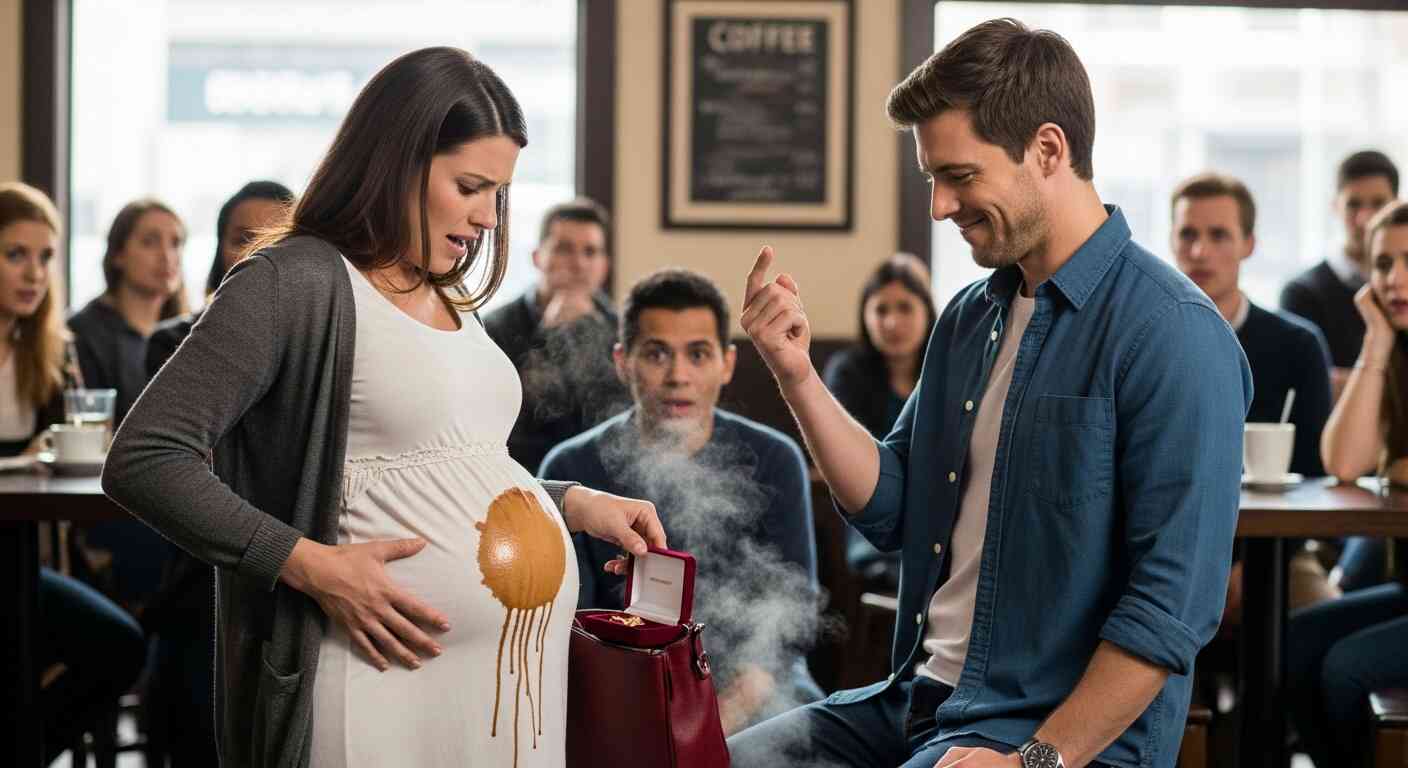
The steaming black liquid splashed across my distended belly, searing through the thin fabric of my thrift-store dress. I gasped, the sudden shock of the heat sending a jolt of genuine panic through me. It wasn’t just about the pain; it was the sheer, degrading malice behind it.
“Oops,” Officer Miller sneered, his badge gleaming under the harsh fluorescent lights of the precinct waiting room. He didn’t even pretend it was an accident. He just tilted his travel mug further, letting the last few drops dribble onto my white sneakers. “Clumsy me.”
I struggled to stand, my center of gravity completely off, my hands shaking as I tried to wipe the scalding fluid away from my baby. I looked up at him, expecting to see something, anything, other than the cold, dark satisfaction pooling in his eyes. This man was a fixture in our town, a pillar of the community, and he was currently enjoying the sight of a pregnant woman in distress.
“What is wrong with you?” I whispered, my voice cracking.
Miller leaned in close, so close I could smell the stale tobacco and cheap cologne on him. He didn’t look like a cop right then. He looked like a monster. “A lot of things are wrong with me, sweetheart,” he said, his voice a low, threatening rumble. Then, he looked down at my stomach, his lip curling in utter disgust.
“Maybe the heat will wake that parasite up inside you.”
The world seemed to tilt on its axis. Time stood still. It wasn’t the insult to me that froze my blood; it was the casual, brutal hatred directed at the innocent life I was carrying. The life that was the only thing I had left in this world.
I stopped breathing. I stopped feeling the burn on my skin. A cold, hard clarity washed over me, a stillness born of absolute, shattering emotional devastation. I didn’t cry. I didn’t scream.
I just reached into my tattered purse.
My fingers closed around the small, smooth object I’d been carrying like a talisman, like a lifeline. Slowly, keeping my eyes locked on his, I pulled out a small, dark velvet box.
Chapter 1: The Weight of Hot Coffee
The steaming black liquid splashed across my distended belly, searing through the thin fabric of my thrift-store dress. I gasped, the sudden shock of the heat sending a jolt of genuine panic through me. It wasn’t just about the pain; it was the sheer, degrading malice behind it. The waiting room of the 12th Precinct was quiet, save for the hum of the vending machine and the distant murmur of voices, but at that moment, it felt like the entire universe had shrunk down to the space between me and Officer Miller.
“Oops,” Miller sneered, his badge gleaming under the harsh fluorescent lights. He didn’t even pretend it was an accident. He just tilted his travel mug further, letting the last few drops dribble onto my white sneakers. “Clumsy me.”
I struggled to stand, my center of gravity completely off at seven months pregnant, my hands shaking as I tried to wipe the scalding fluid away from my baby. I looked up at him, expecting to see something—remorse, irritation, anything—other than the cold, dark satisfaction pooling in his eyes. Officer Thomas Miller was a fixture in our mid-sized American town, a pillar of the community, known for his stern demeanor and absolute intolerance for breaking the rules. And he was currently enjoying the sight of a vulnerable, pregnant woman in distress.
“What is wrong with you?” I whispered, my voice cracking, the pain on my skin finally registering through the shock.
Miller leaned in close, breaching my personal space, so close I could smell the stale tobacco and cheap cologne on him. He didn’t look like a cop right then. He looked like a predator who had finally cornered his prey. “A lot of things are wrong with me, sweetheart,” he said, his voice a low, threatening rumble. Then, he looked down at my stomach, his lip curling in utter disgust.
“Maybe the heat will wake that parasite up inside you.”
The world seemed to tilt on its axis. Time stood still. It wasn’t the insult to me that froze my blood; it was the casual, brutal hatred directed at the innocent life I was carrying. The life that was the only thing I had left in this world. This baby, whom I already loved with a fierce, desperate intensity, was the singular reason I was standing in this precinct, enduring this humiliation.
I stopped breathing. I stopped feeling the burn on my skin. A cold, hard clarity washed over me, a stillness born of absolute, shattering emotional devastation. I didn’t cry. I didn’t scream. The time for tears had passed months ago, on a rainy night when two police officers had knocked on my door with hats in their hands.
I just reached into my tattered purse.
My fingers closed around the small, smooth object I’d been carrying like a talisman, like a lifeline, for months. It was heavy with secrets and pain. Slowly, keeping my eyes locked on his, I pulled out a small, dark velvet box.
He looked down at it, his brows furrowing in momentary confusion, the smirk faltering just a fraction.
“I didn’t come here for your coffee, Miller,” I said, my voice quiet but steady, carrying a weight that seemed to press down on the air in the room. I felt the baby kick, hard, as if acknowledging the moment. “I came here because of this.”
Chapter 2: The Name on the Paper
Miller’s confusion was quickly replaced by irritation. He took a half-step back, crosses his arms over his chest, the “pillar of the community” facade trying to slide back into place. “Listen, lady, whatever story you’re trying to sell, I’m not buying. We don’t have time for this.”
“You’ll make time,” I said. I opened the velvet box. Inside lay a simple, thick gold band. It wasn’t flashy, but it was worn, loved. It was a ring that had belonged to a man who had been my entire world, a man whose loss was a physical ache in my chest every single day.
Miller stared at the ring. I saw the recognition flicker in his eyes, a shadow of something old and painful passing over his face before he masked it with cold indifference. “So what? You have a ring. Plenty of people do.”
“It’s not just a ring,” I said, my fingers trembling slightly as I set the box on the edge of the Formica counter. “It’s an heirloom. Your son, Leo, gave me this before he died in the line of duty.”
The silence that followed was suffocating. The air in the room felt too thick to breathe. I watched Miller’s face, waiting for the crack, for the moment the news hit him. Leo had been his only son, his pride, his legacy. He had died six months ago, and I knew the grief had been eating Miller alive, turning his already stern nature into something radioactive.
But the reaction I got wasn’t grief. It was fury.
“My son?” Miller’s voice was a low, dangerous snarl. He took a step forward, his shadow engulfing me. “Don’t you dare speak his name. You don’t know anything about my son. You’re just some street trash trying to running a scam, trying to get a payout from the department.”
“I don’t want your money,” I said, my voice rising, the adrenaline finally starting to pump. “I want you to know the truth. Leo loved me. We were going to get married. This…” I gestured to my stomach, “…this is his.”
Miller laughed. It was a harsh, barking sound that contained zero mirth. “His? You think I’d believe that my Leo, a decorated officer, a man with a future, would ever lay eyes on someone like you? He had standards, sweetheart. He wouldn’t look at a gutter rat like you, let alone knock you up.”
His words were like physical blows, tearing at the fragile scabs of my self-esteem. He was voicing every insecurity I’d ever had, every fear that Leo’s love for me had been too good to be true. But I knew the truth. I had the memories of Leo’s smile, his touch, the way he would talk to my belly every night before he left for his shift.
I reached back into my purse, my hand fumbling past a worn-out ultrasound photo. I pulled out a single sheet of paper, folded and refolded so many times the edges were fraying.
“I didn’t come here with a story,” I said, my voice cold and sharp as ice. “I came here with proof.”
I unfolded the paper and held it up. It was a DNA paternity test result. I watched Miller’s eyes scan the document. I saw the moment he processed the words ‘Positive,’ ‘Paternity Confirmed,’ and finally, the name listed as the father: Leo Thomas Miller.
The paper fluttered in my hand. I waited for the collapse, for him to fall to his knees, for the realization to crush him. I wanted to see him broken, just like he had tried to break me with that coffee. I wanted him to feel a fraction of the pain I’d lived with every single day since Leo died.
But I had underestimated the depth of Thomas Miller’s denial.
He snatched the paper from my hand, crumpling it in his fist. For a long, terrifying moment, I thought he was going to hit me. “This is fake,” he hissed, his face inches from mine, his eyes wild with rage. “You forged this. You think you can just print out a piece of paper and claim a dead man’s legacy?”
“It’s real,” I whispered, the fight suddenly draining out of me. I couldn’t compete with this level of hate. “I got it done weeks ago. I was… I was afraid to tell you. Leo was afraid to tell you. He said you wouldn’t understand, that you’d be angry because I’m not… I’m not like you.”
“Damn straight you’re not like us,” Miller snarled. He threw the crumpled paper onto the floor, right into the puddle of coffee he’d spilled. “You are nothing. My son is dead, and you are using his memory to try and get something for yourself. Well, it’s not going to work. Get out of my precinct before I arrest you for harassment.”
He turned his back on me and started to walk away, the heavy thump of his boots echoing on the linoleum. He was dismissing me. He was dismissing the truth. He was dismissing his own grandchild.
I stood there, surrounded by the remnants of my ruined dress, my spilled coffee, and my crumpled proof. The humiliation was absolute. I had come here seeking a bridge, a connection to the man I loved through the father he had feared. I had come here to give him a piece of his son back.
And he had thrown it in the trash.
The baby kicked again, a small, subtle movement this time. I looked down at my stomach, and a new feeling surged through me, replacing the fear and the humiliation. It was a cold, quiet rage. A resolve. He didn’t have to believe me. He didn’t have to accept us. But he was going to hear the truth, whether he liked it or not.
I didn’t leave. I took a deep breath, ignoring the stinging of the burn on my skin, and I started walking. I didn’t follow Miller toward the back of the precinct. Instead, I walked straight to the main reception desk, where Sergeant Davis, an older woman with tired eyes who had seen everything, was watching us with a carefully neutral expression.
I set the velvet box on her desk.
“Sergeant,” I said, my voice ringing out in the suddenly silent waiting room. “I need to file a complaint. Officer Miller just assaulted a pregnant civilian and destroyed evidence regarding a legal paternity matter. And while you’re at it, you might want to call his captain. Because he’s about to have a very, very big problem.”
Chapter 3: The Echo in the Halls
Sergeant Davis stared at the ring box, then at me, her gaze lingering on the wet, stained front of my dress. In all her years at the precinct, I doubted she had ever seen an interaction quite like that. The air felt charged, heavy with the aftermath of Miller’s outburst. “You’re Leo’s girl,” she said, it wasn’t a question, more of a quiet realization.
“I am,” I said, keeping my voice steady. “And I’m carrying his child.”
The neutrality on her face cracked, replaced by a wave of genuine pity. It wasn’t what I wanted, but it was better than the vitriol I’d just endured. “Miller’s been… unhinged since the accident,” she said softly, casting a glance toward the hallway where he had disappeared. “But this… this is a whole different beast.”
“He needs to know,” I said. “And the department needs to know that his personal grief doesn’t give him a license to treat people like animals.”
Sergeant Davis sighed, a sound that seemed to come from the very depths of her soul. She picked up the phone. “I’ll call Captain Ramirez down. But honey, are you sure you want to do this here? Now?”
“I’m sure,” I said. “I’ve spent the last six months being invisible, hiding because Leo was scared of what this would do to his father’s reputation. Leo is dead. He doesn’t get to be scared anymore. And I’m not going to let this man make me feel like a parasite.”
While we waited, the precinct buzzed with a low, nervous energy. Officers glanced my way, then whispered to each other. Miller had been a fixture, but he wasn’t well-liked. His arrogance was a known entity. Now, the rumors were flying faster than bullets.
When Captain Ramirez arrived, he was a man of action. He took one look at me, another at the puddle on the floor, and immediately ushered me into a small, private interview room. Sergeant Davis came with us, bringing a dry towel and a fresh cup of coffee—decaf, this time.
“Now,” Ramirez said, sitting across from me, his face a mask of professional concern. “Start from the beginning. Tell me exactly what happened, and exactly what your claim is.”
So I did. I told him about meeting Leo, about our hidden romance, the fears Leo had about his father’s approval, and the joy we felt when we found out about the baby. I told him about the night Leo died, and how I had been left alone, drowning in grief and carrying the legacy of a man I couldn’t publicly mourn.
“I came here today to tell Officer Miller the truth,” I explained, gesturing to the stained dress. “I thought… I thought maybe he’d want to know a piece of his son was still here. Instead, he spilled hot coffee on me, called my baby a parasite, and dismissed my proof.”
“What proof?” Ramirez asked, his tone neutral.
“I had a paternity test,” I said, a wave of sickness washing over me. “Miller grabbed it and threw it on the floor. It’s out there in the coffee puddle.”
Captain Ramirez looked at Sergeant Davis. She nodded once. “I saw him take the paper from her, Captain.”
Ramirez’s jaw set. He didn’t look like a man who enjoyed having this kind of problem in his precinct. He went out to the waiting room and returned a few minutes later with the crumpled, coffee-soaked paper. He carefully unfolded it on the table. The watermarks were smudged, the ink ran in places, but the core information was still legible. Leo Thomas Miller. Positive.
He stared at the paper for a long time. The silence in the room was deafening. Finally, he looked up at me. “Do you have the original, Ms. Vance?”
“This was the copy I was willing to lose,” I said quietly. “The original is in a safe place. Along with Leo’s journals. He wrote about the baby. He wrote about how scared he was to tell his father, but how much he loved me. It’s all there. Dated and signed.”
Captain Ramirez leaned back in his chair, running a hand through his hair. The magnitude of the situation was starting to settle. This wasn’t just a disgruntled officer being rude. This was an officer with a history of aggression, now revealed to be in extreme denial about a situation that directly involved his family.
“Ms. Vance,” Ramirez said, his voice grave. “You have a legitimate complaint. As for the paternity… this department will treat this with the sensitivity it deserves. Leo was one of us. His memory is important. But I cannot make his father accept you. And given his reaction… I would strongly advise you to maintain your distance. For your own safety.”
“I don’t need his acceptance,” I said, my voice strong, surprising even myself. “I just need the truth to be the truth. Leo wasn’t just a decorated officer, Captain. He was a father. And this baby deserves that legacy.”
I left the precinct an hour later, the gold ring back in its velvet box, tucked deep in my purse. I felt lighter than I had in months, even with the dried coffee on my dress. The secret was out. The echo was already moving through the halls of the precinct. The problem was, I knew Miller wasn’t the kind of man to let things go. He had called me street trash. He had dismissed my proof. He had double-down on his denial.
And denial, when it starts to crack, can be a very, very dangerous thing.
Chapter 4: The Crack in the Armor
The aftermath was a slow-motion car crash. I filed the paperwork. I provided the original DNA test results to the department’s internal affairs division. I even submitted copies of Leo’s journals. The process was cold, bureaucratic, and entirely devoid of the emotional weight I was carrying, but it was necessary.
Miller was placed on administrative leave pending an investigation into his conduct. The news traveled fast, of course. This was a small enough town that the “Miller is on leave” rumor was immediately followed by the “Miller’s got a pregnant granddaughter he doesn’t know about” rumor. I saw the looks in the grocery store—pity, curiosity, judgment.
I tried to keep my head down and focus on preparing for the baby, but the quiet of my apartment felt fragile. The shadow of Miller hung over everything. I kept remembering the look in his eyes when he spilled that coffee. The absolute, unadulterated hatred. It wasn’t just grief; it was something else. A deep-seated bitterness that had found a new, easy target.
I began to add a few supporting characters to my life, people who could help me navigate this bizarre new reality.
First, there was Clara, my neighbor. Clara was a retired nurse with a voice like sandpaper and a heart of gold. She’d lost her husband to cancer a few years back and had adopted me and my unborn child. She didn’t ask questions. She just started bringing over extra casseroles and knitted booties.
“He’s a fool, that Miller,” Clara said one evening, dropping off a lasagna. “Anyone with eyes can see you’re carrying a part of that boy. Don’t let his madness steal your joy.” Her motivation was simple: kindness. Her pain was loneliness. Her weakness was a tendency to fuss. But she was my rock.
Then there was Mark, a young lawyer I’d connected with through a legal aid clinic. He was new, hungry, and idealistic. He’d seen the Miller case not just as a job, but as a chance to fight the kind of institutional bullying he detested. His pain was the memory of his own father, another “pillar of the community” who had been a bully at home. His weakness was his inexperience. His memorable detail was that he always seemed to have a smudge of ink on his nose.
“He destroyed evidence, Ms. Vance,” Mark said, his eyes bright. “We have him. The department has to take action.”
“It’s not about winning,” I told him. “It’s about the baby.”
But the real threat wasn’t legal. The real threat was the quiet.
Two weeks into Miller’s leave, the incidents started.
First, I found my tires slashed. Then, the front of my apartment building was spray-painted with ugly, slurring words. Then, the calls began. Late-night, hang-up calls. Or just heavy breathing. I knew it was him. Or maybe one of his cronies. Miller had friends, other “old-school” cops who didn’t like internal affairs sticking their noses into things.
I was living in a state of hyper-vigilance, my body tense, my heart hammering every time the floor creaked. Clara wanted me to move, but I couldn’t. I had nowhere to go, and I was too far along to start over.
The investigation was moving slowly. Captain Ramirez assured me that everything was being done, but “everything” felt like nothing. The department was more concerned with containing the scandal than protecting me.
The crack in the armor, however, wasn’t on my end. It was on Miller’s.
He wasn’t handling the leave well. Rumors of his heavy drinking started to circulate. He was seen at all hours of the day, looking disheveled, a far cry from the immaculate officer I had encountered. The pillar was crumbling. His pain—the loss of his son—was mixing with a toxic cocktail of alcohol, shame, and the dawning, terrifying realization that maybe, just maybe, I was telling the truth.
One rainy Tuesday night, about three weeks before my due date, there was a knock on my door. It was low, deliberate. My stomach dropped. Clara was asleep next door. I picked up my phone, my thumb hovering over the emergency call button.
“Who is it?” I called out, my voice shaking.
There was a silence. Then, a low, gravelly voice. A voice I knew all too well, now rougher and more desperate than I’d ever heard it.
“It’s Thomas,” he said. “Open the door.”
I was frozen. I knew I should call the police. Ramirez had warned me to stay away. This was a violation of his leave, of the unspoken protective order Internal Affairs had supposedly put in place.
But something in his voice stopped me. It wasn’t the rage from the precinct. It wasn’t the cold dismissal. It was the sound of a man who was completely and utterly broken. It was the sound of my Leo’s father, crying out in the dark.
I took a deep breath, ignoring the voice of reason screaming in my head, and I opened the door.