Chapter 1
The humidity in Chicago usually felt like a warm blanket, but today it felt like a chokehold. I sat in the corner of “The Daily Grind,” my hand instinctively resting on the high arc of my stomach. Seven months pregnant, and every part of me ached—my lower back, my swollen ankles, and most of all, my heart.
I was waiting for a decaf latte, the only luxury I allowed myself between grueling shifts at St. Jude’s Memorial. The cafe was packed with the mid-morning rush: suits on their phones, students buried in laptops, and a pair of beat cops leaning against the counter.
One of them, a man with a jaw like a brick and eyes that looked like they hadn’t seen a kind thing in a decade, was complaining loudly. His name tag read Thorne.
“I’m telling you, Miller,” Thorne growled to his younger partner. “The world’s gone soft. Everyone wants a handout. Nobody wants to work for it anymore.”
I shifted in my seat, trying to find a comfortable position. My scrub top was peeking out from under my light jacket, the hospital logo visible. As I stood up to check on my order, my foot caught the edge of my heavy medical bag. I stumbled slightly, a sharp gasp escaping my lips.
I didn’t fall, but I bumped into Officer Thorne’s shoulder.
“Watch it!” he barked, spinning around. His eyes raked over me—the mess of my hair, the exhaustion in my eyes, and the prominent bump of my pregnancy.
“I’m so sorry,” I said, my voice steady despite the adrenaline. “I just lost my balance for a second.”
Thorne didn’t accept the apology. Instead, he looked at my scuffed sneakers and then back at my face with a look of pure, unadulterated disdain. “People like you are always looking for an excuse to be a victim. Dragging your problems into public, expecting the world to move for you because you couldn’t keep your legs closed.”
The cafe went silent. The clink of spoons stopped. I felt the blood drain from my face. “Excuse me?”
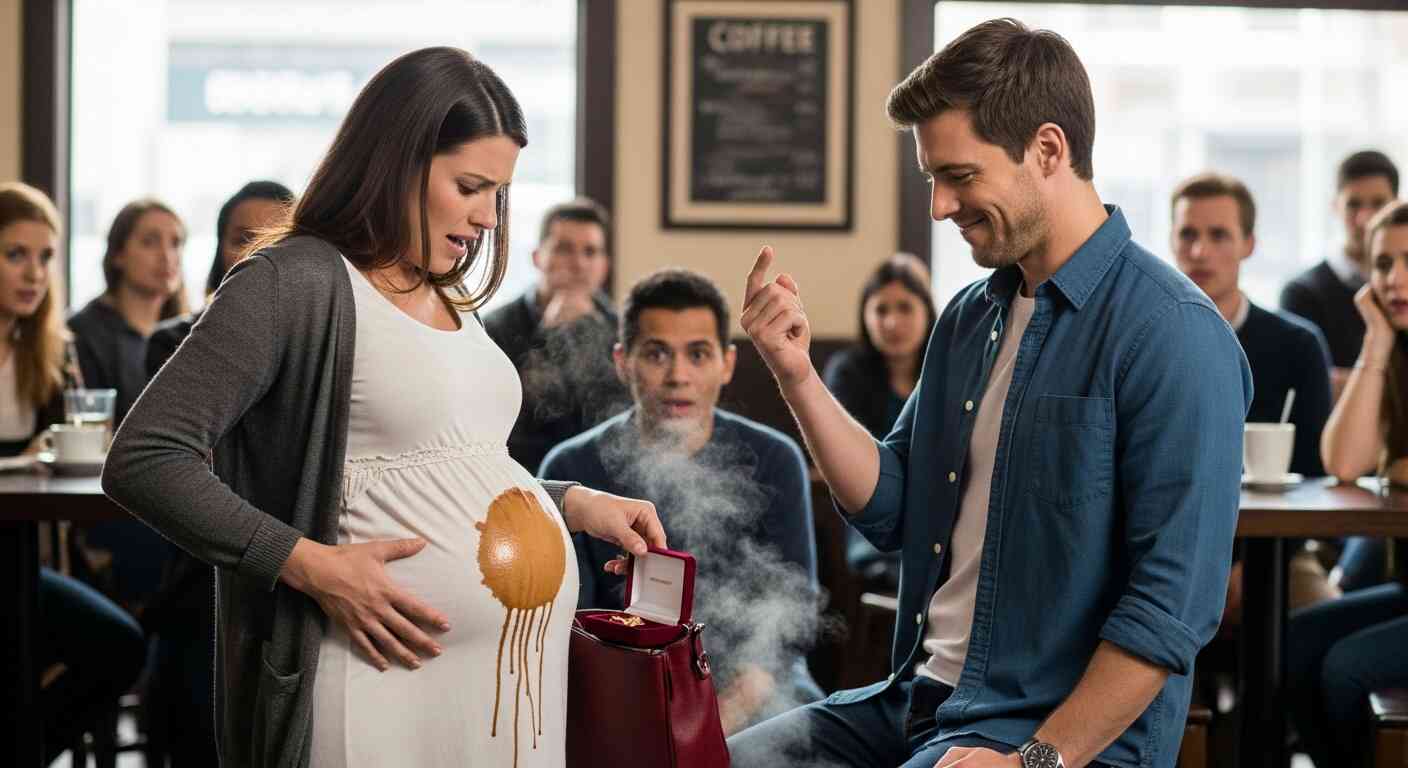
Thorne reached into his pocket and pulled out a handful of loose change. With a flick of his wrist, he showered the coins onto the dirty tile floor. They skittered and rang, several bouncing off my maternity leggings before settling at my feet.
“Pick it up,” he sneered, his voice loud enough for every patron to hear. “Pick it up, it’s more than your bastard will ever earn.”
My heart hammered against my ribs, but not with fear. It was the cold, clinical stillness that usually only came when I was standing over an open chest cavity. I didn’t cry. I didn’t scream. I looked at the nickel resting on the toe of my shoe, then I looked Marcus Thorne dead in the eye.
“Officer,” I said, my voice dropping into a low, terrifyingly calm register. “You should be very careful about who you choose to humiliate. You see, I recognized your name on that tag. You’re Marcus Thorne, aren’t you? Genetic cardiomyopathy. Blood type O-negative. Waiting list priority one.”
The sneer on his face faltered, just for a millisecond.
“I’m the surgeon performing your heart transplant tomorrow morning,” I said.
Thorne let out a jagged, nervous laugh, glancing at his partner who was now looking at the floor in shame. “You? A pregnant brat like you couldn’t hold a scalpel, stop lying. You’re probably a janitor at best.”
I didn’t blink. I reached into my bag and pulled out my hospital ID. I didn’t hand it to him. I held it up so the entire room could see the bold letters: DR. ELENA VANCE – CHIEF OF CARDIOTHORACIC SURGERY. Then, I pulled up the notification on my phone. The donor match. His medical record number was at the top.
Thorne’s face didn’t just go pale; it went grey. The kind of grey I usually see on a patient right before they flatline. His hand started to tremble, the bravado evaporating like mist in the sun. He looked at the coins on the floor, then back at the woman he had just called a “brat.”
The silence in the cafe was no longer awkward. It was heavy with the weight of a man realizing he had just spit on the only person who could save his life.
Chapter 1: The Weight of Copper
The humidity in Chicago usually felt like a warm blanket, but today it felt like a chokehold. I sat in the corner of “The Daily Grind,” my hand instinctively resting on the high arc of my stomach. Seven months pregnant, and every part of me ached—my lower back, my swollen ankles, and most of all, my heart.
I was waiting for a decaf latte, the only luxury I allowed myself between grueling shifts at St. Jude’s Memorial. The cafe was packed with the mid-morning rush: suits on their phones, students buried in laptops, and a pair of beat cops leaning against the counter.
One of them, a man with a jaw like a brick and eyes that looked like they hadn’t seen a kind thing in a decade, was complaining loudly. His name tag read Thorne.
“I’m telling you, Miller,” Thorne growled to his younger partner. “The world’s gone soft. Everyone wants a handout. Nobody wants to work for it anymore.”
I shifted in my seat, trying to find a comfortable position. My scrub top was peeking out from under my light jacket, the hospital logo visible. As I stood up to check on my order, my foot caught the edge of my heavy medical bag. I stumbled slightly, a sharp gasp escaping my lips.
I didn’t fall, but I bumped into Officer Thorne’s shoulder.
“Watch it!” he barked, spinning around. His eyes raked over me—the mess of my hair, the exhaustion in my eyes, and the prominent bump of my pregnancy.
“I’m so sorry,” I said, my voice steady despite the adrenaline. “I just lost my balance for a second.”
Thorne didn’t accept the apology. Instead, he looked at my scuffed sneakers and then back at my face with a look of pure, unadulterated disdain. “People like you are always looking for an excuse to be a victim. Dragging your problems into public, expecting the world to move for you because you couldn’t keep your legs closed.”
The cafe went silent. The clink of spoons stopped. I felt the blood drain from my face. “Excuse me?”
Thorne reached into his pocket and pulled out a handful of loose change. With a flick of his wrist, he showered the coins onto the dirty tile floor. They skittered and rang, several bouncing off my maternity leggings before settling at my feet.
“Pick it up,” he sneered, his voice loud enough for every patron to hear. “Pick it up, it’s more than your bastard will ever earn.”
My heart hammered against my ribs, but not with fear. It was the cold, clinical stillness that usually only came when I was standing over an open chest cavity. I didn’t cry. I didn’t scream. I looked at the nickel resting on the toe of my shoe, then I looked Marcus Thorne dead in the eye.
“Officer,” I said, my voice dropping into a low, terrifyingly calm register. “You should be very careful about who you choose to humiliate. You see, I recognized your name on that tag. You’re Marcus Thorne, aren’t you? Genetic cardiomyopathy. Blood type O-negative. Waiting list priority one.”
The sneer on his face faltered, just for a millisecond.
“I’m the surgeon performing your heart transplant tomorrow morning,” I said.
Thorne let out a jagged, nervous laugh, glancing at his partner who was now looking at the floor in shame. “You? A pregnant brat like you couldn’t hold a scalpel, stop lying. You’re probably a janitor at best.”
I didn’t blink. I reached into my bag and pulled out my hospital ID. I didn’t hand it to him. I held it up so the entire room could see the bold letters: DR. ELENA VANCE – CHIEF OF CARDIOTHORACIC SURGERY. Then, I pulled up the notification on my phone. The donor match. His medical record number was at the top.
Thorne’s face didn’t just go pale; it went grey. The kind of grey I usually see on a patient right before they flatline. His hand started to tremble, the bravado evaporating like mist in the sun. He looked at the coins on the floor, then back at the woman he had just called a “brat.”
The silence in the cafe was no longer awkward. It was heavy with the weight of a man realizing he had just spit on the only person who could save his life.
Chapter 2: Ghost in the Nursery
By the time I walked into my apartment that evening, the adrenaline had long since curdled into a heavy, dragging fatigue. The confrontation at the cafe looped in my mind like a broken film reel. I could still hear the clink of the coins.
I sat in the rocking chair in the nursery—the nursery that was still half-finished. A stack of flat-packed IKEA furniture sat against the wall, a silent monument to the man who was supposed to build it.
My husband, David, had been an ER doctor at the same hospital. He was the kind of man who would stop to help a turtle cross the road even if he was running late for a double shift. Six months ago, a drunk driver had decided a red light was a suggestion. David never made it home.
The “past wound” wasn’t just his death; it was the way it happened. The responding officer that night had been delayed by a minor fender bender a few blocks away, and David had bled out in the street while waiting for the perimeter to be cleared.
I looked at the ultrasound photo on the dresser. Our son. The “bastard,” as Thorne had called him.
A knock at the door startled me. It was Sarah, my younger sister. She was a nurse in the ICU, the only person who could look at me without that suffocating pity in her eyes.
“I heard what happened,” she said, walking in and dropping a bag of takeout on the kitchen island. “The whole hospital is buzzing. Miller—the rookie cop who was with Thorne—told the triage nurse. Elena, that man is a monster.”
“He’s a patient, Sarah,” I said, my voice sounding hollow even to me.
“He’s a bully with a badge,” she countered, her eyes flashing. “He’s the guy who thinks he’s God because he carries a gun. And now he’s terrified because he’s finally met someone who actually holds the power of life and death.”
“I’m not God,” I whispered. “I’m just a woman who’s tired of being the only one left standing.”
“You’re the best surgeon in this state,” Sarah said, grabbing my hands. “But you’re also human. You’re seven months pregnant, you’re grieving, and you just got publicly humiliated by the man whose life you have to save tomorrow. Do you honestly think you can go into that OR without your hand shaking?”
I looked at my hands. They were steady. They were always steady. But inside, I felt a tremor that had nothing to do with surgery.
“I have to,” I said. “Because if I don’t, I’m no better than the people who let David die.”
But as I lay in bed that night, the silence of the apartment felt like a physical weight. I thought about Marcus Thorne. I thought about the hate in his voice. And then I thought about the secret I’d kept from the hospital board—the fact that I had been having Braxton Hicks contractions for three days. I was pushing myself too hard.
A difficult moral choice lay before me. I could step down. I could let Dr. Aris, a competent but less experienced surgeon, take the lead. Thorne would have a 60% chance of survival instead of 90%.
Was 30% a fair price for a man’s cruelty?
Chapter 3: The Pre-Op Shadow
The hospital at 5:00 AM is a world of blue light and hushed voices. I stood at the scrub sink, the smell of antiseptic filling my lungs. It was a scent that usually brought me peace, but today, it felt clinical and cold.
My intern, a bright-eyed kid named Leo, was prepping the charts. He was nervous. Everyone was. The “incident” had become legend overnight.
“Dr. Vance?” Leo asked softly. “Patient Thorne is in Room 402. He’s… he’s asking for you.”
I dried my hands and walked down the hallway. The pacing of my heart was rhythmic, matching the clicking of my clogs on the linoleum. When I pushed open the door to Room 402, the air seemed to vanish.
Marcus Thorne looked different in a hospital gown. The badge was gone. The gun was gone. The bravado was gone. He looked small. His skin was the color of old parchment, and his breathing was shallow, hitched to the monitors that beeped in a steady, mocking tempo.
His partner, Miller, was sitting in the corner. When I entered, Miller stood up immediately, his face flushed with embarrassment.
“Dr. Vance,” Miller stammered. “I… I wanted to say I’m sorry. For yesterday. I should have said something.”
“It’s alright, Officer Miller,” I said, my eyes fixed on Thorne. “You weren’t the one throwing coins.”
Thorne didn’t look at me. He was staring at the ceiling. “Go ahead,” he rasped. “Do it. Tell me you’re going to let me die on that table. Tell me you’re going to get your revenge.”
I walked to the side of his bed. I didn’t feel anger anymore. I felt a strange, detached pity. “Is that what you would do, Marcus? If our roles were reversed? If I was bleeding out in the back of a squad car, would you drive slower?”
He flinched as if I’d struck him. He knew. He knew about David. He was the officer who had been at the scene of the fender bender that night. He was the reason the ambulance had been delayed.
“I didn’t know it was him,” Thorne whispered, his voice cracking. “I didn’t know who he was. It was just… another call. I was tired. I was bitter.”
“That’s the problem with bitterness, Marcus,” I said, leaning closer. “It doesn’t just hurt the people you aim it at. It rots you from the inside out. It’s rotting your heart right now.”
The silence that followed was broken only by the sound of the EKG.
“I’m terrified,” he admitted, a single tear tracking through the stubble on his cheek. “I don’t want to die. Not like this. Not being remembered for… for that cafe.”
“Then give me a reason to save you,” I said. “Because right now, I’m looking for one.”
I turned to leave, but his voice stopped me.
“Dr. Vance?”
I paused at the door.
“I’m sorry. About your husband. And about… about what I said. My father was a drunk. He used to throw things at my mother. I… I became the thing I hated.”
I didn’t answer. I walked out and headed toward the OR. The choice was no longer about 30%. It was about whether I could save a man who had spent his whole life trying to destroy himself.
Chapter 4: The Breaking Point
The surgery began at 8:00 AM.
The OR was a sanctuary of controlled chaos. The heart—the donor heart—was in a cooler, a miraculous gift from a family in Ohio who had lost a daughter. I looked at it and felt the familiar surge of reverence. This was a second chance.
“Scalpel,” I said.
The first hour went perfectly. Thorne’s chest was open, the bypass machine humming as it took over the work of his failing heart. I was in the zone, my hands moving with a precision that felt like prayer.
But then, the room tilted.
A sharp, searing pain radiated from my abdomen. I gasped, my grip tightening on the forceps.
“Dr. Vance?” Leo asked, his voice sharp with concern. “Are you okay?”
“I’m fine,” I lied.
Another wave of pain hit, stronger this time. It wasn’t Braxton Hicks. It was real. The stress, the lack of sleep, the emotional toll of the last twenty-four hours—my body was finally demanding its due.
“Elena, you’re pale,” the anesthesiologist, Dr. Marks, said. “Your heart rate is climbing on the monitor.”
“I said I’m fine!” I snapped.
We were at the most critical stage. Thorne’s old heart was out. He was completely dependent on the machine. If I stopped now, if I handed over the reins to Leo or called for back-up, the transition time could be fatal.
Then, the monitor behind me started to scream.
“Vitals are dropping,” Marks shouted. “He’s crashing on the bypass. There’s a leak in the aortic cannula!”
Blood started to spray, coating my gown, my mask, my face. It was a nightmare in high-definition.
“Clamp!” I yelled, but my hands—my steady, legendary hands—were shaking.
I was having a contraction so intense I felt like I was being split in two. I looked down at Marcus Thorne’s open chest, at the empty space where his heart should be, and then I looked at my own stomach.
I was at a crossroads. I could push through and risk the life of my child, or I could step back and risk the life of the man who had insulted my son before he was even born.
The memory of the cafe flashed back—the coins on the floor.
Pick it up, it’s more than your bastard will ever earn.
In that moment, I realized that if I let him die, I would be picking up those coins for the rest of my life. I would be letting his hate win.
“Leo, take the suction,” I commanded, my voice findind a new, iron-clad depth. “Marks, give me 50 of fentanyl. Not for him. For me.”
“Elena, you’re in labor,” Marks whispered.
“I am a surgeon,” I said, the pain receding into a cold, dark corner of my mind. “And this man is not going to die on my watch.”