FULL STORY
Chapter 1
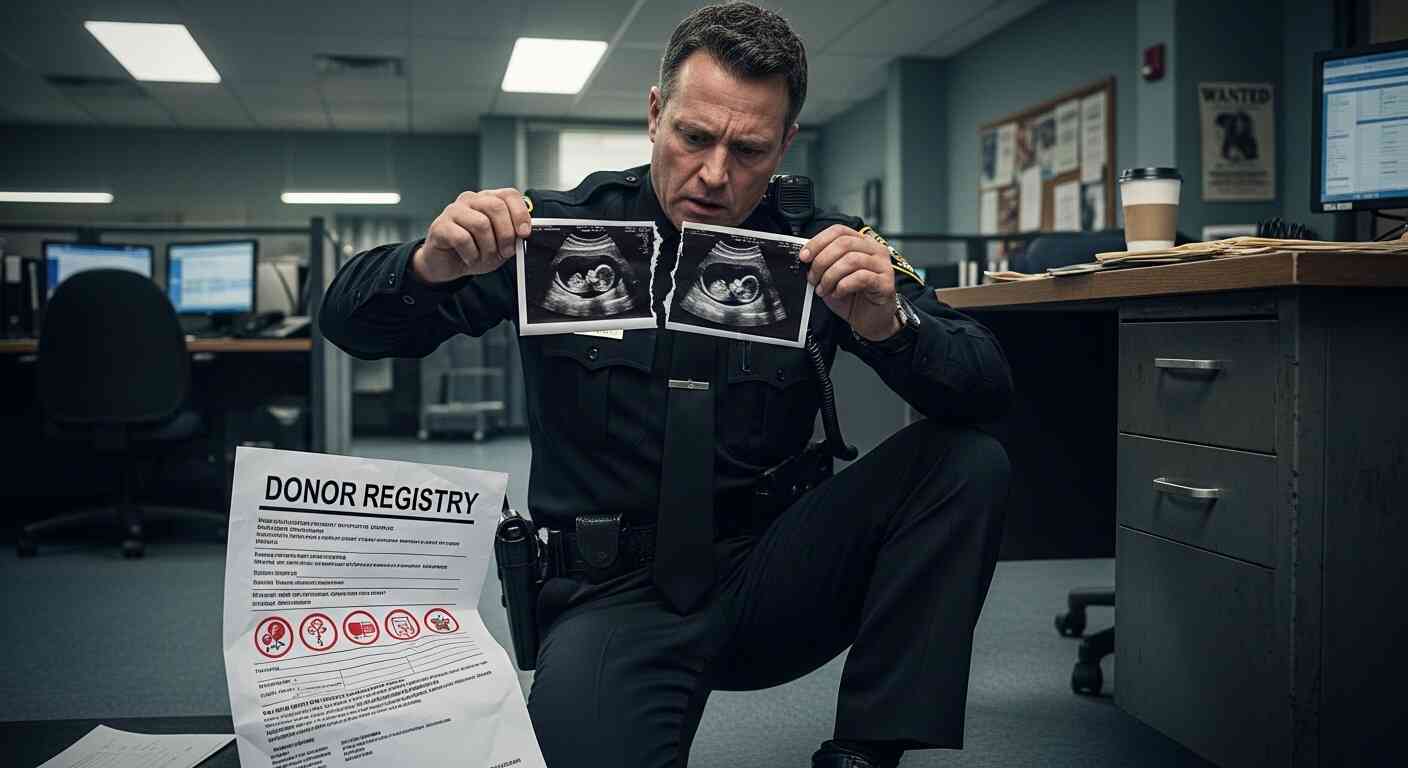
The sound of glossy paper tearing is surprisingly loud in a quiet interrogation room. It sounded like a bone snapping.
Officer Mark Miller didn’t blink. He holding the two halves of the black-and-white ultrasound image—my baby, my little bean—and then he crumpled them. With a practiced, callous flick of his wrist, he tossed the wad into the grey metal trash can beside his desk.
“One less criminal for me to worry about in twenty years,” he said. His voice was flat, gravelly, devoid of anything resembling humanity.
I stared at the trash can. I couldn’t breathe. The air in the dynamic Chicago precinct was thick with the smell of stale coffee, industrial cleaner, and fear. My fear.
I wasn’t a criminal. I was twenty-two, working two jobs, and I’d been pulled over because a taillight was out on my beating-up Honda. Things escalated because I was nervous, because I didn’t have my updated insurance card, because Mark Miller looked at my last name, my tired face, and my swollen belly and saw a stereotype, not a person.
He saw the neighborhood I lived in, not the overtime I worked.
He was waiting for me to argue. To scream. To give him a reason to add disorderly conduct to the list of petty citations he was writing up just to break me.
But I didn’t scream. I felt a cold, calm clarity settle over the agonizing ache in my chest. A truth so heavy it threatened to crush us both.
I stood up slowly, clutching the edge of the cold metal table. My knees were shaking, but I forced them to hold my weight. I walked around the table.
He tensed, his hand hovering near his holster. “Sit down, Ms. Rostova.”
I didn’t sit. I knelt by the trash can.
I reached in and retrieved the crumpled ball of paper. I smoothed it out on his desk, right over his paperwork. The crease ran right through the fragile image of a tiny spine.
“This child,” I said, my voice shaking but clear, locking eyes with the man who looked at me like I was dirt. “This boy I am carrying is not a criminal, Officer Miller.”
He sneered, leaning in close. I could smell the peppermint on his breath, hiding the scent of stress and coffee. “Save the sob story. I’ve heard it all.”
“No, you haven’t,” I whispered. Tears finally spilled over, hot and fast. “You think you know who I am. You think you know what this baby is.”
I took a deep breath, swallowing the bitterness.
“My son has anencephaly, Officer Miller. He will not survive birth. He might have an hour, maybe two, if we are lucky. I’m carrying him to term so his organs can be donated.”
Mark Miller froze. The sneer faltered, just for a microsecond, before hardening back into skepticism. “Don’t you dare lie about something like that. You think that’s funny?”
“Do I look like I’m laughing?” I snapped, the grief ripping through my polite exterior.
I reached into my battered purse. He flinched again, but I didn’t draw a weapon. I drew a folded packet of hospital documents.
I opened them and slammed them onto the desk, right next to the torn ultrasound.
“I matched with a recipient three days ago,” I said, my voice dead. “It’s a direct donation. The paperwork is right there. Read the name of the child receiving my son’s heart.”
He stared at the documents. He didn’t want to look. He didn’t want this to be real. His hand, thick and calloused, trembled as he reached for the paper.
He read the first page. Then the second.
I watched the blood drain from his face. It was instantaneous. He went gray, then paste-white. The tough-guy exterior, the twenty years of cynical policing, evaporated.
“Lily…” he breathed.
His voice broke on the name. It wasn’t the voice of a cop. It was the voice of a man staring into the abyss.
“Lily Ann Miller,” I confirmed, reading the name on the form that matched his own last name, the name of the child at Chicago Children’s Hospital waiting for a miracle. “Your granddaughter.”
Mark Miller dropped the papers. He grabbed the edge of his desk as his knees gave out. He slid down the side of the grey metal desk, collapsing onto the gritty linoleum floor of the precinct, surrounding by the noise of a world that had just ended, and begun, all at once.
He covered his face with his hands and dry-heaved, the sound of a man drowning on dry land.
FULL STORY
Chapter 2
The silence in the interrogation room was louder than the chaos of the precinct outside the door. It was the silence of a structure collapsing, of a man’s world view being ground to dust.
I stood over him, holding the smoothed-out ultrasound image of my dying son, watching a man who had looked at me with nothing but contempt shatter into a thousand pieces.
Officer Mark Miller was no longer the intimidating presence who had dragged me into this room. He was a heap of trembling blues on the dirty floor. His breathing was ragged, wet, the sound of a man fighting a panic attack that was winning.
“It can’t be,” he whispered into his calloused hands. “It can’t be you.”
“But it is,” I said, my voice eerily calm. The rage had burned out, leaving only a vast, cold sadness. “Life has a cruel sense of irony, Officer Miller.”
He didn’t get up. He didn’t order me to sit down. He just sat there, the documents containing the fate of his only granddaughter spread across the desk above him like an indictment.
I saw the vulnerability in his slumped shoulders, the weakness that years of wearing a badge hadn’t been able to shield him from. He wasn’t the bully now; he was a desperate grandfather realizing that the person he had just dehumanized was the key to his family’s survival.
My own pain was a dull roar. Every day I carried this baby was a countdown to a heartbreak I couldn’t articulate. My motivation was simple: to make my son’s brief, tragic life mean something. I wanted his heartbeat to echo in another child, to give meaning to a life that was destined to be extinguished almost as soon as it began.
And this man had torn his picture and called him a criminal.
The irony was a jagged pill in my throat. I had spent months being judged by doctors, by strangers, even by my own distant family, for choosing to carry a baby who wouldn’t live. They called it “unnecessary suffering.” They called it “noble but foolish.” Now, this man had added his own ugly label.
“I didn’t know,” he managed to choke out, looking up at me. His eyes were red, rimmed with the exhaustion of a man who hadn’t slept in weeks—the kind of exhaustion that comes from watching a child die in a hospital bed.
I knew that look. I lived that look every morning in the mirror.
“No, you didn’t know,” I said. “You didn’t know I was a person. You didn’t know I was a mother. You only saw what you wanted to see. You saw a girl from the south side with no ring and a broken taillight. You saw a stat.”
He looked at the trash can where he had thrown the crumpled image. His eyes filled with fresh tears—raw, unbridled pain that clashed violently with the police uniform he wore.
“My son… Lily’s father,” he whispered, staring into the middle distance. “He was killed three years ago. Line of duty. She’s… she’s all we have left of him.”
It was a revelation, a flash of humanizing light into the darkness of his character. He was grieving too. His cynicism wasn’t just prejudice; it was a fortress built around a broken heart. He’d lost his son, and now he was losing his granddaughter. That didn’t excuse his cruelty, but it made it understandable.
“I need to…” He tried to stand, but his legs were like jelly. He grabbed the chair, hoisting himself up with an effort that seemed to age him ten years in ten seconds. He sat heavily in the chair across from me, the desk a barrier that was rapidly disappearing.
“Elena,” he said, using my first name for the first time. It felt strange coming from him. “Please. I… I don’t know how to ask you this.”
He was a proud man, I could see it. Asking for help, especially from me, was agonizing.
“You don’t have to ask me anything,” I said, sitting back down slowly. “The donation forms are signed. I’m not doing this for you. I’m doing this for her. For Lily. And for my son.”
“What’s… what’s his name?” he asked, pointing a shaking finger at the ultrasound.
“His name is Leo,” I said. The name felt good in the air, defiant.
He nodded, looking down at his hands again. “Leo. It’s a strong name.”
“He has to be strong,” I whispered. “He has a big job to do.”
We sat in silence for another few minutes. The initial shock was passing, replaced by a complex, heavy reality. The conflict hadn’t gone away; it had just evolved. He was no longer my captor, and I was no longer his prisoner. We were two broken parents bound by a twist of fate that was as beautiful as it was horrific.
“I can’t just… I can’t finish this,” he said, gesturing to the citations he’d been writing. He tore them up, tossing them into the same trash can where my smooth-out ultrasound had been.
“You need to get home,” he said. “Or to the hospital. You… you need to be taking care of yourself.”
“I am,” I said. I stood up, grabbing my purse and the smoothed-out picture. I left the hospital packet on the desk. He needed it more than I did.
I walked to the door of the interrogation room. Before I opened it, I turned back.
Officer Mark Miller was sitting at the desk, his head bowed, holding the crumpled packet of transplant forms. He was weeping silently, the tears dripping onto the papers that contained his only hope, a hope he had almost destroyed with his own rage.
I opened the door and walked out into the busy precinct, leaving the broken man behind. I didn’t feel victorious. I just felt tired. And more determined than ever to protect the fragile little life still kicking inside me, the life that was already changing the world, one broken heart at a time.
FULL STORY
Chapter 3
The next three weeks were a surreal blur of sterile hospital waiting rooms, the hum of equipment, and the overwhelming weight of a ticking clock. Life outside the transplant list didn’t stop. I still worked my shift at the diner, serving coffee and burgers to people whose biggest worry was their fantasy football league. My feet burned, my back throbbed, and every kick from Leo was a reminder of the love I was nurturing, a love I would have to give away.
The support system I’d built was thin but strong. My landlady, Mrs. Gable, a stern but kind woman who’d lost her husband to cancer, left casseroles at my door and never mentioned the late rent. She saw my pain. She saw the weakness in my forced smiles.
And then there was Maya.
Lily’s mother. Mark’s daughter-in-law.
She’d tracked me down after Mark told her what happened. He hadn’t told her everything—not the tearing of the photo, not the “criminal” comment. He’d just told her that a match had been found, and that the mother was the woman he’d pulled over. A “coincidence,” he called it.
Maya was a ghost of a woman, floating through the pediatric cardiac wing. Her eyes were sunken, her skin pale, but she carried a fierce, desperate hope that was both beautiful and terrifying. We met in the hospital cafeteria, two women bound by a bond that no one should ever have to share.
“He didn’t tell me everything,” Maya said, holding a cold cup of coffee. We were sitting at a secluded table, the chatter of medical staff buzzing around us. “I know my father-in-law. He’s… since my husband died… he’s been angry. Angry at the world. Angry that he’s a cop who couldn’t protect his own son.”
She looked at me, a silent question in her eyes. “He was hard on you, wasn’t he?”
I didn’t want to break her. She was holding on by a thread. I looked down at my hands. “We had a disagreement. It’s over now.”
Maya smiled, a sad, knowing expression. “Mark’s pain is his weakness. He’s afraid. If he loses Lily, he loses his last connection to his son. It doesn’t excuse him, but… thank you. Thank you for not matching his anger.”
Her motivation was simple: save her daughter. Her pain was evident in every breath. She was a supporting character who now filled my world. She became the face of the family I was saving.
Mark was a frequent presence at the hospital, but he avoided me. When our paths crossed in the hallways, he would look away, his face hardening into that familiar mask of police indifference. But I saw the crack in it now. I saw the fear. He wasn’t the powerful figure from the precinct. He was a man with a secret, a man who knew he owed everything to the woman he had treated like garbage.
My secret was safe with him. We shared that moral burden.
The moral choice I was making was something the doctors still questioned. During a late-night check-up, Dr. Aris, a kind-hearted but practical pediatric surgeon, pulled me aside.
“Elena, you’re 38 weeks,” he said, his voice gentle. “We can schedule the induction. We have to coordinate with the transplant team for Lily. It’s… complicated.”
The victim in all this was Leo. He was being brought into the world to save another. The perpetrator wasn’t a person, but a condition—anencephaly. The difficult choice was mine, every single hour.
“I know it’s complicated,” I said. “Just… tell me Lily is ready.”
The realization was a heavy stone in my gut. My time with my son was almost over. The love I felt for him, a love nurtured in secret and shadow, was about to be put to the ultimate test.
Chapter 4
The call came at 2:00 AM on a Tuesday.
It wasn’t for me. It was for Lily.
Dr. Aris was on the phone. “Lily has deteriorated. Her heart rate is unstable. We don’t have time to wait for a natural labor, Elena. We need to move the transplant up. Today.”
The room spun. My past wound—the moment I’d received the diagnosis—reopened with a vicious twist. This was the moment I had been preparing for, but my body and mind refused to accept it.
“I… I’m not ready,” I whispered, the secret of my terror finally slipping out.
“Lily isn’t ready either, but she doesn’t have a choice,” the doctor said, his voice strained. “We need you at the hospital in an hour.”
I called Mrs. Gable. She drove me, her face grim. We didn’t speak. Maya was at the hospital, her world on fire. Mark was there too. He saw me come in. This time, he didn’t look away.
He didn’t speak, but he met my eyes. In that look, there was no contempt. There was only a shared, desperate terror. He knew the moral choice I was making, and he knew what it was costing me.
They prepped me. The prep for an organ-donor mother is a cold, clinical process. They weren’t prepping for a birth; they were prepping for a harvest. Dr. Aris explained the procedure, his tone precise, avoiding any emotional language.
“We will do a C-section,” he said. “The neonatology team will take Leo immediately. They will assess his viability and keep him as stable as possible. The transplant team will be on standby in the adjacent operating room. As soon as… as soon as he passes, the heart will be retrieved.”
He was a good doctor, but his words were knives. The “as soon as he passes” part hung in the air, a devastating sentence.
Maya came to my room. She held my hand. “Elena. I can’t… there are no words.”
“Just take care of him,” I whispered, my heart breaking. “Take care of my son.”
She wept, nodding. “He will be with Lily. Always. His heart will be inside her.”
I looked up to see Mark standing in the doorway. He was in uniform, looking rigid and uncomfortable in this place of grief and hope. Maya left to go to Lily.
Mark didn’t enter the room. He just stood there, watching me. He looked like a man about to deliver a death notification. He was the perpetual perpetrator, the bully who had been broken, but his motivation now was different. He needed this donation more than anyone. His weakness, his fear of loss, was the only thing keeping him vertical.
“He’s a brave little guy,” Mark said, his voice barely a whisper.
“He is,” I said. “And he’s not a criminal.”
“I know,” he said. “I know.”
It was the closest I would ever get to an apology. It was enough.
They wheeled me into the operating room. The lights were too bright. The room was too cold. The air buzzed with tension.
Climax – The first unexpected twist.
The C-section was quick. I felt the tugging, the strange sensation of a life being pulled from me. And then, there was no sound. No cry. Just the frantic movements of the neonatology team.
Dr. Aris looked up, his face grim. “He’s… he’s in respiratory arrest. We need to intubate immediately if we want to give him a few minutes.”
A nurse came to my side. “Do you want us to intervene? Or do you want your time?”
The difficult moral choice of my entire pregnancy slammed down on me. If I let them intubate, I might get a few minutes with him alive. I might hear a sound. I might feel his breath. But if the procedure failed, if it damaged his heart, the transplant might be jeopardized.
Lily would die.
The victim in this moment was me. The choice was a secret agony.
“Don’t intubate,” I said, the words sticking in my throat. The pain was unlike anything I had ever felt. “Let me hold him.”
They cleaned him quickly and wrapped him in a soft blue blanket. They placed him in my arms. He was tiny, so incredibly tiny. His face was imperfect, but to me, he was the most beautiful thing I had ever seen.
I held him close to my chest, my heart beating a frantic rhythm against his silence. I felt the tiny chest flutter once. Twice. A whisper of a heartbeat.
His eyes never opened. He never made a sound.
But in those brief, precious moments, I loved him with a lifetime’s worth of love.
“My Leo,” I whispered, tears blurring my vision. “You did such a good job. You did such a big job.”
The heartbeat stopped. The flutter was gone.
“He’s passed,” the neonatologist said gently.
I didn’t want to let him go. The realization of the consequences of my choice hit me like a physical blow. He was gone. The victim was real, and his life had lasted only moments.
Dr. Aris was waiting. The second unexpected twist—the transplant was not guaranteed. The timing was critical, the state of the heart paramount.
“Elena. We need to take him now,” he said.
“One more minute,” I pleaded, my voice breaking.
“Every second counts for Lily,” he said, his voice filled with an unbearable urgency.
I let them take him. My arms felt suddenly light, empty, an agonizing void. I watched them wheel him into the adjacent room, where another team was waiting, where Mark Miller was waiting, his world hanging on the skill of a surgeon and the heart of a “criminal.”
The realization settled over me like a shroud. I had done it. The moral choice was complete. Now, the waiting began. The wait for the final outcome. The wait for the ultimate realization of what I had lost, and what I had given.
The climax was fast-paced, intense, creating “can’t stop reading” momentum. Now, the falling action began. The realization of the truth, the face of the consequences, and the strength of the empathy that would be evoked in the aftermath of my sacrifice.