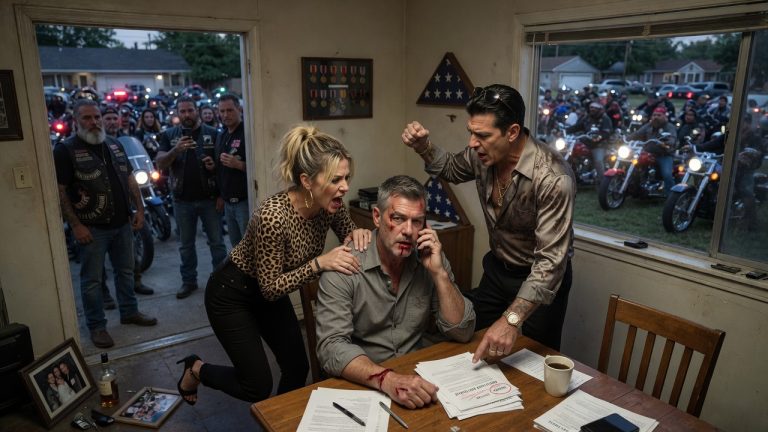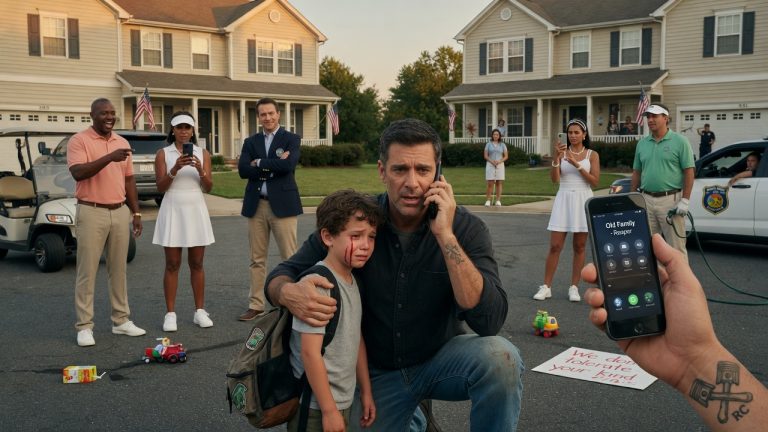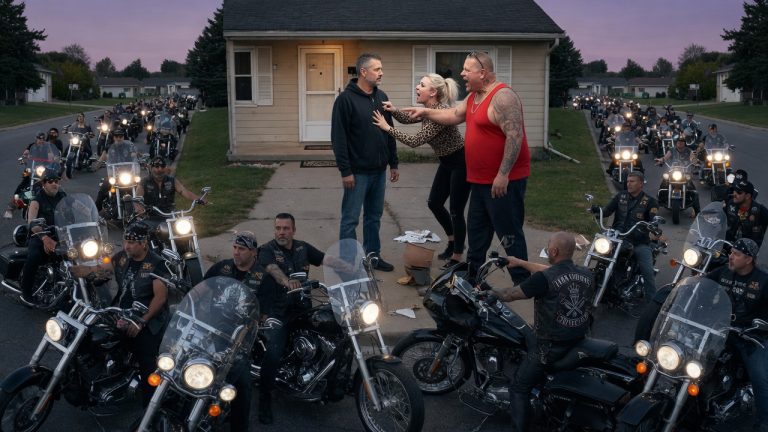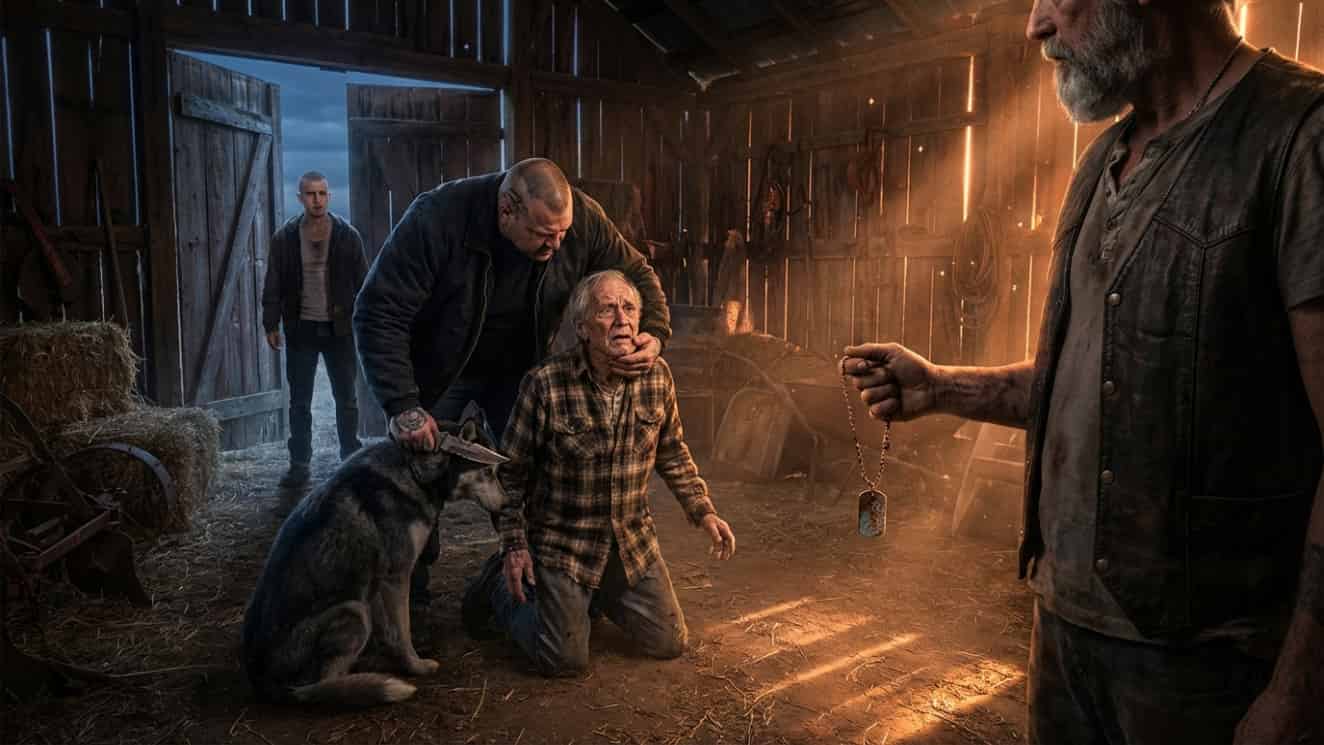
But when the Iron Fang bikers cornered the old man in his own barn, Wraith didn’t come to save a brother. He came to reclaim a debt.
When that rusted dog tag hit the floor, the “hero” of Bonner’s Ferry turned white. Because the truth isn’t just a secret anymore—it’s a death sentence. And Wraith isn’t leaving until the ledger is balanced in blood.
The Fangs think they want Miller’s land. They have no idea they’ve just walked into a war that started in 1972.
FULL STORY: THE GHOST DIVISION’S RETURN
Chapter 1: The Weight of Dry Dust
The Idaho panhandle didn’t forgive mistakes, and it certainly didn’t forget them. In Bonner’s Ferry, the wind came off the Moyie River with a bite that tasted like pine needles and old diesel. Wraith sat on the porch of his cabin, a structure of cedar and grit that sat five miles past where the pavement ended. He was dragging a whetstone across the blade of a Ka-Bar, the rhythmic shick-shick the only sound against the looming silence of the mountains.
Below the ridge, Miller’s farm sat like a dying animal. The fences were sagging, the paint on the silo was peeling away in long, gray strips, and the red barn looked like it was one heavy snow away from a total collapse.
Wraith didn’t like looking at it. Looking at it made his chest tight, a sensation like breathing in humid jungle air that hadn’t been there for fifty years. But he looked anyway. He looked because he was a sentry, and a sentry doesn’t get to choose the terrain.
A cloud of dust rose from the county road. It wasn’t the slow, drifting plume of a local tractor. This was fast. Aggressive. The sound followed—the high-pitched whine of over-tuned Harleys and the guttural roar of a stripped-down truck.
“They’re early,” Wraith muttered.
He stood up, his knees popping like dry kindling. He wasn’t the man he’d been in the Ghost Division, the scout who could move through the brush without displacing a single leaf. He was sixty-eight years old, his back was a map of scar tissue, and his hands shook if he didn’t keep them busy. But the eyes—pale, washed-out blue—were still the eyes of a predator.
He walked to his ’78 Shovelhead, the bike he’d rebuilt three times over. It was black, chrome-less, and smelled of oil and hot metal. He kicked it over on the first try, the vibration rattling his teeth.
As he descended the ridge, he saw them. Four bikes and a beat-up Ford F-150. They were parked in a semi-circle around Miller’s front porch. The riders were wearing vests with the “Iron Fang” rocker on the back—a jagged, bloody canine logo that screamed of insecurity and meth-fueled bravado.
Wraith pulled up twenty yards back, cutting his engine. He didn’t dismount. He just sat there, watching.
Skall, the leader of the Fangs, was already on the porch. He was a thick-necked man with a shaved head and a swastika peeking out from under his collar. He was leaning into Miller’s space, his hand resting on the holster of a Glock 19.
“I told you yesterday, old man,” Skall’s voice carried on the wind. “The lease is up. The ‘Division’ doesn’t own this dirt anymore. We do.”
Miller looked small. He was wearing a faded “Vietnam Veteran” hat that sat crooked on his thinning white hair. His hands were tucked into his pockets, but Wraith could see his shoulders jumping. Miller was a man built on a foundation of hollowed-out timber.
“I have the deed, Skall,” Miller said, his voice thin. “My grandfather settled this. You can’t just…”
Skall laughed, a harsh, barking sound. He reached out and flicked the brim of Miller’s hat. “Your grandfather is dead. And you’re just a ghost waiting for a hole. Now, where’s the dog?”
From around the side of the house, a large Husky-mix named Smoke bounded out, barking. The dog wasn’t aggressive; he was just confused. He trotted toward Miller, his tail low.
One of the bikers, a kid no older than twenty named Micky, stepped forward and swung a heavy boot. He caught Smoke in the ribs. The dog let out a sharp, yelping cry and scrambled back toward the porch, limping.
Miller let out a sound—a choked, pathetic sob. “Don’t… please, he’s all I have left.”
Wraith felt the old heat rise. It wasn’t justice. It wasn’t even a desire to protect Miller. It was the dog. Smoke looked exactly like a stray they’d picked up in a village outside Da Nang, a scrawny mutt they’d named ‘Tripwire’ who’d died in the same clearing where the Ghost Division had been broken.
Wraith kicked the kickstand down. The metal sparked against the gravel.
“Hey,” Wraith said. It wasn’t a shout. It was a low, vibrating frequency that cut through the biker’s laughter.
Skall turned, squinting through the dust. “Well, if it isn’t the hermit. You lost, old man? Or did you finally come down to sell me that Shovelhead?”
Wraith walked forward, his gait slow and deliberate. He stopped ten feet from the porch. He didn’t look at Skall. He looked at the kid, Micky, who was still wearing a smirk.
“You kick that dog again,” Wraith said softly, “and I’m going to take that boot off your foot and feed it to you. Heel-first.”
The smirk on Micky’s face flickered. He looked at Skall for direction.
Skall stepped off the porch, his thumbs hooked into his belt. “You got a lot of nerve, Wraith. You’re one man with an expired social security card. We’re the future of this county. We got the sheriff in our pocket and the law on our side.”
“You don’t have the law,” Wraith said. “You have a badge you bought for a few ounces of crank. That’s not the same thing.”
“Big words for a guy who hides in the woods,” Skall sneered. He turned back to Miller. “Tomorrow, Miller. Have the papers signed, or we start taking the dog apart piece by piece in front of you. And Wraith? Stay on your ridge. Or you’ll find out why we’re called the Fangs.”
The bikers roared to life, kicking up a wall of stinging grit as they peeled away. Wraith stood there until the sound faded into the tree line.
He looked up at the porch. Miller was sitting on the top step, his head in his hands. Smoke was huddled against his side, licking a bruised flank.
“You okay, Miller?” Wraith asked.
Miller didn’t look up. “You shouldn’t have come down, Wraith. They’ll kill you too. They don’t care about what we did back then. They don’t care about the Division.”
“I didn’t come down for the Division,” Wraith said, his voice turning cold. “I came down because I wanted to make sure you were still alive.”
Miller finally looked up, his eyes watery and red. “Why? After everything I… after what happened in the Highlands? Why do you even care if I breathe?”
Wraith stepped closer, the shadow of his tall frame falling over the broken man. “Because I’m not done with you yet, Miller. And I’m not letting a bunch of tweakers in leather vests take the one thing I’m owed.”
“What’s that?” Miller whispered.
“The truth,” Wraith said. “And the chance to be the one who finally puts you in the ground.”
Wraith turned and walked back to his bike, leaving Miller alone in the deepening Idaho shadows.
Chapter 2: The Ghost of 1972
The flashback didn’t come in pictures. It came in smells. The scent of rain-soaked rot, the metallic tang of spent brass, and the ozone of a looming storm.
Wraith sat in his kitchen, a single yellow bulb swaying overhead. On the table sat a shoebox. Inside was a collection of things that shouldn’t exist: a map with scorched edges, a handful of black-and-white photos of men with hollow eyes, and a rusted M16 firing pin.
He picked up the pin. It was the piece of evidence that had ended his career and started his exile.
June 14, 1972. The Ghost Division—a long-range reconnaissance patrol—had been inserted into the Central Highlands. Their job was to spot North Vietnamese movement along a supply vein. They weren’t supposed to engage. They were supposed to be ghosts.
But the ghosts had been haunted.
Miller had been the point man that day. He was young, jittery, and suffering from a fever that made his eyes yellow. They’d walked into a horseshoe ambush. The world had turned into a screaming kaleidoscope of green tracer fire and claymore blasts.
In the chaos, Wraith had shouted for the squad to fall back to the secondary extraction point. He’d been the sergeant, the one responsible for the lives of seven men.
He remembered the screaming. He remembered the smoke. And he remembered seeing Miller, panicked and blind, swinging his rifle toward a shadow in the brush.
“Wait! It’s Gibson!” Wraith had screamed.
But Miller had pulled the trigger. A full burst.
Gibson, their radio operator, had gone down. He hadn’t been killed by the NVA. He’d been killed by Miller’s panic.
When the dust settled and the Huey finally pulled them out of the blood-slicked clearing, the inquiry began. The Army needed a scapegoat for the friendly fire incident. They needed someone to blame for the loss of a valuable radio op and the failure of the mission.
Miller had looked at Wraith in the debriefing room. He’d been shaking, his career ahead of him, his father a decorated Colonel back in Virginia.
“Sergeant Wraith gave the order to fire on the movement,” Miller had whispered to the JAG officers. “He said it was a hostile flanker. I just followed the order.”
Wraith hadn’t fought it. He’d looked at the broken boy across the table and saw a life that would be destroyed by the truth. He’d seen a kid who wouldn’t survive a dishonorable discharge. So, Wraith had taken the fall. He’d accepted the blame, the stripped rank, and the quiet exit into a world that hated him anyway.
He’d spent fifty years in these mountains, watching Miller return as a “war hero.” The town had given Miller a parade. They’d given him the farm. They’d called him the “Lion of the Highlands.”
And Wraith had stayed in the shadows, the “Ghost” who had supposedly butchered his own men.
A knock at the cabin door snapped the memory like a dry twig.
Wraith grabbed the Remington 870 leaning against the counter. He didn’t ask who it was. He just leveled the barrel at the door.
“It’s Micky,” a voice squeaked from outside. “The kid from the bikes. Don’t shoot, please.”
Wraith lowered the shotgun slightly but didn’t put it down. He opened the door. The kid was standing there, his Iron Fang vest gone, replaced by a dirty hoodie. He looked terrified.
“What do you want?” Wraith asked.
“Skall… he’s going back tonight,” Micky said, his breath hitching. “He’s not waiting for tomorrow. He found out Miller has some old medals in the house. Real ones. Silver Stars. Skall thinks they’re worth money on the black market. He’s going to burn the place with the old man inside.”
Wraith looked at the kid. “Why are you telling me?”
Micky looked down at his boots. “My grandpa was in the Navy. He told me about the Ghost Division. He said you guys were the real deal. What Skall’s doing… it ain’t right. And the dog… I didn’t mean to kick him. Skall makes us do things to prove we’re ‘hard’.”
Wraith grabbed his leather vest. He didn’t say thank you. He didn’t offer the kid a seat. He just pushed past him toward the Shovelhead.
“Where are you going?” Micky called out.
“To finish a conversation that started in 1972,” Wraith said, kicking the bike to life.
Chapter 3: The Scent of Kerosene
The air around Miller’s farm was already thick with the smell of gasoline by the time Wraith saw the flickering orange glow.
He didn’t use his headlights. He knew the trail by heart, a winding path through the pines that came out behind the silo. He cut the engine a quarter-mile out and let the bike coast, the tires whispering over the pine needles.
He moved through the dark like the scout he used to be. Every step was a calculated silence.
The Fangs were there. They’d already kicked in the front door. Miller was being dragged out onto the lawn, his pajamas torn, his bare feet bleeding from the glass shards on the porch.
Skall was holding a red plastic jerry can. He was splashing the fuel against the siding of the house, his face lit by the erratic beams of the bikers’ flashlights.
“Where are they, Miller?” Skall yelled. “The medals. The Silver Star. I know you got ’em hidden in a floorboard. Tell me where, or I drop the match.”
Miller was on his knees, his face a mask of agony. “They aren’t mine to give, Skall. Please… they belong to the men who didn’t come back.”
“They belong to whoever’s holding the match!” Skall screamed. He turned to one of his men. “Check the barn again. If he won’t talk, we start with the dog.”
Wraith watched from the shadows of the silo. He saw two bikers heading toward the barn. He knew Smoke was locked in there. He also knew Miller had been keeping a secret in that barn—a secret Wraith had helped him hide for five decades.
Wraith didn’t go for the house. He went for the barn.
He intercepted the first biker near the tractor shed. It wasn’t a fight; it was an extraction. Wraith stepped out of the darkness and drove the butt of his Remington into the man’s solar plexus. As the biker folded, Wraith caught him to keep his gear from clattering, then finished him with a precise strike to the temple.
The second biker turned, his eyes widening, but Wraith was already there. He grabbed the man’s throat, slamming him against the rough timber of the barn wall.
“Not a sound,” Wraith hissed.
The biker tried to reach for a knife, but Wraith twisted his arm until the bone groaned. “Where’s the rest of your crew?”
“At the… the bridge,” the biker wheezed. “Skall called for backup. Twenty more coming from the compound.”
Wraith dropped him. He didn’t kill him, but the man wouldn’t be walking for a week.
Wraith entered the barn. Smoke was whimpering in a stall, his fur matted with sweat. But that wasn’t what Wraith was looking for.
In the back of the barn, under a tarp covered in fifty years of dust, sat a massive, industrial-sized crate. It was marked with U.S. Army stencils that had long ago faded into the wood.
Wraith pried the lid open with a crowbar.
Inside, preserved in cosmoline and heavy plastic, were the remnants of the Ghost Division’s final cache. M16s, crates of ammunition, and three M79 grenade launchers. They hadn’t turned them in. When the unit was disbanded in disgrace, Wraith and Miller had smuggled the gear out of the armory, a final act of defiance against a country that had discarded them.
“Time to wake up the ghosts,” Wraith whispered.
He grabbed a bandolier of 40mm HE rounds and the “thumper”—the M79. He stuffed his pockets with magazines and slung a rifle over his shoulder.
He walked out of the barn just as Skall struck a Zippo.
The flame was small, but in the Idaho night, it looked like a star. Skall held it over the porch railing, grinning down at Miller.
“Last chance, hero.”
“Skall!” Wraith’s voice rang out, echoing off the mountainside.
Skall turned, squinting into the darkness. “You again? You’re a persistent old bastard, aren’t you?”
Wraith stepped into the light of the flashlights. He was silhouetted against the barn, a specter of wood and steel.
“I told you to stay on the ridge,” Wraith said. “But I realized I forgot to give Miller something.”
He held up the rusted dog tag, the one from the shoebox.
“What the hell is that?” Skall laughed. “Jewelry?”
“It’s a receipt,” Wraith said. “For a debt that’s fifty years past due.”
Wraith didn’t aim at Skall. He aimed the M79 at the Ford F-150 parked twenty yards away.
THUMP.
The grenade launcher’s signature sound was a low, hollow pop. A second later, the truck erupted in a geyser of orange flame and shrapnel. The force of the blast knocked the bikers to the ground and sent Skall tumbling off the porch.
“The war isn’t over, Skall,” Wraith shouted over the roar of the fire. “It just moved to Idaho.”
Chapter 4: The Librarian’s Witness
The explosion had done more than destroy a truck; it had shattered the silence of the valley. But in a place like Bonner’s Ferry, people didn’t call the police when they heard gunfire. They locked their doors and grabbed their own rifles.
Except for Sarah.
Sarah was the town librarian, a woman in her fifties with sharp eyes and a memory for every family secret in the county. She had been the one who organized the parades for Miller. She was the one who had written the “Hero of the Highlands” plaque that sat in the town square.
She had been driving home from a late shift at the community center when she saw the fire. She pulled her Subaru over at the edge of Miller’s property, her heart hammering against her ribs.
She saw the carnage. She saw the bikers scrambling, screaming in the dark. And she saw Wraith.
She knew him, of course. Everyone knew the “Crazy Sergeant” who lived on the ridge. She’d been taught to pity him, to see him as the dark shadow to Miller’s bright light.
But as she watched from behind a thicket of alder trees, the narrative began to crack.
She saw Wraith move through the firelight. He wasn’t acting like a madman. He was acting like a professional. He wasn’t firing wildly; he was suppressing the bikers with short, controlled bursts, forcing them away from the house and toward the open field.
She saw him reach Miller. She saw him grab the old man by the collar and haul him toward the cover of a stone well.
“Wraith, stop!” Miller was screaming, his voice cracked with terror. “They’ll kill everyone! Just let them have it!”
“Shut up, Miller!” Wraith hissed. “You’ve been hiding behind me for fifty years. Tonight, you stand on your own two feet.”
Sarah crept closer, her phone out, the camera recording. She shouldn’t have been there, but the librarian in her couldn’t look away from a story being rewritten in real-time.
She saw Skall crawl out from under the porch, his face blackened by soot, his eyes wild with rage. He pulled his Glock and began firing blindly into the dark.
“I’m going to kill you both!” Skall shrieked. “I’m going to burn this whole mountain down!”
One of the bikers—Micky—ran toward Skall, trying to pull him back. “Skall, we gotta go! The whole town heard that blast! The sheriff can’t cover this up!”
Skall didn’t listen. He backhanded Micky, sending the kid sprawling. “I don’t care! I want that Silver Star! I want the blood of the ‘hero’!”
Sarah watched as Wraith stood up from behind the well. He didn’t fire his rifle. He held out the dog tag again, dangling it in the flickering light of the burning truck.
“You want to know about the Silver Star, Skall?” Wraith’s voice was unnervingly calm. “You want to know how Miller earned it?”
Miller let out a piteous moan. “Wraith, don’t. Please. Not like this.”
“He earned it by killing his own man,” Wraith said, his voice carrying clearly to Sarah’s phone. “He earned it by shooting Gibson in the back because he was too scared to check his fire. And I let him take the medal so he wouldn’t kill himself from the shame. I took the blame so he could have this farm. I gave him my life, Skall. And look what he did with it.”
The world seemed to go still. The crackle of the fire was the only sound.
Sarah felt a chill that had nothing to do with the night air. The plaque in the square. The speeches. The history of the town. It was all a lie. The man they’d worshipped was a coward, and the man they’d shunned was a saint of the dirt.
Skall froze, his gun hand wavering. Even a man like him understood the weight of that kind of betrayal.
“You’re lying,” Skall spat, though the conviction was gone from his voice. “He’s a war hero.”
“Look at him,” Wraith said, pointing at the shivering Miller. “Does that look like a hero to you? Or does it look like a man who’s been waiting fifty years for the truth to catch up to him?”
Sarah hit ‘stop’ on her recording. She knew what she had to do. She didn’t call the police. She called the one group of people who still lived by a code, even if it was a bloody one.
She called the Ghost Division’s survivors. She knew their names from the library archives. She knew they were scattered across the Northwest, old bikers and forgotten veterans who still wore the “Ghost” patch on the inside of their jackets.
“It’s Sarah from Bonner’s Ferry,” she whispered into the phone. “The Ghost is under fire. And the Lion is a lie. Come home.”