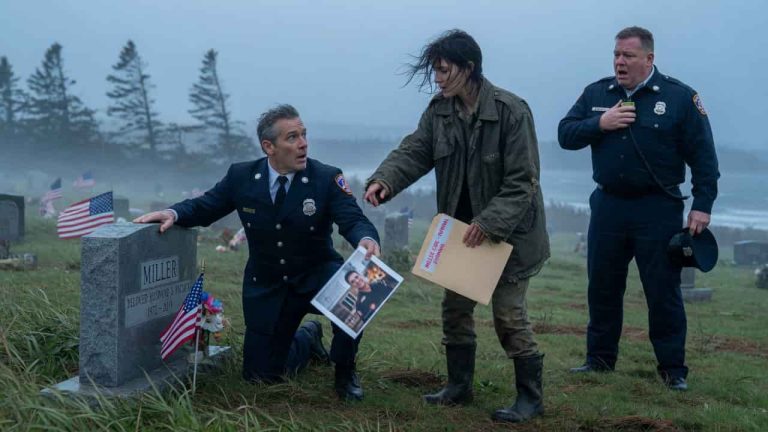
The lobby of the Boston Chronicle is usually a place of hushed whispers and the clicking of expensive heels, but today, the silence was different. It was the kind of silence that happens right before a bomb goes off. My daughter, Mia, stood there with her lip bleeding, her mother’s old film camera lying shattered on the floor like a piece of junk. Marcus Sterling, the man the polls say is the “future of this state,” was still adjusting his cufflinks, looking at her like she was something he’d stepped in on the sidewalk.
“You should learn your place, sweetheart,” Sterling said, his voice smooth as silk and twice as thin. “Some questions don’t get asked. Not by people like you.”
Miller, the editor-in-chief—a man who’d sell his own mother for a Pulitzer—was already nodding, looking for a way to bury the story before it even breathed. He didn’t see me standing by the heavy glass doors. He didn’t see the way the light caught the Northeast Union patch on my back.
I promised Sarah I’d keep the world clean for our girl. I promised I’d never let the shadow of the club touch her life. But Sterling didn’t just hit a journalist. He hit a Thorne. And he did it in a house I bought with blood and ink ten years ago.
“Miller,” I said, my voice cutting through the room like a rusted blade. “Check the deed in the safe. Then tell the Governor why he’s about to lose everything.”
Chapter 1: The Weight of the Leather
The smell of 20W-50 oil and stale coffee was the only thing that ever really made sense to Elias Thorne. He sat on a low stool in the back of the Northeast Biker Union’s main garage, his hands buried deep in the guts of a 1998 Electra Glide. His knuckles were scarred, the skin permanently stained with the grey-black patina of a man who lived by the wrench. To the guys in the club, he was “Crow,” the President who had kept the peace through three turf wars and two federal investigations. To the rest of the world, he was a ghost in a leather vest.
But to Mia, he was just Dad. And that was the problem.
“You’re doing it again,” Mia said, leaning against the corrugated metal doorframe. She was dressed in a sharp navy blazer and grey slacks, a stark contrast to the grease-caked environment. She looked so much like Sarah it made Elias’s chest ache—a physical, radiating heat that started in his lungs and ended in his throat.
“Doing what?” Elias didn’t look up. He felt for the 1/2-inch socket, his fingers moving with a precision that belied their size.
“The brooding. The ‘I wish my daughter worked in a library instead of a newsroom’ look,” she said, stepping over a puddle of coolant. She held up a vintage Leica M3 camera, the leather strap frayed and worn. “I’m taking Mom’s camera today. The interview with Sterling is at two.”
Elias stopped. The ratchet clicked once, then fell silent. He wiped his hands on a rag that was already too dirty to do much good. “Sterling. The Governor’s pet.”
“He’s the frontrunner for the Senate seat, Dad. It’s a big deal. Miller is letting me shadow the lead political reporter. It’s my foot in the door.”
Elias stood up, his knees popping. At fifty-five, he was still a wall of a man, six-foot-four with shoulders that filled a doorway. He looked at the camera in her hand. It was the same one Sarah had been carrying the night she died—the night the “accident” on I-95 had conveniently erased the woman who was three days away from exposing the Union’s ties to the city’s waste management contracts.
He had spent fifteen years making sure Mia never knew the truth about that night. He’d spent fifteen years cleaning up the Union, turning it into a legitimate labor organization, and using the “black” money Sarah had discovered to buy up assets through a maze of shell companies. One of those assets was the Boston Chronicle.
“Just be careful, Mia,” Elias said, his voice like gravel grinding together. “Men like Marcus Sterling… they don’t like people who look too close. They’re like chrome. They look shiny until you realize the metal underneath is thin enough to snap.”
“I’m a journalist, Dad. Looking close is the job description. You’re the one who taught me that ‘truth is the only thing that doesn’t rust.'”
“I was younger then. And I didn’t have a daughter who thought she was invincible.”
Mia smiled, a flash of her mother’s stubborn light, and kissed his cheek. She smelled like expensive shampoo and ambition. Elias smelled like a life he was trying to outrun.
As she walked away, “Mute” stepped out from behind a stack of tires. Mute wasn’t actually silent, he just didn’t see the point in talking if he wasn’t being paid for it. He was Elias’s shadow, a man who had been with the Union since the days when they were still called a gang.
“She’s got the itch, Crow,” Mute said, lighting a cigarette. “The same one Sarah had. She’s gonna digging.”
“She’s an intern, Mute. She’s supposed to fetch coffee and check facts.”
“She’s a Thorne. When’s the last time a Thorne just checked facts?”
Elias didn’t answer. He turned back to the bike, but the rhythm was gone. He kept thinking about the camera. Sarah had died for the truth. He had promised her, as he sat by her casket in a funeral home that smelled of lilies and bleach, that Mia would be different. She would be part of the “clean” world. She would have a name that didn’t make people reach for their holsters.
He reached into the pocket of his vest and pulled out a small, encrypted phone. He dialed a number he’d memorized a decade ago.
“Yeah?” a voice answered. It was Arthur Vance, the lawyer who handled North Star Holdings, the shell company that owned the Chronicle.
“The Sterling interview today at the paper,” Elias said. “I want to know if he brings his own security. And I want a line kept open to the Editor’s office. Miller is a snake. If he tries to suppress anything my girl finds, I want to know before the ink is dry.”
“Crow, you’re playing with fire,” Vance sighed. “If Mia finds out you own forty percent of the paper she’s working for—”
“She won’t find out. Just watch her, Arthur. Sterling is a predator. I can smell it on him from three towns away.”
Elias hung up and looked at his hands. They were shaking, just a little. He’d spent a lifetime learning how to hurt people to get what he wanted. Now, he was realizing that the hardest thing he’d ever have to do was stay still while his daughter walked into the lions’ den.
He picked up a heavy mallet and began to beat a dent out of a fender. The loud, metallic clack-clack-clack echoed through the garage, drowning out the sound of his own heart. He told himself he was just being a worried father. But deep down, in the place where the old Crow still lived, he knew. The past doesn’t stay buried in the dirt. It just waits for the rain.
Chapter 2: The High Rise and the Low Life
The Boston Chronicle building was a needle of glass and steel piercing the low, grey clouds of the Seaport District. Inside, the air was filtered and cooled to exactly sixty-eight degrees, smelling of ozone and high-end stationery. It was a world away from the South End docks where Elias lived.
Mia Thorne felt the weight of the Leica against her hip as she followed Robert Miller through the open-plan newsroom. Miller was a man who looked like he’d been pressed in a book—flat, dry, and slightly yellowed. He was the Editor-in-Chief, but he spent more time at cocktail parties with the city council than he did at the copy desk.
“Now, Mia,” Miller said, not looking back at her. “Today is about observation. Marcus Sterling is doing us a favor by coming here for a sit-down before his rally. We are not here to ‘gotcha’ him. We are here to document the vision of a man who will likely be our next Senator.”
“His ‘vision’ includes a tax break for the developers who just cleared out three blocks of affordable housing in Roxbury,” Mia said, her voice steady. “My mother always said a politician’s vision is usually just a mirror reflecting their donors.”
Miller stopped and turned, his thin lips pulled back in a grimace that was supposed to be a smile. “Your mother was a talented woman, Mia. But she was… idealistic. This is a business. This building, these computers, the salary you hope to earn—it all requires a certain level of cooperation with the powers that be.”
“I thought we were the Fourth Estate, not the PR department.”
Miller’s smile vanished. “Just take the photos, Mia. Don’t speak unless you’re spoken to.”
He turned and marched toward the “Sky Suite,” the glass-walled conference room that overlooked the harbor. Inside, Marcus Sterling was already seated. He was thirty-eight, with hair that stayed perfect in a gale and a smile that looked like it had been designed by a focus group. He was the kind of man who looked like he’d never had a drop of sweat on his brow or a speck of grease under his nails.
When Mia walked in, Sterling’s eyes did a slow sweep of her. It wasn’t the look of a man admiring a woman; it was the look of a man gauging the price of a piece of furniture.
“And who is this?” Sterling asked, his voice a rich, practiced baritone.
“Our intern, Mia Thorne,” Miller said quickly. “She’ll be taking the stills for the piece.”
“Thorne,” Sterling repeated, the name tasting familiar on his tongue. “Any relation to the… legendary Northeast Union?”
Mia felt a chill go down her spine. “My father is a mechanic, Mr. Sterling. He fixes things that are broken.”
Sterling laughed, a short, sharp sound. “A noble profession. I’ve always admired the working man. The backbone of this state, even if that backbone is sometimes a bit… crooked.”
He sat back, spreading his arms across the leather chair. The interview began, a choreographed dance of soft-ball questions and pre-packaged answers. Mia moved around the perimeter, the Leica clicking softly. She watched him through the lens. Up close, without the filter of a television screen, the cracks showed. The way his left eye twitched when Miller mentioned the “housing initiatives.” The way he looked at his watch every three minutes.
She thought about her dad, sitting in that dark garage, his hands covered in oil. He was honest about what he was. He was a man of steel and leather. This man was made of silk and lies.
Halfway through the session, Mia saw a folder on the side table. It was labeled Project North Star. The name hit her like a physical blow. Her mother’s final, unfinished notes—the ones Elias thought he’d burned—had mentioned North Star. She’d always told Mia that North Star was the “black hole” where the city’s dirty money went to disappear.
Mia shifted her position, pretending to check the light. She snapped a photo of the folder’s edge, then another as Sterling leaned forward, momentarily exposing a list of names clipped to the inside.
“Is there a problem, Miss Thorne?” Sterling’s voice was suddenly cold. He was looking directly into the lens.
“Just adjusting for the glare,” Mia said, her heart hammering against her ribs. “The light in here is very… revealing.”
Sterling’s expression didn’t change, but his eyes went hard. He knew. He didn’t know exactly what she’d seen, but he knew she was looking for more than a headshot.
When the interview ended, Miller ushered Sterling toward the elevators. Mia stayed behind, her hands trembling as she rewound the film. She felt a presence in the doorway. It was the Governor’s lead aide, a man with a buzz cut and a suit that didn’t quite hide the bulge of a shoulder holster.
“The Governor would like the memory card from that camera,” the aide said.
“It’s a film camera,” Mia said, holding the Leica tighter. “There is no memory card.”
“Then give me the roll.”
“No. This is property of the Chronicle.”
The aide took a step forward, his shadow falling over her. “The Governor doesn’t like surprises, Mia. And he doesn’t like little girls playing detective.”
“Then tell him to stop giving me things to detect,” she snapped.
She pushed past him, her blood singing with a mix of terror and triumph. She made it to the elevator just as the doors were closing. As she descended toward the lobby, she didn’t see the aide picking up his phone. She didn’t see Miller watching her from the end of the hall, his face pale and sweating.
She walked out into the lobby, intending to head straight to the darkroom. But the elevator bank was blocked. Marcus Sterling was standing in the center of the marble floor, surrounded by his entourage. He wasn’t smiling anymore.
The lobby was full of people—reporters, lawyers, visitors—all stopping to watch the “future of the state.”
“Miss Thorne,” Sterling called out, his voice echoing off the high ceilings. “A word.”
Mia stopped. She felt the eyes of the entire building on her. She felt like she was standing on a stage with a spotlight that was too hot. She didn’t know that three miles away, in a darkened office, Elias Thorne was watching the lobby’s security feed on a laptop, his hand white-knuckled around a heavy glass paperweight.
Chapter 3: The Crack of the Glass
The lobby of the Boston Chronicle felt like a cathedral, all soaring arches and echoing silence. But as Marcus Sterling stepped toward Mia, the air felt thick, like it was being pumped out of the room.
“You have something of mine,” Sterling said. He wasn’t shouting, but his voice carried to every corner of the marble hall.
“I have a roll of film containing a public interview,” Mia replied, her voice shaking despite her best efforts. She stood her ground, clutching the Leica.
Miller, the editor, came scurrying out of the elevator behind them, his face a mask of panicked sycophancy. “Mia, give him the film. Right now. We don’t need this… this theatricality.”
“It’s not theatricality, Robert. It’s evidence,” Mia said, turning to look at her boss. “Why is the Governor so afraid of a few photos of a folder?”
The word evidence hit the room like a stone in a pond. The whispers among the staff grew louder. Sterling’s face went from polished stone to a deep, ugly purple. He was a man who had never been told no by someone who couldn’t be bought or broken. He saw the gathered crowd—the witnesses he usually controlled through campaign donations and “exclusive” leaks. He felt the power shifting, just a fraction.
And then he snapped.
It wasn’t a calculated move. It was the raw, reflexive violence of a man who thought he owned the ground everyone else walked on. Sterling lunged forward, his hand moving in a blurred arc.
The slap was loud—a sharp, wet crack that seemed to bounce off the glass walls for an eternity.
Mia’s head snapped to the side. She stumbled, her boots slipping on the polished marble. She hit the ground hard, her shoulder taking the brunt of the fall. The Leica—the camera that had survived fifteen years of dust and memory—slipped from her hand. It skidded across the floor, the metal casing hitting a stone pillar with a sickening clack. The back popped open. The film, exposed to the harsh fluorescent light of the lobby, was ruined in an instant.
Mia sat on the floor, her hand pressed to her cheek. Her skin was already beginning to bloom into a dark, angry red.
The lobby went dead silent. Even Miller looked horrified, his mouth hanging open like a landed fish. Sterling stood over her, his chest heaving, his expensive silk tie slightly askew. He looked down at his hand as if he didn’t recognize it.
“You… you little brat,” Sterling hissed, the mask completely gone now. “You think you can bait me? You think you’re someone?”
He leaned down, his face inches from hers. “You’re nothing. Your mother was a bottom-feeder who died in a ditch, and your father is a grease monkey who’ll be lucky if I don’t have his shop bulldozed by Monday. You don’t exist unless I say you do.”
Mia looked up at him. There were tears in her eyes, born of shock and pain, but there was something else there, too. A cold, hard ember of her father’s rage. “My mother died for the truth, Marcus. You just proved you’re the lie.”
Sterling raised his hand again, his face twisted in a snarl. “I’ll show you what a lie looks—”
“I wouldn’t do that if I were you.”
The voice didn’t come from the crowd. It came from the heavy glass front doors. They swung open with a slow, deliberate weight.
Elias “Crow” Thorne stepped into the lobby.
He wasn’t the man Mia saw at breakfast. He wasn’t the father who worried about her coffee intake or her grades. He was a force of nature wrapped in scuffed leather. His boots hammered against the marble, a slow, predatory rhythm. Behind him, Mute and four other men from the Northeast Union filtered in, their presence turning the sterile corporate lobby into something that looked like a war zone.
Elias didn’t look at Sterling. He didn’t look at the crowd. He walked straight to Mia and knelt down. His large, grease-stained hand moved with surprising tenderness as he tipped her chin up to look at the bruise on her face.
“Did he touch you, Mia?” Elias asked. His voice was low, a vibration that seemed to come from the floorboards.
“Dad… the camera,” Mia whispered, pointing to the shattered Leica. “He broke it. He broke Mom’s camera.”
Elias looked at the pieces of the Leica. He looked at the ruined film. Then, he slowly stood up. He seemed to grow as he straightened, his shadow stretching across the lobby until it touched Sterling’s feet.
“Robert Miller,” Elias said, his eyes scanning the room until they landed on the trembling editor.
“Elias… Mr. Thorne… listen, this is a misunderstanding,” Miller stammered, stepping back. “She provoked him, she—”
“Shut up, Robert,” Elias said. “You have a safe in your office. Inside that safe is a deed for forty percent of this company held by North Star Holdings. Do you know who signs the checks for North Star?”
Miller’s eyes went wide. He looked like he was about to faint. “You… you’re the silent partner?”
“I’m the man who pays for the ink you use to lie to the city,” Elias said. He turned his gaze to Marcus Sterling. The Governor was trying to regain his composure, pulling his jacket straight, but his hands were shaking.
“I don’t care who you are, Thorne,” Sterling said, his voice cracking. “You and your thugs need to leave. I have security—”
“Your security is outside, Marcus,” Elias said, taking a step forward. “They’re currently having a conversation with thirty of my brothers about the ethics of protecting a man who hits women. It’s a very one-sided conversation.”
Elias stopped six inches from Sterling. He was a head taller and twice as wide. The smell of oil and old leather overwhelmed the politician’s expensive cologne.
“You broke the camera,” Elias said. “That was my wife’s. It was the only thing she had left that wasn’t covered in blood.”
“I’ll pay for it,” Sterling spat, reaching for his wallet. “Just give me a number.”
Elias reached out, his hand moving like a snake. He didn’t hit Sterling. He grabbed the politician’s press badge—the one clipped to his lapel—and ripped it off, tearing the fabric of the suit. He held the plastic badge between two fingers and snapped it in half.
“The number is zero, Marcus,” Elias said. “Because from this second on, you don’t have enough money to buy your way back into this world.”
He turned to his men. “Mute. Call the Union. Tell them we’re moving the meeting to the State House steps. And tell them to bring everyone. Every bike, every patch, every man who’s ever had to swallow his pride for a man in a suit.”
Elias looked back at the crowd of reporters, who were now filming everything on their phones. “You want a story? Here it is. The Governor of this state just assaulted a journalist in her own house. And the owner of this house is taking his keys back.”
He picked Mia up off the floor, his arm around her shoulder, shielding her from the flashes of the cameras. He led her toward the door, leaving Sterling standing in the center of the lobby, a man whose empire had just started to burn.
Chapter 4: The Gathering Storm
The rain began to fall as they stepped out onto the sidewalk—a cold, biting Boston rain that turned the asphalt into a mirror. Elias didn’t say a word as he helped Mia into the sidecar of his vintage Harley. He took off his own leather jacket—the one with the heavy President’s patch—and draped it over her shoulders. It was warm and smelled of home.
“Dad, what are you doing?” Mia asked, her voice small against the rising wind. “You can’t just… own a newspaper. You can’t just threaten the Governor.”
“I didn’t threaten him, Mia,” Elias said, pulling on a pair of heavy riding gloves. “I told him the truth. There’s a difference.”
“But the Union… you promised Mom you’d stay out of the shadows. You promised we were done with the old ways.”
Elias looked at her, the neon lights of the Seaport District reflecting in his tired eyes. “I promised your mother I’d protect you. Everything else was secondary. I tried to do it with money and silence. I tried to buy you a clean world, Mia. But men like Sterling… they don’t let the world stay clean. They think they can smudge anyone they want.”
He kicked the starter. The engine roared to life, a deep, rhythmic thrum that vibrated through Mia’s teeth.
“Where are we going?” she shouted over the noise.
“To the garage,” Elias said. “And then, to the finish line.”
As they pulled away, the sound of other engines began to join them. From the side streets, from under the overpasses, and from the parking garages of the nearby warehouses, bikers began to filter onto the main road. They weren’t just the Northeast Union. There were patches from the Iron Brotherhood, the Highway Saints, even some independent riders who had heard the call over the scanners.
By the time they reached the South End, there were nearly two hundred bikes trailing Elias’s Harley. It looked like a funeral procession for the city’s patience.
Inside the garage, the atmosphere was electric. The air was thick with the scent of wet leather and anticipation. Mute was already there, standing over a map of the city spread across a tool chest.
“Sterling’s at his campaign headquarters,” Mute said as Elias walked in. “He’s got the police commissioner on the phone trying to declare an emergency. They’re scared, Crow. They should be.”
Elias walked to the back of the garage, to a heavy steel locker he hadn’t opened in years. He dialed the combination, the tumblers clicking into place with a sound like a gunshot. Inside wasn’t a weapon, but a thick, leather-bound ledger.
“What is that?” Mia asked, standing at the edge of the light.
“The real North Star,” Elias said, laying the book on the table. “Your mother didn’t just find a name, Mia. she found the map. Sterling wasn’t just a donor. He was the architect. Every construction contract, every waste management permit, every ‘accident’ that happened on a city job site for the last decade… it’s all in here. I didn’t burn it. I couldn’t.”
“Why didn’t you give it to the police?”
Elias looked at her, a bitter smile touching his lips. “Because the man who was the District Attorney back then is the man you just saw in the lobby. Sterling didn’t become Governor by accident. He climbed over the bodies of the people in this book.”
Mia reached out and touched the pages. The handwriting was her mother’s—precise, elegant, and full of the fire that had eventually consumed her.
“If we release this,” Mia said, “everything changes. The Union… you’ll go to prison, too, won’t you? You’re in here, Dad. Your name is on these pages.”
“I know,” Elias said. “I’ve been a ghost for a long time, Mia. Maybe it’s time I stopped haunting this city and let it see what I am.”
“Crow!” Mute shouted from the front door. “We’ve got company.”
Elias walked to the entrance. Two black SUVs had pulled into the alleyway, blocking the exit. Four men in suits got out—not Sterling’s aides this time, but state troopers. They looked uncomfortable, their hands hovering near their belts.
“Elias Thorne!” one of them shouted. “We have a warrant for your arrest. Harassment, witness intimidation, and operating an illegal assembly. Come out with your hands visible.”
Elias looked at the line of troopers. Then he looked back at the two hundred bikers standing in the shadows of the garage, their faces obscured by helmets and bandanas. He looked at Mia, who was holding her mother’s ledger against her chest like a shield.
“The warrant is a lie,” Mia said, stepping up beside him. Her face was bruised, her hair was a mess, but she looked like a queen standing in the middle of a junk pile. “And we’re done with lies.”
Elias felt a surge of pride so strong it almost choked him. He turned to Mute.
“Tell the brothers to clear a path,” Elias said. “We’re going to the State House. And Mute?”
“Yeah, Crow?”
“Make sure the cameras are rolling. All of them.”
Elias walked out into the rain, his hands empty, his head held high. He didn’t look at the troopers. He looked toward the gold-domed building on the hill, where the man who had hit his daughter was currently trying to figure out how to stop the tide.
The storm wasn’t coming anymore. It was already here.
Chapter 5: The Iron Procession
The rain in Boston doesn’t just fall; it settles into your marrow, a cold, grey weight that reminds you of everything you’ve ever lost. Elias Thorne felt it through the seams of his vest as he stood in the mouth of the garage, watching the four state troopers adjust their stance. Their cruisers blocked the alley, blue and red lights strobing against the wet brick, making the puddles look like they were hemorrhaging.
“Crow,” Mute said, stepping up beside him. He wasn’t carrying a wrench anymore. He was carrying a heavy, black-wrapped bundle that Elias knew held the Union’s emergency protocols—burner phones, cash, and the keys to the safe houses. “They’re waiting on a call. They don’t want to move yet. They’re hoping you’ll make it easy for them.”
Elias looked at the lead trooper, a man named Henderson whom he’d known for a decade. They’d shared coffee at three in the morning at the 24-hour diner on Dorchester Ave. Henderson was a good man, but he was a man with a mortgage and a pension, and right now, his orders were coming from the top of the hill.
“I’m not making it easy, Mute,” Elias said. He turned back toward the interior of the garage. “Mia, give me the book.”
Mia stepped out of the shadows. She was still wearing Elias’s oversized leather jacket, the sleeves pushed back. She held the ledger Sarah had died for against her chest. “If you walk out there with this, they’ll take it. It’ll vanish in an evidence locker before the ink is dry on the intake form.”
“They won’t take it from you,” Elias said, his voice dropping to a low, steady hum. “Mute, get the van. The one we use for the toy runs. We’re going to put Mia in the middle of the pack. I want fifty bikes in front, fifty behind, and I want the side-cars flared out. Nobody touches the girl, and nobody touches the book.”
“You’re going to get yourself arrested for felony obstruction, Elias,” Mia said, her voice trembling. “Or worse. Sterling isn’t going to let us reach that building.”
“Sterling thinks he’s playing a game of chess,” Elias said, pulling his helmet over his head. The visor snapped down, turning the world a shade of charcoal. “He thinks he can move the pieces because he owns the board. He forgot that the board is made of the people he steps on. And those people just found their voices.”
Elias walked toward his Harley. He didn’t look at the troopers. He didn’t look at the flashing lights. He kicked the engine over, and the roar echoed through the corrugated metal walls like a physical blow. One by one, the other bikes followed. The sound was deafening, a mechanical heartbeat that drowned out the rain and the sirens.
Mute swung the heavy garage door all the way open.
Elias rolled out first. He stopped ten feet from the front bumper of the lead cruiser. He didn’t put his kickstand down. He just sat there, the bike idling, a low-frequency vibration that made the glass in the cruiser’s windows chatter.
Henderson stepped out of the car, his hand on his holster, his face pale in the strobe of the lights. “Elias, don’t do this! Just come in. We can talk about the lobby incident at the station.”
Elias flipped up his visor. “We’re done talking, Bill. We’re going to the State House. You can lead the way, or you can get out of it. But if you try to stop this many men from seeking justice for a girl who got hit in broad daylight, you better have more than four cars.”
From behind the garage, the rest of the Union surged forward. It wasn’t a chaotic rush; it was a disciplined, tight formation. They flowed around the garage like a river of steel. The troopers backed away, their training failing them in the face of two hundred men who had decided that the law wasn’t working for them anymore.
They moved out onto the main road, a black ribbon of leather and chrome. Elias stayed at the front, his eyes fixed on the distant, glowing dome of the State House. He could feel Mia behind him in the van, protected by a wall of bikes that no police cruiser would dare break.
As they rode through the South End, people came to their windows. They saw the patches—the Northeast Union, the Iron Brotherhood, the Saints—and they saw the sheer scale of the defiance. In a city where power usually moved in hushed tones and backroom deals, this was a scream.
Elias checked his mirror. The media vans were already there, trailing the pack like vultures. He knew Miller would be back at the Chronicle, trying to figure out how to spin this. But Elias had already sent the signal. Every reporter on the Chronicle’s payroll had received an anonymous tip from an encrypted source—the internal deed of the building and a PDF of the first three pages of the North Star ledger.
He was burning his own house down to smoke out the rats.
They reached the base of Beacon Hill, where the streets narrowed and the historical brownstones looked down on them with cold, aristocratic disdain. The police had set up a secondary blockade here—heavy trucks and riot gear. The blue lights were a solid wall now.
Elias slowed the pack. He raised a hand, and the engines dropped to a low, menacing growl. He climbed off his bike, his boots hitting the cobblestones with a heavy thud.
A man in a suit—not a trooper, but a high-level official from the Governor’s office—stepped forward. He had a megaphone, but his hand was shaking so badly he could barely hold it to his mouth.
“This is an unlawful assembly!” the man shouted. “Turn back now or face immediate use of force!”
Elias walked forward alone. He stopped a few feet from the line of riot shields. He could see the eyes of the young officers behind the plastic—scared, uncertain, wondering why they were protecting a man who hit interns against a father who fixed their bikes.
“My name is Elias Thorne,” he said, his voice carrying through the quiet street. “I am a taxpayer, a business owner, and the father of the woman your boss assaulted today. I’m not here to fight you. I’m here to deliver a message to the man inside that building.”
He reached into his vest and pulled out a single sheet of paper. It was a copy of the deed to the Chronicle building.
“I own the ground your boss is standing on,” Elias said to the official. “And I have the proof that he bought his way into that office with blood money. Now, you can let me through, or you can explain to the cameras why the State of Massachusetts is acting as a private security firm for a criminal.”
The official looked at the cameras, then at the wall of bikers, then at the ledger Mia was now holding up from the window of the van. The social pressure was a physical weight. The “silent partner” wasn’t a secret anymore. The power asymmetry had flipped. The Governor was no longer the hunter; he was the prey trapped in a glass cage.
“Let them through,” a voice crackled over the police radio. It was Henderson. He had followed them all the way from the garage. “Let the man talk to the Governor.”
The trucks began to move. The riot shields parted. Elias walked back to his bike, his heart hammering against his ribs. He had won the street, but the real war was waiting at the top of the hill. He looked at Mia, and for a second, he saw Sarah. She was smiling, that fierce, dangerous smile that had always meant the truth was about to come out.
“Ready?” Elias asked as he pulled alongside the van.
Mia nodded, her knuckles white around the ledger. “Let’s finish it, Dad.”
Chapter 6: The Price of Truth
The State House was a labyrinth of marble and echoes, a place designed to make the average man feel small. But as Elias Thorne walked through the grand entrance, followed by Mia and a grim-faced Mute, he didn’t feel small. He felt like the sharp edge of a blade that had been a long time in the forge.
The lobby inside was crawling with security, but they didn’t stop him. The word had filtered down: Don’t touch him. The optics of a second assault, caught on the phones of every staffer in the building, would be the end of more than just Sterling’s career.
They reached the Governor’s outer office. The secretary, a woman who had probably spent twenty years perfecting a look of polite boredom, looked like she wanted to crawl under her desk.
“He’s waiting for you,” she whispered.
Elias pushed open the heavy oak doors.
Marcus Sterling was standing by the window, looking out at the sea of bikers that had completely surrounded the building. The sound of their idling engines was a low-frequency hum that seemed to vibrate the very floorboards of the office. He looked smaller than he had in the newsroom. The charcoal suit was wrinkled, and his hair was finally out of place.
“You brought a mob to my doorstep, Thorne,” Sterling said without turning around. “You think this is how democracy works? A bunch of thugs in leather intimidating a public official?”
“I didn’t bring a mob, Marcus,” Elias said, his voice flat and cold. “I brought a mirror. You just don’t like what’s looking back at you.”
Mia stepped forward, placing the ledger on the Governor’s mahogany desk. The sound it made—a heavy, final thud—seemed to drain the remaining color from Sterling’s face.
“My mother died because of what’s in this book,” Mia said. Her voice was no longer shaking. It was the voice of a woman who had stepped out of her father’s shadow and into her own light. “She spent months tracking the North Star payments. She found the link between the construction accidents on the Big Dig and the ‘consulting fees’ paid into your campaign accounts when you were still in the DA’s office.”
Sterling turned then, a sneer curling his lip. “A bunch of scribbles from a woman who couldn’t stay on the road. That’s not evidence. That’s the hallucination of a dead reporter.”
“It’s not just the ledger, Marcus,” Elias said. He walked to the desk and tapped the cover. “I spent ten years using the money Sarah found to buy the things you love. I don’t just own the Chronicle. I own the firm that handles your private legal defense. I own the warehouse where you keep your ‘off-book’ records. And ten minutes ago, my men finished loading those records into a truck headed straight to the Attorney General’s office.”
Sterling’s eyes went wide. The panic was visible now—a frantic, twitching movement in his jaw. “You… you can’t do that. That’s theft. That’s—”
“That’s justice,” Elias interrupted. “You hit my daughter today because you thought she was weak. You thought she was just an intern you could swat away like a fly. But you forgot that flies carry things. They carry the truth into the clean rooms.”
Sterling looked from Elias to Mia, his gaze landing on the bruise on her cheek. For a second, the room was silent, save for the hum of the bikes outside. The power in the room had shifted so completely that the air felt thin.
“What do you want?” Sterling whispered. “Money? I can make you the richest man in this city. I can give the Union everything they’ve ever asked for. Just… give me the book. Tell the AG it was a mistake.”
Elias looked at Mia. He saw the choice in her eyes—the same choice Sarah had made. It wasn’t about the money. It was about the cost of being able to look in the mirror.
“I’m already rich, Marcus,” Elias said. “I have a daughter who’s better than I ever was. And I have the memory of a woman who was too good for this world.”
Elias turned to Mute. “Open the doors.”
Mute pushed the double doors open. Standing in the hallway were five reporters from the Chronicle, cameras in hand, and Robert Miller, who looked like he’d finally realized which way the wind was blowing.
“Mr. Miller,” Elias said. “The Governor has a statement. He’s going to explain his role in the North Star scandal and his immediate resignation. And if he misses a single detail, my daughter here is going to read from the original manuscript.”
Sterling looked at the cameras. He looked at the ledger. He knew it was over. There was no spin left. The “future of the state” had just hit a dead end.
He began to speak, a stumbling, halting confession that sounded nothing like his polished campaign speeches. As he talked, Elias took Mia’s hand and led her out of the office. They walked past the reporters, past the stunned staffers, and out into the rain.
The bikers saw them come out and a roar went up—a sound of pure, unadulterated triumph that shook the windows of the State House.
But as they reached the Harley, Elias stopped. He looked at the line of State Troopers who were still waiting. Henderson stepped forward, a pair of handcuffs in his hand.
“Elias,” Henderson said, his voice full of regret. “The warrant is still active. The obstruction, the illegal records… I have to.”
Elias nodded. He’d known this was coming. You don’t burn down a Governor’s house without getting some soot on your own hands.
“I know, Bill,” Elias said. He turned to Mia. “You take the van. Go to the darkroom. Finish the story. Not for me, and not for the paper. For your mother.”
“Dad, no,” Mia said, grabbing his arm. “We can fight this. We have the leverage now.”
“No, Mia,” Elias said, pulling her into a brief, crushing hug. “The only way to stay clean is to pay the bill. I’ve been running from this for fifteen years. It’s time I sat down.”
He held out his hands. The steel of the cuffs was cold against his wrists, but for the first time in a decade, the weight in his chest was gone. He had kept his promise. He had protected the only thing that mattered.
As they led him toward the cruiser, Mia stood on the steps of the State House, her mother’s ledger clutched to her chest. She watched him go, the rain washing the grease from her hands.
The aftermath was a hurricane. Sterling was indicted within the week. Miller was fired by the board of directors, and Mia Thorne was offered a staff position—not as an intern, but as an investigative reporter. She refused. She didn’t want a job given to her by her father’s ghost. She started her own independent firm, working out of a small office above the garage.
The Northeast Union stayed together, but they were different now. They weren’t a “gang” anymore. They were the men who had stood up when the city was quiet.
Three months later, Mia visited Elias in the minimum-security facility in Shirley. He looked older, his hair more grey than black, but his eyes were clear.
“I brought you something,” she said, sliding a envelope across the plexiglass.
Inside was a photograph. It was a shot of the State House at dawn, the sun hitting the gold dome just right. In the foreground, out of focus, was a single, weathered leather glove resting on the handlebars of a bike.
“It’s a good shot, Mia,” Elias said, a small smile touching his lips. “The light is… revealing.”
“I used a new camera,” she said. “But I kept the Leica’s lens. Some things you just don’t replace.”
Elias looked at the photo, then at his daughter. The wound was still there, the secret was out, and the consequences had been heavy. But as he looked at the woman she had become—strong, honest, and unafraid—he knew it was worth every second of the dark.
The past didn’t haunt him anymore. It just sat beside him, a quiet passenger on a road that finally felt like it was heading home.
[THE END]