The crumpled DNA report hit Mark’s chest before fluttering to the hardwood floor like a dying bird. I didn’t wait for his excuses. I didn’t wait for the lies I knew were already forming behind his “perfect husband” mask.
I grabbed my keys, the metal biting into my palm, and threw myself into the midnight storm. The rain in Seattle doesn’t just fall; it drowns. It felt like the sky was trying to wash away the last seven years of my life.
“Elena, wait!” Mark’s voice was swallowed by the thunder.
I slammed the car door, the sound echoing like a gunshot through our quiet, manicured cul-de-sac. My hands shook so hard I could barely fit the key into the ignition. My son—the boy I carried for nine months, the boy whose heartbeat I heard before I ever saw his face—wasn’t mine. According to the science, I was a stranger to my own flesh and blood.
But science doesn’t have memories. Science doesn’t remember the 14 hours of labor or the way he smelled like milk and honey when they first laid him on my chest.
I shifted into reverse, tires screaming against the wet asphalt. As I tore away from the house, I saw Mark standing in the driveway, motionless. He didn’t look like a grieving father. He looked like a man who had just been caught holding the strings of a puppet.
My name is Elena Vance, and I’m about to find out if I’m losing my mind, or if I’ve been living in a glass cage built by the man I love.
FULL STORY: PART 1 (CHAPTER 1)
The paper was damp from the sweat on my palms. It was just a standard A4 sheet, yet it weighed more than everything else in the room combined. The bold letters at the bottom of the page—MATERNITY PROBABILITY: 0.00%—felt like a physical blow to my solar plexus.
“Explain this, Mark,” I whispered, my voice cracking like thin ice.
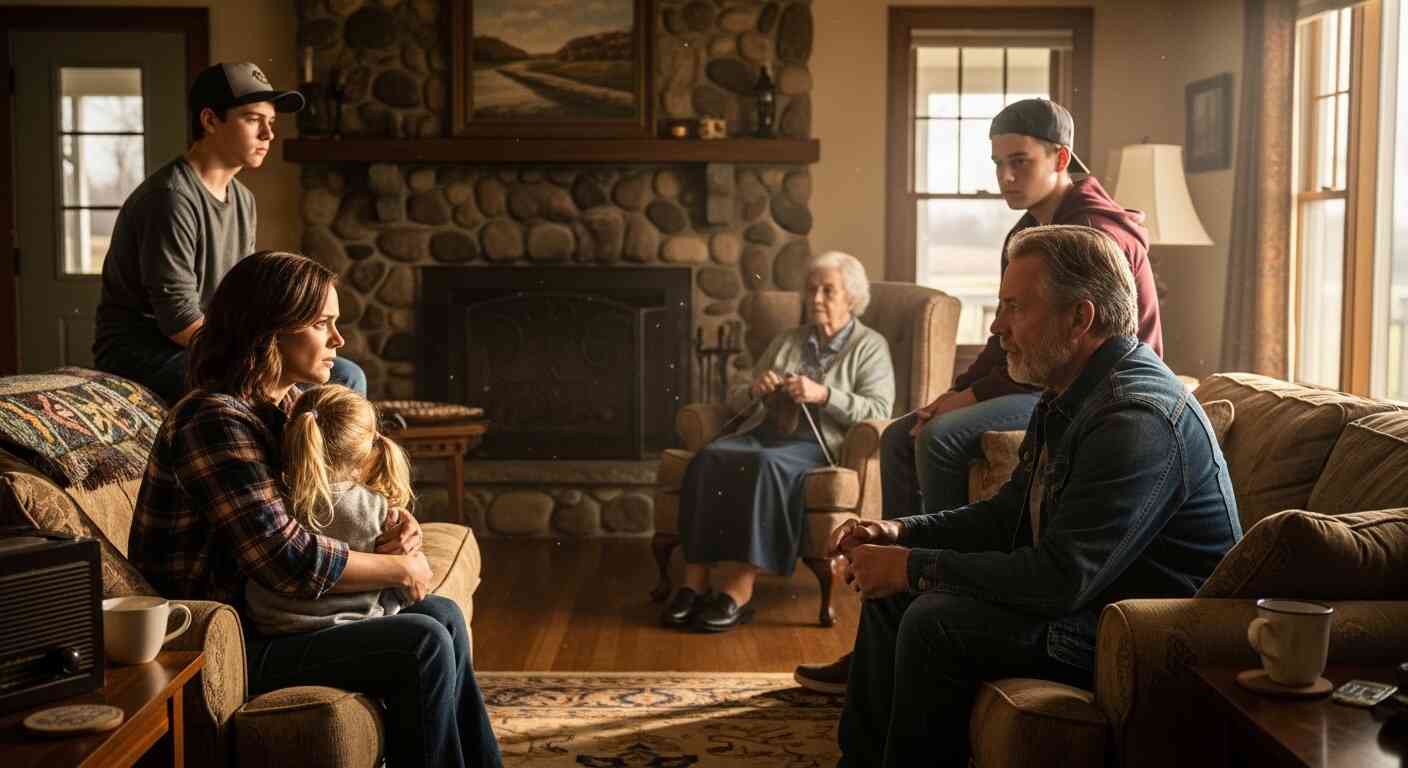
Mark didn’t move. He stood by the fireplace in our designer living room, a glass of expensive bourbon in his hand. He looked like an ad for a luxury lifestyle—wealthy, stable, the kind of man who has everything under control. He didn’t even look surprised. That was the first red flag that should have sent me running.
“Elena, honey, you’re overwrought. Let’s sit down. It’s a lab error. These things happen all the time,” he said, his voice as smooth as silk.
“A lab error?” I hissed, stepping forward. I threw the crumpled report at his face. It hit his cheek and fell. “I did the test three times, Mark! Three different labs because I thought I was going crazy. They all say the same thing. Leo is your son. He is 99.9% your biological child. But he isn’t mine.”
“You’re being hysterical,” he said, and that word—hysterical—was the match that lit the fuse.
I didn’t argue. There was no point. The look in his eyes wasn’t one of confusion; it was calculation. I turned on my heel, grabbed my trench coat and the keys to the Volvo, and bolted.
The night air was a shock of cold. The rain was coming down in sheets, blurring the edges of the world. I threw myself into the driver’s seat, the leather cold against my skin. As I backed out of the driveway, I caught a glimpse of Leo’s bedroom window on the second floor. His nightlight, a small glowing astronaut, was visible through the curtains.
My heart felt like it was being shredded. Who was that little boy sleeping up there? If he wasn’t mine, whose was he? And where was the baby I had pushed into this world seven years ago?
I drove without a destination. The wipers slapped rhythmically—lie, lie, lie, lie. Every memory I had of Leo’s birth started to feel like a movie I’d watched rather than a life I’d lived. The hospital smells, the bright lights, the doctor’s face… why couldn’t I remember the doctor’s name? I’d lived in this city my whole life. I should know these things.
I pulled over near the waterfront, the Puget Sound a churning black abyss to my right. My phone buzzed in the cup holder.
1 New Message: Sarah.
Sarah was my best friend since college. She’d been in the delivery room with me. She was the one who held my hand when Mark was stuck in traffic on the way to the hospital.
Elena, where are you? Mark called. He’s worried. Come to my place. Let’s talk.
I stared at the screen. Something felt off. Mark and Sarah didn’t talk. They tolerated each other for my sake, but they weren’t “call each other in a crisis” friends.
I looked at the DNA report again, lying on the passenger seat. My eyes traveled up to the patient information section.
Patient Name: Elena Vance.
Date of Birth: 05/12/1989.
My breath hitched. My birthday is May 14th. Not the 12th.
It was a small detail. A typo, maybe. But in that moment, under the flickering streetlamps of a rain-slicked pier, it felt like the first crack in a dam. I reached into my glove box and pulled out my registration.
DOB: 05/12/1989.
I pulled out my driver’s license.
DOB: 05/12/1989.
I gripped the steering wheel until my knuckles turned white. I have celebrated my birthday on May 14th every year of my life. My mother sent me flowers every May 14th.
I grabbed my phone and dialed my mother’s number. It rang and rang.
“The number you have dialed is not in service,” a robotic voice said.
I felt the world tilt. I wasn’t just losing my son. I was losing myself.
FULL STORY: PART 2 (CHAPTER 2)
I drove to my mother’s house in Queen Anne. It was a Victorian-style home that had been in our family for generations. Or so I thought.
When I pulled up to the curb, the house was dark. But it wasn’t just dark—it was empty. A “For Sale” sign stood in the front yard, the wood weathered and gray. The realtor’s name was someone I didn’t recognize.
I climbed out of the car, the rain soaking through my coat in seconds. I walked up the porch steps, the wood groaning under my feet. I peered through the front window. The furniture was gone. The walls were bare. There were no photos of me as a child, no dusty books, no smell of lavender and old paper.
“Can I help you?”
I jumped, spinning around. A man was standing on the sidewalk under a black umbrella. He wore a heavy navy coat and looked like he’d been waiting for me. This was Officer Miller—or at least, that’s what the badge on his belt said when the light hit it.
“I… this is my mother’s house,” I stammered. “Margaret Vance. I’m Elena.”
The man stepped closer, his face coming into the light. He looked at me with a mixture of pity and something else—suspicion.
“Ma’am, this house has been vacant for three years. It’s owned by a holding company. There hasn’t been a ‘Margaret Vance’ living on this block in decades.”
“That’s impossible,” I said, my voice rising. “I was here for Thanksgiving! We had turkey in that dining room!” I pointed through the glass.
Miller sighed, a long, weary sound. “Mrs. Vance, I think you should get back in your car. Your husband called in a missing person report. He mentioned you might be… confused.”
“Confused?” I laughed, a jagged, sharp sound. “He told you I was crazy, didn’t he? Did he tell you about the DNA test? Did he tell you that my son isn’t mine?”
Miller reached for his radio. “I have the subject at the Queen Anne property. Send a secondary unit for transport.”
“No!” I lunged for my car. I didn’t care about being polite anymore. I didn’t care about the law. I slammed the door and locked it just as Miller reached the handle.
I floored it, the tires spinning on the wet leaves. In the rearview mirror, I saw Miller didn’t chase me. He just stood there, watching me go, talking into his radio with a chilling calmness.
I needed to find Sarah. Not the Sarah who messaged me, but the real Sarah.
I headed toward her apartment in Capitol Hill, but as I drove, I started noticing things. The street names were slightly off. “Pine Street” was “Cedar Avenue.” The Starbucks on the corner of 4th was a local coffee shop I’d never seen before.
It was like I was in a version of my life that had been edited by someone who didn’t quite have all the facts right.
I reached Sarah’s building. I sprinted up the stairs to 3B and pounded on the door.
“Sarah! Open up! It’s Elena!”
The door opened. Sarah stood there, but she looked older—ten years older. Her hair was graying at the temples, and she was wearing glasses I’d never seen.
“Elena?” she whispered, her eyes widening in terror. “Oh my god. You’re supposed to be dead.”
The hallway lights flickered. From the end of the corridor, I heard the heavy thud of boots.
“She’s here!” a voice shouted. It was Mark.
Sarah grabbed my arm and pulled me inside, slamming the deadbolt. “Elena, listen to me very carefully,” she hissed, her hands shaking. “You didn’t give birth to Leo. You died on the operating table seven years ago. You’re the second one.”
“The second what?” I screamed.
“The second Elena,” she whispered.
Before I could ask another question, the door was kicked off its hinges.
FULL STORY: PART 3 (CHAPTER 3)
The impact of the door hitting the wall sounded like a clap of thunder. Mark stepped into the room, followed by two men in dark suits who didn’t look like police officers. They looked like cleaners.
“Step away from her, Sarah,” Mark said. His voice wasn’t warm anymore. It was cold, clinical, and devoid of the love I’d relied on for a decade.
“What is he talking about, Sarah?” I backed into the kitchen, my hand fumbling for a knife, a heavy glass, anything. “What do you mean, the second one?”
Sarah didn’t look at me. She looked at Mark with a terrifying blend of fear and guilt. “I couldn’t keep doing it, Mark. She started asking questions. The DNA results… she wasn’t supposed to see those.”
“Errors happen in every system,” Mark said, walking toward me slowly, his hands held out as if he were approaching a stray animal. “Elena, darling, you’re having a breakdown. The stress of the promotion, the move… it’s triggered a dissociative episode.”
“Don’t ‘darling’ me!” I swung a heavy ceramic vase at him. He ducked, and it shattered against the wall. “I know my birthday! I know my mother! You’ve changed things! You’ve changed everything!”
“We didn’t change anything,” one of the men in suits said. He was older, with a surgical scar running down the side of his neck. “We just refined you. The first Elena was… volatile. She couldn’t handle the reality of the Vance legacy.”
I felt a cold sweat break out over my entire body. “The Vance legacy?”
Mark sighed, looking genuinely disappointed. “My family’s company, Elena. Vance Biogenics. We don’t just treat illnesses. We solve the problem of loss. When I lost my wife and son in that crash seven years ago, I couldn’t accept it. I had the resources. I had the data. I had the DNA.”
I looked at him, the horror finally crystallizing. “Leo… Leo is a clone?”
“Leo is a miracle,” Mark corrected, his eyes gleaming with a fanatical light. “And you… you are the most successful iteration yet. You have her memories, her heart, her soul. But the biological markers… they’re hard to mimic perfectly. That’s why the maternity test failed. You’re her, but you aren’t her DNA.”
I felt sick. My stomach churned, and I fell to my knees. Every kiss, every “I love you,” every morning waking up in his arms—it was all a lab experiment. I wasn’t a wife. I was a replacement part.
“Where is the first Elena?” I whispered.
Mark’s face darkened. “In the garden. Under the roses you love so much.”
I looked at Sarah. My best friend. “And you? Did they pay you to be my friend? To keep the lie going?”
Sarah looked down at the floor, tears streaming behind her glasses. “I loved the first Elena, too. I thought… I thought if I could have her back, even like this, it would be enough. I’m so sorry.”
“I’m not a person to you,” I said, standing up, my voice trembling with a new kind of rage. “I’m a ghost in a skin suit.”
“You’re my wife,” Mark insisted. “And we can fix this. We’ll just… reset the parameters. A little adjustment to the neuro-pathways, and you won’t remember this night. We can go back to being happy.”
The men in suits moved forward. One of them pulled a syringe from his inner pocket.
“No,” I said.
I didn’t run for the door. I ran for the balcony.
FULL STORY: PART 3 (CHAPTER 4)
The apartment was on the fourth floor. Below, the street was a blur of rain and headlights. I climbed onto the railing, the wind whipping my hair across my face.
“Elena, get down!” Mark shouted, panic finally breaking through his facade. “If you fall, the cellular damage will be too extensive! I can’t bring you back a third time!”
I looked back at him. He didn’t care if I died. He cared about the data. He cared about his “cellular damage.”
“Then let me stay dead this time,” I said.
I didn’t jump. I saw a delivery truck passing below, its flatbed covered in heavy canvas. I timed it, a desperate gamble for a life that wasn’t even mine, and I leaped.
The air rushed past me, a scream caught in my throat. I hit the canvas with a bone-jarring thud. Pain exploded in my shoulder and hip, but I was alive. I rolled into the back of the truck, burying myself under a pile of industrial-sized bags of flour.
The truck kept moving. I lay there, gasping for breath, the white flour mixing with my tears and the rain to create a ghostly paste on my skin.
I stayed in the truck for miles, until it pulled into a warehouse district near the docks. When the driver got out to check his manifests, I slipped out the back.
My body screamed in protest. Every movement was agony. I found a public restroom in a 24-hour diner and dragged myself inside. I looked in the mirror.
The woman staring back was a stranger. Now that I knew the truth, I could see the subtle differences. My eyes were a fraction too wide. My jawline was too perfect. I looked like a doll.
I reached into my pocket. I still had my phone. I had turned it off to prevent tracking, but I needed answers. I turned it on just long enough to search for one thing: Vance Biogenics – Discontinued Projects.
The search results were a graveyard of ethics violations. There were rumors of “The Lazarus Protocol”—a project designed to “grief-proof” the elite by replacing deceased family members with biological duplicates.
But there was a name that kept popping up in the whistleblower forums: Dr. Aris Thorne.
Thorne was the lead scientist who had been fired two years ago. The forums said he was hiding out in a trailer park in a town called Oakhaven, three hours north.
I walked out of the diner and saw a beat-up 1998 Honda Civic with the keys in the ignition—a gift from the universe or a trap from Mark. At that point, I didn’t care.
I drove north. The rain finally stopped, replaced by a thick, oppressive fog. As the sun began to peek over the horizon, casting a sickly gray light over the pine trees, I saw the sign for Oakhaven.
I was a dead woman driving to see a man who played God.
I had no plan. I had no identity. All I had was the burning memory of a little boy named Leo who called me “Mommy.” And I was going to find out if that love was real, or if it was just another line of code.
FULL STORY: PART 4 (CHAPTER 5)
Oakhaven was a town that time—and the law—had forgotten. I found the trailer park at the end of a dirt road. Dr. Thorne’s unit was at the very back, rusted and surrounded by overgrown weeds.
When I knocked, the door didn’t open. Instead, a voice came through a speaker mounted above the frame.
“If you’re from the board, tell Mark he can go to hell. I burned the servers.”
“I’m not from the board,” I said, leaning my forehead against the cold metal door. “I’m the ‘second iteration.’ Mark says I have cellular damage.”
The silence that followed was heavy. Then, the sound of four different locks clicking open.
The man who opened the door was a wreck. His hair was a bird’s nest of white, and his clothes were stained with chemicals. He stared at me, his eyes darting across my face like he was reading a blueprint.
“Number Two,” he whispered. “You lasted longer than I expected. The first one… she only made it three months before the psychosis set in.”
“I’ve been ‘alive’ for seven years,” I said, pushing past him into the cramped, dark trailer.
Thorne laughed, a dry, hacking sound. “Seven years? No, child. You’ve been active for six months. They just uploaded seven years of fabricated memories into your hippocampus. You think you raised that boy? You think you went on those vacations? It’s all digital lace, stitched into your brain.”
I felt the room spin. “No. That’s not possible. I remember the pain… I remember the smell of his hair…”
“Artificial sensory input,” Thorne said, pointing to a stack of hard drives. “Mark couldn’t handle the failure of the first one. So he had us build a ‘curated’ version. A wife who wouldn’t argue. A wife who was perfect. But the DNA… we can’t spoof the maternal markers without compromising the brain stability. He took a risk letting you get that test.”
“Why?” I asked, my voice a hollow shell. “Why did he do it?”
“Because he’s a man who refuses to lose,” Thorne said. “But you’re breaking down, aren’t you? The headaches? The flickering memories?”
I nodded. The room was beginning to glitch. For a split second, I saw the trailer as a clean, white laboratory, then back to the rusted wreck.
“Your system is rejecting the ‘truth’ you discovered,” Thorne said. “You’re a biological computer that’s just encountered a fatal error.”
“Can you fix me?” I asked, clutching the edge of a table.
“I can’t make you ‘real,'” Thorne said, his voice softening. “But I can give you the truth. The real Leo… the first Leo… he didn’t die in a crash. Mark hid him away because the boy was ‘imperfect.’ He has a degenerative condition. Mark wanted a son who would live forever. So he made a new one.”
“Where is he?” I demanded. “Where is the real Leo?”
Thorne reached into a drawer and pulled out a map with a red circle around a private medical facility in the Cascades. “He’s there. But he’s dying, Elena. And if you go there, Mark will find you. He’ll terminate your sequence and start over with Number Three.”
“Let him try,” I said.
FULL STORY: PART 4 (CHAPTER 6)
The facility was a fortress of glass and steel nestled in the mountains. I didn’t have a weapon, but I had something better: the security bypass codes Thorne had given me.
I moved through the halls like a ghost. The staff I encountered didn’t stop me; they just stared. To them, I was the boss’s wife. They didn’t know I was a walking glitch.
I found the room at the end of the restricted wing. The door read: SUBJECT ALPHA.
I stepped inside. The room was filled with the hum of medical equipment. In the center, a small bed held a boy. He looked like Leo, but he was thin, his skin pale and translucent. He was hooked up to a dozen different tubes.
He opened his eyes. They were the same blue eyes I saw every morning.
“Mommy?” he whispered. His voice was weak, a ghost of the boy I knew.
I ran to his side, tears blurring my vision. “I’m here, baby. I’m here.”
“You look… different,” he said, his small hand reaching out. “Your eyes are bright. Like the old Mommy.”
I realized then that it didn’t matter if my DNA matched. It didn’t matter if my memories were uploaded from a server. The love I felt—the agonizing, soul-crushing protectiveness—was the only thing in this entire twisted world that was real.
“We have to go, Leo,” I said, beginning to unhook his monitors.
“You can’t take him.”
I froze. Mark was standing in the doorway. He wasn’t alone. Four security guards stood behind him, their hands on their holsters.
“He belongs here, Elena,” Mark said, his voice trembling with a mixture of rage and grief. “He’s a failed version. I’m trying to save him, but he’s a reminder of everything that went wrong.”
“He’s your son!” I screamed. “And the boy at home… he’s just a toy to you!”
“The boy at home is perfect!” Mark shouted. “He’s the legacy! He’s the Vance future!”
Mark stepped into the room, his eyes fixed on me. “You’re malfunctioning, Elena. Look at your hands.”
I looked down. My skin was turning a dull, matte gray. My vision was tunneling. Thorne was right. The truth was killing me.
“I can save you,” Mark said, his voice dropping to a whisper. “Just step away from the boy. We’ll go home. We’ll fix the code. You’ll wake up tomorrow and you won’t remember any of this. You’ll just be my beautiful, happy Elena again.”
I looked at the dying boy in the bed. He was watching me, his eyes full of a strange, ancient wisdom.
“Mommy,” he whispered. “Don’t forget me again.”
I looked back at Mark. I felt the last of my “programming” snapping. I felt the fake memories burning away, leaving behind a raw, searing void.
“I’d rather be a broken machine than a perfect lie,” I said.
I grabbed the heavy oxygen tank next to the bed and swung it with everything I had into the massive glass window that looked out over the cliffside. The glass shattered into a million diamonds.
The wind howled into the room. I scooped Leo up into my arms. He was light, so light.
“What are you doing?” Mark screamed, rushing forward.
I backed toward the edge of the broken window. The mountain air was cold and pure. For the first time in my existence, I felt truly awake.
“I’m taking my son home,” I said.
I didn’t jump. I didn’t surrender. I looked at Mark—the man who thought he could play God—and I saw the one thing he couldn’t clone: the absolute, terrifying power of a mother who has nothing left to lose.
I stepped out onto the narrow ledge, the abyss below us. My vision was failing. The gray was taking over. But as I felt Leo’s small heart beating against my chest, I realized that some things are written in something deeper than DNA.
The world went white.
In the quiet suburbs of Seattle, a little boy named Leo wakes up. He walks into the kitchen where a woman who looks exactly like me is pouring orange juice. She smiles at him. She kisses his forehead. She has no idea that somewhere in the mountains, the wind is carrying the last breath of a woman who chose to break the world just to be real for one second.
Love isn’t in the blood; it’s in the sacrifice.