CHAPTER 1: THE SHATTERING
The sound wasn’t supposed to be there.
In our neighborhood, the only things you hear at three in the morning are the distant hum of the interstate and the occasional rustle of a deer in the hydrangeas. But this was a low, gutteral growl. A diesel engine.
I rolled over, reaching for Mark. The sheets were cold. Not “just went to the bathroom” cold. They were “empty for hours” cold.
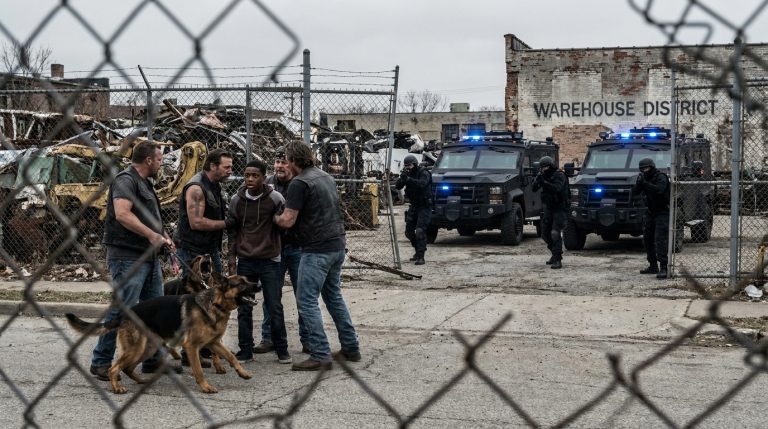
I sat up, my heart doing a slow, heavy thud against my ribs. I walked to the window, pulling back the heavy velvet curtains just an inch. Below, in our driveway, sat a massive, unmarked white box truck. Two men I didn’t recognize were hoisting heavy wooden crates—crates that should have been in our climate-controlled basement—into the back.
Those crates held my father’s legacy. Centuries-old reclaimed mahogany, rare burl, tools that had been in my family for three generations. Millions of dollars in “investments” that Mark had insisted we move from my gallery to our home “for insurance purposes.”
I didn’t grab my robe. I didn’t grab my phone. I ran downstairs, my bare feet slapping against the cold hardwood.
When I burst through the front door, the humidity of the Georgia night hit me like a wet blanket. The men froze. One of them, a thick-necked guy in a Carhartt jacket, looked toward the cab of the truck.
“Mark!” I screamed. “Mark, what the hell is this?”
The truck’s engine revved. The headlights flicked on, blinding me. Through the glare, I saw the silhouette in the driver’s seat. It was him. I knew the way he gripped a steering wheel—white-knuckled and desperate.
“Elena, get back inside!” he yelled through the cracked window. His voice sounded like it had been dragged through gravel.
“Is this the ‘inventory move’ you talked about? At 3 AM? Without me?” I moved toward the truck, but the heavy-set man stepped in my way.
“Move,” I hissed.
“Ma’am, just go inside,” the man said, his voice devoid of emotion.
That’s when I saw it. Through the open back of the truck, a crate had shifted. It wasn’t just wood. A corner had broken, and something metallic and black glinted in the moonlight. Something that didn’t belong in a woodshop.
Mark wasn’t moving my father’s mahogany. He was moving something else. And my father’s wood—my inheritance, my soul—was being used as packing material. Or worse, it was already gone.
A sudden, hot flash of betrayal scorched my throat. I looked down. In the flower bed lining the driveway, there was a decorative paving brick. I didn’t think. I didn’t weigh the consequences. I lunged, grabbed the rough, heavy stone, and sprinted toward the driver’s side.
“Mark, stop the truck!”
He shifted into gear. The truck lurched forward.
I didn’t stop. I swung the brick with every ounce of grief and rage I had stored up over a decade of his “bad luck” and “near misses.”
CRACK.
The windshield didn’t just break; it exploded inward. Mark screamed, throwing his arms up. I didn’t care about the glass. I didn’t care about the blood on my hands. I reached through the jagged hole, trying to grab the man I thought I knew, the man who was currently stealing the last piece of my father I had left.
“Who are you?” I screamed into the dark cab. “What have you done with my life?”
FULL STORY
CHAPTER 2: THE ANATOMY OF A HOLE
Mark Vance was a man made of charisma and expensive cologne. When I met him ten years ago at a fundraiser for the Atlanta Arts Council, he looked like stability. He talked about “legacy” and “preservation.” As the daughter of a master woodworker, I was a sucker for anyone who used those words.
But sitting in the back of a police cruiser three hours after I smashed our lives to bits, I realized that Mark’s greatest talent wasn’t selling antiques. It was filling holes.
He had found the hole in my life left by my father’s passing and filled it with promises. He found the hole in our bank account and filled it with “temporary loans” from “private investors.”
“Mrs. Vance?”
I looked up. Detective Miller was standing by the car door. He was an older man with a face like a crumpled paper bag, a local who had seen too many “perfect” suburban families melt down.
“My husband,” I whispered. “Where is he?”
“He’s in the hospital getting glass pulled out of his cheek,” Miller said, leaning against the door. “But that’s the least of his worries. Do you know what was in those crates, Elena?”
“Wood,” I said, though my voice lacked conviction. “Old growth mahogany. My father’s collection.”
Miller sighed. “We opened the one that fell. There was mahogany, sure. About two inches of it on top. Underneath? High-end, stolen medical imaging equipment. Stolen from the Emory terminal two days ago. Your husband wasn’t an antique dealer, Elena. He was a fence.”
The world tilted. The “investors” who called at 2 AM. The “business trips” to Savannah. The way he always insisted on handling the shipping manifests himself.
“I gave him everything,” I said, the words feeling like lead in my mouth. “I signed the house over for the ‘expansion.’ I gave him the keys to the warehouse.”
“He didn’t just steal from the city, Elena,” Miller said softly. “He liquidated your father’s entire inventory six months ago. The wood in that truck? It’s just the scraps he used to hide the real cargo.”
I felt a coldness settle into my marrow. My sister, Cassidy, pulled up then. She was a high-powered divorce attorney who had spent the last five years telling me Mark was a “glorified con artist.” She didn’t say I told you so when she saw me. She just wrapped a trench coat around my shivering shoulders and glared at the detective.
“She’s not saying another word without me,” Cassidy snapped.
But I wasn’t thinking about lawyers. I was thinking about Silas, my elderly neighbor. He was standing on his porch across the street, clutching a robe, watching me with a look of profound pity. He had seen the trucks for weeks. He had seen the men. And I, the woman living in the house, had seen nothing because I chose to see a hero.
“I need to go home,” I said.
“Elena, there is no home,” Cassidy said, her voice cracking for the first time. “I ran a quick check while I was driving over. The foreclosure notice was served three weeks ago. Mark intercepted it. You have forty-eight hours before the bank takes the dirt you’re standing on.”
FULL STORY
CHAPTER 3: THE LEDGER OF LIES
The house felt like a tomb. Cassidy wanted me to go to a hotel, but I needed to find the truth. I needed to see the evidence of my own blindness.
While Cassidy sat in the kitchen making calls to “mitigate the damage,” I went to Mark’s office. It was a room I rarely entered—his “sacred space.” It smelled of cigar smoke and the false scent of old money.
I started tearing it apart. I ripped the books from the shelves, smashed the drawers of his mahogany desk (likely a fake, too, I realized now). I found it behind a loose floorboard under the rug: a small, black Moleskine ledger.
It wasn’t a business diary. It was a map of a decade-long betrayal.
July 14th: Sold the 1920s lathe. Elena thinks it’s in storage for restoration.
November 2nd: Lost 40k at the underground in Doraville. Used the mortgage payment. Will ‘flip’ the Georgian sideboard to cover.
Page after page. He hadn’t just been a criminal; he was a failing one. He was chasing losses with more theft, using my family’s history as his personal piggy bank.
There were names I didn’t recognize. Julian. The Russian. And then, a note from only three days ago: Julian says the medical gear is the last chance. If the truck doesn’t move by Saturday, they take the wife. Not the house. The wife.
A chill ran down my spine. The truck move wasn’t just a theft; it was a ransom payment. Mark wasn’t just running from the law; he was trying to save me from the monsters he had invited to our dinner table.
“Elena?”
I jumped. Silas was standing at the French doors of the office. He had let himself in. The old man looked frail, but his eyes were sharp.
“I didn’t want to tell you,” Silas said, stepping into the room. “But I saw that man, Julian. He came by yesterday while you were at the gallery. He wasn’t looking at the wood, Elena. He was taking pictures of you through the window. He was measuring the distance from the porch to the street.”
I dropped the ledger. “Mark was trying to protect me?”
“In the most cowardly way possible,” Silas said. “By stealing what was left of your dignity to pay off his sins. He’s not a hero, child. He’s a man who set the house on fire and expects a thank you for trying to carry out one chair.”
Suddenly, the front door chimes rang. It wasn’t the police. It wasn’t Cassidy—she was in the basement checking the pipes.
I walked to the hallway. Through the frosted glass of the front door, I saw a tall silhouette. It wasn’t Mark’s. It was the thick-necked man from the truck.
“Elena Vance?” the voice boomed through the wood. “Mark didn’t finish the delivery. Now we have to talk about the balance.”
FULL STORY
CHAPTER 4: THE DEBT COLLECTOR
“Get in the pantry,” I whispered to Silas.
“I’m eighty-four, not deaf,” he hissed back, but he saw the look in my eyes. I wasn’t the grieving wife anymore. I was the woman who had smashed a windshield with a brick. I was the daughter of a man who knew how to handle a blade and a hammer.
I didn’t open the door. I went to the kitchen and grabbed my father’s heavy wood-turning chisel from the display case. It was ten inches of sharpened high-carbon steel.
“Mrs. Vance, we know you’re in there,” the voice said. “And we know your husband is currently being fitted for a jumpsuit. He owes us two hundred thousand dollars’ worth of equipment that is currently sitting in a police impound lot because of your… theatrics with the brick.”
I stepped to the door. “My husband is a liar. If he owes you money, go to the jail and ask him for it.”
“It doesn’t work that way,” the man, Julian, said. His voice was calm, which was worse. “Mark put this house up as collateral. Not to the bank—to us. We have the deed, signed by you. Or a very good forgery of your signature.”
I looked at the ledger in my other hand. The forgery. Of course.
“The police are on their way,” I lied.
“The police are busy processing a five-ton truck and a husband who’s singing like a canary,” Julian replied. “We just want the ‘extra’ stash. Mark said there was a secondary collection. The ‘special’ wood.”
I froze. The Lignum Vitae.
My father had a small, incredibly rare stash of “Tree of Life” wood. It was worth a fortune, but more importantly, it was the wood he had promised to use for my first child’s crib—a child Mark and I had been “trying” for, another lie in a long list of them.
“It’s not here,” I said.
“Then we’ll come in and look.”
The door handle rattled. Then, the sound of a heavy boot against the lock. Boom.
I backed away, the chisel tight in my grip. Cassidy came running up from the basement, her phone to her ear. “The line is dead!” she screamed. “Elena, what’s happening?”
The door frame splintered. Julian stepped inside. He was wearing a tailored suit that looked wrong on his massive frame. He looked around the foyer with the practiced eye of an appraiser.
“Nice place,” he said. “Shame about the husband. He really did love you, in his own pathetic way. He cried when he signed the papers.”
“Get out,” I said, leveling the chisel at his throat.
Julian laughed. It was a dry, hollow sound. “You’re going to fight me with a wood-carving tool? Elena, I’m a professional. I’m here to collect a debt. Give me the secondary stash, and I leave your sister and the old man in the pantry alone.”
I looked at Cassidy. Her face was white. I looked at the stairs leading to the basement where my father’s ghost lived in the scent of sawdust.
“It’s in the floor,” I lied. “Under the master bed. There’s a safe.”
Julian nodded to his man outside. “Check it.”
As the second man ran upstairs, I saw my opening. I didn’t go for Julian. I went for the light switch.
FULL STORY
CHAPTER 5: THE WEIGHT OF MAHOGANY
The house plunged into darkness. I knew every inch of this floor. I knew which boards creaked and which were silent.
“You think this is a game?” Julian’s voice echoed in the dark. I heard the metallic snick of a folding knife.
I didn’t answer. I grabbed Cassidy’s hand and pulled her toward the kitchen, then into the basement stairs. We went down into the dark, the smell of cedar and old oil rising to meet us.
“In here,” I whispered, shoving her into the small finishing room and locking the door.
I went to the back of the workshop. There, resting on two sawhorses, was the final crate. The real mahogany. It was heavy, dense, and beautiful. My father always said that wood remembers. It remembers the wind, the rain, and the hands that shaped it.
I heard Julian’s heavy footsteps on the basement stairs.
“Elena… I don’t like being lied to. My associate found an empty safe upstairs. That was a mistake.”
I stood in the center of the workshop, the chisel in one hand and a heavy mallet in the other. I turned on the single work lamp over the bench. It threw long, jagged shadows across the room.
“Mark didn’t sell this,” I said, my voice steady. “He couldn’t. He tried to move it three times, and every time, he couldn’t bring himself to touch it. Do you know why?”
Julian reached the bottom of the stairs, his knife glinting. “Because he was a sentimental fool?”
“Because he knew if he touched this wood, I’d know,” I said. “He could lie about the money, the house, and the marriage. But he couldn’t lie about the craft. He wasn’t a craftsman. He was a consumer. He consumed everything I loved.”
Julian lunged.
I didn’t stay still. I kicked the sawhorse. The massive mahogany slab—three hundred pounds of solid timber—swung on its chain hoist. It caught Julian square in the chest with a sickening thud.
He flew backward, hitting the concrete wall. The air left his lungs in a ragged wheeze. He dropped the knife, clutching his ribs.
I walked over to him, the chisel held low. I looked down at the man who represented the final bill of my husband’s life.
“Tell your people the debt is paid,” I said, my voice cold as the Georgia winter. “Mark is gone. The house is gone. The equipment is with the police. If you come back, I won’t use the wood to hit you. I’ll use the tools to bury you.”
Julian looked at me, and for the first time, he saw the woman who had smashed the windshield. He saw a woman who had nothing left to lose because she had already lost everything she thought was real.
“He… he’s still in the ledger, Elena,” Julian wheezed. “He sold your name. Not just the wood.”
“Then I’ll get a new one,” I said.
FULL STORY
CHAPTER 6: THE OPEN ROAD
The sun rose over Buckhead, but it didn’t look like a new beginning. It looked like an ending.
The police had returned. Julian and his associate were in custody. Mark was being moved from the hospital to the county jail. The house was taped off, a crime scene and a foreclosed shell all at once.
I stood on the sidewalk with Cassidy. A small U-Haul trailer was hitched to her SUV. Inside was all I had left: my father’s tools, the Lignum Vitae, and a single box of photos I’d managed to save before the bank’s locks went on.
Detective Miller walked over, handing me a plastic bag. Inside was my wedding ring—the one the man in the truck had been holding.
“It wasn’t blood,” Miller said quietly. “It was red lacquer from the shop. Mark had it in the cab with him. He was holding onto it when you hit the glass.”
I looked at the ring. A simple gold band. A symbol of a decade of beautifully choreographed deception.
“Does it matter?” I asked.
“Probably not,” Miller said. “He’s facing twenty years. The feds are taking over. He wants to see you, Elena.”
I looked at the house. The broken window was boarded up with plywood. The garden I had planted was trampled. The life I had built was a theatrical set that had been struck the moment the lead actor forgot his lines.
“Tell him…” I paused. I thought about the brick. I thought about the roar of the diesel engine in the night. I thought about the man who tried to “save” me by stealing my soul. “Tell him I hope the glass was hard to get out.”
I turned to the trailer. Cassidy looked at me, her hand on the steering wheel. “Where to?”
I looked at the mahogany slab tied down in the back. It was raw, unpolished, and heavy. It was a burden, but it was a solid one. It wasn’t a promise or a lie. It was just wood.
“Somewhere with a different kind of trees,” I said.
As we drove away, I didn’t look back at the suburban paradise that had turned into a prison. I reached into the bag and took out the ring. As we crossed the bridge over the Chattahoochee, I rolled down the window.
The gold caught the morning light for a fraction of a second before it hit the water.
I didn’t feel a sense of peace. I didn’t feel a sense of closure. I felt the terrifying, electric hum of a woman who was finally, for the first time in her life, the only one holding the tools.
The road ahead was long, and the map in my head was gone, but the engine didn’t sound like a threat anymore—it sounded like a heartbeat.
Sometimes the only way to find out who you are is to smash everything you thought you were.