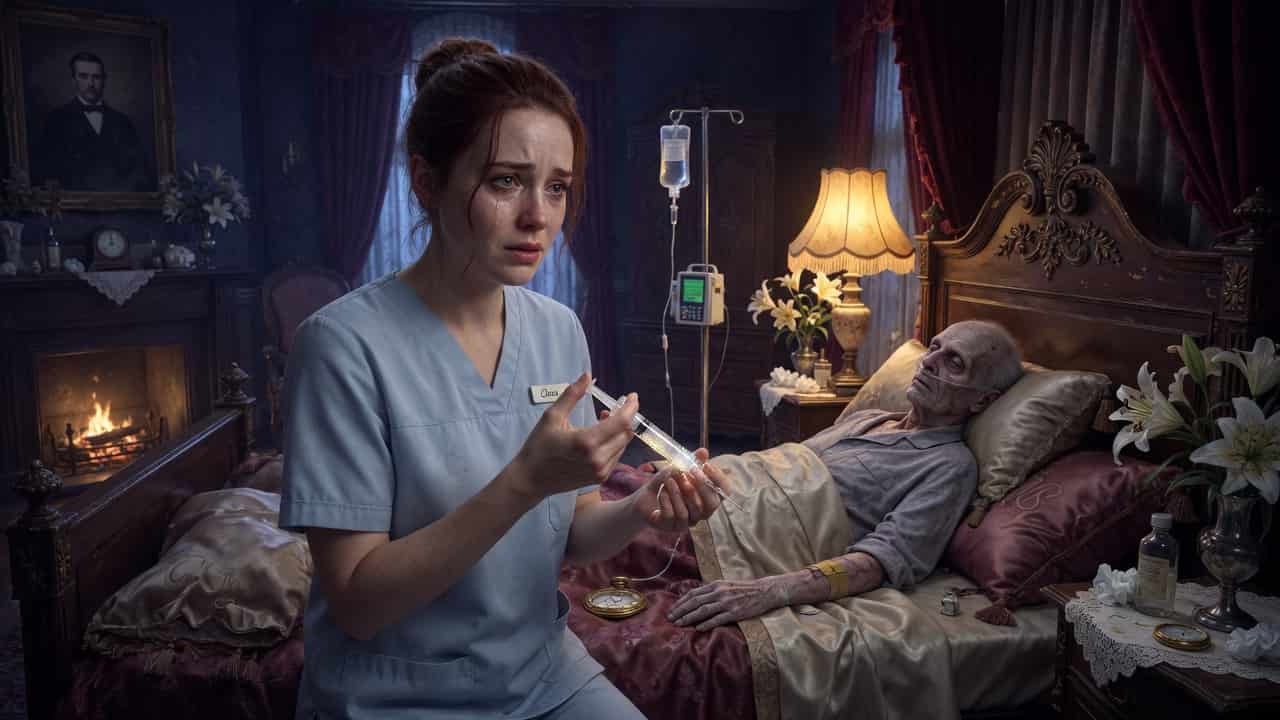
I watched the liquid shimmer inside the syringe, a tiny ocean of mercy or a tidal wave of vengeance.
My name is Clara. I’m a hospice nurse. My job is to walk people to the door of the afterlife and make sure they don’t trip on the way out. But today, the man in the bed isn’t just a patient.
He is Arthur Sterling. The “Steel King” of New England. A man whose portrait hangs in museums, and whose cruelty is etched into the scars on my mother’s soul.
He doesn’t know who I am. To him, I’m just a girl in blue scrubs with soft hands and a quiet voice.
He doesn’t know that every time I check his pulse, I’m thinking about the night my father walked into the Atlantic Ocean because this man—his own father-in-law—stripped him of his dignity, his art, and his will to live.
Now, Arthur is dying. And in a twist of fate that feels more like a curse, he’s rewritten his will.
He’s leaving everything to a “lost granddaughter” he hasn’t seen in twenty years.
He’s looking for me, while I’m the one holding his life in my hands.
The mansion smells like lilies and expensive rot. Every floorboard echoes with the secrets of a family built on skeletons. And as I stand over him tonight, I have to decide:
Do I save the man who destroyed my life? Or do I let the “Gold-Plated Regret” bury us both?
FULL STORY
CHAPTER 1: THE SHADOW IN THE ROOM
The Sterling estate sat on the jagged edge of the Rhode Island coast like a gray stone molar in a mouth of black water. It was called The Reach, a sprawling Victorian monstrosity that had been built on the profits of industrial misery. I pulled my beat-up Honda Civic into the gravel driveway, the engine rattling in a way that felt like a personal insult compared to the fleet of black Land Rovers parked near the servant’s entrance.
I’m a hospice nurse. I deal in the currency of “the end.” I’ve seen people die in sterile hospital rooms, in crowded apartments, and in parks. But death in a house like this? It’s different. It’s quiet. It’s expensive.
“You’re the new one? Clara?”
I looked up to see Elena standing in the foyer. Elena was the night-shift nurse, a woman who wore her scrubs two sizes too small and smelled so strongly of Chanel No. 5 that it made my eyes water. She was currently reapplying lipstick in the reflection of a 17th-century gilt mirror.
“I’m Clara,” I said, keeping my voice flat. I gripped the strap of my bag—the one containing my father’s old charcoal sketches. I never went anywhere without them. They were my anchor.
“Good luck,” Elena smirked, not looking away from her reflection. “The old man is a beast. He’s been through three nurses this month. He tried to throw a crystal water carafe at the last one. Just keep him sedated and don’t touch the silver. The lawyer, Marcus, checks the inventory every morning like we’re common thieves.”
I didn’t tell her that my grandmother had once owned that silver. I didn’t tell her that my father had learned to draw at the mahogany table in the dining room before he was cast out like a stray dog for the crime of being a “penniless dreamer.”
I walked up the grand staircase. The walls were lined with portraits of stern, pale men. At the end of the hall was the master suite.
Arthur Sterling lay in a bed that could have fit five of me. He looked like a skeleton wrapped in translucent parchment. The once-mighty “Steel King” was now a collection of rattling breaths and liver spots.
I checked his chart. Stage IV lung cancer. Morphine drip. Oxygen at four liters.
“Who… who is that?” a voice rasped. It sounded like dry leaves skittering across pavement.
I stepped into the light. “I’m Clara, Mr. Sterling. I’ll be taking care of you today.”
His eyes—a piercing, icy blue that hadn’t faded with age—snapped to mine. For a terrifying second, I thought he recognized me. I thought he saw my father’s jawline or my mother’s brow. My heart hammered against my ribs like a trapped bird.
“You’re late,” he wheezed. “They’re all late. They’re waiting for me to die so they can pick my pockets.”
“I’m right on time,” I said, my voice steadier than I felt. I reached out to adjust his pillow, and my hand brushed his cold, thin skin.
A wave of nausea hit me. This was the hand. This was the hand that had signed the papers to evict my father from his studio. This was the hand that had written the letter telling my mother she was “dead to this family” for marrying a man with “dirty fingernails.”
“You have… soft hands,” Arthur muttered, his eyes fluttering shut as the morphine took hold. “Not like the other one. The other one… she smells like a funeral.”
I stood there in the silence of the room, surrounded by millions of dollars in art and history. I reached into my bag and pulled out a small, folded piece of paper. It was a sketch my father had done of the ocean on the day he died. The lines were frantic, dark, and beautiful.
“You don’t deserve a peaceful end,” I whispered to the sleeping man.
The wind howled outside, throwing sea spray against the heavy glass windows. In that moment, I wasn’t just a nurse. I was a ghost who had finally come home.
CHAPTER 2: THE GHOST OF THE EASEL
By the third day, the routine of The Reach began to settle into my marrow. The house was a tomb that hadn’t been sealed yet.
Elena was my primary source of irritation. She didn’t care about Arthur’s comfort; she cared about his jewelry. I caught her once, hovering over his bedside table, eyeing a heavy gold signet ring he’d taken off because his fingers had swollen.
“He won’t miss it, you know,” she said, sensing me behind her. She didn’t look embarrassed. “He’s got safes full of these things. One little ring could pay off my student loans and buy me a car that doesn’t leak oil.”
“It’s not yours, Elena,” I said, moving past her to check Arthur’s vitals.
“Oh, please, Clara. Don’t act like you’re a saint. We’re both here for the same reason. It’s the paycheck. Except I’m honest about wanting a little extra for the effort of wiping the chin of a man who would’ve stepped on us if we were on fire.”
She wasn’t entirely wrong. Arthur Sterling was a monster. But she wanted his gold. I wanted his reckoning.
That afternoon, Father Thomas visited. He was a man who looked like he was made of dust and old hymns. He’d been the Sterling family priest for forty years. He sat by Arthur’s bed, murmuring prayers that sounded more like apologies.
When he left the room, he found me in the hallway. He looked at me with a strange, lingering intensity.
“You have a very familiar way of carrying yourself, child,” he said, his voice gentle.
“I just have a common face, Father,” I replied, looking down at my clipboard.
“No,” he whispered. “You have the eyes of a man I haven’t seen in a very long time. A man who loved the sea more than he loved himself.”
My breath hitched. “I don’t know what you mean.”
“Secrets are heavy things, Clara,” he said, patting my arm. “They sink the ships they’re carried on. If you’re here for what I think you’re here for… be careful. This house eats the light.”
I spent the rest of the shift in a daze. I retreated to the small gallery on the second floor during my break. It was filled with “curated” art—expensive, soulless pieces meant to show off wealth. But in the very back, tucked away in a corner where the light didn’t reach, I found it.
It was a painting of a woman standing on a cliff, her red dress whipped by the wind.
It was my mother.
My father had painted it. It was his masterpiece, the one he said was the “soul of the world.” Arthur had told him it was amateurish trash. He’d told him it wasn’t worth the canvas it was painted on.
And yet, here it was. Hidden. Kept.
I touched the frame, my fingers trembling. The gold leaf was chipping. Arthur had kept the very thing he’d used to break my father. He’d stolen his talent and hung it in a dark corner like a trophy of a kill.
The rage I’d been suppressing for twenty years flared up, hot and bright. I looked at the medical cart in the hallway. I looked at the vials of concentrated morphine.
It would be so easy. A little extra in the IV. A “peaceful passing” in the night. No one would question it. A man his age, with his diagnosis? It was expected.
I walked back into Arthur’s room. He was awake, staring at the ceiling.
“Nurse,” he croaked.
“Yes, Mr. Sterling?”
“Bring me the box. Under the bed.”
I knelt down and pulled out a heavy, iron-bound wooden chest. I set it on his lap. His shaky hands struggled with the latch, so I helped him.
Inside weren’t jewels or gold. It was full of letters. Hundreds of them. All addressed to Julian and Sarah.
My parents.
None of them had been mailed.
“I’m a coward,” Arthur whispered, a single tear tracking through the deep wrinkles on his face. “I wanted to say I was sorry. But I couldn’t. I couldn’t let them win. I couldn’t let him be right.”
“Right about what?” I asked, my voice a whisper.
“That love is worth more than the empire,” he said, his voice breaking. “I destroyed them to prove him wrong. And now… I’m dying in a castle of sand.”
He looked at me then, his eyes searching mine. “I’m looking for a girl. My granddaughter. I need to give it all back. Everything. Before the dark takes me.”
He reached out, grabbing my wrist with surprising strength. “Help me find her, Clara. Help me find the girl.”
I looked at the man who had murdered my father’s spirit. I looked at the box of unmailed apologies.
“I’ll see what I can do, Arthur,” I said, my heart turning to stone. “I’ll see what I can do.”
CHAPTER 3: THE CONFESSION OF THE DYING
The storm outside The Reach wasn’t just a weather event; it was an atmosphere. The Atlantic was throwing itself against the cliffs with a rhythmic violence that matched the thumping in my chest.
Arthur’s condition was deteriorating. The “lucidity” of the previous day had vanished, replaced by a fevered delirium. He was talking to people who weren’t there. He was arguing with my father.
“The perspective is wrong, Julian!” Arthur barked at the empty air, his hands clawing at the silk sheets. “You can’t feed a family with colors! You’re taking her away from me! You’re stealing my daughter!”
I stood by the window, watching the rain. I felt like a spectator at my own execution.
Marcus Thorne, the family attorney, entered the room. He was a man who looked like he’d been carved out of a very expensive piece of driftwood—hard, polished, and entirely devoid of warmth.
“How is he?” Marcus asked, not looking at Arthur, but at the monitors.
“Not good. The agitation is increasing. I’ve had to increase the sedative,” I said.
Marcus sighed, adjusting his glasses. “He needs to stay conscious for another hour. We have the final amendments to the trust. He’s obsessed with this… search. He’s diverted the entire liquid estate to a trust for the granddaughter.”
He turned to me, his eyes sharp. “You’ve spent a lot of time with him, Clara. Has he mentioned anything specific? A location? A name other than ‘The Girl’?”
“No,” I lied. “He’s mostly just reliving old arguments. He’s not making much sense.”
Marcus grunted. “A billion dollars, Clara. That’s what’s at stake. A billion dollars left to a ghost. If she doesn’t appear within a year of his death, the whole thing defaults to a list of charities he spent his life trying to destroy. It’s his final ‘screw you’ to the world.”
He stepped closer to me. “The firm would be… very grateful… if he were to regain enough clarity to name a different beneficiary. Perhaps a secondary one. Someone who has been ‘loyal’ in his final days.”
The implication hung in the air like the smell of ozone before a lightning strike. He was asking me to manipulate a dying man. Or perhaps, he was testing me.
“I’m a nurse, Mr. Thorne. Not a talent scout,” I said.
He smiled, a thin, bloodless thing. “Of course. My apologies. Just… do your best to keep him ‘present’.”
When he left, I felt filthy. This house turned everyone into a scavenger.
That night, the fever broke for a moment. Arthur opened his eyes. They were clear, but the light in them was flickering low.
“Clara,” he whispered.
“I’m here.”
“I saw him tonight. Julian. He was standing at the foot of the bed. He wasn’t angry.”
“He wasn’t?” I felt a lump form in my throat.
“No. He was just… painting. He was painting the sunset. I told him I’d burned his sketches. I lied to him, Clara. I didn’t burn them. I couldn’t.”
He pointed a shaking finger toward the gallery. “In the back… behind the woman in the red dress. There’s a panel. The key is in the box.”
My heart stopped. The sketches. My father’s life’s work. The things he thought were lost forever, the loss that had finally pushed him over the edge of that cliff.
“Why?” I choked out. “Why did you tell him they were gone?”
“Because as long as he had his art, he didn’t need me,” Arthur cried out, a pathetic, high-pitched sound. “I wanted him to crawl back. I wanted him to admit that my money was the only thing that mattered. I broke his heart to save my pride.”
He started coughing then—a deep, wet sound that rattled his whole frame. I reached for the suction, my movements mechanical.
As I worked to clear his airway, a thought burned in my mind: He didn’t just kill my father. He tortured him first.
I looked at the morphine vial on the cart. One full dose would stop his heart in minutes. It would be a “respiratory failure.” It would be a mercy for him, and justice for Julian.
I picked up the syringe. My hand was rock steady.
“Clara?” he gasped, catching his breath.
“Yes?”
“I think I know why you have his eyes. You’re Sarah’s girl, aren’t you? You’re my Clara.”
The syringe slipped from my fingers, clattering onto the hardwood floor.
He knew. The old fox had known all along.
CHAPTER 4: THE POISON OF INHERITANCE
“How long?” I asked, my voice sounding like it belonged to someone else.
Arthur lay back, exhausted. A ghost of a smile touched his lips. “Since the first day. You have your mother’s stubborn chin. And you look at me with the same loathing your father did. It’s… refreshing. No one in this house is honest enough to hate me to my face.”
I sank into the chair beside the bed. The weight of the secret had been holding me up; now that it was out, I felt like I was collapsing.
“Why didn’t you say anything?”
“I wanted to see what you’d do,” he wheezed. “I wanted to see if you’d kill me. Or if you’d try to butter me up like Elena. But you just… you took care of me. Even when you wanted to scream. You’re a better person than anyone in this bloodline, Clara.”
“I’m not a good person,” I snapped. “I’ve spent every night for a week imagining how to make your heart stop.”
“Then we’re family after all,” he chuckled, which turned into a grimace of pain. “Listen to me. Marcus is coming back tomorrow with the final papers. I’ve left it all to you. But there’s a condition.”
I stiffened. “I don’t want your money, Arthur.”
“You need it. Not for the silk and the cars. But for the name. The Sterling name is a stain. Use the money to wash it clean. Fund the arts. Build the clinics. Do everything I was too small to do.”
He grabbed my hand. “But you have to sign. If you don’t, Marcus and the board will tie the estate up in litigation for decades. It’ll go to the lawyers. Nobody wins.”
I spent the rest of the night pacing the hallways. I went to the gallery and found the hidden panel behind the painting of my mother.
Inside were hundreds of sketches. Vibrant, charcoal, watercolor—a life’s work preserved in the dark. My father’s soul was in that wall.
I sat on the floor and cried for the first time in years. I cried for the man who died thinking he was a failure. I cried for the mother who had died of a broken heart three years later. And I cried for the monster in the other room who had kept these treasures like a dragon guarding a hoard of stolen dreams.
Morning came with a cold, gray light. Elena arrived for the shift change, looking more disheveled than usual. She cornered me in the breakroom.
“I saw the lawyer leaving your room yesterday,” she hissed, her voice sharp with jealousy. “What did you tell him? Did you get to the old man? Did he promise you something?”
“Leave it alone, Elena,” I said, trying to push past her.
She grabbed my scrub top. “I know who you are. I went through your bag while you were in the bathroom. Those sketches… the names on them. Julian Sterling. You’re the granddaughter, aren’t you? The ‘Lost Heir’.”
I went cold. “Give me my bag.”
“Oh, I’ll give it to you. But first, we’re going to talk about my ‘consultation fee’. If Marcus finds out you’ve been ‘influencing’ the patient while hiding your identity, he’ll have you charged with fraud. The will will be voided.”
She leaned in, her perfume suffocating. “I want five million. A drop in the bucket for you. If I don’t get a signed agreement by noon, I’m calling the firm.”
I looked at Elena. She was small. Her greed was so transparent it was almost pathetic. She was exactly what Arthur had been—someone who thought money could buy a personality.
“Do what you have to do, Elena,” I said quietly. “But get out of my way. I have a patient to see.”
I walked back to Arthur’s room. Marcus was already there, holding a fountain pen that looked like a weapon.
“He’s fading fast, Clara,” Marcus said, his eyes cold. “He needs to sign now. And you… you need to witness it.”
I looked at Arthur. He was barely conscious, his breathing shallow and ragged.
“The choice is yours, Clara,” Marcus said, handing me the clipboard. “Sign as the witness. Let him sign as the benefactor. Or let it all burn.”
I looked at my father’s sketches, sitting on the nightstand. I looked at the syringe in my pocket.
The moral choice wasn’t about the money. It was about whether I was willing to become a Sterling to destroy the Sterlings.
CHAPTER 5: THE LONG NIGHT
The atmosphere in the room was thick enough to choke on. The monitors hummed—a steady, digital heartbeat that felt like a countdown.
“He can’t sign,” I said, my voice echoing in the vaulted ceiling. “He’s too far gone. Look at his hands.”
Arthur’s fingers were twitching, unable to grip the air, let alone a pen. Marcus’s face darkened.
“He must sign. I’ve spent two years preparing this transition. If he dies without this signature, the board takes control of the assets during the probate period. It will be a bloodbath.”
“Then let it be a bloodbath,” I said.
Just then, the door swung open. Elena marched in, her phone in her hand. “He’s not signing anything! This girl is a fraud! She’s Julian’s daughter. She’s been manipulating him from day one. I have proof!”
Marcus didn’t look surprised. He just looked annoyed. “I know who she is, Elena. I’ve known since she applied for the position. Why do you think I hired her?”
The room went silent. Even the monitors seemed to quiet down.
I stared at Marcus. “You hired me?”
“Arthur wanted to find you,” Marcus said, leaning against the mahogany bedpost. “But he was too proud to just call. He wanted to see if the ‘Sterling blood’ would bring you here. He wanted to see if you’d come for revenge or for love. I tracked you down six months ago. I made sure your agency was the one we contracted with.”
He looked at the dying man. “He wanted you to have the choice, Clara. The choice to save him or kill him. It was the only way he could know if he’d truly failed as a human being.”
I felt a wave of vertigo. My entire life for the last few weeks had been a staged play. A laboratory experiment conducted by a dying billionaire and his cold-blooded lawyer.
“And what was the result?” I asked, my voice trembling.
“You didn’t kill him,” Marcus said. “Even when you had every reason to. Even when you held the syringe. You stayed a nurse. You stayed… human.”
Suddenly, the EKG monitor began to wail. A sharp, continuous beep that sliced through the room.
“He’s coding!” Elena screamed, her greed momentarily replaced by professional instinct. She lunged for the crash cart.
“No,” I said, stepping in front of her.
“What are you doing? Move!”
“He’s DNR,” I said, my voice firm. “Look at the chart, Elena. Do Not Resuscitate. He made that clear.”
“But the papers!” Marcus shouted. “He hasn’t signed the final amendment!”
“He’s done signing things,” I said.
I walked over to the bed. Arthur’s eyes were open, but they were fixed on something far away. His chest gave one final, shuddering heave, and then… stillness.
The silence that followed was heavier than the storm.
Marcus slammed his briefcase shut. “You just lost a billion dollars, Clara. You realize that? Without that signature, you get nothing. The charities get the liquid, and the estate goes to the state for auction.”
“I don’t care,” I said, looking at Arthur’s peaceful face. For the first time, he didn’t look like a monster. He just looked like an old man who was tired of being mean.
Elena was sobbing—not for Arthur, but for the five million she’d never see. She ran out of the room, her heels clicking frantically on the marble.
I sat by the bed and took Arthur’s hand. It was already growing cold.
“I forgive you,” I whispered. “Not for the money. And not for the house. I forgive you because my father wouldn’t want me to carry your weight anymore.”
I reached into my pocket and pulled out the syringe I’d been carrying. I emptied the morphine into the wastebasket.
I didn’t need it. The ghost was gone.
CHAPTER 6: GOLD-PLATED REGRET
The funeral was a small affair. A billionaire’s death usually draws a crowd, but Arthur had spent his life ensuring he had no friends. There were a few business associates in dark coats, Marcus Thorne looking at his watch, and Father Thomas.
I stood at the back, wearing a simple black dress. I didn’t feel like an heiress. I felt like a survivor.
After the service, Father Thomas walked over to me. He handed me a small, weathered envelope.
“He asked me to give this to you only after he was in the ground,” the priest said.
I opened it. Inside was a key to a safe deposit box in a small bank in my hometown, and a single note in Arthur’s cramped, shaky handwriting:
The ‘The Reach’ is a prison. I couldn’t give you the empire without giving you the chains. So, I didn’t sign the papers. I let the lawyers think I failed. But the safe deposit box… that’s the real inheritance. It’s what I took from your father. Give it back to the world.
I drove back to my small apartment that night. The next day, I went to the bank.
The box didn’t contain money. It didn’t contain gold.
It contained the legal copyrights to every single one of my father’s works. And it contained the title to the old lighthouse where my parents had first met—the one Arthur had bought and shuttered decades ago.
There was also a life insurance policy. A private one, separate from the estate, naming me as the sole beneficiary. It wasn’t a billion dollars. It was two million. Enough to never have to work in a house like The Reach again.
I sold the insurance money and used it to turn the lighthouse into the Julian Sterling Center for the Arts.
I kept the painting of my mother in the red dress. It hangs in the entryway now, where the light of the Atlantic hits it every morning at sunrise.
Sometimes, I still wake up in the middle of the night, feeling the weight of that syringe in my hand. I think about what would have happened if I had pushed the plunger. I think about the darkness that would have settled in my soul.
But then I think of the kids who now sit in that lighthouse, learning to paint the sea. I think of the legacy of beauty that rose from the ashes of a man’s pride.
Arthur Sterling died trying to buy his way into heaven. He didn’t realize that the only way to get there was to let go of the gold.
I am no longer a nurse for the dying. I am a guardian for the living.
And as I look out over the ocean where my father once sought peace, I realize that the greatest revenge isn’t a life for a life—it’s living well enough to make the ghosts smile.
Forgiveness is the only gold that never loses its shine.