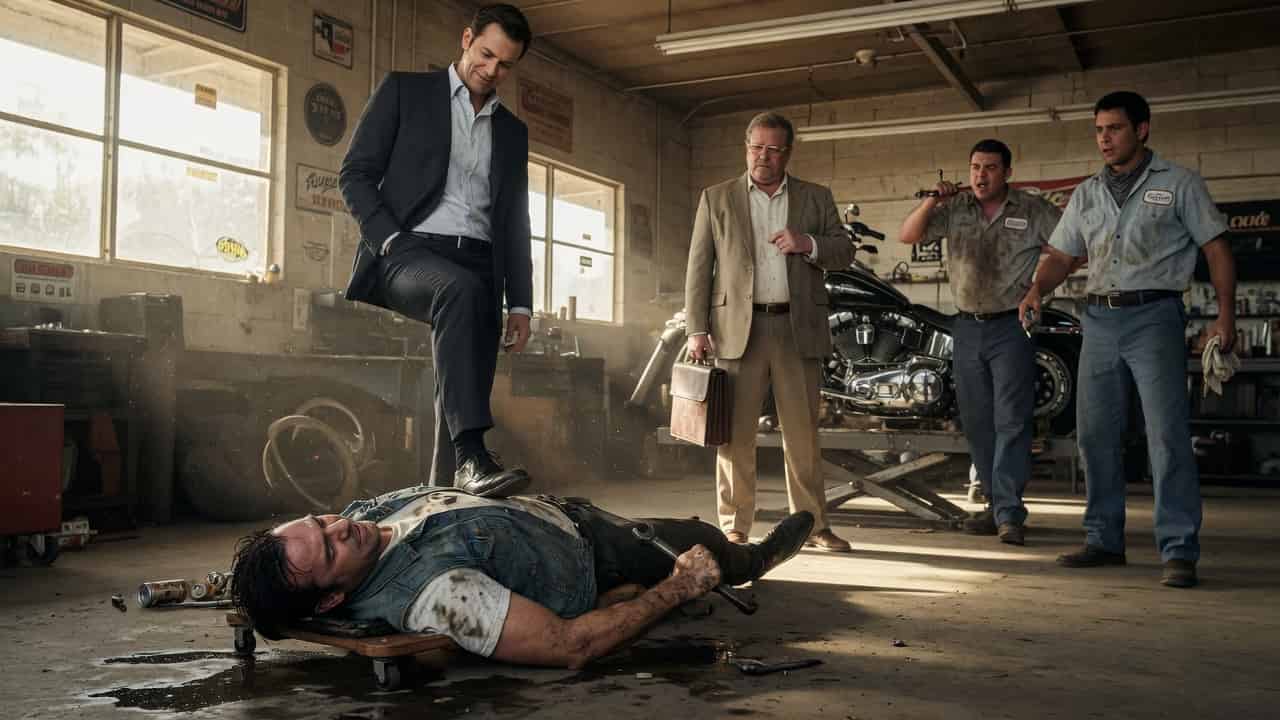
“Get your boot off my chest, Vance.”
Vance didn’t move. He just pressed harder, the polished leather of his thousand-dollar shoes grinding into my sweat-stained shirt. I was pinned to the concrete of my own shop, the smell of 10W-40 and old rubber filling my lungs while my own guys watched from the shadows, paralyzed.
“You’ve got a lot of nerve, grease monkey,” Vance sneered, leaning down so I could smell the expensive scotch on his breath. “Did you really think a bastard born in a trailer could just claim a seat at our table? You’re a mistake, Jax. A dirty little secret that’s about to be swept out of this town along with this pathetic garage.”
Sterling, the family lawyer, didn’t even look at me. He was too busy checking his gold watch, waiting for the humiliation to be over so they could get back to their ivory tower. They think I’m nothing. They think because my mother was forced out of Houston with nothing but the clothes on her back, I’m just some biker with a wrench and a debt.
But I’ve seen the news. I know the Harrison plane went down. And I know why they’re really here—they’re terrified.
I felt the heavy iron wrench in my right hand. I could have ended it right there. But I didn’t. I let him think he won. I let him walk out of there thinking I was broken. Because when I show up at that board meeting on my Harley, they aren’t going to see a victim. They’re going to see the rightful heir coming to burn their empire to the ground.
Chapter 1: The Weight of the Wrench
The humidity in East Texas doesn’t just sit on you; it owns you. It’s a thick, wet wool blanket that smells of scorched asphalt and pine sap. Inside Miller’s Custom Cycles, the air was worse—a stagnant soup of aerosol degreaser, old cigarette smoke, and the metallic tang of grinding steel.
Jax Miller wiped a streak of primary oil from his forearm with a rag that was already more black than red. He was thirty-two, but his hands looked fifty. They were mapped with scars: a jagged white line from a slipped flathead, a circular burn from a hot exhaust pipe, and the deep, permanent stains under his fingernails that no amount of Gojo could ever truly touch.
“Jax, the guy from the bank is on line two again,” Benny called out from the parts counter.
Benny was sixty, had a back like a question mark, and had worked for Jax’s foster father, Silas, since before the shop had a concrete floor. He looked at Jax with eyes that carried the weight of the mortgage.
“Tell him I’m under a bike,” Jax muttered, not looking up.
“He said it’s the final notice, kid. Said if we don’t move on the arrears by Friday, the sheriff’s coming by to paper the door.”
Jax didn’t answer. He couldn’t. Instead, he shoved his creeper back under the frame of a 2014 Street Glide. He needed the silence of the machine. The bank didn’t understand that the shop wasn’t just a business; it was a sarcophagus. Silas had died eighteen months ago, leaving Jax the tools, the building, and a pile of debt that looked like a mountain from the bottom of a hole.
He gripped a 5/8th wrench and started tightening the drain plug, his knuckles turning white. His mind drifted, as it always did when the pressure got too high, to the box in the attic of the small apartment above the shop. Inside was a single photograph of a woman with tired eyes and a denim jacket, and a birth certificate that didn’t have a father’s name on it. Just hers: Elena Miller.
He’d grown up hearing the whispers in town. That his mother had been a “party girl” who got knocked up by some rich tourist passing through on his way to Houston. But Jax remembered the way she used to look at the oil derricks on the horizon—not with curiosity, but with a cold, vibrating hatred.
The roar of an engine interrupted his thoughts. It wasn’t the rhythmic, potato-potato thrum of a V-twin. It was the smooth, surgical whine of a high-end European V12.
Jax rolled out from under the Glide, the wheels of his creeper squeaking on the grit. He sat up, wiping his face with the back of his hand, leaving a smear of grease across his cheek.
A black Maybach had pulled into the gravel lot, kicking up a cloud of dust that settled on the row of customer bikes parked outside. The car looked like a predator in a petting zoo. The doors opened with a soft, expensive thud.
Two men stepped out. One was older, wearing a tan linen suit that cost more than Jax’s truck. He held a leather briefcase like a shield. The other was younger, maybe Jax’s age, wearing a charcoal suit that was tailored so tight it looked like a second skin. He had blonde hair slicked back with military precision and eyes the color of a shallow cenote—beautiful, but empty.
“Can I help you?” Jax asked, standing up. He wiped his hands on his jeans, feeling the sudden, sharp shift in the room’s atmosphere.
The younger man didn’t speak. He just looked around the shop with a look of profound disgust, his nose wrinkling at the smell of the solvent tank. He pulled a silk handkerchief from his pocket and dabbed at his nose.
“We are looking for a Jackson Miller,” the older man said, his voice as dry as parchment.
“That’s me. People call me Jax.”
The younger man—Vance, though Jax didn’t know it yet—smirked. “Jax. Of course they do. It’s so… evocative. Like a character in a bad paperback.”
Jax felt the heat crawl up the back of his neck. “I don’t recall inviting a critique of my name. You got a bike that needs work, or are you just lost on your way to a country club?”
“We aren’t lost, Mr. Miller,” the older man said, stepping forward. “My name is Sterling. I represent the Harrison Group out of Houston. This is Vance Harrison.”
The name Harrison hit Jax like a physical blow. It was the name on the derricks. The name on the towers. The name his mother had died trying to forget.
“I don’t care who you are,” Jax said, his voice dropping an octave. “Get that car off my lot. Now.”
Vance stepped closer, his polished shoes clicking on the concrete. He stopped just inches from Jax, looking down at him despite them being the same height. It was a trick of posture, a trick of money.
“You’ve got your mother’s mouth,” Vance said quietly. “Small. Defiant. Worthless.”
Jax’s hand went to the heavy wrench on his belt, his heart hammering against his ribs. “Don’t you mention her.”
“Oh, I’ll mention whatever I like,” Vance sneered. “See, Jackson, we have a problem. There was an accident. A plane crash. My uncle, my cousins… they’re all gone. Except for the old man, and he’s holding onto life by a thread. And then there’s you. The little stain on the family ledger that just won’t wash out.”
Sterling opened his briefcase. “We have an offer, Mr. Miller. A very generous one. In exchange for your signature on a few documents—renouncing any and all claims to the Harrison estate—we are prepared to clear the debts on this… establishment. And provide you with a modest stipend to move elsewhere.”
Jax looked at the paper Sterling held out. He looked at the Maybach idling in the dust. He looked at Vance’s smug, punchable face.
The debt was crushing him. He could save the shop. He could save Benny’s job. All he had to do was admit he was nothing.
“Get out,” Jax said.
Vance laughed. It was a cold, sharp sound. “Look around, Jackson. You’re drowning in oil and scrap metal. You really want to play the hero? You’re a grease monkey. A mistake. And mistakes get corrected.”
Vance didn’t wait for an answer. He turned on his heel and walked back to the car, Sterling following like a faithful hound. As the Maybach peeled out, spray of gravel hitting the shop’s siding, Jax stood in the center of the floor, his breath coming in ragged hitches.
He looked down at his hands. They were shaking. Not from fear, but from a rage so old and so deep it felt like it had been carved into his bones before he was even born. He wasn’t just Jax the mechanic anymore. He was the man they were afraid of.
Chapter 2: The Mud and the Maybach
The next morning, the heat didn’t just return; it intensified, turning the shop into a kiln. Jax hadn’t slept. He’d spent the night in the attic, staring at the birth certificate. He’d looked for the watermark, the seal, anything that made it feel like more than just a piece of paper. It was real. Jackson Alexander Harrison-Miller. He arrived at the shop at 6:00 AM, hoping to get a head start on a transmission job, but the black Maybach was already there. This time, it wasn’t alone. Two black SUVs were parked flanking it, engines idling, exhaust plumes shimmering in the morning light.
Vance was leaning against the hood of the Maybach, scrolling through his phone. He looked perfectly cool, as if the Texas sun didn’t dare touch him.
“You’re early,” Jax said, stepping off his Harley. He didn’t take off his helmet immediately. He wanted the barrier.
“I find that the best time to handle pests is before they settle in for the day,” Vance said, not looking up.
Jax walked past him toward the shop door, but two men in suits—heavy-set guys with earpieces—stepped into his path. They didn’t say anything. They just stood there, meat-walls blocking the entrance to his own life.
“Move,” Jax said.
Vance finally looked up, a thin smile playing on his lips. “They don’t take orders from people who smell like gasoline, Jackson. Now, about that paper. Sterling tells me you didn’t sign it yesterday. I assumed it was because you were overwhelmed by the number of zeros. I’ve had him add another one. Just for your… emotional distress.”
“You can add as many zeros as you want,” Jax said, pulling off his helmet. His hair was matted with sweat. “The answer is still no. Now get your goons out of my way.”
Vance sighed, a theatrical sound of disappointment. He walked over to Jax, his steps deliberate. The two guards stepped back, creating a space for their boss.
“You know, I asked about your mother,” Vance said, his voice conversational. “The records in the family office are quite detailed. She was a waitress at the club. Real pretty, apparently. The kind of girl who thinks a smile and a short skirt is a ticket to the top. My uncle was bored. It happens. But she got greedy. She thought she could keep the baby and force her way into the bloodline.”
Jax’s jaw tightened so hard his teeth ached. “Shut up.”
“The family paid her to vanish. She took the money and ran to this shithole. And yet, here you are, thirty years later, still trying to latch onto a name that doesn’t want you.”
Vance reached out and flicked a piece of lint off Jax’s vest. Jax swiped his hand away.
“Don’t touch me.”
Vance’s expression shifted. The mask of boredom dropped, revealing the predatory malice underneath. He signaled to the guards.
Before Jax could react, one of the guards grabbed his arms from behind, pinning them. The other shoved him hard in the chest. Jax stumbled back, his boots slipping on a patch of wet mud and oil near the shop’s drain. He went down hard on his back, the air rushing out of his lungs.
“Jax!” Benny shouted, running out from the shop, but the second guard shoved the old man back against the wall.
Jax tried to scramble up, his hands slick with mud, but Vance was already over him. In one swift, practiced motion, Vance stepped onto Jax’s chest.
It wasn’t just a step. He put his full weight onto the heel of his black oxford, right over Jax’s sternum. Jax gasped, his vision blurring at the edges. He was pinned to the muck, the absolute humiliation of it searing worse than the physical pain.
“Look at you,” Vance sneered, leaning down. He looked like he was admiring a bug he’d pinned to a board. “In the mud, where you belong. You really think a bastard of a whore can stand in a boardroom? You think you can sit in the seat my father built?”
Jax grabbed Vance’s ankle, trying to twist it, but the guard behind him kicked Jax’s hand away.
“You’re nothing but a grease monkey with a fairy tale,” Vance said, pressing his boot harder. Jax felt a rib groan under the pressure. “The Harrison name is about power. It’s about legacy. It’s not for people who spend their lives under the gầm xe (undercarriage) of a dirty bike.”
Vance looked up at the gathered mechanics—Jax’s guys—who were standing in the shop door, frozen by the sight of the guards’ hands hovering near their jackets. They were seeing their boss, the man who’d kept them afloat, being treated like a dog in the dirt.
“This is your king?” Vance shouted to the shop. “This is the man you’re following into bankruptcy? He’s a mistake. A genetic error.”
Vance leaned back down, his face inches from Jax’s. “Sign the papers, Jackson. Or I’ll buy this lot and bulldoze it with you still inside. I’ll make sure nobody in this town remembers your mother’s name, let alone yours.”
Vance pulled his foot back, giving Jax a final, contemptuous shove with his toe. He wiped his boot on a patch of dry grass as he walked back to the Maybach.
“We’ll be back tomorrow,” Sterling said, his voice calm as he stepped into the car. “I suggest you spend the night thinking about your future. Or lack thereof.”
The vehicles roared to life and sped away, leaving a thick fog of dust and the silence of a broken room.
Jax didn’t get up immediately. He lay in the mud, staring up at the scorched Texas sky. His chest burned where the boot had been. He could feel the eyes of his men on him—pity, shock, and the slow, agonizing death of respect.
Benny hurried over, kneeling in the dirt. “Jax, oh god, kid… you alright?”
Jax ignored the hand Benny offered. He rolled onto his side, coughing up a bit of grit. He stood up slowly, his movements stiff. He didn’t look at Benny. He didn’t look at the other guys. He walked straight to the sink at the back of the shop and started scrubbing the mud from his arms. He scrubbed until the skin was raw and red, but he still felt dirty. He still felt the weight of that boot.
He looked in the cracked mirror above the sink. He saw the grease, the mud, and the shame. But underneath it, in the set of his eyes, he saw something else. He saw the reason they’d come all this way just to step on him.
They weren’t disgusted. They were terrified.
Chapter 3: Ghosts in the Chrome
The residue of the humiliation hung over the shop like a toxic gas. Nobody spoke. The usual banter, the clinking of tools, the hum of the radio—it was all gone. The mechanics worked in a grim, hurried silence, their eyes avoiding Jax whenever he walked across the floor.
Jax knew that look. It was the look you gave a man who’d been stripped of his dignity in front of his tribe. He could feel the power structure of the shop crumbling. If he didn’t do something, the bank wouldn’t even need to paper the door; the men would just stop showing up.
He spent the afternoon in the “Dead Room”—the back corner of the shop where Silas kept the bikes that were too far gone to save. In the center of the clutter was a 1978 Harley-Davidson Shovelhead. It was the bike Jax’s mother had arrived on thirty years ago. It hadn’t run in a decade.
Jax began to tear it down. He didn’t have a plan, just a need for destruction. He ripped off the seat, disconnected the fuel lines, and finally, he unbolted the gas tank.
He remembered Silas telling him once, “Your mama, she loved this bike more than she loved herself. Said it was the only thing that ever kept its promises.”
Jax shook the tank. Something rattled inside. Not the liquid slosh of old gas, but something solid.
He took a flashlight and peered into the filler neck. There was a plastic-wrapped cylinder wedged against the internal baffle. With a pair of long-reach needle-nose pliers and ten minutes of cursing, he managed to fish it out.
It was a heavy-duty Ziploc bag, yellowed with age. Inside was a handwritten letter and a series of photographs.
Jax, the letter began. The handwriting was frantic, slanted. If you’re reading this, I’m gone, and you’re probably looking for answers. They told me I was nothing. They told me you were a mistake. But you are a Harrison. Your father, Thomas, he loved me. He was going to leave them all for us. But they found out. They didn’t just fire me, Jax. They threatened to make us both disappear. I took the money because it was the only way to keep you breathing. But I never spent a dime of it. I put it in a trust for when you turned thirty. The papers are in the lawyer’s safe in Houston—a man named Miller, my cousin. He’s the one who gave us our name. Use it. Take back what they stole.
Jax stared at the photos. They weren’t of a “party girl” and a tourist. They were of a young woman and a man who looked exactly like Jax, standing in front of a sunset, looking at each other with a terrifyingly pure devotion.
The weight of the secret was a physical pressure in his chest. He wasn’t a mistake. He was the plan.
He walked out to the front of the shop, the letter crumpled in his pocket. Benny was closing up, his movements slow and defeated.
“Benny,” Jax called out.
The old man stopped, his hand on the light switch. “Yeah, Jax?”
“Tomorrow morning, I want everyone here. 7:00 AM. And I want the Iron Dogs called in.”
Benny’s eyes widened. The Iron Dogs were the local MC. They weren’t outlaws in the cinematic sense, but they were the law in this part of the county. They were the men Jax rode with on weekends, the men who’d treated him like a brother when his own blood had disowned him.
“You sure about that? Bringing the club in… that’s gonna escalate things with those suits.”
“They already escalated it,” Jax said, his voice cold. “They stepped on my chest in my own house, Benny. They think they’re the only ones with an army.”
Jax spent the rest of the night working on the Shovelhead. He didn’t sleep. He cleaned the carb, replaced the plugs, and drained the old oil. He worked with a precision that felt like a prayer. By 5:00 AM, the bike was back together.
He rolled it out to the center of the shop, the chrome dull under the fluorescent lights. He kicked the starter. Once. Twice. On the third try, the old beast roared to life, a jagged, violent sound that shook the windows of the shop. It was the sound of a ghost waking up.
He sat on the bike, feeling the vibration through the seat, and he felt his mother there with him. He felt her rage, her fear, and her hope.
The sun began to bleed over the horizon, casting long, sharp shadows across the lot. Jax stood at the open bay doors, watching the road. He saw the first flickers of headlights in the distance. Not a Maybach.
A dozen motorcycles appeared over the hill, moving in a tight, disciplined formation. The Iron Dogs. Leading them was “Bear,” a man the size of a refrigerator with a beard that reached his belt.
They pulled into the lot, the collective roar of their engines drowning out the morning birds. They didn’t park like customers. They parked like a blockade.
Bear hopped off his bike and walked up to Jax, looking at the mud-stained shirt Jax was still wearing from the day before.
“Heard some city boys came by to play rough,” Bear said, his voice a low rumble.
“They’re coming back today,” Jax said.
“Good,” Bear said, cracking his knuckles. “I haven’t had a reason to ruin a good suit in a long time.”
Jax looked at the men behind Bear—mechanics, roofers, veterans, men who knew what it was like to be looked down on by people like Vance Harrison. They were his rescue force, but he knew the cost. If this turned violent, the shop was gone regardless of the debt. The police would be all over them.
But as he looked at the letter in his pocket, he realized he didn’t care about the shop anymore. The shop was a cage. He was ready to burn it down if it meant he could finally stand up.
Chapter 4: The Brotherhood’s Line
At 9:00 AM, the Maybach returned. It slowed as it approached the turn-off, the driver clearly hesitant as he saw the wall of chrome and leather blocking the entrance. The two SUVs pulled up behind it, their doors opening simultaneously.
Vance stepped out, but this time he didn’t look bored. He looked annoyed. He smoothed his tie and walked toward the line of bikers, Sterling trailing behind him, looking genuinely nervous.
“Mr. Miller!” Sterling shouted over the idling engines. “This is a highly irregular way to conduct a business meeting!”
Bear stepped forward, his arms crossed over his massive chest. “We ain’t here for business. We’re here to make sure nobody gets mud on their shoes today.”
Vance pushed past Sterling, stopping a few feet from Bear. He looked up at the giant, his lip curling. “Out of my way, Sasquatch. I have a contract to finish.”
“The only thing you’re finishing is your stay in this town,” Jax said, stepping out from behind Bear.
He was wearing a fresh shirt, but he hadn’t washed the mud off his boots. He wanted them to see it. He was holding a heavy manila envelope in his hand.
Vance laughed, but it sounded forced. “Oh, I see. You called your little club. Is this supposed to intimidate me? I have lawyers who can tie you up in court for the next fifty years. I have deputies on my payroll who can have this entire lot cleared in twenty minutes.”
“Maybe,” Jax said. “But you don’t have this.”
Jax held up the birth certificate—the real one, the one from the safe. He’d made a stop at the cousin’s office in the middle of the night.
Sterling’s face went pale. He squinted at the paper. “Where did you get that?”
“My mother kept records, Sterling. She wasn’t as stupid as you told the family she was. And it turns out, she didn’t just have a kid. She had a husband. Common law in Texas is a powerful thing when you have the right witnesses.”
Vance’s eyes darted to Sterling. “Is he lying?”
Sterling didn’t answer. He was staring at the seal on the document. “If that’s authentic… if there was a recognized marriage… then the trust isn’t just a stipend. It’s the controlling interest.”
The silence that followed was absolute. Even the bikers went quiet.
Vance’s face transformed. The elite composure shattered, replaced by a raw, vibrating desperation. He looked at the shop, then at the bikers, then at Jax. He realized that the “grease monkey” he’d stepped on was now the man who held the keys to his entire world.
“Give me that,” Vance hissed, reaching for the paper.
Bear stepped in his way, a wall of muscle and denim. “Don’t even think about it, kid.”
“You think this changes anything?” Vance shouted, his voice cracking. “You’re still a nobody! You’re still dirt! You think the board is going to listen to you? You think the world is going to accept a biker as the head of Harrison Oil?”
“I don’t care about the board,” Jax said, stepping closer to Vance. The power dynamic had flipped so fast the air seemed to hum with the friction of it. “And I don’t care about the company. But I care about what you did to my mother. And I care about you putting your boot on my chest.”
Jax reached out and grabbed Vance by the lapels of his charcoal suit. The guards from the SUVs started forward, but the Iron Dogs moved as one, a wave of leather and steel that stopped the guards in their tracks.
“Listen to me, Vance,” Jax whispered, his face inches from his cousin’s. “You’re going to get in that car. You’re going to drive back to Houston. And you’re going to tell the old man that I’m coming. Not for the money. Not for the name. I’m coming for the chair.”
Jax shoved Vance back. Vance stumbled, his polished shoes slipping on the same gravel where he’d humiliated Jax the day before. He didn’t fall, but he looked small. He looked like a child wearing his father’s clothes.
“This isn’t over!” Vance screamed, his face red with fury and shame. “I’ll burn you out, Jackson! I’ll destroy everything you love!”
“Try it,” Jax said.
Vance scrambled back into the Maybach, the door slamming with a sound that no longer felt expensive—it felt like a cage closing. The SUVs backed out in a hurry, kicking up a storm of dust that coated the Maybach as it fled.
The bikers let out a roar of laughter and cheers, slapping Jax on the back, but Jax didn’t smile. He felt the residue of the moment—the realization that he’d just started a war he might not survive. He looked at Benny, who was standing in the shop door, looking at Jax with a mixture of pride and terror.
“What now, Jax?” Benny asked.
Jax looked down at the birth certificate, then at the long, straight road leading toward Houston.
“Now,” Jax said, his voice steady. “We ride.”
He walked over to the 1978 Shovelhead. He swung his leg over the seat and kicked the engine to life. The vibration felt like a heartbeat. He looked at the Iron Dogs, his brothers by choice, and then he looked at the horizon where the oil derricks waited.
The mistake was going home.
Chapter 5: The Glass Skyline
The transition from the scrub-oak flats of East Texas to the gleaming glass canyons of Houston felt like crossing into a different century. The heat didn’t change, but its character did. In the country, the sun was a heavy weight; here, reflected off the mirrored surfaces of eighty-story towers, it was a blinding, clinical glare.
Jax led the formation on the ’78 Shovelhead. He’d cleaned it, but he hadn’t polished it. The bike looked like a bruise moving through a room full of diamonds. Behind him, Bear and ten members of the Iron Dogs rode in a tight staggered formation, their exhaust notes bouncing off the concrete barriers of the I-10, creating a rhythmic thunder that made suburban commuters roll up their windows and look away.
Jax’s chest still burned. The bruise from Vance’s boot had turned a deep, sickly purple—a physical reminder of the status he was supposed to accept. He felt the manila envelope tucked inside his denim vest, the edges of the paper pressing against his ribs. It felt heavier than a lead plate.
They pulled onto Louisiana Street, the heart of the corporate district. The Harrison Energy building was a monolith of black glass and steel, rising like a middle finger to the sky. It sat behind a plaza of white marble, decorated with fountains that sprayed recycled water into the humid air.
Jax didn’t slow down as he approached the curb. He hopped the Shovelhead onto the marble plaza, the kickstand scraping a long, ugly white line into the stone. The Iron Dogs followed suit, a dozen heavy machines surrounding the fountain, their engines idling with a jagged, aggressive vibration that sent ripples across the water.
Security guards in crisp blue uniforms appeared at the glass doors within seconds, their hands hovering near their belts. They looked terrified. They were trained for disgruntled employees or peaceful protesters, not a wall of leather, grease, and high-decibel machinery.
Jax killed the engine. The sudden silence was louder than the noise. He dismounted, his boots clicking on the marble—a sound he’d only ever heard in his shop on concrete.
“Stay here,” Jax said to Bear.
Bear spat a stream of tobacco juice onto the white stone. “We’ll be right here, kid. Anyone tries to take you out the back door, they’re gonna have a bad afternoon.”
Jax walked toward the entrance. The sliding glass doors hissed open, and the air conditioning hit him like a physical wall. It smelled of ozone, expensive furniture polish, and the kind of filtered air that cost a month’s rent. He felt out of place—his jeans were stained with primary oil, his t-shirt was damp with sweat, and his boots carried the dust of a town these people only saw from thirty thousand feet.
The lobby was a cathedral of wealth. At the far end, behind a desk made of a single slab of obsidian, stood a woman whose hair was so perfect it looked molded.
“Can I help you?” she asked, her voice hovering between professional politeness and a call for security.
“I’m here to see Arthur Harrison,” Jax said.
The woman didn’t blink. “Mr. Harrison is not receiving visitors. He is in private palliative care. If you have a business inquiry, you can speak with Mr. Sterling on the fortieth floor.”
“I’m not here for a business inquiry,” Jax said, leaning over the obsidian desk. He could smell her perfume—something floral and sharp. He pulled the birth certificate from the envelope and laid it on the desk. “Tell him Jackson is here. Tell him Elena’s son is in the lobby.”
The woman looked down at the paper. She didn’t read it all, but she saw the Harrison seal at the top. Her eyes widened, flicking from the document to Jax’s face. She picked up a phone and whispered into it.
Two minutes later, the elevator doors at the end of the hall chimed. Sterling stepped out. He looked tired. The tan linen suit from the shop had been replaced by a charcoal wool that looked suffocating. He didn’t look at Jax’s face; he looked at the bikers visible through the glass doors.
“This is a circus, Jackson,” Sterling said, walking over. “You think bringing a gang to our doorstep is going to win over the board?”
“I’m not here for the board, Sterling. I’m here for the old man. Vance told me he’s holding onto life by a thread. I want to see that thread.”
Sterling sighed, a sound of genuine exhaustion. “He’s at the penthouse. He hasn’t spoken in three days. The doctors say it’s a matter of hours, maybe a day. Vance is already there, preparing the transition.”
“Then let’s go,” Jax said.
The elevator ride was the longest ninety seconds of Jax’s life. It moved with a silent, nauseating smoothness. He watched the floor numbers climb on the digital display. 10… 20… 30… Every floor represented a world he’d been denied, a legacy that had been weaponized against his mother until it broke her.
Sterling stared at the doors. “You know, your father was the best of them. Thomas. He wasn’t like Vance. He didn’t care about the towers. He wanted to be out in the field, with the crews. He actually liked the smell of the crude.”
“Then why did he let them send her away?” Jax asked, his voice low.
“He didn’t know,” Sterling said, and for the first time, the lawyer sounded human. “Arthur didn’t tell him she was pregnant. He told Thomas that Elena had taken a payout and moved to California with another man. By the time Thomas found out the truth, he was already married to a woman the family had chosen for him. He spent the rest of his life looking for her, Jackson. He never found her because Silas was too good at hiding you.”
The doors chimed. The fortieth floor was a different world entirely. It was silent, carpeted in deep navy wool that swallowed the sound of Jax’s heavy boots. The walls were lined with oil paintings of men who looked like Vance—men with cold eyes and straight noses who had never bled for a dollar.
At the end of the hall, two double doors of polished mahogany stood open. Inside, the room was filled with the rhythmic hiss and click of medical machinery.
Vance was there. He was standing by a floor-to-ceiling window, looking out over the city. He didn’t turn around when they entered.
“I told the guards to call the police, Sterling,” Vance said, his voice flat. “Why is he in my office?”
“It’s not your office yet, Vance,” Jax said.
Vance turned. The arrogance was still there, but it was brittle now. His eyes were bloodshot. “You think a piece of paper makes you a king? This company is a machine. You don’t know how to turn the key, let alone drive it. You’ll be eaten alive by the first quarter.”
“I’m not here to drive the machine,” Jax said. He walked past Vance toward the bed in the center of the room.
Arthur Harrison looked like a ghost made of parchment. He was hooked up to a dozen tubes, his chest rising and falling in a shallow, mechanical rhythm. This was the man who had ordered Jax’s mother into exile. This was the man who had decided that a bloodline was more important than a human life.
Jax stood by the bed. He looked at the old man’s hands—long, thin fingers that had signed away his mother’s dignity. He felt a surge of anger, but it was quickly replaced by a profound, hollow pity. All the towers, all the billions, and it ended here, in a room that smelled like bleach and expensive death.
Vance walked over, stopping on the other side of the bed. “He can’t hear you. He’s gone. The machines are just keeping the heart moving until the paperwork is finalized.”
“Is that what you’re waiting for?” Jax asked. “The heartbeat to stop so you can start spending?”
“I’m the only one who can save this legacy,” Vance said, leaning over the bed. “You’re just a reminder of a mistake. If you have any shred of decency, you’ll take the money Sterling offered and go back to your grease and your scrap metal.”
Jax looked at Vance, then back at the old man. He saw the resemblance—the same curve of the jaw, the same stubborn set of the mouth. He realized that if he took the chair, if he stayed in this building, he would eventually become this. He would become a ghost in a suit, waiting for the next generation to come and claim the throne.
Suddenly, Arthur’s hand twitched. His eyes didn’t open, but his fingers brushed against the silk sheets.
“He’s awake,” Jax whispered.
“He’s not awake,” Vance snapped. “It’s a neurological reflex. Sterling, tell him.”
But Sterling was looking at the monitor. The heart rate was climbing. Arthur’s eyes fluttered open—clouded, yellowed by age and organ failure. He looked around the room, confused, until his gaze landed on Jax.
A rasping sound came from the old man’s throat. A word.
“Thomas?”
It wasn’t a question. It was a plea.
Vance stepped forward, blocking Jax’s view. “Grandfather, it’s me. It’s Vance. I’m here. Everything is handled.”
Arthur didn’t look at Vance. He tried to turn his head toward Jax, his hand reaching out, trembling. “Thomas… I’m sorry… I didn’t know…”
Jax realized the old man was seeing his father. The resemblance was so strong it had pierced through the fog of death.
Vance grabbed Arthur’s hand, his grip too tight. “He’s not Thomas! Grandfather, look at me! Thomas is gone! This is the bastard! The one from the garage!”
The vitriol in Vance’s voice was like a physical stain in the room. Arthur’s heart rate monitor began to beep frantically. He looked at Vance, his eyes clearing for one brief, lucent second. He saw the greed, the malice, and the smallness in his grandson’s face.
Then he looked back at Jax. He saw the oil under the fingernails. He saw the purple bruise on the chest where Vance’s boot had been. He saw the truth.
Arthur reached out, his fingers brushing Jax’s forearm. He gripped Jax’s wrist with a strength that shouldn’t have been possible.
“Fix it,” Arthur whispered.
The monitor flatlined.
The silence that followed was absolute. Vance stared at the old man’s hand, still gripped around Jax’s wrist. He looked like he wanted to scream.
“He’s gone,” Sterling said softly, checking his watch. “3:42 PM.”
Vance pulled Arthur’s hand away from Jax as if the touch were contagious. He backed away from the bed, his face pale. “That didn’t happen. He didn’t say anything. He was delirious.”
Jax didn’t answer. He looked at his wrist where the old man’s fingers had been. He felt the residue of the touch—not the weight of an empire, but the weight of a dying man’s regret.
“It happened, Vance,” Jax said, his voice steady. “And we both know what he meant.”
Jax turned and walked toward the door. He didn’t look at the towers. He didn’t look at the paintings. He walked out of the penthouse and into the hall, the sound of his boots finally belonging in the silence.
Chapter 6: The Residue of the Throne
The funeral was a curated event. It was held at a private cemetery in River Oaks, under a canopy of ancient oaks that had been trimmed to perfection. There were more security guards than mourners. Men in black suits stood like statues, their eyes scanning the perimeter for any sign of the “biker element” that had occupied the corporate plaza three days earlier.
Jax stood at the back, near the iron gates. He hadn’t been invited, and he didn’t care. He was wearing his best black denim and a clean white shirt, his hair pulled back. He looked like a man who had come to witness a closing, not a beginning.
He watched Vance deliver the eulogy. It was a masterpiece of corporate theater—full of words like vision, heritage, and stability. Vance looked every bit the successor, his voice steady, his posture perfect. But Jax could see the way Vance’s hands gripped the edge of the podium until the wood groaned. Vance kept glancing at the gates, terrified that Jax would ride in and shatter the illusion.
Jax didn’t move. He waited until the service was over, until the long line of black limousines had begun to snake out of the cemetery. He waited until Vance was standing by the open grave, alone with Sterling.
Jax walked across the manicured grass. His boots felt heavy, leaving deep prints in the soft earth.
Vance saw him coming and stiffened. “The reading of the will is tomorrow, Jackson. You’ll get your summons. There’s no need for this.”
“I’m not here for the will, Vance,” Jax said. He stopped at the edge of the grave, looking down at the mahogany casket. “I’m here to tell you that I’m taking the payout.”
Vance blinked, the tension in his shoulders dropping an inch. “The payout? You mean the stipend? You’re walking away?”
“Not the stipend,” Jax said. “The full buyout for my share of the controlling interest. Sterling has the numbers. It’s enough to clear every debt in my town. It’s enough to set up a trust for the mechanics’ families for three generations. And it’s enough to make sure you never have a reason to step foot in East Texas again.”
Vance’s face twisted. He looked relieved, but he also looked insulted. “You’re selling your birthright for a garage?”
“I’m buying my freedom from you,” Jax said. “My mother didn’t want this building, Vance. She wanted a life where she didn’t have to look over her shoulder. You can have the towers. You can have the boards and the suits and the ulcers. You can spend the rest of your life trying to be the man your grandfather wanted you to be, and failing every single day.”
Jax pulled a folded piece of paper from his pocket—the common-law marriage certificate. He dropped it onto the casket.
“Tell the old man he was right,” Jax said. “Thomas would have hated it here.”
Jax turned and walked away. He didn’t look back. He walked out of the cemetery, past the guards, and toward the ’78 Shovelhead parked by the curb.
Bear was leaning against his bike, chewing on a toothpick. “How’d it go, kid?”
“It’s over,” Jax said. He swung his leg over the seat and kicked the engine. It roared to life, a raw, honest sound that didn’t belong in River Oaks. “Let’s go home.”
The ride back was different. The pressure was gone. The purple bruise on Jax’s chest had faded to a dull yellow, and the air seemed thinner, easier to breathe. They rode through the night, the lights of the refineries on the horizon looking like a fallen constellation.
They reached the shop at dawn. Benny was already there, sitting on the bench out front with a cup of coffee. He looked up as the bikes pulled in, his face lighting up with a mixture of relief and curiosity.
Jax killed the engine and sat there for a moment, feeling the heat coming off the block. The shop looked small. It looked worn. It looked like a place that required a lot of work.
He walked over to Benny and sat down on the bench.
“We keeping the lights on?” Benny asked quietly.
“We’re keeping them on, Benny. And we’re putting a new roof on. And we’re hiring three more guys.”
Benny looked at him, his eyes damp. “You did it, didn’t you? You took them for everything.”
“No,” Jax said, looking at his hands—greasy again, scarred, and real. “I just took what was mine.”
The Iron Dogs filtered out over the next hour, heading back to their own lives, their own debts, and their own small victories. Bear was the last to leave. He slapped Jax on the shoulder, a blow that would have knocked a lesser man over.
“You ever get tired of being a tycoon, Miller, the road’s always there,” Bear said.
“I’m already home, Bear,” Jax said.
Jax spent the rest of the morning in the shop. He didn’t go up to the apartment. He didn’t look at the photographs. He put on his work shirt, grabbed a 9/16th socket, and rolled under a customer’s bike.
The concrete was cold. The smell of oil was familiar. As he started to work, he felt the residue of the last week—the anger, the shame, the weight of the boot, and the final, rasping apology of a dying man. It was all there, but it didn’t weigh him down anymore. It was just history.
He heard a car pull into the lot. He didn’t move. He waited for the sound of an expensive engine, but it didn’t come. Instead, he heard the familiar rattle of an old truck.
He rolled out from under the bike. A young woman was standing in the bay door, holding a helmet. She looked like she’d been riding for a long time.
“I heard this was the best shop in the county,” she said. “My carb’s spitting, and I can’t get the idle right.”
Jax stood up. He wiped his hands on a rag, the black grease staining the cloth. He looked at her, then at the shop, then at the bright, hot Texas sun pouring through the windows.
“I can fix that,” Jax said.
He walked over to the bike, his boots clicking on the concrete. He didn’t look like a king. He didn’t look like an heir. He looked like a man who knew exactly where he stood. And for the first time in his life, that was enough.
The grease under his nails wasn’t a stain anymore. It was a choice.
Jax Miller leaned over the machine, listened to the heartbeat of the engine, and began to work. Outside, the world kept moving, the towers in Houston kept gleaming, and the name Harrison kept fading into the dust. But here, in the heat and the oil, everything was exactly where it was supposed to be.
The wrench felt right in his hand. The weight of it was exactly what he needed to hold him down to the earth.
[THE END]