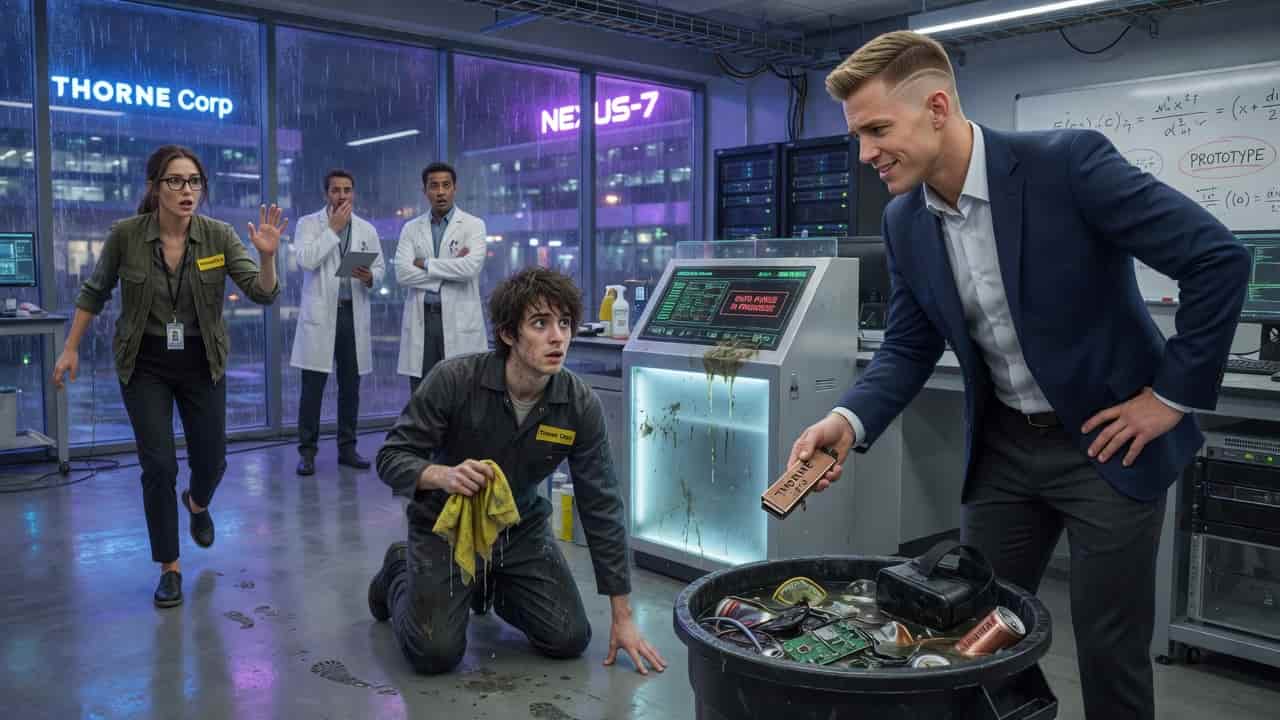
“Fetch it. It’s right there in the trash where you found it.”
Julian stood over me, his tailored suit worth more than my entire life’s earnings. He was holding the one thing I had left of the man I never knew—a vintage copper USB drive. The board of directors was watching. The engineers I’d spent months cleaning up after were staring at the floor, too scared to speak up.
“Julian, that’s enough,” Sarah whispered, her voice trembling. She was the only one who ever looked me in the eye.
He didn’t even look at her. He just smiled at me—that shark-like grin that told me he knew I couldn’t fight back. He knew I couldn’t even read the employee handbook, let alone a legal summons. To him, I was just “biological hardware.” A tool that leaked and breathed.
“You’re a janitor, Gabe. You’re paid to handle garbage,” he said, his voice smooth as silk. Then, he let go.
The USB hit the bottom of the bin with a sickening splash of grey water and old coffee.
“Pick it up. And then get out of my building before I have you arrested for theft.”
I looked at the trash. I looked at the men in the room who called themselves geniuses but stayed silent while a kid was gutted in front of them. They thought I was nothing. They thought my father had forgotten me.
But as the room’s lights suddenly turned a deep, blood-red and the servers began to scream, I realized the building wasn’t his. It was waiting for me.
Chapter 1: The Invisible Man
The hum of the Thorne Tower was a living thing. It wasn’t just electricity; it was the sound of a billion secrets moving through fiber-optic veins at the speed of light. To the world, this building was the altar of the future. To Gabe, it was just 1.2 million square feet of glass, steel, and dust that needed to be erased before the sun came up.
Gabe pushed the grey plastic cart down the hallway of the 42nd floor. The wheels had a slight squeak, a rhythmic chirp-chirp that echoed against the polished marble. He’d tried to oil it once, but the maintenance supervisor, a man who smelled exclusively of menthol cigarettes and resentment, told him not to waste company resources.
“You’re here to clean, Gabe,” the supervisor had said, not looking up from his clipboard. “Not to play mechanic. Stay in your lane.”
Gabe stayed in his lane. He was twenty-two, but he felt older, his joints often aching from the repetitive motion of the mop. He wore the charcoal-grey jumpsuit like a second skin. It was his camouflage. In the Thorne Tower, if you wore grey and carried a spray bottle of industrial-strength ammonia, you became a ghost. People talked over you. They argued about multi-billion dollar acquisitions while you emptied their trash. They cried about their divorces while you wiped their fingerprints off the mahogany desks.
Gabe didn’t mind being a ghost. It was safer than being the “defective” kid.
He stopped the cart outside a glass-walled office. The name on the door had been removed, leaving only a faint rectangular ghost in the dust. Silas Thorne. Founder & CEO.
Silas had died three weeks ago. Heart failure, the news said. Sudden. Tragic. The world mourned the visionary who had turned Silicon Valley into a personal fiefdom. Gabe had watched the funeral on a cracked smartphone screen in the breakroom, eating a lukewarm burrito. He’d watched the elegant woman in the black veil—Eleanor Thorne—and the tall, blonde young man standing beside her, Julian. They looked like royalty. They looked like people who had never known the smell of floor wax.
Gabe stepped into the office. It was cold. The air conditioning was still running at full tilt, preserving an empty room. He started with the trash. He pulled the liner out—it was mostly empty, just a few crumpled printouts. He didn’t look at them. He couldn’t, even if he wanted to.
The letters on the pages always danced for him. They jumped and twisted, mocking his attempts to pin them down. Dyslexia was a heavy word for a kid who had grown up in the system. The teachers at the orphanage called him “slow.” The foster family—the Millers—had called him “difficult.” They’d sent him back after six months because they’d finally conceived their own child, and Gabe’s struggle to read the cereal box at breakfast had become an “unnecessary stressor.”
He moved to the desk, spraying the surface. The scent of lemon-scented chemicals filled his nose. He wiped in long, steady strokes. He knew this desk better than anyone. He knew the scratch on the underside of the left drawer. He knew the way the wood felt slightly warmer near the built-in charging pad.
As he reached for the far corner, his rag caught on something. A small, metallic protrusion near the floor vent.
He knelt, his knees cracking. It was a vintage copper USB drive. It was heavy, much heavier than the plastic ones the interns left scattered in the breakrooms. It had a strange, intricate engraving on the side—a series of interlocking circles that looked like a gear. And underneath, in small, etched letters that stayed remarkably still for once: G-A-B-E.
His heart gave a strange, violent thud against his ribs.
Gabe didn’t know many people named Gabe. He certainly didn’t know any who would have business in Silas Thorne’s private office. He picked it up, the copper cool against his palm. It felt familiar. That was the crazy part. It felt like a piece of a puzzle he hadn’t realized he was carrying.
“What are you doing?”
The voice was sharp, like a glass shard.
Gabe scrambled to his feet, almost knocking over his cart. Standing in the doorway was Sarah. She was one of the lead developers, usually seen with three monitors and a permanent look of exhaustion. Tonight, she looked worse. Her eyes were red-rimmed, and she was carrying a cardboard box filled with her desk belongings.
“Just cleaning, ma’am,” Gabe said, his voice low. He instinctively slid the USB into the deep pocket of his jumpsuit.
Sarah stepped into the room, her gaze sweeping the empty office. “They fired me, Gabe. Ten years. I built the neural architecture for ARES, and Julian fired me via an automated memo.” She laughed, a dry, bitter sound. “The irony. Getting dumped by the AI you gave a voice to.”
Gabe didn’t know what to say. He liked Sarah. She was the only person in the building who called him by his name instead of just pointing at a spill. “I’m sorry, Sarah.”
“Don’t be. This place is a tomb now.” She looked at him, really looked at him for a second. “You should get out of here, too. Before they find a way to automate the mops.”
She turned to leave, but then stopped. “Did you see anyone else come in here tonight? Eleanor? Julian?”
“No. Just me.”
“Keep it that way. Julian is looking for something. Something his father didn’t leave in the will. He’s tearing the building apart looking for a physical key.” She shook her head. “Old man Thorne was paranoid. He didn’t trust the cloud. He trusted things he could touch.”
Gabe felt the weight of the copper drive in his pocket. It felt like it was glowing, pulsing against his leg.
“Goodnight, Gabe,” Sarah said, her voice softening.
“Goodnight.”
He watched her walk away, a small figure in the vast, dark hallway. He was alone again. The ghost in the machine. He reached into his pocket and touched the copper. He didn’t know what it was, but he knew one thing: Silas Thorne had been the only person Gabe ever saw on TV who had the same eyes as him. Not the color—that was common. It was the way he looked at the world, like he was trying to solve a problem that nobody else could see.
Gabe finished the office in silence. But for the first time in his life, he wasn’t just cleaning. He was holding onto something that had his name on it. And in a world that had tried to erase him since the day he was born, that was more dangerous than any chemical in his cart.
Chapter 2: The Golden Heir
The sun didn’t rise in Silicon Valley so much as it just bleached the sky into a pale, expensive grey.
Gabe was finishing his shift on the rooftop lab, a place he usually loved. It was a cathedral of glass, offering a three-hundred-degree view of the mountains and the bay. Normally, it was empty at 6:00 AM, but today, the elevator doors hissed open to reveal a parade.
Julian Thorne led the way. He was dressed in a navy blazer that fit perfectly, his blonde hair caught in the morning light. Behind him was a phalanx of men in suits—lawyers, board members, and a few engineers who looked like they’d been pulled out of bed at gunpoint.
Gabe ducked his head and moved his cart toward the service exit, but Julian’s voice stopped him.
“You. Grey suit. Stop.”
Gabe froze. He didn’t look up. “Yes, sir?”
Julian walked over, his leather shoes clicking with an aggressive precision. He didn’t stop until he was inches from Gabe’s cart. The smell of expensive cologne and espresso hit Gabe like a physical wall.
“You were in my father’s office last night,” Julian said. It wasn’t a question.
“I was cleaning, sir. Scheduled maintenance.”
Julian reached out and ran a finger along the handle of Gabe’s mop. He looked at the finger, as if checking for microscopic filth. “Scheduled maintenance. Right. My father had a habit of hiding things in plain sight. He thought the ‘little people’ were the best security. Because nobody ever notices the help, do they?”
One of the lawyers behind Julian chuckled. It was a dry, sycophantic sound.
“I don’t know anything about that, sir,” Gabe said. His heart was hammering so hard he was sure Julian could see it through the jumpsuit.
“Don’t you?” Julian stepped closer, his voice dropping to a confidential whisper. “See, there’s a gap in the security footage. Five minutes where the cameras in the executive wing went into ‘diagnostic mode.’ Right when you were inside.”
Gabe’s mind raced. He hadn’t done anything to the cameras. He wouldn’t even know how. “The equipment is old, sir. Sometimes it glitches.”
“Glitches,” Julian repeated, his lip curling. He turned back to the group. “Did you hear that? The biological hardware is lecturing us on system glitches.”
Julian turned back to Gabe, his eyes turning cold. “Empty your pockets.”
“Sir?”
“You heard me. Empty them. Now. Or I call security and we do this in the basement with the lights off.”
The engineers in the background shifted uncomfortably. One of them, a man Gabe recognized as the head of hardware, looked at the floor. Nobody spoke. The air in the lab felt like it was being sucked out.
Gabe reached into his pockets. He pulled out a crumpled tissue, a stick of gum, and his plastic locker key. He kept his hand away from the deep side pocket where the copper USB sat.
“The other one,” Julian snapped.
Gabe hesitated. This was the moment. He could feel the eyes of the most powerful people in the valley on him. He was a janitor. He was an orphan who couldn’t read a map. He was nothing.
“I said now.” Julian reached out and grabbed Gabe’s arm. His grip was surprisingly strong, the fingers digging into Gabe’s bicep.
Gabe pulled back, a surge of adrenaline masking the pain. “You can’t do that.”
The room went silent. Even the hum of the servers seemed to drop an octave. Julian let go, but his expression didn’t change. He looked amused, which was far worse than him being angry.
“I can do whatever I want in this building, Gabe. My name is on the front of it. Your name is on a time-card that I can shred in ten seconds.” Julian stepped back and gestured to the group. “He’s hiding something. Look at him. He’s vibrating.”
Julian looked at the cart. On the bottom rack, next to the gallon of bleach, was a small, black plastic trash bin Gabe used for desk-side pickups. It was half-full of dirty water from a leak he’d fixed in the breakroom.
“What’s in the bin, Gabe?”
“Trash, sir. Just trash.”
Julian smiled. He reached into his own pocket and pulled out a sleek, white smartphone. He tapped a few commands. “Sarah was fired yesterday for ‘insubordination.’ She was very close to my father. She told me she saw you in the office. She said you were ‘helpful.'”
He stepped toward the trash bin. “I think you found something. And I think you think it’s your golden ticket.”
Julian reached out and tipped the cart. It wasn’t a violent move, just a casual shove. The cart wobbled, and the black bin slid off the rack, splashing dirty grey water across the pristine floor.
Gabe instinctively knelt to clean it up, the yellow rag in his hand.
“Wait,” Julian said. He reached into Gabe’s side pocket.
Gabe tried to move, but Julian was faster. He yanked the copper USB drive out. He held it up, the morning light catching the engravings.
The lawyers crowded in. “Is that it?” one asked.
Julian looked at the drive, then at Gabe. He saw the name etched in the copper. G-A-B-E.
“Gabe,” Julian read aloud. He started to laugh. It wasn’t a loud laugh, but it was jagged. “You think this is for you? You think my father left his life’s work to the kid who scrubs the toilets?”
“It has my name on it,” Gabe said, his voice cracking. He hated that it cracked. He wanted to sound like a hero, but he just sounded like a scared kid.
“It’s a designation, you idiot,” Julian said, stepping closer. “G.A.B.E. General Automated Biological Environment. It was a project name. A failed AI interface from ten years ago. My father named his failures, Gabe. He didn’t name his sons after janitors.”
He looked at the USB with contempt. “This is a toy for geniuses. A relic of a dead project. It’s not a key. It’s trash.”
Julian held the USB over the black bin, where the dirty water and bits of soggy paper were swirling.
“Julian, don’t,” a voice called out.
It was Sarah. She was standing at the glass doors, her security badge already deactivated, being held back by a guard. “That drive… you don’t know what it is!”
“I know exactly what it is,” Julian said, looking back at her. “It’s a lesson in status.”
He looked at Gabe. “Pick up your rag, Gabe. You missed a spot.”
Then, he opened his hand.
The copper drive fell. It hit the dirty water with a dull plink, disappearing beneath the grey surface.
“Fetch it,” Julian said. “And then get out of my building.”
Chapter 3: The Humiliation
The silence in the rooftop lab was heavy, the kind of silence that happens right before a storm breaks.
Gabe stared at the black bin. The water was murky, a swirl of old coffee, floor dust, and the copper drive that felt like his only link to a world he wasn’t supposed to touch. He could feel the heat in his cheeks, a burning shame that started at his collar and crawled up to his ears.
Julian stood over him, his hands in his blazer pockets. He looked bored. That was the most cutting part—the effortless cruelty of someone who didn’t even think Gabe was worth the energy of a real grudge.
“I’m waiting,” Julian said.
Behind him, the board members were looking at their watches. One of them, a man in a pinstriped suit, whispered to his neighbor, “Can we get on with the encryption audit? This is a waste of time.”
“Humor me, Arthur,” Julian said without turning around. “The help needs to understand the hierarchy. My father was too soft. He let these people think they were part of the ‘family.’ We’re correcting that.”
Gabe looked up at Julian. His knees were damp from the spilled water on the floor. “I didn’t steal it. I found it.”
“And you kept it,” Julian countered. “In this building, that’s theft. I’m being generous by letting you walk out of here instead of leaving in handcuffs. Now, reach in there, get that piece of junk out, and give it back to the company it belongs to.”
Gabe looked at Sarah. She was still being held by the guard near the elevator. Her eyes were wide, pleading. She shook her head slightly, a frantic ‘no’ that Gabe didn’t understand.
“He’s not a dog, Julian!” Sarah shouted. Her voice echoed off the glass walls, making several of the engineers flinch.
“He’s an employee,” Julian snapped, his patience finally fraying. “One who is currently failing to perform his duties. Gabe, last warning. Reach in, or I call the police.”
Gabe felt the room closing in. The neon lights overhead—a sharp, sterile violet—seemed to hum louder. He looked at the engineers. These were people he’d brought coffee to when the machines broke. People who’d left him five-dollar tips at Christmas. They all looked away. The social pressure was a physical weight, pressing him down into the floor.
He reached his hand toward the bin.
The water was cold. He felt the grit of the floor dust against his skin. His fingers brushed against something hard and metallic at the bottom. He closed his hand around the copper drive.
As he pulled it out, dripping and covered in grey slime, Julian let out a short, sharp bark of a laugh.
“There. See? Biological hardware doing what it does best. Retrieving trash.”
Julian stepped forward and held out his hand, palm up. “Give it here.”
Gabe stood up slowly. He wiped the drive on his jumpsuit, leaving a dark, wet streak across the “Thorne Corp” logo. He looked at the drive. The letters G-A-B-E were still there, shining through the grime.
“It’s mine,” Gabe whispered.
The room went deathly still.
“What did you say?” Julian’s voice was dangerously low.
“I said it’s mine. He left it for me. I don’t know how I know, but I know.” Gabe looked Julian right in the eye. The fear was still there, but it was being eclipsed by a cold, hard realization. Silas Thorne had died alone in a building full of people who wanted his money. Gabe had spent his whole life alone in a world that wanted him to disappear.
They were the same.
“You’re delusional,” Julian said. He reached out to snatch the drive, but Gabe stepped back, his boot slipping slightly on the wet floor.
“Don’t touch me,” Gabe said.
“Security!” Julian roared.
The two guards near the door moved instantly. They were big men, professional and emotionless. They moved toward Gabe like a pair of closing jaws.
“Julian, stop!” Sarah broke free of her guard’s grip and ran toward the center of the room. She didn’t go for Julian; she went for the main console—the massive, glass-topped terminal that controlled the building’s entire infrastructure.
“Stay back, Sarah!” Julian warned.
“You want to know what the G.A.B.E. project was?” Sarah screamed, her hands hovering over the haptic sensors. “It wasn’t an AI interface! It was a genetic lock! Silas didn’t trust you, Julian. He knew you’d burn this place down for a headline!”
Julian froze. “What are you talking about?”
“The ‘General Automated Biological Environment’ was his code for his son!” Sarah looked at Gabe, tears streaming down her face. “He found you, Gabe. Three years ago. He watched you. He hired you so he could keep you close without Eleanor finding out. He was waiting until you were ready!”
The board members began to murmur, a low, frantic buzzing. Julian’s face turned a sickly shade of grey.
“That’s a lie,” Julian hissed. “My father had no other children. My mother made sure of it.”
“He didn’t need your mother,” Sarah said, her voice dropping to a whisper. “He needed a soul. Something you never had.”
“Grab him!” Julian pointed at Gabe. “Get that drive and throw him out of the window for all I care!”
The guards lunged. Gabe didn’t think. He didn’t have a plan. He just saw the open port on the side of the main console—a vintage interface Silas had insisted on keeping, even when the engineers complained.
Gabe dove.
He hit the floor hard, his shoulder slamming into the base of the terminal. The guards were inches away. He saw the polished black leather of their boots.
He shoved the copper USB into the port.
For a second, nothing happened. The world stayed exactly as it was: Julian looming, the guards reaching, the board members staring.
Then, the floor began to vibrate.
It wasn’t a shake; it was a deep, resonant hum that seemed to come from the very bedrock of the city. The violet neon lights flickered once, twice, and then turned a violent, screaming red.
A voice boomed through the hidden speakers in the ceiling. It wasn’t the smooth, synthetic voice of the building’s usual AI. It was older. Grittier.
“DNA match confirmed. Identity verified.”
The guards froze mid-motion as the security locks on their belts hissed, magnetic clamps snapping shut, pinning their arms to their sides.
The voice continued, filling every inch of the rooftop lab.
“Welcome home, Silas Gabriel Thorne. The system is yours. How shall we proceed with the intruders?”
Chapter 4: The Handshake
Gabe stayed on the floor, his hand still resting on the copper drive. The vibration from the console was travelings up his arm, a warmth that felt like a pulse. For the first time in his life, the world didn’t feel like a series of jagged edges he had to navigate. It felt like a language he finally understood.
The red light bathed the room in a bloody hue. Julian was backed up against the glass railing, his hands raised as if to ward off a blow. The board members were huddled together near the elevators, but the doors remained stubbornly shut.
“What is this?” Julian screamed, his voice cracking into a high-pitched franticness. “Override it! Someone override this immediately!”
The engineers were frantically tapping at their tablets, but the screens were all dead, displaying a single line of text in a font Gabe could actually read: AUTHORITY REDIRECTED.
Sarah walked slowly toward Gabe. She wasn’t running anymore. She looked like someone who had just seen a ghost and realized it was a friend. She knelt beside him.
“Gabe,” she whispered. “Look at the screen.”
Gabe looked up at the massive glass display that dominated the lab. The dancing letters were gone. In their place was a simple, clean interface. And in the center, a digital scan of a thumbprint—his thumbprint—glowing blue.
“He built this for you,” Sarah said. “ARES isn’t just an AI. It’s a steward. It’s been waiting for the right bloodline to wake it up.”
Gabe stood up. He felt different. The charcoal jumpsuit felt like a costume now, a skin he was ready to shed. He looked at Julian.
Julian’s arrogance had vanished, replaced by a raw, naked panic. “Gabe… Silas… listen. This is a misunderstanding. We can talk about this. The board… we can work out a settlement. You don’t want this responsibility. It’s too much for someone… like you.”
“Someone like me?” Gabe asked. His voice was steady. It was the voice of the man who had cleaned the grime off the world’s most powerful desk for two years.
“You know what I mean,” Julian said, trying to find his footing. “The technical side. The politics. You can’t even read the quarterly reports, Gabe. You’d be a laughingstock.”
Gabe looked at the screen. The letters were shifting, morphing into shapes. He realized the AI wasn’t just talking to the building; it was talking to him. It was adjusting the way information was presented, breaking the words into patterns and colors that made sense to his brain.
ARES: Intruders identified. Hostile takeover in progress. Requesting command.
Gabe realized he held the lives of everyone in the room in his hands. He could lock the elevators. He could drain the oxygen. He could erase their bank accounts with a single thought.
He looked at the engineers. They were the ones who had stayed silent while Julian dropped his life into a trash can. He looked at the board members, who saw him as an “unnecessary stressor.”
“I’ve spent a lot of time being invisible,” Gabe said, his voice echoing in the silent lab. “I’ve heard everything you people said when you thought I wasn’t there. I know who you are.”
He stepped toward Julian. The guards were still frozen, their magnetic locks humming with tension.
“You called me ‘biological hardware,'” Gabe said. He was inches from Julian now. He could see the sweat beading on Julian’s forehead, the way his expensive blazer was rumpled.
“I was joking,” Julian stammered. “It was just… office talk.”
“It wasn’t a joke,” Gabe said. “It was a choice. You chose to see me as less than a person because it made you feel like more of one.”
Gabe reached out and grabbed Julian’s blazer. It was soft, expensive wool. He felt a flash of the old Gabe—the orphan who had been returned to the system—wanting to rip it. But he didn’t. He just straightened the lapel.
“The building is locked down, Julian. Nobody leaves until I say so.”
Gabe turned back to the console. “ARES. Open a secure channel to the police and the SEC.”
“Gabe, wait!” Julian lunged forward, desperation overcoming his fear. He tried to grab Gabe’s arm, but a pulse of static electricity jumped from the console, knocking Julian back. He hit the floor hard, sliding into the black trash bin he’d tipped over earlier.
The grey water soaked into his navy blazer. He looked down at himself, at the slime and the bits of trash clinging to his sleeve. The humiliation had come full circle.
The board members gasped. One of the lawyers started babbling about litigation, but a sharp, rhythmic beep from the speakers silenced him.
“ARES,” Gabe said, his eyes fixed on the mountain view outside. “Scan the executive files. Look for anything related to ‘orphanage returns’ and ‘Eleanor Thorne’s payoffs.'”
“What are you doing?” Julian yelled from the floor.
“I’m reading,” Gabe said. He looked at the screen, where the AI was unfolding a map of his father’s secrets, presented in a way that Gabe could finally, perfectly, understand. “I’m reading the truth.”
The sun finally broke over the horizon, flooding the lab with a blinding gold light. The red emergency glow faded, but the power shift was permanent. Gabe Thorne, the man who had been a ghost, was finally standing in the light.
And for the first time in his life, he didn’t need a mop to clean up the mess.
Chapter 5: The Glass Inheritance
The red emergency lighting didn’t fade; it pulsed, a slow, rhythmic throb that felt like the building’s own heartbeat. In the center of the rooftop lab, the power dynamic hadn’t just shifted—it had inverted. Julian Thorne sat in the spilled grey water of the trash bin, his tailored trousers soaking up the muck he’d forced Gabe to kneel in just minutes before. The board members, men who controlled the flow of billions, stood huddled like children caught in a storm they didn’t understand.
Gabe didn’t look at them. He couldn’t. He was staring at the main console, where the interface was doing something he had never seen a computer do. It wasn’t showing him lines of code or complex spreadsheets. It was translating the building’s massive data stream into a language of light and spatial geometry. To Gabe, the words on the screen usually looked like a swarm of angry bees. Now, they were solid. They were architecture.
“Gabe,” Sarah whispered, her hand hovering near his shoulder but not touching him. She seemed afraid that if she broke the spell, the building might fall. “The system… it’s not just responding. It’s adapting. Silas designed the ARES interface to use a non-linear processing model. It’s meant for a brain that doesn’t see things the ‘normal’ way.”
Gabe wiped his damp palm on his jumpsuit. “He knew,” he said, his voice sounding thin in the vast room. “He knew I couldn’t read the way they do.”
“He knew you saw the patterns they missed,” Sarah replied. “That’s why the company thrived under him. And that’s why it’s been dying under the board. They’re linear. They’re predictable. You’re not.”
The elevator doors at the far end of the lab hissed open. The magnetic locks Gabe had unintentionally triggered must have released for one specific person.
Eleanor Thorne stepped out.
She was seventy, but she moved with the glacial, terrifying grace of a predator that had never been hunted. Her black silk dress didn’t rustle; it seemed to absorb the light around it. She didn’t look at the board members. She didn’t look at the engineers. She looked at the man sitting in the trash.
“Julian,” she said. Her voice wasn’t loud, but it cut through the hum of the servers like a razor. “Get up.”
Julian scrambled to his feet, his face a mask of purple-red rage and white-hot shame. “Mother, the system—the janitor—he did something to the servers. He’s hacked the genetic sequence.”
Eleanor didn’t look at her son. She turned her gaze to Gabe. It was a cold, analytical stare, the kind of look a diamond merchant gives a stone they suspect is a fake.
“So,” she said, walking toward the center of the room. “The ghost finally takes on flesh. I told Silas that leaving a trail was a mistake. I told him that sentimentality was a luxury he couldn’t afford.”
Gabe felt the old familiar knot in his stomach. It was the same feeling he’d had at the Miller house, right before they told him they were sending him back to the orphanage. That sense of being a ‘mistake’ that needed to be erased.
“I’m not a trail,” Gabe said, standing his ground. “I’m his son.”
“You are a biological accident,” Eleanor corrected, her voice smooth and pitiless. “Silas was a man of many appetites and very little discipline when it came to his private life. You were a debt he thought he could settle by giving you a job and a paycheck. He didn’t want a family, Gabe. He wanted a clean conscience.”
“That’s a lie,” Sarah interrupted, stepping forward. “He built the G.A.B.E. interface three years ago. He was watching him, Eleanor. He was waiting for Gabe to prove he had the same spark.”
Eleanor laughed, a dry, hollow sound. “The spark? Look at him. He’s wearing a janitor’s suit. He can barely read a balance sheet. You think the shareholders will accept a ward of the state as the head of the most advanced tech firm on the planet? This building will be stripped for parts before the week is out.”
She turned back to Gabe, her expression softening into something far more dangerous: pity. “Listen to me, Silas Gabriel. Because I am the only person in this room who is being honest with you. You are out of your depth. You have triggered a legacy system that you don’t have the capacity to manage. Give me the drive. Go back to your locker, take your things, and I will see to it that you are set up for life. A small house. A pension. No more scrubbing floors. Just… peace.”
Gabe looked at the copper drive still plugged into the console. Then he looked at Julian, who was currently trying to wipe the grey slime off his blazer with a silk pocket square. He looked at the board members, who were already whispering about ‘legal standing’ and ‘mental competency.’
For twenty-two years, people had been telling Gabe what he was capable of. They had defined him by his failures, his “disability,” and his lack of a last name.
“You’re right, Eleanor,” Gabe said. “I am out of my depth.”
Julian smirked, a flicker of his old arrogance returning. “Exactly. So give it over, and maybe I won’t sue you into a debtor’s prison.”
Gabe ignored him. He looked at the screen. “ARES,” he said. “Show me the internal memo from July 14th, three years ago. The one titled ‘Legacy Contingency.'”
The screen flickered. A document appeared, but it wasn’t a page of text. It was a video file.
The face of Silas Thorne filled the lab. He looked tired, older than he had in the official portraits, sitting in the very office Gabe had cleaned the night before.
“If you’re seeing this,” Silas’s voice boomed, rich and resonant, “it means I’m gone, and my son has finally found the courage to stop hiding. Eleanor, if you’re in the room, be quiet. You’ve had thirty years to run things your way, and all you’ve built is a golden cage.”
The board members gasped. Eleanor’s face went rigid, her jaw locking so tight the tendons in her neck stood out.
“Gabe,” Silas said, his eyes on the camera as if he could see through time. “They’ll tell you you’re broken. They’ll tell you that because you can’t see the world the way they do, you don’t belong in it. But I spent my whole life trying to build a machine that thinks like you. That sees the connections, the shortcuts, the beauty in the chaos. You’re not the ‘help,’ Gabe. You’re the upgrade.”
The video cut to a series of legal documents—each one signed, notarized, and encrypted with a 256-bit genetic key.
“The Thorne Trust isn’t controlled by the board. It’s controlled by the ARES core. And the core only answers to one person. Not the person with the best degree. Not the person with the most shares. But the person who can see the code.”
Silas Thorne leaned forward, a small, sad smile on his face. “I’m sorry I wasn’t there to teach you, Gabe. I was a coward. I was afraid of what Eleanor would do to you. But I left you the keys to the kingdom. Don’t let them take them back.”
The screen went black.
The silence that followed was absolute. Julian looked like he was about to vomit. Eleanor stood perfectly still, her eyes fixed on the black screen.
“ARES,” Gabe said, his voice no longer trembling. “Revoke all executive access for Julian and Eleanor Thorne. Effective immediately.”
“You can’t!” Julian screamed, lunging toward the console.
Before he could reach it, the floor beneath his feet hummed. The glass elevators behind him chimed.
“Access denied,” the building’s voice said. It wasn’t the gritty voice of Silas anymore; it was the standard AI, but it sounded sharper. “Mr. Julian Thorne, your credentials have been purged. Please exit the premises. Security will escort you to the curb.”
The two guards who had been frozen by their magnetic locks suddenly found their arms free. But they didn’t go for Gabe. They turned toward Julian.
“Sir,” one of the guards said, his voice flat. “It’s time to go.”
“I’ll kill you!” Julian yelled at Gabe, his face contorted. “I’ll burn this place to the ground before I let a janitor have it!”
“You won’t,” Gabe said. “Because you don’t know the password to the sprinklers.”
As Julian was dragged toward the elevator, kicking and screaming like a child losing a toy, Gabe turned to Eleanor. She hadn’t moved. She looked at him with a mixture of hatred and a strange, new kind of respect—the kind one predator gives to another who has finally landed a bite.
“This isn’t over, Gabriel,” she said. “The lawyers will tear you apart. They’ll find the records from the orphanage. They’ll show the world how ‘defective’ you are.”
“Let them,” Gabe said. “I’ve spent my whole life being told I was broken. It doesn’t hurt anymore. But you? You’ve spent your whole life being told you’re the queen. I wonder how it feels to find out you’re just a tenant.”
Eleanor didn’t answer. She turned on her heel and walked toward the elevators, her silk dress finally making a sound—a sharp, aggressive hiss against the floor.
When the doors finally closed, the lab felt cavernous. The board members were still there, hovering like ghosts.
“Gentlemen,” Gabe said, looking at the men in the suits. “I think you have a lot of paperwork to do. And Sarah? You’re not fired anymore. In fact, I think we need a new Chief Operating Officer.”
Sarah leaned against the console, a shaky laugh escaping her. “I don’t know, Gabe. I’m pretty used to being ‘insubordinate.'”
“Good,” Gabe said. “We’re going to need a lot of that.”
He looked at his hands. They were still dirty from the trash water. He walked over to his cart, took a fresh bottle of water, and poured it over his fingers. The grey grime washed away, disappearing into the cracks of the floor he’d spent two years polishing.
He wasn’t a janitor anymore. But as he looked out at the valley, he knew the real cleaning was just beginning.
Chapter 6: The Weight of the Name
Three days later, the Thorne Tower was the center of a global media firestorm. The “Janitor King” story had broken within hours, fueled by leaked security footage and a press release from the board that read more like a confession.
Gabe sat in the penthouse suite, a space he had only ever seen while holding a vacuum cleaner. It was a cathedral of minimalist design—all white marble, floating glass, and views that made the world look like a toy set. He was wearing a simple dark sweater and jeans. Sarah had tried to get him into a suit, but Gabe had refused.
“I’m not Julian,” he’d told her. “I’m not going to play dress-up.”
He was looking at a digital tablet. The ARES interface had already mapped out the company’s rot. Under Julian’s brief tenure, Thorne Corp had been funneling millions into failed offshore ventures and “reputation management” firms. The company wasn’t building the future; it was trying to hide its own shadow.
“They’re waiting for you,” Sarah said, stepping into the room. She looked different too—her hair was pulled back, her eyes sharp. She looked like the leader she had always been. “The press, the lawyers, the internal teams. They want to know if the building is going to stay standing.”
“Is it?” Gabe asked.
“The stock took a twenty percent hit,” Sarah admitted. “But the engineers? They’re staying. They saw what happened in the lab. They saw the AI react to you. In this town, that’s better than any CEO’s speech.”
Gabe walked to the window. Below, the police had set up barriers to keep the news vans away. It felt like a siege. “I spent my life trying to be invisible, Sarah. Now I’m the only thing anyone is looking at.”
“Because you’re the first real thing this building has seen in decades,” she said. She walked over to the desk and picked up the copper USB drive. It had been cleaned, the copper polished until it shone like a new coin. “There’s one more thing. On the drive. A partition we couldn’t open until the board was officially purged.”
Gabe took the drive. “What is it?”
“A personal file. For your eyes only.”
Gabe sat on the edge of the massive white sofa. He plugged the drive into the tablet. The screen didn’t show data. It showed a map of a small, dusty town in Nevada.
Ely.
Under the map was a single sentence, written in the blocky, high-contrast letters ARES had designed for him: Go to the house on 4th Street. The blue one with the sagging porch.
“Sarah,” Gabe said, his voice barely a whisper. “I need to go.”
“The board meeting is in two hours, Gabe.”
“Cancel it. I’m not a CEO yet. I’m still just a kid who doesn’t know who his father was.”
He left the tower through the basement, using the service tunnels he’d mapped out during his night shifts. He caught a grey, nondiscreet sedan ARES had summoned for him and drove. He drove through the night, past the neon glitz of the valley and into the high, cold desert.
The house on 4th Street was exactly as the map described. The blue paint was peeling, and the porch looked like it was tired of holding itself up. It was a house for people who had run out of places to go.
Gabe knocked on the door.
An older woman answered. She had grey hair tied in a loose bun and eyes that were the exact same shade of amber as the ones Gabe saw in the mirror every morning.
“You took your time,” she said. Her voice was scratchy, like sandpaper on wood.
“I… I’m Gabe.”
“I know who you are, Silas Gabriel. You look just like him when he was young. Before the money turned his heart into a calculator.” She stepped back, gesturing for him to come in. “I’m Martha. I was Silas’s sister. The one Eleanor made him forget.”
The house smelled of cinnamon and old paper. It was the complete opposite of the Thorne Tower. There was no glass, no steel, no hum of servers. Just life.
“He came here once a year,” Martha said, sitting in a worn velvet chair. “Every year on your birthday. He’d sit right where you’re sitting and cry. He’d tell me about the orphanage. About how he tried to get you out, but Eleanor had documented his ‘instability.’ She told him if he ever acknowledged you, she’d use her family’s connections to make sure you were moved to a facility where he’d never find you again.”
Gabe felt a cold shiver run down his spine. “She threatened me. Even then.”
“She didn’t just threaten you, honey. She used you as a leash. Silas stayed with her to keep you safe. He figured as long as you were ‘just another orphan,’ you were out of her sight. He hated himself for it. Every day.”
Martha reached into the pocket of her cardigan and pulled out an old, faded photograph. It was a man and a woman, standing in front of this very house. The man was Silas, looking happy, his arm around a woman with messy dark hair and a wide, honest smile.
“That was your mother,” Martha said. “She wasn’t a socialite. She was a teacher. She taught kids who struggled to read, just like you. Silas loved her more than the company. But Eleanor… she made sure she disappeared.”
“Disappeared?” Gabe’s heart stopped.
“She didn’t kill her, Gabe. Eleanor isn’t that brave. She bought her. Told her if she didn’t leave the state and give you up, Silas would lose everything. Your mother thought she was saving his future. She died ten years ago in a car accident in Montana. She never stopped writing to him. I have the letters in the back.”
Gabe took the photo. He touched the face of the woman he’d never known. For the first time, the “defect” in his brain didn’t feel like a curse. It felt like a connection. His mother had helped kids like him. She had understood the way his mind worked.
“He left you the company, Gabe, because it was the only way he knew how to give you back the life that was stolen,” Martha said. “But he also left you this.”
She handed him a small, leather-bound notebook. “He wrote this for you. Not for the AI. Not for the board. Just for his son.”
Gabe opened the book. The handwriting was cramped, messy. To anyone else, it would have been hard to read. But to Gabe, the letters didn’t dance. They sat still, as if they knew they were finally home.
Gabe, the first page read. The world is going to tell you that you are a collection of what you lack. They are wrong. You are a collection of what you survived. Don’t build things to be powerful. Build things to be true. And for God’s sake, fire Julian.
Gabe laughed. A real, deep laugh that cleared the last of the Thorne Tower’s sterile air from his lungs.
He stayed with Martha for two days. He read the letters from his mother. He learned that his name, Gabriel, wasn’t a project code. It was the name of his mother’s father. He learned that he liked his coffee with too much sugar, just like Silas did.
When he finally drove back to Silicon Valley, the press was still there. The lawyers were still waiting. The board was still terrified.
Gabe walked into the Thorne Tower through the front door. He wasn’t hiding anymore. He was wearing the same dark sweater and jeans.
He went straight to the boardroom. Eleanor and Julian were there, surrounded by a team of high-priced lawyers. They looked like they were ready for a war.
“We’ve filed the injunction, Gabriel,” Eleanor said, her voice like ice. “We have testimony from the orphanage staff regarding your learning disabilities. We’re challenging the will on the grounds of Silas’s mental state when he designed the ARES sequence.”
Gabe didn’t sit down. He walked to the head of the table. “You can have the money, Eleanor.”
The room went silent. Julian’s jaw dropped. “What?”
“The money, the stocks, the real estate,” Gabe said. “I’ve instructed ARES to partition the Thorne Trust. You and Julian get forty percent. It’s more than enough to keep you in silk and navy blazers for the rest of your lives.”
“What’s the catch?” Eleanor asked, her eyes narrowing.
“The catch is the IP,” Gabe said. “The ARES core. The neural architecture. The patents. They stay with me. And the building? I’m turning it into a foundation. A school for kids who think like I do. For the ones the ‘geniuses’ in this town leave behind.”
“You’re throwing away the most valuable company in the world to build a school?” Julian sneered. “You really are an idiot.”
“No,” Gabe said, looking Julian in the eye. “I’m just a janitor. I know how to spot trash. And I’m taking it out.”
He looked at Eleanor. “The partition is active. If you sign the non-compete and the NDAs, the money is yours. If you fight me, ARES will release the logs of every payoff, every threat, and every illegal merger you’ve authorized in the last twenty years. I don’t need a lawyer to do that. I just need to press one button.”
Eleanor Thorne looked at her son. Then she looked at the man standing at the head of the table. She saw the copper USB drive sitting on the desk—the drive she had tried to throw away.
She picked up the pen.
An hour later, the room was empty. Gabe was alone with Sarah.
“You really did it,” she said. “You walked away from the crown.”
“I didn’t walk away from anything,” Gabe said. He looked at the main console, where the AI was already reconfiguring the building’s layout, turning executive suites into classrooms. “I’m finally doing the work I was meant to do.”
He walked to the window. The sun was setting, casting long, golden shadows over the valley. He felt the weight of the name Thorne on his shoulders, but it didn’t feel heavy anymore. It felt like a tool.
He reached into his pocket and touched the old photograph of his parents. He wasn’t a ghost anymore. He wasn’t a defect.
Gabe Thorne looked out at the future he was about to build. It was going to be messy. it was going to be complicated. And for the first time in his life, he couldn’t wait to read all about it.
The screen on the wall flickered one last time, a message from the core.
ARES: System clean. Ready to begin.
“Me too,” Gabe whispered. “Me too.”