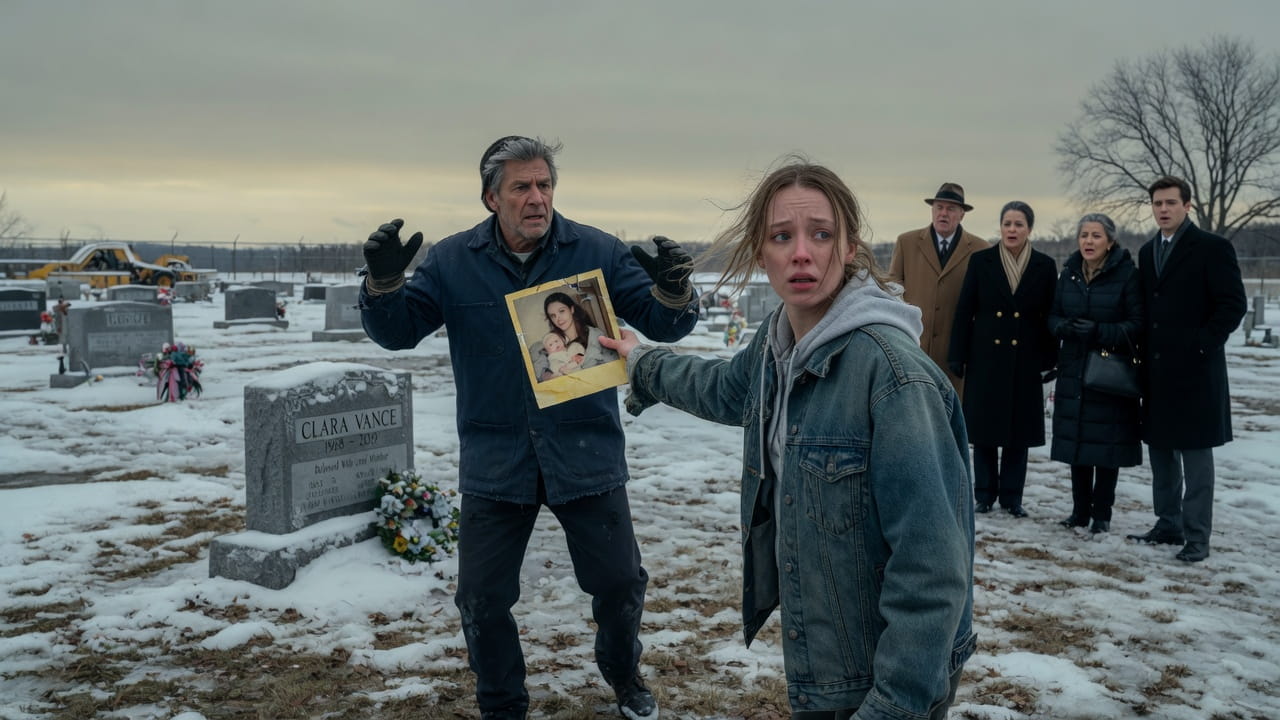
“You’ve got the wrong spot, honey. This isn’t a place for tourists.”
Marcus adjusted the collar of his work coat, his voice gravelly and tired. It was the anniversary—the one day a year the Vance family gathered in the slush of a Cleveland April to remember Clara. She’d been the light of their lives, the quiet orphan girl Marcus had rescued from a hard life and given a home.
But the girl in the denim jacket didn’t move. She stood there, her boots sinking into the grey mud, staring at the name carved in granite. She looked like she’d walked halfway across the country, and she looked like she had nothing left to lose.
“I’m not a tourist,” she whispered, her voice cutting through the wind.
Brenda, Marcus’s sister, stepped forward, her face a mask of suburban outrage. “This is a private family moment. If you’re looking for a handout, you’re in the wrong place.”
The girl didn’t look at Brenda. She looked straight at Marcus. With a trembling hand, she reached into her pocket and pulled out a scrap of paper—a torn Polaroid, yellowed by time and grease. She shoved it into Marcus’s space, forcing him to see.
“She told you she was alone in the world, didn’t she?” the girl asked. Her eyes were hard, full of twenty years of unvented rage. “She told you she had no one. But she left me on that porch when I was six years old. She promised she’d come back. I waited twenty years for her to come back.”
Marcus looked at the photo. Two little girls. One was Clara. The other had the same eyes as the stranger standing in the snow. The lie didn’t just crack; it shattered.
Chapter 1: The Weight of the Anniversary
The ground in Northeast Ohio during early April isn’t really ground at all; it’s a saturated, grey sponge that smells of wet rot and road salt. Marcus Vance stood by the window of his kitchen, watching a cardinal pick at a frozen suet block. His hands, thick-fingered and mapped with the fine white scars of thirty years as a union carpenter, hummed with a low-grade ache. It was a weather-driven pain, the kind that reminded him he was fifty and that he’d spent too many winters framing houses in the wind off Lake Erie.
He took a sip of black coffee, the steam fogging his glasses. The house was quiet—too quiet. It had been quiet for two years, ever since the cancer had hollowed Clara out and taken her in the span of a single brutal summer. He’d kept everything exactly as she’d left it. The ceramic jar of wooden spoons on the counter, the lace curtains he hated but never moved, the faint scent of lavender laundry detergent that seemed baked into the drywall.
The phone on the laminate counter buzzed. It was Brenda.
“We’re leaving in ten,” his sister said, her voice sharp and efficient. “You got the flowers? I told the florist specifically no carnations. Clara hated carnations. They look cheap.”
“I got the roses, Brenda,” Marcus said, his voice a low rumble. “White ones. Like always.”
“Good. And Marcus? Wear the nice coat. Not that canvas thing you wear to the job site. It’s an anniversary. It’s a matter of respect.”
Marcus looked at his navy canvas coat hanging by the mudroom door. It was stained with sawdust and old sweat, but it was warm. It felt like a second skin.
“I’ll see you there, Brenda.”
He hung up before she could start in on the guest list. Every year, the Vance clan treated the anniversary of Clara’s passing like a high-stakes social event. His brothers, their wives, the cousins—they all showed up to the cemetery in a convoy of SUVs, performing a grief that Marcus felt mostly in the quiet spaces of the night when he couldn’t sleep. They loved Clara because she was easy to love. She was the orphan girl from nowhere, the one Marcus had found working a diner shift in a dead-end West Virginia coal town and brought back to the stability of the Vance family. She’d been grateful, soft-spoken, and perfectly content to let Marcus be the center of her world.
He grabbed his keys and the heavy bouquet of white roses from the fridge. The drive to the cemetery was a blur of grey suburbs and strip malls. He pulled his Ford F-150 into the slushy gravel lot of the St. Jude’s cemetery and saw the crowd already forming. Brenda was there, wrapped in her black wool coat, looking like a high-end crow. His brothers, Jim and Pete, stood nearby, checking their watches.
“You’re late,” Brenda said as he approached. She reached out and straightened his collar, her eyes narrowing at the canvas coat. “Honestly, Marcus. You look like you just walked off a roof.”
“I’m here, aren’t I?” Marcus muttered.
They began the walk through the rows of headstones. The wind was biting, carrying the sharp scent of an incoming storm. The Vance family moved in a tight knot, their boots crunching on the icy grass. Marcus felt the familiar tightening in his chest. He hated this. He hated the way they all watched him, waiting for him to break down, waiting for the “quiet man” to finally show the crack in his armor.
As they rounded the bend toward the Vance family plot, Marcus stopped.
There was someone already there.
A girl—no, a woman, maybe mid-twenties—was standing directly in front of Clara’s headstone. She looked out of place, like a piece of debris blown in by the wind. She was wearing a denim jacket that was three sizes too big and a pair of mud-caked sneakers. Her hair was a matted nest of blonde, and she was shivering so hard Marcus could see her shoulders jerking from twenty feet away.
“Who is that?” Brenda whispered, her voice dropping into a defensive hiss. “Is she a vagrant? Marcus, tell her to move.”
Marcus didn’t move. He watched the girl. She wasn’t praying. She wasn’t crying. She was just staring at the stone, her hands shoved deep into her pockets.
“Maybe she’s at the wrong plot,” Jim said, stepping forward. “Hey! Miss! You’re on private ground here.”
The girl didn’t turn around. She didn’t even flinch at Jim’s voice.
Marcus felt a strange, cold prickle at the base of his neck. He walked forward, leaving his family behind. The closer he got, the more he noticed the details. The girl’s jacket was frayed at the cuffs. Her jeans were thin, soaked through with grey slush at the hems. She looked exhausted, the kind of exhaustion that goes deeper than sleep—the kind that settles into the bone.
“Miss?” Marcus said, his voice softer than Jim’s. “You okay? You might have the wrong spot. This is my wife’s grave.”
The girl finally turned.
Her face was a roadmap of hardship. Her skin was sallow, her eyes rimmed with red, but her features—the slant of her cheekbones, the shape of her mouth—hit Marcus like a physical blow. He felt the roses in his hand go limp.
“She’s not who you think she was,” the girl said.
Her voice was thin and raspy, but it carried a weight that silenced the wind. Behind Marcus, he heard the rest of the Vance family catch up. Brenda was already opening her mouth to deliver a lecture on trespassing, but the look on the girl’s face stopped her cold.
“Excuse me?” Marcus asked, his heart hammering against his ribs. “What did you say?”
The girl reached into her jacket pocket. Her hand was shaking so badly she almost dropped the scrap of paper she pulled out. It was a Polaroid, the edges curled and yellowed, a jagged tear running down the middle.
“She told you she was an orphan,” the girl said, her eyes boring into Marcus’s. “She told you her parents died in a fire and she had nobody left. That was the story, right? The poor little girl from the mountains.”
“How do you know that?” Marcus demanded. He felt a sudden, hot flash of anger. This was a prank. This was some cruel, sick joke. “Who are you?”
The girl shoved the photo toward him. “My name is Ellie. And I’m the sister she left behind to rot.”
Chapter 2: The Polaroid in the Slush
The silence that followed was heavy, more suffocating than the cold. Marcus stared at the photo. It was a picture of two small girls sitting on the edge of a sagging wooden porch. One was older, maybe ten, with her arm wrapped protectively around a toddler. The older girl was unmistakable. It was Clara. The same shy smile, the same way she tucked her chin when she was nervous. But she wasn’t an orphan in the photo. She was a child, and she was holding a sister Marcus never knew existed.
“Marcus, don’t listen to her,” Brenda snapped, stepping between them. Her face was flushed with a righteous, suburban fury. “She’s obviously disturbed. Probably saw the obituary and looked for a mark. Give me that photo.”
Brenda reached for the Polaroid, but Ellie yipped like a cornered animal and pulled it back, clutching it to her chest.
“Don’t touch me!” Ellie screamed. The sound was raw, vibrating with a desperation that made the rest of the Vance family recoil. “I didn’t come here for your money! I came here to see if she really did it. If she really lived this perfect, clean life while I was living in a goddamn trailer with a monster!”
Marcus felt the world tilting. He looked at Clara’s headstone—Clara Vance, Beloved Wife. He’d spent twenty years believing she was a clean slate. She’d told him her parents were gone, that she’d grown up in foster homes before striking out on her own at eighteen. He’d admired her strength. He’d loved her for her resilience.
“You’re lying,” Marcus said, but his voice lacked conviction. He looked at Ellie’s face again. The resemblance was undeniable. It was like looking at a ghost that had been dragged through the dirt.
“Ask her,” Ellie pointed a trembling finger at the grave. “Ask her about the man in the mountains. Ask her about Walt. Ask her why she left a six-year-old in that house when she ran away at sixteen. She told me she was going for help. She said, ‘Stay quiet, Ellie. Hide in the crawlspace. I’ll be back with the police.’ I waited in that crawlspace for two days, Marcus. I waited until Walt found me.”
A low murmur went through the Vance family. Jim and Pete exchanged looks of profound discomfort. This wasn’t the anniversary they’d planned. This wasn’t the dignified memorial Brenda had curated. This was a scandal, leaking out into the public air of the cemetery.
“This is enough,” Brenda said, her voice dropping into the tone she used when she was firing a cleaning lady. “Miss, if you don’t leave right now, I’m calling the police. You are harassing a grieving family.”
“Brenda, shut up,” Marcus said.
Brenda gasped, her hand flying to her throat. “Marcus! She is a stranger! She is lying!”
“Look at her, Brenda,” Marcus turned, his eyes hard. “Look at her face. You tell me she’s a stranger.”
Brenda looked at Ellie, really looked at her, and the color drained from her cheeks. She saw it too. The Vance family pride was a powerful thing, but it couldn’t blind them to the truth of blood.
“She died two years ago,” Marcus said, turning back to Ellie. “She’s gone. You’re too late for whatever it is you’re looking for.”
Ellie’s face buckled. For a moment, the hardness vanished, replaced by a hollow, crushing grief. She looked down at the slush-covered grave, her shoulders sagging. “I know. I saw it online. Took me this long to get the bus fare together. I didn’t come to talk to her. I knew I couldn’t do that.”
“Then why?” Marcus asked.
“I wanted to see the man who kept her,” Ellie said. She looked up, her eyes wet and fierce. “I wanted to see if he was like him. If she just traded one cage for another.”
Marcus felt a surge of indignation. He’d treated Clara like a queen. He’d given her everything. A three-bedroom ranch, a retirement account, a family that embraced her. He’d been the hero of her story. At least, that was the version he’d told himself for two decades.
“I loved her,” Marcus said, his voice thick. “We had a good life. A quiet life.”
“Quiet,” Ellie spat the word out like it was poison. “Yeah. Clara was real good at being quiet. That’s how she survived. She learned how to be whatever you wanted her to be so she never had to go back. But she knew I was still there. She knew he was still looking for her.”
“Who?” Marcus asked. “Who is Walt?”
“Our father,” Ellie said. “And he’s not just looking for her anymore, Marcus. He’s looking for me. And he knows I’m here.”
A cold gust of wind whipped through the cemetery, sending a spray of icy grit into Marcus’s face. He looked at his family—his brothers looking away, his sister vibrating with panicked judgment. Then he looked at Ellie, a girl who had nothing but a torn photo and a lifetime of scars.
“Get in the truck,” Marcus said.
“Marcus, no!” Brenda stepped forward, grabbing his arm. “You cannot be serious. You don’t know this girl. You don’t know what she’s capable of. She could be a drug addict, a criminal—”
Marcus shook her hand off. It was the first time in his life he’d ever raised a hand to his sister’s influence. “She’s Clara’s sister, Brenda. Which means she’s family. Whether you like the look of her or not.”
He turned and walked away from the grave, leaving the white roses lying in the slush. Ellie followed him, her sneakers squelching in the mud, her oversized jacket flapping in the wind. As they reached the parking lot, Marcus looked back. The Vance family was still standing there, a black smudge against the grey sky, watching their carefully constructed world begin to unravel.
Chapter 3: The Diner Revelations
Marcus drove in silence, the heater in the truck blasting a dry, dusty heat that made his eyes itch. Beside him, Ellie sat huddled against the door, her knees pulled up to her chest. She smelled like stale cigarettes, wet denim, and a frantic, unwashed fear. It was a sharp contrast to the memory of Clara, who always smelled like expensive soap and the vanilla candles she kept in the bathroom.
He pulled into a 24-hour diner on the edge of town, a place with cracked vinyl booths and a waitress who looked like she’d been carved out of driftwood. It was mid-afternoon, the dead zone between lunch and dinner, and the place was mostly empty.
“Eat,” Marcus said, sliding into a booth. “Order whatever you want.”
Ellie looked at the menu like it was written in a foreign language. Her hands were still shaking, a fine, rhythmic tremor that she couldn’t seem to stop. “I’m not hungry.”
“You’re vibrating, kid. Your body needs fuel. Get the patty melt. It’s the only thing they don’t screw up.”
She eventually ordered a burger and a large coffee, clutching the mug with both hands as if she were afraid someone would snatch it away. Marcus watched her. Up close, in the harsh fluorescent light, she looked even younger and even more damaged. There were faint, silvery scars on the backs of her hands, and a bruise was yellowing along her jawline.
“Start from the beginning,” Marcus said. “Clara told me she grew up in foster care in Wheeling. She said her parents died in a house fire when she was eight.”
Ellie let out a short, harsh laugh. “A fire. That’s poetic. Walt did try to burn the place down once when he was drunk, but he was too stupid to get the kerosene right. No, Marcus. We didn’t grow up in foster care. We grew up in a holler outside of Logan. Our mother left when I was a baby. It was just us and Walt.”
“And who is Walt?”
“A man who thinks daughters are property,” Ellie said. She took a jagged breath, her eyes fixed on the tabletop. “He’s a man who uses his fists to solve problems he doesn’t understand. Clara was the one who took the brunt of it. She’d hide me in the cabinets, tell me stories so I wouldn’t hear him coming up the porch steps. She was my hero. For a long time, she was the only thing that felt real.”
Marcus felt a sick, oily knot forming in his stomach. He remembered Clara’s aversion to loud noises. The way she’d jump if a door slammed or if he raised his voice even slightly during a football game. He’d always thought she was just sensitive. He’d never realized he was watching a reflex.
“She left when she was sixteen,” Ellie continued. “She’d been saving pennies for a year. She told me she was going to find a way to get us both out. She kissed me on the forehead, told me to be a brave little bird, and then she walked out the door. I waited. I waited by the window for three days. When Walt realized she was gone, he… he didn’t take it well.”
“And you never heard from her again?” Marcus asked.
“Not a word,” Ellie said. “Not for twenty years. I figured she was dead. I figured the world had chewed her up. Then, about six months ago, Walt got a letter. It wasn’t from her. It was some life insurance thing, a notification about a beneficiary change or something. I don’t know how the lawyers found him, but they did. It had her name on it. Clara Vance. And an address in Cleveland.”
Marcus felt the blood drain from his face. He’d handled the insurance after Clara died. He remembered the paperwork, the boxes he’d ticked without thinking. He’d tried to find her “next of kin” because the policy required it, but his investigator had come up empty. Or so he thought.
“Walt saw that address,” Ellie said, her voice dropping to a whisper. “He saw that she’d been living a life. That she’d been happy. It broke something in him. He spent months planning, getting his strength back. He’s been in and out of jail for years, Marcus. He’s a sick, vengeful man. He thinks Clara owes him for the twenty years she ‘stole’ from him.”
“She’s dead, Ellie,” Marcus said, his voice cracking. “There’s nothing for him to take.”
“He doesn’t care,” Ellie said. “He wants the money. He wants the house. He wants someone to pay for the fact that his life is a sewer. And he thinks I’m the way to get to it. He followed me when I left. I tried to lose him in Columbus, but he’s like a dog on a scent.”
The bell above the diner door jingled. Marcus flinched, his hand instinctively reaching for his heavy coffee mug. A group of teenagers walked in, laughing, but the tension didn’t leave the booth.
“Why come to me?” Marcus asked. “Why not go to the police?”
“Because the police in Logan are his cousins,” Ellie said. “And the police here… what am I going to tell them? That my daddy is coming to beat me because my dead sister lied to her husband? They’ll put me in a psych ward or send me back to him.”
She looked at him then, her eyes pleading and hollow. “I didn’t come here to ruin your life, Marcus. I just had nowhere else to go. I thought… I thought maybe if he saw she was really gone, he’d stop. But he’s not going to stop. He’s coming for whatever’s left of her.”
Marcus looked out the window. The sky was turning a bruised purple. He thought about his quiet ranch house, his union pension, his reputation in the town. He thought about Brenda and the Vance family, and the way they’d look at him if he brought this girl into their orbit.
But then he thought about Clara. He thought about the woman he’d loved for twenty years, the woman who had lived every single day in fear that her past would catch up to her. He realized, with a crushing certainty, that he hadn’t known her at all. He’d loved a ghost she’d created to survive.
“You’re staying with me,” Marcus said.
“You don’t want that,” Ellie whispered. “He’s dangerous, Marcus. You don’t know what he’s like.”
“I’m a Vance,” Marcus said, and for the first time, he felt the weight of his own family name as a weapon rather than a burden. “We don’t leave people out in the cold. Not even the ones we didn’t know we had.”
Chapter 4: The Shadow on the Porch
The Vance family home was a tidy, brick-fronted ranch on a cul-de-sac where the neighbors noticed if your grass was an inch too long. Bringing Ellie through the front door felt like smuggling a bomb into a church. Marcus led her into the guest room—the room Clara had decorated with floral wallpaper and lace doilies for the grandchildren they’d never had.
“Stay here,” Marcus said. “There’s towels in the bathroom. Take a shower. I’ll make some food.”
He went into the kitchen and stood over the sink, his head bowed. His world was vibrating. The silence of the house, which had once felt like a sanctuary of grief, now felt like a vacuum. Every object he looked at—the magnetic grocery list on the fridge, the wicker bread basket—felt like a lie.
How could she not tell him? Twenty years. They’d shared a bed, a bank account, a life. He’d watched her sleep every night, and she’d been carrying a sister’s ghost and a father’s shadow the whole time. The betrayal was a dull, thumping ache in his chest. It wasn’t that she had a past; it was that she didn’t trust him enough to share the weight of it.
He was interrupted by the sound of the doorbell. Not a polite ring, but a frantic, rhythmic pounding.
He opened the door to find Brenda. She was still in her funeral clothes, her eyes wide and panicked.
“Tell me she’s not here,” Brenda said, pushing past him into the foyer. “Marcus, I’ve been calling you for an hour. Do you have any idea what people are saying? Jim saw her get into your truck. The whole family is in an uproar.”
“She’s in the shower, Brenda. Lower your voice.”
“She’s in the shower?” Brenda’s voice rose to a shrill peak. “In Clara’s house? Marcus, have you lost your mind? That girl is a grifter. I looked her up on the way over—well, I tried to. There’s no record of a ‘Ellie’ in the Logan papers, but there’s plenty of talk about that family. They’re trash, Marcus. Deep-mountain, violent trash. You are bringing a predator into your home.”
“She’s a victim, Brenda,” Marcus said, his voice low and dangerous. “She’s Clara’s sister. Clara lied to us. All of us.”
“So what? Clara was a Vance! She earned her place here. Whatever she did to get away from that life, I don’t care. She was a good woman. This… this creature is going to destroy everything you’ve built. Think about your job! Think about your standing in the union!”
“I’m thinking about a six-year-old girl who was left in a crawlspace,” Marcus said. He stepped toward Brenda, his height suddenly a threat. “I’m thinking about my wife living in fear for twenty years because she didn’t have anyone to protect her. Well, she has someone now. Or her sister does.”
“You’re a fool,” Brenda spat. “You always were a soft touch, Marcus. But this isn’t a stray dog. This is a girl with a father who is likely on his way here to burn your house down. Did she tell you that? Did she tell you her daddy is a convicted felon with a history of assault?”
“She told me,” Marcus said. “And I’m not afraid of an old man from West Virginia.”
“You should be,” Brenda said, her voice turning cold. “Because if you keep her here, you’re on your own. The family won’t back you. We won’t be part of this circus.”
She turned and marched out, the door slamming behind her with a finality that made the windows rattle. Marcus stood in the hall, the silence rushing back in.
A moment later, Ellie appeared at the end of the hallway. She was wearing a pair of Clara’s old pajamas—oversized silk things with a pattern of tiny birds. They hung off her thin frame, making her look even smaller. Her hair was wet, plastered to her skull.
“She’s right, you know,” Ellie said. Her voice was flat, devoid of hope. “You should listen to her. I’m a mess. And he’s coming.”
“I’ve dealt with bullies before, Ellie,” Marcus said, though he wasn’t sure if a man like Walt qualified as a bully. “This is my house. You’re safe here.”
“Nobody’s safe,” Ellie said.
She walked to the living room window and pulled the curtain back just a fraction of an inch. Marcus followed her gaze. Outside, the streetlights were flickering on, casting long, distorted shadows across the cul-de-sac.
At the end of the street, parked under a dying oak tree, was a rusted, primered-grey pickup truck. The engine was off, but the headlights were on—two dim, yellow eyes watching the house.
Marcus felt a cold sweat break out on his upper lip. He recognized the silhouette in the driver’s seat. It was a man, large and hunched, a cigarette cherry glowing in the dark of the cab.
“Is that him?” Marcus whispered.
Ellie didn’t answer. She just let the curtain fall and backed away from the window, her breath coming in short, jagged hitches.
“He’s not coming for me, Marcus,” she said, her voice trembling. “He’s waiting for you to realize what you’ve got. He wants to see how much you’re willing to pay to keep your quiet life.”
Marcus looked at the front door. He thought about the bolt he’d installed himself, the solid oak frame. It felt like paper now. He looked at Clara’s pajamas on Ellie’s back and realized the residue of the lie was everywhere. He wasn’t just defending a girl; he was defending a ghost, and the ghost was the only thing he had left.
He walked to the mudroom and grabbed his heavy framing hammer from his tool belt. He didn’t know if it would be enough, but it felt right in his hand.
“Go to the back of the house,” Marcus said. “Lock the bedroom door. Don’t come out until I tell you.”
“Marcus—”
“Go!”
He stood in the dark of the foyer, the hammer resting against his thigh, watching the yellow eyes of the truck through the glass of the door. The anniversary wasn’t over. The real ceremony was just beginning.
Chapter 5: The Monster at the Threshold
The night didn’t settle over the cul-de-sac so much as it curdled. Marcus stood in the darkened foyer, the weight of the framing hammer in his hand feeling both ridiculous and necessary. He didn’t turn on the porch light. He didn’t want to give the man in the truck a target, though he knew the dim glow from the kitchen was already outlining him against the glass.
In the back of the house, he heard the soft click of the guest room door locking. Ellie was back there, probably huddled in the corner of the bed Clara had picked out, wearing the pajamas Clara had folded. The symmetry of it was a jagged pill to swallow. He wondered if Clara had ever stood exactly where he was standing now, looking out at the dark, waiting for the past to pull up to the curb.
The truck at the end of the street didn’t move for twenty minutes. It sat idling, a low, rhythmic rattle that Marcus could feel in the soles of his feet. Then, the driver’s side door creaked open. The interior light flickered on—a sickly yellow bulb—revealing a man who looked like he had been constructed out of gristle and old leather.
Walt didn’t hurry. He stepped out into the slush, his movements slow and deliberate, the arrogance of a man who knew he wasn’t going to be stopped. He was tall, but stooped, wearing a heavy duster coat that had seen better decades. He took a long drag from his cigarette, the ember brightening, and then he began the walk up Marcus’s driveway.
Marcus’s heart was a frantic bird against his ribs. He was a big man, a man who had handled unruly crews on job sites and stood his ground against predatory contractors, but this was different. This wasn’t a dispute over a paycheck or a structural beam. This was a man who had broken the woman Marcus loved before Marcus had ever met her.
Walt stopped at the bottom of the porch steps. He didn’t knock. He just stood there, looking up at the house, his face obscured by the shadow of his grease-stained cap.
“I know you’re in there, Mr. Vance,” the voice called out. It was a sandpaper rasp, deep and wet with years of unfiltered tobacco. “I ain’t here for trouble. I’m just a father looking for his girls.”
Marcus tightened his grip on the hammer. He stepped closer to the door, his voice low and steady. “You’ve got no girls here. You’ve got a trespassing warning if you take one more step.”
Walt laughed—a dry, hacking sound that ended in a cough. He spat a dark glob of phlegm into the snow. “Now, that ain’t no way to talk to family. I seen the girl get in your truck. And I know the other one is in that ground down the road. You’ve been keeping what’s mine for a long time, Marcus. I reckon we’re overdue for a chat.”
“The only thing you’re overdue for is a jail cell,” Marcus said. He felt a surge of heat in his neck. “I know who you are, Walt. I know what you did to them.”
“Is that what she told you?” Walt took a step up, then another. He was on the porch now, the wood groaning under his weight. He leaned in toward the glass, and Marcus could see his eyes—small, dark, and flat as stones. “Clara always was a storyteller. She had to be. It’s how she got people to do things for her. She was a runner, Marcus. A liar. She didn’t leave because of me. She left because she was greedy. She wanted a house like this. She wanted a man like you who’d believe any sad song she sang.”
“Shut up,” Marcus hissed. The hammer felt heavy, tempting.
“She leave you anything? Any of that insurance money?” Walt leaned his forehead against the glass, his breath fogging the pane. “That’s my blood money, Marcus. She stole twenty years of my life. I think it’s only fair I get a taste of what she left behind. You give me the girl and a check to cover my travel expenses, and I’ll be back on the highway before the sun comes up. You can go back to your quiet little life, and nobody has to get hurt.”
The casual cruelty of the offer made Marcus’s stomach turn. It wasn’t just the demand; it was the way Walt spoke about Ellie, like she was a piece of equipment he’d misplaced.
Before Marcus could respond, a pair of headlights swung into the cul-de-sac. A white-and-black cruiser pulled up behind Walt’s truck, its spotlights cutting through the dark. Marcus felt a momentary wave of relief, followed by a sharp, cold dread.
Sheriff Miller stepped out of the car. He was a man Marcus’s age, a guy he’d played high school football with. Miller was steady, but he was also a man of the law, and the law didn’t always care about the truth of a crawlspace.
“Everything alright here, Marcus?” Miller called out, his hand resting casually on his belt. He walked up the driveway, his eyes locked on Walt. “Got a call about a suspicious vehicle.”
Walt didn’t flinch. He turned around, spreading his hands wide in a gesture of exaggerated innocence. “Evening, Officer. No trouble here. Just having a private conversation with my son-in-law. My daughter passed, you see. I’m just trying to pay my respects.”
“He’s harassing me, Dave,” Marcus said, finally opening the door but staying behind the screen. “He’s been sitting at the end of the street for hours. He’s looking for a girl he has no right to.”
Miller looked from Walt to Marcus, his expression unreadable. He knew the Vance family. He’d been at Clara’s funeral. “Is the girl in the house, Marcus?”
“She’s my guest,” Marcus said defensively.
“She’s my daughter,” Walt interjected, his voice dripping with faux-pathos. “She’s got a troubled mind, Officer. Ran away from a treatment center down south. I’ve been chasing her halfway across the country trying to get her the help she needs. Marcus here, he’s a good man, but he’s been misled. He doesn’t know the history.”
“I know the history,” Marcus growled. “I know exactly what you are.”
“Marcus,” Miller said, stepping onto the porch. He looked at the hammer in Marcus’s hand and frowned. “Put that away. Now.”
Marcus hesitated, then lowered the hammer.
“Here’s the thing,” Miller said, turning to Walt. “I don’t care about your family drama. But Marcus is a taxpayer and a friend. If he says you’re harassing him, you’re harassing him. You’ve got five minutes to get that heap of a truck out of this neighborhood, or I’m impounding it and putting you in a holding cell for the night. We can sort out the custody and the ‘treatment center’ paperwork at the station tomorrow morning when the magistrate is in.”
Walt’s eyes flickered with a brief, sharp rage, but he smoothed it over instantly. He gave a mocking little tip of his cap. “Whatever you say, Sheriff. I didn’t mean no offense. I’ll be at the Motel 6 out by the interstate, Marcus. You think on what I said. The truth has a way of coming out, one way or another.”
Walt walked back down the steps, his gait loose and arrogant. He got into his truck, the engine roaring to life with a cloud of blue smoke, and pulled away. Miller stayed on the porch until the taillights disappeared.
“You okay?” Miller asked, looking at Marcus through the screen.
“I’m fine, Dave. Thanks for showing up.”
“Look,” Miller sighed, rubbing the bridge of his nose. “That guy looks like trouble. If he’s her father, he’s got certain rights unless there’s a protective order. You need to be careful, Marcus. This isn’t a construction site. You can’t just hammer your way through this. If she’s in trouble, you need to go through the proper channels.”
“The proper channels didn’t help her twenty years ago,” Marcus said.
“Maybe not. But they’re all we’ve got now. Don’t do anything stupid.”
Miller left, and Marcus retreated back into the house, locking the door and leaning his forehead against the wood. The silence felt different now. It was thin, brittle.
He walked back to the guest room and knocked softly. “Ellie? It’s me. He’s gone. For now.”
The door opened an inch. Ellie’s face was pale, her eyes wide with a terror that made her look like the child in the Polaroid. “He’s not gone. He’s just waiting. That’s what he does. He waits until you think you’re safe, and then he picks at the scab until everything starts bleeding again.”
Marcus looked at her, and then he looked past her at the room. On the nightstand sat a small, ceramic jewelry box that had belonged to Clara. He’d never opened it since she died. He walked over, his fingers trembling, and lifted the lid.
Inside, nestled among the silver chains and pearl earrings, was a small, brass key and a folded piece of yellow legal paper. He pulled the paper out. It was Clara’s handwriting—tight, controlled, and beautiful.
Marcus, the note began. If you’re reading this, it means the quiet wasn’t enough. I’m sorry I was a coward. I’m sorry I didn’t tell you that the monster was real. The key is for the locker at the bus station in Wheeling. Take care of her, Marcus. Please. She’s the only good thing I ever left behind.
Marcus felt a tear track through the stubble on his cheek. She’d known. Even in the middle of their “perfect” life, she’d known the day would come. She’d prepared for it, but she hadn’t trusted him enough to stand beside her while she did.
“We’re not going to the police, Ellie,” Marcus said, his voice hardening. “And we’re not staying here.”
“Where are we going?”
“To Wheeling,” Marcus said. “We’re going to find out what else she was hiding. And then I’m going to make sure your father never follows a scent again.”
The residue of the night was a heavy, suffocating blanket. As Marcus packed a small bag, he realized his life as a “quiet man” was over. He was a Vance, and for the first time in his fifty years, he understood that loyalty wasn’t just about showing up for anniversaries and funerals. It was about what you were willing to destroy to keep a promise you didn’t even know you’d made.
Chapter 6: The Price of the Quiet Life
The drive to Wheeling took three hours through the heart of a rain-slicked night. The Ohio River was a black ribbon of sludge running alongside the highway, reflecting the skeletal remains of the old steel mills. Ellie sat in the passenger seat, staring out the window at the passing dark. She hadn’t spoken since they left Cleveland. She looked smaller in the daylight, her face etched with the kind of permanent fatigue that only comes from a lifetime of looking over your shoulder.
Marcus gripped the steering wheel, his knuckles white. The note in his pocket felt like it was burning a hole through his coat. He kept replaying the last twenty years in his head, looking for the seams, the places where Clara’s lie had almost come apart. He remembered her sudden bouts of insomnia, the way she’d sit in the kitchen at three in the morning staring at nothing. He’d thought it was grief for her “dead” parents. Now he knew it was the sound of a ticking clock.
They reached the Wheeling bus station just as the sun was beginning to bleed a pale, sickly grey into the sky. The station was a tomb of glass and concrete, populated by the ghosts of the morning shift and the hollow-eyed travelers who had nowhere else to be.
Marcus found the locker. The brass key turned with a heavy, mechanical thud. Inside was a weathered leather satchel—the kind Clara used to carry when she was still working at the diner where they met.
He took it back to the truck and sat with it on his lap. Ellie watched him, her breath hitching. “Open it,” she whispered.
Inside the satchel was a thick stack of envelopes, all addressed to Ellie Vance. They were postmarked from all over—Cleveland, Akron, Columbus. None of them had been mailed. Beside the letters was a heavy manila envelope containing ten thousand dollars in cash—hundreds and fifties, bound with rubber bands. It was the “rainy day” fund Marcus thought they were saving for a new roof.
But it was the letters that broke him. He opened one at random.
July 14, 2012. Dearest Ellie. Today Marcus bought me a rose bush for the garden. I wanted to tell him about the wild roses that grew behind the trailer, but I couldn’t find the words. Every time I look at him, I feel like a thief. I’m building a life out of the bricks I stole from you. I hope you can forgive me one day. I hope you’re still a brave little bird.
Marcus dropped the letter, his eyes stinging. She’d been writing to a ghost for twenty years. She’d been living a double life, one half filled with the mundane comfort of their marriage, and the other half drowning in a sea of unvented guilt.
“She tried,” Ellie said, her voice cracking. She reached out and touched the stack of cash. “She was trying to buy my way out. She just didn’t know how to send it without him finding her.”
“It wasn’t enough,” Marcus said, the bitterness rising in his throat like bile. “Money doesn’t fix what he did.”
A shadow fell across the hood of the truck.
Marcus looked up. Walt’s primered-grey pickup was idling ten feet away. The old man had followed them. He’d known exactly where they’d go. He stepped out of his truck, and this time, he didn’t have his hands in his pockets. He was holding a rusted crowbar, the iron glinting in the morning light.
“You always were a predictable son of a bitch, Marcus,” Walt said, walking toward the driver’s side window. “I knew she’d have a stash. Clara was a squirrel. Always hiding things.”
Marcus didn’t hesitate. He opened the door, hard, catching Walt in the chest and sending the old man stumbling back into the slush. Marcus stepped out, his boots hitting the pavement with a heavy thud. He didn’t have his hammer this time. He just had his hands—hands that had spent thirty years breaking and building.
“Get away from the truck, Walt,” Marcus said, his voice dangerously calm.
“Or what?” Walt sneered, regaining his balance. He gripped the crowbar, his knuckles gnarled and yellow. “You’re a suburban carpenter, Marcus. You don’t know what it’s like to fight for your life. I’ve killed men for less than what’s in that bag.”
“Then you’d better get started,” Marcus said.
Walt swung the crowbar in a wide, desperate arc. Marcus ducked, the iron whistling past his ear, and then he closed the distance. He drove his shoulder into Walt’s midsection, the impact knocking the air out of both of them. They went down in the freezing mud, a tangle of limbs and resentment.
Walt was old, but he was mean. He clawed at Marcus’s face, his fingernails digging into the skin around his eyes. He smelled of rot and cheap whiskey. “She hated you!” Walt hissed into Marcus’s ear. “She told me once she couldn’t stand the way you looked at her like she was some kind of saint. She wanted to come home! She missed the mountains!”
The lie was so transparent, so pathetic, that it gave Marcus a sudden, cold clarity. He grabbed Walt’s wrist, twisting it until the crowbar clattered to the ground. Then he pinned the older man to the pavement, his forearm pressed against Walt’s throat.
“She didn’t miss you,” Marcus said, his voice a low, vibrating growl. “She spent every day of her life running from the memory of your shadow. And now, she’s done running. And so is Ellie.”
“You think you can keep her?” Walt gasped, his face turning a dark, mottled purple. “She’s just like Clara. She’ll leave you too. It’s in the blood.”
“Maybe,” Marcus said. “But she’s not leaving with you.”
He didn’t hit him. He didn’t have to. He just held him there, in the mud and the grey light of a dying city, until the fight went out of the old man. Walt’s eyes, once so full of a predatory heat, flickered and went dull. He was just a pathetic, broken man clinging to a power that had long since evaporated.
A siren wailed in the distance. Someone in the bus station must have called it in.
Marcus stood up, wiping the mud from his face. He looked at Ellie, who was watching from the truck, her face pressed against the glass. She looked horrified, but there was something else there too—a spark of something that looked like the beginning of dignity.
The Wheeling police arrived in a flurry of blue lights. Marcus didn’t resist. He stood with his hands up, explaining the situation as Walt was handcuffed and dragged to his feet. He told them about the harassment, the history in Logan, the stash in the locker. He told them everything.
It took six hours in a cramped interview room before they were allowed to leave. Walt was held on a litany of charges—interstate stalking, assault, and several outstanding warrants from West Virginia. The “proper channels” were finally working, mostly because Marcus had forced them to.
As they drove back toward Cleveland, the sun finally broke through the clouds, casting a long, golden light across the hills. The silence in the truck was different now. It wasn’t a silence of secrets; it was the silence of the aftermath.
“What are you going to do with the money?” Ellie asked. She was holding the stack of letters in her lap, her thumb tracing the familiar handwriting on the envelopes.
“It’s yours,” Marcus said. “It was always yours. Clara just didn’t know how to give it to you.”
“I don’t want it,” Ellie said. “I want to go to school. I want to be a nurse. I want to live in a house where the doors don’t have to stay locked.”
“Then we’ll use it for that,” Marcus said.
They pulled into the cul-de-sac as the neighborhood was settling into the evening routine. The neighbor was mowing his lawn. A group of kids were riding bikes. It looked like the quiet life Marcus had always cherished.
But as he walked up the porch steps, he realized the quiet was different. It wasn’t the absence of conflict; it was the peace that comes after a war. He looked at the empty space where the grey truck had been and felt a strange, hollow relief.
Brenda’s car was in the driveway. She was sitting on the porch steps, her face tight with worry. When she saw them, she stood up, her eyes darting from Marcus’s bruised face to Ellie’s tired expression.
“Marcus,” she said, her voice soft for once. “I… I heard what happened. Jim called. The family… we didn’t know.”
“I know, Brenda,” Marcus said, walking past her. “None of us did.”
He went into the kitchen and sat at the table. He looked at the note from Clara one last time, and then he set it on fire with a kitchen match, watching the paper curl and blacken in the sink. He was letting her go—not the saint he’d imagined, but the woman she’d actually been. A woman who was flawed, terrified, and deeply, painfully human.
Ellie came in and sat across from him. She picked up a stray rose petal that had fallen from the bouquet he’d brought home a lifetime ago.
“You okay?” she asked.
Marcus looked at his hands, still stained with the mud of Wheeling. He felt the ache in his joints, the residue of the lie, and the weight of the future. He wasn’t a hero. He was just a man who had finally stopped being quiet.
“I’m fine, Ellie,” Marcus said. “Let’s get some dinner. I think there’s some soup in the fridge.”
The story didn’t end with a grand gesture or a poetic summary. It ended with the clink of spoons against ceramic bowls and the low hum of the refrigerator. The Vance family would still gossip. Brenda would still judge. But in the small, brick-fronted ranch, the ghosts had finally been laid to rest, and the “brave little bird” had finally found a place where she didn’t have to fly anymore.
Marcus looked at Ellie and saw a future that Clara had paid for with twenty years of silence. It wasn’t the life he’d planned, but as he reached out and patted her hand, he realized it was the only one worth living. The quiet life was gone, and in its place was something much harder, and much more real. He was fifty years old, and for the first time, he was finally home.