“What the hell are you doing to her grave?”
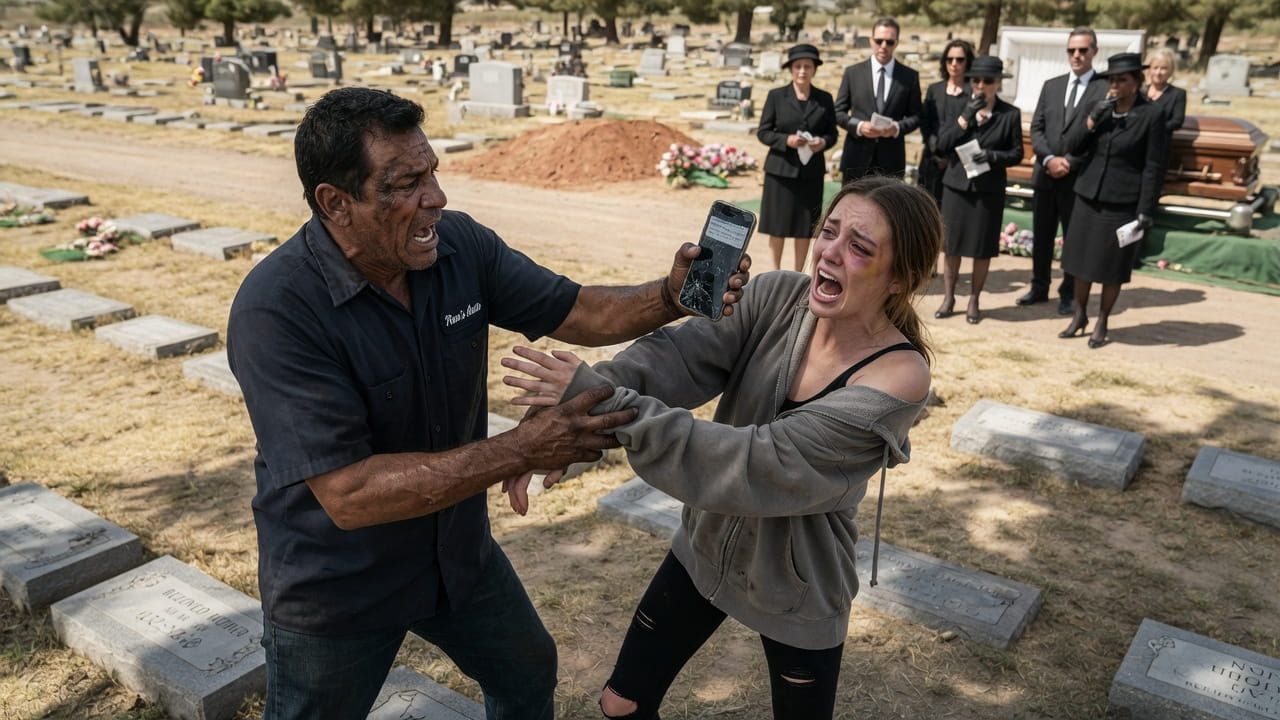
Keith didn’t wait for an answer. He’d spent the last year visiting this plot every Sunday, polishing the marble, talking to the woman who was the only good thing he’d ever owned. Seeing this scrawny girl in a dirty hoodie trying to deface Sarah’s name felt like a physical strike to his chest.
He grabbed the girl’s wrist, hard enough to make her gasp. Across the cemetery, a funeral procession for a local judge halted. Six prominent members of the community stared at them—at the local mechanic manhandling a homeless-looking teenager over a fresh grave. The shame of the scene burned in Keith’s throat, but his rage burned hotter.
“She was a saint!” Keith roared, his voice carrying over the parched grass. “You don’t get to touch her!”
The girl didn’t run. She didn’t beg. She looked at the crowd of witnesses, then back at Keith with a look of pure, agonizing pity.
“You think she’s a saint because he told you so,” she rasped, her voice cracking. She fumbled a shattered smartphone out of her pocket and shoved it toward his face. “But she wasn’t running from an accident, Keith. She was running from him. She was trying to save me.”
She hit play, and the voice that filled the air wasn’t a memory. it was a scream. It was his wife, Sarah, sounding terrified in a way he’d never heard, followed by the unmistakable sound of the man Keith had worked for—his own father-in-law—threatening to end it all.
The whole cemetery went silent. The truth was out, and Keith realized the woman he’d buried was a stranger who died for a secret he was never supposed to know.
Chapter 1: The Shrine of a Saint
The heat in Phoenix doesn’t just sit on you; it presses. It’s a weight that gets into the joints, making every movement feel like a negotiation with the air. Keith Miller wiped a line of stinging sweat from his forehead with the back of a hand that would never be truly clean again. The grease was deep now, etched into the whorls of his fingerprints and the calluses of his palms like a permanent map of a decade spent under the bellies of broken trucks.
“You’re thinking again, Keith,” Pops said. The old man didn’t look up from the engine block of the ’98 Silverado he was dissecting. Pops had owned the garage since before the strip malls had swallowed the north side of the city. He smelled like STP oil treatment and cheap cigars. “Told you, that’s a dangerous habit for a man with a wrench in his hand.”
Keith didn’t answer. He just tightened the bolt on the alternator he was installing. The metal groaned under the torque. He liked the groan. It was a sound of something being forced into place, of something finally being secure.
“It’s Sunday,” Keith said, his voice gravelly from a morning of silence.
Pops stopped his work, his hands finally stilling. He looked over his spectacles, his eyes softening behind the grease-smeared glass. “Right. Sunday.”
Sunday meant the cemetery. It meant the four-mile drive in the heat-shimmer of the afternoon to the Garden of Peace, where the grass was kept unnaturally green by a small army of sprinklers that fought a losing war against the Mojave. It meant Sarah.
It had been fourteen months since the accident. Fourteen months since a state trooper had knocked on his door at three in the morning to tell him that his wife’s sedan had left the road on a sharp curve near the Verde River. A blown tire, they’d said. A tragic, instantaneous end to a woman who had spent her thirty-six years being the moral compass for everyone who knew her.
Sarah had been the kind of woman who kept a stash of granola bars in her glove box for the homeless guys on the I-17 off-ramps. She was the one who remembered birthdays of people she hadn’t seen in ten years. She was the daughter of Richard Sterling—a man whose name adorned half the real estate developments in the valley—and yet she’d chosen a man who made his living in a garage. Keith had spent every day of their seven-year marriage wondering when the mistake would be realized, when she’d wake up and notice the oil under his fingernails and the way he forgot to call her “honey” in front of her high-society friends.
But she never did. She’d just smile, tuck a lock of auburn hair behind her ear, and tell him he smelled like hard work.
When he arrived at the cemetery, the sun was at its most punitive. He parked the truck, grabbed the small bucket of cleaning supplies he kept in the cab, and started the walk toward the Sterling family plot. Richard had insisted on the location—a prime piece of real estate under a sprawling mesquite tree.
Keith saw her headstone from fifty yards away. It was white marble, elegant and understated, just like her. But as he got closer, something looked wrong.
A figure was crouched over the grave.
Keith’s pace quickened, his boots crunching on the dry patches of turf. At first, he thought it was a groundskeeper, but the person was too small, too erratic. It was a girl, maybe sixteen, wearing an oversized grey hoodie that looked insane in the hundred-degree heat. She was digging at the base of the marble with something metal, a scraping sound echoing in the stillness.
“Hey!” Keith shouted.
The girl flinched, nearly falling backward. She looked up, and for a second, Keith saw a flash of pure, unadulterated terror. Her face was pale, almost translucent, and a yellowing bruise bloomed across her left cheekbone like a dying flower.
“What the hell are you doing?” Keith demanded, his voice booming. He reached the grave and saw the damage. Two of the brass letters of Sarah’s name had been pried loose, hanging at crooked angles. “You’re defacing a grave? Do you have any idea who this was?”
The girl scrambled to her feet, clutching a small screwdriver. She looked like a cornered animal, her chest heaving under the heavy fabric of the hoodie.
“I’m not… I’m not defacing it,” she gasped. Her voice was thin, reedy.
“The hell you aren’t,” Keith said, his rage bubbling up, hot and fast. This was his sanctuary. This was the only place where he could still feel the phantom warmth of Sarah’s presence. “This woman was a saint. She never hurt a soul in her life. And you’re here prying the name off her headstone like a common thief?”
He reached out, his mechanic’s grip closing around her wrist before she could dart away. He didn’t mean to be rough, but the anger was a live wire.
“Let go!” she screamed.
Across the lane, a funeral procession for a local dignitary had just pulled to a stop. A line of black cars, gleaming in the sun, sat like a row of beetles. People in expensive suits and silk dresses began to climb out, their faces turning toward the commotion. They saw a large, grease-stained man holding a terrified, bruised girl captive over a grave.
The social pressure hit Keith like a physical wave. He could feel the judgment of the mourners, the way they leaned into each other, whispering. He was the brute. He was the one causing the scene. But he couldn’t let go. Not while she was standing on Sarah’s heart.
“You’re going to stay right here until I call the cops,” Keith growled. “You’re going to explain why you’re messing with her.”
The girl looked at the crowd of mourners, then back at Keith. The terror in her eyes shifted. It didn’t disappear, but it was joined by something else. Pity.
“You don’t want the cops, Keith,” she whispered.
He froze. “How do you know my name?”
“Because she talked about you,” the girl said, her voice trembling but suddenly clear. She reached into her hoodie pocket with her free hand and pulled out a phone. The screen was a spiderweb of cracks, the glass missing in some corners. “She talked about the man who was too good for this world. The man who didn’t know he was living in a glass house.”
Keith’s grip loosened, his fingers going numb. “What are you talking about?”
“She wasn’t a saint,” the girl said, and the words felt like a slap. “She was a ghost. And she was trying to save me from the man who put her in this ground.”
She hit a button on the shattered phone. A jagged audio file appeared.
“Listen,” she said, her voice a jagged edge. “Listen to what your ‘saint’ was doing the night she died.”
And through the tiny, tinny speaker of the broken phone, Keith heard a sound that stopped his heart. He heard Sarah’s voice—not the soft, melodic tone she used at dinner, but a raw, gutter-level scream.
“Drive, Haley! Don’t let him catch you! He’s right behind us!”
Then, the sound of a high-performance engine roaring, the screech of tires, and a man’s voice—distant but unmistakable—shouting a command that sounded like a death sentence.
Keith stared at the girl, the phone, and the crooked brass letters of his wife’s name. The world didn’t tilt; it simply ceased to make sense.
Chapter 2: The Cracked Screen
The silence that followed the audio clip was heavier than the Phoenix heat. It was a vacuum, sucking the oxygen out of the air. Keith stared at the phone in the girl’s hand as if it were a live grenade. The mourners across the way had stopped their hushed conversations, their collective gaze fixed on the tableau of the mechanic and the girl. They were witnesses to a collapse they didn’t understand.
“Play it again,” Keith rasped.
“No,” the girl—Haley—said, pulling her wrist out of his now-slackened grip. She tucked the phone back into the dark cavern of her hoodie. “Not here. Not with them watching.”
She gestured vaguely toward the mourners. Keith looked over. He saw Detective Vance among them. Vance was a regular at the garage, a man who liked to talk about “law and order” while Pops changed the oil on his unmarked cruiser. Vance was looking at them with an expression that wasn’t just curiosity. It was a cold, calculating assessment.
“Who are you?” Keith asked, his voice shaking. He felt like he was standing on a fault line. The Sarah he knew—the Sarah who knitted scarves for the elderly and cried at dog food commercials—didn’t scream about being caught. She didn’t have a girl named Haley.
“I’m the daughter Richard Sterling doesn’t want anyone to know about,” Haley said. She looked down at the grave, at the crooked letters. “And Sarah was the only person who cared if I lived or died. She was prying me out of his house, Keith. That’s why she was on that road. She wasn’t alone.”
“The report said she was alone,” Keith said, the words feeling like dry ash. “Single-vehicle accident. Blown tire.”
“Richard paid for that report,” Haley said. Her eyes were hard now, the fear replaced by a brittle, ancient anger. “Just like he pays for that mesquite tree to stay green while everything else out here dies. He’s been paying to keep the world pretty for a long time.”
She turned to leave, her movements jerky and desperate.
“Wait!” Keith reached out, but he stopped himself before he touched her. The bruise on her face seemed to pulse in the sunlight. “Where are you staying?”
“Nowhere you need to know,” she said. “I just wanted to see her. I wanted to tell her I made it. But seeing her name next to his… I couldn’t stand it. It’s a lie. This whole place is a lie.”
She darted away, disappearing behind a row of tall cypress trees before Keith could find his feet. He stood alone at the grave, the cleaning bucket at his feet. The water inside it was already warm.
He looked down at the headstone. Sarah Miller. Beloved Wife.
He’d spent fourteen months worshipping a memory that was apparently a carefully curated exhibit. He thought about the night of the accident. He’d been at the shop late, working on a transmission. Sarah had told him she was going to her father’s house for dinner, a peace offering to bridge the gap between them. He’d kissed her forehead, told her to be patient with the old man, and watched her drive away.
He never saw her alive again.
He looked back toward the funeral procession. Detective Vance was walking toward him now, his gait slow and deliberate, the way a predator moves when it knows the prey has nowhere to go.
“Everything all right, Keith?” Vance asked. He was a big man, his suit straining at the shoulders. He had the kind of face that looked like it had been carved out of a canyon wall—all hard angles and deep lines.
“Fine,” Keith said, his heart hammering against his ribs. “Just a kid. Some vandal.”
Vance looked in the direction Haley had run. He squinted against the sun. “Long way out here for a kid to come just to kick some dirt around. What did she want?”
“Nothing,” Keith said. He could feel the lie sticking in his throat. He’d never been a good liar. Sarah used to laugh at him, saying his face was like a billboard for his thoughts. “She was just confused.”
“Confused,” Vance repeated. He stepped closer, invading Keith’s personal space. The smell of expensive cologne and old coffee wafted off him. “Richard’s been worried about you, Keith. Says you spend too much time out here. Says a man needs to move on.”
“Richard’s always been worried about a lot of things,” Keith said.
“He’s a good man,” Vance said, his voice dropping an octave. It wasn’t a compliment; it was a boundary. “He’s done a lot for this town. For the department. For you. He wouldn’t want to see you getting caught up with the wrong kind of people. People who tell stories.”
Keith looked Vance in the eye. For the first time, he saw the uniform behind the suit. He saw the power that Richard Sterling wielded—not just in the skyscrapers and the housing tracts, but in the people who were supposed to keep the peace.
“I’m just cleaning the grave, Detective,” Keith said.
“Good,” Vance said. He patted Keith on the shoulder, a gesture that felt more like a warning than a comfort. “Keep it clean. That’s the best way to honor her.”
Vance walked away, returning to the black cars. Keith watched them drive off, a caravan of silence.
He knelt by the grave. He picked up the screwdriver Haley had dropped. It was a cheap thing, the handle cracked. He looked at the brass letters. S-A-R-A-H.
He reached out and touched the “S.” It was loose. Underneath the brass, the marble was scarred, the stone raw and unprotected.
He didn’t clean the grave. He just sat there in the dirt until the sun began to dip toward the horizon, painting the desert in shades of bruised purple and gold. He thought about the audio. Drive, Haley!
He realized then that he didn’t know his wife at all. He knew the version of her that fit into his life, the version that Richard Sterling allowed to exist. But there was another Sarah—a woman who screamed in the dark, a woman who hid a sister in the shadows, a woman who died in a car that wasn’t supposed to have anyone else in it.
He stood up, his legs stiff. He didn’t go home. He went to the shop.
Pops was gone, the bay doors locked. Keith used his key, the familiar scent of oil and metal acting as a temporary anchor. He went to the small office in the back, where he kept his personal files. He pulled out the folder from the insurance company, the one he hadn’t looked at in a year.
He flipped through the photos of the crash. The sedan was a mangled heap of silver metal. The tire was shredded. The official cause: catastrophic failure leading to loss of control.
He looked closer at a photo of the interior. The passenger side was crushed, the dashboard pushed back into the seat. The report said the passenger seat was empty.
But in the corner of the frame, half-hidden by the deployed airbag, was something the photographer hadn’t bothered to move. It was a small, pink hair tie.
Sarah didn’t wear pink. She hated it. She said it was too “dainty.”
Keith closed the folder. His hands were shaking so hard he had to grip the edge of the desk.
He’d been a mechanic his whole life. He knew how machines worked. He knew that when a part failed, it left a trail. Friction, heat, residue.
He’d spent fourteen months looking at the friction. It was time to look for the residue.
Chapter 3: The Corrupt Shield
The next morning, the garage felt like a cage. Every time a customer walked in, Keith jumped, expecting to see Vance’s broad shoulders or Richard Sterling’s polished smile. He spent four hours over the open hood of a Jeep, but his mind was five miles away, at a cheap motel on the edge of the city.
He’d found Haley. It hadn’t been hard. There were only three motels within walking distance of the cemetery that didn’t ask for a credit card upfront. He’d spotted her grey hoodie on the second-floor balcony of the Desert Rose, a place where the neon sign hummed with the sound of dying insects and the carpet probably had its own ecosystem.
“You’re gonna snap that wrench, son,” Pops said, leaning against the tool chest. “What’s the girl’s name?”
Keith looked up, blinking. “What?”
“The one who’s got your head in the clouds. Or the gutter. Usually one or the other with you.” Pops chewed on a toothpick. “You haven’t been right since yesterday. And don’t tell me it’s the heat. You’re a desert rat.”
“It’s nothing, Pops,” Keith said, but his voice lacked conviction.
“Nothing don’t make a man look like he’s waiting for a heart attack,” Pops said. He walked over, his boots heavy on the concrete. “Look, Keith. You’re like a son to me. Which means I know when you’re about to do something stupid. If this is about Richard, stay clear. That man has more layers than an onion, and every one of ‘em will make you cry.”
“Did you know her, Pops? Really?” Keith asked, the question slipping out before he could stop it.
Pops sighed, a long, weary sound. “I knew the girl you brought in here. She was sweet. She was kind. But she was a Sterling, Keith. They’re built on secrets. It’s the family business.”
Keith didn’t ask anything else. He finished the Jeep, washed his hands with the orange pumice soap that never quite got the black out of his cuticles, and told Pops he was taking a long lunch.
He drove to the Desert Rose. The air was thick with the smell of asphalt and exhaust. He parked a block away and walked to the motel. He climbed the stairs to room 214.
He knocked.
Silence. Then, the sound of a chain sliding into place. The door cracked open an inch. A single blue eye, rimmed with red, stared out at him.
“It’s me,” Keith said. “Keith.”
The door closed, the chain rattled, and then it opened fully. Haley stood there, looking even smaller than she had at the grave. She’d changed into a t-shirt that was three sizes too big, the bruise on her face now a dark, ugly purple.
“Did you bring the cops?” she asked.
“No,” Keith said. He stepped inside. The room smelled of stale cigarettes and cheap floral disinfectant. A single suitcase sat on the bed, half-packed. “I want to hear the rest of the audio.”
Haley sat on the edge of the bed, her shoulders hunched. She picked up the cracked phone. “Why? It won’t change anything. She’s still dead. And he’s still the king of the mountain.”
“Because I’ve been living a lie for fourteen months,” Keith said. He sat in the only chair, a plastic thing that creaked under his weight. “I thought I was the one who failed her. I thought I should have been there to check the tires, to drive her home. I’ve been carrying that every damn day.”
Haley looked at him, and for a second, the hardness in her eyes cracked. “She loved you, you know. She used to tell me about your house. How quiet it was. How there were no cameras, no people in suits. She said it was the only place she could breathe.”
“Then why didn’t she tell me about you?”
“Because she knew what Richard would do if he found out she was helping me,” Haley said. “I’m the mistake, Keith. My mom was a secretary at one of his firms. He paid her to go away, but I didn’t go away. I grew up, and I started asking questions. And when my mom… when she got sick, Richard decided I was a liability.”
“He was hurting you,” Keith said, his eyes going to the bruise.
“He was ‘correcting’ me,” Haley said, the word dripping with sarcasm. “Sarah found out. She started coming over when he was away. She’d bring me books, clothes. She told me she was going to get me out. That night… that night we were halfway to the border when he found us.”
“How?”
“Vance,” Haley said. “He’s always watching. He’s got trackers on all the cars. Sarah thought she’d disabled it, but she missed one.”
She hit play on the phone again.
The audio started with the same scream. Drive, Haley! Then, the sound of a heavy vehicle ramming the back of the sedan. The metal-on-metal screech was sickening.
“Sarah, stop!” Haley’s voice, younger and terrified, came through the speaker.
“I won’t let him take you back!” Sarah shouted.
Then, a new voice. It was distant, distorted by the wind, but the cadence was unmistakable. It was Richard Sterling, his voice calm, cold, and utterly terrifying.
“Pull over, Sarah. Don’t make this more difficult than it needs to be. You’re making a scene.”
“Go to hell, Dad!”
A sudden, violent crash. The sound of glass shattering. A long, high-pitched scream that ended in a sickening thud. Then, silence.
Five seconds of nothing but the sound of the desert wind.
Then, a footstep. A door opening.
“Is she dead?” It was Vance. His voice was flat, professional.
“Check the girl,” Richard said.
“She’s gone, sir. Ran into the brush. She won’t last the night in the canyon.”
“Ensure the tire is destroyed,” Richard said. “Make it look like a blowout. I want the report on my desk by morning. And Vance? Not a word to Miller. He’s a simple man. He’ll believe what he’s told.”
The audio cut off.
Keith felt like his skin was being flayed. A simple man. He’d been the convenient idiot, the grieving widower who would be too broken to ask questions.
“He killed her,” Keith whispered.
“He ran us off the road,” Haley said. “He didn’t mean to kill her, I don’t think. He just wanted to stop us. But when she hit that tree… he didn’t even call for help. He just started the cover-up.”
There was a sudden, sharp rap at the door.
Haley bolted upright, her face turning ashen. “He found me.”
Keith stood up, his hand going to the heavy Maglite he carried in his belt. “Stay behind me.”
He walked to the door and looked through the peephole. It wasn’t Richard. It was Detective Vance. He wasn’t in a suit today. He was in his uniform, his badge gleaming under the yellow hallway light. He had two other officers with him.
“Open up, Keith,” Vance’s voice echoed through the door. “We know you’re in there. And we know you have the runaway.”
“She’s not a runaway, Vance!” Keith shouted back. “She’s a witness!”
“She’s a confused girl with a history of drug use,” Vance said, his tone shifting to that patronizing authority Keith had heard on the audio. “Richard just wants her home where she can get help. Don’t make this a kidnapping charge, Keith. You’re a good guy. Don’t throw your life away for a girl you met yesterday.”
“I heard the tape, Vance!”
The hallway went silent.
“The tape is inadmissible, Keith,” Vance said, his voice now dangerously low. “And if you’re holding onto stolen property, that’s another felony. Open the door. Now.”
Keith looked at Haley. She was clutching her phone, her eyes wide with a hopeless sort of terror. He looked at the window. There was no fire escape. They were trapped.
“I’m not opening the door,” Keith said.
“Fine,” Vance said. “Have it your way.”
A heavy thud shook the door. The frame groaned.
“Keith, please,” Haley whimpered.
Keith looked around the room. He saw his truck parked in the lot below. If they could get to the stairs…
“Get in the bathroom,” Keith commanded. “Lock the door.”
“What are you going to do?”
“I’m going to be the simple man they think I am,” Keith said.
He grabbed the heavy plastic chair and slammed it against the window. The glass shattered, a spray of diamonds falling onto the asphalt below. He didn’t jump. Instead, he grabbed the heavy dresser and shoved it against the door just as the second blow landed.
The wood splintered. A boot came through the panel.
“Miller!” Vance screamed.
Keith went to the bathroom door. “Haley, listen to me. I’m going to draw them away. When you hear the truck start, you run for the back stairs. Don’t look back. Go to the garage. Go to Pops. Tell him ‘The oil is black.’ He’ll know what to do.”
“Keith, no—”
“Go!”
He didn’t wait for her to argue. He climbed onto the windowsill. The jump was twelve feet. He’d had worse falls under trucks. He leaped.
He hit the pavement hard, his knees barking in protest, but he rolled and came up running. He dove into his truck, the engine roaring to life with a familiar, angry growl. He floored it, the tires screaming as he fishtailed out of the parking lot.
In his rearview mirror, he saw Vance and the other officers burst onto the balcony. They didn’t go for Haley. They went for their cars.
Keith led them away, his heart pounding a frantic rhythm. He was the distraction. He was the target. And for the first time in fourteen months, he wasn’t just a mechanic. He was a man with a purpose.
Chapter 4: The Stalker’s Journal
Keith led the cruisers on a high-speed dance through the industrial district, weaving between semi-trucks and darting down narrow alleys he knew from years of test drives. He finally lost them in the maze of shipping containers near the rail yard, cutting his lights and coasting into a dark bay between two rusted warehouses.
He sat in the silence, his breath coming in ragged gasps. His knuckles were white where he gripped the steering wheel.
He wasn’t a simple man. He was a man who knew how to find the root of a failure.
He waited twenty minutes, watching the blue and red lights sweep the horizon a few blocks away, then fade. He didn’t go to the garage. He didn’t go home. He went to a place Sarah had never mentioned, a place he’d only found by accident when a bill had arrived in the mail two months after the funeral.
A storage unit on the north side of the city.
He’d kept it because he couldn’t bear to throw anything of hers away. He’d assumed it was just extra furniture, things from her college days that didn’t fit their life. He’d never even opened the lock.
He pulled up to the gate of the facility. The moon was a sliver of bone in the sky. He punched in the code from the bill—her birthday.
The gate slid open.
He found unit 402. He used a pair of heavy-duty bolt cutters from his truck to snap the padlock. The door rolled up with a metallic shriek that sounded like a scream in the quiet night.
He clicked on his Maglite.
The unit wasn’t full of furniture. It was full of boxes. Dozens of them, stacked neatly, labeled in Sarah’s precise, looping script.
Sterling Construction – 2018.
Land Acquisitions – West Valley.
Personnel Records.
Keith opened the nearest box. It was filled with folders. He pulled one out. It was a dossier on a woman named Elena Vance. The detective’s ex-wife. It contained photos of her at a grocery store, a copy of her bank statements, and a detailed log of her daily routine.
He opened another box. It was full of photos of Haley. Haley at school. Haley at a park. Haley crying in the back of a black SUV.
Sarah hadn’t just been helping her sister. She’d been stalking her.
Keith felt a cold sweat break out on his neck. He sat on a stack of boxes, the light of the Maglite shaking in his hand. He looked at the labels again. These weren’t the records of a saint. These were the records of an obsession.
He found a small leather-bound journal at the bottom of the “Personnel” box. He opened it to the last entry, dated three days before she died.
He’s hurting her again. I saw the marks on her neck today. He thinks because he built this city, he can own the people in it. He thinks he can erase Elena and then erase Haley. He’s wrong. I’m going to take her. I’m going to take everything he’s hidden and burn it all down. Keith thinks I’m at the library. Keith thinks I’m perfect. God, I wish I could tell him the truth, but he’s so good. He’s the only clean thing I have left. If he knew what I was really doing, he’d look at me the way Dad looks at the world. Like a problem to be solved.
Keith closed the book. The residue was here. The friction that had killed her wasn’t just her father’s cruelty; it was her own desperate, secret war. She’d been protecting him from her darkness while she tried to save a girl from his father’s light.
He realized then that the “accident” wasn’t just a car leaving the road. It was two worlds colliding.
He heard the sound of gravel crunching outside.
He doused the light.
A car had pulled up to the unit. Not a police cruiser. A sleek, black Mercedes.
The door opened, and a man stepped out. He was tall, silver-haired, wearing a suit that probably cost more than Keith made in a year. Richard Sterling.
He was alone. He stood in the doorway of the unit, the moonlight catching the edge of his polished shoes.
“I knew you’d find it eventually, Keith,” Richard said. His voice was calm, conversational, as if they were discussing a property line over drinks. “You were always more observant than you let on. It’s the mechanic in you. You look for the cracks.”
Keith stood up, the journal heavy in his hand. “You ran her off the road.”
“I tried to stop her,” Richard said, stepping into the unit. He didn’t look afraid. He looked tired. “Sarah was… troubled, Keith. She had a manic streak. She became obsessed with things she didn’t understand. She thought she was a crusader, but she was just a vigilante. She was going to ruin lives. Not just mine. Yours.”
“She was saving a child,” Keith said, his voice trembling with a rage that felt like it might burst his chest.
“She was kidnapping a girl who needed professional help,” Richard countered. He moved closer, his shadow stretching across the boxes of secrets. “Do you think the world is as simple as you make it, Keith? You think there are good guys and bad guys? There are just people who build and people who destroy. Sarah was destroying. I was trying to preserve.”
“You let her die in the dirt,” Keith said. “You didn’t call an ambulance. You called a crooked cop to plant a tire.”
Richard paused. For a fleeting second, his composure wavered. A flicker of something—regret? shame?—passed over his face. “I did what was necessary to protect the family name. The name Sarah carried. The name you carry.”
“I don’t want your name,” Keith spat.
“Then what do you want? Justice? Revenge?” Richard smiled, a cold, thin line. “Vance is at your garage right now. He’s looking for the girl. And he’s not going to be gentle this time. He thinks you’ve corrupted her. He thinks you’re part of the ‘manic streak’ now.”
Keith’s blood ran cold. Pops.
“If you touch them—”
“I don’t want to touch anyone, Keith,” Richard said. “I just want the phone. And I want those boxes. Give them to me, and you can go back to your garage. You can be the simple man again. I’ll even buy you that shop you’ve always wanted. No more Pops, no more grease. Just a clean life.”
Keith looked at the boxes. He looked at the journal. He thought about the audio of Sarah’s scream.
He realized that Richard Sterling didn’t see people. He saw assets and liabilities. And right now, Keith was a liability that was being offered a buy-out.
“The oil is black, Richard,” Keith said.
Richard frowned. “What?”
“It’s a mechanic’s term,” Keith said. He stepped forward, the Maglite in his right hand. “It means the engine is gone. It means there’s no fixing it. It means you have to tear it down and start over.”
He didn’t wait for Richard to respond. He swung the heavy Maglite, not at Richard, but at the overhead light fixture. The unit plunged into absolute darkness.
Keith knew this space. He’d spent ten minutes memorizing the layout while he searched. He dove past Richard, his shoulder catching the older man and sending him stumbling against a stack of boxes.
Keith ran for his truck.
He heard Richard shouting for Vance on his cell phone as he peeled out of the facility.
He had the journal. He had the truth. But Vance was at the garage, and Haley was a target in a room full of witnesses who wouldn’t know how to stop a man with a badge.
He drove toward the garage, the engine screaming, the heat of the night finally catching up to him. He was a simple man, maybe. But even a simple man knows that when the structure is rotten, the only thing left to do is pull it down.
Chapter 5: The Pressure Plate
The drive from the storage facility to the garage was a blur of neon and heat, the engine of Keith’s truck screaming a mechanical protest that matched the roaring in his ears. He kept the leather-bound journal on the passenger seat, a small, heavy anchor in the storm of his life. Every time he glanced at it, he saw the phantom of a woman he had lived with for seven years and never truly known. Sarah wasn’t just a victim. She was a weapon. She had been building a case against her father with the same quiet, obsessive precision she used to organize their spice rack.
He hit the turn onto the industrial strip where Miller’s Garage sat. The blue and red strobes of police cruisers were already painting the rusted corrugated metal of the neighboring warehouses. There were three cars—Vance’s unmarked cruiser and two standard-issue patrol units. A small crowd had gathered at the edge of the yellow tape: a couple of guys from the nearby tire shop, a woman who ran the taco truck on the corner, and a few neighbors who looked like they were waiting for a show.
The social shame of it hit Keith first. This was his place. This was where he had built his reputation as an honest man who didn’t overcharge for a head gasket. Now, it was a crime scene, and the man holding the tape was the one who had helped bury the truth of his wife’s death.
Keith didn’t slow down. He hopped the curb and skidded to a halt ten feet from the garage’s main bay door. He didn’t wait for the dust to settle before he was out of the truck.
“Miller! Stay back!” one of the patrolmen shouted, his hand hovering near his holster.
Keith ignored him. He saw Pops standing near the office door, his face pale, his hands trembling. Two officers were holding the old man by the arms, treating him like a common drunk.
“Let him go!” Keith roared.
“Keith, don’t!” Pops yelled, his voice cracking. “They’ve got the girl in the back! They’re saying she’s a runner from a state facility!”
Keith pushed past the patrolman, his shoulder knocking the man back. He didn’t care about the consequences anymore. He burst through the side door of the garage.
The air inside was thick with the scent of old grease and the sharp, metallic tang of fear. The compressor in the corner was humming, a rhythmic thump-thump-thump that felt like a heartbeat. In the center of the bay, under the harsh fluorescent lights, Haley was zip-tied to a heavy steel stool.
Detective Vance stood over her. He wasn’t hitting her—that wasn’t his style when witnesses were around. Instead, he was leaning in close, his face inches from hers, his voice a low, terrifying drone.
“Where’s the phone, Haley? You know how this works. You give me the phone, we find a nice, quiet place for you to get clean. You keep being difficult, and we start looking into what happened to your mother. We start looking into why she really disappeared.”
Haley was shaking, her eyes fixed on the floor. Her lip was bleeding again. “I told you. I don’t have it.”
“Look at me when I’m talking to you!” Vance grabbed her chin, forcing her head up.
“Take your hands off her, Vance,” Keith said, his voice flat and dangerous.
Vance didn’t jump. He slowly released Haley’s chin and turned, a slow, predatory smile spreading across his face. He looked at Keith’s grease-stained shirt, at the wild look in his eyes, and he laughed. It was a dry, hollow sound.
“The simple man returns,” Vance said. “You’ve had a busy night, Keith. Reckless driving, evading arrest, breaking into a secure facility… You’re racking up quite the tab.”
“I found the boxes, Vance,” Keith said. He stayed by the workbench, his hand brushing against a heavy pipe wrench. “I found the dossiers. I found the photos of your ex-wife. I know why you’re on Richard’s payroll. It’s not just the money, is it? He’s the only thing keeping you out of a cell.”
Vance’s smile faltered. The air in the garage seemed to grow colder, despite the lingering Phoenix heat. The two patrolmen who had followed Keith inside hesitated, looking between their superior and the mechanic.
“I don’t know what you’re talking about,” Vance said, but his eyes were darting toward the office where the journal might be hidden.
“Sarah knew,” Keith said. He stepped closer, the weight of the secret giving him a kind of terrifying clarity. “She wasn’t just helping Haley. She was documenting every bribe you took, every property Richard seized through illegal foreclosures, every person who ‘disappeared’ when they got in the way of a Sterling development. She was going to burn the whole thing down. That’s why she was on that road.”
“She was a mentally unstable woman who died in an accident!” Vance shouted, his voice echoing off the metal rafters.
“Then why was Richard there?” Keith asked. “Why is his voice on the recording telling her to pull over? Why were you there five minutes later, planting a tire?”
Vance stepped toward Keith, his hand moving to the grip of his service weapon. “You’re making a very big mistake, Miller. You think people are going to believe a grease monkey and a junkie runaway over a decorated detective and the most powerful man in the valley? You’re a nobody. You’re a ghost in a blue shirt.”
“I’m the man who fixed your brakes for five years, Vance,” Keith said. “I’m the man who knows exactly how a machine fails when it’s been pushed too hard. And right now, your machine is red-lining.”
Keith reached into his pocket and pulled out the leather journal. He held it up so the patrolmen could see the Sterling logo embossed on the cover.
“This is Sarah’s journal,” Keith said, his voice carrying to the men by the door. “It’s full of names. Dates. Account numbers. It’s not just about Richard. It’s about everyone he bought. If I don’t walk out of here with this girl, this book goes to the Feds. Not the local PD. The Feds.”
Vance’s face went from pale to a deep, mottled purple. He looked like he was about to draw his weapon, but one of the patrolmen, a younger guy named Miller—no relation—stepped forward.
“Sir?” the young officer asked, his voice uncertain. “What’s he talking about? What recording?”
“Shut up, Miller!” Vance barked.
“He’s talking about the murder of my wife,” Keith said, turning his gaze to the young officer. “He’s talking about a girl who’s being hunted because she saw a man she was supposed to trust turn into a killer. Look at her. Look at her face. Does she look like a criminal to you, or does she look like someone who’s been terrified for her life?”
The young officer looked at Haley. She looked up then, her eyes swimming with tears, the bruise on her cheek a vivid mark of the “correction” she’d received.
The silence in the garage was absolute, save for the hum of the compressor. It was the residue of a lifetime of small-town loyalty finally meeting the reality of institutional rot.
“Let her go,” Keith said, his voice a low command.
Vance looked at the patrolmen. He saw the doubt in their eyes. He saw the way they were shifting their weight, their hands moving away from their belts. He was losing the room. The social structure that had protected him for a decade was fracturing under the weight of a simple man’s truth.
“This isn’t over, Keith,” Vance whispered.
“You’re right,” Keith said. “It’s just starting.”
He walked over to Haley and pulled a pocketknife from his belt. He sliced through the zip-ties. She slumped against him, her body racking with silent sobs. He held her, his large, rough hands shielding her from the room.
“I’ve got you,” he whispered. “I’ve got you.”
He looked at Pops, who had been released by the officers and was standing by the door, his eyes wide with a mix of shock and pride.
“Pops,” Keith said. “The oil is black.”
Pops nodded, a grim understanding passing between them. He walked over to the main bay door and began to pull it shut, the heavy chain rattling, the sound a final seal on the world they had known.
Keith led Haley toward the office. He didn’t look at Vance. He didn’t have to. The detective was standing in the center of the garage, a man alone in a kingdom of grease and shadows, realizing that the simple man had finally found the crack that would bring the whole building down.
But as Keith closed the office door, he felt the weight of the residue. Sarah had been a stranger. She had been a spy. She had loved him, maybe, but she had used him as a shield for her own war. He had rescued Haley, but he had lost the woman he thought he was protecting. The truth didn’t set him free; it just gave him a new kind of prison to live in.
He sat Haley down in the worn leather chair behind the desk. He handed her a bottle of water.
“We have to wait,” Keith said. “He’ll be here soon.”
“Who?” Haley asked, her voice trembling.
“Richard,” Keith said. “He doesn’t let anyone else clean up his messes. He’s going to come here to make me an offer. And this time, I’m going to make sure the whole world is listening.”
He looked at the phone on the desk—his own phone, not the cracked one. He had already hit the “send” button on a file he’d uploaded to a cloud server he’d set up an hour ago. The file was titled The Sterling Residue.
He sat in the dark office, watching the headlights of a sleek black Mercedes pull into the lot. The final confrontation wasn’t about justice. It was about seeing the monster clearly, once and for all, before the light went out.
Chapter 6: The Sterling Residue
The black Mercedes didn’t pull up with sirens or screeching tires. it drifted into the gravel lot of Miller’s Garage like a shadow returning to its source. Richard Sterling stepped out, his movements fluid and controlled, his expensive suit a sharp contrast to the grit and grime of the industrial strip. He didn’t look like a man coming to a fight; he looked like a man arriving for a closing.
Inside the office, Keith watched the monitors of the security cameras he’d installed three years ago. The grainy black-and-white feed showed Richard standing by the bay door, his hands in his pockets, looking at the “Closed” sign with an expression of mild annoyance.
“He’s here,” Keith said.
Haley gripped the arms of the chair. “Keith, don’t go out there. He’ll… he’ll find a way to twist it.”
“He already did,” Keith said. He looked at her, seeing the resemblance to Sarah more clearly now—not in the features, but in the way she held her breath when she was scared. “That’s the problem with men like him. They think the truth is something you can negotiate. But I’m not selling.”
He grabbed the journal and the cracked phone. He walked out of the office and into the main bay. Pops was standing by the workbench, a heavy iron pipe in his hand.
“You don’t have to do this, Pops,” Keith said.
“I’ve been in this garage forty years, Keith,” the old man said, his jaw set. “I’ve seen a lot of things break. I’m not gonna watch you get crushed.”
Keith nodded. He walked to the bay door and pulled the release. The door rolled up with a heavy, metallic groan, letting in the cool midnight air and the smell of the desert.
Richard Sterling stood there, framed by the moonlight. He didn’t look at Pops. He didn’t look at the cruisers still parked at the edge of the lot, their officers now standing back, watching the scene unfold like a play they weren’t allowed to interrupt. He looked only at Keith.
“You’ve caused a lot of damage tonight, Keith,” Richard said, his voice smooth and resonant. “Vance is finished. He’s in the back of one of those cars right now, being questioned by Internal Affairs. I had to make a call. I couldn’t have a corrupt officer reflecting poorly on the family.”
“You threw him under the bus to save yourself,” Keith said.
“I trimmed the fat,” Richard corrected. He stepped into the garage, his eyes scanning the space with a cold, analytical detachedness. “Vance was a tool. He became blunt. It happens. But you… you’re still sharp, Keith. I’ve always admired that about you. You’re a man of the earth. You understand how things work.”
“I understand how you work,” Keith said. He held up the journal. “I read it, Richard. All of it. I know about the land in the West Valley. I know about the environmental reports you buried to build those subdivisions. I know about the money you funneled into the governor’s campaign.”
Richard sighed, a sound of genuine disappointment. “And what do you think that gets you? A headline for a day? A few months of legal wrangling that my lawyers will bury in appeals until you’re an old man? You’re trying to fight a mountain with a shovel, Keith.”
“I’m not fighting a mountain,” Keith said. “I’m exposing a grave.”
He hit “play” on the cracked phone, but this time, he plugged it into the garage’s sound system—the one Pops used to play old country music while they worked.
Sarah’s voice filled the cavernous space, booming off the metal walls, echoing out into the night where the patrolmen and the neighbors were listening.
“Drive, Haley! Don’t let him catch you! He’s right behind us!”
Richard’s face didn’t change, but his eyes narrowed.
“Sarah, stop!”
“I won’t let him take you back!”
Then, the cold, calm voice of Richard Sterling, amplified until it sounded like the voice of a god.
“Pull over, Sarah. Don’t make this more difficult than it needs to be. You’re making a scene.”
The recording played through to the end—the crash, the silence, the cold orders to destroy the tire and ignore the husband. When it finished, the silence that followed was absolute. Even the crickets seemed to have stopped.
“The whole town just heard you, Richard,” Keith said. “I’ve got the garage speakers wired to a live stream. There are about five thousand people watching this right now on the local news feed. My friend at the taco truck? She’s a whiz with social media.”
For the first time, Richard Sterling looked old. The polished veneer cracked, revealing a man who was suddenly, violently aware of his own mortality. He looked toward the gate, where the neighbors were holding up their phones, recording the scene. He looked at the patrolmen, who were no longer standing back. They were moving forward, their faces grim.
“You think this changes who I am?” Richard whispered, his voice losing its resonance.
“It changes who we are,” Keith said. “We’re not the people who believe your lies anymore.”
Richard looked at Keith, a long, searching gaze that contained a lifetime of arrogance and a sudden, sharp realization of defeat. He didn’t shout. He didn’t beg. He simply turned and walked back to his car. He didn’t get in. He stood by the driver’s side door, waiting for the officers to reach him.
The arrest was quiet. There were no sirens, no struggle. Just the click of handcuffs and the sound of a powerful man being led into the back of a Ford Explorer.
As the cruisers drove away, the crowd began to disperse. The neighbors offered nods of respect, the kind given to a man who had survived a storm. Pops walked over and put a hand on Keith’s shoulder.
“Go home, son,” Pops said. “I’ll lock up.”
“Thanks, Pops.”
Keith walked back into the office. Haley was sitting there, her face buried in her hands. She looked up as he entered, her eyes red and raw.
“Is it over?” she asked.
“For him, yeah,” Keith said. He sat on the edge of the desk. “For us… I don’t know.”
He looked at the journal, still sitting on the desk. It was the residue of his marriage. He realized then that he would never be able to think of Sarah without thinking of the woman in these pages—the stalker, the vigilante, the woman who had lived a double life right under his nose. He loved her, and he hated her, and he would spend the rest of his life trying to reconcile the two.
“What happens now?” Haley asked.
“You’re going to stay with me for a while,” Keith said. “Pops has an extra room in the back of his place until we find something permanent. We’ll get you a lawyer. A real one. We’ll find out what happened to your mom.”
Haley stood up, her movements slow and hesitant. She walked over to Keith and did something she hadn’t done since he’d grabbed her wrist at the grave. She hugged him. It wasn’t a movie hug; it was a desperate, clinging thing, the grip of someone who was finally letting go of the edge of a cliff.
Keith held her, his heart heavy with a grief that felt like a permanent part of his anatomy. He had rescued the girl, but the cost had been the memory of the woman he loved.
A month later, the garage was quiet. The Sterling empire was in freefall, the legal system finally catching up to the years of corruption. Vance was awaiting trial, and Richard was in a high-security facility, his lawyers failing to find a way out of the digital trap Sarah had set.
Keith was back under a truck, the familiar scent of oil and metal acting as a balm for his frayed nerves. He heard a car pull into the lot—a small, beat-up Honda. Haley stepped out, wearing a clean t-shirt and jeans, her face clear of bruises. She was going to school now, a “regular kid” for the first time in her life.
“Hey, Keith,” she said, leaning against the bay door.
“Hey, kid. How was the test?”
“A-minus,” she said, a small, genuine smile lighting up her face. “Pops is taking me for ice cream.”
“Good. You earned it.”
He watched her walk away, her gait confident and light. He thought about the Sarah he’d known—the woman who cried at dog food commercials. He wondered if that woman had been real, or if she’d just been a mask the vigilante wore to stay sane.
He realized he would never know. And that was the residue. You don’t get to have a clean ending in a world built on secrets. You just get to decide which truths you’re going to live with.
He went to the cemetery that Sunday. He didn’t bring the cleaning bucket. He just stood there, looking at the white marble.
The brass letters were back in place. Sarah Miller. Beloved Wife.
He reached out and touched the “S.” It was firm now, secured with industrial-strength adhesive he’d brought from the shop. It wouldn’t come loose again.
He didn’t talk to her. He didn’t tell her he missed her. He just stood in the heat, feeling the weight of the sun on his back, and acknowledged the woman who had died to save a stranger.
“Thanks, Sarah,” he whispered.
He turned and walked back to his truck. He didn’t look back. He had a garage to run, and a girl to protect, and a life that was finally, painfully, his own. The oil was black, the engine was gone, but the man was still standing. And in the desert, that was as close to a victory as you were ever going to get.